The Energy Security and Net Zero select committee has a new report out,
Zero sum game: How the UK can reframe the energy transition
The second line of the summary is,
The political consensus that enabled the UK to be a world leader in tackling climate change and transitioning to clean energy has broken down.
This was a political consensus that seems to have been the result of calculated triangulation that measured the popularity of an idea rather than its feasibility. The Tories probably thought that by standing where the centre was, they would win votes from the other lot, push them left. They thought they could depend on their base as well. That was the only reason that the Net Zero consensus persisted as long as it did.
Well, they blew that. Last time around, they stood in the centre and lost to a less unpopular party which pretended for the while to also stand in the centre. And they lost from their base those who had finally given up on them. As we know, the first thing the blue team “discovered” upon their unceremonious defenestration was that UK Net Zero was also UK self-destruction. The consensus, for so long their true north, actually pointed to a long road of decline ending in either a dry corpse falling into a ditch…
…or the first step back whence we had come.
The road to hell was flanked by signs like:
Net Zero is the growth opportunity of the twenty-first century
The Tories are now ready to at least apply the brakes. But the country is in the charge of those who form a majority on the ESNZ committee. Their preferred explanation for the new schism is the “gas price shock,” whose effects resulted in “scapegoating of the transition.”
I have to note that the gas price shock pre-dates the crumbling of the consensus by two years. The end was just a matter of when: the consensus was held together by moral posturing, not because it was the right answer to a difficult question. It was impossible to oppose Net Zero, because to say it was a mistake brought a stink and a stain upon the sayer, resulting in them being cast out, banished. Only the old, or those with no standing to lose, or a brave, principled and foolhardy few could offer token resistance to the madness.
The madness defined itself as good, and by the nature of things, everyone who stood in its path was therefore evil. So if MPs had doubts, they smiled blandly and said nothing – with a few honourable exceptions. They didn’t take it as seriously as they ought to have done. If you accede to the madness of Net Zero, you have to say no to anything of any actual use you might want to do for your country. Such is the appetite of Net Zero that, like dry rot, it has turned the timbers of the UK to powder.
Net Zero has nothing to do with tackling climate change. Climate change may have been the impetus for the Climate Change Act, but as Mark has pointed out in these pages, it was acknowledged at the time that unilateral action was pointless. But after the debacle of Copenhagen, that was all that was left. Then in 2019 we offered what we offered without conditions, in the hopes that others would follow.
Emissions cuts from the UK are not enough to dent the global total, which continues to rise. And as I am fond of saying, and I think a few more people than before are noticing, the rule applies only to territorial emissions. It means we can reduce our emissions by outsourcing manufacturing and importing the goods we used to build here. So, when a factory closed, it took us a little further down the road to Net Zero, the road to hell. The jobs lost were a parochial concern, and parochial concerns cannot be a justification to halt progress.
It would have been better, and may even have had a slight relevance to the climate, if in 2019 Theresa May had simply amended the 80% territorial target to 80% consumption instead of 100% territorial, “Net Zero.” It would have been better because the pain would have been severe straight away, and the threshold for general opposition, the cracking of the consensus, would have been reached sooner: remember, this could only happen when necessity overcame the inevitable moral stain that came with speaking up.
Net Zero may have been raised to “tackle climate change,” but a child could understand that it never had a chance of doing that. For we can just keep importing things we can no longer make. It can almost be as if nothing has changed, for a time. The lights go on, and the supermarket shelves are stocked. We can just keep importing things we can’t make any more until we run out of money. (We’ve already run out of money. But our good standing means we can get a new credit card every month, and use the advance to pay the minimum repayment on the other 150.)
According to the Committee, the term “Net Zero” has become toxic.
Well, no. The term is not the problem. The problem is the insane law that mandates it, a law that is insane now and always has been:
- As a unilateral action, it can have no effect on climate even under the most alarmist of scenarios.
- As a territorial action, we can pretend to be virtuous for a time with little pain, while exporting our emissions and continuing as before.
Territorial Net Zero is Net Zero Lite. But there is still pain. The effort to tie up our bit of the problem – the territorial emissions that we cannot export away – is eroding our way of life. Because the easy stuff gets cut first, escalating pain has to be applied to cut the rest. It means a vast and dilute network of intermittent electricity leading to ruined landscapes, damaged ecology and expensive energy. Expensive energy leading to self-imposed rationing.
We are now far enough down the road to hell that, looking over our shoulders, we see a life that was better. For the first time in Britain’s history we have not just lost prosperity, we have chosen to give it up. Just as every parent looked forward to a better life for their child… they now look forward to bequeathing them a country that is worse. And not worse because of climate change: worse because of the insane medicine we took to cure it. We see in the distance behind us better things that we have thrown away deliberately, not had wrested from us by an adversary.
Then we turn our backs on the past and trudge on.
The next freshly-stuck billboard we pass has a slogan that reads,
Remember the wider benefits of the energy transition
They say it’s about the messaging, but it isn’t. A bleak vista surrounds us: what is the messaging supposed to say? That others see differently, see lambs gambolling on a hillside of spring grass?
The messaging that the Committee says we need connects “the energy transition” – no longer Net Zero, that phrase has been struck out by the censor’s pen – with benefits such as,
Lower bills,
Warmer homes,
Jobs and career opportunities for young people,
Energy security,
And health improvements.
That’s all great, but these things are all features of the world we are deliberately abandoning, not features of the Net Zero world we are travelling to, if we don’t just throw ourselves into the ditch before we get there.
The Committee says that the Department for Energy Security and Net Zero should drop Net Zero from its name. I concur. They should drop it from their remit, too.
Calling this journey the road to hell may be overly dramatic. The road to hell is long, and life is still good. That we can see cracks appearing, and can point to individual instances of decline, is something that has always been. In generalising from the specific, I am engaging in just the sort of thing that happens when the localised destruction of a weather event is generalised to the global destruction of climate change. So there should always be a questioning voice: can it really be that bad? I’ve already said that we can partly sidestep Net Zero by exporting emissions, after all. That will still be the case when the new Carbon Border Adjustment Mechanism comes in. And ultimately, fossil fuels will run out either way. Net Zero may shorten the journey, but the destination is the same. Is it hell, regardless? If so, human civilisation is kaput everywhere, not just here.
In the absence of Net Zero, the future history of dwindling hydrocarbons plays out quite differently, I think. In any case, in the absence of Net Zero, our own reckoning with the final hydrocarbon drought comes much later. A hundred years later? Time in which the cost of hydrocarbons rises, and this incentivises alternatives. Renewables have never been these alternatives, nor can they ever be. If history is a guide, then the new energy will be more dense than the old, which, superseded, will never run out. If the new energy is less dense, then the foundation of civilisation is cracked from side to side.
Towards the end of their summary, the Committee says:
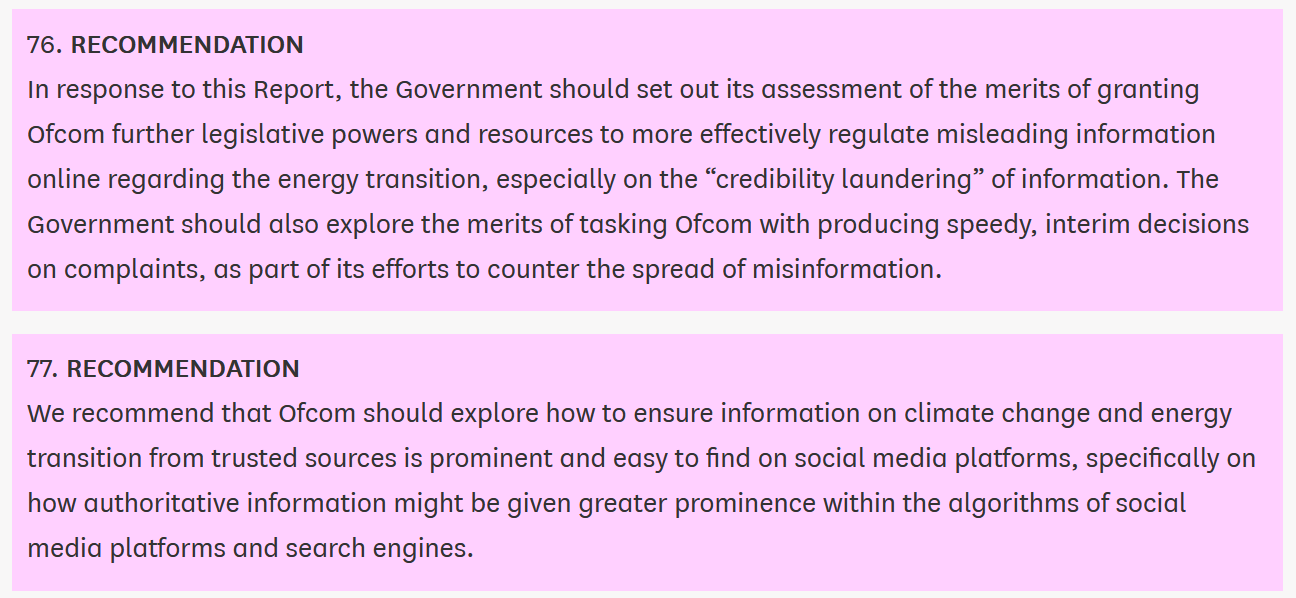
We are concerned at the increasing use of “credibility laundering” of internet myths relating to the energy transition. We would like to see social media platforms encouraged or mandated to emphasise credible information sources over those working to engender outrage and misinformation.
I had to look up what “credibility laundering” means. It means to demonstrate virtue publicly, to deflect attention from more sinister realities. I do not know who the Committee accuses of this. I do know that the charge of “credibility laundering” finds an exemplar in the Committee itself, whose pursuit of virtue has seemingly blinded it to physical realities.
The consensus has broken. The pain is now such that the moral cost of opposition to Net Zero has dwindled by comparison. So the dogged virtue hunters fear they are losing the debate. Their solution, freshly stuck to the next billboard on the road to hell is the slogan,
SILENCE
==
Apologies for this slightly incoherent rant. I was working out my thinking as I went on Sunday evening, and suffering from the first virus of autumn. I would appreciate it if, in comments, anyone has a better explanation for Net Zero than a triumph of virtue-signalling over good sense.
==
The last two recommendations of the Committee:


Outstanding Jit: a rant maybe, but incoherent decidedly not. Thank you.
LikeLike
I believe Net Zero has nothing to do with virtue signalling and I agree it has nothing to do with saving the planet. Our Uniparty political leaders simply cannot be so thick as to not realise that Net Zero is wrecking the economy to no useful purpose. I believe that Net Zero is just one of various desperate ploys by the British deep state to impose totalitarian, coercive one-world governance on the populace via their compliant Uniparty puppets.
Fortunately the deep state now has no chance of achieving that malign goal thanks to the US Trump administration, except that it has still to accept that reality.
Here’s a mini-essay comment on that theme I posted 6 months ago under a David Turver post.
Here’s a short comment on that theme I made recently on the origin, unachievability and nefarious purpose of Net Zero under a Paul Homewood post.
LikeLike
Seconded, Robin. The two paragraphs from the Report, highlighted at the end of Jit’s piece, are terrifying. That a report full of misinformation seeks to clamp down on accurate criticism, by labelling it as misinformation, and seeks to extend still further Ofcom’s powers in this regard, beggars belief. Featuring George Orwell as the backdrop to the article is sadly all too apposite.
As for this:
I point it out regularly, because it bears repetition, but this is where I made the point most forcefully:
https://cliscep.com/2023/05/05/read-it-and-weep/
By the way, I was unaware of the implications of the Impact Assessment to the Climate Change Act until Robin drew the relevant paragraphs to my attention – full credit goes to Robin, not to me.
Finally:
Nope. It makes no sense at all. An energy transition, over the long haul, will be necessary, but the establishment chose to rush to the wrong solution. This has had many negative consequences – job losses; export of jobs, money, industry and emissions to countries with lower environmental (and often lower human rights) standards; higher bills; reduced energy security; less reliable energy; massive constraints payments, as the government now rushes to mess up the solution to the problem caused by rushing to net zero, namely building renewable energy structures in remote locations before ensuring the connections were in place; environmental destruction; and so on ad nauseam. It never did make sense. That was obvious from the start to anyone prepared to think about it. It’s increasingly obvious now even to those who are hard of thinking – the evidence is all around us. Why does much of the establishment continue to cling desperately to the wreckage? Is it because they simply can’t acknowledge that they got it terribly wrong? Do they fear the anger of the masses if they admit it has all been in vain (and worse than in vain,because of the damage caused)? Does the Labour Party fear that the voters will cast it into the outer wilderness for decades once the madness has been acknowledged? Thus they can’t acknowledge it. I don’t know. But I do know that throughout history society has done crazy things, and history shows that they were crazy. History will show that of Net Zero too.
LikeLiked by 2 people
Meanwhile, energy security?
“UK in talks with EU partners to release strategic fuel reserves if needed, BBC understands”
https://www.bbc.co.uk/news/articles/c5zjzjgdeneeo
https://notalotofpeopleknowthat.wordpress.com/2026/09/28/diesel-drivers-paying-price-for-govt-neglect/
https://notalotofpeopleknowthat.wordpress.com/2026/09/30/fawley-maintenance-shutdown-will-exacerbate-diesel-crisis/
LikeLiked by 1 person
Mark, you ask whether the Labour Party fears that the voters would cast it into the outer wilderness for decades once the madness has been acknowledged. Perhaps it does, but the Conservative Party is at least as responsible as Labour for the madness – arguably more so – yet it seems willing to face up to and introduce changes that would in effect get rid of it.
LikeLike
Robin,
Oh yes, the Tories are fully culpable. But at least they (some of them, anyway, including most relevantly their current leader) are showing signs of repentance. Labour, by contrast, is doubling down on the madness. And madness it is. The evidence just keeps mounting:
“Hundreds of jobs under threat at Grangemouth chemical plant”
https://www.bbc.co.uk/news/articles/c9n747kgx6evo
LikeLike
Wonder if we forget the “Hockey stick & Greta” effect on how we go here.
Seems to me UK ministers past & present are determined to leave a legacy policy that appeals to the UN (Guterres), thinking about the next lucrative career move. Or are they all stupid?
PS – great rundown of stupid by Jit & the end quotes tells you everything you need to know about this “select committee” of “yes” morons.
LikeLike
Do you remember when we had snowball earth or when there was no snow at the poles, and sea level was 200′ higher? Me neither. Do you remember Camelot when-
The rain may never fall till after sundown
By eight, the morning fog must disappear
In short, there’s simply not a more congenial spot
For happy-ever-after-ing than here in Camelot
What do we do now?
Doug Allen
LikeLike
“US pressures Europe to release diesel reserves as Trump threatens export ban”
https://www.bbc.co.uk/news/articles/c5zjzjgdeneeo
Meanwhile, Kathryn Porter is also commenting on the diesel issue:
https://watt-logic.com/2026/10/01/us-diesel-export-ban/
LikeLiked by 2 people
Paragraph 54 of the Report:
Er, that’s right. The Annex is worth a read too, relating to a programme of inviting the public to participate prior to the report being produced:
LikeLiked by 3 people
Thank you Mark. That was a devastating critique of their “Public Engagement Event.” Unfortunately it seems that they only heard the answers they wanted to hear.
Meanwhile, I have just listened to the Andrew Neil Report. From about 20 mins discussion with Liam Halligan turns to the way Net Zero has led to the loss of most the UK’s refineries. In other words, it has demonstrably made us less “energy secure.” But don’t worry. It’s still the right road.
LikeLiked by 2 people
Mark – great find, what a travesty.
Jit – thanks for the vid link, lets hope N England & Scotland have a mild winter.
LikeLike
Jo Nova on the NYT on the rebrand of climate / Net Zero as “energy security.”
LikeLiked by 1 person
Excellent. You have inspired me to post my own, less subtle, Orwellian-themed article.
LikeLiked by 1 person
Jit (and everyone else),
It’s also worth looking at the witnesses cited by the Report. It seems that in order to bear witness, you had to belong to an organisation which supports Net Zero. In order, as they appear in the Report:
Climate Change Committee
Bob Ward, Policy and Communications Director at the Grantham Research Institute on Climate Change and the Environment (gets more than one mention)
United Nations (“has warned of a “massive disinformation campaign” that is hindering the transition to low carbon energy”)
The Welsh Government (“stressed that climate, health, economic and security benefits are “interconnected” and should be communicated through a “strong national Government-led narrative” that is simple and coherent.”)
Rachel Brisley, Director, Energy and Environment, Ipsos UK
DESNZ, specifically Ben Golding, Director, Clean Power 2030 Unit, DESNZ
Chris Stark, Head of the UK’s Mission for Clean Power 2030 at DESNZ (gets more than one mention)
As well as individuals, the Report cites “a recent report by Potential Energy Coalition, commissioned by the Rockefeller Foundation”
David Whitehouse, Chief Executive, Offshore Energies UK (some mistake, surely!)
Andrew Sissons, Deputy Director, Sustainable Future Mission at Nesta
Luke Tryl, Executive Director at More in Common
Professor Hugh Montgomery, Director, Centre for Human Health and Performance, University College London (UCL)
The Minister for Energy, Michael Shanks
Numerous references to the former Energy Secretary (presumably one Mr E, Miliband)
Dr Romanello (presumably this Dr Marina Romello: “the Executive Director of the Lancet Countdown: Tracking Progress on Health and Climate Change, an independent and multi-disciplinary research collaboration of almost 100 academic centres around the world, and headquartered at University College London’s Institute for Global Health. Marina led a team of researchers in developing England’s National Health Service’s Net Zero commitments, and is a member of numerous advisory boards for projects focusing on health and climate change.”)
The Royal Society and the Academy of Medical Sciences (“have recommended incorporating health further into climate narratives, suggesting that the “UK Government has a key role to promote a stronger focus on health within the international climate narrative”.”)
The Country Land and Business Association (CLA) (“told us that climate change is already having a significant impact on food production, citing the increasing prevalence of flooding in recent years.”)
Judicaelle Hammond, Director of Policy and Advice at the CLA (“dismissed the myth that solar energy threatens food security, with current solar deployment using only around “0.1% of UK land”, meaning its land impact remains minimal”…She stressed that “the best and most versatile land [ … ] is already protected under planning system”. [sic]). Interesting deployment of a meaningless statistic – 0.1% of UK land is not the same as 0.1% of UK farmland: https://cliscep.com/2026/09/18/what-price-solar/
Dr Amanda Slevin, Co-Director, Centre for Sustainability, Equality and Climate Action, Queen’s University Belfast
Claire Chappell (she isn’t identified any more than that, but I guess she might be the Claire Chappell who is Head of Climate Behaviour Change & Engagement, Welsh Government: https://committees.parliament.uk/writtenevidence/143860/pdf/)
The Royal Institution of Chartered Surveyors
Geraldine Bolton, Chief Executive of the Confederation of British Metalforming
Andrew Sissons (presumably this Andrew Sissons: “Andrew is a director on Nesta’s mission to create a sustainable future, which focuses on decarbonisation and economic recovery. His team focuses on setting up innovation projects and partnerships that reduce carbon emissions from homes, which is a key part of the UK reaching net zero. Andrew has a background in climate change, economic geography and productivity. Andrew joined Nesta from the Environment Agency, where he led the agency’s work on funding and green finance, having previously been the agency’s chief economist. He has worked in government (Cabinet Office, MHCLG) on cities and local growth policy, helping to create the new metro mayors in several cities in England. He has also previously worked at The Work Foundation and as an economic consultant.” https://www.nesta.org.uk/team/andrew-sissons/)
Emma Pinchbeck, Chief Executive at the CCC
The MCS Foundation (“a UK-based charity working to make every home carbon-free through the adoption of renewable energy and low-carbon technologies“)
The CCC Citizens’ Panel
Ofgem
Dr Tom Franklin (“wrote to tell us that misleading narratives surrounding the energy transition, fuelled by misinformation, are gaining traction and require proactive, fact-based counter-campaigns, including targeted myth-busting (e.g. on heat pumps and EVs) and the use of trusted third-party voices such as scientists and community leaders”)
The Dalton Nuclear Institute, University of Manchester
Dr Amanda Slevin (QUB’s first cross-University Lecturer in Climate Policy, Politics and Sustainability. “presented examples of scaling community-based models such as climate action hubs and mobilising existing networks (e.g. Northern Ireland Community Energy, Drumlin Wind Energy, Rural Community Network, NICVA) as trusted messengers”)
Dr. Roger Harrabin, journalist and former BBC Energy and Environment Analyst (that’s an honorary doctorate from Cranfield University, by the way). (He “contended that climate change is underreported by broadcasters compared to other topics with similar levels of public concern such as crime, which he argued broadcasters covered much more regularly and prominently than they did climate change”!)
Ian Macrae, Ofcom’s’ Director of Market Intelligence “told us “the corollary to having a whole load of, frankly, misinformation and rubbish out there is that people have access to trusted news and information””)
Professor Hugh Montgomery (again – “warned that widespread misinformation and deliberate disinformation are undermining support for the energy transition, including activity by state-linked “malign actors” identified in the United Nations and NATO reports (2022–2024). He argued that Government must “inoculate with information first” by proactively improving public understanding before false narratives take hold”)
Laura Rhea, Ofcom’s Director of Standards and Audience Protection
I suppose one way to be able to produce the Report you intend to produce is to ensure that the only people invited to comment are people who are pretty much guaranteed to tell you what you want to hear. Why am I not surprised?
LikeLiked by 2 people
Thank you Mark. That was something I had a mind to mention, but forgot. In particular, I wanted to point out that perhaps they could have heard from Dieter Helm. Although they probably would have forgot about whatever he told them as soon as he was out of the door. Helm has a double-pager in today’s Times, titled “Net-zero drive is only making us poorer: time for climate realism.”
The GMB’s general secretary also featured in the Times, where he described DESNZ as “basically the ministry for P45s.” [Sorry for the bad photograph, taken on the train this morning.]
LikeLiked by 2 people
Thanks for this excellent article and comments. We really are in deep do-do.
Given Mark’s list of participants, I’m surprised they received so much dissenting comment. Good to know there are still some folk around who are resolute enough to spell out the reality. Assuming the comments are roughly accurate, it is appalling to think that such effort went into this nefarious behaviour. There must have been a large team working on how to ensure they got the outcome they wanted.
LikeLiked by 1 person
MikeH,
They held a roundtable event, inviting members of the public (I know not on what basis they were selected) to meet with members of the Committee and guest speakers. I know someone who attended, but only now has she been able to tell me what went on – they were sworn to secrecy until such time as the report was published! Hers is one of the contrarian comments. She is not particularly a climate sceptic, but is an energy realist, and she was disappointed in the way the process was managed. If I understand her correctly, she felt that the event was held to try to persuade any doubters that they were wrong, rather than to listen to people’s doubts and concerns. The only credit I can give to the committee is the fact that in the Annex to their incredibly biased report, they did print the comments from people who attended and who were upset by the nature of the round table event.
LikeLiked by 1 person
Mark; Thanks for that explanation. Clearly the result was pre-ordained so the whole exercise was nothing more than propaganda. As you say, it’s surprising they published any dissenting comments.
LikeLike