The ARC-Welded Green Scare Machine
TONY THOMAS
OCT 28 2026
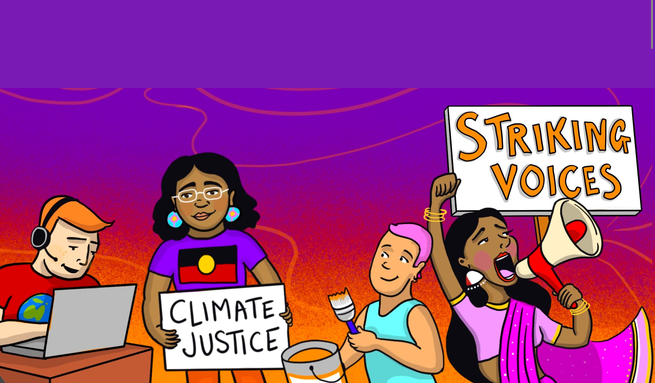
Much has been written about the promotion of climate strikes and indoctrination in Australian schools, but we haven’t heard much from the kiddie strikers themselves. No-one seems to chronicle their climate angst and media-chasing as they rehearse for post-school agitation and identity politics. Happily, an education professor at Victoria’s Deakin University (Australian ranking: 11th) has blown the whistle on these sensitive matters.
She is Dr Eve Mayes, Associate Professor (Pedagogy and Curriculum) and her accidental disclosures appear in abstruse journals, the formidable academic jargon studded with green and black talking points.
The Australian Research Council’s dispensers of grants love this shtick and awarded Eve[1] $490,266.00 in grants to confer with the activist schoolkids in “so-called” Australia, under the header, Striking Voices.[2] The grant helped fund a separate paper (co-author at Deakin, Dr Emma Rowe also got $407,391from ARC) last year about mining/petroleum companies’ alleged insidious funding of school projects. That’s odd because BHP pledged Deakin itself $5.64 million (p73) in philanthropic environmental money in 2023: Deakin was thrilled.
Eve (“she/her”) identifies as an activist of British and Russian migrant ancestry, and
a second-generation white settler scholar (p215) who worked as a secondary school English teacher on Dharug Country, in Western Sydney, for ten years (2007–2016), and lived on Gadigal Country before she moved to Wadawurrung Country, Victoria, where she currently lives.[3] [4]
She’s an accidental whistle-blower because she actually wants more climate indoctrination in schools, not less. Some kids’ inability to get climate-justice teaching is a “curricular injustice”, she believes. Schooling, she says with co-authors, is a site of cultural and political struggle, intertwined with state systems of governance and surveillance. Both curricular justice and climate justice are openly political, seeking to create more just futures. She advocates “unlearning Euro-Western colonialist, extractivist and capitalist modes of teaching, learning and relating.”
Professor Eve teamed for the research with former high-school strikers/activists now in junior academia and climate lobbies. One landed a staff job with NSW Greens MLA Jenny Leong, another as organiser with Pacific Climate Warriors, and two variously associated with the Youth Climate Coalition. Professor Eve writes of climate classes’ association with helplessness, anxiety, distress and emotional isolation. A 16-year-old girl from a metro Victorian independent school said:
We get taught about it all the time at school and all the problems associated with it but we are kinda stuck in how to fix it and it feels like everyone is waiting till the last minute to do something.
Professor Eve reported that teachers screened climate documentaries “seemingly without opportunities for students to debrief the emotions stirred by these films.” Alexa, a seasoned climate justice organiser, explained her lessons (NSW regional government school):
I have one strong memory of being in a science class and we were watching that doco Before the Flood. I just remember feeling so upset, and I was, just drawing, and I just couldn’t really watch it. And then my teacher came around and was like, ‘Oh, stop, stop doing that [drawing]’. And I was like, ‘No, I can’t, I can’t sorry.’ And then I just went to the toilet and just got really upset that no one else seemed to be getting upset as well. I’m like, ‘How are you guys okay about this? You just watched that: destroying the whole world, and then and then everyone’s just fine and going on with their lives.’
This 2016 film by mega-emissions hypocrite Leonardo DiCaprio was 96 minutes of celebrity propaganda foisted on the kids by a teacher in violation of state policies against political indoctrination. Here’s some snippets:
Dr Enric Sala, marine biologist: 2040, you will be able to sail over the North Pole. There’s going to be no sea ice left in the Arctic Ocean in the summer.
Fact: The sea ice has not diminished in the past 20 years].
Jason Box, glaciologist: The [climate model] projections for the future are,
are really conservative.
Fact: The IPCC scenario-writers this year junked their most-used and extreme scenario for 2100 as “implausible”.
News Reporters: Miami, New Orleans, Boston and Long Beach, California, may be doomed to fall victim to ever-rising sea levels. South Florida as we know it could be washed away by risings seas.
Sunita Narain, environmentalist, New Delhi: We have 700 million households who cook using biomass today. If those households move to coal, then the entire world is fried.
Professor Jeremy Jackson, marine ecologist: I think reefs as we know them
are gonna virtually disappear. We could go back to 3 billion years ago and [oceans become] just a whole lot of slime.
Fact: Barrier Reef coral is at record highs.
Johan Rockström, Stockholm Resilience Centre: Once you’ve invested in wind and solar, you actually have free energy forever.
Fact: Energy prices rise, and keep rising, whenever so-called “renewables” prevail. Australia is a prime case study.
DiCaprio: And what haunts me the most is that last panel [of Hieronymus Bosch’s painting], the one with the charred, blackened skies…A planet that we collectively have left to ruin … We ask you to protect it, or we, and all living things we cherish, are history.
Fact: DiCaprio is a high school dropout whose concern for the environment doesn’t extend to retiring his private jet.
Emotionally wrought climate crusader Alexa, last seen consoling herself about our doomed planet in the school lavatory, says this of her teachers:
They just frustrated me because what I care about is that we stop burning coal because that is causing the climate crisis and killing us all.’… So: ‘Everyone, recycle and turn off your lights off!’ And I’m just like, ‘Actually that’s not really it.
One 15-year-old Queensland girl claimed adults didn’t care about the climate crisis because
they won’t be around to suffer while there’s a classroom of 30 young people that won’t live to their age. My friends aren’t as enthusiastic about it. Going to strikes and protests with my Amnesty group peers (people 2+ years older) is not the same as having my friends care about what I’m saying.
Alexa recounted an out-of-school Rising Tide climate space where the gathering shared the deep ecology practice of ‘truth mandalas’, telling
how they’re feeling about the climate crisis … everyone just says, ‘we hear you’ and it’s so powerful. Everyone was just in tears the whole time.
Some kids told of sympathetic Victorian teachers undermining non-partisan policies by supporting student activists in ‘non-official’ ways that ‘quietly encouraged’ them:
The teachers care but can’t always allow things like postering but will often to an extent help to spread the word in a non-official way. I regularly hear that they can’t advertise it because I go to a government school, but they are very supportive of student attendance at strikes.
A 15-year-old Victorian girl:
My first school didn’t support my actions, but [the environment team] quietly encouraged people to take action, and some teachers supported me (e.g. helped with catching up work, offered support).
Other government schools were unsupportive from the beginning. Some schools, said a 15-year-old girl from a metropolitan school in Queensland, made it ‘very difficult, even if you lied and said you weren’t going [to the protest].’ Emma, 16, from rural WA, explained:
If you don’t have a leave pass or you can’t show yours or anything, then there’s teachers at every single entrance out of the school with a clipboard and a list of names of people who are allowed to leave. The last time they did that, there were like 20 kids who weren’t allowed to leave school. So, they all had their little signs standing on the road to the highway. And that was pretty cool.
Another 15-year-old (govt, metro NSW) spoke about teachers’ caution:
When I started to mention about justice, some teachers would just turn off. When I brought in ‘social justice’ into the group, I think [a particular teacher] just kind of like, ‘oh, I’m not really sure whether we can do that here. It’s not the right space. Environment Club doesn’t need that.’ Among independent schools, some encouraged climate strikes while others disciplined the kids. A feminist-minded girls’ school even allowed ‘cool’ older girls to use school assembly to announce strikes and banners. At an elite Sydney boys’ school, Owen, 17, was surprised to be pushed by the school to do an interview with the local newspaper as one of the “Greta Thunbergs of the east”. In regional Victoria, James, 16, said
At my first rally, the school were all over that. They sent a photographer down. They let us wear a uniform. They put it in the yearbook, for the green team page, whatever. It was funny. So, I think they really like milked that, they loved it. They’re like, ‘Look at us: this student, he’s like going doing stuff in the community. That’s amazing.’
The authors said this particular school wanted to market itself as a ’saviour school’ with its young global leader, ‘ready to save the world.’
Shoi, from a feminist-aligned girls school, described her ‘political awakening’ as a moment sparked by a school drama camp where students watched a piece of verbatim theatre based on the words of asylum seekers detained offshore that was ‘really amazing’ but also left her ‘very shaken’ and with ‘a feeling of guilt’:
Then somehow literally a week or two after seeing that play, I also went to my first ever protest, which was a School Strike. This time it was an empowering and energising creative energy. So it was two things that coincided really nicely: of feeling like, ‘Oh, I need to do more about things that are bad in the world.’ And ‘I need to take political action now, not just wait to study it.’
She went on to ‘watching YouTube videos about anti-capitalism’ and Youth Climate Coalition training workshops in which climate change was ‘linked’ to colonialism and ‘First Nation’s justice:
I found out more about the idea of societal collapse because of climate change, social injustices that get driven by climate change. And that was the connection that I needed. Even just connecting back to the idea of climate refugees.
Grace (outer metro NSW independent school) spoke about a history teacher who taught her about ‘people power and the bigger forces at play’, was ‘super open to being critical of the syllabus, and who encouraged her to take a ‘decolonial perspective on history [which] has really shaped a lot of my journey with climate change’. James’ school’s initial support (Catholic, metro Qld) changed when the school strikers’ target shifted from government policies to the local NAB bank:
We were just outside of NAB bank, doing a bit of a Fossil Fuel Fiesta sort of thing, chalking, couple of speeches. And [a school official] pulls up in a car, and he’s like, ‘What are you doing here? It’s on a school day; we’re missing school and we’re in the uniform.’
And he’s not happy. And we’re like: ‘We’re doing a protest, like climate action protest.’ And he’s like: ‘In your school uniform?’ And like: ‘Yeah, like we thought that was okay.’ And he’s like: ‘Get back to school, right now.’ The police had called the school and said, ‘there are students from your school at this NAB branch’ , and school was not happy about that… really concerned about keeping a positive image.
Professor Eve’s team focus, in her book chapter in Planetary Justice: Stories and Studies of Action, Resistance and Solidarity (page 225) moves on to racial frictions within the youth climate-justice movement:
There is so much work that still needs to be done by white settlers who identify as concerned about climate justice (and I include myself here)…
For white settler activists, reflecting on white privilege can risk becoming an exercise in navel-gazing, narcissistic confessions of guilt and fragility…
This praxis can generate a sense of ‘dissonance’ between one’s ‘espoused politics’ and the realization that one is ‘complicit in the oppression of others’…
It might also involve white activists stepping up to correct each other ‘so that activists of colour do not need to expend energy doing so’.
Her chapter headed, “White Audacity” tells of white girls feeling entitled to quickly become office bearers in the protests, throwing themselves at the “cool” opportunities for TV and newspaper pics:
When campaign strategy focuses on getting media attention, who gets to speak and who doesn’t get to speak becomes a point of struggle, heightening the competitiveness and space-claiming practices that splinter people from each other rather than strengthen solidarity.While these inner-city whites continued to “hog the spotlight”, less-white Western Sydney and regional kids went unheard, arriving late and leaving early by train, and “all the while receiving no recognition for this struggle from their geographically privileged organizer peers.” Outer-Sydney kids were also less able to network to step up to leadership positions, “effectively cutting their activist journey short.”
Other conflicts for western Sydney-side kids of colour were parents telling them to study more and strike less. As one co-author wrote,
it took a large amount of rebellion on my part for them to allow me to continue to organize strikes. I was lucky to be able to have eventually won my parents over, but for many other young people this would not be a possibility at all.
Despite organisers of colour achieving an improved media strategy, tokenism, micro-aggressions and tensions were still present. Although on the surface SS4C (school strike for climate) was ticking all the boxes, certain racial dynamics became almost unavoidable.
The movement then set up two caucuses, one BIPOC and one white, both to properly educate the white kids, using Layla Saad’s 2020 textbook “Me and White Supremacy”. The result was BIPOC, regional and rural students getting first call for the media. “White audacity” began, Eve says,
…with the theft of the lands now known as Australia by British colonizers from First Nations peoples with the logic of terra nullius. These logics continue to operate in overt and also subtle ways to maintain white dominance … Environmental destruction intersects with colonialism, capitalist exploitation and racism … on these lands and waters currently known as Australia.”
She argues that ecofeminists and school strikers with white privilege, class privilege and able-bodied privilege lack empathy with blacks agitating for sovereignty, land rights and reparations.
Her co-authors, South Asian/Pacific activists ‘of colour’, introduced a new term, “The Master’s House”:
This is a visual metaphor of a house (the structure of domination) held up by three foundational pillars: capitalism, white supremacy, and patriarchy. This training included discussion of how corporations and specifically, fossil fuel companies and corporations, are shaped by and benefit from these pillars of oppression.
These pillars are also part of activist spaces themselves; activist group meetings are not pure progressive spaces that exist beyond structures of oppression. Just because a person is a school student does not mean that they are untainted by structures of power and domination, especially when these have come to shape the privileges and inequalities that they benefit from each day. Youth activist spaces are sites where colonial, capitalist, and patriarchal logics still circulate, structure and shape what is possible and not possible to be said and done.
Whiteness, with its sub-genre of ‘Anglo-ness’, is everywhere. If you can make heads or tails of this passage, consider it an example:
Whiteness is more than essence and skin pigmentation. Whiteness, and access to its material and symbolic benefits, can be accumulated through cultivating a particular ‘linguistic, physical and cultural disposition’ characteristic of ‘Anglo-ness’…
One can accumulate whiteness by ‘adopting the look, accent, taste, attitudes, behaviour and lifestyle preferences that conform to the norms set by Australians. Whiteness, as Arathi Sriprakash and colleagues write, is ‘mediated through ableism, hetero-patriarchy and classism as simultaneous forces of domination under settler colonialism’, and ‘whiteness works differently upon different racialised groups: Indigenous; white settler or immigrant; Black or Brown immigrant, refugee or settler’.Another string to Professor Eve’s bow, writing with Emma Rowe, is how mining companies use gifts to schools to allegedly bribe their way into classrooms lessons, thus undermining the ‘proper’ climate narrative. The fruits appeared with peer-review approval in Australian Education Researcher a year ago, when Rowe and Mayes described local impacts of the mining industry:
Immediate environmental risks include landscape erosion, contamination of surface water and groundwater (such as acidic water, and making water unsuitable for drinking), and emitting harmful substances into the air. Mining can lead to communities becoming unliveable. In Australia, most mine sites are located on traditional Indigenous lands causing significant, at times overtly destructive impacts (e.g. Juukan Gorge) to the ecosystem.
The authors complain that one reviewer, clearly not green-left myopic, objected
If this article is to appear in AER [journal], it needs to include some acknowledgement or examples of the potential benefits fossil fuel company investment may bring to public schools and communities beyond program funding”.
Rowe and Mayes responded brusquely, perhaps overlooking BHP’s $6 million to Deakin:
It is not the role of academic research to promote fossil fuel companies, and there is a need for wider academia and scholars to engage in critique of the fossil fuel industry.
Their paper does some more accidental whistle-blowing on indoctrination of primary schoolkids. It mentions “scholarly accounts” of how at least one primary teacher “educated” her tots about Australian mining’s evil ways since colonisation:
Dahlgren (2021) analyses a pro-coal lobbyist’s account of a classroom lessonwhere students mined chocolate chips from a chocolate chip cookie, and then were asked to put the cookie back together, with the lesson that ‘mining destroys beyond repair’.
Elsewhere Eve and another collaborator, Dena Arya, even turn up the heat against their academic playground itself:
What are the structural conditions and embodied relations of power and privilege which drive researchers into the capitalist-driven hustle of ‘publish or perish’?
They wonder if research that is
inextricably linked to European imperialism and colonialism’, can co-exist with modes of climate justice “that seek to refuse and dismantle colonial and capitalist systems of power?”
Moreover, research is also
unevenly shaped and constrained by gender, class, whiteness, racialisation, neurotypicality, dis/ability, and geography.
Divvying-up millions of dollars in grants is an academic sore point – how much (if any) should go to young co-workers and participants, “acknowledging the loss of potential earnings, loss of community, family and personal time?”
In Planetary Justice, Professor Eve even turns her investigative blowtorch onto how joint authors organise their hierarchy:
While all authors are paid members of a research team, Eve Mayes is the ‘principal investigator’ on the project and manages the project budget (and its finite number of employed personnel hours)… There are always micropolitical forces in writing with others: who can add, modify and delete texts? Who has time and headspace to write? These pressures are amplified within the intergenerational institutional dynamics of an academic research team.
What you’ve just read, all of the above, represents something like a million dollars worth of your taxes being finely targeted by the Australian Research Council’s selectors, purportedly for the betterment of the national weal. If simple expenditure is a talisman of worth, ARC’s current boss, who pulls in $533,550 per annum, must know what the country and its schoolkids need.
Subscribe to Tony’s free Substack here.
[1] I often cite Dr Mayes as “Eve” because that’s how she describes herself in her papers. A D-Level Deakin Associate Professor is paid $210,230,000, including 17% super
[2] Striking Voices: “Co-creating and amplifying stories of young people’s climate justice organising has intended to counter deficit representations of young people as ‘victims’ of climate change, and to highlight strength, inventiveness and fun, amidst exhaustion, ambivalence and frustration.”
[3] My First Prize for hyperbole goes to Eve’s quotes from the Indigenous Youth Climate Network: “We are the first scientists, the oldest continuing culture. We’ve defended Mother Earth for thousands of generations. We have survived every shit storm that’s been thrown at us. We are First Nations. We are trailblazing the path out of this crisis. We know what to do. It’s time for you to follow our lead … We are young, black, deadly warriors, and together, we’re unstoppable”.
[4] I believe Waddawurrung Country is inhabited by the Geelong tribe.

