As we all know by now, wind is the cheapest form of electricity. There are many proofs of this – as an example, three years ago, the Good News Network was telling us how wind farms were soon even going to be paying negative subsidies.
“Offshore wind power will soon be so cheap to produce that it will undercut fossil-fuelled power stations and may be the cheapest form of energy for the UK,” said lead researcher Dr. Malte Jansen, from the Centre for Environmental Policy at Imperial. “Energy subsidies used to push up energy bills, but within a few years cheap renewable energy will see them brought down for the first time. This is an astonishing development.”
Good News Network
Astonishing.
Last year wind power became so cheap it was nine times cheaper than gas, as Carbon Brief pointed out (eventually; when they started talking, wind was four times cheaper than gas, but by the time they had finished their sentence, they had to revise the stat upwards to nine times cheaper).
In January, it was announced that the penetration of wind was now over 25% in the UK, and had tipped over 80% at some point:
The UK hit a major energy milestone in 2022 as windfarms produced a record amount of the country’s electricity, according to National Grid. Wind-powered electricity made up 26.8 percent of electricity generation in 2022, up from 21.9 percent the year before, figures from National Grid ESO indicate. And earlier this week, National Grid announced the smashing of another record after the percentage of zero carbon electricity generated onto the grid hit a stunning new record of 87.6 percent.
Express
You see? We can do it, guys. Deniers go to hell, this is no pipe dream. The plummeting cost of wind and our aggressive deployment of it explains why the UK now has the cheapest electricity among developed nations. Manufacturers are flocking to us to build their factories here, so that they can take advantage of cheap energy and the best-trained and most motivated workforce in the G20.
That’s why Labour’s plan to quintuple – er, quadruple – er, water down the quadrupling of offshore wind makes perfect sense. It’s not really even borrowing money because the loan pays for itself in next to no time. The Green Industrial Revolution will definitely work.*
THE SOUND OF A NEEDLE BEING SCRATCHED ACROSS A RECORD
Actually, of course, the notion that wind power brings cheap electricity is delusional. It is a “cheap way to produce expensive electricity” – a phrase I think I heard at the “Decouple” podcast and deployed on my green councillor when he knocked at the door for a chat. How so? Well, as has been pointed out in various fora over the years, wind brings with it a lot of baggage that is “off book.” A recent article by Willis outlines some of the issues that are conveniently forgotten by the likes of Carbon Brief. The parasitic role of wind on a previously stable grid comes about by its inherent instability. Plus, wind farms have to be established in far flung places, necessitating long cables to reach the “core” grid where people live. Means have to be employed to stabilise its frequency; supply backup power for lulls; pay for grid extensions; and for flipping between DC and AC or stabilising the AC [I’m not sure about this last, since the wind farm developer might be responsible some for that]. Then we have the old favourite, which is that – in the UK at least – the “astonishing” rock-bottom prices that wind farm developers promise to sell their power at in some far-off day turn out to be illusions, one-sided bets to get in the game, a ploy beloved of public contractors world-wide, e.g. aircraft carrier manufacturers, or railway line builders, but particularly destructive in this case.
But we don’t just have to rely on argumentation to settle this “argument,” do we? When Rossi produced his E-cat and promised room temperature fusion, it was very easy to use straightforward measurements to establish his veracity. Or it would have been, if the test conditions had been appropriate. But I digress. I decided to find out what effect wind power has on the cost of electricity directly, by collecting two sets of data for a range of countries: 1) the cost of electricity and 2) the penetration of wind. See how easy it is? I decided to avoid cherry-picking a list of countries by taking the top 20 countries by PPP GDP, a list in which the UK now ranks 10th. This list came from Mr. Wiki. Next I got wind penetration stats from Our World in Data. Household electricity prices for September 2022 came from GlobalPetrolPrices.com. Then all I had to do is plot one against t’other, and prove, once and for all, just how stupid we deniers are.
Now before we go any further, we should note a few caveats. These are that some countries might subsidise their electricity. Others might tax it. Some countries might not even have universal connection yet, and that might artificially reduce the cost of electricity in those places. There might be corruption, incompetence, who knows what. And while I am implying – rather strongly implying, I admit – a causal link, correlation is not causation and both variables here might be strongly correlated with a third, some measure of societal decadence perhaps. Some countries might be connected to other countries with other grid characteristics. But with all that being said, what happens when you add wind power to your grid? Does your electricity get cheaper, or more expensive?

Well, there’s your answer. The more of your electricity you obtain by harvesting wind, the more expensive it gets. I have resisted putting a line through the graph, but I will tell you that if I did, it would have a positive slope.
Wind power is still popular – I think it might be the most popular electricity generator according to vox populi, although it is more popular in the abstract than the particular. I suppose this has something to do with an endless stream of stupid people crawling out of their burrows, each eager to make yet another asinine announcement about how cheap wind power is.
And don’t even get me started on the dead birds.
Note & Featured Image
*Don’t let this lead you to think I have any more respect for the other Westminster parties than I do for Labour. They all have a policy of national suicide, which I am against.
The featured image is from Dall.E, with a prompt something like “A Matisse paper cut-out of a dystopian wind farm with dead birds.” This is an evolved version, which has become quite abstract; but I rather liked the emotional effect of all those spiky bits.
Update
In response to Mark’s piece on LCoE and Jo Nova’s piece on the same topic, I thought I’d update this post with recent figures (23.v.2024). Almost a year has passed, and another year of data is available on both axes. Does the relationship still hold? After all, 2022 was an unusual year. Here are the results for the same 20 countries, from the same data sources:
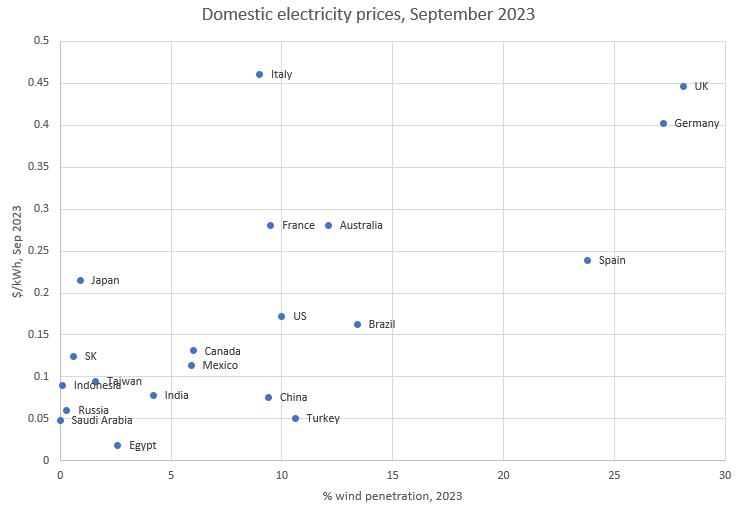
Things have changed somewhat. We in the UK can be proud that we have overtaken Germany in the cost of our domestic leccy. I’ll post this graph on Mark’s, since it is currently active.


Yes Jit – but you seem to have forgotten that wind turbines are so beautiful
Apologies: I’m having problems with the link. But my point (confirmed by the head of the National Trust) still stands.
LikeLiked by 1 person
The greater the penetration, the more consumers are screwed on electricity prices.
LikeLiked by 3 people
One trick wind proponents like to use is pointing to Iowa or Scotland where they have a real high percentage of wind generation but they don’t mention that they are part of a larger grid that absorbs electricity when it’s windy and supplies it when it’s calm. There’s no hump for wind and solar to get over. There’s just an impenetrable intermittency brick wall for them to run into.
LikeLiked by 2 people
Two points, one concerning Mr. Wiki:
“Jimmy Wales is an internet entrepreneur and co-founder of Wikipedia and Wikia. He is a non-executive director of Guardian Media Group, owner of the Guardian…”
https://www.theguardian.com/profile/jimmy-wales
Second, unintended consequences:
“Impacts of accelerating deployment of offshore windfarms on near-surface climate”
https://www.nature.com/articles/s41598-022-22868-9
“Wind turbine wakes can impact down-wind vegetation greenness”
https://iopscience.iop.org/article/10.1088/1748-9326/ac8da9
LikeLiked by 1 person
JIT,
That’s all admirably clear. Unfortunately the fact deniers who claim that renewables, especially wind power, represent cheap energy, won’t believe you. Even more unfortunately, they seem to be in charge of government policy.
LikeLiked by 1 person
South Australia has the most expensive power on mainland Oz and highest wind/ solar penetration. Of course, the politicians try to assure everyone they are unrelated.
They often have so much domestic solar that the windfarms and grid solar get dispatched off but keep GTs dispatched on at very high non-market prices. If the wind is blowing strong at night, they export the power to Victoria, often at very low or negative spot prices. Then at the dawn and dusk peaks, import a lot back in at very high prices. As politicians can read things into numbers that no-one else sees, I suspect the wind power dumping is what the base their price statements on.
Most days when there isn’t significant wind, they have to fire up not only gas turbines, but diesel engines. Their beloved batteries do next to nothing, being held as fast start reserves. That daily canyon is why their price is so expensive.
New South Wales aren’t going to let SA take the crash test dummy title without a fight though. They closed Liddell coal fired station after years of running it into the ground, and no new stations built. That means they almost always have to import power and their prices are going up 20% (unrelated to closing coal of course).
You can see market pricing and supply here.
https://aemo.com.au/en/energy-systems/electricity/national-electricity-market-nem/data-nem/data-dashboard-nem
LikeLiked by 2 people
“Britain’s green energy disaster should be an awful warning to Americans
Citizens of the USA, give thanks that you hardly have any offshore wind power”
https://www.telegraph.co.uk/news/2023/06/11/green-energy-disaster-uk-awful-warning-america/
LikeLiked by 1 person
As a really good example of why South Australian electricity are so prices, this has just been issued – it happens very regularly – several times a week.
“Possible intervention to manage power system security in South Australia (SA) Region
AEMO ELECTRICITY MARKET NOTICE
Possible intervention to manage power system security in South Australia (SA) Region
The synchronous generating units currently expected to be synchronised in SA from 2330 hrs 11/06/2023 will be inadequate to maintain a secure operating state in SA.
AEMO estimates that, in the absence of sufficient market response by 1400 hrs 11/06/2023 , AEMO may need to intervene by issuing a direction requiring one or more SA synchronous generating unit(s) to operate or remain synchronised to maintain power system security in SA.
Having to do this is why the “cheap” renewables are so expensive. Costs aren’t assigned to the renewables that caused them. Similar things happen in other grids.
LikeLiked by 1 person
Chris, it would seem that SA has two big problems:
1. They still have to rely almost 100% on gas generation at times when the sun isn’t shining and the wind isn’t blowing.
2. When the sun is shining and the wind is blowing, renewables penetration approaches 100% and minimum demand drops to near zero at midday because so many homes have solar panels fitted, but they STILL have to instruct synchronous generators to operate or continue to operate, which must be incredibly expensive and wasteful.
3. The long term ‘solution’ to this problem is to build more synchronous condensers, but they still need the generators to supply electricity when renewables aren’t working.
“High and growing distributed PV penetration is reducing minimum operational demand, with minimum demand already falling below the thresholds for secure operation of a South Australian island. Minimum demand continues to occur in the middle of the day, typically at the weekend or on public holidays. A record low operational minimum demand (sent-out) of 290 MW was recorded on Sunday 11 October 2020 at 1:00 pm. Minimum demand is forecast to approach zero by 2023-24 in some scenarios, or earlier if PV penetration continues at a pace faster than that forecast. Minimum demand is extremely sensitive to forecast growth in distributed PV. Evidence of strong sales and installations in 2019 and 2020 have strengthened the confidence that consumers continue to look for energy savings through PV installations, and distributed PV forecasts have been revised upwards accordingly. COVID-19 had been assumed to temper some installation growth, however, as at the end of June 2020, there was limited evidence to confirm any real slowdown of distributed PV installations. Due to the continued strong uptake of distributed PV projected, forecast minimum operational demand is declining rapidly.
As well as energy resources to meet demand, the power system also needs services to maintain system strength and keep frequency and voltage within required limits. These system security services have traditionally been supplied by synchronous generators, but when this generation is not online – such as at times of low operational demand – alternative options are needed.
AEMO issued 253 directions in South Australia in 2019-20, directing synchronous generators to maintain the system in a secure operating state, compared to 153 issued in 2018-19. This continued the trend of a substantial increase on previous years. • Synchronous condensers, improved interconnection, and contingency frequency reserves from renewable generation and large-scale battery storage, as well as fast-start and rapid-response technologies, are all being progressed as more sustainable long-term options.
Despite the relatively strong penetration of renewable energy and battery storages, gas-powered generation (GPG) remains a critical source of firming supply and at times provides almost 100% of the electricity demand in South Australia when renewable generation is not available.”
chrome-extension://efaidnbmnnnibpcajpcglclefindmkaj/https://aemo.com.au/-/media/files/electricity/nem/planning_and_forecasting/sa_advisory/2020/2020-south-australian-electricity-report.pdf?la=en
LikeLike
Jaime
Without trying to get too technical, with the reliance on wind and solar, SA has two issues to deal with. They are lack of inertia and fast reserves. The two are linked.
The inertia they can get from synchronous condensers. They can be a substitute for GTs though they consume electricity, rather than produce it. The reserves are a harder issue. If the state is importing power. and that or the biggest windfarm or heaviest loaded transmission line trips, then voltages and frequencies drop. The rate of drop is governed by the load loss and the inertia. However, to stabilise the grid, they need reserve generation to pick up the slack or the load shedding relays to protect their section of the grid. If they can’t, then it rapidly turns to blackouts. Syncons can’t help with reserves. The normal rule for reserves is they should be multiple sources (in case one fails) AND they are the size of the biggest unit on, which could be an interconnector. Heywood currently is 360MW so it would be the one that determines the reserves needed right now.
They can go years without a failure scenario happening or it could occur tomorrow. However, when it does, the coal or GT plant will be blamed by politicians who have been caught out.
SA has already passed going all wind and solar. The duck curve became a canyon. Some months ago, around noon on a number of days, they were exporting power, negative pricing some windfarms & grid solar dispatched off but they had GTs on minimum load. However, that evening, they were firing up the diesels. It was detailed over at Wattclarity.
LikeLiked by 1 person
Here is their dashboard which is well designed and informative:
https://aemo.com.au/en/energy-systems/electricity/national-electricity-market-nem/data-nem/data-dashboard-nem
and here are their grid operational notices:
https://www.aemo.com.au/market-notices
LikeLiked by 2 people
Excellent article by Kathryn Porter on her website Watt-Logic:
It confirms that the economics are not as portrayed by wind enthusiasts. Indeed it seems likely that prices will be moving up.
LikeLiked by 1 person
“Ørsted warns about rising costs of UK wind development ”
https://www.ft.com/content/4621f549-85dc-4731-b3ad-6d76969c31d4
LikeLike
” . . . . . the costs of developing offshore wind have risen 20-40 per cent since Russia’s invasion of Ukraine.”
Is this what Starmer means by ‘energy security’? Wasn’t the whole idea of developing ‘home grown’ sustainable energy so that we could protect our energy from global price shocks whilst saving the planet at the same time?
LikeLiked by 1 person
Mark, Jaime – as Jaime says, something smells wrong with all rises blamed on “Russia’s invasion of Ukraine.”
seems to me some are using this crisis as an excuse to bump up prices/profits.
LikeLiked by 1 person
Indeed, dfh.
If you check back, you’ll find that prices started rising a good bit before the Ukraine affair.
But it’s a damn good excuse!
LikeLike
“The first great requisite of motive power is, that it shall be wholly at our command, to be exerted when and where and in what degree we desire. The wind, for instance, as a direct motive power, is wholly inapplicable to a system of machine labour, for during a calm season the whole business of the country would be thrown out of gear. Before the era of steam-engines; windmills were tried for draining mines; “but though they were powerful machines, they were very irregular, so that in a long tract of calm weather the mines were drowned, and all the workmen thrown idle. From this cause, the contingent expenses of these machines were very great; besides, they were only applicable in open and elevated situations.”
That’s a quote from William Stanley Jevons in 1865, posted by dennisambler on NALOPKT.
We’re still learning the lesson, over 150 years later……
LikeLiked by 2 people
DFH, Cat. Prices may have begun to rise before Russian invasion of Ukraine but I don’t think you can argue that the rises weren’t further impelled upwards by that occurrence, or even that the war was the cause of most of he price rises. For many essential commodities, like grains and potash (for fertiliser) it may have been responsible for world wide shortages and thus price increases.
LikeLike
Mike, you can read the entirety of The Coal Question at Archive.org. It is full of sensible discussions of principle, even if some of the conclusions and predictions did not hold up completely!
LikeLike
The ramping up of UK natural gas price is shown in this graph from Trading Economics, which I’ve annotated with the dates of the sharp peaks.
Trading Economics’ current summary of UK natural gas reads:
LikeLike
Jit,
I noticed that there was a sudden upwards surge in the price of gas, according to the BBC Market Data page. It’s still only around 1/7 what it was at the peak, but it’s a worrying trend. Nevertheless, it’s still at a level where the claims about renewables being cheaper, never mind massively cheaper, than gas, remain rubbish.
LikeLike
Jo Nova reports that “The most expensive electricity on Earth is in countries with “cheapest sources of electricity””
LikeLiked by 2 people
You beat me to it, Jit!
As with Net Zero, the UK leads the world in its pursuit of disastrous policy. Meanwhile we trail the field in things that matter like growth, education, health, etc..
LikeLiked by 1 person
Jit – thanks for updated graph,
LikeLike
Behind a paywall, unfortunately:
“Britain paying highest electricity prices in the world
Cost of power for industrial businesses now four times more expensive than in US”
https://www.telegraph.co.uk/business/2024/09/26/britain-burdened-most-expensive-electricity-prices-in-world/
LikeLike
The paywall can be side-stepped to a modest extent here:
https://dailysceptic.org/2024/09/27/britain-has-highest-electricity-prices-in-the-world/
LikeLike
This story was mentioned by Robin over at the “5th update” thread here. The writer seemed to be under the impression that it was our continuing reliance on gas that was to blame. However, that has the obvious retort that such an argument fails to consider that when we relied more on gas, our leccy was cheaper.
LikeLiked by 2 people
I suggest that the DESNZ dropped the proposal to decouple the price of gas from the price of electricity precisely because it would reveal that it is renewables which are responsible for the long term increase in electricity prices and not gas. David Turver has explained how this works. The fact is, we are being conned into believing that reliance upon gas for backup generation is what is causing high electricity prices and that building more renewables will bring down the cost of electricity, whereas the exact opposite is true. It is vital that the public are made fully aware of this con.
LikeLiked by 2 people
We also have the highest domestic electricity prices in the IEA. Quite an achievment.
https://x.com/7Kiwi/status/1839569654366216407
LikeLiked by 2 people
H’mm – thinking aloud here – is it not the case that the price of gas-powered electricity will rise inexorably as the volume of gas-powered leccy goes down? The gas generators will become increasingly underutilised, and through standing idle for an increasing proportion of the time, they will have to charge more when they are called upon. A generator that is on standby, but called upon for one hour of the year, would have to recoup its entire costs in that one hour.
[I appreciate that there are special arrangements for stand-by generators in place under a separate bidding scheme.]
LikeLiked by 1 person
From the latest release of DESNZ Quarterly Energy Prices:
I hope things stop going so well soon.
LikeLiked by 1 person
Jit: your point about the price of gas generation makes a lot of sense but it seems to be a very complicated issue with all the different subsidy schemes, constraint payments, interconnectors, etc. One point which puzzles me is that, aiui, the price of gas power includes a “carbon tax”. So, if gas sets the price for all generators, they are being paid this levy which seems paradoxical for “zero-carbon” suppliers.
LikeLike
Ed Hoskins has a long article on his website:
https://edmhdotme.wpcomstaging.com/the-myth-of-cheap-renewable-power-in-the-uk/
It concludes:
In summary, just comparing the bare costs of delivering units of power to the Grid, according to the US EIA comparative costs:
LikeLiked by 2 people
“UK electricity cleanest ever in 2024, with record 58% from low-carbon sources
UK has more than halved amount of electricity generated from fossil fuels but gas still had largest share at 28%”
https://www.theguardian.com/environment/2025/jan/02/uk-electricity-cleanest-ever-in-2024-with-record-58-from-low-carbon-sources
Note that the “low-carbon sources” include “ biomass from sources such as burning wood pellets and landfill gas”.
The article is basically a puff piece encouraging us in our quest for the supposed net zero nirvana. The elephant in the room is the implication for prices. Naturally, the Guardian doesn’t talk about that. Neither does the Carbon Brief article on which the Guardian story is based, but it does remind us of the unhelpful (to wind warriors) fact that “A further reason for the levelling off in wind power output is that windspeeds have been below average for the past two years.”.
Interestingly, according to the iamkate website, today’s average price for electricity has been £110.55 per MWh; over the last week it has been £83.08; over the last year it has been £70.91; and the all time price is £67.69 per MWh. I should have thought these numbers were relevant to the debate – as renewables account for more of our electricity generation mix, prices are going up. Under the “more renewables” scenario, prices also seem to be highest in winter, when demand is also highest, so the system appears to be making things worse, not better.
LikeLiked by 1 person
Mark, I have data on this, which I will show at some point!
LikeLike
Bjorn Lomborg wrote about this recently in the WSJ:
Green Electricity Costs a Bundle
The data make clear: The notion that solar and wind power save money is an environmentalist lie.
https://www.wsj.com/opinion/green-electricity-costs-a-bundle-wind-solar-data-analysis-power-prices-259344f4?st=wqPbnX
If that link is paywalled try this route:
https://www.realclearpolitics.com/2025/01/02/green_electricity_costs_a_bundle_638288.html
I liked this paragraph:
Poor countries are especially hurt by the lie that green energy is cheap. Rich countries often refuse to help poor countries with fossil fuel projects. If solar and wind really were less expensive, the world’s poorer countries would easily leapfrog from today’s energy poverty to energy abundance. New energy infrastructure would all be solar and wind. But this happens only in rich countries where generous subsidies and existing fossil-fuel backup infrastructure make our solar and wind deception possible.
LikeLiked by 3 people
potentilla – thanks for the link, your partial quote is worth repeating –
“New energy infrastructure would all be solar and wind. But this happens only in rich countries where generous subsidies and existing fossil-fuel backup infrastructure make our solar and wind deception possible.“
Looks like the UK net zero flagellants have adopted plans along these lines, but without the “existing fossil-fuel backup infrastructure“.
LikeLike
It’s nice to see that Lomborg’s graph substantially echoes mine, although mine does not include solar power.
It is now quite obvious that the renewables enthusiasts won’t let the facts intrude on their beliefs. The figures presented at Cliscep may have low circulation, but that can’t be said of Lomborg’s, or of official government statistics.
All politicians ought to be aware of the situation we are in, and the course we are on. They must also know that every further movement in this direction is damaging the UK. The only defence I see for them against the charge that they are deliberately harming their own country’s interests is that they believe that if we keep pushing, we will eventually push through some sort of barrier, and find green pastures on the other side. This is still reckless stupidity. Perhaps the politicians are unaware of the facts? There is no excuse for them to be ignorant. If they wish to steer our country, it is a basic requirement to understand the condition of the ship. Any other choice is dereliction of duty.
So we come down to a choice of malevolence, delusion, stupidity, or ignorance.
LikeLiked by 3 people
For some reason the phrase “I’m alright, Jack” springs to mind regarding our pols.
LikeLike
Jit, discussion at Cliscep has often mentioned the characteristics you list, namely “malevolence, delusion, stupidity, or ignorance.” However, I think we should add “wilful ignorance” for those who will listen to only those like-minded people who inhabit the same insulated bubble as themselves. Regards, John C.
LikeLike
“Miliband’s Cheaper Electricity Claims Do Not Add Up
We spend around £6-8bn per year on gas for electricity, so how can spending £260-290bn on the Clean Power 2030 plan make our electricity cheaper?”
https://davidturver.substack.com/p/miliband-cheaper-electricity-claims-do-not-add-up
Conclusions
Even after making assumptions that are most favourable to Miliband, we can see that the extra costs of running his Clean Power grid are going to be of the order of £29-32bn each year for finance, operations and the extra costs of the capacity market.
Even considering this plan, let alone trying to implement it is the economics of the mad house. Miliband’s sums simply do not add up. He should be sent as far away from our energy system as possible. I find it difficult to imagine the size of cannon that would be required to fire him so far away he could only be seen by the Hubble telescope, but even that would cost less than his bonkers CP2030 plan.
LikeLiked by 1 person
Mark: I think Miliband’s answer to Turver’s obvious point – not that Mad Ed would deign to answer him – is that any sacrifice is worthwhile when you’re saving the planet. The claim that it would make our electricity cheaper was just a ruse to get people on board. The fact that they’re not to like reality doesn’t matter to a Government with a huge majority.
LikeLike
Robin,
Maybe that is what Miliband would say, but as we’ve pointed our relentlessly here, nothing the UK does will make the slightest difference to the planet and its climate. Which brings us back to the sub-heading to your series of articles – it’s unachievable, it’s disastrous, it’s pointless.
Even Miliband has largely given up (so far as I can see) talking about saving the planet and about reducing energy bills and is falling back on energy security and the need for the UK not to be dependent on foreign dictators, but given that not utilising our own fossil fuels is reducing our energy security, and given that much of our supplies come from the USA and Norway, that argument is pretty lame too (perhaps Miliband will class the USA under Trump as a dictatorship?).
LikeLike
Ralph Schoellhammer in UnHerd:
LikeLiked by 1 person
Jit,
As a thoroughly disgruntled old lefty alarmed at the turn of events in politics around the world, and shaking my head in disbelief at Trump’s interview and Q&A session earlier today, it’s the conclusion that really resonates with me:
…Ultimately, current support for Right-wing parties has less to do with their dishonesty than with that of their opponents. Almost every mainstream politician in Europe promised a sustainable economic expansion based on green policies, and now they are changing their tune, saying that it will take additional sacrifices while the potential benefits are indefinitely postponed. The Timmermans-style bureaucrats would be more credible — and may actually halt the rise of the populist Right — if they would admit their own dishonesty before levelling the charge at others….
LikeLike
I think Mr Monbiot should look at the graph contained within Jit’s article above.
“UK energy prices are soaring – and propagandists want to sell you a false reason why
The war on Iran has put fossil-fuel prices centre stage, but don’t believe those who tout ‘maximising the North Sea’ as our salvation”
https://www.theguardian.com/commentisfree/2026/mar/13/uk-energy-prices-soaring-war-iran-fossil-fuel-north-sea
The claims in the headline to his article, he says, are “are burning, smoking lies.”
He then proceeds to claim that those who say extracting North Sea oil and gas would make our bills come down are wrong. But is anyone saying that? Quite a lot of people are making the point that it would make our energy supply more secure and less dependent on foreigners, if an avowedly dirigiste government made it a condition of new oil and gas exploration licences that a substantial proportion of the fossil fuels extracted had to be supplied to UK customers. The same could be said for fracking (whatever the rights and wrongs of it – “Greens” don’t seem to have a problem with processes akin to fracking when it comes to extracting geothermal energy).
He then sets out to disprove that high electricity prices are linked to extra renewables in the system, despite the fact that high electricity prices have gone hand in hand in with increasing reliance on renewables. That’s just a coincidence, he says, the real reason being “the price of electricity does not reflect the mix of sources. It is set at almost all times by its most expensive component. And what might that be? Oh yes, fossil gas.”
To make the argument he indulges in an impressive piece of legerdemain:
By far the cheapest component of our energy supply is the electricity produced by renewables, principally wind and solar.
That may be true, but it ceases to be true the moment you factor in the whole system costs of running a grid with increasing proportions of renewables in it. Constraints payments, grid expansion costs, back-up (mostly using gas, which is thereby forced to run inefficiently and expensively at the same time as bearing an artificial carbon cost), and so on, paint a very different picture when you take them into account:
https://cliscep.com/2024/05/21/voila/
It’s a bit ironic that we energy realists are often accused of being conspiracy theorists, yet Mr Monbiot’s article ends with a traditional Guardian journalist-type conspiracy theory:
…What explains this epidemic of idiocy? It’s simple. What the owners of newspapers and politicians want is what their entire class demands: a world in which resources are controlled and prices harvested by those who own them. You can do this with fossil fuels, whose reserves are concentrated and under the exclusive control of the companies licensed to exploit them. You cannot do it with renewables, because sunshine and wind are everywhere.
Renewables are highly competitive and, for this reason, low-profit. Fossil fuels are uncompetitive and high profit. Media proprietors, like almost all billionaires and hectomillionaires, gain exceedingly by investing in them. If it is sometimes hard to tell the difference between fossil-fuel lobbyists and the billionaire press, this is because there isn’t one. For the sake of the ultra-rich, we are all being gaslit.
Of course, foreign pension funds and multi-national renewable energy companies are investing in a system that allows them to hoover up UK CfD subisidies for 20 years and all the rest of it out of a spirit of magnaminity. They’re not evil capitalist profiteers, far from it. Apparently.
LikeLiked by 2 people
“Direct fuel” in the electricity price cap calculation is £298 out of £833, ~36% of the (pre VAT) bill. If you knock off the £39 in CfD top-ups from the direct fuel, it brings the wholesale cost to £259, or ~31% of the bill.
And that’s after some policy costs have been moved off the bill and onto general taxation this quarter.
Monbiot has propaganda to deliver.
[I will make an updated breakdown of a leccy bill, when I have a moment.]
LikeLike
From Mark’s Monbiot quote above:
“By far the cheapest component of our energy supply is the electricity produced by renewables, principally wind and solar.“
How can he ignore the blatant evidence which totally contradicts his assertion?
Taking wind, for it to be the “cheapest component” in our energy mix, its price would obviously have to be below the overall market price set, usually, by gas. But that is definitely not the case.
Effectively all onshore wind comes under the Renewable Obligation scheme whereby the operators are paid the market price PLUS one RO certificate (ROC) for each MWhr supplied. Before the recent disruption the market price was averaging around £80/MWhr. A ROC is worth about £75. So onshore wind farms were receiving approx £155/MWhr – close to double the market price.
Roughly 40% of offshore wind also comes under the RO system but those farms are paid TWO ROCs per MWhr on top of the market price – so roughly £230/MWhr under normal conditions.
The rest of offshore wind is paid under the CfD scheme whereby each project receives a guaranteed “strike” price, usually via a top-up since the market price is often lower. True, there were a few projects some years ago – AR4? – which had very low strike prices which caught the headlines, especially since they were quoted in 2012 pounds. However that has not been the case for the majority of projects before or since. I’ve read that the weighted average CfD price for all operating offshore projects is around £150/MWhr.
So, in crude terms, the price of wind varies between TWICE and THREE TIMES the typical market price. That is not “cheap” by any defintion.
I expect I’ve been preaching to the choir – apologies! If there is something fundamentally adrift in my understanding, please flag it up so I won’t embarass myself in future!
LikeLiked by 1 person