It was a dry summer for the south of England, and by August the entirely objective voice of the ECIU (the Energy and Climate Idiot Unit, or something) was telling us
UK harvest on track for historic lows after drought and heatwaves desiccate crops – new analysis
Well, it was dry in the south. I can attest to that, having seen it. I was too hot on probably two occasions. But it was dry.
There are a number of nuances that might be overlooked if we just consider the ECIU’s headline. The first is that many crops are supposed to dry out. The second is that when they say “historic lows” what they actually mean is “still very high levels, in historical terms.” [Don’t get me started on the distinction between “historic” and “historical.”]
Now that the harvest is in, the numbers are confirmed as down on last year, for the most part. For wheat, the figure given by AHDB is 6.9 t/ha, down from 7.2 t/ha in 2025. To be fair, that is down on the ten-year average of 7.9 t/ha by, er, a round tonne.
The ECIU’s subtitle is,
New analysis of industry forecasts suggests 2026 could be the worst harvest on record costing farmers hundreds of millions in lost revenue
Well, everyone knew it wasn’t going to be the worst harvest on record, and so did they. That means they were lying. You can try to put a spin on it, but that is what it is. We actually have records going back to before the Black Death, so I really doubt that this year is the worst on record – don’t you? It might be the worst in a decade. I don’t know. We’ll see about that in a moment. It has to be said, that the ECIU were loving life. They were making hay while the sun shone, or spreading climate terror while the sun shone, at least. Here is what their expert (Tom Lancaster, land, food and farming analyst) had to say on the matter:
From the wettest winter on record in 2024, to the hottest summer in 2025 and now unprecedented heat and drought this year, we are in danger of UK farming entering a climate doom loop, as repeated impacts undermine the capacity of farmers to drill next year’s crop. Without reducing emissions to net zero, to bring the climate back into balance, conditions will continue to deteriorate. It is now a clear priority for the future of UK food production, farming and the countryside that sustains it. Our green and pleasant land is transforming into a parched and increasingly unproductive one.
There are two alternatives: either he knows that Net Zero cannot have any effect on conditions for farming in the UK, or he does not. Neither option speaks well of the ECIU, given the soundbite he delivered there. Then, they have a bridge to sell us.
“Climate doom loop”? Please, nobody take these clowns seriously any more.
Anyway, let’s get back to the historical context. The wheat yields since 1885 are available at Defra, but we can go back further using painstaking reconstructions derived from manorial records. English agricultural output and labour productivity, 1250-1850: some preliminary estimates by Apostolides et al 2008 is available on Archive.org and includes a figure showing yields up to 1900, which I’ve spliced in true hockeystick style onto the modern data of Defra (after having converted the latter from tonnes per hectare into bushels per acre).
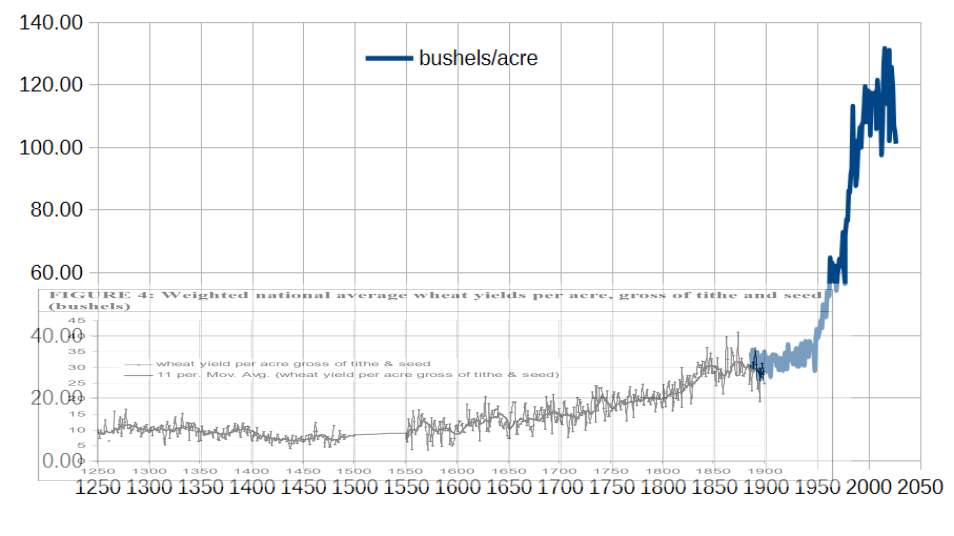
The very old yields were about ten bushels per acre; 2026’s was just over 100 (which, if you were wondering, is considerably higher). I should note that there are a number of uncertainties here, but nothing that affects the scale of the increase in yield.
I should also note that the yield, back when, amounted to 3.36 seeds per seed. So, in order to get 10 bushels from an acre, our distant ancestors had to sow 3. That’s about 5.5 times modern sowing density.
Various agricultural improvements have been made across the centuries (enclosure; seed drills; crop rotation), but things really took off in about 1950. We already had the Haber process and were therefore no longer dependent on animal-derived (or mined) nitrogen fertiliser. Add diesel tractors, irrigation by borehole, (what was then) modern crop breeding and organochlorine pesticides and things improved rapidly: the yield of wheat in 1950 was 40 bushels per acre; now, in this, the “worst on record” year, it is a mere 100 bushels per acre.
Looking back through the data, the last time we had a harvest of wheat lower than 2026 was in fact…
…drum roll…
…
2012.
[Some say, the low wheat yield of 2012 would have been impossible without climate change, but they have no explanation for why the years 2013 to 2026 had higher yields than 2012.]
I must take the opportunity here to state that putting a carbon border tax on imports of ammonia is emblematic of the utter stupidity of climate policy in the UK (and by extension, those setting the policy). The imposition of carbon taxes that have driven diesel refineries to close here is also stupid. Both are products essential to agriculture. Neither survive contact with Net Zero.

