How classrooms become “Impact” zones on climate
An federal-state endorsed teaching group is helping Australian schools reverse their long decline – but at the same time brainwashing kids with climate alarm and woke-ism
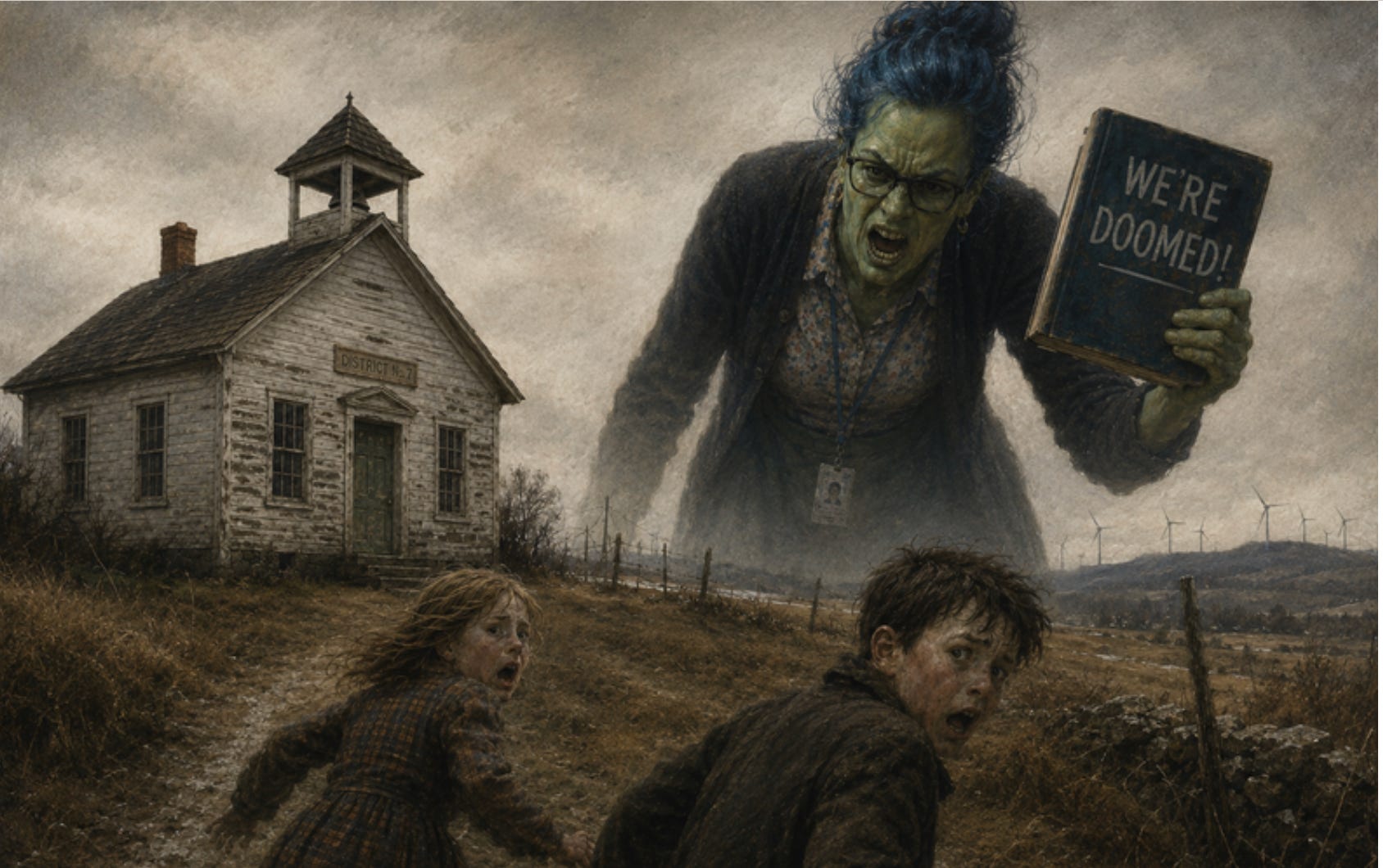
It’s great that after just five years’ operation, a government-backed non-profit service to teachers is lifting the effectiveness of teachers’ classroom work.
But, and it’s a big ‘but’, Impact Teaching Group is already infected by leftists’ outlook on the world.[1] I’ve accessed content that is not just fashionably green but foolish and inaccurate.
I’ve also found 1-minute “Acknowledgements of Country” affixed to the start of Impact lessons about Aborigines. The teacher’s instruction is: “As a sign of respect, please take a moment to deliver an Acknowledgement of Country” (p18). The lesson schedule explicitly allocates: “Acknowledgement of Country – 1 min” when the lesson contains material concerning ‘First Nations peoples and/or Country’.
It’s like forcing kids to sing the national anthem before a civics lesson, or to chant “Grace” before lunch break. These Impact lessons also gee-up kids to root for treaties and do guilt trips about colonialism. I’m actually sad about these fallings-off because Impact’s orthodox body of work looks so promising. It’s exceptional and not the rule to find Impact encouraging kids to activism.
[For northern hemisphere readers I’ve omitted my copious take-down of Impact’s material on Aborigines in order to focus on Impact’s climate material].
Education researchers say that it takes close to 20 years to move from evidence-proved good teaching theory to established teaching practice. If Impact is the real deal, schools can now start to claw their way back from their long decline – the PISA international ratings show our 15yo’s proficiency in reading and maths has eroded by about two years’ worth of schooling since the early 2000s.
What’s Impact’s system? Its on-line learning kits (Foundation to Year 10) are based on simple step-by-step increases to get results without overloading kids’ immature brainpower.
Mercifully, a teacher doesn’t have to create all this from scratch. It’s like Henry Ford assembling cars the smart way from components. Impact has mobilised 700 teachers and experts who’ve created 11,000 free packs (at mid-2026) involving lessons, worksheets, quizzes, slides, videos and tests.
The federal-state quango called Australian Education Resource Organisation (AERO) helped create Impact and mentors it. AERO collates research-proven best practices here and overseas, then gets the top systems out into classrooms through Impact’s prefabricated lessons.
The Impact delivery of on-line education contrasts with several long-standing free systems. These are ABC Education, the federal-state “Scootle” (encyclopaedia-style material of abysmal quality and relevance[2]); the Human Rights Commission and Amnesty’s shockingly-political lessons; and Cool.org, the stamping ground of green-left educationists.
Cool bulks as large as Impact. Its raison d’etre has never been secret. It’s to turn kids into horrid little activists and school-strikers preaching net-zero myths and Aboriginal romance to principals, parents, shire councillors and especially voters.[3]
Impact and Cool jointly dominate third-party access to classrooms. Both claim reach into 95% of schools, and teacher sign-ons of 170,000-plus (Impact) and 175,000-plus (Cool). Cool claims 2.5m kids taught annually; Impact doesn’t give a figure. Impact, however, has taken only five years to reach school client tallies approaching Cool’s, that Cool recruited during 20 years.
Now for the sour news about Impact’s “progressive” slant. To be fair, the government-mandated curriculum is itself wretchedly “progressive” and it’s hard to disentangle Impact’s slants from the governments’.
RENEWABLES ‘GOOD’
Impact’s renewables material blends ignorance and green talking-points into an atrocious muddle.
Impact gives 11 year-olds English composition exercises spread across ten lessons, including to compare the strengths and weaknesses of using renewable energy sources “in preference to non-renewable sources”– a nicely-worded hint. There is also supposed to be factual teaching – fat chance: “In this lesson, we will learn about methods we use to gain energy from non-renewable sources such as coal, oil and gas.”
The kids’ essays have to be “persuasive”. The supplied comparisons are outrageously biased towards renewables, almost beyond satire but no joking matter for the mining industry and half the country’s parents.
The supplied video is by Amanda Barrett, “she/her” – children’s literacy specialist who has a Bachelor in Communications (Marketing & Advertising) from Monash and Grad/Dip Education (RMIT). (below from Lmked-In)

Her heart’s in the right place[5] – but what is she doing unleashing economic idiosyncracy into regular classrooms?
Amanda expects the kids to regurgitate all her dubious talking points, including that
‘Mining can destroy the environment … and finally, mining is dangerous.’
Amanda explains that coal has been going strong since 1880s,
“and you might be wondering then what’s the big deal? Like why is coal so bad? Let’s find out.”
[The “big deal” is actually that coal-power liberated humanity, including Ms Barrett, from squalor, back-breaking toil and early death].
She continues that coal when mined takes millions of years to replace (but why would anyone bother?), and that coal cooks the planet:
“Mining for coal can also cause the ground to cave in and make underground fires that burn for decades at a time, polluting the atmosphere. Don’t forget to take notes.”
Amanda doesn’t mention that until zealots in government sabotaged coal-fired power, Australia for half a century had such low-cost and reliable electricity that it wasn’t even a conversation piece.[6] She continues,
“Oil is cheap and reliable like coal. But the problem is that once we use up all of the oil in the world, we don’t have any more.”
In 1974 before she was born, I was in the Canberra Press Gallery and heard Labor’s Energy Minister Rex Connor swear that all Australia’s oil would be used up by 1984. The crude-oil production last fiscal year (including condensate) was 90m barrels. As for gas, Australia’s sitting on vast amounts that Labor and its green-tape won’t let us extract. And Victoria has enough brown coal to power my state cheaply for hundreds more years. Amanda:
“When mining for oil, if there’s a problem with the drilling or machinery, the oil can explode out of the well and spill into the ocean or surrounding land, killing sea and wildlife. So that’s a really big problem with oil mining as well. So like coal, when the byproducts of oil are burned, they also release carbon dioxide into the air and they contribute to global warming.
Reminder to Ms Barrett’s pupils: the world runs on oil, regardless of her phobias about explosions and spills. And without mineral exports Australia would be Paul Keating’s banana republic – or worse. Just observe Prime Minister Albanese begging overseas for oil and diesel to keep us going. And somehow Impact’s lesson forgets to mention that wind turbines kill bats, hawks and eagles and have devastated Queensland’s pristine forest ranges. Amanda:
Our third fossil fuel is natural gas. Mining for natural gas can cause environmental problems. Fracturing rocks cause mini-earthquakes, and gas leaks can contaminate water sources making people sick and animals sick. Like oil, natural gas is expected to run out in the next 100 years, which is not very good.”
[Oh for heaven’s sake, Amanda! The world’s tankers are hastening to USA ports to buy America’s fracked gas. It’s been safely extracted there for 20 years, in volumes that have increased nearly 20-fold]
On nuclear power, Amanda shows pics of the cooling towers. Unlike their ABC, she has the decency to mention that they’re emitting steam, not dirty plumes of deadly CO2. Amanda burbles on:
Uranium is a non-renewable resource. The other issues with nuclear energy is that nuclear power is difficult to harvest and nuclear power plants are very complicated to run.
Maybe Amanda personally would find the plants ‘very complicated’ to run, but engineers have produced this ‘very complicated’ nuclear power for France for the past half century. And why doesn’t she describe windpower as “difficult to harvest” – especially when there’s no wind – via its thousands of kilometres of high-voltage transmission lines across farmland?
Nuclear energy also produces a radioactive material that can be extremely toxic to people and the environment. If something goes wrong with a nuclear power plant it can affect the environment around it for hundreds of years.
Sure, Russian incompetence caused the Chernobyl disaster. The Fukushima blow-up was from both an earthquake and tsunami, but not one person died. Nuclear power today generates 9% of the world’s electricity, and in half a century there’s been no contamination from transport and storage of nuclear waste.[7]
She lists some plus factors of fossil fuels, namely “Locating fossil fuels is quite easy.[What!? Ask a geologist.] They generate large amounts of energy quite cheaply.” Then she moves on to renewables:
“Solar energy is good because it’s cheap to run [except when the sun sets]. Solar energy is good but it uses toxic substances to make the panels which are bad for the environment. And finally, solar energy is good, so we [she means the Chinese] need to find a way to make the panels without damaging the environment… Renewable energy sources don’t run out. They’re constantly able to be replenished, which is fantastic.”
In the real world, panels and turbines wear out in a decade or two. The blades, concrete, plastics and toxic scrap have to be disposed of and the whole cycle repeated, which is not so ‘fantastic’ for the environment.
If Amanda’s lesson typifies what Australian schoolkids are taught, we’ll be in big trouble when such kids grow up to become Greens politicians.
THE LAST BEAR
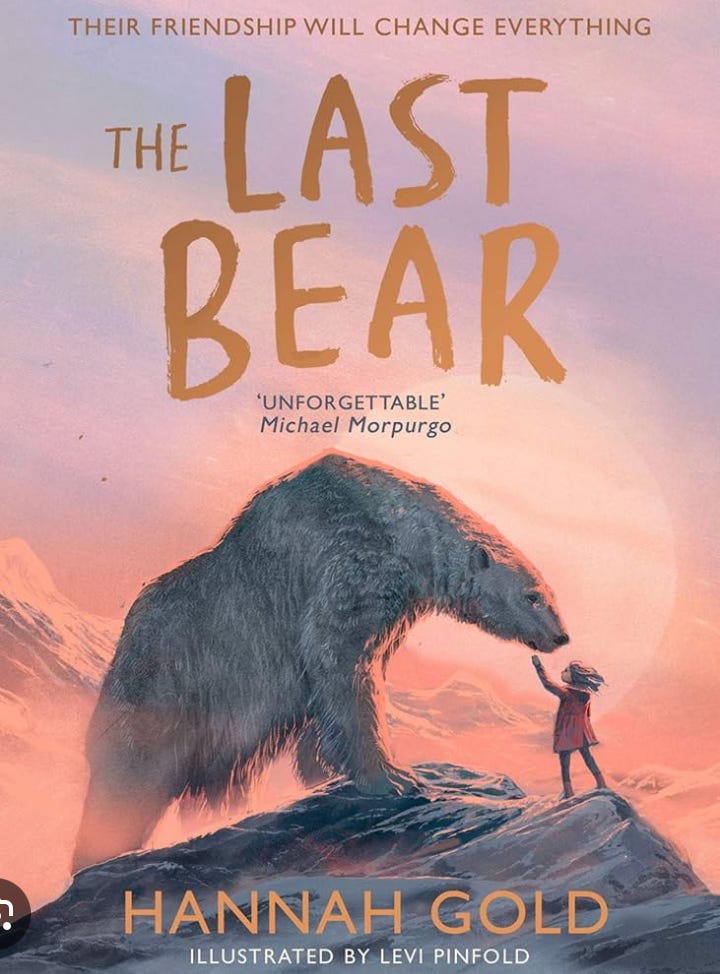
Impact is expert at shoe-horning climate propaganda into routine education. In English for 11-12yo’s, there’s a complex of lessons lasting five weeks (requires log-in) based on The Last Bear novel by UK author Hannah Gold. Of course it’s about the supposed last “polar” bear, reminiscent of Al Gore’s photoshopped hungry bear perched on an ice-floe. In the real world, polar bear populations have re-bounded since countries banned hunting.
The book’s ‘last’ bear is the last one on Bear Island, which lies north-west of Norway in the Barents Sea. The story’s theme is that warming’s melted pack ice so bears can no longer reach there, particularly from Svalberg archipelago. In fact a bear arrived in 2019[8] while Hannah Gold was writing that they can’t.
Her plot’s about an 11yo on the island who miraculously saves a starving bear while her climate-scientist father is manning the weather station. She heals its paw injured by plastic waste, rides it around the island like a horse, and finally gets it back to its mates and girlfriends on Svalberg. It’s nicely written and illustrated and has won heaps of prizes overseas for a kid’s book. With her other kids’ titles, she’s sold more than a million books.
Gold explains overtly that The Last Bear packs a climate message for kids. She wanted an up-beat story to reverse the playbook about kids becoming depressed and hopeless over climate. So it’s her “ message of inspiration” that “no one is too young or insignificant to make a difference.”
She explicitly wants the books to “empower our children” to climate activism. Her book’s message is that the best way to protect polar bears is “to do everything you can to fight the [imagined] climate crisis.”
It’s all a crock – polar bears can (with some difficulty) make the 200km swim to Bear Island[9] and catch seals with or without pack ice. They’re thriving and Arctic sea ice for the past decade has ceased to decline, flattening the previous 20-year trend.
The Svalberg arctic foxes that Ms Gold also supposes to be in critical decline from global warming are in fact rated as “least concern” and trapping is still allowed. The problem is not the climate but rivalry with the larger red foxes, increased by humans settling in the Arctic. Impact tells our kids none of this.
The UK publisher describes the book as a “battle cry for our world.” Australian publisher Harper Collins supplies teaching materials for 11yo’s to “Create a presentation about climate change”, while a mini-industry has arisen from other third-party suppliers getting aboard the Last Bear bandwagon.
A 30-page Last Bear study guide influenced by WWF misinformation and Polar Bears Intl exhorts kids to write persuasive protests to the Norway-based Arctic Council against oil development – kids get no case “for” the development (with normal safeguards) and merely brainstorm using the supplied negatives, e.g.
“I propose that we enforce stricter regulations to prevent the habitat destruction of Arctic Foxes because…” (p10)
It’s a waste of time as the Council has no executive powers over member states. This hasn’t deterred primary-school letter writers, egged on by their green-minded principals. Case in point is a primary school 60km north of Melbourne, which you can look up here (see p5). The Grade 4/5 kids swallowed the Last Bear message whole, whether via Impact or independently. The principal was proud of the kids’ letters to the Arctic Council, which were probably sent, judging by the correct Tromso, Norway PO Box number on one of them.
Girl C— writes how she is ‘truly heartbroken’ by the (non-existent or unproven) decline of polar bears attested by WWF. “If they go extinct we may as well be doomed!” she tells the Arctic Council, proposing 2050 as the doom date after relentless Arctic sea ice decline (absent for the past 20 years). “How do we expect polar bears to live without food?” she pleads.
She is rightly concerned about plastic oceanic pollution but demands that plastic be banned “as a whole” – which would bring civilisation to its knees. “If we don’t act quick, then polar bears, and consequently humanity, will be doomed,” her letter concludes.
Boy Q—writes that the poles are losing 82,000squ km of ice a year (the National Snow and Ice Data Center reported last September that for the Arctic there had been “no significant trend in September minimum extents” over the previous two decades). The boy claimed from some green source that the poles have been heating twice as fast as the rest of the planet (Fact: no warming in Antarctic for the past 70 years[10]). He claims there’s only 25,000 polar bears left (this IUCN guesswork dates from 2016), and that 70% of them will be gone by 2050. He tells the Arctic Council that “if you fail to protect our planet, it will not go unnoticed with most of our arctic animals disappearing forever”.
My take from the two letters is that what kids are taught in school about climate is mostly bogus, given climate’s complexity and uncertainties (it’s not even known if tree-planting increases or decreases global warming). Schools don’t care because their union-and-department approved goal is activism for turbines and solar panels.
No other school subject is so riddled with falsehoods. The material from Impact that I’ve cited here is all-the-more disappointing coming from one of our more advanced organisations seeking to lift quality of teachers’ work in classrooms. The material also reinforces kids’ pessimism about the imaginary climate “crisis” blighting their future.
Subscribe free to Tony’s Substack here for his full output.
[1] Impact was formerly named “Ochre Education” – the name change occurred just this month.
[2] I accessed Scootle’s ridiculous and crude augmented-reality game about an island, Mt Resilience, that achieves the nirvana of CO2-neutrality – “a roadmap to our future”, except residents have to drink the island’s treated wastewater. Brightly-coloured hot-air balloons and Zeppelins compete with jetliners for the airspace. Authors of this farrago were the ABC, Australian Museum, BoM and “35 of Australia’s leading minds in climate and resilience research.”
[3] Cool’s 2024 Impact Report includes a quote, “Cool supports teachers to take action on real-world issues. My students feel inspired and empowered to work alongside teachers to create change.” (p17).
[4] Impact’s supporters include charities focused on education and disadvantaged kids , like the Paul Ramsay Foundation, Origin Energy Foundation (which also supports Cool.org), Brett and Annie Fogarty’s Fogarty Foundation and Eureka Benevolent Foundation (Belinda Hutchinson AC and her husband Roger Massy-Greene AM), Catholic backers include Melbourne Archdiocese Catholic Schools, National Catholic Education Commission, Catholic Education Canberra & Goulburn and Catholic Education Sandhurst.
[5] Barrett: “I’m the founder of Literacy Learning Australia — a specialist literacy service supporting school-aged students (8–18) with reading, spelling, and writing difficulties, including those with diagnosed dyslexia, ADHD, and autism. My programs are grounded in the Science of Reading and delivered with a trauma-informed lens. I know that most kids who struggle with literacy have already experienced years of failure before they reach me. Building skills is only part of the work. Rebuilding confidence is the other half.”
[6] Victoria’s wholesale price for electricity around 1998-99 was about $20 per MwH, today about $100.
[7] The worst nuclear waste accident involved a truck with spent fuel overturning in New Mexico in 1971, but the fuel cask was undamaged.
[8] According to the Svalberg Posten newspaper
[9] The longest recorded bear swim is around 600km
[10] Hansi A. Singh & Lorenzo M. Polvani (2020), “Low Antarctic continental climate sensitivity…” Climate and Atmospheric Science, Vol. 3, Article 39, 2020. It opens, “The Antarctic continent has not warmed in the last seven decades, despite a monotonic increase in the atmospheric concentration of greenhouse gases.”

