To an ecologist, wildfires are intrinsically interesting. Wildfires structure communities, and communities structure wildfires. Plants in fire-prone habitats have evolved interesting strategies to adapt to fire. Good examples are the serotinous cones of some pine species, which do not open until they have been cooked, and the aromatic shed leaves and bark of eucalypts.
The basic principle is that fire begets fire. Fire selects for fire-adapted species, which are more prone to burning when there is a spark. In the absence of fire, more competitive plants, without any adaptations to fire, may gradually take over. That’s why, if you kept fire away from the UK’s moors for long enough, they would become woodland. This would be far less flammable than the heather-clad hills, and would probably perpetuate.
Naturally, theory is different to practice, and most of us prefer to stay far away from wildfires. Unfortunately for the residents of the Gironde, the fire has come to them in July 2026. There has been a lot of apocalyptic language uttered about the present spate of fires, and yesterday I heard that the Macron said that this was the worst fire trouble for France since World War 2. More on the Macron in a moment.
Not much has been said about the cause of the fires near Bordeaux (two days ago: 10 miles away; yesterday: 9 miles away). So, I thought I’d have a search of the news to see what is known. Different sources give different answers (none claiming a natural origin).
A glance at Google Earth said that there was lots of pine plantation in the region. What sort of pine, I asked the AI. Maritime pine, it said, Pinus pinaster.
Well, I was a little surprised. Why? Because it’s a fire-adapted species.
Now, I can’t confirm that the majority of the plantations are Pinus pinaster, nor that the fires have occurred within pinaster plantations, not without going there and having a look. But at first sight, it seems rather risky to go about deliberately planting a fire hazard in great dense blocks. I mean, the foresters don’t want a fire to burn all their trees, they want, in due course, to harvest them.
Next I turned to Google Scholar, and found a 2006 paper on fire and Pinus pinaster by Fernandes & Rigolot.
The wildfire problem associated with maritime pine stands is especially acute in the western part of the Iberian Peninsula, at the intersection of Mediterranean and Atlantic climate influences, i.e. where summer drought and high plant productivity coexist. Here, fuels can build-up to levels which are probably unequalled by pine stands in temperate climates elsewhere (Vega, 2001). The afforestation of communal lands in the 20th century has replaced the traditional matrix of grazed shrubland and pasture with dense stands of maritime pine, often extending over thousands of hectares of rough terrain, thus allowing landscape fire propagation in the years to come in a context of increasing depopulation and poor management (Rego, 1992).
The tale of communal grazing being replaced by afforestation is something I have seen referred to only yesterday, by Miquel Vila at UnHerd.
The AI also alerted me to a site discussing some earlier fires in the same region. The Global Peatlands Initiative were writing about the 2022 “zombie” fires in the Gironde (reigniting after a lull), and bemoaning the 19th-century draining of the swamplands of south-west France, and the subsequent deployment of vast areas of pine plantation. It was a recipe for disaster.
Until 1946, when the Commissioner of Bordeaux decreed the creation of firefighting organizations (Papy, 1950), wildfires were common in the region, especially in drought years. It was hoped that improved firefighting capacity would prevent large fires, but in August 1949 a saw-mill caught on fire and the subsequent blaze burned around 50,000 hectares of Landes pine plantations. The 1949 fire was the largest in France to date and also the most deadly. Tragically, 82 people, mostly volunteer firefighters, were killed while trying to extinguish the flames (Papy, 1950).
Now back to the Macron, whose wisdom features at that GPI story.
Following the 1949 wildfire in Landes, there were calls for the pine plantations to be replanted. This was done, with the addition of a network of firebreaks, which reduced the risk of large fires. Following this year’s [2022] wildfires there were once again calls for the pine trees to be reinstated and President Macron promised this will happen.
The ashes were barely cold and they were out planting FIRE-ADAPTED pine plantations again?
It’s rather like mixing gunpowder by the light of a bonfire.
Having heard that there were significant fires in the Gironde in 2022, I went to EFFIS and their annual reports to read all about them. In south-west France in 2022,
The total number of fires was 3 066, destroying 32 908 hectares of vegetation. This last figure is marked by four major fires, which accounted for 87% of the area burned. Of these, two started within a few hours of each other on July 12 at La Teste de Buch (5 709 hectares) and Landiras (12 552 hectares).
What about the fire causes?
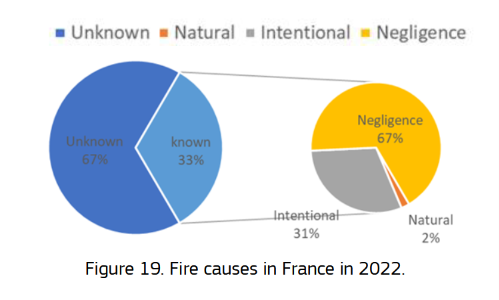
Only 6 312 fires, or 33% of the total, have a known cause. This percentage, higher than the 2006-2021 average of 26% of fires with a known cause, reflects progress in the search for causes. Of these fires with a known cause :
• 330 were attributed to a natural cause (lightning), i.e. 1% of all fires or 2% of fires with a known cause, which is below the average of 7% of fires with a known cause, and a far cry from the 2006 record (580 fires or 23% of known causes).• 4 119 fires were accidental, i.e. 22% of all fires, or 67% of fires with a known cause, which is close to the average.
• 1 863 fires were of deliberate origin, i.e. 10% of all fires or 31% of fires with a known cause, which is slightly higher than the average of 27% of known causes.
So, the cause of 2% of known fires was dry lightning, and 31% was arson.
What about the Macron? Well, the fires had political consequences, as the EFFIS report lays out:
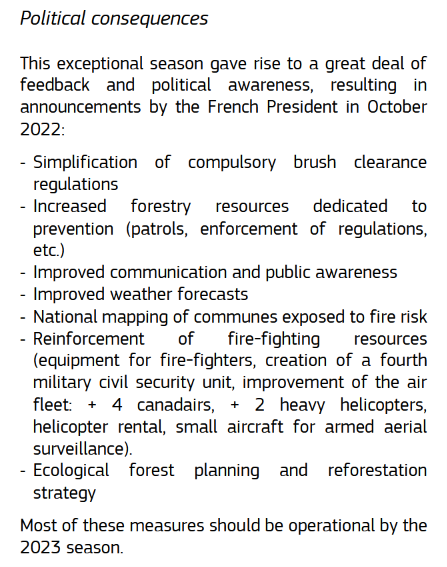
The measures do not look like a hill of beans to me. [Asterisk: the last item is the most important, but I doubt anything serious resulted.] Were they in place by 2023? Who knows. But it’s quite obvious that the Macron should have decreed that fire-adapted trees should not, on any account, be used for commercial forestry in this region. There are alternatives. Maybe the alternatives don’t grow so fast? Well, they don’t burn so fast, either.
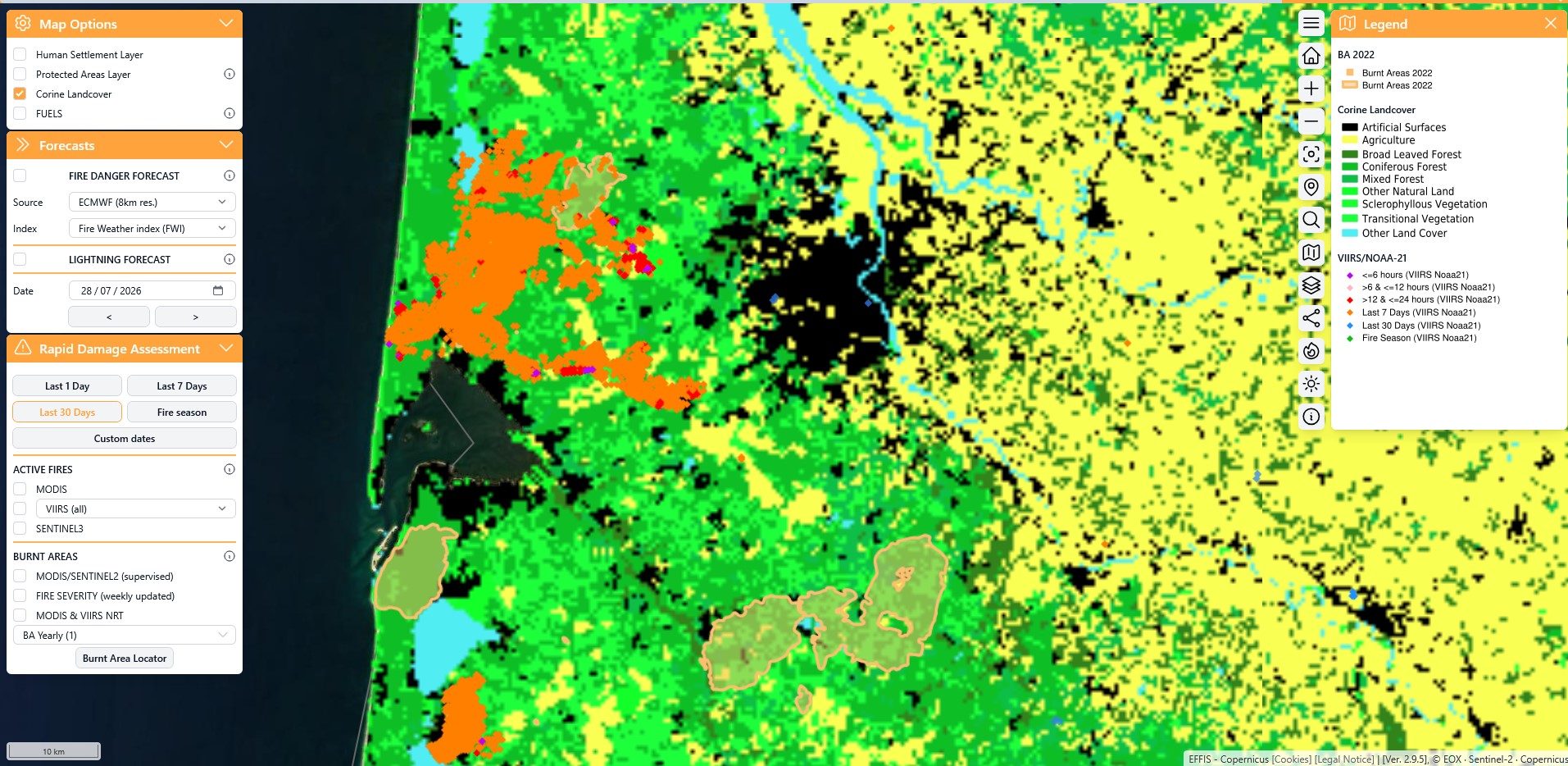
The first image below shows the EFFIS event viewer. The present fires (last thirty days) are in orange, and the 2022 fires are outlined in pink (Bordeaux is the central black blob) (the other black blob is the Bassin d’Arcachon, with Cap Ferret the green finger to its west). The 2022 fires were not as large, but you could hardly argue that they were not of a similar scale. The wake-up call was there, but the French President did not heed it. Meanwhile, folks are demanding that we place the blame for all this on the “climate crisis”, and using it as proof that Net Zero is now compulsory. Well, only an idiot could believe that, if they had thought about it for the time it takes to eat a Raffaello.
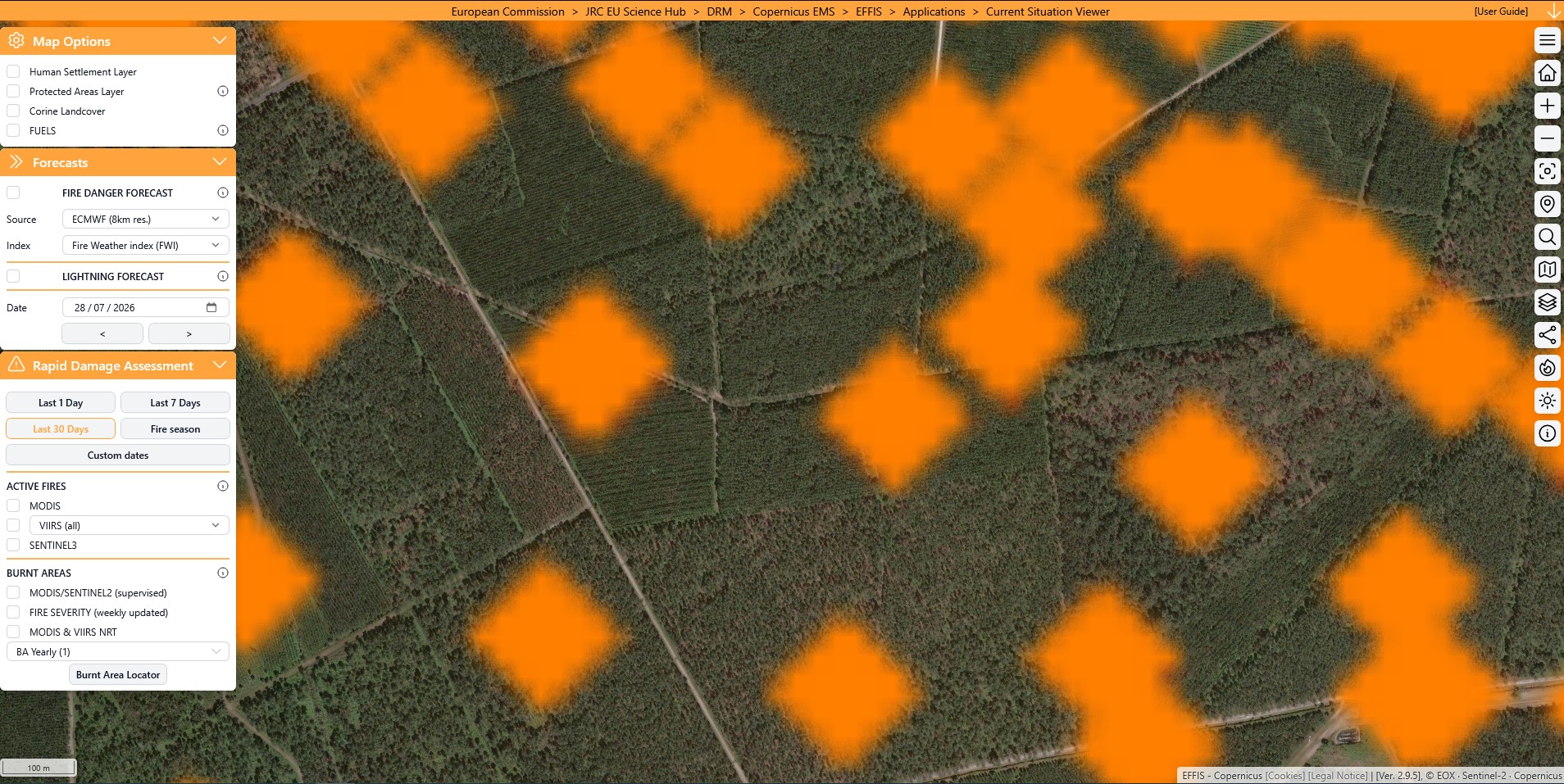
Next, I have zoomed in towards the centre of the orange area west of Bordeaux (for some reason the damage indicators do not resize). Here you can see the sort of habitat that has burnt this time.
/message ends
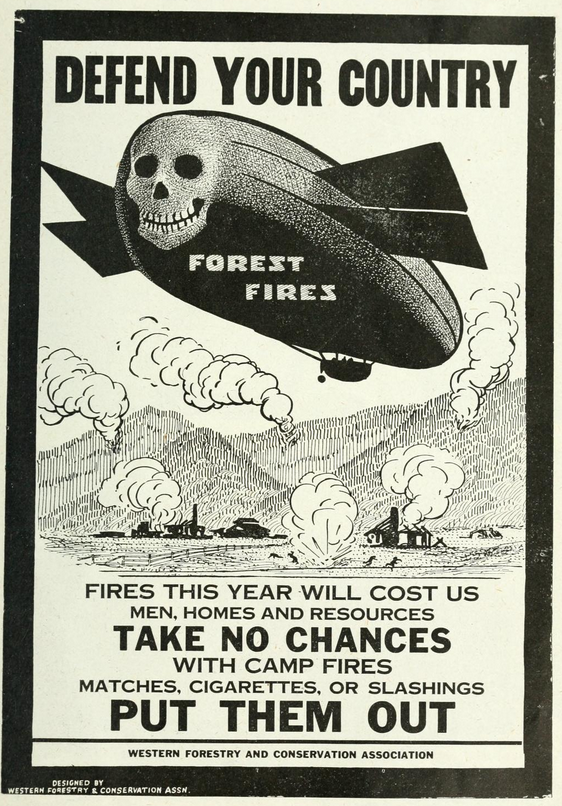
The featured image is an ad from the Canadian Forestry Journal in 1917. I’ll paste it in again here, as it no doubt got clipped up top.
PS. “The Prometheus Zone” is a real thing, apparently. But it relates to that other fire-prone area of France, the one on the Mediterranean coast. I came across it in the 2022 EFFIS report, and thought it sounded kinda cool.
PPS. Further reading (thanks to John R for the tip off): Wildfires: why media coverage doesn’t always make the climate connection.
 Climate Scepticism
I hhope someone calls Macron to account, reminding him of what he said
LikeLiked by 1 person
I think it’s undeniable that if a location has a wet winter, which encourages growth of inflammable material, then a long, hot dry spell, that is creating conditions for wild fires to occur. But wild fires depend on something to start them. As the pie charts in this article show, we don’t know what causes most fires, but we do know that in those cases where we have a known cause, natural causes represent a tiny minority of the fires.
It makes sense therefore to analyse the causes of the fires, and also to consider the extent to which other factors are making things worse – such as planting highly inflammable commercial woodlands in areas where the climate means that wild fires could be problematic.
A serious study, funded objectively, rather than skewed towards finding that climate change is inevitably the culprit, would assess all the factors objectively, and would weight the relative factors. Perhaps, then, we would find that climate change is a relatively minor player. Perhaps not. But we’ll never know so long as the hysteria is all about climate change.
Balance to the narrative, with a concentration on facts, would also be helpful. Our World in Data is worth a look:
https://ourworldindata.org/wildfires
LikeLiked by 2 people
Paul Homewood also has a piece worth reading:
LikeLiked by 1 person
This is also interesting:
https://forest-fire.emergency.copernicus.eu/apps/effis.statistics/estimates
We’re just over halfway through the year and just over halfway through meteorological summer, so that has to be borne in mind, but while it’s clear that Italy, France, Sweden and the Netherlands are seeing more areas burned than usual, most of Europe is seeing burns at well below the long-term average.
These graphs:
https://forest-fire.emergency.copernicus.eu/apps/effis.statistics/seasonaltrend
show a massive summer spike, and it looks as though this year’s spike has arrived early. What will be key is if the spike continues, in which case the apocalypse narrative might have some merit, but if the spike drops off as quickly as it usually does, then overall wildfires may turn out across most of Europe to be less than, or no worse, than, usual. Time will tell.
LikeLiked by 1 person
Entropy (aka Mother Nature) is a cruel mistress. You don’t get to pretend to play her at her own game and then, at your convenience, defy her fundamental law, i.e. that she should always increase, which is in fact the Second Law of Thermodynamics. A forest has much higher entropy than a scrubland moor. Fire adapted forests are higher entropy than non fire adapted. Land management requires the continuous input of useful work/energy, e.g. animal grazing, agricultural farming, scrub clearance and controlled winter burns to maintain an artificial (but highly productive) biome. Start sodding around with that by introducing ‘Green’ land management and ‘rewilding’ farmland etc. whilst forgetting that there are low entropy humans wandering around with very low entropy boxes of matches, cigarette lighters and accelerants and you’re asking for trouble. Politicians don’t understand entropy.
LikeLiked by 3 people
On our yearly road trips to southern Spain during the 90’s and early 2000’s we used the west coast route past Bordeaux every year at the beginning of July. I would lay money on there was a huge thunder storm with giant lightning all round us every year. The rain was so heavy all traffic on the motorway stopped for hours including the lorries. I also remember huge gaps in the forest planted with sun flowers and maize. On the flip side when the edges of the storms reached into Spain, in the mountains it wasn’t rain but huge hail the size of large marbles, we had to stop in fear of the windscreen shattering. The only fires we saw were in southern Spain where there had been no rain …. Yet, it was coming big time.
LikeLiked by 1 person
I can now like comments again. Hooray.
Another day, another wildfire. This one is in lowland England, so it has got some dreary idiots into a state of hysteria.
The facts of the case are that the wildfire in question has occurred on Dunwich Heath, which is largely composed of old and very leggy heather, which was a time bomb waiting to go off (although nothing like as dangerous as maritime pine).
Now, yesterday I said that if you exclude burning long enough, your habitat transitions to a non-burnable community. For Suffolk, that means heather is invaded by birch and pine, and a long time down the road, in comes oak. The oak shades out the heather, which is the fire adapted plant. Then you have a non-burnable community.
But. If you want to keep the heath (it is now a rare habitat, although in times past it would have been considered wasteland) you have to regenerate the heather and keep creating bare areas. The usual way as seen in the moors is winter strip burning (there is a debate of course to be had about how much upland moorland should be retained as it is). Unfortunately, strip burning in winter is somewhat frowned upon, and the local land managers – maybe NT – have resorted to desultory efforts with a flail, leaving a hundred hectares or more just waiting to go up. Heather burns wet, in the middle of winter at 600 m, so it’s going to go well after a dry spell in July at 0 m.
I am quite incensed by this photo released by Reuters:
They’ve contrived to make it look as if Sizewell is on fire by using a very long lens (the fire is about 4 km away).
BBC live coverage.
LikeLiked by 1 person
“Europe turns to goats to prevent wildfires
As abandoned farmland ignites around Europe, livestock and their appetites could be key to preventing wildfires.”
https://www.politico.eu/article/europe-goat-herders-fire-fighters-wildfires-spain-france/
LikeLiked by 1 person
In Scotland West Lothian when I was a kid 50yrs ago, it was gorse fires that raged almost every summer, but nobody panicked as they were not a threat & no wind to blow sparks.
Must be terrifying in a forested area.
LikeLiked by 1 person
I think we should be entitled to expect better than tabloid sensationalist headlines from the BBC, but sadly it’s now the norm, especially if they’re turning the story into one about the “climate crisis” [sic]:
“Fire-ravaged heath ‘could take 25 years to recover'”
https://www.bbc.co.uk/news/articles/cvgl4zjl3zyo
And where does that claim come from? Read on, and eventually you find:
LikeLiked by 2 people
It certainly won’t take 25 years, that much is for sure. The fire-adapted species (heather and gorse) will be back much faster. But it is well known that leggy heather regenerates more slowly compared to vigorous young heather. Birch and pine, with wind-blown seeds, will colonise rapidly – though naturally will take some time to achieve the stature they have today. It’s all a question of what habitat is wanted.
Matt Ridley opines on the topic of controlled burning in today’s Mail. He is right as far as he goes, but does not respect the idea that ecological succession happens. On the moors, as I might have mentioned, most end points are woodland. But the flatter tops are likely to end up as Sphagnum bogs. It is this latter habitat that bans on burning on deep peat are intended to recreate. Heather-dominated habitat is entirely man-made.
LikeLike
I recently read John Lister-Kaye’s book Song of the Rolling Earth: A Highland Odyssey, which is partly autobiographical and largely about the field centre he created at Aigas in the Scottish Highlands. It’s a fascinating book written by someone who cares deeply about the environment. The section dealing with heather uplands and how protecting them from deer and the like rapidly leads to natural reforestation was fascinating.
LikeLiked by 1 person
Thanks for an excellent article covering a dozen important points which have received zero coverage in the French media, as far as I can see. I’ll just add a few points from the 24 hour coverage which has quite literally driven every other story out of the news for the past 3 weeks.
France is on holiday of course, which means that, as in the 2003 heatwave, no important decisions can be made at any level above that of the local mayor. There’s a huge wave of public sympathy for firemen, local authorities, farmers, voluntary associations etc. and a corresponding disgust with all central authority. This will make itself felt at the “rentrée” (end of school holidays) in the usual French fashion, with predictable knock-on effects on next year’s presidential & parliamentary elections. Expect the centre, & anyone who has been in office this century, to disappear electorally.
The 4 Canadairs Jit mentioned in the 2022 report were reduced to 2, and are due to be delivered next year, I believe. With a 6% budget deficit, France is way over EU limits on public financing, & will be facing a Greece-style IMF crisis very soon, presumably after the victory of Marine le Pen next May. There is no money for anything, except of course the defence of Ukraine.
Current estimates of causes of the fires are 90% man-made, with 60% of those being deliberate. There have been over 200 arrests for arson, with some clear-cut cases already having been dealt with. Some have been voluntary firemen, but it will be interesting to see the motivation of others. I’ve seen reports of plans for a 10 minute city to the west of Bordeaux, plus Europe’s biggest solar panel park, plans that would become more attractive if the terrain is reduced to a desert. I wouldn’t be surprised if the obsessional fascination shown by the media hasn’t encouraged some feebleminded arsonists.
Media coverage has been overwhelming, hysterical, and disgraceful. For the 1st 2 weeks I never saw a map showing the extent of the fires. All senior staff at the TV channels are on holiday, & reporting is left to trainees from journalism schools. They’ll say things like: “Seven villages have been evacuated,” without telling you which ones, presumably because a list of names would spoil the stylistic effect of their polished French prose & get them marked down in their exams. The threat to large population centres is over for now, the death toll limited to two firemen, but the overall impression of the media coverage has been of a country fascinated by its own decline.
LikeLiked by 1 person
“I study the boreal forest. This summer wildfires came for my home
Here are things that will – and will not – help us fight the threat of wildfires”
https://www.theguardian.com/commentisfree/2026/jul/31/i-study-the-boreal-forest-this-summer-wildfires-came-for-my-home
Not Bordeaux, but Canada. This article in the Guardian/Observer, pushes the climate change angle, naturally, but also usefully says that we need to:
LikeLiked by 2 people
Geoff: it will be interesting to know what the motivations of the arsonists were, if they ever come to light during the investigations. The cynic in me has a hypothesis that some people would be willing to set a fire to make a climate point. [I have no evidence for it.]
Mark, wildfires in the middle of nowhere are no-one’s business. As we have seen elsewhere, people have a tendency to build settlements in the middle of flammable habitat, and then wonder why they get burnt out. But there is no mileage in trying to change the species composition on a large scale where no-one lives.
As so often the case, “climate change” (if it can be said to contribute to wildfires, which I genuinely don’t believe) is a purely human problem. Floods and fires have gone on since before we were here, and will do so after we have gone. Nature laughs at the largest fire (which is why I am annoyed when reporters speak of areas “destroyed” by a fire).
I can no longer “like” comments. That didn’t last long!
LikeLiked by 2 people
Jit
..suddenly I can like comments, for the first time in months. Perhaps there’s a limit on how many people are allowed to like at one time.
There have been examples of “green” arsonists in the USA I believe, and I noted that the environmental journalist in a recent TV discussion here in France was quick to dismiss the idea that deliberate arson played an important role.
My son lives just between the area of the coastal fires and Bordeaux (the fire got to within 7 km of their home.) It’s all deciduous forest round there, a lot of oak, but it doesn’t look very old. It would be interesting to see if the fire stopped or was retarded at the boundary between pine & deciduous.
LikeLike
Regarding the Dunwich Horror, in today’s Telegraph (no link as read on Pressreader):
“Rewilding blamed for Suffolk wildfire”
Well, yes and no. The aerial photography (see Google Earth) shows a large block of over-mature heather with a few trivial mown strips here and there – RSPB, or whomever is responsible for the management, cannot hide from this obvious point. However, the leggy heather did not cause the fire: that was a human. I’m hoping it was a genuine, hard to avoid accident, not an idiot dropping a cigarette. But the evidence of the photography is that the fire was made a lot more intense by the (lack of) management. (But still perhaps only 20% as intense as the fire fronts near Bordeaux.)
LikeLike
This link might work for the Telegraph article:
https://archive.ph/izbxE
LikeLike
Another Telegraph article:
“Disappearing villages leave Europe in era of fire
The emptying countryside means land is becoming unguarded and vulnerable to blazes”
https://archive.ph/STcMA#selection-2265.4-2269.86
LikeLiked by 1 person
“Arson arrest made over largest of Washington state’s wildfires”
https://www.bbc.co.uk/news/articles/c5y3ppmmev1o
This being a BBC Verify article, naturally it ends thus:
LikeLike
Mark, the line about making wildfires more likely is quite tautological, as well as facile. The concentration of CO2 in the atmosphere has been far higher than it is today. Was the planet a giant inferno then?
LikeLiked by 1 person
“Fires started ‘deliberately’ on mountain as crews tackle blaze”
https://www.bbc.co.uk/news/articles/cz05xp0vvpro
LikeLike
“Hundreds arrested over French wildfires, but who is to blame?”
https://www.bbc.co.uk/news/articles/cvgxjn92x9jo
LikeLiked by 2 people
“Firefighters in hospital as homes destroyed in West Midlands fires”
BBC coverage.
Several fires today. There was also one not far from our house here in sunny Norwich. I haven’t seen anything on causes yet on the BBC, so will search elsewhere for that.
LikeLike
More on the local fires.
“What we know so far about the West Midlands fires“
You might begin with “How did they start?” I probably would have. However, some way down, we do come to that question – the most important, bar none, if the idea is never to have a repeat.
The BBC begins by saying how hot it was. As Ray Bradbury reminded us, Fahrenheit 451 is an important number. This quote from that section was rather curious:
Have you ever, when moving about, spontaneously ignited the vegetation around you, perhaps by friction?
LikeLiked by 2 people
“Hundreds arrested on suspicion of arson in France as wildfires rage across Europe”
https://www.theguardian.com/world/2026/aug/14/arrested-suspicion-starting-wildfires-europe-france
LikeLiked by 1 person
The Guardian: never one to understate its case:
“Without action wildfires in Europe will increase 39% even in best-case climate scenario, study finds
Improvements in fire management however could mitigate increases by more than 70%, study shows”
https://www.theguardian.com/world/2026/aug/20/wildfires-europe-increase-climate-scenario-study
Happily, the article provides a link to the study:
https://onlinelibrary.wiley.com/doi/10.1111/gcb.71043
It may be a brilliant piece of work, or it may not – I cheerfully admit that I don’t know, but I tend to be sceptical of studies based on modelling:
However, the key thing is that the Guardian has chosen to report its findings in what I would argue is a misleading way (misinformation, anyone?). What it actually said is (quoting from the abstract):
72%-92% is technically covered by “more than 70%” but isn’t the same.
In fairness, the Guardian does quote the best-case scenario from the study. The worst-case scenario is much worse:
LikeLiked by 1 person
“Cause of fire that destroyed heathland unknown”
BBC link.
Either deliberate, or criminal negligence. But they won’t tell you that.
LikeLike
Well, this is interesting, especially as it is in the Guardian:
“Pine-cone grenades and planet-baking carbon: the French fires 170 years in the making – a visual guide
An 1857 decree to drain swamps and plant a monoculture, detritus from the trees and global heating combined to produce the conditions for the Gironde inferno”
https://www.theguardian.com/world/2026/aug/23/french-fires-150-years-in-the-making-visual-guide
LikeLiked by 2 people
They’ve been reading Cliscep?
I do love the way experts say we have to do things that will help (land management), as well as things that either won’t help, or will make 1% difference in about 80 years (reducing CO2 emissions).
LikeLiked by 2 people