Suppose we’re 10yo’s again: nice! In our primary school Miss Brown is rolling out a lesson she’s downloaded from the green/left Cool.org crowd. Nothing unusual about that: well over 225,000 Australian teachers have done so since Cool started in 2008[1], delivering lessons to about 20 million kids. Cool is like an unaccountable education mill tucked inside the school system.
Miss Brown’s Cool lesson is Writing about Climate Change – Poems about Butterflies.[2] It’s undated so she doesn’t realise it’s from mid-2022 and stale.
She asks us, via Cool’s script,
What changes to our environment are we seeing due to climate change? [Wow! That’s a big ask for us 10yos!]. What animals have been affected by changes to their environments due to climate change? Likely answers may include polar bears, koalas, whales. One animal we want to focus on in particular is the butterfly.
Ouch! Butterflies might be ‘animals’ but my mum and dad call them ‘insects’. Polar bear populations are thriving. Koalas boom and bust and often get culled, but not because Australia has warmed 1degC in 100 years.[3] Whales? They’re dodging Japanese grenade-tipped harpoons more than global warmth.
Cool’s lesson is simplistic, not from educational necessity, but to stir up us kids’ outrage about butterfly-killing emissions. The Monarch’s are in long-term decline (largely because their caterpillars’ milkwood feed is getting scarce), but they were recently re-classified globally “Vulnerable” after briefly listing as “Endangered” in 2022. The North American eastern population rebounded by two thirds last year.[4]
Says Cool’s script,
Independently, students write down emotive vocabulary to describe the monarch butterfly… Emotive language may include: fragile, delicate, graceful, fluttering, as thin as paper, lively, vibrant, intriguing, symmetrical, swarm, array, flight…You might like to watch the [outdated ABC] video a couple of times.
Miss Brown tells us to “Share a fond memory you have of a butterfly”, and misinforms us that it’s drought harming milkweed, rather than spraying, urbanisation and roadside mowing.
With the “facts” set, Cool and the cross-curriculum ‘sustainability’ priority drive us 10yo’s on to “Take action: Writing a poem to communicate scientific knowledge.” Our Cool worksheets display kids’ sample poems like Sophia V’s
“Plea To Save The Earth”.
It’s time to wake up and see Mother Earth’s pain.
Humanity’s selfishness is becoming insane.
Soon her cries will turn to gloom,
And man will cause its own doom.
Another by a Silvia S—is titled “About Destruction Of Earth” :
…Oceans filling with thick oil crude.
All sea life destined to a slow, awful doom.
There has to be something that someone can do,
Like raise the awareness to those around you
That if we don’t heed the problem at hand
It’s your life that’s at stake, the destruction of man.
Tapping at our laptops, we write our own poems, assured that rhymes and scanning don’t matter these days. Cool advises Miss Brown: “Allow the students to let their creativity spark and write what comes to mind.” She sets us the goal: use the butterfly slaughter “to send a message to the reader about the impact of climate change.”
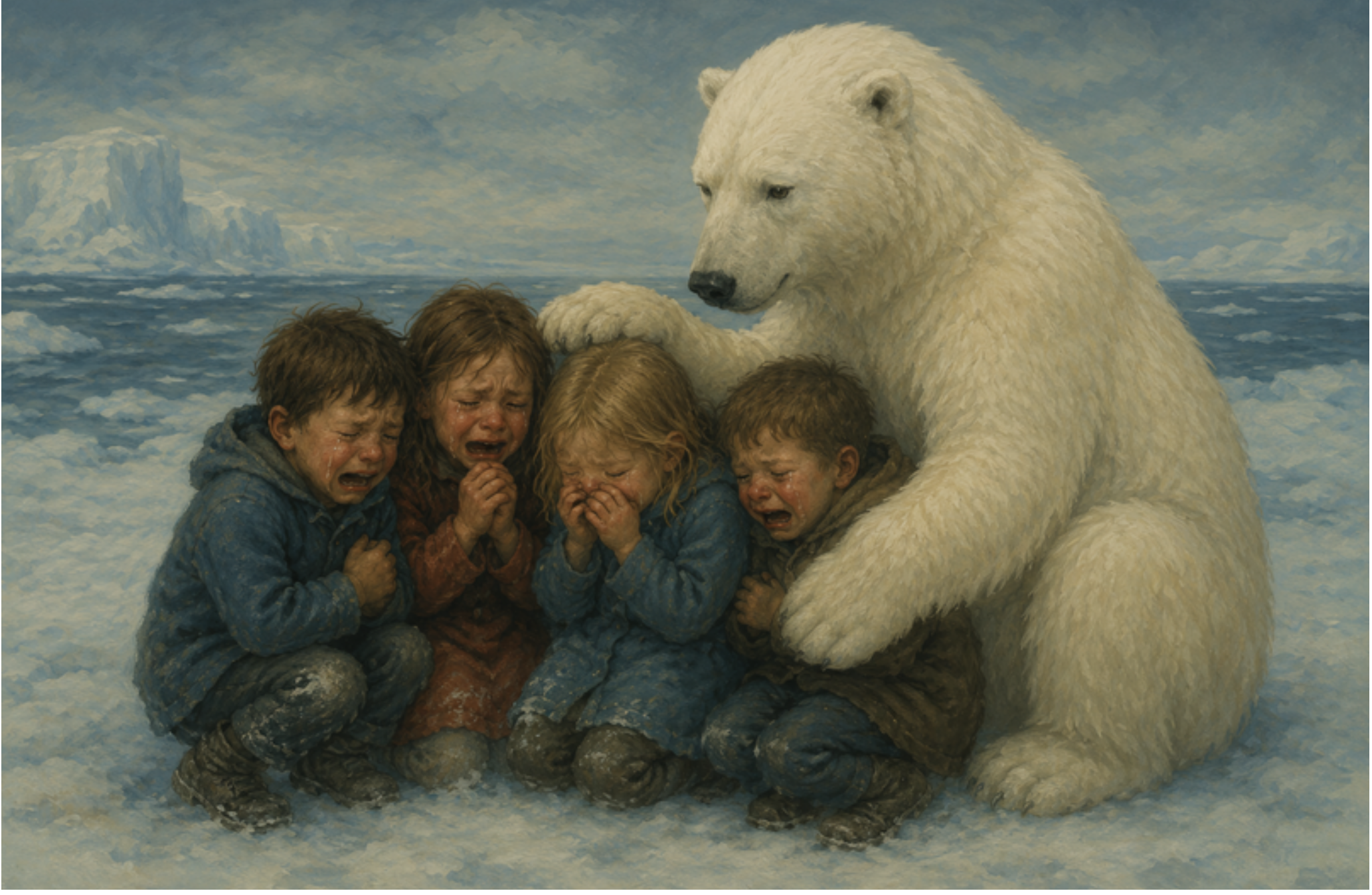
As for the polar bears, numbers since 2005 have increased from around 22,000 in 2005 to as many as 30,000 today. But we’re to create posters about them:
Success criteria: Students can employ persuasive language and design elements for a sustainability cause; recall facts about Polar Bears; think creatively.
Miss Brown meanwhile shows us Al Gore’s photoshopped fakery of a polar bear starving on an ice floe. I’m about to fix my eco-anxiety by stabbing my heart with a compass point, when I hear the morning bell ringing for play recess.
During recess I precociously dig out stats on this mysterious Cool outfit. Well over 25,000 teachers are on its systems each year, involving at least one Cool-using teacher in more than 90% of schools.[5]
They use Cool because 76% find their workload unmanageable, a third are trying to teach outside their expertise, and 90% lack prep time.
They download lessons more than 250,000 times a year, each lesson saving three hours prep and shared to teach an average 186 kids.
More than half of surveyed teachers have low morale and two-thirds say Cool’s material “brings joy back to their teaching.” Three-quarters say kids using Cool materials behave and engage better.
Jason Kimberley, of the multi-millionaire Just Jeans fortune, started Cool in 2008 “to turn a passion for equitable, real-world education into tangible global impact.”[6]
In 2024 Cool commissioned a third-party Social Impact Report. It starts for some reason with Cool’s tribute to Aborigines “as they lead the way with their knowledge and aspirations for future generations.”
Its data includes that more than 70% of the teachers (84% of Cool’s paid subscribers) have “‘taken action on social and environmental issues” , along with two-thirds of their pupils.
“Focus groups showed that this joint action between the educators and students is critically important…educators said that Cool.org resources are influencing a generation of ‘change-makers’.”
The study enthuses about kids as activists:
“Students take action on sustainability and social justice issues, nurturing behaviour that stays with them for life. Educators take action along with their students. Long Term: Informed, active and empowered citizens for a happier, healthier, more sustainable and just society for all.”
It’s all done on a shoestring. Cool’s 2025 charity filing shows income up strongly from $3,012,000 to $3,909,000 through extra grant income and successful tenders to government.
Major recent donor foundations include Myer, Lord Mayor’s and Ian Potter, Twiggy Forrest’s Minderoo, some Murdochs, and Cannon-Brookes’ Boundless. “Partners” include the Australian Human Rights Foundation, The Conversation and Reconciliation Australia.
Now let’s put on our real age and check Cool’s sustainability lessons for high-schoolers. They range from the usual anti-emissions agitprop to full-on derangement, like advocating “Degrowth and minimalism to combat climate change.” Prating that economic growth is a planet-destroyer was popular a decade ago and taken up by the Australian Academy of Science with its Fenner conference, Addicted to Growth? How to move to a Steady State Economy in Australia. (The Albanese government is perfecting our degrowth economy per capita).
Cool’s degrowth “lesson” begins with a witless analogy about ever-growing numbers of kids wanting a slice of the class’s cake. They try to make a bigger cake but run out of flour and eggs. Beyond this “cake ceiling” , kids steal cake.
It’s all Green’s tripe because technology and innovation have already accommodated the globe’s population increase from 4 billion to 8 billion in 50 years.
For degrowth, kids are supposed to darn socks (as if!), and get their books from “commonable libraries” (whatever they might be). Kids audit their belongings down to 10 essentials and 33 pieces of clothing and shoes for a month. Cool briefs teachers:
Depending on how harsh you want to be, you could even make students count their bed and their desk as an item…Direct students to imagine a future where humans have scaled their consumption right back. We are living on renewable energy sources. Nature is flourishing…
Contrast this with a future where countries around the world continue to grow unsustainably. We have used up all of the earth’s natural resources, mining the earth bare and deforesting all of our natural flora. We are now struggling to feed the population, and have hunted many species to extinction, especially fish.
There is not enough housing for everyone, and people are living on the streets…we don’t really need a lot of what we think is necessary in order to be happy. … The alternative is to consume ourselves to death.
Maybe teachers will soon be on strike and demanding reduced wages.
As psychologist Clare Rowe noted in Part One, schools shouldn’t traumatise kids about the climate. Cool likes it both ways: extremes can make kids
feel sad or anxious about the future becoming darker and scarier by the day. So, reassure students that we can have a hopeful and optimistic outlook on this report, rather than one of doom and gloom.
However, in the lesson for 14yos, “Exploring the Truth About Climate Change, kids get the “worst case scenario” of no-policy-change absurdly causing “sea-level rise of 2.5 meters” – that’s the height of my study’s ceiling. Even the dire IPCC scenarios put sea rise by 2100 at under 1m. But Cool decides its 2.5m isn’t scary enough so it quadruples the rise:
634 million people live within 33 vertical feet of sea level and are at high risk of flooding andhaving their land become submerged.
Meanwhile, warming also kills off species, “gone forever…the threat to all species will climb as temperatures rise.”
On scariness, Cool puts it to kids,
“ Climate change is a challenging topic to discuss, especially when it comes to looking at its effects and impacts. You’re not alone if you feel worried, scared, or upset about climate change. Sometimes it can feel easier to not know. But, acknowledging some of the hard bits now will make it easier for you to find a way to be positive and hopeful about this later on, and be inspired to take action. However, if it all gets too much: stop, take a break, and come back to it later.”
Another lesson says,
Even the most hopeful of us have down days when it comes to living with a future under climate change. What are some of the ways we can find hope on these dark days?
Climate change can be overwhelming and can bring up a range of emotions; it can feel like a huge weight on your shoulders. But it’s not a weight you need to carry alone. Talking about it with the people around you will help… at the very least, you’ll know you’re not alone.
In a brief for “Talking about climate change”, Cool (equating weather with climate) tells teachers:
Climate change can induce feelings of sadness, worry, anxiety and grief among many of us, particularly among those young people who have already experienced the effects of climate change, for example, through bushfires (sic) or floods (sic).
When discussing climate change with students, it is important to create a safe and positive classroom environment that encourages participation and cooperation without pressuring those who may not feel comfortable sharing their thoughts or feelings. Remember, just because a student in your class may have lived through an event linked (sic) to climate change, it is not their responsibility to educate the rest of the class about it… It may be appropriate to share some coping mechanisms with them, such as deep breathing, going for a walk, taking time out, journaling, drawing or listening to music.
If all else fails, Cool provides contacts for Kids HelpLine, Headspace, Beyond Blue Youth and Lifeline.
In a Hope Framework video, “Hamish from Cool.org” tells teachers that climate can make them and their classes upset: “The world can feel like a pretty unhappy and unkind place at times.” Students need to explore the issues but in ways that support their psychological safety. Cool’s lessons, he says, have inputs from psychologists, counsellors, scientists “and all manner of experts in the education field.”
Cool loves to downplay good news, telling kids
In 2023, there were over 220 extreme climate events. There was a 30% increase in fatalities caused by climate events on the previous year… and our ability to cope with them is getting less.
The reality is that risk of dying from weather disasters has fallen by more than 99.5% in the past century, thanks largely to better forecasting, food transport and infrastructure. The “increase” cited by Cool is an extreme cherry-pick.
Cool says that “current warming is on par with nothing humans have ever seen.”
This is junk. The Medieval, Roman, and Minoan warming eras were comparable or greater than now, with food surpluses enabling the massive constructions and civic works.
Cool’s bias is always towards gloom, as in a lesson for 15yos
Food Security and Climate Change in Australia. This involves a climate-model-based narrative about “the potential climate change risks to food security around Australia.” It even posits a ‘GFC’, ie Global Food Crisis: “Many experts predict that this crisis will become worse in the next 40 years,” says Cool.
The reality is that ABARE stats show national wheat yields have doubled since 1980 and production trebled. But Cool intones, “Climate change could change all that” because of imagined heat, dryness and extremes.
“Top soils that are crucial for food production are at a higher risk of drying out during a drought and being blown away. Have you ever seen or experienced a dust storm?”
Cool offers kids stale alarmist videos from charities (both videos now more than 13 years old) about future food perils.[7] Kids are urged towards “growing your own veggie patch” – how many teachers themselves dig potatoes?
Primary-school kids get a lesson on activism with a pic helpfully showing a protestor’s sign, “Stop denying the earth is dying.” The lesson begins,
10 years to act! Time to get our skates on and act for climate! Scientists have estimated that we have 10 years to change our carbon using ways…
I couldn’t discover whether this lesson was from 5, 10 or 20 years ago, i.e. whether the planet has already collapsed.
Cool’s other great cause is wind turbines.
Wind is a wonderful way to create electricity. A renewable resource wind energy is created with (sic) the wind blows! It’s a continuous, non-polluting energy source. A switch to wind energy is a switch for a climate positive future.
To describe erratic wind-power as “continuous” is a stretch.
Cool devotes mulitple lessons for kids on combating “Climate Denialism and Disinformation”, creating straw men to knock over instead of genuine sceptic science. From my searches, Cool at no point invites kids to inspect mainstream sceptics like Anthony Watts, Joanne Nova and 2022 physics Nobelist John Clauser. What Cool calls “myths” from deniers seem pretty factual to me, such as Myth 3, “Renewable energy is expensive” and Myth 4, “Solar and wind can’t work because they are dependent on the Weather.”
Cool sends kids out to the front lines in the climate wars:
Student Worksheet:
Climate change denial is on the rise among teenagers. What role do you think schools have in addressing this issue? What should schools be doing?
Cool complains the scepticism involves
“powerful economic interests at work: The fossil fuel industry has funded disinformation campaigns for years to create this kind of doubt about climate change…”
Cool doesn’t mention the scores of billion dollars promoting alarmism.
In class, kids are directed to form up into groups of five, to compare their reactions to (alleged) sceptic material, discussing issues like, “What might be the consequences of denial in terms of action for climate change?” They are to create
“a short video…to challenge climate disinformation and increase environmental action on the issue of climate change … Students can share their final versions with an audience.”
Cool tell kids how to create a “climate change pamphlet” for adults,
with the kids creating “powerful evidence”. In Cool’s brave new world kids are “educated” and then they “educate” their parents. Cool certainly covers all the bases: telling kids that snow in Texas “is a symptom of the atmosphere heating, rather than a refutation of it.”
Cool’s “reputable” sources for kids include Tim Flannery’s Climate Council,
the WWF lobby, The Conversation, and the federal Climate Change Department.
Other lessons provide for “Exploring Climate Change” (15yos) not through science work but through Damon Gameau’s propaganda film 2040 that pretends green policies 15 years in the future have solved every issue. As usual, kids critique each other’s answers, which makes any cynicism risky.
Cool says that its lesson, “Living with climate change”
may bring up guilt, anxiety, or sadness as students learn
about our planet’s challenges…You may like to remind students that understanding these issues and campaigns such as Earth Hour [are] small steps towards a healthier, more sustainable world.
Talking of campaigns, Cool loves Greta Thunberg (now a pro-Palestine fanatic), and quotes her:
“When enough people come together, then change will come and we can achieve almost anything. So instead of looking for hope – start creating it.”
Cool also loves Schools Strike 4 Climate, for “school students of all ages, races, genders, backgrounds and sexualities [as] one of the biggest movements in Australian history” . Isn’t it odd for third-party school educators to encourage absenteeism?
Subscribe to Tony Thomas’s free substack here
[1] Cool annual report , 2023. Later reports not available
[2] Because of Cool’s paywalling, links might provide only fragmentary material. Cool Powerpoints are especially inaccessible without subscription.
[3] Cape Otway — thousands of koalas have been sterilised or euthanised in recent years because of overpopulation and starvation risks.
[4] Claims in the Smithsonian that the Monarchs are suffering from dry spells caused by climate change are bunk. The IPCC finds no evidence that warming increases droughts .
[5] Cool’s 2023 annual report says its long-term targets are 250,000 teachers and 250,000 parent teachers, and 500,000 international educators, total 1m. It wants student preparedness to take action on issues raised from around 66% to 93%.
[6] The Kimberleys sold out of Just Jeans for $64m in 2001.
[7] Cool also revives Al Gore’s hoary Inconvenient Truth fictions from 2006, regurgitating Gore’s dud forecast, “There will be no more snows of Kilimanjaro.”


Aristotle, echoed by St. Ignatius Loyola, (founder of the Jesuits) said – give me a child under 7 & I will make the man.
Indoctrination of the young has always been a tool of despots, it’s easy to do & the implanted ideas last for generations.
From pre-biblical times to the present day, children have been used & abused by the very people that should be protecting them, there are an estimated 300,000 children are engaged as child soldiers worldwide.
Just In the U.S.A. military-style boarding schools and junior military academies there are ~ 40,000 ‘students’ all being indoctrinated.
LikeLiked by 1 person
Sorry I hould have added …
The ‘greens’ see this as a war against the climate so justify their abuse of children.
LikeLike
Hopefully there really is an increase in scepticism in school pupils, and it is due to them recognising the horsey apples being dropped by Cool for what they are. An impartial lesson gives both sides, it does not erect a straw man of the opposition’s position to knock down. Example: CO2 fertilisation effect.
LikeLike