There I was, snacking on a stir fry, and there it was.
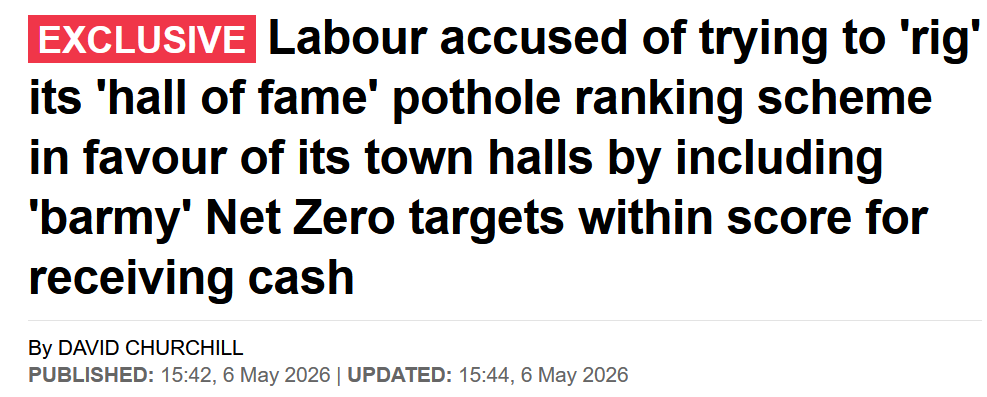
Story link. Yes! You caught me reading the Daily Mail, with its sidebar of shame, featuring today an actress said to be looking identical to Sarah Ferguson, but in fact looking like a completely different person (herself, presumably).
Well, it was mad enough (the pothole story, not the Sarah Ferguson look-alike story) that in a sane world, it was impossible. But I was tantalised nonetheless, because the world run by the present Labour Pantheon is – or might just be – mad enough for the story to have a little facty seasoning.
The accusation is:
Labour was today accused of trying to ‘rig’ its ‘hall of fame’ pothole rankings scheme in favour of its own town halls by quietly including ‘barmy’ Net Zero targets.
Ministers last month announced councils who perform badly at fixing pock-marked local roads would have cash withheld in a bid to drive up the numbers being filled in.
But it descended into farce today as it emerged the small print shows town halls can score points for whether they have ‘plans to decarbonise its maintenance operations and increase climate resilience’.
Naturally, the Mail did not link to a document showing how the rankings are calculated. So I had to go and look. Just peek. You know. Just in case.
Here is the page for the rankings. From there, you can reach the page for the methodology. There, 11 sub-metrics are listed, which are combined to produce an overall score. One of them – number 9 (they are numbered 1 to 10, but there is a 5a and 5b, hence 11 in total) reads thus:
| Whether a local highway authority has plans to decarbonise its maintenance operations and increase climate resilience |
Well, there you have it. The local authorities get points for Net Zero crap.
Not so fast. Not quite so fast. For on that page there is also a spreadsheet, giving the individual scores for each local authority. And to my eye, it looks as if things are not quite as they seemed 0.12 seconds ago. Metrics 7-10, of which Net Zero is one, are combined into one measure. The head of the column for that measure says this:
Metrics 7-10 – score penalty for not providing evidence relating to areas of highways maintenance best practice [note 9]
So now it looks as if the penalty for not following the green brick road is quite a minor part of the calculation. However, the raw data used to calculate the scores are not given, and I don’t see how to recreate them. Note 9 says this:
| Local highway authorities were asked to provide evidence of plans relating to 4 areas of highways maintenance best practice in their transparency reports: plans to adopt innovation, plans to minimise disruption from street or road works, plans to decarbonise & increase climate resilience, and plans to maintain footways or cycleways. |
[The four areas being sub-metrics 7-10.]
It looks to me as though not providing evidence of madly Net-Zeroing their tarmac did in fact cost local authorities points in the overall assessment. It also seems as though the penalty was relatively small, and I cannot confirm whether it resulted in any of them going up a tier or down a tier.
/message ends
 Climate Scepticism
Hmm. Where to start?
Increasing the resilience of roads is a good thing, but climate resilience? Weather resilience yes, climate resilience means what? Does this government have to insert climate references, however, meaningless, into everything? And isn’t it somewhat absurd to seek to decarbonise road maintenance operations? How on earth do you even begin to do that?
My one consolation is that given the awful state of the roads where I live, the league table has got it right – my Council is shown on all the metrics to have a “red” alert score, which certainly sounds correct! I’d be a lot happier if I thought that all this nonsense would result in fewer potholes in the roads round here, but I can’t see how it will.
LikeLiked by 1 person
And Jit, don’t forget:
https://cliscep.com/2024/01/15/potholes-to-be-made-worse-by-climate-change/
LikeLiked by 1 person
Thank you Mark. I had completely forgotten about that. It all makes sense now.
I think.
LikeLike
“Description – Tarmac is the generic name given to road surfacing materials, which is comprised of tar-like materials mixed with mineral aggregates like Portland cement, sand, gravel or concrete. However, the word ‘tar’ is used to describe a number of distinct substances that aren’t actually tar. Tar is refined natural resin or ‘pitch’, usually from the wood and roots of pine trees, but these are rarely found in our pavements. In fact, most of the ‘tar’ in tarmac is bitumen, which can be found in nature as a semi-solid form of petrol; but it is more commonly a bi-product of crude oil production by distillation. Popular lore holds that tarmac was invented by the Scotsman John McAdam, but in fact a county surveyor called Edgar Hooley was the man whose serendipitous encounter with an industrial spillage made road surfaces stick. McAdam had invented crushed stone surfaces, which were fine for horse-drawn coaches, but when cars became popular these surfaces were inadequate. The story goes that Hooley was surveying in Derby and saw a smooth section of road near an ironworks. When he investigated he was told a barrel of tar had fallen on the road, and waste slag from the furnaces had been poured on it to clear up the mess…and so tarmac was born.”
Bold mine.
Tarmac – Institute of Making
LikeLiked by 2 people
Jit’s now setting the theme for Guardian articles…..
“Potholes – that’s what voters care about. But you wouldn’t know it from the local elections coverage
As I bounced dangerously around a Sussex road, I was reminded of the parlous state of our highways – and the serious neglect of local issues”
https://www.theguardian.com/commentisfree/2026/may/08/potholes-voters-local-elections
It’s the potholes, stupid. Despite the attempts of national politicians to pretend otherwise, the local elections should have been about potholes. Believe it or not, the state of our roads beat the cost of living, the NHS and immigration as the top election issue in the final YouGov poll. They ranked highest in the Local Government Association’s list of local service dissatisfactions. Voters knew what these elections were about, even if no politician was ready to agree.…
…Keir Starmer launched a “Christmas boost” of £1.6bn to fill no fewer than 7m holes – as if he was going to do it himself.
However, the bureaucrats took charge and each pothole was subject to severe “detailed performance metrics”. No such discipline was visited on the government’s own HS2, which was squandering £7bn a year, unaudited by Whitehall. The Treasury even anticipated it might save £125m from its original Christmas bonanza by fining local authorities for not meeting their pothole quotas. The contempt for local democracy was total….
…At the last election, Starmer copied Blair. He pledged “to deepen democracy … by devolving power to communities”. Like Blair he did nothing of the sort. He became another centraliser, and merely proved that centralisation does not work, even with potholes. He is paying the price, as may my car.
LikeLike
“Pothole Repair Lorry Swallowed by Pothole it Was Sent to Fix”
https://dailysceptic.org/2026/05/11/pothole-repair-lorry-swallowed-by-pothole-it-was-sent-to-fix/
LikeLike
“A pothole has burst my tyre – what now and how do I claim?”
https://www.bbc.co.uk/news/articles/c5yxx7e84kmo
LikeLike
“‘They’re a nightmare’ – councils pay £2m in pothole claims”
https://www.bbc.co.uk/news/articles/c99l45ge738o
LikeLike
“The pothole puzzle: the bumpy ride to fixing Britain’s broken roads
Councils fix a pothole every 17 seconds – but getting on top of the repair backlog would cost £18.6bn. Why is it so hard to solve a problem that drives the nation crazy?”
https://www.theguardian.com/news/ng-interactive/2026/may/23/politics-potholes-bristol-britain-no-quick-fix
Naturally:
But the Guardian does concede:
Also:
I wonder if that extends to including “climate metrics” in their assessment of Councils’ eligibility for funding?
LikeLiked by 1 person
I can understand if they might want to claim that the “climate emergency” makes winters wetter. But colder? Presumably this is all about the way climate change causes everything that you don’t want, and nothing you do want.
LikeLiked by 1 person
Yes, the colder winters point is bizarre. Do their editors read what their contributors write?
LikeLike