I got to thinking what sort of things the UK has too much of, goods that it has a net surplus in balance of trade terms. The spur for this question was something I read in a government document (more of which in a moment).
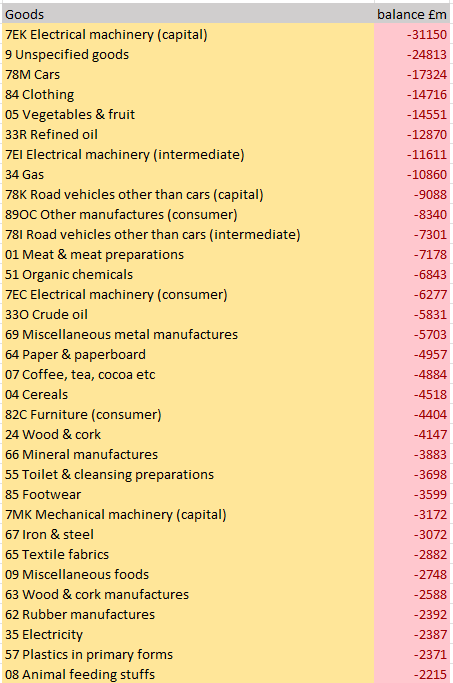
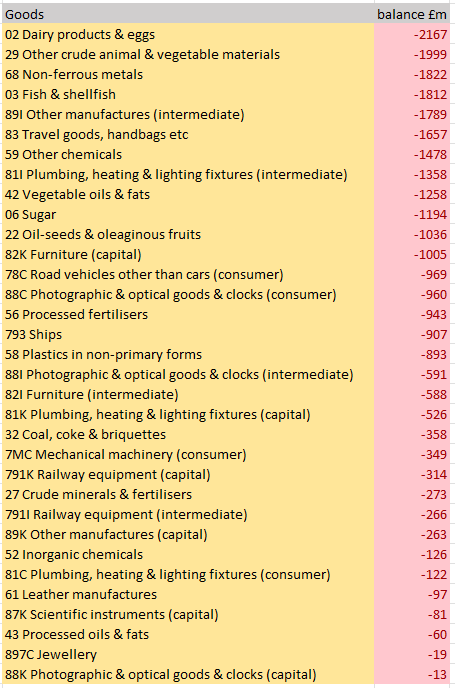
Anyway, before I tell you what we have too much of, let me first tell you what we have too little of. Now, there are numerous caveats to this data. It only deals with goods, and while we know we have a deficit in goods, we have a surplus in services. So this table may make things look worse than they really are. And yes, describing exports as things we have too much of is flippant and not really what is going on. But bear with me. The data are in ascending order of 2025 trade balance, so the goods we have the worst balance on are at the top.
As to the thing that I read that was so disturbing? Well, it was the UK’s Food Security Report 2024. I’m going to cut in a case study from there in its entirety. Please read it all.
Case Study 1: Flour fortification and calcium carbonate
The Bread and Flour Regulations 1998 mandate the compulsory addition of calcium carbonate, iron, niacin, and thiamin to non-wholemeal wheat flour to help protect against nutrient deficiencies within the population. Previously, the supply of calcium used for flour fortification in the UK was sourced from a quarry in England, Steeple Morden. While this met the purity criteria for calcium carbonate in the Bread and Flour Regulations 1998, it was not compliant with the criteria set out for calcium carbonate in EU food law. Hence, industry has moved to a new calcium carbonate source which is compliant with both domestic laws and EU laws enabling single lines of production and giving the ability to serve both domestic and export markets. Calcium carbonate composition is determined by the natural geological makeup and is therefore unvarying and very difficult to change, meaning that existing UK quarried supply of calcium carbonate cannot meet EU criteria as they stand. Additionally, calcium carbonate used in flour has other requirements such as particle size which is needed to be suitable for purpose. The multinational supplier of calcium carbonate has since decided to rationalise their business model which has led to a reliance on a single quarry site in France to source all calcium carbonate for UK flour. Since this shift, the quarry in England has ceased production of food-grade calcium carbonate, meaning that domestic production is no longer a contingency option should supply of calcium carbonate from France be disrupted. Even if this were a contingency option, there could be significant challenges around supplying flour fortified with calcium carbonate that is not compliant with EU food additive requirements. Events such as the widespread protest in France in early 2024 have demonstrated knock-on effect to supply chains, pointing to the potential vulnerabilities of reliance on this single source.
Due to the scale of flour production in the UK and restrictions of storage space, frequent deliveries of calcium carbonate are required with some larger mills receiving tanker load deliveries 1 to 2 times per week. This is the JIT model whereby raw materials are purchased to align with production schedules and large stockpiles are not held. While enabling efficiencies in supply, it means that a disruption in the supply of calcium carbonate could lead to the depletion of stocks quickly with immediate effects on UK millers’ ability to produce flour complaint with UK law. While there has been no break in the supply of compliant flour in the UK, this example highlights that there are areas where highly specialised ingredients and inputs are required by the UK food system, and limited suppliers producing to this specification. This, combined with an industry model that does not encourage stockpiling beyond immediate needs, presents a risk to the UK food system. Bread is a staple food for the UK population with a short shelf life and any disruption would be felt immediately by the population and would likely affect public confidence in the UK food system.
This issue is not exclusive to calcium carbonate and could also be true for most of the mandatory nutrients required to be added to flour. Thiamin and niacin are obtained exclusively from China due to difficult synthesis and low profit margins. A short-term issue with thiamin supplies was seen at the beginning of the COVID-19 pandemic but the effects were minimised, and stocks of worldwide supplies were redirected to the UK in time.
Now, also in ascending order, so the things we are doing best at are at the bottom, come the goods we have a surplus in.
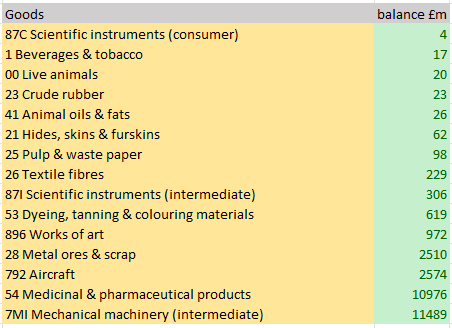
Yes, it’s a shorter list. But Metal ores & scrap! Get in. We’re winning there. And we made a net £20 million exporting live animals, something I lived for decades thinking had been banned.
There’s at least one more thing we have too much of, I think:

/message ends
The data come from this location at ONS. There’s one table for exports, one for imports, and a summary one showing the net, although there the commodities are collapsed into larger groups.


Today we read that deliveries of syringes, gloves and IV bags to the NHS are at risk due to the Iran conflict. There are also warnings about deliveries of diesel and jet fuel.
LikeLike
I am no prophet, but I have been banging on for ages about the all-too obvious problem of being reliant on imports for things that are of great importance. One might have thought politicians would have learned that lesson during the U-boat campaigns in the First and Second World Wars, but it seems they haven’t.
Autarky as a concept might seem a little too Hitlerian for people to be comfortable with it. And yes, global trade can be beneficial – it makes sense for countries to focus on what they’re good at, thereby driving up efficiencies and driving down costs; also some things can only be found in certain locations, so it also makes sense to be able to provide something that others want/need in order to get the things that you don’t have, but want/need.
However, as soon as there’s a snag with international trade, those countries that are overly dependent on supplies from other countries find themselves in great difficulties. Sadly, and problemmatically, for us, the UK must be a country that is near the top of that list.
It’s all very well for Miliband to bang on about renewables providing us with energy security in an uncertain world, freeing us from fossil fuel dictators etc, but he’s wrong. Those academics and green charities/lobbyists writing earnest leader articles and producing studies saying as much are, IMO, charlatans peddling the Emperor’s new clothes. Renewables are unreliable, need back-up, and have made us hugely dependent on others for our energy. Not least, we have an increasing dependence on China, a country which the Labour government in Westminster and the SNP government in Holyrood, seem to be very comfortable with. I have nothing against the Chinese people. I’m less keen on the CCP. And I’m decidedly unhappy about making ourselves increasingly dependent on them.
And as you say in your article, energy is just the beginning. We are reliant on the rest of the world for so much really important stuff, it’s truly terrifying. It’s certainly a lot scarier than climate change.
LikeLiked by 3 people
The NHS supply story can be found in the Telegraph:
“NHS boss fears supplies could run out in days
Deliveries of syringes, gloves and IV bags at risk over Iranian blockade of Strait of Hormuz”
I hope this is an accessible link:
https://archive.ph/6ycxO/again?url=https://www.telegraph.co.uk/news/2026/03/31/nhs-days-away-from-supplies-running-out-iran-war/
ALso, note this:
…The UK imports about three-quarters of its drugs, but even those that come from the EU or closer to home are often made from materials shipped from countries such as China or India.…
LikeLiked by 2 people
By the way, Jit, it seems some of his own constituents agree with you regarding Mr Miliband:
“The voters in Ed Miliband’s own constituency enraged by his net zero crusade
As fuel prices soar, Doncaster residents find the Energy Secretary’s opposition to North Sea oil and gas bewildering and infuriating”
https://archive.ph/uVcGQ#selection-2151.4-2210.0
…Hardy, who started out as a home-bred pig wholesaler and developed Marr Grange Farm into a hub for home-grown and responsibly sourced meat, needs these fuels to power his tractors, vans and machinery. “I reckon this has already cost me £6,000, and the war’s only been going a month,” he says.
“But what I really can’t understand is how we’ve become so reliant on these fuels from the other side of the world when we’ve got it right on our doorstep. It’s in the North Sea, for goodness sake, so why not use it like Norway does? It’s common sense – which is something our local MP doesn’t seem to have a lot of.”…
LikeLiked by 3 people
So just how much bread do we export, if zero, then why are we complying with a rule that does not have a material effect on a product, if however we do, then simple- the export bread is manufactured in a bespoke unit and exported.
In any manufacturing business, you never have a single source of supply, this leaves you 100% vulnerable to the vagaries of life- strikes, price gouging, transportation, export/import tax hikes, export/import embargo, or plain old competition from a rival who is determined to wipe you out by bulk ordering the complete production for forward delivery.
The fact that this Government lied about respecting the Brexit vote, a 50+% vote which considering almost 73% of those eligible voted, compare that to the “landslide” vote turnout of 59%- more people wanted out but Starmer wants in and is doing everything you would expect a sly lawyer to do- adopting rules and regulations to “smooth” business whilst not putting any of these “changes” to Parliament.
Expect no less from a Fascist who is determined to crush this Country under the jackboot of Authoritarian rule.
LikeLike
Jit,
On April Fool’s Day, you generally regale us with a spoof article. Today, however, your piece is all too serious. If it is a spoof, then it’s a highly successful one, because it’s so highly believable.
Sadly, the perpetrators of an all-too-real April Fool are the establishment figures (politicians, civil servants, academics, many journalists and media figures, etc., etc.) who we expect to be the adults in the room, looking after our interests. Unfortunately the joke is on us.
LikeLiked by 1 person
Good insights, Jit.
The USA has the same problem but under the new administration they have the good sense to be doing something about it. US Secretary of State Marco Rubio gave a conciliatory but uncompromising speech at the February 2026 Munich Security Conference to the assembled European/globalist leadership. The full transcript is here.
Rubio said this on deindustrialisation:
“Deindustrialization was not inevitable. It was a conscious policy choice, a decades-long economic undertaking that stripped our nations of their wealth, of their productive capacity, and of their independence. And the loss of our supply chain sovereignty was not a function of a prosperous and healthy system of global trade. It was foolish. It was a foolish but voluntary transformation of our economy that left us dependent on others for our needs and dangerously vulnerable to crisis.”
Rubio diplomatically declined to say who was the instigator of this “foolish” policy (or what was its ulterior motive) but it is obvious he was referring to “British imperial policy” as explained by Promethean Action in this eye-opening episode (16 minutes, well worth watching), which pinpoints the start of this dastardly deindustrialisation policy to 1977.
Under the USA’s new National Security Strategy they are now leveraging their status as global consumer of last resort to command $trillions from abroad to restore their self-sufficiency by rebuilding their run-down industrial base.
Compare this to what has happened in the UK. During the 1980s we had massive deindustrialisation, although to be fair the political options at that time were very limited. At the time most people thought that being reduced to a service economy would be hunky dory.
Then along came the climate change hoax. With official statistics (Dukes 2025) showing that in 2024 the UK was still 75.2% dependent on fossil fuels for its primary energy supplies, UK Net Zero is clearly going nowhere yet has already given us the highest electricity prices in the developed world, a crippling four times higher than the USA, with devastating deindustrialisation proceeding apace.
In 2022 along came Ukraine and the loss of cheap oil and gas from Russia and now four years later the conflict in Iran which have both shown, as most sensible people already knew, that even if the countryside and seascapes were totally carpeted with a surfeit of windmills, solar panels and batteries, the economy is stuffed without an ample supply of hydrocarbons and reliable dispatchable electricity. Yet Starmer et al remain hell bent on their ideological destruction of the North Sea oil and gas industry (and lots of others) and of course they continue to rule out domestic fracking.
Harsh geopolitical reality will hopefully soon force a policy reversal here in the UK.
Some of the above text is from my latest post on Scotland’s delusional climate change plan, appropriately posted on the Think Scotland website thanks to Brian Monteith.
LikeLiked by 3 people
On “Case Study 1: Flour fortification and calcium carbonate” – food for thought. Thanks for sharing.
LikeLike
It’s a funny thing, but I don’t remember reading anything about this in the UK’s National Risk Register.
LikeLiked by 1 person
Who to believe?
LikeLiked by 1 person
According to this survey, there is a majority for more drilling in every party.
https://x.com/lfg_uk/status/2038941878943469859
Who is Miliband listening to?
Today on PM, the Minister for Procurement of Paperclips, or whatever he was Minister of (are we self-sufficient in paperclips?) came on with an unbelievable blather about the government’s “pragmatic” approach to the North Sea. Pragmatic? Nope. Dogmatic.
The last lot were bad. This lot are so incompetent, it feels as if they are actively working against the wellbeing of their people.
LikeLiked by 6 people
This is a lightly edited version of an e-mail I have just sent to my Guardian-reading, Labour supporting, retired academic friend:-
Hello …..,
Thank you for this link (Top Brussels official urges Europeans to work from home and drive less – POLITICO). Unfortunately this man is trying to go in opposite directions at the same time when this is said, “Longer term, he urged EU countries to double down on building more renewables, saying this must be the time we finally turn the tide and truly become energy independent.”
After all the science, engineering and economics he still has NOT understood that current “renewables” are the very opposite of renewable (because they require so much energy to create) and they also make us dependent upon China etc., which is the opposite of independence! If he was serious about energy independence then he would have said, “Drill, baby, drill. Mine, baby, mine. Frack, baby, frack.”
No wonder the USA’s strategic review says (page 25 of https://www.whitehouse.gov/wp-content/uploads/2025/12/2025-National-Security-Strategy.pdf ), “Continental Europe has been losing share of global GDP—down from 25 percent in 1990 to 14 percent today—partly owing to national and transnational regulations that undermine creativity and industriousness.”
However, your e-mail was very timely as I was about to send you some pertinent energy articles that you may (or may not) wish to consider.
Firstly, Kathryn Porter again ( https://watt-logic.com/2026/03/26/oil-and-gas-strategy/ ) who says, “What does the government have to say about this long term reliance on oil and gas? Absolutely nothing. Not a single thing. Just constant repetition of the “get off gas” mantra. Worse, we’re actively suppressing domestic production, sending a clear signal to investors that the North Sea is closed for business. This creates a black hole at the heart of policy, because we’re locking in continued demand for hydrocarbons while dismantling our ability to supply them. The inevitable result is a greater reliance on imports, higher exposure to international markets, and loss of control over a critical part of our energy system. That’s not a transition, it’s a deliberate choice to increase vulnerability.”
Here is The Daily Sceptic ( https://dailysceptic.org/2026/03/31/north-sea-mythbuster-why-the-seven-arguments-against-drilling-are-all-wrong/ ) which ends its article thus, “The argument against domestic oil and gas production is not primarily technical or economic, but political. It deserves to be argued on those terms with honesty about the trade-offs involved.”
The article (above) includes data on North Sea fossil fuel reserves and also on tax revenues from that basin.
And, finally, here is Fraser Myers in Spiked ( https://www.spiked-online.com/2026/03/26/britains-energy-nightmare-is-of-our-own-elites-making/ ). I particularly liked the section that begins, “According to Miliband, fossil fuels cannot be produced domestically at scale. And even if they could, he claims, we would still be prisoners of a volatile global energy market. The energy secretary is wrong on all fronts. Catastrophically so.”
Later on Myers writes, “There is simply no rational, let alone progressive, argument for throttling the North Sea. For the past decade or so, the big bet made by the establishment has been that renewables can replace energy derived from fossil fuels. Wind and solar, they claim, are not only cheaper, but offer more security of supply, too. Again, these are sheer delusions … Britain is set to exit what Miliband calls the ‘rollercoaster of fossil fuels’, only to lock in crisis-level energy costs in the longer run.”
Myers ends with these words, “Britain’s energy policies are nothing short of suicidal. Blinded by Net Zero zealotry, Miliband and his predecessors have made our energy supplies more costly, less secure and more reliant on foreign imports. The result is an almost permanent energy crisis that will long outlast the current conflict in the Middle East. If the economic pain of the next few months doesn’t change the establishment’s thinking then perhaps nothing ever will. It will confirm, beyond any shadow of a doubt, that our current trajectory of deindustrialisation and decline will have been actively chosen by our rulers.”
Not a pretty picture. But do Labour and fellow travellers care a fig? Do they, as you rightly put it, understand about resilience, reducing costs for consumers and long-term energy security? Not a chance.
By contrast, Badenoch and Farage and many other energy realists either have long understood or are beginning to understand. But I wonder if the ‘luxury belief’ set at the BBC and The Guardian et al. understand or care.
End of e-mail rant.
Regards, John C.
LikeLiked by 3 people
Nils Pratley again, contiuning to be one of the few Guardian journalists talking any sense:
“Starmer’s ‘five-point energy plan’ was not a plan
Two of the points were measures on energy bills from the autumn budget, another restated the existing energy strategy”
https://www.theguardian.com/business/nils-pratley-on-finance/2026/apr/01/starmer-five-point-plan-energy-bills-iran-war
…“We’re taking back control of our energy security, by investing in clean British energy.” Come on, the Clean Power 2030 plan cannot be accelerated in response to the war. It is a five-year £200bn infrastructure project. Nuclear power stations take at least a decade to build. The windfarms commissioned this year will start spinning in 2028 and 2029.
They all help necessary energy transition, but most energy analysts project that savings for consumers from a cleaner system only start to arrive around 2040, assuming the government continues to load the bulk of costs and levies on to bills.
And, by the way, gas-fired generation will still be needed as back-up to intermittent wind and solar, so the fossil fuel “rollercoaster”, in the over-used political metaphor, is not wholly escapable.…
...As with previous energy shocks, the decisions aren’t easy. But repeating measures taken in last November’s budget is not a plan.
LikeLiked by 1 person
“They all help necessary energy transition, but most energy analysts project that savings for consumers from a cleaner system only start to arrive around 2040, assuming the government continues to load the bulk of costs and levies on to bills.“
Not sure what that statement means?
Is he saying that after 2040 energy consumers will start to see saving from “a cleaner system“, but to get that saving, bills will be higher for the next 14yrs to pay for infrastructure.
Wonder if he meant tax bills?
LikeLike
PS- just occurred to me that by 2040 UK will be so hot that we will need those big fans to keep us cool 🙂
LikeLike
dfhunter,
I’m pretty sure he’s saying that bills will continue to go up until 2040 (or at the very least, that there’s no chance of them going down before that date) subject only to the caveat that if the government continues to move the cost of renewables from bills to general taxation, then bills could go down (or at least not go up) before then – but renewables will still be hitting us in the pocket until 2040.
Of course, higher bills are inevitable for the foreseeable future – notwithstanding what the Guardian, “green” academics and the CCC say, NESO says upgrading the grid to cope with renewables will cost £3 trillion. That’s an awful lot of money, and we’re all paying for it one way or another (higher electricity bills, higher taxaction, higher cost of living generally as businesses that we use face higher energy bills and pass them on to consumers in higher prices).
As for the magic 2040 date? I suggest it’s so far in the future, and there are so many variables and uncertainties between now and then, that a claim of cheaper electricity from 2040 onwards can at best only be purely speculative. Will we have solved the intermittency problem with cheap energy storage at scale by then? Who knows? But I have serious doubts.
LikeLiked by 1 person
“How could strait of Hormuz closure affect UK food and medicine supplies?
Effects of Iran’s blockade will depend on how long crisis lasts as disruption ripples through supply chains”
https://www.theguardian.com/world/2026/apr/02/strait-of-hormuz-iran-closure-uk-food-medicine-supplies
All bets are off,” said Prof Tim Lang from City St George’s, University of London. He is one of the world’s food supply chain experts and has written numerous reports on food security, which he said have largely been ignored by successive governments.
“Britain, and the rest of the world, has not seen what a medium-term impact of a massive shock to the world energy system is,” he said. A sharp hike in fossil fuel prices has huge impacts even in the short term to food supplies, as fuel is used to transport food, and the inputs such as fertiliser used to grow vegetables are made from fossil fuels. Greenhouses and chicken barns are heated with gas.…
And much more.
LikeLiked by 2 people
“A food inflation crisis is coming”
Andrew O’Brien’s note in UnHerd.
LikeLiked by 2 people
There are fuel protests in Ireland – which to this cynic the BBC seemed slow to tell us about. Government advice? Or is that tin-foil-hattery?
Back in the summer of 2000, the UK had its own fuel protests. Back then, petrol was 80p a litre and diesel 80.8p (so says the wiki page; the 80p limit being breached seems to have been the trigger).
In the 26 years since, general inflation (CPIH) is 91%.
Today’s average fuel costs are 158p for petrol and 191p for diesel (fuelfinder).
The relative inflation on fuel – and yes it may be a blip – is 98% for petrol and 136% for diesel.
The Irish government threatened to take away the driving licenses of the protesters. For hauliers about to go bust, this may seem like an empty threat.
LikeLike
According to reports, we are now – somewhat ironically – about to run into a shortage of CO2 thanks to the closure of the Strait of Hormuz. How this works is quite the mystery.
LikeLike
Jit, I heard something about that so tried to do a bit of digging on where the UK gets CO2 from. My search efforts kept deluging me with guff about CO2 emissions, carbon capture, etc.
However, I did glean a few snippets. Apparently we lost much, if not all, of our domestic CO2 production when our fertiliser plants closed. We now import our fertiliser, much of it from the Middle East, hence the impact of the Iran war. I would guess that we were obtaining CO2 from the final processing of those imports. According to the BBC, the govt is paying CF industries to restart production at one of its plants for 3 – 4 weeks “until things settle down”.
So this looks like another bit of collateral damage from our de-industrialisation.
Common sense says that we could rectify the problem easily and quickly, given the will. As well as re-starting domestic fertiliser production, there are many other sources of CO2 which could be tapped and purified to the required standard: steam reformers; multiple combustion processes; etc. But I did say “given the will” so I very much doubt we will see a proper effort to identify potential shortages and find alternative sources. We need a bit of “action this day”!
I expect we will soon hear about fertiliser shortages. My older son is a farmer and, by chance, his order for this year was delivered just before it all kicked off. He’s heard that there’s a lot of farms struggling to get supplies.
LikeLiked by 2 people
“China’s control over UK’s antibiotics supply ‘leaves Britain vulnerable’, report warns”
Mail link.
How did we get here?
LikeLiked by 1 person