Just a quick one from me, as threatened. Well, it’s quick for you, but not for me; I have just spent 4 hours raking through Ofgem spreadsheets.
What has happened to the electricity part of the Energy Price Cap in the year since I first looked at it?
Well, it was not simply a case of updating a few cells, I can tell you that. Some items have been deleted; others are new. The default energy use level has changed in some of the calculations, adding to confusion (the ultimate answer is not affected by this change).
Back at the budget, the Chancellor announced £150 off bills, which you won’t be surprised to learn, did not wholly materialise. To achieve this, she did two things: one, moved 75% of Renewables Obligation (RO) costs onto general taxation, and two, cancelled the frankly embarrassing Energy Companies Obligation (ECO), that thing with all the botched insulation.
Policy Cost changes
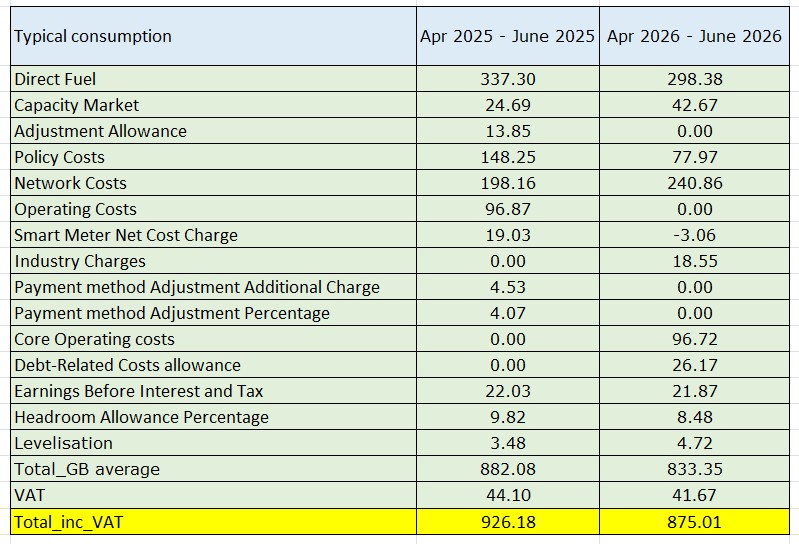
Renewables Obligation is the “legacy” top up to renewable generators, lately replaced by Contracts for Difference (CfD). A year ago, RO cost the typical bill payer £89 plus VAT. It is now £22 plus VAT. That alone is a saving of £67, but we may tremulously note, the typical taxpayer is now having to pay that £67 by other means.
ECO was about £24 a year ago, and is now deleted. So that’s a genuine saving off the leccy bill of, um, £24.
Other things have gone the other way. The Chancellor likes to trumpet about another £150 off some bills, the “Warm Homes Discount”, WHD. This is a subsidy for “the poor.” On the leccy side, it was £11 +VAT a year ago, and is now £17. That’s an inflation rate of 50%, in case you were wondering. And I must note the shiny new nRAB – nuclear Regulated Asset Base – adding another £13 to the bill.
Direct Fuel changes
The wholesale cost is now £93 lower than a year ago. Perhaps this is the miracle of Ed Miliband’s cheap, home grown energy that we control?
CfDs have gone up – you knew they had, didn’t you? A year ago, they were £31 +VAT. Now they are £39 +VAT. That’s an inflation of 26%.
Capacity Market and Network Costs
The Capacity Market has risen from £25 to £43 in a year – inflation of 78%. Still, it’s all about keeping the lights on, eh? Network Costs are up from £198 to £241, or +22% in a year.
Some people are in arrears on their bills, and Ofgem has added a new item, “Debt-Related Costs allowance” that adds £26 to the bill. [This is not an additional £26. It’s complicated to work out, but is mostly derived from minor bill items that are now deleted.] Most of the other costs are simply shuffled from one bucket to another, which I could now explain in numbing detail, but I won’t, unless someone is particularly interested.
The upshot is a saving of £50 in a year (although bear in mind the stealth transfer of £67 of RO to general taxation. However, from the previous price cap, i.e. Jan-Mar 2026, it’s -£73.
Not discussed here, but on the gas side, the cost is now about £150 lower than a year ago, mostly due to lower fuel costs, and also the deletion of ECO. WHD has, though, gone up. [More detail can be provided, if demanded.]
Below is a table comparing the April-June 2025 price cap with the upcoming April-June 2026 price cap.
Here’s what Ed and the team had to say about the savings the government had delivered:
Effective from 1 April next year [i.e. 2026], the average household will benefit from a £150 reduction in the costs on their energy bill. This is in addition to £150 off bills from the Warm Home Discount (WHD) which will benefit 6 million households. This initiative forms part of an ongoing commitment to lower the cost of living for working people. From April 2026/27–28/29, 75% of domestic costs associated with the Renewables Obligation (RO) will be met by the Exchequer. From April 2026, the Energy Company Obligation (ECO) will no longer be levied on energy bills.
Featured Image
A charming little solar farm near Norwich.
 Climate Scepticism
Thanks for doing the hard yards on that. It’s a bit difficult to see how certain people can keep claiming that we in the UK have high electricity bills due to the price of gas (which, in any event, is artificially inflated by an imaginary carbon cost which is dumped on it and which goes up every year).
LikeLiked by 3 people
Thank you for the utter confusion – no doubt illustrating it was exactly your intention!
One thing I noticed: VAT (5%) seems to be charged on the total 2 lines above the bottom line. How can the “Debt-related Costs Allowance” and “Headroom Allowance Percentage” – which I didn’t even know existed – be considered a value-added service delivered to the customer? As opposed to Coulombs flowing through the wire?
Great illustration of the nonsense!
LikeLiked by 1 person
sebt – there are lots on seemingly unfair incongruities along these lines, such as the insulting requirement to pay VAT on fuel duty when filling up at the pump.
LikeLike
“Ofgem should tell it straight: electricity prices are set to stay high for years”
https://www.theguardian.com/business/nils-pratley-on-finance/2026/may/26/ofgem-should-tell-it-straight-electricity-prices-are-set-to-stay-high-for-years
Unfortunately, Nils Pratley, who is usually a rare voice of common sense at the Guardian, went and spoilt it. Perhaps this is the price of getting articles published at the Guardian:
Actually, Nils, it’s a very strong argument for resisting a rushed, half-baked and expensive energy transition which is economically and environmentally damaging and which is also damaging our energy security.
Does this really have strong public support? Will the public continue to support it in loaded opinion poll questions if they understand that it’s making their electricity more expensive rather than – as they were promised – cheaper?
LikeLiked by 1 person
“Three reasons why UK electricity prices are so high”
https://www.bbc.co.uk/news/articles/cn8n5vnmjlzo
This is a BBC Verify article, so it’s no surprise that the first two reasons they come up with blame gas (though the article does admit “The US has a higher share of natural gas in its electricity generation mix than the UK – 40% – but American wholesale gas prices are considerably lower thanks to the shale gas production boom of the past 20 years.”). But read on, and reason 3 is rather interesting:
Then there’s a surprisingly frank admission that many net zero zealots would like to hide this uncomfortable fact:
LikeLike