Ofgem, 22 November 2024:
From 1 January to 31 March 2025 the price for energy for a typical household who use electricity and gas and pay by Direct Debit will go up by 1.2% to £1,738 per year. This is because wholesale prices remain high due to global factors.
Ha! Those will be the global factors, which have a singular ability to turn their beady eyes on the UK?
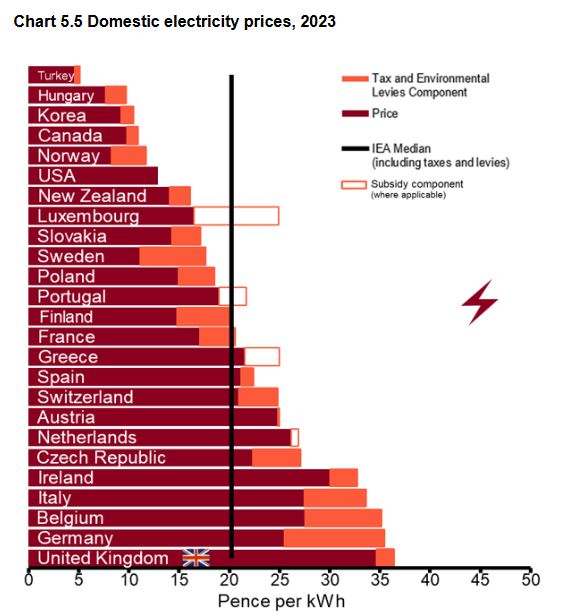
In reality, as sceptics know well, prices are high because of the best part of two decades of wanton and furious destruction of our energy system. And the malignant force at the heart of decision making is gleefully knocking a cold chisel into it. (Notice how small our “tax and environmental levies component” is. True dat, or…? (compare to head image.))
A point about the Energy Price Cap which is not I think widely publicised is the recent drop in the benchmark amount of energy a household uses, the TDCV or “Typical Domestic Consumption Value,” to which the goblins at Ofgem often append the word “value” for good measure:
Given our assessment and stakeholder feedback which supports amending the TDCV values, we intend to reflect the updated TDCVs in how we communicate the level of the price cap from the implementation date of 1 Oct 2023. We will ensure this change is communicated clearly and appropriately to all stakeholders. We will make clear that the revised TDCVs (all else held equal) will result in a lower level of the price cap that is being communicated, which is due to a downward revision of the underlying consumption assumptions, rather than a reduction in underlying costs.
To what extent people are aware that the price cap now relates to a lower energy consumption than prior to October 2023, I do not know. The annual gas usage of the “typical” home has dropped from 12 MWh to 11.5 MWh, and leccy usage is down from 2.9 MWh to 2.7 MWh, so that the price cap is automagically lower.
The upcoming price cap has the following characteristics:
Leccy: standing charge 60.97p/d; 24.86p/kWh ~ £223/yr + £671 (£721)
Gas: standing charge 31.65p/d; 6.34p/kWh ~ £116/yr + £729 (£761)
Total: £1,739 (slight variation owing to rounding).
The figures in parentheses show what the price cap would have been before October 2023, all else kept equal. It is ~£82 lower than it would have been, but for the downward revision of TDCV.
Asterisk: the TDCV has already been reduced, back in 2020, although that might only have affected leccy. I lack the will to look it up.
Interestingly of course there is more than one reason for reducing consumption. One is that you no longer need as much of the product. The other is that you can no longer afford as much of the product. Here’s what National Energy Action says (22nd August, 2023):
There are two main reasons why the TDCV has been reduced.
Firstly, because there have been legitimate efficiency gains in UK households, through making the fabric of homes more energy efficient, and through white goods becoming more efficient over time.
Secondly, and more worryingly, demand has reduced over the last two years as households have rationed their energy in response to high energy prices. For example, polling conducted by National Energy Action (NEA) and Birmingham University found that 81% said they rationed energy that winter, while 55% rationed hot water and 13% had reduced the use of powered medical equipment at home in response to high prices.
The “typical” home is probably an estimate of the median. The DESNZ stats I have looked at (not shown here) use the average, which is higher than the median. [The average used by DESNZ has also been revised downwards.]
When pitching to be elected, Labour and its very earnest former leader promised to reduce consumer energy bills by £300. My interpretation of M. Miliband’s promise is that the energy price cap should be £300 less than it was in the last quarter before the election: April to June 2024. At this point it was £1,690.
That would mean Ed’s promise could be considered kept if at some future point during this parliament the cap came down to £1,390. (They have refused to put a timetable on things, against which they may be judged.) Of course, the figure of £1390 would not account for inflation, & would make the SoS’s task harder. What would make it easier would be if we ration our energy use some more, and also if the price cap drops anyway because Ofgem revises the TDCV down (also if we improve our energy efficiency, of course).
Some might argue that the July to October 2024 price cap should be Ed’s baseline, since it was announced on 24th May 2024, in advance of the election, i.e. it was based on the previous government’s efforts. This was lower at £1,568, which would make the job of shaving £300 off it more difficult.
So far, things are trending in the wrong direction: the January-March 2025 price cap is £1,738, as mentioned. Discounting inflation, we’re either £170 in the wrong direction, or £48, depending on when the start line is. And that’s not to mention the Winter Fuel Allowance.
On TV last week, Ed was seen to redefine his promise of £300 savings as “up to £300”. A saving up to £300 could be a saving of £1, as Naga Munchetty pointed out to him on BBC breakfast. (Good for her, because the breakfast presenters are usually too credulous. I gave up watching it at some point, when the proportion of actual news dropped so low as to make the whole unbearable.)
Here’s where I saw the clip with Naga: Mike Graham showed it when talking to the Bish on TalkTV.
Prediction: it seems to me quite obvious that the price cap can only go one way – north – unless M. Miliband is allowed to offload some of the costs onto general taxation. His failure will be waved away with several excuses, including that we are on the cusp of a breakthrough when the critical level of weather-dependent generation is reached. In fact, the critical level is that at which we cease to grow, and start to retract. And to make a bolder prediction, we will begin to see cracks once the sugar rush of spending in the Budget has worn off. Twelve months from now will see the truth of it. For the UK, it’s either the golden era of growth of Starmer, Reeves and Miliband’s Milestones, or it’s the slow spiral into decay of Jit’s augurs of doom. Of course, there’s still time to change the road we’re on, as the man said.
Glossary for posterity
Default Tariff Cap
What Ofgem used to call the Energy Price Cap. Everyone else called it the Energy Price Cap, and Ofgem seems to have caved in in 2023.
Energy Price Cap
A default tariff – hey ho – introduced at the start of 2019. Back then, it was £1137. The idea was that people who had never switched provider, and were therefore getting ripped off compared to those who had, would save money. In practice, it seems that the tariffs all migrated to the capped price.
A notable side effect occurred in the escape from Covid lockdown in 2021. At this point, gas wholesale prices surged, but the small suppliers, who were not able to raise prices above the EPC, fell over like a row of dominoes. [And it’s worth noting that this happened before the rise in gas price associated with the Russian invasion of Ukraine in February 2022.]
Energy Price Guarantee
After the 2022 invasion, gas prices rocketed yet more. In September 2022, Liz Truss, the much-ridiculed ephemeral PM, decided to, in effect, cap the price cap. This was at a level of £2,500 for the typical home, when Ofgem wanted a price cap of £3,549. [They later wanted to hoik it to over £4 grand.] Truss also ordered that fracking be commenced, in order that the UK might have resilience against such events in future. Alas, we all know what happened to Truss, and to fracking, once the technocrats got the man they always wanted.
Let me offer you a choice: in one hand, you’ll have Starmer. In the other, Truss. You can only keep one. Which do you choose?
Energy Grant / Energy Bills Discount
A payment of £400, split I seem to remember into three tranches of £133, that Rishi Sunak (then Chancellor) announced in the wake of the Russian invasion. By the time it came to pass, he was probably PM.
Winter Fuel Payment
A payment to all pensioners, which I think was up to £300, which was canned by our new Chancellor, Rachel Reeves, once she had discovered a black hole at the centre of the Milky Way, I mean in the public finances. Now only the poorest get it, who have applied for pension credit.
Bonus image – Where domestic energy bill data is filed:

UPDATES:
February ’25. The default tariff has been announced for April to June 2025. Here’s how the price cap has changed, since Labour’s incumbency began. So far, M. Miliband’s promised saving of £300 has actually become an added cost of £281. He now has to find £581 savings off an annual bill to fulfil the promise. I will update further, if there are political ramifications.
| Period | Energy Price Cap | M. Miliband’s Position (savings needed to fulfil promise) |
| July to September 2024 | £1,568 | £300 |
| October to December 2024 | £1,717 | £449 |
| January to March 2025 | £1,738 | £470 |
| April to June 2025 | £1,849 | £581 |


Put California down there at the bottom with the UK. California’s lowest rate is 31p equivalent and up…mostly up.
LikeLike
Let me offer you a choice: in one hand, you’ll have Starmer. In the other, Truss. You can only keep one. Which do you choose?
Give me a break, Jit! Can’t I do what I find myself doing regularly at the polling station these days, and say none/neither of the above?
Actually, I think it’s an unfair question. Truss wasn’t given a chance for her policies to play out. Starmer’s aren’t playing out very well at this stage, but it’s early days. On the basis of what I have seen of both of them to date, I revert to “neither of the above”.
By the way, I note Starmer in that clip, from earlier this year, was talking about bills being “about £400” lower, and that this would be a “permanent drop”. He also claimed that renewables (which he and Miliband insist on calling “clean” power – it isn’t) are about one third of the price of fossil fuels. As regards whole system costs that simply isn’t true. Do he and Miliband even understand this stuff? At least they’ve moved on from claiming that renewables are “9 times cheaper” than fossil fuels, so I suppose that’s progress. However, we still require a great deal more progress before they even come close to getting a grip on the subject, and I fear that by then it will be too late.
LikeLike
Further thoughts. They seem to have shied away in their manifesto from promising a specific price reduction in our energy bills. This is all they said they by way of anything that could be described as a commitment:
Families and businesses will have lower bills for good, from a zero-carbon electricity system.
https://labour.org.uk/change/make-britain-a-clean-energy-superpower/
In the “strong foundations” section of their manifesto, they simply say:
We will bring down the cost of energy.
https://labour.org.uk/change/strong-foundations/
Then again, the manifesto also said:
It is not just sleaze and scandal that have eroded trust. Just as corrosive has been the inability of politicians to keep promises made to the British people. Over the last 14 years, the vast chasm between Conservative slogans and reality has shown a contempt for democracy. From claiming “we’re all in it together” while decimating public services, to the empty promises to “level up”, gimmicks and gestures have shamefully replaced the hard graft of governing.
In contrast, Labour has been transformed from a party of protest to one that always puts the interests of the country first. Now we are determined to do the same with our politics, returning government to the service of working people. This will require a reset in our public life; a clean-up that ensures the highest standards of integrity and honesty….
...Setting the highest of standards in public life is not just about better behaviour or decision-making, though it will improve both. It is also central to restoring trust between the public and politics. After 14 years of chaos, division and disrespect, the British people are understandably cynical about appeals to come together in the national interest. But the challenges we face demand nothing less – it is the lifeblood of national renewal. This plan recognises that politics must make the first move in repairing that bond.
https://labour.org.uk/change/serving-the-country/
Thus spoke Free Gear Keir and his free gear pals.
It’s worth looking at the video of pensioner Gary, who said he would vote Labour because they would give us cheaper energy and they would look after the elderly and the vulnerable.
It’s worth reminding ourselves of this too:
https://www.facebook.com/TheLondonEconomic/videos/941303277823914/
LikeLike
https://x.com/BjornLomborg/status/1863556124965761277
LikeLike
Snewzk, it will be interesting to see if the UK ever generates enough solar electricity to create a duck curve. Somehow I doubt it.
Mark, it occurs to me that politicians tend to do the opposite to what Truss did. They inject the country with sugar, which gives a quick boost but soon wears off, leaving us worse off than when we started. But they don’t dare take a hit up front for growth later – perhaps wisely.
The fluff about standards in public life is not ageing well.
LikeLike
Just in case people in public life have forgotten their existence, the Nolan principles of standards for public life can be found here:- https://www.good-governance.org.uk/publications/insights/the-nolan-principles
Regards, John C.
LikeLike
Mark’s comments on the rumours of a price cap rise:
======
So much for the promise of bills reductions:
“Miliband urges energy watchdog to act as typical bill could rise by more than £100 a year
Exclusive: Whitehall source expects bills in England, Scotland and Wales to rise by about £9 a month over the next three months”
https://www.theguardian.com/money/2025/feb/18/miliband-urges-energy-watchdog-to-act-as-typical-bill-could-rise-by-more-than-100-a-year
Ed Miliband has urged the energy watchdog to take swift action as it emerged that the typical energy bill could soar by more than £100 a year amid a rise in global gas prices.
A Whitehall source said they expected bills in England, Scotland and Wales to increase by about £9 a month over the next three months in a blow to government plans to tackle the cost of living.
They blamed volatile global gas prices linked to the end of the transit deal that enabled gas to flow to Europe, through Ukraine, from Russia.
Miliband, the energy secretary, has written an urgent letter to Ofgem, saying the price rise means the energy regulator must move faster to protect consumers.
This month, gas prices hit a two-year high, exacerbated by the lack of gas storage in Britain and Europe, combined with colder weather though prices have begun to stabilise. Cornwall Insight, a consultancy which produces closely watched forecasts for the energy price cap, is set to release its latest forecast on Tuesday....
My emphasis above, because weather is influential with regard to energy costs, not just with regard to it being cold, but also because we have seen a series of dunkelflautes over the UK and over western Europe through late autumn and winter. During these extended periods, the cost of electricity is always extremely high. It’s a function of depending on renewables, not a glitch.
===
The Guardian , perhaps inadvertently, confirms the point I made in my last comment:
https://www.theguardian.com/politics/live/2025/feb/18/defence-secretary-john-healey-armed-forces-nigel-farage-reform-uk-politics-live-news-updates
The forecast by the influential consulting firm Cornwall Insight is higher than its earlier prediction that prices would rise to £1,785 a year this spring after colder weather and limited renewables caused gas storage levels to fall across Europe.
===
LikeLiked by 1 person
The Cornwall Insight predictions are also at the BBC.
Time will tell if they are accurate. I will update the head post when the changes are announced.
LikeLike
Jit – I notice they are a bit coy as to why “the end of the transit deal that enabled gas to flow to Europe, through Ukraine, from Russia.” has happened.
BBC had this article (Updated 1 January 2025) – Ukraine stops transit of Russian gas to EU in end of era – BBC News
Quick quote – “Ukrainian President Volodymyr Zelensky said that his country would not allow Russia to “earn additional billions on our blood”. Poland’s government meanwhile said the cut-off was “another victory” against Moscow.”
I remember, on another post, being incredulous that Russian gas pipelines were still operating thru Ukraine during the conflict.
From that article we get this the European Commission link – e8a46964-f29b-44f8-9410-689f9e34463b_en “End of transit via Ukraine – Information from the conclusions of the Commission’s assessment”
Quote – “The EU gas infrastructure capacity:
In terms of infrastructure, the European gas system has sufficient capacity to cope with the
end of the Ukraine transit agreement. Thanks to the recent development of LNG import
capacities and interconnections capacities, the EU gas system is resilient and flexible. This is
notably the result of EU policy on the internal market and infrastructure and notably the
implementation of key projects of common interest, including financial support from the
Connecting Europe Facility. With the current level of integration and diversification of the
European gas market, all the Member States can have access to LNG and pipeline imports
from alternative routes, making possible the entire replacement of the gas currently transiting
through Ukraine.”
LikeLike
A related link – France leads Europe in growing Russian LNG imports
Partial quote –
“Due to Russian aggression in Ukraine, European Union countries have shifted to importing LNG to reduce dependence on pipeline gas imports directly from Russia. Nevertheless, AFP noted that a large portion of these imports still comes from Russia, making the European Commission’s goal of phasing out Russian gas by 2027 increasingly difficult to achieve.”
LikeLike
And nobody is talking about Turkey’s imports……
“Turkey currently imports gas from Russia through the Blue Stream and TurkStream pipelines, from Azerbaijan via TANAP and from Iran through the Eastern Anatolian Natural Gas Main Transmission Line. This gas could be exported to Europe through existing connections*, including the Western Line and the Trans-Adriatic Pipeline (TAP).
With the capacity to import approximately 75 billion cubic meters (bcm) of gas annually, Turkey’s domestic demand of 50 bcm leaves an exportable surplus of 25 bcm. However, increasing export capacity to European markets would require infrastructure upgrades on the Greek and Bulgarian borders.”
Turkey is a member of NATO, of course, and was/is applying for EU membership.
LikeLiked by 1 person
Forgot the link for those quoted paras:
https://nordicmonitor.com/2025/01/turkey-to-position-itself-as-potential-russian-gas-transit-hub-for-europe-despite-sanctions/
LikeLike
“An energy price disaster is creeping up on Keir Starmer
As businesses collapse, the Labour government is beginning to panic over rising bills”
Kamal Ahmed in the Telegraph.
LikeLike
Jit – from your link, partial quote’s sums things up –
“Alison Wedgwood, of the family dynasty, is in despair.”
“For pottery factories the price of electricity is 28 pence per kwh in the UK, and it’s 9 pence in France, 8p in Spain and just 7p in the USA. How did this happen? How on earth can our pottery manufacturers compete with that?”
As said on another post comment by Mark – ““Britain’s net zero economy is booming, CBI says Green sector growing at triple the rate of the UK economy, providing high-wage jobs and increasing energy security”
Not sure even rose-tinted glasses can explain this madness.
LikeLiked by 1 person
Thank you Ofgem. Thank you Ed Miliband. Thank you Net Zero:
“Energy bills to rise by more than expected in April”
https://www.bbc.co.uk/news/articles/cgl0k772lwpo
Energy prices will rise by 6.4% in April under regulator Ofgem’s new cap – a higher than expected increase adding pressure on people’s finances.
It means a household using a typical amount of gas and electricity will see their annual bill rise by £111 a year, or £9.25 a month, taking the total bill to £1,849 a year....
...Analysts had forecast a 5% rise in prices, before Ofgem’s announcement on Tuesday….
I think I’m right in saying that until this year the price cap has always gone down in April.
LikeLiked by 2 people
The head post has now been updated with the April to June 2025 price cap. The typical annual bill is now £281 more than July to September 2025, meaning that M. Miliband’s promise of a £300 saving is now £581 away. [edit: typo]
LikeLiked by 1 person
“Energy bills to rise by more than expected ahead of winter“
Only +£35, but it’s the wrong direction. I see I did not update with July-September, which I will do tomorrow I hope, together with October-December.
LikeLike
“Wind Farms Are Driving Up Electricity Bills, Admits Ofgem”
https://dailysceptic.org/2025/08/27/wind-farms-are-driving-up-electricity-bills-admits-ofgem/
Energy bills are rising to help fund the extra costs of wind farms, Ofgem admitted today as it announced gas and electricity costs will go up by double the expected amount from October.…
…The regulator said the hike was “driven by an increase in electricity balancing costs” – which relates to the extra expense of paying wind farms in remote areas to turn themselves off because the network cannot take their power to where it is required.
This can also mean other generators such as gas plants which are closer to consumers are then paid millions of pounds to fire up to replace the wasted wind.…
…Britain has so far wasted £815 million this year by switching off wind turbines and paying gas plants to switch on, according to Octopus Energy’s Wasted Wind tracker.
This equates to £3.4 million a day in costs arising from wind farm curtailment and replacement so far in 2025. The total is up from £631 million at the same point in 2024….
LikeLiked by 1 person
Although the Guardian inevitably quotes at length from Labour’s hilarious attack on Farage, it seems it has to admit that it’s government policy which is driving the increase in the price cap:
“Energy bills to rise more than expected for millions of British households
Typical annual bill to increase by just over £35 to £1,755 from October when Ofgem raises government price cap by 2%”
https://www.theguardian.com/money/2025/aug/27/higher-energy-bills-price-cap-rises
Energy bills will rise more than expected for millions of British households this autumn as a result of the mounting cost of government subsidies.…
…The higher than expected increase comes despite a 2% fall in the wholesale price in the energy markets over the last three months.
Prices for households will go up just as the colder weather sets in because money is needed to cover the rising cost of the government’s energy policies....
…£17 will go to balancing the energy system as Britain relies more heavily on renewable energy sources. The money will fund payments made to shut wind farms when there is more renewable energy generation than can be used, or to fire up gas plants when renewables are in short supply.…
…Cornwall Insight has predicted that the price cap will fall slightly in January. This depends on weather patterns, on whether geopolitics affects market prices, and on whether new policy costs, such as those to support investment in new nuclear-generating capacity, are added to bills.
Is it really wise to make the cost of our energy so unpredictable that it “…depends on weather patterns…”?
LikeLiked by 1 person
“Energy Bills Moron Premium
Even though gas and electricity prices are down, the energy price cap has gone up”
https://davidturver.substack.com/p/energy-bills-moron-premium-ofgem-price-cap
...After stripping out carbon taxes, direct fuel costs are up £71 since 2018 but are down just over a £1 since the last price cap. Direct fuel costs, excluding carbon taxes now make up only 23% of electricity bills.
The biggest increase since 2018 is in renewables and Net Zero related items that have gone up by £213. Of this, Network costs are up £97, subsidies are up £57, split into a £30 increase for Renewables Obligations, Contracts for Difference £22 and Feed-in-Tariffs £5. Carbon taxes are up over £30 and now cost about £67, the Capacity Market cost has increased by £14 and the Energy Company Obligation has increased by £15.
Other Costs are up £76 since 2018, with the bulk of the change being an increase supplier operating costs, an allowance for bad debt and the Warm Homes Discount. The increase in allowable margin has also added cost to bills.
Overall, some 59% of the increase in electricity bills can be attributed to Net Zero related items, with 20% to increased fuel costs and the remaining 21% to other items....
LikeLike
The reduction of £117 in the default tariff from April has been confirmed.
BBC link. They just could not bear to utter the phrase “renewables subsidies”, calling it “some charges.”
LikeLiked by 1 person
As a pleasant surprise, the Guardian’s reporting of this story is more honest:
“Energy bills will fall by £117 for millions of households in Great Britain from April
Ofgem cap drops by 7% to £1,641 a year for consumers’ average gas and electricity costs”
https://www.theguardian.com/money/2026/feb/25/energy-bills-fall-households-april-price-cap
...The cut, which will provide some relief to stretched household finances, follows the November budget, in which the chancellor shifted some green energy costs away from household bills and into general taxation.
However, the fall is smaller than the £150 cut in April promised by Reeves, as her cuts were partly offset by the increased cost of maintaining and upgrading the UK’s energy networks….
Unfortunately, they also fail to point out that “upgrading the UK’s energy networks” and associated costs means “new infrastructure related to, and solely required for, renewable energy“.
LikeLike