If you crawl around the drainpipes of the internet enough, you will see plenty of news about how great things are going for EVs. An example this week from Mr. Bloomberg is shown in the featured image.
[Visit the link for the entire self-congratulatory marmalade.]
This excerpt hints at what is actually going on:
COLIN McKERRACHER (BloombergNEF’s head of Advanced Transport): But policy really matters and what you can safely say is that in places where there is no supportive policy, there’s very, very little EV adoption. And in places where there’s a lot of policy, there’s a lot of adoption.
JIT: And in places where packs of starving feral dogs roam, people don’t take their families on picnics.
In a car review a fortnight ago, it was reported that the Lucid Air is the best EV around. According to Auto Express,
It’s a crying shame we won’t get the Lucid Air in the UK, for it is arguably the best EV in the world right now.
OK Kevin, how much is it?
The basic version available in some European countries…
costs the equivalent of just 80 grand and delivers a real-world range of over 400 miles, a 0-62mph claim of less than four seconds and a top speed of 140mph. And that’s just the base model.
Just 80 grand! For just the base model. Remarkable!
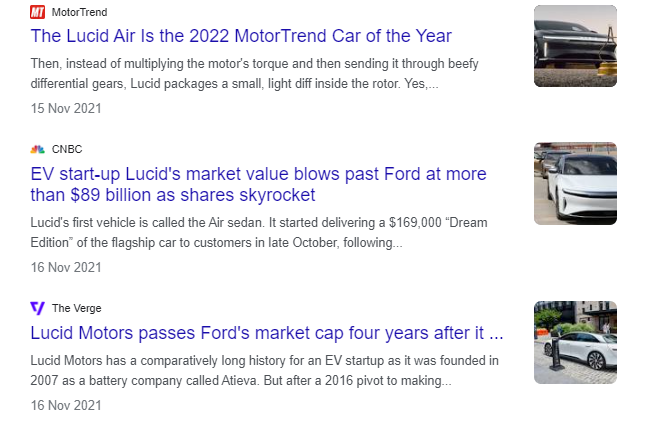
The story of Lucid Motors (so far…) is an interesting one. In 2021, Lucid was the next big thing:
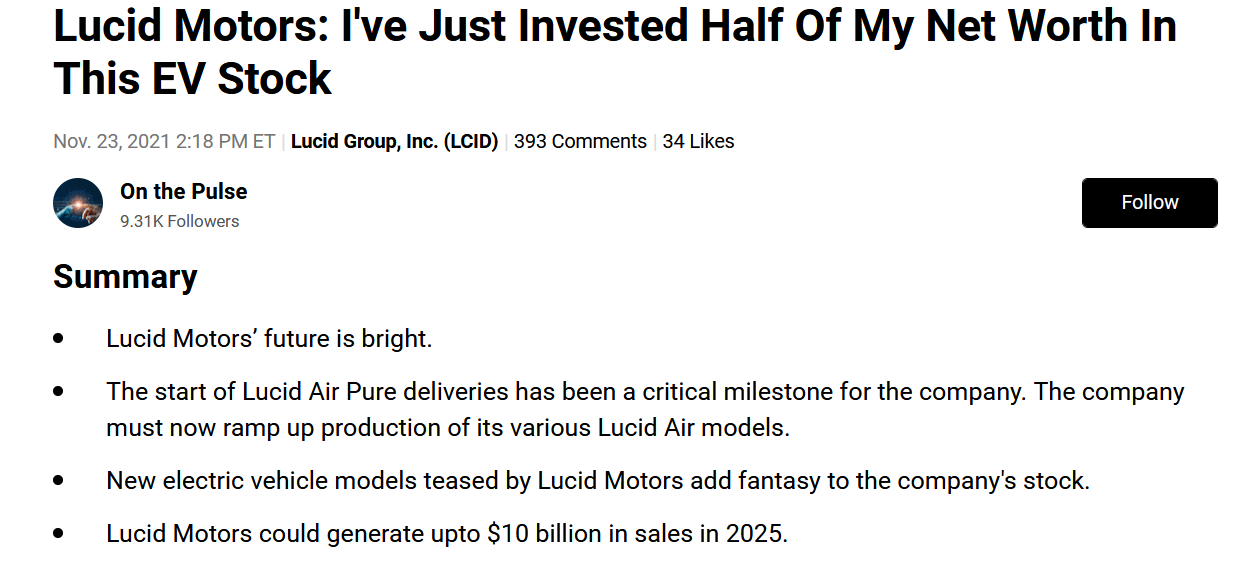
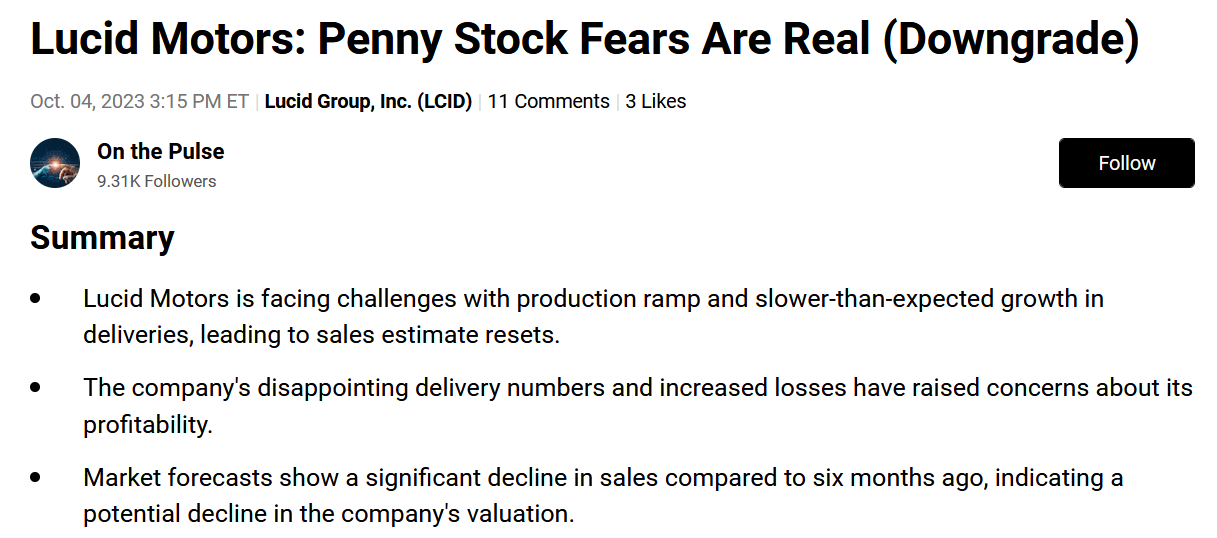
In fact, some smart guy called Mr. “On the Pulse” got so excited by Lucid that he bet the farm on it.
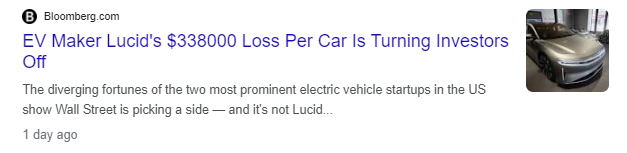
What happened next? This headline – coincidentally also from Mr. Bloomberg – hints that not everything is rosy.
This is what happened to the share price after Mr. “On the Pulse” invested half his net worth in the project (at about where the blue dot is).
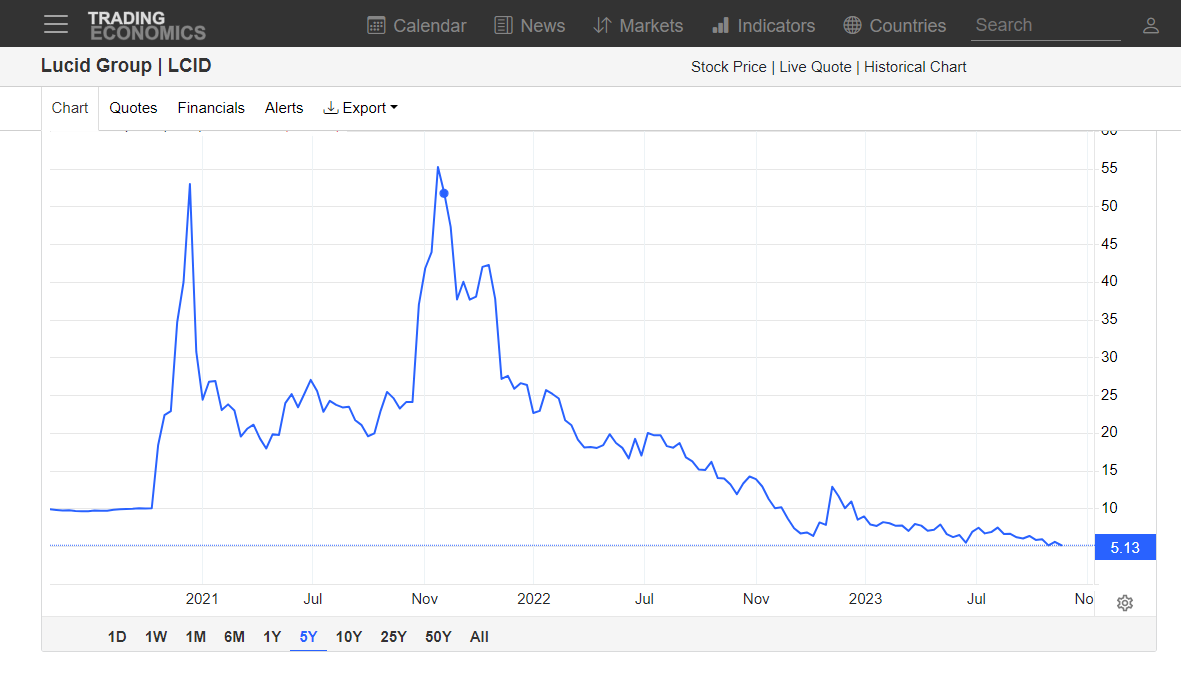
The good news for Mr. “On the Pulse” is that he still has the 50% of his net worth that he didn’t spend on Lucid shares. However, it is fair to say that he is ruing his punt:
I count my investment in Lucid Motors as the largest investment error I have made so far.
Mr. On the Pulse
Well, you can say that again.
I count my investment in Lucid Motors as the largest investment error I have made so far.
Mr. On the Pulse
Thanks. I heard you the first time. Lucid has gone for the luxury EV market, which of course is low volume and rife with competition. Maybe they will make a go of it. They do have the serious backing of the Saudis, so they will not go bankrupt any time soon. Obviously Lucid are not really going to be affected by EV mandates or quotas, which will mostly benefit mass market vehicles.
And what about those mandates-slash-quotas themselves?
Well, the air started going out of Rishi Sunak’s EV mandate “concession” before he had finished speaking.
Hooray! No new car buyer will be forced to buy an EV in 2030. Except they will. Oh.
That’s because rather than ban ICE vehicles entirely, he’s merely offering the sop of an allowable quota of 20%, sliding rapidly down from a 78% allowable quota of ICEs next year. Yeh, Mr. Denier, but any one of us could be in that 78% next year or 20% in 2030, so we aren’t banned from buying an ICE car. No indeed. But the back of my envelope tells me that we will be paying a lot more for our ICE car than otherwise.
I’m not going to go over the numbers here, but my toy estimate of the effect of the quota is of an additional cost to consumers and businesses of £4 billion per quarter in 2030 at the low end (should we fully comply with the 80% mandate). This just accounts for the extra costs of EVs: there are no fines, because the proportion of ICEs is within the quota.
That’s just for sales of course. You may argue that there will be savings on fuel so the net cost is lower.
Note also that my estimate of £4 bill does not include the additional costs created by the new zero-emission van mandate (10% next year and cranking up). You can probably add a billion per quarter in 2030 for that. The ball-park is £20 billion a year in added costs for no improvement in productivity.
This all adds to inflation of course. However, it may marginally reduce CO2 emissions and/or particulates, with the caveat that the heavier EVs will produce more particulates from their tyres, if anyone cares about that.
ASTERISK: Everything I know about economics I learnt from Economics for Dummies, so I am very much Jon Snow on the topic. My estimate of these costs is not science. Although I can show my working if it is demanded. The cost to the country if we fully comply is easy to compute given reasonable assumptions: (i) £10,000 average cost advantage for ICE vs EV and (ii) no reduction in overall sales volumes. Numbers for partial compliance are a bit harder to work out but are easy enough with a spreadsheet. Of course the real picture is far more complex than my toy model; there are not two kinds of cars, one costing £10,000 less than the other but subject to a £15,0000 fine for each vehicle over a 20% quota.
DOUBLE ASTERISK: The toy model implies that the Exchequer would rather we carried on buying ICEs. That way, they get the full VED, the fuel duty, and the VAT on it, plus the value of all the fines. If we comply with the mandate fully, the tax take from the fines will be diverted to paying the costs of the car companies, while the fuel duty etc goes up in smoke.
That’s the non-U-turn U-turn, which was accompanied by a mixture of indignation and credulity and not enough cynicism.
One would have thought that the future should have a certain inevitability about it. Do EVs? I don’t think so. EV sales can limp along with a burly man on each arm, but once the burlies let go, the sales fall over. EVs will eventually have to stand on their own four wheels. Naturally if by that time the opposition is banned… well, then the prophecies are true.
EVs are the future.



Jit, an interesting article, thank you. I hadn’t heard of Lucid EVs, so am now better informed. However, for me the key take away point is linked to your “Sunak Blinks” article – has he really blinked:
LikeLike
As for whether the future is EVs, I think much will depend on whether they keep bursting into flames and causing immense damage along the way. If they do, they may have to be banned, rather than forced on an unwilling public. It is, of course, much too early to say what caused the huge fire in a car park at Luton Airport last night, but an EV has to be a possibility, especially (so the Daily Mail reports):
The BBC confirms these limited details:
https://www.bbc.co.uk/news/live/uk-england-beds-bucks-herts-67075159
LikeLike
Well Mark, Jo Nova certainly suspects that EVs were either directly or indirectly the cause of that massive fire, multiple explosions and car park collapse.
LikeLike
Apparently it was a diesel. @9.35 at this link: https://www.bbc.co.uk/news/live/uk-england-beds-bucks-herts-67075159
No surprise that folks immediately jumped to the idea that it might be an EV. ICE cars are usually easy to douse with a bit of foam. What happened?
LikeLiked by 1 person
Thanks JIT, a great & illuminating read
LikeLike
If it turns out that the Luton airport fire was either caused by an EV or exacerbated by EVs the repercussions could be significant. As Mark says, it could arguably be said that they must be banned – after all, in slightly different circumstances, a lot of people could have died. But, if they were banned, the repercussions would be enormous. Not least, as transport emissions are a major percentage of the global total, it could undermine the net zero project. Interesting.
LikeLike
Further to the above, see this article by Paul Homewood. His conclusion:
LikeLike
Further to the above this video (‘ It’s OVER. The Luton Airport Fire just KILLED the EV market. Here’s why.’) is amusing, interesting and could just possibly be correct.
LikeLike
The BBC is reporting a suggestion by the fire officer that the fire may have started in a diesel car. I have to say I find that hard to believe, given that diesel tends to be difficult to get alight in a dramatic way. We shall just have to wait for more information, but I expect a determined effort to blame anything other than EVs.
LikeLike
The ‘diesel car started it’ claim – although unlikely – may be accurate. But the real issue is not how the incident started but why it became so serious. As Paul Homewood put it:
LikeLike
Ah, I get it. Climate change [solutions] didn’t spark the fire but made the resulting conflagration much more extensive.
Cue another fruitless debate on wildfire causality 🙂
LikeLike
This video claims to show the start of the fire:
The car is either a Discovery or an Evoque.
However the fire was reported as starting on the top level whereas this is clearly not.
Worth keeping perspective: the huge car park fire in Liverpool 6 years ago started in a diesel – also a JLR product.
LikeLiked by 1 person
MikeHig,,
Thanks for that, and for the timely reminder to maintain perspective. However, I am still perplexed as to how a fire can spontaneously start in a diesel car. I accept that it must be possible, but it seems to be much less likely than a spontaneous fire in an EV:
https://dieselfuelhq.com/can-diesel-catch-fire/
So yes – it can and does happen, but it seems likely to be a rare and unusual event. And for it to cause the conflagration in this case? It may well be that EV batteries played their part too.
LikeLiked by 1 person
I’m not convinced by the diesel car story. Neither is an AA technical expert by the sound of it.
“Andrew Hopkinson, the chief local fire officer, said:
On arrival my officers were faced with a severe and rapidly spreading fire involving a large number of vehicles that ultimately spread to multiple floors and involved a partial collapse of the car park.
He said the car park does not have sprinklers, and if it did they “may have made a positive impact”. He said up to 1,500 vehicles were inside the car park at the time of the fire. The blaze is believed to have started with a diesel-powered vehicle “and then that fire has quickly and rapidly spread”, he said.
AA technical expert Greg Carter said the most common cause of car fires is an electrical fault with the 12-volt battery system. He added that diesel is “much less flammable” than petrol, and in a car it takes “intense pressure or sustained flame” to ignite diesel.”
https://www.msn.com/en-gb/money/other/luton-airport-fire-appears-accidental-says-fire-chief-as-flights-suspended-until-3pm-business-live/ar-AA1i1x04
LikeLike
Range Rover Discovery’s have an existing recall for a fault which can lead to significant fires:
https://car-recalls.eu/recall/land-rover-discovery-sport-2020-mhev-fire/
LikeLike
Paul Dennis, thanks for the info. The recall in question is almost three years old, but it confirms that the fault can lead to car fires, and I guess not all owners will have responded to – or perhaps even be aware of – the recall.
LikeLike
Yes Paul, that may well be so. But, as I say above, the real issue is not how the incident started but why it became so serious, so quickly.
LikeLiked by 1 person
Robin, there are clearly issues that may, or may not involve an exacerbation of the situation due to the presence of BEV’s in the car park. However, I don’t think we are doing ourselves any favours by jumping to conclusions in the absence of evidence, or of any inquiry to date.
LikeLike
Paul, I completely agree. But do you think that anyone on this thread has jumped to a conclusion in the absence of evidence? If so who do you have in mind?
LikeLike
Mark, It is indeed difficult to ignite diesel however I am pretty sure that most car fires start for reasons unrelated to the fuel/power source. Electrical faults seem to be a common cause, as noted above. Oil or hydraulic fluid leaking onto a hot turbo or exhaust is another.
LikeLiked by 1 person
Autocar article on the risks of BEV fires:
https://www.autocar.co.uk/car-news/electric-cars/how-much-fire-risk-are-electric-vehicles
Early on it gives some figures for the number of EV fires vs ICE but does not control them for the relative numbers of each on the road, nor for vehicle age.
Some interesting comments from an electrochemistry expert.
LikeLike
The ‘diesel Range Rover’ described by the press appears likely to be a hybrid diesel/electric which caught fire and then burned so intensely that the diesel filled fuel tank exploded. What could possibly have sparked a fire in such a vehicle and, as Robin points out, what could possibly have caused the fire to spread so rapidly and burn so intensely thereafter?
LikeLike
Re the Luton airport fire:
1.1 There’s no hard evidence that an EV started the fire.
1.2 There’s no hard evidence that EVs caused the rapid escalation of the fire.
2.1 There’s no hard evidence that an EV didn’t start the fire.
2.2 There’s no hard evidence that EVs didn’t cause the rapid escalation of the fire.
Likely reactions:
1. Insurers. As there’s an obvious possibility that EVs were the cause, they’ll be reviewing and probably increasing EV premiums (or refusing cover altogether).
2. Car park and ferry operators. For the same reason, they’re likely to be considering restrictions on EVs.
3. Car buyers. In view of the above, anyone thinking of buying an EV is likely to think again.
4. Policymakers. They should be reconsidering the wisdom of making the purchase of EVs obligatory – consider the risk when nearly all the cars in a car park or on a ferry are EVs. But they probably won’t.
PS1: This this report is interesting – Five cars destroyed at Sydney Airport after battery from luxury electric vehicle ignites
PS2: my car is a Range Rover petrol hybrid. Groan.
LikeLiked by 1 person
A fire on a train loaded with EVs in the Channel tunnel doesn’t bear thinking about.
LikeLike
Re: Insurers and EVs on ferries
Intuition tells us that EVs ought to be banned from ferries, but the insurers themselves are sanguine about the risks. The International Union of Marine Insurance has just (end of August) put out a report on best practice and recommendations for the carriage of EVs. They set out their position on the risks in paragraph 2:
This goes against much of what we think we know. The reason we presume EV fires to be more dangerous on ferries is that they are hard to extinguish. IUMI does not seem to recognise that fact. Perhaps they see the adoption of EVs as a given and therefore any restrictions on them as impossible. They point to battery management systems making thermal runaway very unlikely and note that EVs and ICE cars release similar amounts of energy overall because much of it comes from all the plastic in the vehicle, not the fuel tank or battery. They also note that the burning plastic itself is highly toxic – i.e. that all vehicle fires emit toxic smoke regardless of powertrain.
What about the problem of actually putting the fire out? They recommend timely detection coupled with CO2/ drencher systems. We know that battery fires don’t need oxygen, but the rest of the flammable material making up the car does.
They advocate physical checks of EVs prior to loading for signs of damage, but do not recommend against vehicle charging on board.
How realistic is all this? We will presumably never know what happened to the Felicity Ace now it is at the bottom of the ocean. Controversy surrounds events on the Fremantle Highway. Presumably if EVs are demonstrated to have caused a serious event, things might change.
Report available here: https://iumi.com/opinions/position-papers#
LikeLiked by 1 person
O/T, perhaps, but of vague relevance, given the propensity of lithium-ion batteries to go up in flames:
“Battery recycling warning after fires in waste in Devon”
https://www.bbc.co.uk/news/uk-england-devon-67124881
LikeLike
“Car parking spaces will have to be bigger because of electric car fires
1960s-era fire safety laws dangerously inadequate to tackle risks from EV batteries, says report”
https://www.telegraph.co.uk/money/net-zero/burning-electric-cars-dunked-baths-water-stop-fires-spread/
LikeLike
Thanks Mark. Almost the exact opposite of the IUMI position.
LikeLike
“London college says it offers UK’s first electric vehicle charger course”
https://www.bbc.co.uk/news/uk-england-london-67092451
LikeLike
“The Auto Makers Cry for EV Mercy”
So car manufacturers needing to achieve a fleet average emissions level could make a handful of EVs and lots of ICE SUVs, and the weighted sum would come out in their favour. But the new regulations do away with that scheme.
https://archive.vn/47HmG
LikeLike
The future of cruising is electric too, according to this:
Electric propulsion and solar sails. What’s not to like?
LikeLike
“Was the Luton Airport Fire Caused by an Electric Vehicle?”
https://dailysceptic.org/2023/11/04/was-the-luton-airport-fire-caused-by-an-electric-vehicle/
LikeLike
Mark; If the internet sleuths are right, it was a 2014 vehicle.
Land Rover’s first hybrids hit the market in the Spring of 2014: the full-fat Range Rover and RR Sport. Both are much bigger than the Evoque/Disco Sport which seem to be the most popular vote as the culprit.
LikeLike
Whatever the cause of the fire in the car park at Luton airport, this seems fairly unambiguous:
“Watch: Firefighters tackle raging Texas Tesla fire”
https://www.bbc.co.uk/news/av/world-us-canada-67389134
LikeLike
“Rishi Sunak’s net zero delay ‘will slash demand for electric cars’
OBR analysis suggests higher energy prices and interest rates could reduce proportion of new cars sold that are electric from 67% to 38%”
https://www.theguardian.com/environment/2023/nov/22/uk-slashes-predicted-takeup-electric-cars-half-energy-prices
Slightly more fuel duty? £700m p.a.! A drop in the ocean, I suppose, compared to the money the Guardian would have the government throw at net zero. As for the headline (“Rishi Sunak’s net zero delay ‘will slash demand for electric cars’”), it’s hardly borne out by the body of the article. Higher financing costs, higher electricity prices, and lower petrol prices seem to be the main reasons (that, and I would suggest, that the moderate number of EV enthusiasts have now signalled their virtue by buying their EV) seem to be the main reasons for declining EV sales. The OBR suggests, as an additional possible factor, that the deferral of the new ICE car ban to 2035 may also be dissuading car buyers from going electric. That’s rather different from Sunak’s delay slashing EV car sales. But hey, Guardian, why let the facts get in the way of a headline?
LikeLike
Jo Nova summarises a CBC report that EVs are not as reliable as ICE cars:
“EV’s report 80% more problems than petrol, diesel cars”
https://joannenova.com.au/2023/11/evs-report-80-more-problems-than-petrol-diesel-cars/
LikeLiked by 1 person
“German electric car sales plummet after subsidies run out”
https://www.iol.co.za/motoring/industry-news/german-electric-car-sales-plummet-after-subsidies-run-out-3e61a484-ab71-46b2-8cdd-3cb053b02749
LikeLike
Ford halves 2024 electric F-150 production plans on slowing demand
https://financialpost.com/commodities/energy/electric-vehicles/ford-halves-electric-f-150-production-plans-ev-market
“The move comes as Ford scales back spending on electric vehicles by US$12 billion and after it downsized by nearly half a battery factory it’s building in Michigan. Farley has said the robust EV demand the company expected hasn’t materialized because potential buyers are balking at high prices and spotty charging infrastructure.”
LikeLike
potentilla,
So much for the jobs promised by Biden with his strangely-named Inflation Reduction Act.
LikeLike
In Britain, if manufacturers want to scale back production of electric sewing machines, er, sorry EVs, because buyers don’t want them, then they will have to also scale back production of ICE vehicles, which buyers do want, because of ZEV. This is not a bug, it’s a feature of transport policy in this country.
LikeLiked by 1 person
If Ford are waiting for better charging infrastructure to solve their problems re: EVs, they are going to be waiting a long time. Can anyone genuinely see a tradesperson picking an EV over an ICE, unless forced to?
LikeLike
I suspect the charging infrastructure problem is a temporary issue in North America as Ford has a deal to use the Tesla network starting next year:
https://media.ford.com/content/fordmedia/fna/us/en/news/2023/05/25/ford-ev-customers-to-gain-access-to-12-000-tesla-superchargers–.html
The Tesla charging network is very extensive in North America and works really well. No hassles and very fast.
I think the real problem for EV manufacturers is that the demand is slowing rather than growing. Those who can afford an EV as a second vehicle have bought them already. However if the range is sufficient for a days work, I can visualize a tradesperson using an EV as long as they can charge at home. Starting each day with a full “tank” is very satisfying.
LikeLiked by 1 person
“Canada to require all new cars to be zero-emission by 2035
Automakers are pushing back, arguing goal is unrealistic given higher cost of EVs and patchwork nature of charging infrastructure”
https://www.theguardian.com/world/2023/dec/19/canada-car-emissions-automaker-electric-2035
If that is true, why not simply leave it to the market? The fact that the Government thinks it needs to intervene to achieve the result it wants, suggests to me that demand doesn’t exceed supply at all. I note that the words seem to be carefully chosen: “demand for EV vehicles in Canada has previously outstripped the available supply” (my emphasis).
Hybrids that can drive 50 miles on their electric charge will qualify as zero-emission vehicles! It is truly becoming surreal.
LikeLike
Meanwhile:
“Audi Hits Brakes on Electric Vehicle Rollout as Demand Plummets”
https://dailysceptic.org/2023/12/19/audi-hits-brakes-on-electric-vehicle-rollout-as-demand-plummets/
LikeLike
“‘My electric car dreams turned into a nightmare'”
https://www.bbc.co.uk/news/uk-scotland-edinburgh-east-fife-67726590
Ah yes, the wonderful “just transition”.
LikeLike
“Electric cars: Sales lose momentum, prompting tax cut calls”
https://www.bbc.co.uk/news/business-67890627
“Growth in demand for new electric cars has flatlined, new figures suggest.
The number of electric cars sold reached record levels last year, but their share of the market did not increase, the Society of Motor Manufacturers and Traders (SMMT) said.
It means electric vehicles (EVs) failed to improve market share for the first time since 2018, raising concerns over green pledges.
The figures have sparked calls for tax cuts to boost uptake among buyers.”
The article goes on to suggest that lack of financial incentives might explain lack of EV uptake. I would suggest that the real reason is that most if not all EV enthusiasts are now already EV owners; and that most drivers aren’t EV enthusiasts for the simple reason that ICE vehicles work better for most (though admittedly not for all) motorists. If people want them, they will buy them, and you won’t need the carrot of “financial incentives” (aka subsidies) on the one hand and the stick in the form of fines on manufacturers for selling too many ICE vehicles, on the other.
LikeLike
Interesting Autocar article on the ZEV mandate which shows how various manufacturers have performed last year and the implications for them in 2024 and beyond:
https://www.autocar.co.uk/opinion/business-electric-vehicles/which-brands-are-best-shape-zev-mandate-comes-effect
Things are not looking good for JLR and a number of other major brands.
LikeLiked by 1 person
Mikehig,
Very interesting: thank you.
LikeLike
Mark; yes, it’s going to be particularly interesting to see how the “stragglers” react to their situation.
For example, JLR appear to be well up the proverbial creek without a paddle. Currently they don’t have a single full EV in their range, having discontinued the Jag i-Pace last year.
The EV Range Rover is due later this year but there’s no way it will make up at least 22% of sales across the group. They are going to miss the target by miles. While deferral may delay things, there is no way they can afford the k£15 per vehicle penalty on the “excess” ICE sales and buying credits from the likes of Tesla is likely to be almost as costly.
They are about to run onto the “shoals of reality”, to borrow someone’s choice phrase.
Looking at the other big players who are well behind the targets – Ford, Stellantis, the Japanese – massive market disruption seems certain.
LikeLiked by 1 person
“Hertz to sell one third of it’s EV’s — customers don’t want them and they cost too much to fix”
https://joannenova.com.au/2024/01/hertz-to-sell-one-third-of-its-evs-customers-dont-want-them-and-they-cost-too-much-to-fix/
Also discussed by Ross Clark at the Telegraph:
https://www.telegraph.co.uk/news/2024/01/12/the-ev-fiasco-has-descended-into-farce-just-ask-hertz/
Jo Nova’s headline says it all really. Given the choice, rental customers don’t pick EVs. I haven’t rented a car in a while, but I would reject outright any attempt to foist an EV on me if I needed one now.
But the future is still EVs: once there is no competition, they’ll win out handily.
LikeLike
Lot of different opinions on the Hertz piece, good comments in WUWT explaining all the business possibilities against customer choice against ICE costs etc etc.
LikeLike
“What a backflip: The Biggest political party in the EU now wants to drop the ban on petrol and diesel cars”
Jo Nova, via Net Zero Watch
LikeLike
Been catching up on a couple of articles – Passengers rescued by small boats after Nicola Sturgeon’s ‘green’ CalMac ferry breaks down
The ‘green’ MV Hallaig vessel – once hailed by Ms Sturgeon as a ‘symbol’ of the SNP Government – broke down on Thursday after a battery overheated, leaving around 40 passengers stranded on the Isle of Raasay. Scottish Daily Express 8/9/23
Firefighters called to CalMac vessel after smoke billows out from ‘green’ ferry’s battery
Firefighters rushed to the MV Hallaig after it was involved in a second incident in a matter of days, shortly after suffering a breakdown which left passengers stranded on the island of Raasay. Scottish Daily Express 9/9/23.
But the hybrid vessel – which runs between Sconser on Skye and the isle of Raasay – broke down in the autumn, with passengers having to be rescued. She is now relying solely on fossil fuel because it will take 18 months to find and fit a £1.5million replacement for a faulty battery.
The Hallaig is the first of 3 hybrid ferries with a 10 year battery lifespan, all 3 have had various problems with the batteries charging and syncing the drives . The batteries actually did last 10 years so the countdown begins for the other 2 ferries.
A bit of a diversion – Returning to the fabled ferries being built in Glasgow, both are dual fuel running on either LNG or Diesel. ” CalMac currently plans to import the LNG from Qatar and transport it by road tanker from a terminal in Kent. Glen Sannox has two Wartsila dual-fuel main engines and two auxiliary engines, running generators. All have six cylinders. The choice of engine size was a design stumbling block in the first months of the build.6 Jun 2023” And from the BBC -”This Liquefied Natural Gas (LNG) is much easier to transport and can be used as a portable fuel for ships or even trucks and cars.
But it is still a fossil fuel that produces carbon dioxide when burned.
Ending our reliance on natural gas in our homes is seen as a key climate change goal – so why are we building gas-powered ships?”
LikeLiked by 2 people
Thanks James. What are they hoping to power their ferries with? Wind?
LikeLiked by 2 people
“Electric Cars Cost Twice as Much to Insure as Petrol Vehicles”
https://dailysceptic.org/2024/01/24/electric-cars-cost-twice-as-much-to-insure-as-petrol-vehicles/
Original story in the Telegraph:
https://www.telegraph.co.uk/business/2024/01/24/electric-cars-cost-twice-as-much-to-insure-than-petrol-and/
LikeLiked by 1 person
“Electric car acceleration ‘makes crashes more likely’
Broker says premiums are being driven up by the higher number of EV accident claims”
https://www.telegraph.co.uk/business/2024/01/27/electric-cars-acceleration-powerful-crash-more/
Behind a paywall, unfortunately.
LikeLike
Thanks Mark.
I can attest to the danger of the EV accelerator. (I don’t know if I’ve mentioned this before, but it bears repeating if so.)
Last New Year’s Day our family were engaged in a frankly implausibly-wholesome activity – namely making next year’s Christmas cards – when there came an urgent knocking at the door.
For some reason, we heard the knocking of our next-door neighbour, but not the tremendous crash that preceded it a minute earlier.
For context, the houses in our road are terraced, and cars park along the pavement.
A man visiting his relatives had come in his shiny new Skoda EV, and in attempting to leave he caused an incredible amount of damage to machine, brick, and flesh. From parked, he shot forward, grazed the side of one car (slight damage), side-swiped another (broken axle, written off), hit our car and spun it through 90 degrees and into another car (ours written off eventually – lots of damage but the quote was more than the value of the car sadly), crashed into an unlucky pedestrian and knocked him into a wall (broken ankle and crushed leg) and rolled forwards into a garden and cracked the brickwork of a bay window/shattered a pane of glass).
From a standing start, in the space of about ten metres.
Now if you total up what that driver’s insurer had to cough up… and bear in mind that such damage would be impossible if the car was a diesel… it’s not surprising to find out that EV insurance is rather high.
Two other things: first, after a crash like that, you would hope that the EV battery would self-isolate, wouldn’t you? Well, it didn’t. The recovery guy actually reversed it onto his vehicle. Second, the EV was not written off despite the damage it had caused, and was seen visiting the street later in the year – although the crash driver had swapped places with his missus, and was now firmly in the passenger seat.
It was not all bad. All the neighbours came out, and we were able to catch up with people we had not spoken to for months in some cases. Cups of tea appeared, including for the shell-shocked driver. There was no animosity. The only dark cloud was the injured pedestrian, who I think has mostly recovered.
EVs huh!
LikeLiked by 2 people
Duplicate post:
20mph zones are not sufficient – we’re going to need ‘0-20 in not less than 5 seconds’ zones!
LikeLiked by 1 person
It was a Skoda Enyaq. From Skoda:
So not that quick off the blocks (maybe not a linear acceleration), but there’s a little irony in their description and my experience of it!
LikeLike
The opening post described the crash in values of Lucid stock. The same now applies to Polestar:
https://finance.yahoo.com/news/tesla-byd-cutthroat-ev-price-131835886.html
When Polestar was floated, its shares were bid up to $13 by excitable idiots. They are now (a mere 18 months later) worth $2.20.
Don’t worry guys. The future is EVs, whether we want it to be or not.
LikeLiked by 1 person
By the way, in the opening post in October I noted that Lucid Group’s shares had plummeted to $5.13 from over $50. They are today at $2.65.
LikeLike
“Weaker-than-expected EV sales prompt Australia’s biggest lithium miner to cut production
Australia’s aspirations to profit from global demand for electric vehicles are taking a hit thanks to a price crash for crucial battery minerals, such as lithium and nickel”
https://www.theguardian.com/australia-news/2024/jan/31/australia-ev-sales-figures-lithium-prices-greenbushes-perth
LikeLike
Apparently the future is electric planes:
“Weatherwatch: study makes green case for electric planes
Electric aircraft had lower climate impact than fossil fuel-powered aircraft after a quarter of its lifespan”
https://www.theguardian.com/news/2024/feb/02/weatherwatch-study-makes-green-case-for-electric-planes
There are just two teeny weeny problems:
Bit of a proviso there. Also:
LikeLiked by 2 people
“Mercedes-Benz chief vows to build petrol cars ‘well into’ 2030s
German car giant waters down its targets for electric vehicle sales as demand slumps”
https://www.telegraph.co.uk/business/2024/02/22/mercedes-benz-chief-build-petrol-cars-2030s/
LikeLiked by 1 person
The accompanying photo looks like it is the launch of an electric G-Wagon. I wonder if they really believe that it will be capable of journeys like Otto’s?
LikeLike
“YORK: Diesel buses replace electric due to power issues”
https://www.yorkpress.co.uk/news/24132912.york-diesel-buses-replace-electric-due-power-issues/
LikeLike
No comment:
“Electric cars produce twice as much CO2 as trains, says rail group data
Rail Delivery Group said it hopes analysis will allow businesses to make greener travel choices”
https://www.theguardian.com/business/2024/feb/27/train-travel-generates-less-carbon-than-battery-ev-says-rail-group-data
LikeLike
Anyone taken a train lately? It seems that if you’re on your own, the price of a rail fare is comparable to the petrol cost of driving. As soon as there are more than one of you, the car wins easily. It’s as if the rail fares are set at a level that will discourage use.
LikeLike
“Apple unplugs self-driving electric car project, reports say”
https://www.bbc.co.uk/news/business-68420817
LikeLike
“Drivers Don’t Want Electric Cars, Aston Martin Admits”
https://dailysceptic.org/2024/02/28/drivers-dont-want-electric-cars-aston-martin-admits/
LikeLike
“Plan to double power of e-bikes sparks fire fears”
https://www.bbc.co.uk/news/technology-68439194
LikeLike
Mark, I don’t want to tell anyone else what they can do, but… these things look lethal. Walking along the road the other day, I saw a kid on a leccy bike – basically it was a souped-up pushbike. No helmet, no lights, (inferred) no license, no insurance. He was keeping up with traffic flowing at 30 mph, and riding about a yard behind the car in front. I could only imagine the quality of his brakes.
LikeLiked by 1 person
Amid the EV gloom, spare a thought for hydrogen fuel cell cars:
https://jalopnik.com/toyota-offers-40-000-discount-on-a-car-most-people-can-1851272189
LikeLike
“Britain’s e-bus ticking timebomb: How nearly TWO THOUSAND electric buses worth £800m face urgent recall over fears they could see burst into flames
The Driver Vehicle Standards Agency issued the emergency recall of 1,758 buses
A fire risk has been identified in the £800m fleet’s aircon and heating system”
https://www.dailymail.co.uk/news/article-13141825/Britains-e-bus-ticking-timebomb-nearly-TWO-THOUSAND-electric-buses-worth-800m-face-urgent-recall-fears-burst-flames.html
LikeLike
Mark; I doubt that article would have been written if the defective HVAC systems had been fitted to conventional vehicles. It is clickbait. The fire risk is not related to the motors or traction batteries. It also states that the risk arises if the HVAC is not turned off when the bus is parked up, i.e out of service with no passengers aboard.
LikeLike
Thanks Mike. Standard Daily Mail fare, then. I will endeavour to be more careful in future. Still, it’s staggering to note how much electric buses cost.
LikeLike
Mark: Yes, typical DM.
While I’m all in favour of getting rid of the old, smokey diesels it does come at a price – more than twice a conventional bus I think I read somewhere. That will be down to the huge batteries, even though they are using the cheaper LFP technology – over 3 times the capacity of the biggest car battery.
Then there’s the charging infrastructure. Each bus uses two 112 kW feeds to charge so they must have put in some beefy electrics as a station with, say, 40 EV buses would pull 10 MW!
There’s no end to the slump in EV prices. A garage in Eastbourne is offering the brand new Honda with £16,000 – over 20% – off the list price!!
LikeLiked by 1 person
I don’t know about the future, but it seems the recent past isn’t EVs:
“Nissan accused of dumping its electric car pioneers”
https://www.bbc.co.uk/news/technology-68426263
LikeLike
Ross Anderson has an interesting article in the Speccie this morning:
Why Apple killed its electric car
The unmet promise of the self-driving EV
An extract:
I like my hybrid. But an EV? Not interested.
LikeLike
Mark; that 2G shutdown which is going to hit early Nissan EVs has not been given much publicity. We know it’s going to make older smart meters “dumb” so those that had not already failed will have to be replaced.
Makes me wonder if there are any other bits of kit out there which are going to be affected.
LikeLiked by 1 person
Mikehig,
The implications may be rather worrying, though not being remotely “techie”, it’s all beyond me, I freely admit.
LikeLike
https://calgaryherald.com/news/politics/alberta-budget-electric-vehicle-tax-fairness-questioned
Alberta Budget 2024: Electric vehicle groups question fairness of new $200 annual tax
The Alberta government says the new levy is equivalent to the amount combustion vehicle drivers pay each year in fuel tax.
The Federal Government of Canada is subsidizing EV purchases to the tune of $5000, so a $200 annual tax is pretty small by comparison. The Government giveth and another Government taketh away.
Are there other jurisdictions that are already tackling the issue of lost fuel tax revenue from EV uptake?
LikeLike
I find it hard to understand why the early Nissan EV software problem is such a big deal: being unable to defrost your car remotely is hardly the end of the world. And, in any case, activating the option might not be worthwhile in view of the reduction in range involved.
LikeLike
potentilla,
I think it’s a problem that will be landing on the doormats of finance ministers all over the western world very soon. I’m far from convinced that anything like enough thought has been given to the problem, given that the scale of the problem is potentially huge.
LikeLike
Robin; pre-heating your EV on cold mornings via an app has the advantage that it is done while the car is still plugged in so has no effect on range. However, from what I have read, this can also be set to a fixed schedule from the car’s own controls so it’s not totally lost, just slightly less convenient. Incidentally, remote starting is quite a common option on high-spec ICE cars, allowing pre-heating (or cooling), provided the vehicle is not parked on the public road.
Mark; quite agree about techie stuff! I usually ask my kids for help!
On the fuel duty question, the scale is indeed huge – it raises about £29bn, I believe. I suspect the govt is aware of the problem but they are in a bind because anything they do to level the playing field is likely to discourage people further from buying EVs. So they are moving very slowly: the Benefit-in-Kind tax break is rising to 2% from zero (vs 35-40% for pure ICE!) and EVs will no longer be exempt from road tax (might be from this year).
LikeLike
Mikehig: surely there must be circumstances when EVs aren’t plugged in on cold mornings? Yes, I have remote starting/heating on my hybrid (using the petrol engine). And a heated steering wheel – lovely!
LikeLike
Robin: it probably happens as, from what I’ve read, some users do not plug in every night because the car has enough range to cover several days – or more – of their journeys. I guess they can adjust their charging behaviour to suit. That said, some of the special EV tariffs do not kick in unless the car is connected, so those folk plug in every night to get the low rates for all their consumption, running washers, dryers, immersion heaters, etc in the cheap “window”.
LikeLike
An interesting article about how ‘U.S. and European auto companies are racing into Chinese rare earth monopoly and other supply traps posing inevitable economic and national security threats‘:
Weakest Link for EV’s Is in China’s Supply Chain
LikeLike
Robin; interesting article but misses the mark a bit by conflating nickel and cobalt with the genuine rare earths (as shown in the heading picture) where China does have a complete stranglehold. Those rare earths are essential in the manufacture of the generators fitted to wind turbines, for example. Also there’s no mention of the move, led by Tesla in China, to LFP (lithium iron phosphate) technology which avoids the use of nickel and cobalt.
LikeLiked by 2 people
Mike, I’m a bit confused, perhaps because I have been retired for a few years now. However, in my design work on electric motors/generators in More Electric technologies, mostly ships and aircraft, we would use NdFeB permanent magnets for their high energy density, but we switched to SmCo permanent magnets where their slightly lower energy density was compensated by greater robustness in harsh environments (highish temperatures and/or corrosion risk). The truly rare earth elements were IIRC added in traces to change the particular properties of a given magnet type e.g. to impart particularly high temperature performance.
So are you saying cobalt and nickel are no longer needed for magnetic applications? Or are you speaking only about battery technologies such as LFP?
Regards, John.
LikeLiked by 1 person
John; sorry, my post was a bit unclear. I was referring to battery technology wrt nickel and cobalt, as mentioned in the article, not electric motors. I don’t know what materials go into EV motors but I’ve not seen any mention of nickel, cobalt or rare earths.
LikeLike
Mikehig, phew! Thank you for this clarification. I am relieved on several counts that the permanent magnet technology which ruled the roost when I retired about 8 years ago has not yet been swept away …
So I understand that NdFeB permant magnets (PM) are usually the preferred choice for PM motors and generators within the automotive sector, while SmCo PM are often preferred for harsher environments (e.g. aero and military applications).
Regards, John.
LikeLike
Reporting on an environmentalists’ attack on a Tesla factory in Berlin, the Guardian says this:
Oh dear – that’s going to confuse a lot of the paper’s readers.
https://www.theguardian.com/technology/2024/mar/05/leftwing-vulkan-group-claim-responsibility-tesla-factory-pylon-arson-attack-berlin
LikeLiked by 1 person
John C: glad we cleared that up! Your comments confirm that the article should have looked at motors, not batteries, wrt rare earths. Anyway, China controls most of the sources for this stuff and virtually all of the processing….and the rest of the world watched it happen.
LikeLike
The BBC headline concentrates on celebrity and on avoiding any mention that the vehicle in question was an electric one:
“Craig Phillips: TV star shaken after Jaguar brakes fail during drive”
https://www.bbc.co.uk/news/technology-68514718
“Craig Phillips, former winner of the reality TV show Big Brother, has described his fear when the brakes failed on his Jaguar I-Pace electric vehicle while he was driving.
It is the second report of the brakes failing on this particular model while in motion.
Mr Phillips said it was “terrifying” to feel “out of control” of the vehicle while his family were also inside.
Jaguar said it was investigating and took both claims seriously.
Earlier this week, another I-Pace driver claimed to have found himself unable to brake on a motorway as the car accelerated and had to be flanked by police.
“Following the incident involving a Jaguar I-Pace on the M62 on the afternoon of 6th March, we are looking into this matter with urgency,” Jaguar Land Rover (JLR) said.
“A full review is underway to determine the cause of this incident, which is still yet to be established. The safety of our clients and vehicles is JLR’s highest priority.”
It said it was also taking Mr Phillips’ claims seriously.”
LikeLike
Regarding the earlier incident, Geoff (Buys Cars) has an interview with the driver.
LikeLike
The vehicle’s computer log will show what happened, if it ever sees the light of day….
LikeLike
The gps program in our 2002 Lexus LS 430 no longer works in most areas. We assume it’s related to the move to 5 g.
LikeLike
“‘Unexploded bombs’: call for action after 11 deaths in UK due to e-bike fires
Dangerous batteries and conversion kits still being sold online, new safety data reveals”
https://www.theguardian.com/news/2024/mar/09/unexploded-bombs-call-for-action-after-11-deaths-in-uk-due-to-e-bike-fires
“Eleven people were killed in fires caused by e-bikes in the UK last year and now ministers face calls for urgent action over the sale of dangerous products.
E-bike fires can be particularly deadly because they can rapidly ignite in a fireball, and because the bikes are routinely left to charge overnight in hallways, they can block what may be the only exit. Campaigners compare the most dangerous products to “unexploded bombs”.
New figures produced by the Office for Product and Safety Standards (OPSS), drawn from data from UK fire and rescue services, reveal what is believed to be the highest number of deaths recorded from e-bike fires in the UK last year…”
LikeLiked by 1 person
This story has already been told by Mark in An Unhealthy Obsession, but this take by Karol Sikora is more appropriate here:
The NHS prefers electric ambulances to saving your life
(If you can’t read it, try banging the escape key as the page loads.)
LikeLiked by 2 people
“Electric rickshaw bursts into flames near Buckingham Palace
Fire not treated as suspicious, say Metropolitan police, after onlookers describe hearing ‘explosion’ as vehicle caught fire”
https://www.theguardian.com/uk-news/2024/mar/30/electric-rickshaw-bursts-into-flames-near-buckingham-palace
LikeLike
“Tesla ‘disaster’ with fewest deliveries since 2022”
https://www.bbc.co.uk/news/business-68715906
“Deliveries from Elon Musk’s Tesla have slid sharply in the first three months of the year, as the EV company grappled with a fire at its European factory, global shipping disruption and other challenges.
The company handed over just under 387,000 electric cars to customers – the smallest quarterly figure in more than a year.
That was down more than 8% year-on-year and far fewer than analysts expected.
Shares fell more than 4% on the news.
Wedbush Securities analyst Dan Ives described the update as an “unmitigated disaster … that is hard to explain away”...
…Mr Ives said the figures suggested the first quarter had been a “train wreck into a brick wall” for the company, raising the pressure on Mr Musk.
“This is a fork in the road time to get Tesla through this turbulent period otherwise troubling days could be ahead,” he said.
The company said production in the first quarter fell about 1.6% year-on-year, from 439,701 cars in 2023 to 433,371 during the same period this year.
But deliveries were more significantly affected, dropping more than 8% year-on-year.
That marked the first annual fall for any quarter since 2020. Deliveries were down 20% compared with the final quarter of 2023.
The drop comes as car companies across the industry have been scaling back their electric car ambitions, warning of weaker-than-expected demand...
LikeLike
Norfolk pothole repairs soar amid concerns over roads
No link to the report, which I will try to find.
LikeLike
The report is here, but there is no mention of EVs that I can see. This seems to be editorialising on the part of the reporter. The foreword does make an unsupported allegation:
LikeLike
In short, don’t trust the media – always do your own research!
LikeLiked by 1 person
“Electric cars lose share as private sales fall”
https://www.bbc.co.uk/news/articles/cnl745dg550o
“Sales of electric cars are failing to keep up with the wider market, figures show, as the industry renewed calls for the government to provide incentives for private buyers.
Some 15.2% of new cars registered in March were battery electric vehicles, the Society of Motor Manufacturers and Traders (SMMT) said, down from 16.2% a year earlier.
While registrations of electric cars to company fleet buyers increased, sales to individuals fell...
…The industry body also said the decline in market share for electric vehicles “underscores the need for government to support consumers“.
“A sluggish private market and shrinking EV market share… show the challenge ahead,” said Mike Hawes, the SMMT’s chief executive.
“Manufacturers are providing compelling offers, but they can’t single-handedly fund the transition indefinitely.”…”
LikeLike
As we all know, one of the (many) problems associated with the quasi-forced shift from ICE vehicles to EVs is the difficulties faced by motorists who have neither a garage nor a drive on which to park their car – how then do they charge an EV? The following by the BBC sums up so much that is crazy is about this whole agenda, IMO:
“How to charge an electric car with no driveway”
https://www.bbc.co.uk/news/articles/c0d3jy2yp9po
It got off to a bad start with me, given the first highly contentious paragraph, smugly stated as though it’s fact:
“If we want to ditch our polluting vehicles and replace them with cleaner, greener electric cars…“
Well, time for a BBC Verify fact-checker, I think. There are lots of arguments around the cleanliness of EVs and regarding how “green” they really are. But it continues with a true statement, for sure:
“…we have a problem: The huge number of homes with no off-street parking.
City streets full of terraced houses present a particular challenge. Research by the RAC Foundation suggests in Nottingham as many as forty per cent of households, external have no access to a private parking space.“
The solution? Throw money at it and “dig covered channels across pavements so drivers can charge outside their home.”
The money being thrown at net zero is seemingly endless, and out of control. Is anyone in a position of authority keeping count?
“The government has now approved payments of £185m to local authorities, part of a £381 million Local Electric Vehicle (LEVI), external fund to improve infrastructure to charge electric and hybrid vehicles.“
And how’s it going?
“Residents say traffic is a particular problem in the Darley area, particularly at school pick-up time.
“Parking is a nightmare round here,” one man said. “It’s a bit inconvenient at the moment with all these parking spaces now being taken up by electric cars….”
LikeLiked by 1 person
“Tesla lays off more than 10% of its workforce”
https://www.bbc.co.uk/news/technology-68818113
“The company is set to report its quarterly earnings later this month but has already reported a decline in vehicle deliveries in the first quarter, its first in nearly four years and also below market expectations. Some analysts described the results as “tumultuous.”
Last month, Tesla reduced production at the Gigafactory in Shanghai and last week Tesla told employees who work on the Cybertruck that shifts will be shorter on the production line at the Austin.
Tesla has begun to feel the impact of slowing demand for electric vehicles (EVs).The company has scrapped plans to produce an inexpensive car, abandoning one of Musk’s longstanding goals to make affordable EVs for the masses….”
LikeLiked by 2 people
So the big boys are suffering? What about the upstarts?
Posted on April 1, but no joke. According to the piece, Rivian is making a loss of $40,000 per car.
LikeLike
And on BBC NEWS tonight – Northumberland battery factory ditched in favour of data centre – BBC News
Also had a quick piece on why – “China can produce EV cheaper” – wonder what the reason might be for that – mmm
LikeLike
Is the global EV bubble bursting?
The Daily Mail. Includes a useful graphic showing the “hidden environmental costs of an EV.”
LikeLike
Jit; that DM graphic includes the claim that it takes 50,000 miles for the ICE car’s emissions to match the EV. Such claims are typically based on using the average CO2 intensity of the grid. However that is a false metric because a new EV is an incremental demand. All zero-carbon generation is always fully allocated as it is prioritised onto the grid. So a new, incremental demand will always be met by increased gas-fired power (in the UK).
LikeLike
According to CNN’s number crunchers, Ford is losing >$100,000 on every EV sold, as reported here by Jo Nova.
The company is solidly in the black thanks to commercial sales, and apparently the share price rose on the news that the EV division had lost over a billion dollars in the quarter.
LikeLike
This could get interesting:
Biden announces 100% tariff on Chinese-made electric vehicles
White House levy to protect US makers from cheap imports likely to inflame trade tensions
https://www.theguardian.com/business/article/2024/may/14/joe-biden-tariff-chinese-made-electric-vehicles
LikeLike
Autocar is reporting that Mercedes is cutting back on EV development and reducing their sales forecasts in light of slowing sales:
https://www.autocar.co.uk/car-news/new-cars/report-mercedes-stops-developing-new-platform-luxury-evs
LikeLike
Is reality dawning?
“Is the move to electric cars running out of power?”
https://www.bbc.co.uk/news/business-69022771
Buoyant electric car sales are a must if we’re to hit our climate targets. But EV sales in the West are down and if governments want them to recover it may have to be at the expense of their own economies.
And much more.
LikeLiked by 2 people
Also from a couple of days ago: “The EV car crash continues“
LikeLike
Jit – thanks for JoNova link, with this partial quote By Matt Oliver, The Telegraph
“Drivers warned of petrol car shortages as net zero to ‘choke off’ supply
Car salesmen face a shortage of petrol vehicles under Rishi Sunak’s net zero crackdown, one of Britain’s biggest dealership chains has warned.
Vertu Motors said sales of electric cars had “stalled” in the UK, raising the risk that manufacturers will miss sales targets mandated by law. Under the zero emissions vehicle (ZEV) mandate, 22pc of carmakers’ sales must be electric this year with the target rising annually until it reaches 80pc in 2030.
But with manufacturers risking fines of £15,000 per car for breaching the rules, Vertu warned that many might simply throttle supplies of petrol and diesel cars to artificially boost their compliance.”
The link in above quote is to Law to limit petrol car sales is ‘terrible for the UK’, warns Vauxhall maker (telegraph.co.uk) which has this quote –
“Asked whether the maker of Vauxhall and Citroën cars could stop selling models in the UK, he replied: “I’m not going to sell cars at a loss.”
Mr Tavares blamed sagging demand for electric cars, which were “crashing in the world of reality” due to high prices, poor charging infrastructure and range anxiety among consumers.
The “natural” market share of electric cars was currently just half of what car companies are required to sell under regulations brought into force this year, he added.”
Chickens & home come to mind.
LikeLike
“Why the EU might be about to make Chinese electric cars more expensive”
https://www.bbc.co.uk/news/articles/cpww6w412n7o
LikeLike
“Electric carmaker Fisker files for US bankruptcy protection
Company blames supplier delays for missed production targets and has struggled to meet sales forecasts”
https://www.theguardian.com/business/article/2024/jun/18/electric-carmaker-fisker-files-for-us-bankruptcy-protection
…The prospect of a switch from petrol and diesel to electric cars – alongside Elon Musk’s success with Tesla – has prompted a host of entrepreneurs to challenge incumbents. However, many of them have failed after spending billions in investor cash that had been raised in a bubble during the coronavirus turmoil.
EV startups have faced a number of headwinds. Rising interest rates have made it much harder for loss-making companies to find funding, and has weighed on demand for electric cars that remain more expensive than petrol or diesel equivalents, even if total running costs are lower on average.
Increasing competition in the electric vehicle space – particularly from China – has also put pressure on manufacturers to cut prices, making profitability harder.
US failures include Lordstown Motors, which was once feted by Donald Trump as the saviour of the Ohio town from which it took its name, and Proterra, a bus and battery company. Both collapsed in 2023.
Proterra’s collapse took down one of its British customers, Volta Trucks, which has since tried to restart with new funding. Another British electric vehicle champion, Arrival – which was valued at $15bn after a splashy New York listing in 2021 – collapsed in February.…
LikeLiked by 2 people
Saw a report that EV sales in Germany are down 30%, yoy. Also VW are re-allocating one third of their EV development budget to continuing ICE development.
Straws in the wind…..
LikeLiked by 1 person
I usually find MGUY Australia to have an interesting outlook on EV sales. Here is one example:
Market reversal: FEWER people would now choose an EV | MGUY Australia – YouTube
LikeLike
And if you liked that one, you will no doubt appreciate the following, in which Ben Pile receives an honorable mention:
LikeLiked by 2 people
“Carbon emissions from vans still rising as UK drivers cling to diesel
Costly new vehicles, limited choice and scarce charging points are holding back a switch to electric by businesses”
https://www.theguardian.com/environment/article/2024/jun/22/carbon-emissions-vans-rising-uk-drivers-diesel
…While more people are opting to drive electric or plug-in hybrid cars, van drivers still prefer diesel because electric vans are much more expensive with little choice of models.
Those who do choose an electric van find they cannot use some public electric vehicle charging stations, which can be too small or have charging cables that are too short.
Campaigners say the next government should give businesses financial incentives to pick zero emission vans and improve charging infrastructure.
Research from Transport and Environment, a clean transport and energy advocacy group, found there are a million more vans on the road since 2014, and nearly all are diesel fuelled. Although the growth of online shopping has meant more delivery vans, most are still used by small businesses or sole traders….
LikeLike
Maybe EVs are the (distant) future, and faster charging will undoubtedly help. However, this was yet another dubious article from the BBC:
“Electric car battery charges in under five minutes in track test”
https://www.bbc.co.uk/news/articles/cz9dp3ye77do
Firstly, the headline is misleading, since it charged from 10% to 80% in under five minutes, it wasn’t a full charge.
Secondly, the key piece of crucial information that is a glaring omission from the article is any discussion of costs.
Thirdly, this is something of a joke:
Dr Sai Shivareddy, co-founder of Nyobolt, told the BBC he was pleased with the results but admitted that the tests had been “nerve-wracking”.
The demo was carried out live in front of an invited audience of industry professionals for the first time – with a few hitches along the way.
Challenges included the UK heatwave, a failure in the concept car’s cooling system, and a standard on-site charger that was not made by Nyobolt.
These factors prevented the firm from recreating laboratory results, in which it says the battery can charge from 0% to 100% in six minutes.
So not under five minutes for a full charge, not even under laboratory conditions (despite the misleading headline). And one of the factors challenging the test was the “UK heatwave” [sic]. Seriously? They must be joking.
LikeLiked by 1 person
Missed this at the time. I am sorry for the staff.
https://www.bbc.co.uk/news/videos/cgllkjexkrgo
LikeLiked by 1 person
“Mysterious deaths cast a shadow over Sweden’s $12bn electric car battery champion”
Some bizarre deaths and injuries at Northvolt.
Perhaps this is something like the curse of Tutankhamun, where if you have a large enough group, you find some unexpected deaths if you look hard enough.
LikeLike
Jit,
It’s so obvious. It was the Russians! Probably in revenge for Sweden recently joining NATO. No doubt undercover Russian agents smeared Novichok on some door handle inside the factory. No mention of cause of death or autopsies. Maybe they’re still waiting for tissue sample analysis results from Porton Down. With so much oil and gas to sell to Europe, Northvolt would have been an obvious target for evil mastermind Putin.
LikeLike
“Jim Ratcliffe’s Ineos pulls launch of Fusilier electric SUV
Company blames delay on weak demand and confusion over government policies on ‘tariffs, timings, and taxation’”
https://www.theguardian.com/environment/article/2024/jul/03/jim-ratcliffes-ineos-pulls-launch-of-fusilier-electric-suv
Sir Jim Ratcliffe’s Ineos has delayed the launch of its Fusilier electric SUV, blaming weak consumer demand and uncertainty about government policies.
Ratcliffe only unveiled plans to produce the low-emission vehicles in February, with production expected to begin in 2027.
However, it emerged on Wednesday that the project to build the Fusilier, to be marketed as a plug-in hybrid and electric vehicle (EV), had been delayed indefinitely.…
LikeLike
“Sceptics say EVs will overwhelm the grid. In fact, they could be part of the solution
Electric vehicles are ‘batteries on wheels’ that can put energy back into the National Grid when solar panels and windfarms do not provide much power”
https://www.theguardian.com/environment/article/2024/jul/15/electric-vehicles-bidirectional-charging-national-grid
…Vehicle-to-grid technology is a tantalising prospect. Rather than building power stations, hydroelectric storage or banks of stationary batteries, the idea goes, we can use the energy stored in car batteries. The car becomes a portable power pack, a backup for power cuts in the home, and even allows drivers to make money by selling power back to the grid.
The NGESO produces annual guesses of what Great Britain’s electricity system will look like in 2035 and 2050. It sees a big role for cars feeding power back into the grid. Capacity could reach 39GW in its most optimistic scenario (equivalent to a tenth of massively expanded electricity generation capacity).
What an excellent idea…unless you want to go anywhere in your car on the day after a dunkelflaute.
LikeLike
Mark; there are so many problems with this apparently simple concept it’s hard to know where to start.
There are something over 1m EVs on our roads, very few are equipped with bi-directional onboard chargers which would enable V2G. Until a significant number are so equipped, it’s not going to happen.
None of the domestic chargers (actually just connectors – the charging units are built into the cars) presently installed are suitable for V2G. So they would all have to be replaced with new units, along with all future installations, which would also have to be fitted with the regulatory safety systems to avoid backfeeding the grid during a power outage.
The most any car could feed into the grid would be 7 kW (apart from some rare cases) so the numbers required to provide serious power would be huge.
Aiui – my knowledge is shaky here – any supply to the grid could only support the local low-voltage distribution network: power cannot be fed back into the higher voltage network. Large scale power transfers into the higher-voltage system and thus around the grid are impossible. Thus the amount of power that could be absorbed by the Grid would be limited by the demand in each local network relative to the output of the EVs connected to it.
There simply would not be the scale to provide meaningful back-up. By 2030 there might be 10+ million EVs in use, if the mandate is realised. Even if all of them could provide most of their battery capacity – say 50 kWh – that would not go far during a period of dunkelflaute in an all-electric future with almost no nuclear to call on and gas generation unable to span the shortfall. It’s easy to foresee a shortfall of 20+ GW so even 500 GWh from all those batteries would last little more than a day.
Then there are all the human factors. Many folk will not accept their batteries been drained so will simply not connect their EVs. Those who do will probably cease to do so after the first time they find themselves stranded. They will also be aware that subjecting their batteries to additional cycles could accelerate degradation and may infringe the terms of the manufacturers’ warranties. All sorts of liabilites would arise if someone is stranded by the Grid drawing their power: business losses; appointments missed; medical emergencies; cancelled holidays; etc.
Lastly there are the Health & Safety aspects of trying to power homes from EVs. Quite a few EVs are fitted with 240V sockets which are useful for powering tools, running picnic kettles and so forth. However it is inevitable that, during outages, folk will run extension leads and try to feed their homes with the serious risk of backfeeding the Grid.
In summary, it’s one of those alluringly simple concepts that is doomed to founder on the reefs of reality.
LikeLiked by 2 people
MikeH: Thanks so much. That explanation (and I did read the caveats) supplements my gut feel that Vehicle to Grid (V2G I confess is a pretty new acronym for me) is yet another boondoggle for favoured suppliers to heap further misery to those outside the Miliband magic circle.
I’ll link to this from where I quoted Peter North saying “We should also note than none of this fantasy can work without V2G, in which motorists are coerced into buying more expensive, inferior vehicles to act as a grid balancing battery reserve“.
So, even with coercion, V2G may well not work?
LikeLiked by 1 person
Richard: it’s hard to see what “coercion” could be applied. How do you make someone connect their EV when required if they don’t want to/forget/are not home/etc?
They might offer silly tariffs for power exported to the grid but even that would not work for those who want to keep their car well-charged or have a long trip planned or have been caught out once by finding little range left for the next day. That last point would be amplified if the shortfalls last more than a day or two as charging would not be possible until the grid generation recovers.
As I said, I’m shaky on the workings of local distribution networks: it would be interesting to get the views of someone with expertise. There is also the issue of capacity: many/most local systems were not designed for sustained, multi-kW loads per house, whether exporting or charging. Aiui there would be issues with cable ratings, transformer loads, etc.. I read somewhere that there are over 300,000 local transformers few of which are sized for the looming demand.
As I see it, V2G could help with peak-shaving over the short term: it’s not a viable back-up for large shortfalls.
LikeLiked by 2 people
Thanks again Mike. You’re shaky (on some parts) and I’m shakier (on more). But the money to be made on these hairbrained schemes, under the normal cronyist terms, though presumably with favours now going mainly to Labour donors, modulo all the normal greenwashing of ultimate sources, makes me what might call … a sceptic.
LikeLiked by 2 people
“Porsche Scraps Electric Car Targets as Demand Slumps”
https://dailysceptic.org/2024/07/23/porsche-scraps-electric-car-targets-as-demand-slumps/
...The German car manufacturer previously said that EVs would account for 80% of its new vehicle sales by 2030. But bosses have now watered down that goal, saying sales will depend on uptake and how the technology develops around the world.
It comes after a slew of rival car companies watered down plans for electric models, cast doubt on customer enthusiasm for the technology and expressed support for low-carbon alternatives to petrol known as e-fuels.
Porsche said: “The transition to electric vehicles will take longer than we assumed five years ago….
LikeLike
A few weeks in to the new Labour government, with its announcements about net zero policies, and chickens are already coming home to roost:
“Car firms demand more help to meet 2030 petrol ban”
https://www.bbc.co.uk/news/articles/cn09pvjpzdjo
Drivers need better incentives to buy electric to help manufacturers meet the government’s 2030 petrol and diesel ban, the UK car industry has demanded.
The Society of Motor Manufacturers and Traders (SMMT) said support packages were needed to make the electric vehicles (EV) switch more attractive and affordable.
It comes as figures reveal EV production dropped 7.6% in the first half of 2024.
The new Labour government has pledged to restore the petrol and diesel ban to 2030, after previous prime minister Rishi Sunak pushed it back to 2035.…
...people wanting to go green earlier have been met with steep costs for doing so, with the average cost to buy an electric car in the UK amounting to around £48,000., external
The SMMT has argued car-makers have been mandated to build more electric cars and hit growing EV sales targets each year, but the rhetoric to switch in recent years and incentives for consumers has not been strong enough.
Mr Hawes claimed it was currently “extremely expensive to sell EVs in the because you have no incentives” which had caused an “affordability gap”.
“Consumers respond to carrots not sticks and we are seeing that at the moment,” he added.
He said three incentives would help drive up demand for EVs:
Bring public charging costs for EVs in line with rates paid for home-charging.
Cut VAT charged on EV sales for three years by half
Exempt EV vehicles from an expensive car supplement duty which applies to cars valued more than £40,000…
Money, money, money. Taxpayers are going to be screwed to force motorists to buy cars they don’t want.
LikeLiked by 1 person
Mark; it’s a call for yet more money as you say.
It struck me that we never see any figures for the current level of subsidies. By my fag-packet calculations, the cost is considerable.
There are now well over a million pure EVs on our roads. The vast majority are company cars – say 1 million. The Benefit-in-Kind of those cars is 2% versus 37% or so for conventional ICE. The average cost of EVs is k£48, so the drivers are paying tax on £960 instead of £17,760. Thus HMRC is losing out to the tune of 40% of £16,800 per car per year (assuming all are in the 40% bracket).
That adds up to nearly seven billion pounds a year!
Add in the loss of fuel duty, zero road tax, subsidies for chargers and the capital tax breaks for companies buying their own cars and the figure is even higher. Then there are the much greater numbers of PHEVs which qualify for similar but lower incentives.
The total cost to the Exchequer could, I guess, be £10 billion – or more. Every year.
We are told that lifting the cap on child benefits would cost £3 bn which is hard to find. Cutting EV subsidies would be an easy solution.
LikeLiked by 1 person
From WUWT, a story about a truck carrying lithium batteries overturning and catching fire, causing an extensive road blockage.
LikeLike
Jo Nova’s report on the dreaded EV fire in the car park under the apartment block.
I will search diligently for reports of this in the mainstream media and report back in due course.
LikeLike
LikeLike
“Ford scales back EV plans citing price pressures”
https://www.bbc.co.uk/news/articles/cevj21kjv1wo
Ford is shaking up its strategy for electric vehicles (EVs), scrapping plans for a large, three-row, all-electric SUV and postponing the launch of its next electric pickup truck.
Chief financial officer John Lawler said the firm was adjusting its plans in response to “pricing and margin compression”.
The move comes as growth in demand for electric cars has faltered, leading to price wars and other pressures.
Ford said the new timetable would allow it to take advantage of technological advances in batteries and other areas that are expected to lower costs and expand how far the cars can go without charging.
Overall, the Michigan carmaker said changes would reduce the share of annual capital expenditures dedicated to “pure” electric vehicles from 40% to 30%.
They are expected to cost about $1.9bn (£1.5bn) in write-downs and new spending….
LikeLiked by 1 person
Mark – thanks for the link, partial quote –
“But Ford, like others in the industry including rival General Motors, had already said it would scale back its investments and ambitions, spooked by signs of weaker than expected consumer demand and preference for hybrids, which use a combination of fossil fuels and battery power.
Though sales of electric cars in the US have picked up again in recent months, competition has kept pressure on carmakers. Ford reported last month it had sold more than 50,000 electric cars since the start of the year, up more than 60%. But its electric business also lost nearly $2.5bn.”
As usual my math/business head is confused. So they sold around 50,000 which was 60% up from when?
ps – I went for a Honda Jazz Hybrid this year, seems ok so far.
LikeLike
I made the mistake of clicking on this link in the Independent which turned out to be an advertorial for Vauxhall:
Women in charge: female drivers’ EV FAQs answered
https://www.independent.co.uk/life-style/motoring/vauxhall-electric-streets/women-electric-vehicles-faq-charging-b2559952.html
According to a recent Auto Trader report there is a growing gender gap in electric vehicle uptake with women being left behind. In essence, the issue is about presentation. Too often, EVs are promoted on the strength of their tech and gadgets, which is a priority for only 12 per cent of women, who are much more interested in safety, reliability and cost.………..
I don’t have off-street parking. Can I still charge an electric vehicle?
Most of the questions and answers were reasonable enough but the following waffly response would not be at all reassuring to female drivers or indeed anybody. And there’s a patronizing “don’t worry” if you can’t charge your EV at home.
If yours is one of the 40 per cent of UK households that doesn’t have off-street parking, don’t worry. Vauxhall has launched the Electric Streets Campaign, a huge country-wide survey investigating current and future demand for EVs, the results of which they are sharing with decision-makers so they can make smart and effective investments into our charging infrastructure.
If 40 percent of households in the UK have no driveway or garage good luck with meeting your 2030 targets or whatever. We have a Tesla (love it) but would definitely not have an EV without access to home charging.
LikeLiked by 1 person
Thanks potentilla. As I have probably mentioned, banning new ICE cars for those without off-street parking is effectively telling a large chunk of society they can never have a new car. Of course they can still have a new car after 2030, but most, like you, would not want to rely on public chargers. They would self-exclude in large numbers.
Meanwhile, on the BBC I read that Canada is imposing 100% tariffs on Chinese imports of EVs. Unsurprisingly perhaps, China’s plan is to bankrupt western car makers by flooding the market with unsustainably-cheap vehicles.
LikeLike
A quote from that BBC article:
Canada says it will impose a 100% tariff on imports of China-made electric vehicles (EV) after similar announcements by the US and European Union.
The country also plans to impose a 25% duty on Chinese steel and aluminium.
Canada and its Western allies accuse China of subsidising its EV industry, giving its car makers an unfair advantage.
China has called the move “trade protectionism” which “violates World Trade Organization rules”.
“We are transforming Canada’s automotive sector to be a global leader in building the vehicles of tomorrow, but actors like China have chosen to give themselves an unfair advantage in the global marketplace”, said Canadian Prime Minister Justin Trudeau…
I am reminded somehow of 2016:
https://www.theguardian.com/us-news/2018/jun/06/donald-trump-justin-trudeau-burning-down-white-house-tariffs
…During a tetchy phone call last month to discuss looming steel and aluminum tariffs, Canada’s prime minister, Justin Trudeau, reportedly asked how Trump could justify the new duties on national security grounds….
LikeLike
Four key reasons not to buy an EV (even if you can afford one and can install a home charger):
LikeLike
Jaime: a few of your comments about EVs are not quite on the money.
LikeLike
Regarding the Canada 100 percent tariff on Chinese EVs, A Globe and Mail columnist had a pithy comment:
https://www.theglobeandmail.com/politics/opinion/article-global-warming-isnt-as-important-to-ottawa-as-cheap-chinese-cars/
Politicians keep telling us that global warming is the greatest threat Canada faces. But it turns out there is one threat even greater: cheap Chinese imports…..
But the next time a politician tells you that we must do everything in our power to combat global warming, ask them why they won’t let you buy a cheap Chinese EV
LikeLiked by 2 people
“Hyundai to double hybrid range as demand for ‘pure’ electric cars slows”
https://www.theguardian.com/business/article/2024/aug/28/hyundai-to-double-hybrid-range-as-demand-for-pure-electric-cars-slows
“The carmaker Hyundai has said that it will double the range of its hybrid car models amid a wider slump in consumer demand for “pure” electric vehicles…
…Earlier this month, the UK car industry downgraded its forecast for EV sales this year.
The lobby group the Society of Motor Manufacturers and Traders downgraded an earlier forecast that battery cars would account for 19.8% of total sales this year to 18.5%, with some carmakers concerned that they would miss EV targets set by the UK government.
Under the zero emission vehicle mandate, 22% of each carmaker’s sales must be pure battery cars in 2024, rising to 80% by 2030.
Labour has said it will reintroduce a plan to ban new petrol and diesel car sales in 2030, after the former prime minister Rishi Sunak delayed it until 2035….”
LikeLike
Potentilla: as I expect you know, that EV ban is highly ironic given that, only – 6 years ago, Trudeau argued with Trump against putting tariffs on Chinese vehicles.
LikeLike
LikeLike
LikeLike
MikeH: Canada and US auto manufacturing is highly integrated dating back to the 1965 Auto Pact. Once the Biden administration imposed the 100% tariffs on Chinese EVs, Canada really had no choice but to follow. Furthermore Canada has recently subsidized the construction of a number of EV battery plants so for better or worse we are “all in” with EVs. Low cost Chinese EVs would significantly undercut any local product. The funny thing is some Tesla models sold in Canada are manufactured in China. I guess there will. be some workaround.
LikeLike
Potentilla: thanks for the clarification. Maybe Trudeau’s opposition to Trump’s tariffs was more to do with animosity towards the Donald.
Yes, it will be interesting to see how things evolve. China has just restricted the export of antimony which has numerous tech applications, including critical defence hardware. Since they control so many critical materials, I expect they will apply pressure sooner or later. Canada is probably better-placed than most given its mineral reserves – could even be an opportunity to develop/expand local production.
LikeLike
“Thousands to lose their jobs as VW slashes $11 billion in costs”
https://electrek.co/2023/12/07/thousands-to-lose-their-jobs-as-vw-slashes-11-billion-in-costs/
…The job cuts are part of the automaker’s struggle to keep pace as the industry shift to EVs, with VW’s electric car orders falling in Europe. The company has already slashed production at several plants in Germany, and now it’s facing mounting pressures from EV competitors Tesla and BYD, which are taking a hefty market share in VW’s biggest markets. Higher interest rates and inflation and an end to EV subsidies in Germany have also taken their toll on VW, Europe’s biggest automaker….
…Tough days for VW, which has struggled to transition to EV powertrains, which are much more expensive than an equivalent ICE vehicle, and that difference is more noticeable in VW’s market segments. Plus they’ve unrolled some uninspiring products with chaotic, buggy software issues, creating a ton of bad buzz, and that hasn’t helped matters. And let’s not forget that VW is no stranger to axing jobs. They cut 30,000 jobs, with 23,000 of those in Germany, after Dieselgate back in 2016, as part of a “restructuring” designed to help the company recover from the scandal.
Plus VW has been announcing job cuts for months: Volkswagen’s Zwickau site, which employs 10,000 and is the first to exclusively produce electric cars, has already been shaving off jobs due to weakening production demands, starting with 500 temporary jobs being cut next year. At VW software subsidiary Cariad, 2,000 of 6,5000 people employed there will lose their jobs over the next two years.…
LikeLiked by 1 person
Meanwhile, in the UK:
“Petrol cars ‘rationed to meet eco targets’”
https://www.msn.com/en-gb/cars/news/petrol-cars-rationed-to-meet-eco-targets/ar-AA1pR3zR
Car makers are rationing sales of petrol and hybrid vehicles in Britain to avoid hefty net zero fines, according to one of the country’s biggest dealership chains.
Robert Forrester, chief executive of Vertu Motors, said manufacturers were delaying deliveries of cars until next year amid fears they will otherwise breach quotas set for them by the Government.
This means someone ordering a car today at some dealerships will not receive it until February, he said.
At the same time, Mr Forrester warned manufacturers and dealers were grappling with a glut of more expensive electric vehicles (EVs) that are “not easily finding homes”.
He said: “In some franchises there’s a restriction on supply of petrol cars and hybrid cars, which is actually where the demand is.
“It’s almost as if we can’t supply the cars that people want, but we’ve got plenty of the cars that maybe they don’t want. [my emphasis].
“They [manufacturers] are trying to avoid the fines. So they’re constraining the ability for us to supply petrol cars in order to try and keep to the government targets.”…
…But the scheme has prompted stark warnings from bosses at major brands, such as Vauxhall owner Stellantis and Ford, which have said they cannot sacrifice profits by selling EVs at large discounts indefinitely….
…Mr Forrester added that although some people might cheer falling electric car prices, supporters of the ZEV mandate in its current form were “economic buffoons, because car manufacturers are being forced to discount EVs to such an extent that they’re making losses… and that is not a good thing for business”.
He said: “What the Government’s actually doing is constraining the new car market, which has a big impact on VAT receipts for them, and creates a business environment in the UK where manufacturers may question whether they want to make cars here.
“As Carlos Tavares [chief executive of Stellantis] has said, why should they sell cars at a loss because of UK government policy?
“The new car market is no longer a market, unfortunately. It’s a state-imposed supply chain.”...
LikeLiked by 1 person
“Volvo gives up plan to sell only EVs by 2030”
The punters don’t want them, and the incentives to sweeten the pill are now being cut, so car manufacturers are now stuck between building what customers want, and fulfilling the mad Net Zero scheme that they had ample time to push back against when it was nascent.
As I said up top:
LikeLiked by 4 people
Wife bought a hybrid Honda Jazz, seems ok so far & I’m all for EV with petrol back up.
Madness to ban hybrid‘s as that seems the sensible option/choice for most people.
As usual you can’t help but feel NZ is a brain virus, once infected it colours your every decision.
LikeLike
I seem to be in a minority of one when it comes to hybrids, since I don’t see the point of them. Several friends of mine own hybrids and like them, including one who is an engineer. It seems to me you’re carrying around two lots of power-producing systems, adding to the weight of the vehicle, and generally reducing its efficiency. So far as I can see they achieve low mpg from the petrol side of the operation, and you don’t get to go far on the battery either. Am I wrong? I’m happy to be proved so, if someone can explain to me the advantages.
LikeLike
Well, they have their uses. In town, they can collect kinetic energy that would otherwise be lost under braking etc. A mild hybrid is good in such a scenario. But on the open road, as you suspect, their fuel efficiency is lower than a petrol car that is not carrying a battery. I would never suggest a plug-in hybrid, since then you are likely dealing with a puny engine and a giant battery.
Meanwhile, on Spiked this morning:
The elitism of electric cars
At the heart of discussions around EVs rests a trend found with any number of topics. Those advocating for a new ‘progressive’ thing all too often have an intractable inability to understand the concerns held by people outside their bubble, who are fond of the status quo and cautious about upending it.
LikeLiked by 1 person
I’ve had a plug in hybrid for a year that is efficient. It has a practical all electric range of between 60 and 70 miles – sufficient for nearly all my daily needs. Virtually all my driving is done in all electric mode at 4.4 miles per kW.hr (ca. 8000 miles). In the year I’ve had it I’ve also completed two return trips to Cornwall (1500 miles), three return trips to Northumberland (1600 miles) and a trip to Orkney and the west Highlands (1700 miles), another 4800 miles all in hybrid mode and using just over 110 gallons of fuel – 44 mpg. I get the pleasure of all electric driving 100% of the time (the wankel motor drives a generator) and zero range anxiety. Filled up the total range is 500 miles. What’s not to like?
LikeLike
Paul Dennis, thanks for the information. I can see that it works for you, and that’s great. Personally, I will take some persuading to give up my diesel car, that achieves 60+ mpg around town, 70mpg on a run, and on a really good run 80mpg (plus a range comfortably in excess of 700 miles on a full tank).
LikeLike
Mark, you’re absolutely right. A good diesel is very efficient and can be a joy to drive. It really does come down to what works for individuals and I’m with you 100% in that for most an EV, or PHEV is not the best option. We should be free to make our choice and not be pushed into making one which is not suitable or affordable depending on our circumstances.
LikeLiked by 2 people
Mark: aiui plug-in hybrids with a decent electric range have the advantage of very low running costs, assuming home charging on one of the low, off-peak EV tariffs. The 4.4 miles per kWh quoted by Paul Dennis probably works out at around 2.5 pence per mile, depending on the tariff details, etc.. Your diesel economy is exceptional but, even so, works out at 8 – 10 pence per mile.
However the really significant cost benefits accrue to company car users. PHEVs qualify for a much lower BiK rate than standard ICE cars: 8% vs 37% iirc (2% for full EVs). That is worth quite a few £000s is tax savings.
PHEVs are seen as combining the best of both worlds by some for the low running costs, smooth driving, lack of range anxiety, etc.. Others see them as the worst of both worlds, carting around two propulsion systems which add weight, take up space and introduce much extra complexity with potential reliability concerns. You pays your money……
As already said, we should be free to make our own choices.
LikeLiked by 2 people
“Toyota Slashes EV Output By 30% For 2026”
https://www.zerohedge.com/markets/toyota-slashing-ev-output-30-2026
LikeLiked by 1 person
Sub-headline from the FT:
“Northvolt to cut jobs and sell off unit to survive EV chill. Swedish battery maker has been grappling with factory problems and slowing growth in European EV take-up”
LikeLike
Adding to the tales of woe, the CEO of Renault is forecasting huge losses for EU manufacturers unless penalties are relaxed/delayed:
Also the Italian govt is calling for the ban on sales of new ICE to be delayed (can’t remember where I read that!).
Something’s gonna give – and soon imho.
LikeLiked by 1 person
With a nice anti-Net Zero rant from 18:30 ish that is well worth listening to.
LikeLike
“‘Democrats are losing’: a battle on EVs could cost Kamala Harris votes in Michigan
Trump promises to end electric vehicle mandate. Harris has been silent, risking swing state autoworkers’ critical votes”
https://www.theguardian.com/us-news/2024/sep/13/michigan-voters-electric-cars-trump-harris
As the critical swing state of Michigan hangs in the balance, experts warn that Democrats’ poor messaging over the shift to electric vehicles could lose them the state in November’s election.
“I will end the electric vehicle mandate on day one, thereby saving the US auto industry from complete obliteration, which is happening right now,” Donald Trump told the Republican national convention in a speech this summer that would reach tens of millions of people.
Despite his burgeoning friendship with Tesla’s Elon Musk, Trump has remained a consistent critic of EVs and battery-powered vehicles more generally. The messaging has resonated with many United Auto Workers (UAW) members, eroding Joe Biden’s support among union members in Michigan by as much as 25 points since the 2020 election.…
Meanwhile in Europe:
“Production of electric Fiat 500 halted for lack of European orders
Stellantis suspends output for four weeks after it becomes latest carmaker to be hit by slowdown in EV sales”
https://www.theguardian.com/business/2024/sep/12/production-of-electric-fiat-500-halted-lack-of-european-orders-stellantis
LikeLiked by 2 people
I thought this made some well-known points rather well:
The Environmental Downside of Electric Vehicles
https://fee.org/articles/the-environmental-downside-of-electric-vehicles/?fbclid=IwY2xjawFMWkNleHRuA2FlbQIxMQABHRcTHdVuxmvoHdiFsvvVsqQtJOy5Iqf_4EMOHTc6sZzm66-5-5qKu97RNg_aem_aGbzBX0IjfcmnnhPXRMNQA
I especially liked the opening paragraph:
LikeLiked by 3 people
According to a report on the front page of the Telegraph, Labour are not reinstating the ICE ban from 2030 – or rather, they are not banning hybrids from 2030. What sort of hybrids will be allowed for purchase, I’m not sure. Apparently the ZEV mandate remains, so 80% of cars will be pure electric in 2030.
The tale can be read here, if you are able to read it.
There’s nothing surprising there, other than the hint that just maybe the ratchet has stopped tightening.
LikeLike
“Second-hand electric car prices falling at faster and faster rate”
Telegraph link, if you can access it.
LikeLike
Even the Guardian can’t deny the bleeding obvious:
“Car industry calls for shift in EU emissions targets amid slowing EV sales
Automotive lobby group warns ‘multibillion-euro fines’ will punish manufacturers without relaxation of rules”
https://www.theguardian.com/business/2024/sep/19/car-industry-calls-for-shift-in-eu-emissions-targets-amid-slowing-ev-sales
Europe’s car industry has called for the relaxation of EU emissions targets after sales of electric cars stalled further in August, adding to growing political pressure that threatens to slow the transition away from fossil fuels.
The European Automobile Manufacturers Association (ACEA), a lobby group, said that its members could face “multibillion-euro fines” because the shift to electric production has not been quick enough to meet the EU targets.
Italy’s prime minister, Giorgia Meloni, on Wednesday criticised the EU for “self-destructive” policies on shifting to electric production and vowed to make a push to change them. Germany and the Czech Republic, two of the largest manufacturers of cars and parts, have also been increasingly vocal in asking for the rules to be relaxed.
The overall European car market has been struggling. The number of cars sold in the EU fell to 643,000 in August, down by nearly a sixth compared with last year, according to the ACEA.
However, sales of electric cars fell more rapidly, by 44% compared with August 2023…..
LikeLike
In the immediate aftermath of the pager and walkie-talkie sabotage, audaciously carried out by the Israelis this week, most experts speculated upon the planting of a small amount of explosive in the devices concerned. But not everyone jumped to the same conclusion, because it was noted that all the devices involved were powered by lithium batteries, leaving open the possibility that a remote hacking was involved that caused the devices to explosively overheat their batteries. This theory doesn’t seem to be the one favoured by the press, I have to say, but at least one highly-regarded international anti-terrorism consultancy seemed in little doubt when it first announced the news:
“FLASH ALERT: LITHIUM BATTERY EXPLOSIONS IN PAGERS ACROSS LEBANON AND SYRIA; HEZBOLLAH FIGHTERS INJURED”
https://www.counterterrorismgroup.com/post/flash-alert-lithium-battery-explosions-in-pagers-across-lebanon-and-syria-hezbollah-fighters-injur
I’ve no idea what technologies were involved in the attack but I am confident that the truth will be readily discerned in due course. The only two thoughts I have at present are these: The remote hacking theory would obviate the need for the Israelis to intersect the supply chain of both pagers and walkie-talkies on such a large scale – a feat that seems quite incredible otherwise. Also, remote hacking to cause battery explosions, if technically feasible, doesn’t say a lot for the security of any nation that is heavily dependent upon lithium battery-powered devices – let’s say for all of its public and private transport. Even if cyberattack proves not to be the case on this occasion, I am still left with a concern.
https://www.researchgate.net/publication/321095614_Vulnerabilities_of_Electric_Vehicle_Battery_Packs_to_Cyberattacks_on_Auxiliary_Components
LikeLiked by 1 person
“Batterymaker Northvolt to cut 1,600 jobs amid electric car ‘headwinds’
Move comes after weeks of uncertainty over reports of financial problems as green vehicle sector struggles”
https://www.theguardian.com/business/2024/sep/23/battery-maker-northvolt-cut-jobs-sweden-electric-car-market
The Swedish batterymaker Northvolt is to cut 1,600 jobs, in response to “headwinds” blowing through the electric car industry.
The battery company announced redundancies across three of its sites on Monday, including 1,000 in Skellefteå, in northern Sweden, where it is suspending the expansion of Northvolt Ett, Europe’s first homegrown battery gigafactory.
The company, which has been seen as Europe’s most promising contender to China’s battery producers, will also cut 400 jobs in Västerås, in central Sweden, where Northvolt Labs is based, and 200 in Stockholm, home to its head office….
...Europe’s electric vehicle sector has been struggling as consumer demand for greener vehicles struggles to increase quickly enough. Last week, industry figures showed the number of cars sold in the EU fell to 643,000 in August....
...The cuts are the latest in a wave of job losses sweeping the industry, including 14,000 announced by Elon Musk’s Tesla earlier this year and thousands linked to potential factory closures by Volkswagen in Germany.
Separately, the Swedish broadcaster SVT reported on Monday that faulty pipes at Northvolt’s factory in Skellefteå, which is close to the Arctic Circle, have leaked a toxic chemical, NMP, used in battery manufacturing because the facility was not built to withstand the cold....
LikeLiked by 1 person
“Aston Martin shares shaken after profit warning”
https://www.bbc.co.uk/news/articles/c9qvy913012o
Don’t be misled by the headline. There’s a lot more about the struggles of the EV sector and the large number of profit warnings being issued across the sector.
LikeLiked by 1 person
“Toyota delays US electric car plans as sales slow”
https://www.bbc.co.uk/news/articles/clylzgmp3zpo
Toyota is pushing back the start date for electric vehicle (EV) manufacturing in the US, as global demand for battery-powered cars continues to soften.
The Japanese motor industry giant was aiming to start production in late 2025 or early 2026.
Toyota now expects to launch its US EV operation at an unspecified time in 2026, a company spokesperson told BBC News.
Several other major car makers, including Volvo and Ford, have recently scaled back their EV plans….
LikeLiked by 1 person
Resilience?
LikeLike
It was not alone, seemingly:
LikeLike
I did wonder what would happen to an EV if it encountered flood water.
LikeLike
“Carmakers ramp up pressure on chancellor for EV sales subsidies
Bosses say cost of complying with zero-emission vehicle mandate is ‘astronomical, and unsustainable’”
https://www.theguardian.com/environment/2024/oct/04/carmakers-ramp-up-pressure-on-chancellor-for-ev-sales-subsidies
...Manufacturers around the world have for months complained of stalling growth in the demand for EVs. Japan’s Toyota on Thursday said it would delay the start of electric vehicle production in the US until 2026, after previously suggesting that it would begin at the end of 2025. Ford and Volvo are also among those who have delayed their transition.
The SMMT figures showed registrations of new diesel cars for private buyers in September grew by about 17.2% compared with the same month in 2023. That compares with a rise of approximately 3.7% for pure battery electrics.
The plateau in global sales has forced carmakers in the UK into what the SMMT described as “unprecedented manufacturer discounting” to try to hit the ZEV mandate and avoid fines of up to £15,000 per vehicle if they fail to meet it. The SMMT said manufacturers had discounted electric cars by a cumulative £2bn so far this year.
Mike Hawes, the SMMT’s chief executive, said: “The cost of that compliance is astronomical, and is unsustainable.”…
LikeLiked by 1 person
“Four years after buying an electric car, why am I still forced to play hunt-the-charger?”
https://www.theguardian.com/commentisfree/2024/oct/05/four-years-after-buying-an-electric-car-why-am-i-still-forced-to-play-hunt-the-charger
Not exactly a ringing endorsement from an EV enthusiast in the Observer.
LikeLiked by 1 person
Thank you Mark. I could write an entire rant about that piece, and might do so.
LikeLike
“Wait longer for an electric taxi, says Uber boss”
https://www.bbc.co.uk/news/articles/cm29j4kx4vmo
People waiting for an Uber should be patient enough to wait a few minutes longer for an electric car, the boss of the ride-hailing firm has said.
“A couple of minutes isn’t going to kill anyone,” Dara Khosrowshahi told the BBC in an interview.
Uber has options to encourage customers to choose electric rides but he says governments should be doing more to support sales of electric vehicles.
Cheaper, Chinese-made electric vehicles are also “good for the environment” he said…..
…Most Ubers are still petrol, diesel or hybrid vehicles, so it is likely customers will have to wait a little longer for an EV to arrive…
…Most Ubers are still petrol, diesel or hybrid vehicles, so it is likely customers will have to wait a little longer for an EV to arrive…
LikeLike
“Ed Miliband’s electric-car targets are a fantasy
Labour’s plan to ban the sale of all petrol and diesel vehicles by 2030 is doomed to fail.”
https://www.spiked-online.com/2024/10/20/ed-milibands-electric-car-targets-are-a-fantasy/
…EV manufacturer Tesla and its owner Elon Musk might get a lot of publicity. But the world’s EVs and their batteries, like its renewables, come mostly from China. Indeed, 92 and 80 per cent of LFP and Li-NMC cathodes include minerals that go through the hands of the Chinese Communist Party (CCP). This presents Labour and Ed Miliband with a dilemma. Given that prime minister Keir Starmer has said that he wants Britain to move ‘in lockstep’ with the EU, he may find himself having to impose tariffs on Chinese EVs. If he does that, he’ll inflate their prices, rendering Labour’s phase-out of petrol and diesel cars even harder to achieve.
Miliband’s hopes of meeting that 2030 deadline look slim. It is unlikely cheaper, heavy-hitting batteries will be around to make EVs affordable for most British car buyers in the near future. If Miliband is still in post by then, he will meet revolt not just from car makers, but also from new car buyers who refuse to pay through the nose for EVs.
His career prospects are not great.
LikeLiked by 1 person
Mark; like so many articles, this one misses a key aspect. Around 80% of EV sales are company cars where the large tax breaks make ICEs totally non-competitive.
In these straightened times it shows the strength of the green zealotry that money is thrown at EV users who are unlikely to be “poor” whileOAPs are deprived of the fuel allowance.
LikeLiked by 1 person
Some slight exaggeration on the part of the Mail, but still:
“End of the road for electric cars: Shocking chart reveals how EV sales have SLUMPED around the world – with Volkswagen the latest carmarker forced to close its factories as a result”
The plan of Volkswagen to close 3 factories has been widely covered in the press, and I do not doubt that the “transition” has much to do with it.
LikeLiked by 2 people
Chris Morrison has an important article in today’s Daily Sceptic:
Electric Vehicle Battery Size Should be Cut by One Third Due to Acute Lithium Shortage, Say U.K.’s Top Engineers
He refers to a detailed report published by the National Engineering Policy Centre (NEPC – part of the Royal Academy of Engineering) that states what Chris (correctly I’m sure) describes as the obvious fact that ‘there isn’t anything like the amount of raw materials available to transition to Net Zero and most of the extraction processes required are an ecological disaster’. (Re EV battery size go to page 45 of the NEPC report.)
On the wider issue of materials required for Net Zero, he also refers to a recent McKinsey report that ‘Current mineral supply could be as low as 10% of projected 2050 requirements.’
Two extracts from Chris’s article:
Well worth reading in full.
LikeLiked by 2 people
This is Money link. I could not find the precise numbers on gov.uk. Why would the government make it easy?
Some years ago the plug in car grant was abolished. Now, we have the obvious counterpoint: the non-plug in car penalty.
Will folk use the threat of this stick to buy EVs? Or keep their hands in their pockets, or maybe pick up an old car instead?
LikeLike
We planned to buy a second new diesel next year to keep us going for the foreseeable future. If this is true, then we won’t be doing so. But we certainly won’t buy an EV instead.
Fortunately we read the runes and bought a new diesel last year. Now it will have to last a couple of years longer than we originally planned.
Maybe it’s just as well. We were going to buy a VW, but what a mess they are in, thanks to a number of factors which include EV mandates and high German energy costs.
LikeLike
Not sure it’s so bad as the headline suggests. It seems it all depends on what car you buy. The higher the emissions, the higher the tax.
I will be checking the emissions level of Golfs asap!
LikeLike
There are several factors at play here.
The first year tax has 3 or 4 grades, depending on the car’s emissions and the rates have increased.
According to a comment on a car forum:
“5.86 VED First Year Rates – The government will change the VED First Year Rates for new cars registered on or after 1 April 2025 to strengthen incentives to purchase zero emission and electric cars, by widening the differentials between zero emission, hybrid and internal combustion engine (ICE) cars.
• Zero emission cars will pay the lowest first year rate at £10 until 2029-30.
• Rates for cars emitting 1-50 g/km of CO2, including hybrid vehicles, will increase to £110 for 2025-26.
• Rates for cars emitting 51-75 g/km of CO2, including hybrid vehicles, will increase to £130 for 2025-26.
• All other rates for cars emitting 76 g/km of CO2 and above will double from their current level for 2025-26.
5.87 VED Expensive Car Supplement – The government recognises the disproportionate impact of the current VED Expensive Car Supplement threshold for those purchasing zero emission cars and will consider raising the threshold for zero emission cars only at a future fiscal event, to make it easier to buy electric cars”
That expensive car supplement is currently £500 and applies for the first 5 years from purchase for any car with a list price, including options, of over k£40.
No doubt the car mags will put together some tables in due course to show how it all works out.
I can’t see this being enough to move the dial on EV sales but it may well push folk to hang on to their old cars for a few more years, depressing new sales even more.
This is all for new cars but I expect the rates for all cars will be hiked as well.
LikeLike
VW’s woes according to German blogger Eugyppius:
https://dailysceptic.org/2024/10/31/leading-green-intellectual-demands-deindustrialisation-rationing-and-the-end-of-the-banking-system-to-save-the-climate/
Basically what I’ve been saying for quite some time now. It’s not an ‘accident’, it’s not a cock up and it’s not about the climate.
LikeLiked by 1 person
‘it’s not about the climate‘
That’s only true if you’re quite sure she’s lying. I’m not – I suspect she could really be mad enough to think that ‘fixing the climate’ is the overriding priority and that the only way to achieve it is deindustrialisation.
LikeLike
Robin, I’m a conspiracy theorist, not a coincidence theorist. You’re suggesting it is a coincidence that a trained banker and economist with an abiding interest in social and economic issues, with very little, if any, scientific training and apparently no genuine interest in climatology or meteorology, decided, upon assessing the impact of greenhouse gas emissions on the planet’s oceans and atmosphere, that the only solution was to deindustrialise Western nations and abolish capitalism forthwith.
https://www.silbersalz-festival.com/en/p/ulrike-herrmann
The above is an AI generated answer from a Brave search on Herrmann.
LikeLike
Well Jaime I persist in thinking that – like some other climate cultists – she could really be mad enough to think that ‘fixing the climate’ is the overriding priority and that the only way to achieve it is deindustrialisation. No element of coincidence involved.
LikeLike
That’s the point Robin. There’s nothing to suggest she’s a climate cultist who wants to ‘fix’ the atmosphere; plenty to suggest she is ideologically fixated on ‘fixing’ the social ills of capitalism. It’s pure coincidence that carbon emissions reductions in order to stop the planet burning up are an ideal way to demolish capitalism and liberal democracies, to be replaced with communism and collectivism.
LikeLike
In searching for vehicle excise duty on the government website, the search threw up this link:
It just goes to show. You can get the staff, but you can’t get rid of them when they turn out to be incompetent. I’ll keep looking…
[edited for a homonym typo :(]
LikeLike
Here is the 2024 table:
So, Mark’s 2.0 TDI Golf was £220 and will now be £440 from April. An average Range Rover at £2340 this year will be £4680 next year. Then, as its asking price is a hundred and fifty grand, maybe the new owner won’t blanch.* The annual year 2 onwards would have been £600 including the £410 expensive car tax.
*If they haven’t left the country.
Gov’t link.
LikeLike
So you say Jaime. I don’t agree. Let’s leave it at that.
LikeLike
“Volkswagen cuts plan sends shock through the ‘Detroit of east Germany’
In the city of Zwickau, which has a proud history in the country’s mighty automobile industry, there are fears about the economic and political fallout”
https://www.theguardian.com/business/2024/nov/03/volkswagen-cuts-plan-sends-shock-through-the-detroit-of-east-germany
…Zwickau, west of Dresden on the Czech border, became home in 2020 to VW’s first plant dedicated entirely to producing electric vehicles. A source of strong local pride, it was also a €1.2bn (£1bn) roll of the dice that may sour dramatically if the gamble, as now feared, fails to pay off.
Slack EV sales were among the key reasons cited last week by Volkswagen – Europe’s number one carmaker and Germany’s biggest employer – for its decision to embark on a brutal cost-cutting drive….
…In 2023, VW let hundreds of temporary contracts run out while pledging to preserve permanent jobs. The same year Zwickau turned out about 247,000 EVs, far below the plant’s capacity of more than 300,000 vehicles a year. The site’s problems are symptomatic of Germany’s crucial car industry as a whole.
The country’s chancellor, Social Democrat Olaf Scholz, surprised many by coming to power in 2021, riding on a pledge of “respect” for hard-working Germans. But his fractious government is struggling to respond to a crisis that has made Europe’s top economy the worst performers among industrialised nations.
At the start of the year, Berlin cut EV subsidies to address budget shortfalls, hobbling the domestic market and giving a boon to cheaper Chinese models even before the EU imposed extra tariffs on imports, touching off a potential trade war with China.
Meanwhile, the far-right Alternative für Deutschland (AfD) has successfully seized on the internal combustion engine as a touchstone of prosperity being sacrificed on the altar of Green-voting urban elites.…
LikeLiked by 1 person
Recycling lithium batteries the easy way:
LikeLiked by 1 person
“Bentley delays its switch to electric-only cars from 2030 to 2035”
https://www.theguardian.com/business/2024/nov/07/bentley-puts-back-its-switch-to-electric-only-cars-from-2030-to-2035
Bentley Motors has said it will continue to sell fossil fuel cars until 2035 – five years later than previously planned – as the luxury carmaker announced its first electric vehicle will be an SUV.
The British brand said it would reveal its electric “urban SUV” in 2026, in an update to its strategy on Thursday.
Bentley, owned by Volkswagen, is the latest carmaker to delay the shift from polluting petrol and diesel to electric-only propulsion, as growth in sales of electric cars has slowed in some key markets. Toyota, Volvo and Ford have also changed plans for electric models in response to a slower shift….
LikeLiked by 1 person
Mark – liked the end quote from your link –
“Battery cars offer some distinct advantages to luxury carmakers: electric motors make very little noise compared with the contained explosions of internal combustion, and they offer smooth and rapid acceleration.
It is likely Bentley would – at first – be reliant on imported batteries because of relatively slow progress in building a factory in Britain.”
Yea, the contained explosions of internal combustion bothers many car owners (not), but uncontained EV Battery explosions are OK.
LikeLiked by 1 person
This story was also covered in the Telegraph, where it was written:
“Frank-Steffen Walliser, Bentley’s chief executive, admitted that there was “not a lot of demand” among the company’s existing customers for electric models, amid a wider slowdown in EV sales across the industry this year.”
https://www.telegraph.co.uk/business/2024/11/07/bentley-delays-electric-car-rollout-five-years-slump-demand/
LikeLiked by 1 person
Jit – thanks for the link. Liked one of the top comments –
“David Anderson 2 days ago – So consumers who can afford to spend huge money on a car aren’t interested in an EV”
Should have guessed my quote above was tacked on the end by Jasper Jolly (financial reporter for the Guardian) just to push the EV message.
LikeLike
“Don’t waver on electric car targets, big UK businesses tell Labour
Manufacturers want ministers to ease EV mandate, which would mean energy firms losing out”
https://www.theguardian.com/environment/2024/nov/17/big-uk-businesses-tell-labour-dont-waver-on-ev-targets-as-pressure-grows
It’s interesting when one set of vested interests meets another sort of conflicting vested interests:
...One of the big concerns is that without a change of heart there could be UK job losses. Stellantis is due to give a decision on a review of the future of its Vauxhall van factories at Luton and Ellesmere Port, after threatening to close them unless market demand for electric vehicles picks up and the UK loosens regulations.
The mandate means 22% of manufacturers’ electric car sales this year must be electric, rising to 80% in 2030 – although in practice various loopholes mean most carmakers appear on track to avoid fines if they overshoot.
The industry meeting will also include several companies that are likely to express support for the mandate.
Alex Thwaites, director of electric vehicles at Ovo, which has 4 million customers across Britain, said it provided “certainty for both UK drivers and the automotive industry”, and added that industry and government should be making “the switch to electric vehicles an easier choice”.
Some energy companies stand to lose out if the ZEV mandate is relaxed because it will hit demand for electric charging at home and at their dedicated charge points. [My emphasis] SSE, for example, is investing heavily in a joint venture with the French oil company TotalEnergies to install 3,000 ultra-rapid charge points….
LikeLiked by 1 person
Mark, something similar in the BBC here.
Wrong answer.
LikeLike
Jit – from your BBC link –
“In April, Stellantis chief executive Carlos Tavares told The Telegraph newspaper the rules were “terrible” and that it could force the car maker to reduce its presence in the UK.
The Unite union has urged the company to commit to its future at its Luton and Ellesmere Port factories to address the “fear and rumour” it has created through announcing the strategic review.
Unite added it is “already having constructive discussions with government and industry to reform the EV mandate to protect jobs”.”
Well if Unite are pushing for reform to protect jobs for “working people” how will Labour paint themselves out of that corner?
LikeLiked by 1 person
And the Telegraph’s version of the same story has this:
By which they mean the viability of UK factories.
LikeLiked by 2 people
An interesting clash of lobbying this morning, as detailed in the Telegraph. On the one hand, you have the car manufacturers, who want the EV mandate watered down. On the other, you have an assortment of companies, who are saying that any such relaxation will hurt them. These include pension funds, electricity suppliers (including those with a liking for variable tariffs), EV leasers and charge point companies.
The latter group are saying that without the policy support of the EV mandate, their business model or investments fall off a cliff. The former group are saying that the present policy support is pushing them off a cliff.
Is there a middle way? More subsidies for the car manufacturers?
Given the power, I’d cancel the EV mandate tomorrow. Let people buy the car they want.
LikeLiked by 3 people
Jit; as we near the end of the year, it’s going to get very interesting. Overall EV sales are around 18%, year-to-date, so getting close to target. However that masks the wide discrepancies between individual manufacturers. While Tesla and Polestar are obviously at 100%, other “legacy” brands are sruggling – especially Stellantis and Ford.
There are some short-term dodges which may allow fines to be avoided but it’s going to be close. Future years will be much tougher.
LikeLike
It’s going well, isn’t it?
“Ford to cut 800 UK jobs as electric car sales stall”
https://www.bbc.co.uk/news/articles/c20626dy9d6o
Ford has announced it will cut 800 jobs in the UK over the next three years.
The move is part of a major restructuring programme, which will see 4,000 posts closed across Europe as a whole.
The company said it had to act because of difficult trading conditions, including intense competition and weak demand for electric vehicles….
...This is the second round of cuts to hit Ford’s operations in Britain in less than two years. In March 2023 it said 1,300 jobs were to go, a fifth of its workforce, most of them at the Dunton site...
…The latest announcement comes at a time when car manufacturers across Europe are struggling.
Among the issues they face are high energy costs, weaker than expected demand for electric cars and growing competition from Chinese manufacturers.
Many of the continent’s biggest names, including Volkswagen, Mercedes Benz and BMW have seen their profits tumble this year.
Volkswagen is even contemplating the closure of factories in Germany, a step that would be unprecedented.
“The automotive industry is going through a period of massive disruption at the moment,” explained Ms Brankin.
“We’ve got unprecedented competition, regulation and lots of economic headwinds”…
…In addition to the cuts in the UK, Ford will be shedding 2,900 jobs in Germany and another 300 in the rest of Europe.
Meanwhile in Britain, the government is coming under intense pressure from the car industry over rules designed to force them to build more electric vehicles. The issue is due to be discussed at a meeting between industry and ministers on Wednesday afternoon.
Under the so-called Zero Emission Vehicle (ZEV) Mandate, which came into force this year, at least 22% of cars sold must be classed as zero emission. If manufacturers fail to hit their quotas, they could face fines of up to £15,000 per car.
A number of carmakers are already struggling to meet their targets, although there are flexible mechanisms built into the rules which should allow them to avoid fines for the moment.
But the quota is due to rise to 28% next year, and to 33% in 2026 – being ramped up each year after that to hit 80% by 2030.
Manufacturers insist this is happening too fast. Although sales of new EVs are rising – with one in five cars sold in October being battery powered, they say this is misleading.
They claim demand for electric cars simply isn’t high enough yet, forcing them to offer unsustainable discounts in an effort to meet their targets.
Some are calling for the government to water down the quotas, in order to give them more time.…
LikeLiked by 2 people
Mark, you missed off a bit from the end:
LOL, as the young folk say.
LikeLiked by 2 people
Or LOLLY as some old folk say.
From May 8, 2024 – ChargeUK appoints Vicky Read as first CEO – transportandenergy we get this –
“Technology and Decarbonisation Minister Anthony Browne said: “The UK is at the forefront of the global shift to zero emission driving, and I’m looking forward to working with Vicky Read in her new role as ChargeUK’s first CEO.
“As more people than ever switch to electric, this strengthening of ChargeUK’s leadership team reflects the importance of EV charging infrastructure in achieving net zero, and the continued efforts of Government and industry in growing the network.”
LikeLike
The pressure on the EV mandate is rising:
https://www.autocar.co.uk/car-news/electric-cars/nissan-wants-urgent-action-zev-mandate-after-government-talks
Nissan’s European CEO said: ““The mandate risks undermining the business case for manufacturing cars in the UK, and the viability of thousands of jobs and billions of pounds in investment. We now need to see urgent action from the government by the end of the year to avoid a potentially irreversible impact on the UK automotive sector.
Noting that Nissan employs 7000 people in the UK across its facilities and that it contributes more than £2bn to the UK economy, Cartier added that the firm was committed to working with the government on a long-term solution, but said “action is needed urgently to ensure we protect UK car manufacturing and ensure we can all realise and support the transition to zero emissions and carbon-neutrality”.
LikeLiked by 1 person
It’s a shame that they all feel obliged to pay obeisance to net zero, even while kicking back against its damaging effects. He should instead be saying to ministers, “Do you want jobs and a functioning economy, or don’t you? Net zero is destroying both”.
Let’s hope he did say something along those lines behind closed doors.
LikeLiked by 1 person
Mark – you would think any government minister would get the message on this by now.
Seems Ed has the Rasputin effect on fellow ministers.
https://th.bing.com/th/id/OSK.HEROPj90PmC6Axreo9FS0lgqpsSmDF7i5jm-Vv5r1K7U1MUE?rs=1&pid=ImgDetMain
LikeLike
From the Spectator: “Northvolt, the Swedish electric vehicle supplier, has filed for bankruptcy with its debt reaching $5.8bn.”
LikeLiked by 1 person
Also at the Telegraph.
LikeLiked by 1 person
“Electric shock: carmakers battle strict UK electric car rules as big fines loom
As Ford announced cutting 800 UK jobs it said rules forcing companies to sell more EVs each year are ‘unworkable’”
https://www.theguardian.com/environment/2024/nov/22/electric-shock-carmakers-battle-strict-uk-electric-car-rules-as-big-fines-loom
…Carmakers are not experiencing the expected demand for electric cars, with a resurgence instead in sales of hybrids that combine a petrol engine with a smaller battery.
Demand for electric cars has been hit by concerns over public charger numbers, as well as a political backlash (veering into full-on culture war) from critics of net zero carbon policies who argue they are too expensive. Battery cars remain more expensive upfront (even if much cheaper in the long run) despite manufacturers being forced into steep discounts that they argue are unsustainable.
The carmakers have launched a rearguard lobbying effort to persuade the UK government to relax the mandate, but now find themselves pitted against car charger companies, fleet owners and environmental campaigners who argue that climate targets and billions of pounds of investments will be under threat if the UK government backtracks.
Under the mandate, electric cars must make up 22% of sales of new vehicles this year, rising to 28% in 2025 – albeit with important loopholes that can reduce the target considerably. If they miss their targets, carmakers face fines of up to £15,000 for each vehicle…
…The Japanese manufacturer Nissan, which runs the UK’s largest car factory at Sunderland, said the mandate was threatening “the viability of thousands of jobs and billions of pounds in investment” – even if industry insiders think it unrealistic that the company would really abandon the plant. Stellantis, the owner of the Vauxhall, Peugeot and Citroën brands, claimed in the summer that it could close van plants in Ellesmere Port and Luton because of the mandate….
Typical Guardian – the fact that people don’t want EVs is apparently down to the culture wars, the fault of critics of net zero policies who argue they are too expensive. Then in the next line, they confirm that they are expensive.
LikeLiked by 1 person
And more on the Northvolt story:
“EU battery hopes in tatters as Northvolt CEO resigns and company files for bankruptcy
The company ran into big problems with production at a time when demand for EVs slumped.”
https://www.politico.eu/article/northvolt-bankruptcy-ceo-peter-carlsson-resign-eu-battery/
In a huge blow to Europe’s plan to set up its own battery industry to power electric cars, Peter Carlsson resigned as CEO of battery-maker Northvolt on Friday morning, shortly after the company filed for Chapter 11 bankruptcy protection in the U.S.…
…The filing, and departure of its cofounder, marks a swift reversal of fortunes for the company that was set to be Europe’s battery champion and chief competitor to the Chinese and other Asian companies that dominate the sector.
“Northvolt’s liquidity picture has become dire,” the company said in its Chapter 11 petition.
Northvolt’s Swedish subsidiary, Northvolt Ett Expansion, filed an application for bankruptcy in October.
Sweden’s government has consistently said it will not step in to save the company. German officials considered getting involved, but the government is cash-strapped and dealing with turmoil in its domestic automotive industry — the same woes that started Northvolt’s downfall....
...Northvolt’s downward spiral began over the summer when BMW canceled a contract worth €2 billion. The next blows came fast, with Volvo saying it would take over its joint venture with Northvolt as soon as it finds an investment partner.
In September, Northvolt announced it was laying off 1,600 people, or a quarter of its workforce in Sweden, and suspending its gigafactory expansion project.
But the biggest setback came from Volkswagen, which is Northvolt’s top investor and holds 21 percent of the company. The German automaker is facing a financial crisis of its own with slowing sales in China and negotiations with union workers over layoffs and potential plant closures….
LikeLiked by 1 person
Mark – from your comment above –
“The carmakers have launched a rearguard lobbying effort to persuade the UK government to relax the mandate, but now find themselves pitted against car charger companies, fleet owners and environmental campaigners who argue that climate targets and billions of pounds of investments will be under threat if the UK government backtracks.“
Is it only me that finds this quote strange?
By “rearguard” I assume they mean this definition – “a reactionary or conservative element in an organization or community: “the academies acted as powerful guardians of the rearguard”
Then – “but now find themselves pitted against car charger companies, fleet owners…”
Maybe the “car charger companies” should be working with the “carmakers battle strict UK electric car rules” as, in the long run they need EV sales to make a profit. Maybe they drank the Kool Aid & listened to the hype. Made your bed etc….
LikeLike
“Britain Set to Water Down Electric Vehicle Rules”
https://dailysceptic.org/2024/11/26/britain-set-to-water-down-electric-vehicle-rules/
The story is in the Telegraph, but the Daily Sceptic opens up part of the story that would otherwise be behind the paywall:
Jonathan Reynolds, the Business Secretary, will announce a fast-track consultation on potential policy changes to the phase-out of petrol engines at an industry gathering on Tuesday, it is understood.
The rethink comes after Mr. Reynolds and Louise Haigh, the Transport Secretary, last week met executives from seven carmakers, trade groups and charging firms.…
But:
…The Government is expected to stress that a final 2030 deadline for new petrol and diesel sales is non-negotiable. However, it is also likely to suggest that carmakers will be able to delay cuts to petrol and diesel sales in the run-up to 2030, provided they make up for it by selling even more electric cars later on…..
Kicking the can down the road, in the hope that something turns up to solve the problem. But the big problem for them is that the destruction of the UK car industry is still going to happen on Labour’s watch.
LikeLike
Indeed:
“Vauxhall owner to close Luton factory”
https://www.bbc.co.uk/news/articles/cy8n3n62wq4o
The owner of Vauxhall has announced plans to close its van-making factory in Luton, putting about 1,100 jobs at risk.
Stellantis, which also owns brands including Citroen, Peugeot and Fiat, said it would combine its electric van production at its other UK plant in Ellesmere Port.
Rules imposed to speed up the transition to electric vehicles (EV) in the UK partly drove the decision, the company said.…
LikeLike
Mark; looks like they are kicking the can past the next election…..Are they not bothered about a second term or, as you suggest, are they just hoping something will turn up, Micawber-style?
Also, without looking at the figures, I would guess that there’s not much room for manoeuvre. Pushing early-year shortfalls onto the targets for later years will make them unachievable.
In other news I read that ThyssenKrupp is cutting 40% of its workforce in Germany, blaming it on falling demand (from the car industry, I wonder?) and cheap imports from China. Many clouds on the horizon.
LikeLiked by 1 person
The Telegraph’s version of the Luton story has this as the first part of its summary:
There seem to be hints in the air of increased incentives to encourage take-up, as well as the “delay” in the mandate. If there is an official delay, I’ll add it to the timeline post.
LikeLiked by 2 people
On the front of today’s Mail:
LikeLike
And the BBC has a follow-up:
“Electric car targets could be eased as demand flags”
https://www.bbc.co.uk/news/articles/c98dzyy850jo
There never was any demand – it was artificially created by giving huge tax breaks to employees who took an EV rather an ICE vehicle as part of their package; by exempting them from road tax; by exempting them from fuel duties (VAT – especially at the reduced rate for home chargers – hardly counts compared to the level of duties and VAT on petrol and diesel). With a level playing field, I suspect EVs would struggle to represent more than 5-10% if new car sales.
Even the BBC and the government come close to admitting as much:
...Manufacturers argue that demand for electric cars has not been as high as was expected when the rules were drawn up.
As a result, to avoid fines, they say they are having to discount new vehicles heavily, or subsidise rivals that build electric cars only, none of whom have a manufacturing base in the UK.
Sales of electric cars have been increasing. In October, they made up nearly one out of every four cars registered. However, industry sources insist this is largely down to unsustainable discounting.
Addressing MPs on Tuesday, Reynolds said he did not think the rules around EV sales were working as intended.
“I don’t think green industrial policy should be protectionist but at the minute let’s be frank – what we have inherited is the opposite, it’s incentivising imports over domestic production,” he said...
LikeLike
“Porsche: Future EVs Might Get Gas Engines After All
The company admits it’s “sticking with the combustion engine for much longer.””
https://www.motor1.com/news/742256/porsche-future-evs-gas-engine-possiblity/
Porsche has realized people still want gas cars, admitting recently the EV adoption isn’t going as planned. Indeed, sales of the fully electric Taycan sedan/wagon duo are down by a whopping 50% globally through the third quarter of 2024. Automotive News Europe now quotes the company’s Chief Financial Officer saying the new plan is to “react in our product cycle” by continuing investments in combustion engines.
Lutz Meschke said Porsche will be pouring money into gas engines for the Cayenne and Panamera. As already announced, the V-8 is sticking around for the long haul as it will live to see the 2030s, at least in the SUV. Interestingly, the CFO went a step further and admitted that future models initially conceived as EVs might spawn derivatives with ICE power…
LikeLiked by 1 person
Mark; the govt is already in a corner wrt to those subsidies you mention, let alone any further efforts. They cost many billions, especially the BiK tax breaks, and that’s with only 1.2 million EVs on the roads – of which probably 1 million are company cars. Those payments will become unsustainable if numbers were to ramp up fast.
I find it totally bizarre that they can’t afford winter fuel payments but are happy to hose far more money at comfortably-off (if not downright wealthy) business folk.
LikeLiked by 1 person
According to the BBC1 news at 1 today, a 10-year-old girl playing football was killed when a BMW i40 drove through a fence and onto the pitch, from parked.
Sounds as if EVs need their acceleration limited.
Here is an MSN link about the story. The “from parked” element is not mentioned in the story, but was on the TV news (I wound it back to confirm). No doubt the facts will emerge.
LikeLike
Update on the above story. From a month ago:
“What happened to Poppy Atkinson? Girl, 10, ‘died from head injuries’ after car drove onto sports pitch”
There are rather a few stories these days of EVs shooting off and causing mayhem thanks to their instant torque. However, [tinfoil conspiracist ideator] it doesn’t seem as if the stories have been given the prominence they warrant. I will try to see if anyone has pulled a few threads together on this.
LikeLiked by 1 person
Mark/Jit – must admit I’ve wondered why no update on the cause of this tragedy has appeared on TV news (Mark has see it, but I missed it) as it seemed to beg an explanation.
LikeLike
Mildly amusing:
“Starmer cannot have armoured electric Range Rover ‘because of bomb risk’
Jaguar Land Rover says ‘required safety levels cannot be achieved’ for EVs so PM must to stick to petrol version”
https://www.theguardian.com/business/2025/sep/01/jaguar-land-rover-electric-armoured-cars-safety-levels
…Britain’s largest carmaker has claimed electric vehicles (EVs) do not offer adequate bomb protection.
The prime minister’s armoured Range Rover Sentinels will need to remain as petrol versions for the foreseeable future, according to their manufacturer, Jaguar Land Rover.
JLR addressed the issue in written responses to a government consultation on EV sales rules. The documents – obtained by Fast Charge, a newsletter covering electric cars, and shared with the Guardian – detailed how JLR and other carmakers lobbied the UK government to weaken targets requiring them to sell more EVs each year.
JLR said armoured cars should be excluded from the targets, known as the zero emission vehicle mandate, because it “does not see any workable engineering solution to the challenges surrounding an armoured BEV [battery EV], primarily because the required safety levels and blast protection cannot be achieved”.
Armoured vehicles are a small but very profitable business for carmakers. They usually have bulletproof glass, armour plating, and “bomb blankets” under the floor, adding hundreds of kilograms of weight to already heavy cars.
While JLR did not say what specific vulnerabilities it sees in armoured electric vehicles, key engineering roadblocks are likely to include the extra weight from the battery cells, range issues and the time needed to recharge….
LikeLike
Mark,
More likely JLR are all too aware of the risk posed by the battery of an armoured EV if subject to an attack. Damage to a few cells can provoke “thermal runaway” leading to “premature disassembly” to use the SpaceX term.
LikeLike
“Sales of electric cars hit record high in September”
https://www.bbc.co.uk/news/articles/cwyd094168go
It sounds as though EVs are nearly there, doesn’t it? Yes the detail reveals that sales of all cars were up in September (a new registration month) and that most of the EV sales were for businesses whose employees are taking advantage of the tax breaks (BiK) available or were to leasing companies. Individual car owners are yet to be convinced. This is the reality:
…The SMMT said sales were driven by carmakers offering discounts, a larger choice of models, and the introduction of the government’s grant scheme.…
Meanwhile, on the other side of the Pond:
“How the US got left behind in the global electric car race”
https://www.bbc.co.uk/news/articles/c8ex2l58en4o
It’s a race? Really? In the US, this is the reality:
...And in updates to investors this week, General Motors, Ford, Tesla and other companies all reported record electric sales over the past three months.
This marked a bright spot in an industry wrestling with the fallout from still high interest rates and buyers on edge over inflation, tariffs and the wider economy.
But analysts say the boom was caused by a dash to buy before the end of a government subsidy that helped knock as much as $7,500 (£5,588) off the priceof certain battery electric, plug-in hybrid or fuel cell vehicles.
With that tax credit gone as of the end of September, carmakers are expecting momentum to shift into reverse..…
It’s almost 30 years since GM introduced the first mass-produced EV, in 1996, followed by Toyota with the Prius in 1997. I would suggest that any industry that still relies heavily on tax breaks and subsidies after thirty years is a business that isn’t viable. It’s certainly not a business of much interest to the general public.
LikeLiked by 2 people
Of course, the BBC reckons that EVs are inevitable. But that does not square with the need to keep subsidising them and penalising the opposition. Let’s see how well they would do without the ridiculous ZEV mandate.
The EVs have now been brought into the scope of VED, as the Treasury realised that its own policy was starving it of cash. If as they intend ICE cars dwindle, then they’ll have to raise fuel duty to make up that gap. Or use road charging, which there will be no avoiding with all the tech we have on board.
LikeLiked by 1 person
Mark, As well as being subject to VED, EVs are now subject to the luxury vehicle tax (whatever it’s called) on cars over k£40 OTR price and are no longer exempt from the congestion charge. Further, the new purchase grants are only available for “low-priced” EVs.
The unintended consequence of these measures is to boost the sales of cheap EVs from China, especially since we do not apply any tariffs on them, unlike Europe, although they do not qualify for the grants. You may have noticed some new brand names appearing on the road: BYD; Jaecoo; Leapmotor; XPeng; Zeekr; etc.
Then there are the western branded EVs which are made in China: MG; Polestar; Mini; Volvo; etc.. Overall this is hammering the European car companies.
LikeLiked by 1 person
MikeH, indeed:
“Chinese EV giant BYD sees UK sales soar by 880%”
https://www.bbc.co.uk/news/articles/c3w5jl2jgqwo
Chinese car making giant BYD says the UK has become its biggest market outside China, after its sales there surged by 880% in September compared to a year earlier.
The company says it sold 11,271 cars in the UK last month, with the plug-in hybrid version of its Seal U sports utility vehicle (SUV) accounting for the majority of those sales….
…The UK is particularly attractive to firms like BYD as the country has not imposed tariffs on Chinese EVs, unlike other major markets such as the European Union and the US.
BYD, which offers cheaper models than many of its Western rivals, said its share of the UK market jumped to 3.6% in September.
The company will launch more new hybrid and electric cars in the months ahead, said the BYD’s UK manager Bono Ge. He added that the brand’s future in Britain looks “hugely exciting”, having just opened its 100th retail outlet….
...But the [taxpayer-funded subsidy] scheme excludes Chinese-made vehicles due to the emissions produced in their manufacture. [My emphasis]
BYD has criticised the decision and said it would damage the UK’s car market in the long-term.
LikeLike
OK, so this is about hybrids, not EVs, and it always annoys me when CO2 is described as “pollution”, but this is probably as good a place as any for this story:
“Plug-in hybrids pollute almost as much as petrol cars, report finds
Analysis of 800,000 European cars found real-world pollution from plug-in hybrids nearly five times greater than lab tests”
https://www.theguardian.com/environment/2025/oct/16/plug-in-hybrids-pollute-almost-as-much-as-petrol-cars-report-finds
Plug-in hybrid electric vehicles (PHEVs) pump out nearly five times more planet-heating pollution than official figures show, a report has found.
The cars, which can run on electric batteries as well as combustion engines, have been promoted by European carmakers as a way to cover long distances in a single drive – unlike fully electric cars – while still reducing emissions.
Data shows PHEVs emit just 19% less CO2 than petrol and diesel cars, an analysis by the non-profit advocacy group Transport and Environment found on Thursday. Under laboratory tests, they were assumed to be 75% less polluting.
The researchers analysed data from the onboard fuel consumption meters of 800,000 cars registered in Europe between 2021 and 2023. They found real-world carbon dioxide emissions from PHEVs in 2023 were 4.9 times greater than those from standardised laboratory tests, having risen from being 3.5 times greater in 2021.
“Real-world emissions are going up, while official emissions are going down,” said Sofía Navas Gohlke, a researcher at Transport and Environment and the co-author of the report. “This is the gap that is getting worse and it is a real problem. As a result, PHEVs pollute almost as much as petrol cars.”…..
LikeLiked by 1 person
You can drive around the city without turning the engine on, so the potential is there for saving CO2 – at the point of use, at any rate. We know that people are disinclined to plug in their PHEV. Partly this may be laziness. Partly it is inconvenience. We do know that there are tax benefits for having a PHEV based on its electric-only range, but nowhere is it written that you have to drive anywhere on battery only. The suspicion arises that people opt for the PHEV for the tax benefits, and could care less about the plug-in part.
LikeLiked by 1 person
Jit; Company car drivers were known for never plugging in their hybrids with stories of cars being returned after a 3-year lease with the cable still in its original wrapping. They couldn’t be bothered with the hassle since there was no incentive for them with their fuel paid by their employers. It’s my impression that this has started to change with companies looking to obtain the fuel savings.
Another factor is the growing proportion of hybrids that are private purchases. All of the users that I know make full use of the electric range because of the savings (they all charge at home).
This raises a potential problem. Aiui battery life is largely influenced by the number of discharge cycles, especially full-empty-full. Most BEV users keep their batteries in the 20 – 80% range and only need to charge once or twice per week. However PHEV users cane their batteries, often doing a full cycle per day. Time will tell if this is going to lead to lots of degradation.
LikeLiked by 1 person
“Lamborghini swerves away from all-electric future”
https://www.bbc.co.uk/news/articles/clykvq2955qo
The boss of Lamborghini has said its customers still want “the sound and the emotion” of internal combustion engines, and the company will use them in its cars for at least the next decade.
Speaking to the BBC at the Italian supercar-maker’s London showroom, chief executive Stephan Winkelmann said enthusiasm for electric cars was declining – creating an opportunity to focus on hybrid power instead.
Lamborghini will decide in the next month whether a long-planned new model, the Lanzador, will be all-electric, or merely a plug-in hybrid, he said.…
LikeLike
In the i this morning:
“EV grants bigger than £3.7K and cheaper charging to offset incoming taxes”
Wanting to put up the road tax for EVs, the Chancellor also wants to make sure the playing field is tilted firmly in their favour. The important people have also noticed that fuel duty returns are going to diminish, so Reeves is considering a tax on car mass (won’t favour EVs) and a pay-per-mile system. Which the tinfoil-hatted among us might think explains all the computerisation of our cars.
Options to keep the playing field tilted towards EVs include cancelling business rates on chargepoint owners, reducing VAT on public charging, and extending grants for purchasing EVs.
LikeLiked by 1 person
“Rachel Reeves to slap drivers with new 3p pay-per-mile charge”
So says the Express. Similar news makes the front page of the Telegraph.
Suddenly having noticed that the income from fuel duty is falling thanks to all the sparky cars, Reeves now has to impose other forms of taxation. The cynic in me says that the self-reporting will soon be replaced by remote data collection using cars’ built-in over-the-air systems. Also, that it will be extended to the rest of us. Also, that it won’t stay at 3p per mile for long.
Although the optimist in me says that none of this will come to pass, or that it will be smashed to smithereens by a future government “doing the right thing.”
LikeLiked by 1 person
Jit – you have to laugh at “EV drivers would declare their estimated mileage each year and pay a corresponding fee”. Wonder how soon a hack to EV miles driven is rife.
LikeLike
Well, a couple of points:
LikeLiked by 1 person
“Driving competition: China’s carmakers in race to dominate Europe’s roads
Chinese manufacturers are using the electric transition to seize market share, with the UK as their gateway”
https://www.theguardian.com/business/2025/nov/07/china-in-push-to-dominate-europe-electric-vehicle-market-with-uk-as-gateway
When Tesla wanted to catch the eye of British buyers, it put its cars and bright signage at a dealership in west London’s prominent Hogarth roundabout. Exposure to half a million drivers every day helped the US carmaker to become the dominant electric vehicle seller in the UK. Yet drivers passing by that site now see something different: twin Chinese brands Omoda and Jaecoo, both owned by the state-controlled manufacturer Chery.
Chinese cars are on a roll across Europe – they outsold Korean rivals in western Europe for the first time in September. That success is highly reliant on the UK. Of the half a million Chinese cars sold in western Europe between January and September, 30% were bought by Britons, according to Matthias Schmidt, a Berlin-based automotive analyst….
Jit, perhaps you should change the title of your article:
The Future is Chinese EVs…..
LikeLike
Mark; it’s worth remembering that, as well as the plethora of new Chinese brands, many of the other brands’ EVs are made in China: Polestar; many Teslas; Mini; some BMWs; most Volvos; Lotus; MG; etc.
LikeLiked by 1 person
“London congestion charge to rise to £18 – and electric vehicles will have to pay
Motoring groups criticise changes for making it ‘harder to go green’ though discounts of up to 50% will apply”
https://www.theguardian.com/politics/2025/nov/13/london-congestion-charge-to-rise-20-and-apply-to-ev-for-first-time
LikeLike
“Will pay-per-mile raise Reeves money or drive people away from electric vehicles?
Need for new road taxes is clear – but there are concerns that pricing plan could stall transition away from petrol”
https://www.theguardian.com/environment/2025/nov/22/pay-per-mile-electric-vehicles-rachel-reeves-road-taxes
…According to Department for Transport (DfT) figures, battery electric cars – with lower running costs than petrol – are used more: clocking up about 8,900 miles on average in 2024. At 3p a mile, that would bring in £267 a car from the 1.4m EVs currently on the road – about £375m a year in total.…
LikeLiked by 1 person
Mark,
That level of ppm taxation is unlikely to influence anyone who bothers to look at the numbers. EV users currently pay about 2p per mile, assuming they charge at home on the preferential off-peak rates. The proposed 3p tax would take that cost to 5p.
In comparison a typical family car is unlikely to cost less than 15p per mile in mixed motoring and many/most will cost a lot more. So an EV will probably save at least 10p per mile, even with the new tax. That’s getting on for £1000 per year at the mileage you quoted – and probably much more for many.
There is also the major challenge of how to collect the tax as there’s no obvious, workable mechanism.
LikeLike
According to the OBR, fuel duty currently raises £24.4 bill and is slated to rise £3 bill owing to planned policies – reversing the 5p cut and the freeze.
Ultimately, the intention of “the” transition is for that to be zero, or at least, that will be an unpleasant side effect for the Treasury.
There are presently 47 million vehicles, the duty-payers of which are responsible for that £24.4 bill – about £500 per vehicle per year on average, although that covers a vast range (from 0 to a very large number for some HGVs).
If the average distance driven was 10 K, then 5p per mile would make good the missing £24 billion.
LikeLike
“EV grant scheme boost worth £1.3bn expected in Budget”
https://www.bbc.co.uk/news/articles/c39pk873wlwo
The government is expected to announce an extra £1.3bn in funding for a scheme encouraging the use of electric vehicles (EVs) at next week’s Budget.
The Electric Car Grant scheme started in July as part of the move to zero emission vehicles. The government says it has helped 35,000 switch to EVs.
However, early research suggests there is little indication the scheme has attracted entirely new buyers....
That third sentence sounds about right. They aren’t getting people to switch quickly enough from ICE vehicles to EVs, despite the grant scheme. There is no evidence the grant scheme is working. There is a black hole in the public finances. What to do? I know – let’s make the black hole bigger by throwing yet more money at a scheme that doesn’t work in a forlorn attempt to persuade more people to buy EVs that they don’t want.
LikeLiked by 3 people
Mark, the leak also says:
(I’ve taken out the link to Zapmap.)
In July last year, the chargepoints numbered 65K (as described in Woes of the Virtuous). It’s now 87K, so has gone up 22K in a little over a year. With 1.8 million EVs on the road, there is one public charger per 20 vehicles. My estimate for petrol pumps is one pump per 700 vehicles (petrol/diesel/hybrids).
LikeLike
Jit,
Interesting statistics. I suppose a few things follow:
How many people can charge their EVs at home? I imagine most of the early purchases were by people with home chargers. If I’m correct, then the statistics are even more skewed in favour of EVs (after all, I can’t fill my car up with diesel at home).
Against that, how many of the public charging points actually work? I have read quite a few stories about lots of them being out of order.
Finally, of course, I can be in and out of a busy petrol station in five minutes, even when I have to wait to get access to a pump. How long does it take to charge an EV (to get perhaps 1/3 of the range of my diesel car). I suppose they do need more chargers than ICE cars need petrol pumps. But the scale of chargers per EV does seem absurd. What is all this costing? And equally to the point, what – if anything – is it achieving?
LikeLike
Mark, From reading EV forums, the vast majority of EVs are charged at home. Some users get cheap/free charging at work which often seems to be aimed at those with company cars who can’t charge at home.
A few posters do run solely on public charging but they are not high-milers so do not need to charge often nor to put in a hefty charge. They “graze” – putting in few kWh when they can within their normal itineraries. A lot of places have chargers – as the numbers show – and “rapids” of 22 or even 50 kW are becoming more common. So an hour in the supermarket/gym/shopping centre/cinema/wherever can put in enough juice for quite a few days’ motoring. Of course this is not cheap, often working out at a similar cost per mile to ICE, but it seems to work for them.
Public charging does seem to have improved markedly in recent times. There are a lot more chargers, many are “ultra-rapid” 150 kW+, payment has been largely standardised (similar to pay-at-pump), and so on. Tesla have opened up a lot of their network to non-Tesla vehicles which has been a big step forward for many EV users.
Refuelling (charging) times and range are not much of an issue these days. On longer journeys the majority of travellers stop every 2/3/4 hours anyway for comfort, refreshment, give kids or pets a run-round, whatever. 20 minutes on even a 150 kW charger typically adds enough range for the next spell of driving. The 250+ kW units which are usually a feature of major charging stations take even less time.
There are hassles, of course: chargers blocked by cars that are not charging – or even ICEs; folk who misguidedly try to charge to 100% which takes far longer; failed/vandalised chargers; queues on peak traffic days; payment problems with older chargers; etc.. However, afaics, it all works well for most people.
The irony is, of course, that until there is a genuine, deliverable surplus of renewable energy, any incremental demand like EVs or heat pumps is met by turning up the wick on gas plants. So EVs are not emission-free, in the UK at least.
As for cost, the govt has trimmed some of the subsidies but they are still throwing a lot of money at EVs, on top of support for chargers, with contributions to purchase of up to £3,750 on some models and, in particular, the big tax benefits for business buyers and users.
What will it achieve? Sweet FA in the short term wrt emissions. It may help clean up the air in urban areas but that has improved drastically anyway. Timescale is worth keeping in mind. New pure-ICE cars will be on sale until 2030 and, aiui, hybrids until 2035. So anyone who does not want to change or whose use case doesn’t suit EV can stay with ICE for another 15 – 20 years.
To be fair, virtually everyone who has switched seem to be very happy. There are very few stories of folk going back to ICE and those are usually changes in circumstance such as the need to tow. The comment often comes up on the forums that essentially all EV drivers have years, if not decades, of experience owning and driving ICE and they have voted with their wallets.
LikeLiked by 2 people
MIkeH:
Timescale is worth keeping in mind. New pure-ICE cars will be on sale until 2030 and, aiui, hybrids until 2035. So anyone who does not want to change or whose use case doesn’t suit EV can stay with ICE for another 15 – 20 years.
Quite! My wife and I bought a new diesel car two years ago, and we save it for longer journeys, while keeping our old car (which in the past I would have traded in) for shorter local journeys. This is hardly “green” but it is the inevitable consequence of our being determined to ensure we can keep our ICE cars for as long as possible. Given the ability of diesel engines to run and run (I believe the world record is three million miles) so long as they are well-maintained, and given my age, I think I may well avoid having to own an EV at all before I shuffle off this mortal coil.
LikeLiked by 1 person
There are certainly advantages to EVs – however, as has been said several times here and elsewhere, they are not for everyone, and everyone should not be forced into them.
The road we are on – excuse the pun – is unsustainable, even though it was supposed to be an improvement on the old road, which was itself said to be unsustainable. There is now far too much tech in cars, and this has ripped out the affordable end of the market. Also, it has the potential to render vehicles obsolete. Few of us use ten-year-old computers. (A comment which applies equally to new ICE.) There must eventually come a rebalancing, where reparability becomes a focus. We hear horror stories of failed LED bulbs leading to multi-hundred-pound bills, when not so long ago, a £5 bulb was all that was needed, and could be installed by the owner with little difficulty. Consider the humble Land Rover Defender: famed for bits falling off – but also that every bit that falls off can be replaced. Nothing of its ilk is made today. Its value is frankly unbelievable – just have a look at 20-year-old vehicles on Autotrader.
How many of the users of the EV forum you speak of, Mike, actually own their own vehicles, and are not planning to hand them back when they are three years old, or have cars provided through their work?
I may also point out that the manufacturers that are doing well in “the” transition are not generally local to this country, or this continent – the ZEV mandate is one of the biggest acts of national self-destruction the UK has ever undertaken. It leaves the politicians who ordered it looking like fools, or worse.
If a certain populist party wins the next election, the ZEV mandate will be gone, and EVs will disappear from sales forecourts like the dew of the morning.
LikeLiked by 1 person
ASTERISK: I was not, of course, referring to the shiny new Defender.
LikeLike
Jit; I fear you are spot on wrt to the over-complexity of modern vehicles. As well as making them impossible for the non-specialist to work on, a lot of the tech makes driving them a pain in the posterior
Indeed, very few EVs are bought outright; about 80% are company cars which are mostly leased, I would guess, and many/most of the private owners are also on the “monthlies”. The same goes for ICE of course, although the proportion of company cars is lower.
Chinese car brands are having a field day, with new ones appearing almost weekly, it seems. This is especially true for EVs, encouraged by the UK not having any tariffs in place, unlike the EU. In addition many of the “western” brand EVs are actually made in China: Mini; Polestar; some Volvos; some Teslas; Lotus; etc.. Nissan is the only company that makes an EV in the UK, afaik.
In my view the subsidies are unsustainable and the mandate is going to drive legacy manufacturers out of much of the market: it’s not going to last.
LikeLiked by 3 people
Another report whose conclusions might reasonably be questioned, perhaps:
“Battery electric cars will overtake diesels in Great Britain by 2030, analysis suggests
London predicted to be the first UK city to go diesel-free, largely because of the ultra-low emission zone”
https://www.theguardian.com/business/2026/jan/04/battery-electric-cars-diesels-great-britain-london-ulez
Battery electric cars are poised to overtake diesels on Great Britain’s roads by 2030, according to analysis that suggests London will be the first UK city to go diesel-free.
The number of diesel cars on Great Britain’s roads in June had fallen to 9.9m in June last year, 21% below its peak of 12.4m vehicles, according to analysis by New AutoMotive, a thinktank focused on the transition to electric cars. Electric car sales are still growing rapidly, albeit more slowly than manufacturers had expected.
However, the transition to cleaner vans is lagging behind cars, and the number of diesel vans has continued to rise, to a record 4.4m.…
…Battery electric cars made up only 4% of the cars on UK roads last year, compared with 32% diesels and 58% that use petrol, according to the Society of Motor Manufacturers and Traders (SMMT), a lobby group. The other 6% were hybrids, which mostly combine a smaller battery with a petrol engine.…
So in just 4 years, vehicles that currently represent 4% will overtake those representing 32%, despite the fact that EV sales are growing more slowly than expected. Interestingly:
…However, the analysis found that people in cities appeared to be selling their diesels to people in more rural areas.…
No link to the report is provided.
LikeLiked by 2 people
“Electric car discounts are unsustainable, warns industry group”
BBC link.
LikeLiked by 1 person
Note also from that BBC article:
…electric car sales were still not increasing fast enough to meet official targets, he said, warning of a growing gap between consumer demand and the government’s ambitions.…
…Electric cars accounted for 473,340 new registrations last year, giving them a market share of 23.4%.
That was a significant increase on 2024, but still below the government’s headline target of 28%, under what is known as the Zero Emission Vehicles Mandate (ZEV Mandate).
The mandate stipulates that carmakers which fail to sell enough electric cars, as a percentage of their overall sales, can face heavy fines….
So, despite taxpayer subsidies for EVs, and massive discounts by carmakers in a desperate attempt to avoid fines, there is still a growing gap between consumer demand and the government’s ambitions…[my emphasis]. A very big carrot, and a very big stick are both in use, and it still isn’t enough.
LikeLiked by 2 people
Additional…
[The BBC also find it necessary to get a soundbite from green parasites ECIU]
Regarding Vauxhall, you can get a brand new electric Frontera [probably time-limited link] for £128 a month on lease, if you put 6 months down. [No, no-one wants one. No, it shares nothing with the original Frontera, which was actually quite a practical and desirable vehicle at the time.]
LikeLike
See the BBC article has nice graphic –
And covered it the news today with “1 in 4 cars sold in the UK were Electric” with lots of images of EV charging stations just in case viewers needed another nudge,
ps – not sure what to make of this – “Colin Walker of the Energy and Climate intelligence Unit, an environmental research group, welcomed the latest registration figures. “2025 has been another bumper year for EV sales, with nearly one in four cars sold in 2025 being an EV,” he said. “This policy in turn will boost the UK’s second-hand market where the majority of us buy our cars, easing cost of living concerns for drivers.”
LikeLiked by 1 person
ECIU has a known agenda and should not be considered a neutral commentator. You could say the same about Net Zero Watch. But only one of the two frequently finds itself quoted on BBC articles about the ZEV mandate.
As to the comment itself – well, it is incoherent as the sales are below the target, which as Mark says, involve strong push-pull forces on manufacturers. A “bumper year” would be 25% of sales EVs, outside any incentives and penalties. As it is, the expectation must be that dealers will reach the target, even if it means selling cars people don’t want to buy.
EV values are low in the second-hand market. That makes them good options for people whose use case makes one appropriate for them. For anyone who bought one new, it’s not such good news.
The government could reduce VED for old cars, “easing cost of living concerns for drivers.”
LikeLiked by 2 people
“Nissan makes £888m loss after asset devaluation”
https://www.bbc.co.uk/news/articles/c150z2q79evo
Nissan’s UK operations made a pre-tax loss of £888m last year after it wrote off the value of its equipment.
The Sunderland car maker deducted a £656m impairment charge from its accounts ending 31 March 2025 because its fixed assets – such as machinery – had become less valuable.
The company said key factors in the devaluation were “challenges” it faced in electrifying its car models as well as increased competition.…
LikeLike
“Uber abandons pledge to hit Labour’s electric car target
Chief executive says all-EV fleet in Europe and US will not happen before 2030″
https://archive.ph/yrX7R#selection-2679.4-2683.82
Uber has abandoned its 2030 net zero pledge as its chief executive signalled that drivers and governments were turning their backs on electric cars.
Dara Khosrowshahi warned on Tuesday that its goal to switch to an all-electric fleet in major UK, US and other European cities by 2030 was “just not going to happen”.
It is the first time the Uber boss has admitted it will miss the target, which was set at the start of the decade.
Uber has previously announced that London would be its first net-zero city in 2025, although the latest figures show it is less than halfway towards meeting that goal.
Speaking at the World Economic Forum in Davos, Switzerland, Mr Khosrowshahi insisted that Uber would continue to increase the share of EVs on the app.
However, he added: “Our EV target of being all-electric by 2030 – that’s just not going to happen based on everything that’s happening in society.”…
LikeLiked by 1 person
“For The Future Of EVs, What Policy Is “Stupid”?“
Francis Menton on the removal of EV subsidies in the US.
LikeLiked by 1 person
“Electric cars deliver ‘no proven carbon savings’ in the UK, scientists warn in ‘sanity check’ study”
Mail link. There will be a swarm of bees trying to sting this paper to death. But the authors could not quite bring themselves to depart fully from the party line anyway. They glimpsed the truth, and then slammed the book closed, before too much dangerous information seared their retinas.
LikeLike
Jit, Thanks for putting up that link. I’ve been arguing that point for a long time. Until we have a regular excess of “zero-carbon” electricity and the grid capacity to transport it to wherever the demand is, any new demand will be met by gas. The issue is compounded by the fact that the majority of EVs are charged overnight when there is obviously zero solar and winds tend to be lower.
I’m going to see how this is received on the EV motoring forums, with popcorn to hand!
LikeLiked by 1 person
“Rural drivers to face steepest bills under UK’s mileage-based electric vehicle tax
Analysis reveals big regional disparities as critics say Labour’s proposed levy could slow uptake of EVs”
https://www.theguardian.com/environment/2026/feb/16/rural-drivers-uk-mileage-electric-vehicle-tax-labour
...The mileage-based charge was announced alongside a £1.3bn boost to the electric car grant, a scheme that gives buyers up to £3,750 off the price of a new EV. The Office for Budget Responsibility estimated that the tax could reduce EV sales by about 440,000 over five years.
Officials are consulting on the 3p-a-mile tax, which falls to 1.5p a mile for plug-in hybrid drivers, until mid-March.
Fuel duty is expected to raise £24bn this financial year but receipts are already falling, from £27.5bn in 2019-20.
A government spokesperson said: “Similar to fuel duty, those who drive more will pay more. Right now, electric vehicle drivers pay no fuel duty, while petrol drivers pay around £480 a year. That’s not fair. Under the new system, electric vehicles will pay half the duty of petrol cars – still the cheaper, greener choice.”
And still not fair!
LikeLiked by 1 person
Mark, the fun will start when they try to implement this! How are they going to get annual mileage figures for cars under 3 years old (after that the MOT could serve)? The vast majority of EVs are company cars and most of the private ones are bought on lease/finance/etc.. It’s easy to see lots being handed back after 3 years with “anomalous” mileages! There will probably be a booming trade in mileage adjustment for tech-savvy kids with laptops and “dongles”….
LikeLiked by 1 person
MikeH,
Yes, it’s crazy, isn’t it? Not only are our politicians delusional, they’re also utterly devoid of practical nous and common sense. Mind you, one might have hoped that the numerous advisers and civil servants might have pointed out the flaws in the plan…
LikeLiked by 2 people
Chips in every car that track your car ?
LikeLiked by 1 person
“Vauxhall owner to restart sales of diesel cars in Britain
New strategy comes as EV models cancelled to reflect drivers’ ‘real-world needs’”
https://archive.ph/eR50g#selection-2221.4-2225.84
The owner of Vauxhall has resumed the sale of diesel cars in Britain as the company reels from a £19bn writedown from its shift into electric vehicles (EVs).
Stellantis confirmed it is bringing back previously discontinued diesel models in Europe and will sell existing ones for longer as part of a drive to focus on profits.
The move comes after the car giant – which also owns Peugeot, Fiat, Citroën and Jeep – cancelled the launch of new EVs and announced plans to bring back hybrids. Executives described it as a shift back towards the “real-world needs” of drivers.
Since the end of 2025, the car giant has quietly reintroduced diesel variants of vehicles such as the Peugeot 308, Opel Astra, Citroen Berlingo and the DS 4 across Europe, according to Reuters.
In the UK, this does not seem to have happened yet for most of the group’s brands.
However, a diesel version of the Peugeot 308 does appear to have gone back on sale in Britain since December, internet archives show….
LikeLiked by 1 person
Mark – it may seem like a wise choice, but if they don’t sell enough EVs, they’re going to get pinged. There are now “flexibilities” allowing companies to sell hybrids that count towards their target, but of course pure diesels or petrols still count in the (still large) rump of old tech.
Naturally, if you’re having to discount EVs to get them out of the dealerships, then if the discount gets big enough, you might as well take the fine and sell diesels. Alas, that will mean diesels cost thousands more than they need to. And in 2030, unless the wind changes, they will no longer be able to sell them.
Down with “green” government.
Dougie – all modern cars have such devices. The government has yet to dare that particular path. The cynic says they are waiting for evidence of non-compliance with self-declaration before announcing it as “a last resort.”
If they get their way, and we all drive EVs, then the hole in the budget presently filled by fuel tax will require not just road charging, but closing loopholes – such as mileage blockers.
LikeLike
PS – as Mike says, there is no way to get official annual mileage from new cars until they have their first MOT. There will now be a double incentive to use mileage blockers: so that you don’t pay as much mileage tax, and so that you can get the cheapest lease deals (5,000 miles per year for 3 years), while actually driving thousands more. The leasing companies are not going to examine cars too closely when they’re handed back after 3 years, are they? If the milo says 15K and they suspect the real value is 35K, they’ll be incentivised to shrug and sell it on as a 15K mile car.
LikeLike
Mark: “one might have hoped that the numerous advisers and civil servants might have pointed out the flaws in the plan…”
More likely they would see it as an opportunity to expand their department’s role by establishing a whole new cadre for the job, after many appropriate committees, consultations, etc..
This would accord with the comments on various threads about bureaucracies.
LikeLike
Perhaps the future isn’t hybrid?
“Plug-in hybrids use three times more fuel than manufacturers claim, analysis finds
While most hybrids are said to use one to two litres of fuel per 100km, a study claims they need six litres on average”
https://www.theguardian.com/environment/2026/feb/18/plug-in-hybrids-use-three-times-more-fuel-than-manufacturers-claim-analysis-finds
Plug-in hybrid electric cars (PHEVs) use much more fuel on the road than officially stated by their manufacturers, a large-scale analysis of about a million vehicles of this type has shown.
The Fraunhofer Institute carried out what is thought to be the most comprehensive study of its kind to date, using the data transmitted wirelessly by PHEVs from a variety of manufacturers while they were on the road….
...According to the study, the vehicles require on average six litres per 100km, or about 300%, more fuel to run than previously cited.
The scientists of the Fraunhofer Institute found that the main reason for the higher-than-stated fuel usage was due precisely to the fact that the PHEVs use two different modes, the electric engine and the combustion engine, switching between both. Until now it has been claimed by manufacturers that the vehicles used only a little or almost no fuel when in the electric mode. The studies showed that this was not in fact the case….
I have never thought that hybrids make sense, lugging two systems around instead of one (a bit like renewable energy, which needs a second system in place to provide back-up). Two is never going to be cheaper or more efficient than one,
LikeLike
The trouble seems to be that the owner never plugs the car in, and simply uses the petrol engine. Then they are indeed lugging around a battery and an electric motor for no purpose. (Remember the reports of a few years ago of plug-ins being returned at the end of leases, with the charging cable still in the packaging.) Mild hybrids make more sense, although even then, the ones I have taken on long journeys do seem to guzzle the fuel. On the other hand, if drivers did plug in their cars, then they could use only the battery for short journeys, and never use the petrol engine at all.
A better version is the range-extending hybrid, where the drive is always electric, but there is an onboard generator fuelled by petrol, which can recharge the battery without a lengthy stop.
That said, I’m never going to have an EV or anything with a substantial battery!
LikeLike
“Even auto giants know it: the electric car boom is out of charge
World’s biggest manufacturers write off billions as they retreat from an EV boom that never was”
https://archive.ph/pYFnU#selection-2595.4-2599.99
“I think the customer has spoken. That’s the punchline,” said Jim Farley, the chief executive of Ford.
The American boss was speaking last week as his company unveiled a $5bn (£3.7bn) annual loss, barely two months after it had booked a shock $19.5bn write-down.
The cause? An aggressive bet on electric vehicles (EVs) that backfired spectacularly.
In 2025, sales of the Mustang Mach-E crossover and the F-150 Lightning pickup truck – once hailed by Farley as the “truck of the future” – went into reverse.
Worse, the electric Model-E division has booked losses of more than $13bn since 2023.
Now it has consigned the F-150 to the dustbin and has scrapped much of its future EV plans, with the company set to put a greater emphasis on hybrids.
Ford isn’t the only automotive giant counting the costs of a failed bet on electric.
In the past year, the world’s biggest carmakers have written off more than $60bn from their balance sheets as they retreat from an EV boom that never was.
The figure includes a €22bn (£19bn) charge reported by Vauxhall owner Stellantis, along with a $7.6bn hit to General Motors, €5.1bn at Volkswagen Group, $4.5bn at Honda and $1.2bn at Volvo, among others.
“Most of the Western carmakers are now facing big issues,” says Felipe Muñoz, of Car Industry Analysis.
Broadly speaking, EV sales are growing. But a rapid shift to electric that both carmakers and politicians had hoped for has failed to materialise. “Many drivers are still not comfortable making the shift,” says Muñoz….
LikeLiked by 1 person
I can “like” comments again. Hooray.
While browsing for data, I came across something that surprised me. The old Mini was a lightweight car – about 600 kg. The newest “Mini” on the market is quite a bit heavier:
The snip comes from ev-database.org.
LikeLike
I passed a new Mini in a supermarket car park yesterday. I think it may be bigger than our VW T-ROC.
LikeLike
Tbf, the latest Mini Countryman is classed as an SUV. I saw a test summary which had the VW Tiguan as one of its rivals. The petrol models weigh in at between 1600 and 1750 kg.
They’ve certainly grown a bit from the Issigonis original!
LikeLiked by 1 person
“Lamborghini pulls plug on plans to launch all-electric supercar
Company will shift focus to hybrids, citing drop-off in EV demand among sports car lovers who ‘miss the noise’”
https://www.theguardian.com/business/2026/feb/22/lamborghini-pulls-plug-on-all-electric-supercar
The Italian supercar manufacturer Lamborghini has abandoned plans to make all-electric vehicles, and will instead focus on making plug-in hybrid cars, after a drop-off in demand for EVs among its wealthy clientele.
Lamborghini unveiled its first all-electric concept car, the Lanzador, in 2023, but it is no longer planning to put it into production.
The carmaker’s chief executive, Stephan Winkelmann, told the Sunday Times that developing EVs risked becoming an “an expensive hobby” for the brand, given that the “acceptance curve” for battery-powered cars among its customer base was getting “close to zero”.
Winkelmann said the Lanzador would be replaced by a plug-in hybrid, meaning its range would consist only of plug-in hybrids by 2030. In the meantime, the company would continue to build combustion engine vehicles for “as long as possible”, he added….
LikeLiked by 2 people
I always find it interesting to look again at the head post (Posted on by Jit) to gauge where we are now. In Jit links we had this partial statement in October 5, 2023 by – Colin McKerracher, head of Advanced Transport at BloombergNEF, on this week’s episode of Zero. –
“The rise of electric cars is staggering. Over the past decade, Teslas have gone from being the car of the uber rich to the car of the Uber driver. All of the major automakers are taking the plunge on EVs, which is driving down prices and expanding available options. Globally, this year will see more than 14 million electric cars sold, according to BloombergNEF, compared with just 700,000 in 2016. And some 23 countries have now passed a crucial EV tipping point — 5% of new-car sales — after which adoption picks up dramatically. In China, the biggest EV market, 38% of new-car sales were electric in August.”
Well it seems after dipping a expensive toe in the water, the plug has been pulled on the plunge.
LikeLiked by 2 people
“Rolls-Royce Scraps Electric Car Target as “Drivers Prefer V12 Engines””
https://dailysceptic.org/2026/03/19/rolls-royce-scraps-electric-car-target-as-drivers-prefer-v12-engines/
The 120 year-old manufacturer outlined plans five years ago to go all-electric by 2030 but said on Wednesday that it would continue to produce internal combustion engine cars into the next decade.
The company said customers, who typically pay more than £300,000 for one of its luxury vehicles, were continuing to ask for petrol cars.
Chris Brownridge, the Chief Executive, also pointed to softer Government EV targets for the change in approach.
Rolls-Royce, which is owned by BMW, had set a target in 2021 to produce only electric cars when it unveiled its “Spectre” EV.
Brownridge said on Wednesday that Rolls-Royce would keep making cars featuring its smooth V12 engine.
“We recognise some clients would rather have a V12 engine. The V12 is part of our history,” Brownridge said, according to the Times.
It is the latest car manufacturer to abandon or water down EV targets, following such as Bentley, Aston Martin and Ferrari. Bentley said on Tuesday that it would cut around 300 jobs as it prepares to launch its first EVs.
Many companies that have backed away from EV targets have said that drivers of high-performance cars prefer the responsiveness and feeling of driving a petrol car and are not prepared for electric.
LikeLiked by 2 people
Also this:
LikeLike
And this:
LikeLiked by 1 person
Will Ed notice/care which way the wind is blowing ?
LikeLike
It seems blindingly obvious that the heaviest cars on the UK’s roads are EVs, given the substantial weight of all those batteries. Yet, note the headline:
“SUVs are making Britain’s potholes worse, say scientists
Engineers link reduced lifespan of roads to shift to heavier cars, some bought to navigate damaged surfaces”
https://www.theguardian.com/uk-news/2026/apr/11/suv-britain-potholes-worse-scientists-heavier-cars
There is a single, almost throwaway, reference to EVs in the whole article:
…The Institution of Civil Engineers has said that heavier vehicles – also including electric cars – are a factor in pothole formation and reducing the lifespan of roads.…
LikeLiked by 1 person
Mark,
Not all EVs are heavier than their ICE equivalents. Teslas are very similar in weight, for example, as are some of the new Chinese models, from what I have read.
I would suggest that much of the growth in car weights comes from the market’s move to SUVs and “crossovers” which are both bulkier and heavier than normal saloons and estates.
Aiui, damage to the road surface is a function of the 4th power of the vehicle’s axle load. If correct, then cars are a sideshow: trucks are the culprits.
LikeLiked by 1 person
There will always be exceptions, but the average EV is 200-600kg heavier than its ICE equivalent. The average SUV is 200-300kg heavier than a sedan or hatchback. Given the fourth power law, the average EV causes between 2 and 2.25 times more road stress than its ICE equivalent. Trends in an increase in sales of EVs and SUVs both correlate well with an increased number of potholes, but so does the increase in the numbers of up-to 3.5 tonne delivery vans touring residential areas as a result of an increase in online shopping. When it comes to residential roads, heavy goods vehicles would cause massive damage in comparison to other vehicles but there is no evidence that their numbers have increased on such roads. However, none of this really explains the current crisis, since the most important correlation has been between the reduction in road repair funding and the increase in potholes. We are becoming a bankrupt nation and the state of our roads is a prime indicator of that decline.
LikeLiked by 1 person
MikeH,
I was tempted to note (as Jit has done previously elsewhere at Cliscep) that lorries and other large heavy vehicles cause the vast bulk of the damage to the UK’s roads. As you observed, in that regard, SUVs are a sideshow, but the people at the Guardian seem to hate them, hence their latest article.
Of course, they might have said that EV SUVs are an issue…..
LikeLike
Mark,
I resorted to stealth editing my previous comment since it was giving the impression that EVs are heavier on average than SUVs, which I believe not to be the case.
LikeLike
By which I meant ‘ICE SUVs’.
I’m not having a good day 🙂
LikeLike
The internet says that more than 50% of new cars are SUVs, so we can probably say EV SUVs are heavier than ICE SUVs.
LikeLike
“Nissan turnaround plan pins hopes on ‘AI-defined vehicles’
Japanese carmaker will add self-driving abilities to 90% of cars in future and cut a fifth of its models”
https://www.theguardian.com/business/2026/apr/14/nissan-turnaround-plan-pins-hopes-on-ai-defined-vehicles
Why does Nissan need a turnaround strategy?
…Nissan and other traditional carmakers have struggled with the need to invest in new battery electric technologies. Mid-sized Japanese manufacturers in particular have failed to keep up with the pace of change from Chinese manufacturers, who have rapidly become the world’s leading producers of electric cars.…
…Nissan said that its main markets would be Japan, the US and China, and reaffirmed its commitment to hybrids, which combine a petrol engine with a smaller battery. It revealed a new hybrid Rogue SUV (known as the X-Trail in some places) targeted at the US market, where Donald Trump has torn up incentives to shift to electric cars.…
…Masahiro Akita, an analyst at Bernstein, a research business, said the plans were reasonable, but he added: “Amid ongoing macro uncertainty, it remains unclear whether Nissan can deliver sustained top-line growth and achieve a genuine turnaround.”
LikeLiked by 1 person
Nissan has recently been criticised for turning off features of its older EVs (4 years and over), via the discontinuation of their app. Guardian link.
LikeLike
“Jaguar Land Rover could have shifted production from UK without £380m battery subsidy, officials warned
Government officials said in December that Britain’s largest automotive employer could lead exodus from UK”
https://www.theguardian.com/business/2026/may/05/jaguar-land-rover-production-uk-battery-subsidy
Jaguar Land Rover would have considered moving car production out of the UK and slashing jobs if not for a £380m subsidy for its sister battery company, government officials claimed privately.
Officials at the Department for Business and Trade (DBT) warned in December that Britain’s largest automotive employer may have triggered an exodus from the UK car industry, according to state aid documents prepared by the competition regulator.
JLR is owned by Tata Sons, an Indian conglomerate that also controls Britain’s largest steelmaker. Tata Steel has received £500m to upgrade its Port Talbot steelworks. Earlier this month the government also extended a grant of £380m to Agratas, Tata’s new business, which is building a battery “gigafactory” in Somerset to supply JLR and other carmakers…..
There are so many places where I could have posted that. Yet another cost of net zero.
LikeLiked by 1 person
“Ferrari shares fall after launch of first EV as Jony Ive design proves divisive
Some analysts question whether design of Luce, starting at $640,000, lives up to sportscar brand’s heritage”
https://www.theguardian.com/business/2026/may/26/ferrari-luce-ev-jony-ive-design-sports-car
Of course it’s the fault of the design. It couldn’t possibly be that Ferrari owners don’t want to buy a £545,000 EV.
LikeLike
Mark – thanks for the link, love how it ends –
“Despite their efforts to distinguish the car from the rest of Ferrari’s products, the Luce still contained some efforts to appeal to petrolhead instincts, such as a motor sound played through speakers that is audible inside and outside the car. Ferrari claimed the sound was “authentic” because it was amplified directly from the sound of the motors.”
What a joke.
LikeLike
In this occasion the BBC report seems more on the money than the Guardian one:
“Ferrari shares slump after it unveils first fully electric car”
https://www.bbc.co.uk/news/articles/cwy22rddy5no
LikeLike
They can’t call it “divisive” unless they can find someone who likes it. Then, it doesn’t really matter what we plebs think of it, since even if we might like the look of an F355, we’ll never be able to buy one.
I suspect they will sell them – as part of a deal with collectors who want proper Ferraris – buy a leccy one and get bumped up the queue for one with an engine. I doubt very much whether the leccy one will hold its value!
LikeLike
“Electric buses being charged by diesel generators”
https://www.bbc.co.uk/news/articles/cpvw4p0k384o
LikeLiked by 1 person