(Prompted by Mark’s piece about solar panel manufacturing in the EU.)
Last year, I plotted some figures showing elementary facts about UK energy use. One thing I didn’t plot was jobs in energy.
Now, Mark frequently points out green job losses and other failures in Where Did All the Green Jobs Go? What I’m going to show here is how much energy the UK consumes, and how many workers provide that energy.
At this point I should mention the obvious point: jobs in energy are a cost, unless you are exporting energy and getting paid for it. The key metric is productivity. You cannot argue that we need more farmers (I’m sorry, farmers, I love you!) unless the quantity of produced food goes up. You don’t employ more gardeners… if your garden is shrinking…
The first figure shows, on two separate Y axes: (i) the UK’s final consumption of energy in thousands of tonnes of oil equivalent and (ii) the number of jobs in the energy industries, in thousands.
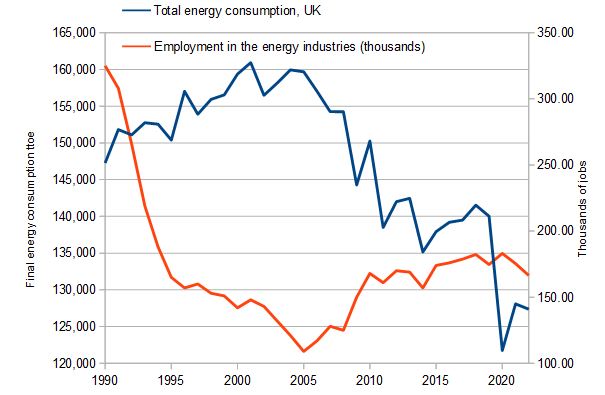
The UK’s energy consumption peaked at the turn of the millennium and has been declining ever since. There are a number of reasons for this, and depending what your beliefs are, it is possible to battle over those reasons. More efficient use of energy? Loss of energy-intensive industries?
(Of interest also is the fact that the UK ceased to be a net exporter of energy in 2004.)
The number of jobs in energy declined from the 70s onwards (and probably since before then; the statistical release I have to hand begins in 1980 for jobs but only 1990 for energy). This reflects the loss of jobs in coal (and inasmuch as coal use switched to gas, reflects an improvement of productivity). Employment in energy reached a nadir in 2005 and then began to climb.
This climb was not matched by a climb in energy consumption. It occurred as energy consumption was falling.
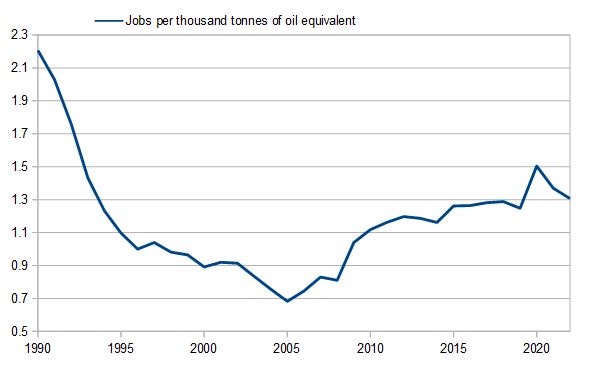
Now, if you divide one set of numbers by t’other, you get the productivity of employment in energy. Productivity maxed out in 2005, and has been sliding ever since.
So:
Maximum energy use: 2000
Last year as net exporter of energy: 2003
Peak productivity: 2005
I leave it to readers to interpret the meaning of these figures and dates.
The data came from here.
Image: Archive.org (1910 ish).


Very interesting – thank you. Perhaps I have been a bit hard in pointing out the apparent lack of “green” jobs (save in the lobbying arena etc), given that the data you have supplied suggest that for a period the number of jobs in the energy sector did increase. They do now seem to be decreasing again, but whether that is a temporary phenomenon, or the beginning of a long-term trend, remains to be seen.
Jobs are important, but as you point out, more jobs for loss energy implies greater costs and lower productivity (unless we export energy to help our dire balance of payments – and as you point out, we no longer do that either).
It would be nice if an independent economist with no axe to grind (assuming such a person exists) would carry out a detailed analysis of the implications for our economy as a result of net zero and the “great transition”. I have little doubt that on most metrics, it’s damaging.
LikeLike
The fantasy about Green jobs in energy is just a restatement of Frédéric Bastiat’s “Broken Window” economic theory.
LikeLiked by 1 person
So productivity has nearly halved in 17 years?
I assume the 2011 “peak” (i.e. trough in productivity) was due to covid reducing industrial energy use, while leaving employment unchanged. But what explains the increase in energy employment from 2005? It’s not manufacture of windmills & shiny glass panels, for sure.
I once looked at government definitions of Green Jobs. It included anything from recycling agents (dustbin men to you) to employees of climate NGOs.
Governments and green activists are under pressure to create 2 competing narratives:
1) that Net Zero will create green jobs
2) that green energy is cheap.
It’s going to be hard to do both.
LikeLiked by 1 person
A recent letter in the Scotsman:
“News that the total number of offshore wind jobs in Scotland fell from 29,700 to 25,700 in the past year while profits have risen from almost £9 billion to £13bn are another nail in the coffin of the SNP-Greens’ “just transition”. They must find a way to tax these excess profits which are, after all, partly boosted by subsidies paid from “green levies” on our energy bllls”.
And in the spirit of the circular economy and terminology re-useability, they could even call it the “windfall tax”.
Allan Sutherland, Stonehaven, Aberdeenshire“
LikeLike
“The Cost of Green Jobs
The astronomical cost of jobs in renewable energy”
https://davidturver.substack.com/p/astronomical-cost-of-green-jobs
An excellent analysis, yet again, from the ever-reliable David Turver.
LikeLike
David Turver again:
“Revealed: Renewable Energy Jobs Are Being Subsidised by £250,000 Each, Every Year”
https://dailysceptic.org/2024/04/03/revealed-renewable-energy-jobs-are-being-subsidised-by-250000-each-every-year/
“…We can see that each offshore wind job cost £247,000 in subsidy, each onshore wind job nearly £283,000 and solar £238,000. The average across all three sectors is nearly £253,000 per job.
Now remember, this is not a one-off payment to get a new industry up and running, it is an ongoing annual payment. The ONS does not publish its estimate of the salaries in the sector, however, the annual subsidies are far higher than any reasonable estimate of the average salaries paid in the sector.
It is crystal clear that all talk of a “green revolution” is simply a pipedream. These green jobs are only a façade: Potemkin jobs to give politicians and policymakers a good sound bite and make them feel good about themselves. The idea that we can move to “green prosperity” by subsidising each job to the tune of over £250,000 each year is plainly absurd. If we take any further steps down this “green prosperity” road, we risk bankrupting the nation.“
LikeLiked by 1 person
Each ‘Green job’ costs a quarter of a million quid and ‘clean’ Green energy literally costs the earth.
LikeLiked by 1 person
“Green Jobs Make Us Poorer
Green jobs are still costing us a fortune”
https://davidturver.substack.com/p/green-jobs-make-us-poorer
…each offshore wind job cost £264K in subsidy, each onshore wind job cost over £309K and solar nearly £100K. The average across all three sectors is over £192K per job.
Now remember, this is not a one-off payment to get a new industry up and running, it is an ongoing annual payment. The ONS does not publish its estimate of the salaries in the sector, however, the annual subsidies are far higher than any reasonable estimate of the average salaries paid in the sector.
Conclusions
It is crystal clear that all talk of a “green revolution” is simply a pipedream. These green jobs are only a façade, Potemkin jobs to give politicians and policymakers a good sound bite and make them feel good about themselves. The idea that we can move to “Green Prosperity” by subsidising each job to the tune of £192K every year is plainly absurd. These jobs are a drag on the rest of the economy, acting as a tax on energy. We need to end this economic fantasy.
LikeLiked by 2 people
“Government vows to create 400,000 jobs in energy sector”
https://www.bbc.co.uk/news/articles/c3vnr45x5qyo
The government has announced plans to train and recruit more workers for the UK’s clean energy sector, promising to create 400,000 extra jobs by 2030.
Plumbers, electricians and welders are among 31 priority occupations that are “particularly in demand”, with employment in renewable, wind, solar and nuclear expected to double to 860,000 in five years, ministers have said.
Speaking on the BBC’s Sunday with Laura Kuenssberg programme, Energy Secretary Ed Miliband said thousands of jobs were needed to develop Britain’s clean energy sector to “get bills down for good”…..
Do you think he understands how it works?
LikeLiked by 2 people
Thank you Mark. The story inspired an incoherent rant by me.
LikeLike
It was more coherent than Mr Miliband!
LikeLike
Yet Miliband seems to get a free pass on the BBC with this kind of statement.
Seems BBC Verify is never called on when it comes to NZ & Ed. Strange that!!!
LikeLiked by 1 person
dfhunter,
As you know, my view of BBC Verify is that it is simply a weapon the BBC deploys to try to discredit people and policies it dislikes. You will never see it being used to analyse policies and statements by people of which the BBC approves.
LikeLiked by 1 person
Polly Toynbee might do well to read your article, Jit. Hers is a triumph of hope over reality:
“Ed Miliband’s new green jobs will bring Britain hope. I dare Reform to denounce them
While Nigel Farage promotes retro plans to reopen coalmines, will he really tell thousands of clean energy workers to leave their well-paid, local jobs?”
https://www.theguardian.com/commentisfree/2025/oct/21/ed-miliband-new-green-jobs-britain-hope-reform
LikeLiked by 1 person
Mark – thanks for the Toynbee link. Like how she has this quote about “clean energy workers” –
“Miliband met a young woman who left her Pizza Hut job when she won an apprenticeship in clean energy at Sheffield Forgemasters. Who would pull the plug on her?”
Lets have a look at Article: Sheffield Forgemasters launches 2025 apprentices recruitment – partial quote –
““Sheffield Forgemasters has an exciting future following the MoD acquisition, and we are driving forward with a programme to create next-level engineering skills-sets for defence and civil nuclear markets. “Successful candidates will receive fully-funded training, working towards a professional qualification whilst getting paid, and will have a future career in one of the most advanced engineering facilities of its kind. “We are hoping to encourage candidates who have an eagerness to learn and build a career to apply for the roles, which will provide skills for life and excellent professional development. “Our remit is to deliver higher levels of defence work and to advance manufacturing technologies for civil nuclear power and renewable energy markets.”
Now it may be true this young woman is working on “renewable energy” side, but this from 2023 –
Forgemasters: Sheffield steel firm makes loss
LikeLiked by 2 people
“Electricity Productivity Data Shows we are Falling Down the Energy Cliff
Electricity generation productivity has halved since electricity generation peaked in 2005″
https://davidturver.substack.com/p/electricity-productivity-data-falling-down-energy-cliff
Back in January the government released the results of the first part of the seventh Allocation Round (AR7) renewables auction and claimed they would unlock “7,000 good, skilled jobs in every corner of the country”. Earlier this month, they claimed the AR7a results would support “up to 10,000 jobs”.
On the face of it, more jobs sounds like a good thing. But creating more jobs by digging holes and filling them in again creates activity but destroys value. We are falling into the same trap with the electricity generation sector and in danger of falling down the energy cliff….
...The Net Energy Cliff was first described by Euan Mearns and describes what happens when we use technologies with low energy return on energy invested (EROEI) like wind and solar power. Net Energy is the surplus energy available to society after deducting the energy used in energy gathering activities. If we have EROEI = 1, then net energy is zero. We are using as much energy to gather energy as the useful energy produced. Figure 4 shows net energy as a percentage of total energy is plotted against EROEI. The blue area on the chart shows how the energy left for society varies with EROEI. When EROEI starts to get into single figures the energy available for society starts to plummet rapidly as we spend more time and energy gathering energy and we have much less net energy available and society starts to degrade.
Starting with the industrial revolution, society moved up the EROEI scale as we made the transition from wood to coal, then coal to oil and gas and then on to nuclear resulting in lots of surplus energy. This meant we could move from a largely agrarian society to one where we could invest in infrastructure such as better buildings, roads, bridges, railways, ships, cars, aeroplanes and even spacecraft. We could invest time and effort into scientific research that produced new inventions that used more of that energy such as steam engines, internal combustion engines, electric motors, computers, rockets and so on. Surplus energy also allows more time and effort to be devoted to education and high culture such as art, theatre and music.
We can clearly see that the move to low EROEI intermittent renewables is moving us back down the EROEI scale and we run the risk of falling down the net energy cliff. The productivity data discussed above shows this happening in real time.
Net Zero using intermittent renewables is the energy equivalent of digging holes and filling them in again. Net Zero is destroying value and causing society to regress. The sooner it is stopped the better.
LikeLiked by 3 people