A few weeks ago, someone put a petition on petition.parliament.uk to ask the government to
Reduce Vehicle Excise Duty by 50% for vehicles aged 20 to 39 years
It currently (10 a.m., 7.iii.2026) has 43,529 signatures. The plea has generated a reply from someone in government, who basically said, no, you predominantly white males of a certain age, you.
I haven’t signed it. Why? Well, I thought about it, and then thought about it some more, and concluded that this is not the right solution. Of course, we want to keep old vehicles on the road and not see them scrapped because owners can’t afford VEDollars. But VED is in such a mess, it needs more than a tweak like this. I’ll try to explain VED’s present wrinkles, and then to come up with a solution.
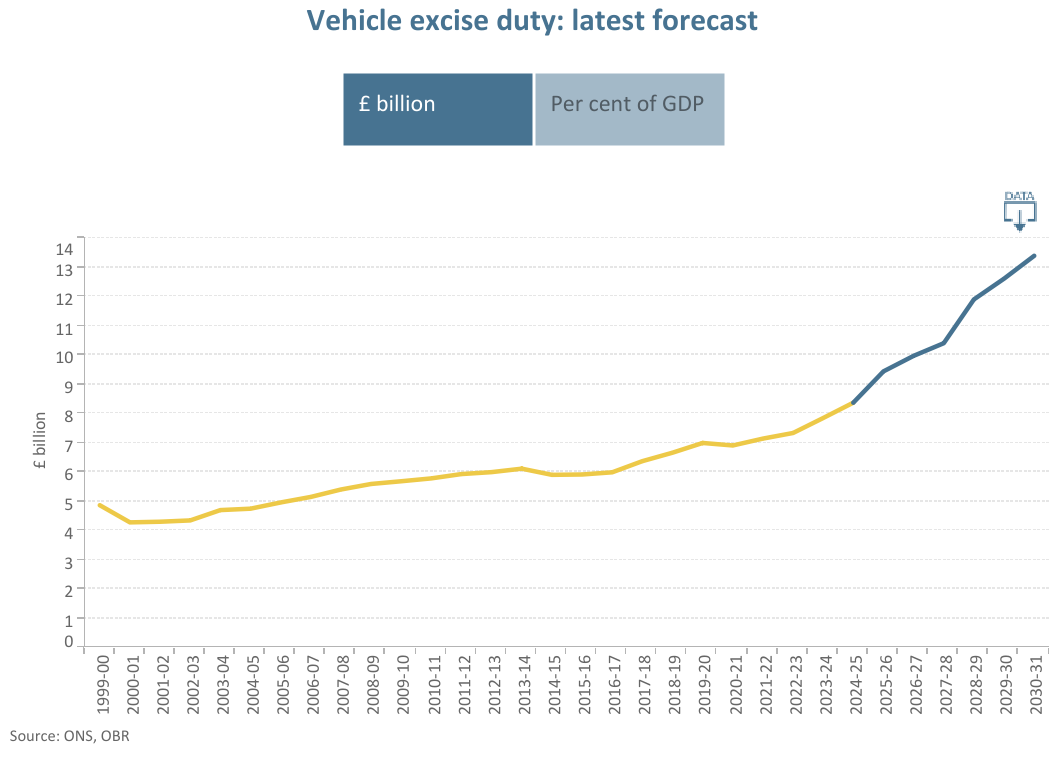
For our international readers, VED means Vehicle Excise Duty. It is commonly called car tax. In a fantasy world, it’s designed to pay for the upkeep of roads. In the real world, it’s just one of many levers the government can pull to wring money out of its people. In 2024-5, it raised £8.4 billion, or 0.28 percent of GDP, according to the OBR.
The quantity raised is slated to rise, thanks to the first-year charge and the luxury car tax, and the fact that EVs are now joining in:
The system
For quite a while, VED was based around CO2 emissions. That’s the case from 2001 to 2017. From 2017, a flat rate applies to all vehicles, but this is not backdated, so older vehicles may pay more, or less. There is also now a luxury car charge added to the VED, payable over years 2-6 of the vehicle’s life for cars that cost north of £40,000, and a 1st-year charge, which is still based on CO2. If you go back to pre-2001, not that there are many vehicles that old remaining, the tax is based on engine size. The luxury car charge threshold is going to go up to £50,000 for EVs, to soften the blow of them having to pay the upcoming Pay Per Mile charge of 3p per mile. This paragraph has all come from the top of my head, so I may have to review it. Below I’m going to give a few illustrative examples, to show the range of charges involved.
BMW 323i yr 1982 = £0
Ford Focus Zetec 1.4 yr 2000 = £220
Ford Focus 1.6i yr 2003 = £265
Ford Focus 1.0T Ecoboost Zetec yr 2018 = £195
Range Rover Sport 4.2 V8 yr 2005 = £430
Range Rover Sport 4.2 V8 yr 2007 = £760
Range Rover Sport 5.0 V8 yr 2018 = £195
Range Rover Sport 4.4 V8 bought today for £118,400: Yr 1 = £5,490; Yr 2-6 £195 standard rate plus £425 luxury tax; Yr 7 onwards, £195.
BMW 118d Yr 2010, £35.
Just a few examples there, but you get the idea – the entire thing is a mess. The Range Rover Sport example typifies the chaos. An example registered before March 2006 pays £430 per year, but one from after March 1st 2006 pays £760. That’s because the top band was expanded, but the change wasn’t applied retrospectively, which was probably thought to be unfair.
Some considerations
- All road users should contribute something. All registered vehicles use the road.
- Road wear is proportional to the 4th power of mass per axle.
- Acceleration is important, because most particulates are produced under acceleration.
- Carbon dioxide: the planet is cooking.
- Combustion particulates, NOx, etc…
- VED is independent of miles driven.
- I don’t believe in the luxury car tax. We already have VAT.
- We want to keep old cars going, because this is the greenest option.
- There is never going to be a fair way of charging VED.
On 1., I have in mind things like gantries, signage, CCTV suites, those guys that go haring up and down the road all day looking for debris etc, rescue vehicles.
Re: 2. and 3., at this point you’re probably thinking, when Jit is the dictator of the UK, he’s going to punish EVs for being too fat, and for accelerating too fast. Well, maybe my pro-ICE bias is shining through a bit. But my prime thinking goes back to the soul of VED – to pay for the upkeep of the roads. Based purely on mass per axle, then HGVs are orders of magnitude more damaging than even the heaviest EV. But we can’t apply the tax proportionally, else we will tax commerce off the road.
Item 4. is probably annulled by fuel duty, I think. Since every gram of CO2 emitted was formerly petrol, then a hefty “carbon tax” has already been paid. In fact, I calculated this pseudo-tax to be >£1000 per tonne of CO2 emitted, if memory serves – it is in these pages somewhere, if I can find where. It’s here. But it was calculated ther per tonne of C, not CO2, so it’s even more monstrous.
Regarding 5. and particulates etc, I think this should be discounted. It is in theory part of the MOT test, after all. I would like to see black smokers pulled over by the cops, because anecdotally, it looks like 1% of the vehicles produce 99% of the (tail pipe) particulates.
On 6., and the problem that road use is not the same for all vehicles, well at least there is the fuel duty, and now the Pay Per Mile tax for EVs, to partly address that variation.
Regarding 7., as noted, there is already something called VAT, so I can’t see the fairness of charging people more for expensive cars on top of that. The expensive car does not automatically create more road wear or pollution, so that should be out.
On 8., keeping old cars going – this is an obvious thing to do, but on the other hand, the old car may use the road as much as a young car. I think the current system (exempt from 40 years) is probably correct, although it would be possible to shorten the number of years needed to qualify as tax exempt. Few cars get to enjoy this privilege as matters are. I’ll produce a recommendation for a new age cut off in a moment.
On 9., this is a kind of shrug. We can’t perfect it, but it can be better than what we have, while raising the same money for the exchequer.
Basic numbers
UK car fleet, 2024 = 36,362,160
VED take: 8,400,000,000
Average VED per car = £231 (i.e. £36 more than the present default value). The calculated number includes cars that do not currently pay VED because they are >40 years old.
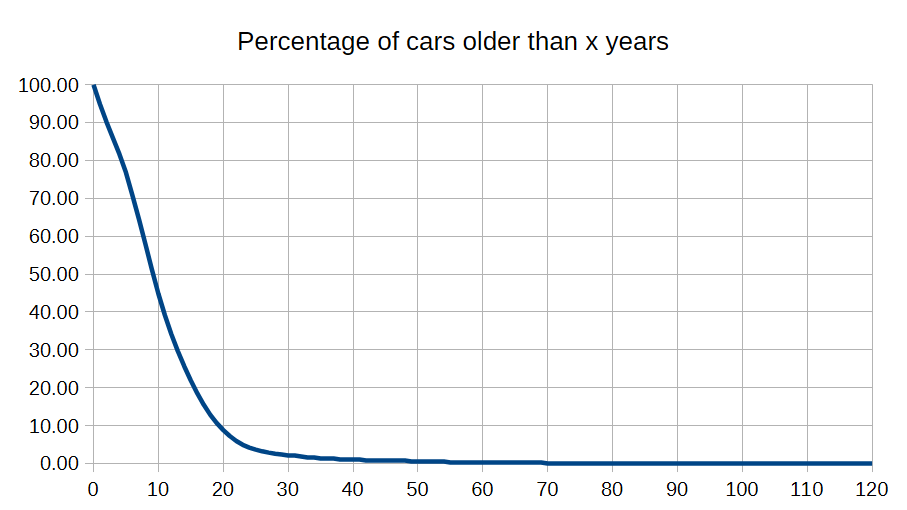
Average age of a car = 10.0 years. This is also close to the median age. So, half of all cars are <10 years old.
Historic vehicles and cancelling VED
The figure above is not a survivorship curve – for that, we’d need to know the number of cars registered in each year. So half of the fleet is older than ten years, but that does not mean necessarily that half of all cars are scrapped within 10 years.
Only 1% of cars are 40+ years old. So being released from the Chancellor’s palpation at that age is not a very generous cutoff. At the moment, the 40-year cutoff means that the VED take is spread among 99% of the fleet. Above, I wrote that the average VED per car is £231. Actually, it’s £233 if you ignore the >40 year cars; making cars over 40 free, costs the average car £2. If we made the cutoff >25 years, i.e., everything over 25 years pays no VED, then the average for the remainder would need to be £242.
If that sounds low, it’s because, while only 1.0% of cars are older than 40, only 3.65% are older than 25. The rump is still large enough to absorb this policy, which I think would be justified in terms of the goal of keeping things going as long as they are still viable. (Incidentally, bump it up to £253 on average and you can make everything older than 20 years free – that’s how biassed the fleet is towards young vehicles.)
How to rejig VED for the vehicles that still pay
I don’t think basing VED on CO2 emissions is a good idea. That’s because, as mentioned, ICE cars already pay fuel duty. My calculation based on the average CO2 emissions per km of the 2024 fleet is that fuel duty adds an average of 5p per mile to the cost of travel (6p per mile with VAT). Note that figure does not include the cost of the fuel. For reference, the numbers are:
2310 g CO2 / l petrol (this is what the AI said; I have my own calculation somewhere, but haven’t checked)
133.7 g CO2 / km (fleet average emissions, for cars only, excluding EVs). The number also does not include the part of the fleet with “unknown” emissions.
~0.06 l petrol / km
£0.5295 / l petrol in duty (ex. VAT)
~£0.03 cost per km of duty
~£0.05 cost per mile of duty
~£0.06 cost per mile of duty, inc. VAT.
The 6p per mile charge on ICE compares to the 3p per mile that EVs are going to pay from 2028, and the 1.5p that PHEVs are gong to pay. (The latter will also pay fuel duty.)
What about the mass on axle, and acceleration?
Unfortunately, I don’t have the data to calculate new VEDs for all extant vehicles based on these parameters. It would be quite time-consuming to work this out. I will note that according to ev-database.org, the Porsche Taycan Turbo GT Weissach (no, it doesn’t have a turbo) tips the scales at 2.295 tonnes and has 0-62 mph time of 2.2 seconds. Accelerationtimes.com says that the humble Ford Fiesta 1.0 Ecoboost takes 8.8 s to get to 60 mph (that would have been considered fast, in my day – anything under 10 s was fast). It weighs in at 1.15 tonnes.
Simply looking at the value of its mass / acceleration, the Taycan scores 100X the Fiesta. (Yes, that ignores the 4th power, and the fact that there are two axles.) I don’t think extreme versions of VED based on this sort of thing are viable, or fair, even if it is more proportional to road wear and particulates, etc.
If I were to advise our Chancellor on this topic, I would first consider as a baseline scenario a flat rate for all at about £242, with no charge for cars older than 25 years.
However, it seems somehow ludicrous to charge the same for a Fiesta as a Taycan. I think a better plan would be a flat rate – to pay for things other than road wear – £100 seems like a nice round figure that I plucked from the air. The rest can be made up appropriately, while totalling the same. Naturally, I can’t work out the value without buckets of data. But here’s an example with the mass categories in 500 kg bands. <1000 kg for the first, and every 500 kg thereafter, up to the 3 tonne monsters. Something like:
<1000 kg = £100 (for example, Austin Mini)
1000 kg < x < 1500 kg = £175 (for example, Ford Fiesta)
1500 kg < x < 2000 kg = £250 (for example, Volvo XC40)
2000 kg < x < 2500 kg = £325 (for example, Porsche Taycan
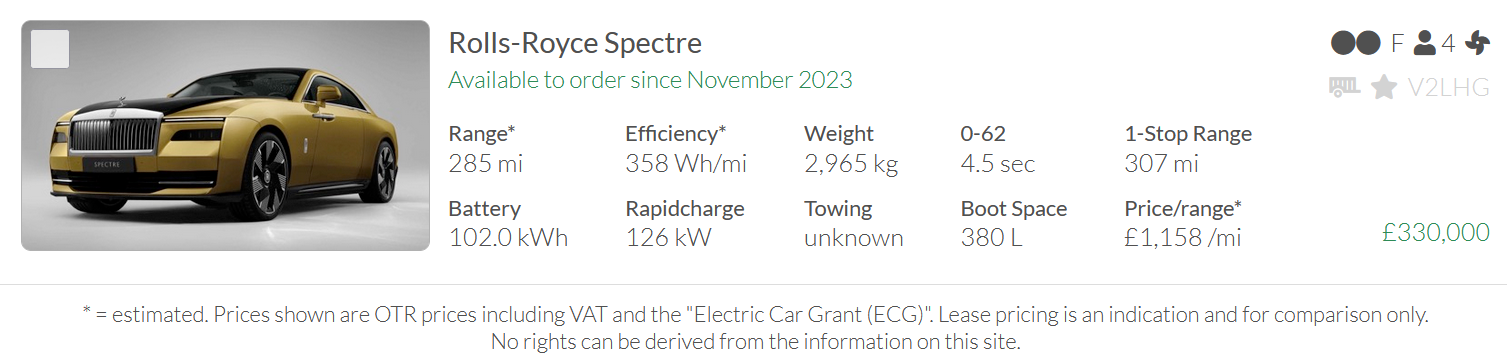
2500 kg = £400 (for example, Rolls-Royce Spectre)
…ish. Tweaking would be needed to get the total up to the current £8.4 billion. Probably upwards, because even in these days of ever fatter cars, the average is still probably in the second bucket. Of course, it might be better to separate things into 100 kg buckets.
For simplicity, acceleration is not included.
There are no first year charges, and no luxury car tax. Yes, some cars will pay more than they do today, in particular those from 2001-17 in the low CO2 brackets. What about the impractical Pay Per Mile for EVs? I don’t like it, and I see a lot of avoidance coming, unless the Chancellor chooses to use more insidious methods to collect the data. But I don’t like fuel duty either, and that is effectively a Pay Per Mile tax. This at present raises £24.4 billion (+ VAT), almost 3 times VED (but it is slated to slowly fall – albeit after a short-term rise, thanks to the cancellation of the current 5p discount, due in a few months, and the re-attachment of the escalator). We could simply quadruple the above VED bands, and get rid of fuel duty altogether, and the oppressive Pay Per Mile. That would, of course, penalise light users, and favour drivers who do a lot of miles.
Conclusion
Well, there is no conclusion. Or rather, the conclusion is that the system is a mess and there is no easy, simplifying fix. Like a moth around a hurricane lamp, I have circled around the subject without ever reaching the heart of it. I would like to have minions at my command to work up the various options, but sadly, I don’t.
I would though be delighted to hear other Clisceppers’ ideas for a fair way to simplify VED. Please alert me to numerical or logical errors. I have a seasonal virus, and the numbers are not as clear to me as they sometimes are.
/message ends
Postscript
While fuel duty raises about £24 billion, ex. VAT – and I have yet to hear a cogent reason for double taxation here – the EV lobby has recently scored a major victory in its own battle against “unfair” taxation. It has been decided that the appropriate VAT rate for public charging should be 5%, the same as the domestic rate for electricity, rather than the commercial rate of 20%. [See for example, Fleetpoint.]
Now, at the moment, the amount raised by VAT on public charging is still in the “trivial” bucket, compared to the grand scheme of things. The AI seems to indicate a figure of around £100 million presently, which, if HMRC accepts the ruling, will automagically become £25 million.
Naturally, when everyone is driving an EV, the loss of about £35 billion in fuel duty + VAT* will have to be offset by a draconian charge on EVs. If I were them, I would not celebrate this victory too loudly. Sauron’s eye might be drawn their way.
===
*Guessed by assuming that the duty on petrol is roughly equal to the cost of the petrol; both parts then subject to the 20% VAT.
===
The featured image is of a Spectre, snipped from Rolls-Royce’s own site. They ought to support my new system, I should think. According to EV-database.org (see stats below), the Spectre weighs in at a shade under 3 metric tonnes. Not bad for a coupe. Not captured in the shot, but an unusual feature of this fat car, is that its doors open the wrong way.
 Climate Scepticism
You state that the Earth is cooking due to Carbon Dioxide- are you just stupid or really thick?, the Earth is not cooking, it’s not even simmering, it’s struggling to get from a Mass Extinction CO2 level of 165ppm, now crossing the 280+ppm and needs to be at 900+ppm to ensure life continues.
You are confusing the minor temperature increase experienced over the last 100yrs with a problem, the planet is slowly returning to its historic temperature level prior to the Little Ice Age that caused so many problems during the 18th and early 19th centuries.
CO2 has nothing to do with warming, Mankind has nothing to do with warming, look at the historic records, CO2 has been in the mid 3000ppm and the planet survived, the planet has been warm, cold, almost a snowball, warm etc- there is no “Climate Crisis” just a bunch of eco lunatics who think that they and only they have the cause of temperature minor increase worked out and ignored the fact that the planet has a long established cycle where sometimes it is cold, sometimes warm but never hot.
dot be honest, I expected better from your site than this.
LikeLike
I would personally favour a weight-based VED, with some kind of equivalent “pay-per-mile” for EVs to match the fuel duty on petrol and diesel vehicles. Given that transport costs are a significant component of much commercial activity, any changes that increase overall tax rates will be anti-growth, and ought to be avoided by any government with a sensible attitude to fostering economic activity (current administration fails on almost every action against this criterion).
LikeLiked by 1 person
Davisonfamily –
LOL, as the young folks say. You perhaps should have paid more attention in your English classes, when they were teaching you about the rhetorical technique called “irony.”
You may apologise when ready.
LikeLike
My “second car” is a 2017 Toyota Aygo run around. Last summer the wife and I had a delightful holiday in Colmar (France) with a couple of friends and were driven down in their (also 2017) Mercedes C220 D Se luxury cruiser that accelerates live an EV, is the most comfortable car I have ever sat in and looks in show room condition. On checking fuel consumption at the end of the week it came out as just, by a whisker, over an amazing 80mpg! This is actually better than I get from my Aygo albeit that is from just tootling around. Even more amazing is that the Merc is also just £20 VED.
As our good friend driving pointed out, he would probably need a second mortgage to pay the road tax on a new one. Needless to say he intends to keep it running ……basically forever!
LikeLiked by 1 person
I like the incentive to keep things running – it’s greener. Our 11 year old Golf diesel pays just £20 VED p.a. so long as they don’t increase it, I don’t need it to be exempt to persuade me to hold onto it.
Given the (now largely notional) connection between VED and road repairs etc, I like the idea of linking the amount of VED to vehicle weight, and I don’t care about CO2 emissions (sorry, EV owners).
LikeLiked by 1 person
The problem is there are so many conflicting factors. While it makes sense to keep older cars on the road to save the resources used in building new ones, there are downsides. Older cars are generally more polluting (in air quality terms). They may lack useful safety features such as ABS and airbags. Dynamic aspects such as braking performance may be inferior. Protection, both for occupants and others, is lower. Running costs can be higher due to worse fuel consumption, greater maintenance costs, ULEZ charges, etc..
A flat rate seems the best option, phased in gradually, and drop the attempts to social-engineer peoples’ choices.
LikeLiked by 1 person
At the risk of going O/T, but following on from MIkeH’s comments about the downsides of older cars, exempting them from needing an MOT test strikes me as being a very odd, and potentially dangerous, policy.
LikeLiked by 2 people
Mark – I’m sorry that your car is going to be paying more VED under my scheme…:) – not that the chancellor is going to see or follow my advice.
Mike – the newer cars may well be safer. They may also be more dangerous (as a consequence of the ever-growing mass of vehicles, not just EVs). I also question whether newer vehicles will have lower maintenance costs – particularly as regards electronic components. I have the feeling that buttons and knobs will always triumph over touch screens, and I don’t see why a piece of wire was not an adequate hand brake system!
LikeLike
There are older cars and other older cars…
A small percentage of us own much older cars that are younger than forty years old, for which the term ‘modern classics’ has been coined. They are part of our motoring heritage. This sort of vehicle is often loved and cared for. It has been bought for a reason, more than just getting from A to B. It is usually looked after, regularly serviced and kept up together. They have to pass an MOT for emissions. Insurance is often good value; this is because it comes with a mileage limit, so they spend a lot less time on the roads. Very different from an ‘old banger’ or one that is in constant daily use, doing the usual 10 -12 thousand miles p.a.
I own two Honda CRXs, 1996 and 1992. I don’t feel at all guilty about having two cars like this. They are both under a tonne kerbside weight. They are on a 3,000-mile insurance limit. I look after them, plus Honda engines are so reliable – they go on and on. Their V-Tec engine design promotes economy around town and power when you need it. One car doesn’t get driven much in winter because of the salt on the roads. However, I’m paying an absurd amount of tax. This year £365 each. I feel, given the circumstances, that I’m being totally ripped off by HM Gov.
I will never buy an electric car. They are mostly very ugly, too big, and I like to drive my car, not be driven by it. There are too many things to go wrong in the electronics department of modern cars. My cars are tremendous fun to drive, have very little excessive technology in them, and come from an era when cars had generally become more reliable. I believe Rowan Atkinson, who originally trained in car engineering, drove an electric car, and he said it ended up being boring to drive.
Mark: re. MOT: A lot of classic cars – forty years plus -don’t need an MOT, but their owners still get one. It’s a good way of checking the car is safe to go on the roads, and they have to have an emissions test, of course.
LikeLiked by 1 person
I like to drive my car, not be driven by it.
Exactly! And despite the safety features on modern cars (not all of which do their job well, some of which are an adverse distraction), I feel much safer (because I am more in control) driving a car with a manual gear box than I do driving an automatic.
LikeLiked by 1 person
My fisher friend drives a BMW 320 D , it is a very very nice car, on our fishing trips he can get 60 + mpg. I get 50 mpg at very best with my 2012 Xtrail. There seems to be a balancing of costs between the 2, low maintenance costs in a local garage but high ved for the x trail , against what I would deem as huge maintenance costs in a BMW garage and lower ved. Another cost difference the price of a tyre for the BMW is over twice what I pay for the Xtrail and I can take it into some pretty rough places and come out with a load of wood for the burner.
LikeLiked by 1 person
Jit; wrt car safety, it probably depends on your position. Drivers and passengers are very well-protected in modern cars. However I would not want to be in something like a classic Mini if it was hit by one the latest leviathans weighing close to 3 tonnes! Pedestrian/cyclist safety is probably better these days with the regulatory requirements and all the sensors.
As for maintenance…..anecdotally my feeling is that modern cars are more reliable but I’ve never seen any stats comparing reliability for different ages. Maintenance requirements have certainly come down: 2 years/20,000 miles is not unusual for makes with variable servicing. Unfortunately costs have rocketed. Some EVs – Teslas – don’t have any regular service requirements, just a recommendation to change cabin filters and brake fluid every couple of years.
One thing for sure…..older cars are more fun when that’s what you want!
LikeLiked by 1 person
James – until comments in this thread, I had not fully appreciated just what you can get away with and still remain in the £35 tax bracket! [I’d take the X-trail.]
Mike – I had in mind the cost of parts – see recent Scottish Car Clan videos, where Grant outlines some of the shenanigans that manufacturers are getting up to in attempts to prevent drivers using their local mechanic or doing the jobs themselves.
LikeLike
notforuses –
When I’m Chancellor, both your vehicles will be VED-free.
Perhaps I should initiate a petition along these lines. I’ve often thought of starting one demanding that “funded by UK Government” plastered on the side of buses and buildings must become “funded by UK Taxpayers.” A small change, but turns a lie into the truth.
LikeLike