The Guardian has found a new report that has caused it much excitation, and it is easy to see why:
The paper, published on Friday in the journal Nature Communications Earth & Environment, found that from 2006 to 2020, the climate crisis contributed to about 15,000 deaths from exposure to small particulate matter from wildfires and cost about $160bn. The annual range of deaths was 130 to 5,100, the study showed, with the highest in states such as Oregon and California.
Scary stuff, I’m sure you will agree. But before discussing the report’s findings in any detail, it is perhaps worth reflecting upon the nature of the study undertaken. Whilst you might be forgiven for believing that scientific measurements lay behind the grim proclamation of a climate change-driven increase in pulmonary deaths, the truth is that the paper is based heavily upon mathematical modelling – or more to the point, mathematical modelling layered upon mathematical modelling. In fact, they used a clinical model to predict the health impacts resulting from wildfire smoke dispersion that had itself been modelled. This modelling took as its starting point a posited climate-driven increase in burn area as calculated from ecoregion-level empirical models using fire weather index (FWI) and precipitation from ERA5, whilst using counterfactual analysis based upon a climate model ensemble (CMIP6). With so many models to work with, what could possibly go wrong? Well, plenty from where I am standing.
Before going any further, I should point out that I’ve got nothing against mathematical modelling. I would say that if it is all you have to work with, then work with it. But should you do so, it is very important to keep a clear idea as to how much credence one can place in the modelled results. Even worse, when modelling is layered upon modelling, you end up with an exercise that is likely to be riven with compounding uncertainties. Given that we are dealing here with three layers of modelling, I think it is fair to say that the result could be characterised as modelled speculation.
Predictably, the Guardian article chooses not to highlight the study’s speculative nature, preferring instead to lead with confident statements that emphasise the hazards posed by the “climate crisis”. It isn’t until one reads towards the bottom of the article that the reality starts to find its voice. Specifically, the article reports that Marshall Burke, global environmental policy professor at Stanford University, feels that whilst evidence linking climate change to burned areas was “rock solid”, the modelling layered on top was a bit flaky:
“Linking burned area to smoke is trickier because you never know exactly which way the wind’s going to blow,” he said, and he wondered how the death estimates compared with fatalities tied to general air pollution.
Even then, we are only beginning to unearth the truth with this quote. I can easily see why the smoke dispersal modelling should be highly dubious, but the idea that this contrasts with a “rock solid” foundation of FWI calculations is simply absurd. That may be the hype issued by outfits such as the World Weather Attribution (WWA) centre but the reality could not be further from the truth. In the recent WWA attribution study of the 2025 LA wildfires the uncertainties associated with the FWI calculations were such that they actually rendered the results statistically insignificant. I’ll repeat that: whilst the paper said that the FWI was made 35% more probable under climate change, the results were equally consistent with the idea that climate change played no role whatsoever! So let us be realistic here; there is actually nothing in the Communications Earth & Environment study that can be referred to as rock solid.
So what exactly did the paper say? If you recall, the Guardian spoke of a “climate crisis” that has contributed to about 15,000 deaths between 2006 and 2020. Let’s put aside for one moment the vagueness behind the concept of contributing towards death, and focus instead upon how such a contribution might fit into the scale of things. After all, even in a counterfactual world in which climate change didn’t happen, wildfires would still have blown their smoke over populated areas leading to pulmonary illnesses. So what is the scale of the increase attributed to climate change? The answer to that question can be found in figure 4 of the report: ‘Increasing climate change contributions to wildfire PM2.5 mortality for CONUS between 2006 and 2020’.
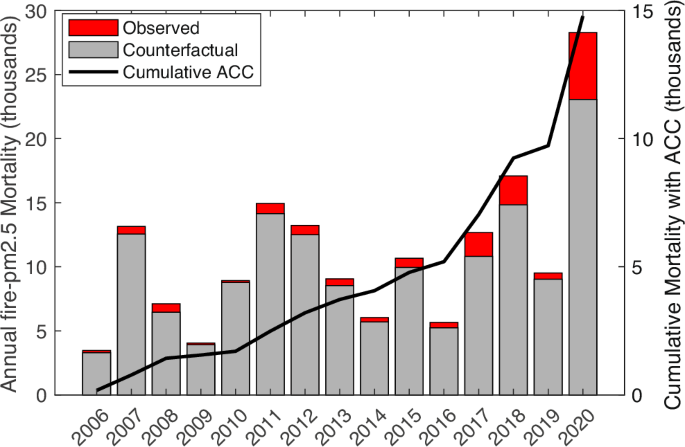
I don’t wish to sound complacent here, but apart from a very odd looking glitch in 2020, the climate-driven contribution doesn’t look that spectacular to me. In fact, what this graph does rather well in my opinion, is draw attention to the scope of contributions from non-climatic factors. For example, what would the graph have looked like if the counterfactual analysis addressed instead the impact of trends in arson, or trends in urban sprawl adjacent to fire risk areas? But of course, in asking those questions, one comes up against the revelation of a misplaced focus, for which we have Professor Patrick T. Brown to thank. It is no surprise whatsoever that the study quantifies only the climatic contribution – after all, that’s what all similar studies do. You will never see a figure akin to the above that quantifies the wildfire mortality due to human decision-making, other than, of course, the decision to burn fossil fuels.
To be fair to the Guardian, they do actually quote Professor Brown, albeit deep within the bowels of the article:
Patrick Brown, a Johns Hopkins University lecturer in climate and energy policy, said he had some concerns about the study. One was conceptual. The study acknowledges the power non-climate drivers have on wildfires, but it doesn’t give them proper weight, he said in an email. Brown, who was not involved in the study, worries decision-makers could wrongly conclude that mitigating planet-warming carbon emissions is the only solution. “Yet in many regions, the more immediate life‑saving action may be fuel breaks, prescribed burns, ignition‑source regulation, public health efforts, etc,” he said.
Even so, the delicate Guardian reader is provided with an immediate antidote to deal with Brown’s heretical poison:
But ultimately, the study notes, the problem of deaths from wildfire smoke will only get worse without the reduction of greenhouse gas emissions.
And I suppose, to the Guardian reader at least, that is all that you should be worrying about. Besides which, it’s all science, don’t you know. You may scoff, but you’re probably just an orc like me. We just need to understand that ‘a study has shown’. And that’s an end to it.


Implying that the average net positive value of each Californian and Oregonian over the course of the remainder of their now foreshortened lives would have been $10 million. I wonder if that number has been defrayed by the savings arising from the CO2 those individuals will no longer be able to emit! Not counting al the other benefits to the natural environment of their non existence!
LikeLiked by 1 person
I mentioned that Guardian article in passing at the time, and suggested that it probably merited a Cliscep article in its own right. Thanks for making a much better job of it than I would have done.
LikeLiked by 2 people
Mark,
I came back from holiday and found your suggestion. It seemed like an offer too good to miss.
LikeLiked by 2 people
I don’t think I can take this “study” seriously. Everything in fire-prone habitat burns in the end. If fire intervals get longer, then the eventual fire is more serious. Presumably it produces more toxic smoke than more regular fires with lower fuel levels.
Also, more than one million people die each week. Everyone dies of something in the end. That is not meant to sound callous; it’s just that it’s hard to find tenuous links to deaths from things like air pollution compelling. We have seen statistical misrepresentation in the case of deaths in the UK from air pollution. I refer the interested reader to a little note I wrote about the topic last year. [The headline figure of 40,000 premature deaths becomes everyone dies 3 days earlier when scrutiny is applied.]
LikeLiked by 3 people
Another scare paper that feeds the MMGW narrative using dodgy data via mathematical modelling.
LikeLike
I’ll leave this one here for you, John:
“Toxic wildfire pollution infiltrates homes of 1bn people a year, study finds
Dangerous indoor pollution could be tackled with air purifiers but costs are too high for many, researchers say”
https://www.theguardian.com/environment/2025/may/14/toxic-wildfire-pollution-infiltrates-homes-of-1bn-people-a-year-study-finds
Toxic pollution from wildfires has infiltrated the homes of more than a billion people a year over the last two decades, according to new research.
The climate crisis is driving up the risk of wildfires by increasing heatwaves and droughts, making the issue of wildfire smoke a “pressing global issue”, scientists said.
The tiny particles produced by wildfires can travel thousands of miles and are known to be more toxic than urban air pollution, due to higher concentrations of chemicals that cause inflammation. Wildfire pollution has been linked to early deaths, worsened heart and breathing diseases and premature births.
Previous studies have analysed outdoor exposure to wildfire smoke, but people spend most of their time indoors, particularly when seeking refuge from wildfires. The new analysis is the first global, high-resolution study of indoor spikes in wildfire pollution..…
LikeLike
PS I should have mentioned the final two paragraphs:
...Jing Li and Yifang Zhu, both of the University of California, Los Angeles, and not part of the study team, said: “As wildfires continue to intensify due to climate change, reducing indoor exposure to wildfire smoke has become a pressing global issue that goes beyond individual action and requires comprehensive, policy-driven solutions.”
They said more research was needed to validate the modelling study with on-the-ground measurements and exploration of factors such as the age of buildings, as older buildings have been shown to let more smoke in, and whether an increase in cooking indoors during wildfires adds to the pollution levels.
The link to the study:
https://www.science.org/doi/10.1126/sciadv.ady0890
LikeLike
Thanks for the link Mark. I’ll take a look later when I have the time.
LikeLike
I like to get a sense of proportion. Some observations
2020 as an outlier year
From the graph, in a 15 year period 2020 had about a sixth of the Fire-PM2.5 deaths and a third of those deaths due to climate change. Fire-PM2.5 deaths are not all from death certificates, but are estimated. 2020 was an exceptionally high year for deaths in the USA, being 18.5% or 529k higher than 2019. Remember Covid-19?
A small proportion of Fire-PM2.5 mortality
From the graph, I estimate around 170k Fire-PM2.5 deaths, so the 15k climate-related Fire-PM2.5, are just 9% of the total. A very small proportion, which will be quite sensitive to changes in modelling assumptions
A trivial cause of death
15,000 is a lot of people. But from 2006 to 2020, there were 39,857,859 registered deaths in the USA. 15,000 is just 0.038% of the total. That is, 1 in 2600 deaths. In 2019, from death certificates, the three major causes were Heart disease (23%), Cancer (21%), and Accidents (unintentional injuries) (6%). Accidents were the cause of death for 173,040. In 2023, that figure had risen to 227,039, or 8% of deaths in the year. Which deaths should policy-makers concentrate upon? climate-related fire-PM2.5 or accidents?
Mitigation or Adaptation?
Even if climate-related fire-PM2.5 deaths are a worthwhile object of policy, how should it be tackled? Indirectly through the US cutting emissions (climate mitigation), or directly through lessening wildfires (adaptation)?
Global warming (hence dangerous climate change) is caused by cumulative greenhouse gas emissions. Just looking at CO2 emissions, suppose that after the Paris Conference of December 2015 President Obama had issued an Executive Order creating net zero from 1/1/16. What difference would it have made? In 2023 cumulative global emissions were 1810 GtCO2, or 19.1% higher than in 2015. With the US net zero from 1/1/16 it would have been 1769 GtCO2, or 16.4% higher than in 2015. The marginal impact on ‘climate change’ would have been negligible. It should be noted that attempts to cut global emissions significantly in this decade have inevitably failed, despite what some countries might do.
The adaptive approach would have been to stop the spread of wildfires. Build fire-breaks, have emergency water supplies, clear trees near houses etc. Such measures would have prevented much of the damage in the Los Angeles fires of a few months ago, whatever the cause.
Why is it that policy-makers use expensive mitigation approaches with insignificant impacts, rather than much cheaper, more direct and effective adaptation initiatives?
LikeLiked by 6 people
Thank you Manic – the chart link was broken, so I’ve embedded one – I hope this is what you had in mind.
LikeLike
Maybe a bit O/T for this thread, but related – NOT Global Warming – Forests & The Roadless Rule | Musings from the Chiefio
Never heard of this US “2001 Roadless Rule” before. Chiefio gives this vid link –
The Roadless Rule is One of the Most Destructive Regulations in the History of the United States
The speaker MS. Hageman doesn’t hold back on the real cause for destructive forest fires in the US.
LikeLiked by 1 person
This video makes a number of germane points:
The whole video is quite entertaining, but it becomes particularly relevant to my post when it reaches 9mins 40secs, Part 2: Models v Reality.
LikeLike
Thanks for the link John – for some reason the phrase & the vid “Baby Seals” he used (in the Ehrlich bit – 11mts) chimes with me.
Maybe I’m wrong, but seems people on TV shows/sports & political events all act like “Baby Seals”.
I only clap when something moves me or I feel it needs applauded, not every 30 secs.
LikeLike