Thursday. There was I, cooking tea. There was the radio, playing Radio 4’s PM. So much so normal. Then, at about 25 mins into the programme, came a feature about life working in a Cambodian brick kiln. Not fun, you might imagine. You would be right.
The story is that Cambodian farmers got into debt thanks to increasing droughts, and were forced into some sort of indentured service for the brick kiln owners.
Partial transcript follows. My interjections are in italic.
LAURA BICKER: How hot is too hot? And what effect is our warming climate having on some of our most vulnerable workers? That was what we hoped to examine in Cambodia’s brick kilns.
…
It’s horribly hot in the brick kiln. UK researchers monitoring the workers’ body temperatures found that most were heat stressed and two had heat stroke.
LAURIE PARSONS (Royal Holloway): We are not all equal under the climate… the people who are most vulnerable socially, economically, will tend to be the people who are also most vulnerable to climate change. So we need to consider how climate change impacts people through the lens of labour and inequality. And recognise that labour, exploitation, is a major factor in the worst impacts of climate change.
The textile industry is big in Cambodia, and they burn off cuts in the kilns as cheap fuel. Various brands were implicated by the presence of garments with their labels on. An emotive contrast is made between a barefoot Cambodian girl and the Disney PJs that are about to go up in smoke that she will subsequently breathe.
BICKER: The majority of Cambodia’s brick workers were farmers. As Cambodia’s climate changes and droughts become more common [sic], they took on debt to try to keep their farms going. When that failed, they migrated to the city. But they earn so little, that the debt will never be paid.
What do we know about Cambodia? Apart from the obvious tragedies of its history, I mean. Well, we know that it is still a highly corrupt state, and that although it badges itself as a democracy, any party that threatens the ruling party ends up getting taken off the ballot somehow. According to Wiki, peasants are being driven off their land:
Forced land evictions by senior officials, security forces, and government-connected business leaders are commonplace in Cambodia. Land has been confiscated from hundreds of thousands of Cambodians over more than a decade for the purpose of self-enrichment and maintaining power of various groups of special interests. Credible non-governmental organisations estimate that “770,000 people have been adversely affected by land grabbing covering at least four million hectares (nearly 10 million acres) of land that have been confiscated”, says Paris-based International Federation for Human Rights (FIDH).
https://en.wikipedia.org/wiki/Cambodia
I don’t know the facts of this, but I would be interested to hear about it on PM, instead of hearing climate change blamed. Has there ever been a country that developed and where peasant farmers did not migrate to the cities and end up working in squalid conditions?
And what about that assertion about increased droughts? Looking at KNMI’s climate explorer, I could not find precipitation data for any long stretch in Cambodia itself, so there was no way to tell. (Weather data frequently ended in 1970, for reasons that you may guess.) The nearest long data series I found was from over the border in Thailand:
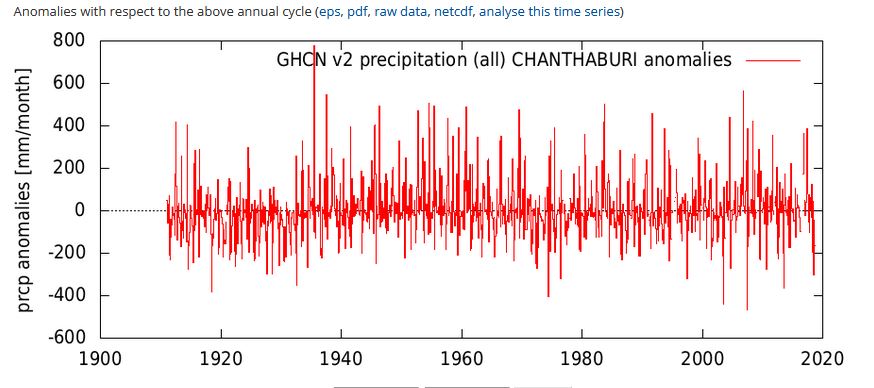
No, me neither.
Conclusion
There is a story here. It’s a shame that the spectre of climate change has to be dragged in from offstage to enable the manipulation of the narrative.
Your author shouted rather less polite words at the radio, but it didn’t answer. It just kept on rabbiting away as if I wasn’t there.
You can listen to the relevant PM episode here. (From 25 min 30 secs ish.)
Featured image
From Pexels. I’ve no idea where this kiln is, and the workers may well have never stacked a brick in their lives. I’m not sure how to access the metadata.


Yes, JIT, this is the standard “pincer movement” approach used to advance an agenda – in this case the climate agenda …
That is, some of the most elite and priviledged in UK society (e.g. the BBC for whose propaganda/output we have to pay a licence fee – that is how elite they are!) grip us in the jaws of a vice. One jaw is the elite messenger (here the BBC) promoting its “luxury belief” over the air waves, while the other jaw is the story of a usually poor and exploited minority group, often far from our shores, which is suffering due to climate change.
The subtext is firstly, in the case of the climate narrative, that if only you licence-fee-paying proles would give up using energy then the exploited minority would suffer less, at least suffer less from the changing climate aspect of their oppression. The second message of the subtext is that the BBC will always be here for you (provided you keep paying your fees!) in order to point the way from its luxury and elitist position towards the moral high ground (at least as it sees it).
It is all rather transparent, but (in my view) no less disgusting for that. While I like much of the BBC’s output, some explicit awareness by the BBC of its elite and priviledged position is long over due, as is an awareness that the climate agenda it has been promoting is doing huge damage to the industrial infrastructure and social fabric/cohesion of this country; but it seems not to care since it is the proles that bare most of the consequent hardship, while the BBC rolls along blissfully indifferent to their injuries and secure in the self-knowledge that the BBC in its stratospheric position is doing the right thing for the world and the climate.
Regards, John.
LikeLike
I suspect that Cambodians have long had more than climate change to worry about. I have a biography of Pol Pot on my bookshelves, waiting for me to decide that I can stomach reading it. Given the issues faced by Cambodian peasants over the last 50-60 years, I doubt if climate change even registers with them, and it certainly wouldn’t make a list of their top 10 problems.
LikeLike
For further BBC low quality, incompetent journalist information, it’s also hot work in blast & arc furnaces, deep underground Mines, confined space works, sewers etc etc – it’s nothing to do with climate, just the process!
LikeLiked by 1 person
“We will only talk about the profound problems of the poor in Cambodia in the context of the climate agenda.”
“The climate agenda is a massive power grab by the world’s richest and most greedy.”
The first is the BBC, as evidenced by my last thirty years listening.
The second is by now hard fact.
Moral high ground not.
LikeLiked by 2 people
“Equality under the climate”. Is this a NEW concept? It’s certainly new to me. It probably has some use but I cannot fathom what.
LikeLike
The ‘trusted’ BBC practices ‘political meteorology’ by attributing regional/localised ‘drought’ (meteorological/hydrological/agricultural) to a generalised concept of ‘climate change’ (caused by your car and gas boiler of course). They do this by denying the reader/listener very important additional/contextual information and data. I have nothing but contempt for this organisation now.
“Nigam [29] concluded that circulation anomalies due to changes in the zonally-averaged state of the El Niño Southern Oscillation (ENSO) modulate low-level moisture fluxes over southeast Cambodia, Laos and Vietnam. ENSO and SST anomalies are linked. SST is measured at a number of locations along Equator in the Pacific Ocean, from Niño 1 in the east to Niño 4 in west [30]. Anomalies occurs when the SST is > +0.5 or < −0.5 for five consecutive 3-month running means over one of the regions of the Equatorial Pacific (positive values create the El Niño effect, and negative values the La Niña effect). This measurement is known as the Ocean Niño Index (ONI). The most commonly used region for calculating ONI for drought monitoring is Niño 3.4 [30,31]. Lyon [32] used Niño 3.4 to measure the strength of El Niño and the spatial extent of droughts in tropical regions. Gadgil, et al. [33] found that Niño 3.4 is well correlated with Indian Summer Monsoon rainfall. It has also been used in Thailand [34], Indonesia [35], Malaysia [36]. Indices have been calculated for other regions, for example, Niño 3 was used by Ashok, et al. [37], and Niño 4 [25,38] and Niño 1+2 [39] have been used as well.
Understanding ENSO behaviour is critical to understanding indicator-driven Cambodian climate definitions, as is the case in the rest of Indochina [71]. Pearson product-moment correlation coefficients were computed for SPI values for different time periods for Kampong Speu station and assessed against a range of climate indices that other researchers have argued influence the SEAM. The highest correlations were found for Niño 3.4 [29,71] lagged by three months (Table 5, Figure 6). It is likely that the 12-month SPI values account for overall drought conditions throughout the year and that this leads to higher correlations than SPI values calculated for shorter time periods.
The results above indicate that SPI-defined drought years (based on the Kampong Speu station data) are strongly associated with droughts that cause significant damage to paddy rice; and that the 12-month SPI values are significantly correlated with major El Niño events (Table 5, Figure 6)."
The BBC, in practicing 'political meteorology' by blaming 'climate change' for drought is aiding the Cambodian government in its effort to NOT share critical data enabling proper drought monitoring, which would empower citizens to take action.
"Cambodia has not introduced any early warning system for drought even though it has been noted that drought forecasting is urgently required [74].
Rice-damaging droughts in Kampong Speu province can be linked statistically to ENSO through the Niño 3.4 index. The association between ENSO and drought in the province indicates that when the Pacific Ocean warm pool moves westwards drought is likely to occur. Notwithstanding a previous study by the Ministry of Environment (MoE) which argued that flood and drought occurrences in Cambodia are not always associated with the ENSO events [8], the findings in this paper are supported by Buckley et al [48] who argued that a decline in rainfall associated with ENSO event heralded the collapse of the Angkor era. That said, the MoE study has some validity. The 1995 drought, which appears unrelated to any ENSO event in the record, damaged more than 4,000 hectares of paddy in KPS. Moreover, the three-month SPI value for this drought was high was −0.61.
Drought is a significant economic and livelihood hazard in Kampong Speu province. Droughts damaged more than 1000 hectares of paddy rice in seven of the thirteen years between 1994 and 2006. In each case the damage can be explained in terms SPI-defined droughts related to ENSO phenomena. Late growing season droughts are more damaging than early or mid-season droughts.
We argue that drought monitoring is urgently required in Cambodia if the drought alleviation measures that need to taken are to be effective. This is essential to enhance rural production systems and to improve farming household livelihoods, and to enable to government to achieve its rice export targets."
https://www.mdpi.com/2225-1154/3/4/792
Alternatively, you might say that the BBC practices strategic environmental ignorance on behalf of its corporate sponsors and globalist ideological interests:
"Strategic environmental ignorance: Antipolitical knowledge gaps from drought measurement to adaptation in Cambodia"
https://www.sciencedirect.com/science/article/pii/S1462901122001988
"In shaping environmental policy, knowledge is power. Yet the opposite is also true. Control over the absence of knowledge facilitates certain policy outcomes being deflected, obscured, or magnified in a way that furthers political, personal, or institutional ends. Applying previous work on ignorance studies and agnotology to the development of Cambodian drought policy, the paper demonstrates how data gaps, restrictions on data sharing, and obstacles to data dissemination serve institutional interests and shape policy development.
Far from being neutral, climate change policy decisions are ‘highly normative’ (Symons, 2014: 267) and play out in a ‘political arena’ (Lindegaard, 2018) in which some voices are far louder than others. The voices of marginalised people, communities, and institutions, on the other hand, are compromised not only in policy formulation, but also in decisions relating to data creation sharing, and dissemination.
As an issue with the potential to impact everything on earth, the ‘globalising instincts’ of climate science have drawn it consistently towards the planetary scale (Hulme, 2010: 559). More recently, the same trend has been evident also in the analysis of climate politics, ‘as the global climate system dominates scientific and political discourses’, causing the field below the scale of the nation state to ‘disappear from view’ (Mahony and Hulme, 2018: 399).
This ongoing environmental crisis manifests primarily through the lens of water. Rainfall patterns have shifted significantly since the 1920s (Doch, Diepart and Heng, 2015), badly affecting farmers’ livelihoods (Lawreniuk and Parsons, 2020; Doch, Diepart and Heng, 2015). The drought of 2016 was declared by Prime Minister Hun Sen to be the ‘worst natural disaster to hit Cambodia in 100 years’ (Save the Children, 2016: 3), but similar patterns have since become routine, compounded by El Niño Southern Oscillation [ENSO] anomalies1 in four of the last five years (Climate Prediction Centre, 2020). At the same time, Cambodia’s struggles with water are further magnified by the impacts of upstream dam construction on the Mekong River, which are now playing a significant role in worsening regional drought (Eyler and Weatherby, 2020).
The hydrology of the Mekong River is increasingly recognised as a key factor in the manifestation of drought in Cambodia. Upstream infrastructural developments are key determinants of hydrological flows across the Mekong basin, contributing significantly to shocks and environmental pressures in Cambodia in recent years (Eyler and Weatherby, 2020). As Cambodia’s Senior MoWRaM official explained, this places a highly influential dimension of Cambodia’s water resources in the unpredictable hands of human actors:
‘They have many disaster management committees to train people how to read the land, but the flood risk of a river you cannot predict perfectly…because the natural law is now changed. Upstream there are many developments, especially hydropower, so predicting the water levels is not so accurate. Sometimes, when a hydropower dam such as in Laos, for example, is connected, the water levels change and change quickly, dramatically. Before I used to record one hydropower station and they opened it not according to a regular process. [Rather], when they see the clouds getting dark, they open the [water] gates quickly, so the water [level] changes quickly, making forecasting water levels a little bit difficult for us [and making it difficult for us] to run modelling to calculate the level of the river’ (Senior MoWRaM official, 28/02/2019)."
Flood and drought are nothing new in Cambodia, but they are highly politicised both by the Cambodian government and by the BBC:
"This is not to suggest that the Cambodian government is opposed to publicity surrounding the Kingdom’s environmental vulnerability. Indeed, Prime Minister Hun Sen has himself referred to the threat faced by climate change on a number of occasions, calling it ‘one of the grave challenges that must be addressed in the 21st century’ in 2013 (Hun Sen, cited in Phnom Penh Post, 2013) and raising the issue again at various points since. Nevertheless, despite openness over the generalities of climate change, the specifics of its impact are politically charged. As the director of a Western NGO outlined:
‘Flood, because it has a long history in Cambodia that predates climate change’s effects, it’s not as sensitive, but drought is a relatively new – it’s not really new, but there is a perception that it is a new hazard resulting from climate change – and it’s much more difficult to address, which I think is also why it’s more sensitive."
BBC: "Hey, let's run a story about poor peasants in Cambodia getting driven off their land by climate change induced droughts in Cambodia and being forced to work in brick kilns as hot as hell (made even worse by record high temperatures in Cambodia because of climate change). The PM of Cambodia will be well pleased, I bet."
Scum.
LikeLiked by 3 people
Jit,
I’ve learnt from experience that precipitation trends are rarely evident when looking at a country as a whole. Normally, one has to focus upon regional and intra-seasonal variability before patterns emerge. This is particularly true when dealing with countries that have a climate that is predominantly ENSO driven. For example, this is what the World Bank has to say regarding Cambodia’s recent precipitation history:
“During the 1971–2020 climatology, the central province of Kampong Thom and eastern province of Ratanak Kiri observed the largest total decreases in precipitation per decade (−44.71 mm and −43.44 mm, respectively), with the strongest effects during summer wet monsoon months. Provinces encompassing the eastern slopes of the western highlands, including Takeo, Kampot, Kampong Speu, and Battambang observed little annual change in precipitation per decade, with small increases during spring months and the greatest drying during fall months. In contrast, several western provinces observed significant precipitation increases over the same time period, especially during spring months. Pailin in the western highlands observed the largest annual increase per decade (+17.95 mm), followed by Koh Kong along the western coast (+8.02 mm).”
Click to access 16814-WB_Cambodia%20Country%20Profile-WEB.pdf
Of course, the key issue is the extent to which regional variations can be uniquely attributed to climate change on the global scale. Forming this link is never as straightforward as the BBC and its ilk would want you to believe. Take for example, the following quote given in Jamie’s comment above:
“At the same time, Cambodia’s struggles with water are further magnified by the impacts of upstream dam construction on the Mekong River, which are now playing a significant role in worsening regional drought (Eyler and Weatherby, 2020).”
LikeLike
John, your point is well made. I took the closest long series of precipitation I could find. I doubt there is actual data to prove changes at sub-national levels. Where does the World Bank get the idea of trends of -44.71 mm/decade? I would be pleased to see their data, but one presumes their numbers are the output of computer modelling and do not really exist. It is disappointing to see them report decadal trends to the nearest hundredth of a millimetre, which in my mind at least calls into doubt the validity of anything they say.
As you say, attribution is key even if a trend is shown. But I cannot help but think that they would have made hay too had the trend been in the opposite direction. (Farmers driven off their land by
monsoon floods.) Heads I win; tails you lose. Your only chance is for the coin to land on edge (h/t Terry Pratchett).
LikeLike
Just as there is an interesting ongoing debate about Graham Spanier, which impinges tangentially on the climate-suffused Mann-Steyn-Simberg trial, the death of Henry Kissinger in November dredged up a much older and deeply divisive debate about the terrible history of Cambodia in the 1960s and 70s, which led to genuine genocide. (Which I’m told by someone I know who’s worked there for many years still deeply traumatises the older generation.) How much was Kissinger, the former Secretary of State under Nixon and Ford, to blame?
I didn’t realise that on this Peter Hitchens feels pretty much the same as his brother Christopher did. See Peter Hitchens attacks Henry Kissinger for worst atrocity in ‘history of the entire human race’ (an extreme wording that is stronger than precisely what he says) published by Times Radio just after Dr K died. On the other hand Kissinger’s official biographer Niall Ferguson claims that William Shawcross, who did largely lay the blame on Kissinger in his pioneering 1979 book Sideshow, now sees the US bombing as more a matter of a choice between terrible alternatives. See the Charlie Rose interview with Ferguson in December.
Last word to Hitchens though, in 2014, which brings together climate and genocide in a different way:
— https://hitchensblog.mailonsunday.co.uk/2014/04/beware-of-the-green-rapture-it-may-not-happen-.html
LikeLiked by 1 person
Jit,
I’m very much reminded of the climate change narrative that accompanied the recent Pakistani floods. Of course the BBC, Guardian and fellow travellers went with the theme that the flooding was all down to climate change and it was only going to get worse if you didn’t trade in your gas boiler. A quick glance at the country’s precipitation history, however, showed that extreme variability was the norm and always has been, albeit with no overall change. But then a deeper dive showed that extremes were becoming more common at the regional level. Such events, however, had their explanation in local weather phenomena that couldn’t be easily connected to global changes – the climate models are still not fit for that purpose. Furthermore, there were non-climatic factors that shouldn’t have been ignored (like deforestation) but the BBC had no trouble doing so. This is reminiscent of the situation highlighted by Patrick Brown regarding forest fires and their causation. A simplified narrative focussing on global climate trends is preferred to the much more messy but far more insightful narrative that examines all scales and potential causations.
And yes, quoting decadal changes to the hundredth of a millimetre is a joke.
LikeLiked by 1 person
Richard Drake, I think you summed up the climate agenda neatly when you wrote on 4th February at 9.06pm, “The climate agenda is a massive power grab by the world’s richest and most greedy.” And we know that such people need more power and more money, an objective which they are trying to achieve via influence on and through media outlets such as the BBC.
While such people are currently effective at advancing their mantra of “We’re just saving the world”, it is becoming increasingly clear that they are really “Saving the world just for rich people”.
Regards, John.
LikeLiked by 3 people
While the BBC is not the only media outlet to promote the narrative of serious climate change, it is particularly egregious in this regard, and for several reasons. These are well covered in the 2011 report, “THE BBC AND CLIMATE CHANGE: A TRIPLE BETRAYAL” by the late Christopher Booker:-
Click to access booker-bbc.pdf
From Booker’s foreword (at pages 9 – 10) we note, “… as this report will try to show, the BBC has not only failed in its professional duty to report fully and accurately on one of the biggest scientific and political stories of our time: it has betrayed its own principles, in three respects.
First, it has betrayed its statutory obligation to be impartial, using the excuse that any dissent from the official orthodoxy was so insignificant that it should just be ignored or made to look ridiculous.
Second, it has betrayed the principles of responsible journalism, by allowing its coverage to become so one-sided that it has too often amounted to no more than propaganda.
Third, it has betrayed the fundamental principles of science, which relies on unrelenting scepticism towards any theory until it can be shown to provide a comprehensive explanation for the observed evidence.
In all these respects, the BBC has above all been guilty of abusing the trust of its audience, and of all those compelled to pay for it. On one of the most important and far-reaching issues of our time, its coverage has been so tendentious that it has given its viewers a picture not just misleading but at times even fraudulent.”
Abuses of trust and impartiality; that sums up the BBC’s climate output for me rather succinctly. But others may have different opinions.
Regards, John.
LikeLike
JC – https://www.theregister.com/2013/01/31/bbc_28gate_legal_fees/
Bishop Hill covered it better, but can’t find a link!!!
LikeLike
dfhunter, thank you for this link. While I maintain a rough and ready library of e-links related to many climate/energy topics, including 28Gate, I did not have this one – I do now!
Unfortunately, however, I do not have any Bishop Hill blog articles on the topic either. Although I do have the slim book (58 pages) he, Andrew Montford, wrote on the topic, “The Propaganda Bureau” which he published in 2012. The final two pages list the attendees at that fateful seminar held on Thursday 26th January 2006.
Regards, John.
LikeLike
John Cullen – found a Bishop Hill blog article (maybe not the best) -http://bishophill.squarespace.com/blog/2012/11/13/28gate-media-coverage.html#comment19236954
you may recognise a few names in the 74 comments under the short head post.
ps – If you have the book by Andrew, this is just another e-link for your reference.
LikeLiked by 1 person
Well, I have at last got around to reading the biography of Pol Pot (by Philip Short, a former BBC journalist), which has been awaiting my attention for far too long. A few pages in, while discussing the village where Pol Pot was born in the 1920s, he writes (the book was published in 2004), talking about the house on stilts owned by Pol Pot’s younger brother (Nhep) built on the site of their parents’ house:
“…The stilts are a protection against flooding, although severe floods have come only once in Nhep’s lifetime, a few years back, the result of uncontrolled logging along the Mekong river…”.
An interesting start with regard to the Cambodian climate.
LikeLike
Page 232 of the Pol Pot biography:
“The villagers ate forest tubers; there was no rice because of a three year drought…That was in 1962.”
LikeLike
Never mind hot brick kilns, what about exploding ammunition?
“Cambodia blames heatwave for deadly ammo blast”
https://www.bbc.co.uk/news/articles/crgy20j75vgo
Cambodia has blamed factors including the heatwave gripping south-east Asia for a deadly ammunition warehouse explosion.
Twenty soldiers were killed in the incident in Kampong Speu province, Cambodia on Saturday.
Rejecting claims that rebellious soldiers were to blame, officials said the blast was caused by a combination of faulty munitions and extremely hot weather.
Temperatures of up to 43C (109.4F) are forecast for the country….
That’s forecast, as opposed to having happened. According to the Guardian (surprisingly, perhaps, slightly more circumspect in its reporting), the temperature on the day in question reached 39C:
“Ammunition explosion at Cambodia military base kills 20 soldiers
Four buildings destroyed in blast that also damaged homes in nearby villages”
https://www.theguardian.com/world/2024/apr/28/ammunition-explosion-at-cambodia-military-base-kills-20-soldiers
…Cambodia, like many countries in the region, has been suffering from an extended heatwave, and the province where the blast took place registered a high of 39C (102F) on Saturday. While high temperatures normally can’t detonate ammunition, they can degrade the stability of explosives over a period of time, with the risk that a single small explosion can set off a fire and a chain reaction...
Interestingly, that paragraph appears to have been lifted wholesale from an AP story:
https://apnews.com/article/cambodia-soldiers-killed-ammunition-explosion-530def1f2c8da38138d73b0b895df0e7
It’s interesting that the Cambodian government seeks to avoid blame, and climate is a handy get-out-of-jail free card these days. Other explanations are available:
“Explosion in Cambodia that killed 20 at an army base was likely caused by mishandling of ammunition
A senior military official in Cambodia says the huge explosion over the weekend that killed 20 soldiers at an army base in the country’s southwest appears to have been an accident caused by mishandling of ammunition by troops”
https://www.independent.co.uk/news/cambodia-ap-phnom-penh-army-swiss-b2537042.html
A huge explosion in southwestern Cambodia over the weekend that killed 20 soldiers at an army base appears to have been an accident caused by mishandling of ammunition by troops, a senior military official said Tuesday…
…The initial but still not official theory was that the soldiers were unloading ammunition from a truck and stacking it on the ground before moving it into the storage facility, causing one item to explode, he said. That set off a chain reaction, added Mao Phalla.
However, he said it will be difficult to determine the exact chain of events as all those involved in the unloading were killed…
…A 2014 report by the Swiss-based group Small Arms Survey highlighted the dangers of poorly stored or mishandled munitions, calling it a “global problem.” It noted that from 1979 through 2013 there were more than 500 incidents involving unplanned explosions at munitions sites.
LikeLiked by 2 people
Today I made myself sick on sticky toffee pudding, and apparently it’s all due to climate change. I’ll let a local reporter take up the story:
“Earlier today, a local man who wishes to remain anonymous became queezy after eating far too much sticky toffee pudding in a local Italian restaurant. He had ordered a tirimisu but was disappointed to be told that it had not set on time. As compensation he was served a double portion of sticky toffee pudding, which he felt obliged to eat. Scientists have linked recent warm weather to an increase in the number of tirimisus not setting on time. Professor Otto of the Grantham Institute warned, ‘Our models show that this man’s dyspepsia was up to 10 times more likely to have occurred due to historical warming and unless we cut out the use of fossil fuels immediately there will be many more such incidences of people getting sick on sticky toffee pudding’.”
I only mention this because it seems as plausible as most of the things that get blamed on climate change nowadays.
LikeLiked by 1 person
It’s not just Vietnamese brick kilns…
“‘I feel dizzy but I can’t stop’: global heating is already making kiln workers’ lives unbearable. And it will only get worse
Researchers mapped brick kilns across India and used climate models to forecast the levels of heat stress workers face between now and 2050″
https://www.theguardian.com/global-development/2024/dec/09/global-heating-indian-kiln-workers-bricks-heat-stress-extreme
Naturally, climate change is the problem:
...India’s 2024 summer was particularly harsh, with the country experiencing the longest heatwave on record. Bihar was one of the northern states that bore the brunt of the extreme temperatures, with more than a dozen deaths from suspected heatstroke as schools were forced to close.
And it is going to get worse. Heatwaves in India are projected to become more intense, last longer and occur at a higher frequency and earlier in the year, and the northern states, including Bihar – which have the highest concentration of brick kilns, themselves a contributor to rising temperatures – will see the most brutal temperatures…..
LikeLiked by 1 person