People sometimes ask me why I am against Net Zero.
Well the answer is, I ain’t. But wait. Don’t I regularly argue against it in these very pages?
Not really, no. I have nothing against the principle of Net Zero, any more than I have against the principle of building a ladder to the moon. But if my government and seemingly everyone else in Parliament (the establishment, not the band) were so hell bent on the ladder to the moon idea that they ignored its ruinous cost, cast it in legislation and brooked no opposition, that would be different.
Regular Clisceppers will know my views on this, but I’m going to spell them out here in as clear a form as I can for others who might happen by. What follows therefore might seem like stating the bleedin’ obvious – but for our elites and many of our fellows, it is evidently not at all obvious.
There are several premises used to promote Net Zero:
- We face an existential threat from increasing atmospheric carbon dioxide concentrations caused by emissions from modern civilisation;
- The only solution to 1) is to reduce carbon dioxide emissions to nothing, i.e. to reach Net Zero;
- Reaching Net Zero will not cause undue harm.
I demur on all three.
1. The Existential Threat
As readers know, I do not deny the role of carbon dioxide as a greenhouse gas. Therefore human energy use that results in the emission of carbon dioxide will in turn result in a warmer atmosphere. We can argue about the degree of warming (I think it will be within manageable limits), but it is worth noting that when the term “global warming” lost its cachet, it was replaced by the term “climate change.” To the cynic, this was a ploy aimed at bringing damaging weather – e.g. floods – into the sphere of responsibility of carbon dioxide and therefore us middling plebs, who had nothing to do with it. But it does encapsulate an important idea – that of change. A warmer atmosphere does not equal “climate worsening.” Change will bring costs and benefits.
I searched for adverse effects from climate change in the writing of Denierland, and while there were some, I could find no evidence of an “existential” threat. Anyone who claims the contrary must explain what we will all die of. We in the UK will not die from a few airbases, Heathrow airport and St James’ Park reaching 40C twice a decade.
In the interests of Feynmannian “bending over backwards,” to me the strongest case the alarmist has is on hurricanes. It seems likely that the strongest hurricanes will be stronger in the future, based on the higher surface heat of the ocean supplying them with extra energy. But hurricanes won’t be more frequent. Sea level rise may worry some, but it really needn’t. Absent a sudden acceleration this is nothing that our present civilisation can’t deal with. Nature meanwhile cares not a whit at what level the sea sloshes.
And what of Nature itself? Species that can’t migrate away from warmer climes may eventually find their habitat unsuitable. There will be new suitable habitat at higher latitudes, but island species for example won’t be able to reach it. There are of course solutions to this problem that don’t involve Net Zero.
The worst kind of alarmist will point to any adverse weather event and shamelessly stamp “climate change” on it. If they truly believe what they say, then they are in need of an education. There is no reason to suppose that weather disasters will become less frequent if we succeed in reaching Net Zero. There will still be hurricanes, tornadoes, floods, droughts, and heatwaves, and I don’t believe that in net they will be ameliorated by curbing our carbon dioxide emissions to Net Zero. An inconvenient fact for the alarmist is that the mortality rate from weather disasters has plummeted in the past century, thanks to our fossil-fuelled civilisation. Our energy-rich UK of today is more resilient to disasters than the Net Zero country of 2050 will be.
In an earlier post, I attempted to put the present level of carbon dioxide in the atmosphere in its proper context. That context is that the pre-industrial concentration (said to be 280 parts per million) was relatively very low in terms of the history of Earth. The concentration we might reach in 2060 (call it 560 ppm) will be nothing that Earth has not seen before, and life on Earth thrived in those long aeons.
Conclusion: increasing carbon dioxide concentration is not an existential threat. A warmer atmosphere will cause some negative consequences, as well as some positive consequences.
2. Net Zero as the only solution
What are the threats that Net Zero seeks to answer in the UK? Let’s accept for a moment that the recent heatwave was made more likely because of climate change. It caused disruption, and maybe deaths (ignore for a moment the other side of the balance sheet, the times when it is too cold and disruption and deaths are caused thereby). One response to the threat of more heatwaves might be Net Zero Now. Another might be to install an air conditioner in the old folks’ home. Which wins?
Acting unilaterally in cutting emissions is pointless because the UK produces less than 1% of global CO2 emissions. But we’ve had all these climate meetings at which all the rest of the world has agreed to join us, right?
Well no, not at all. The decadent and guilt-wracked West has promised to reach Net Zero. But the developing world, where all the growth in energy use and wealth resides, have made no such commitments. (Countries, like China, which have made commitments, have set them so far in the future that they can continue growing their emissions now. And boy, are they increasing them now!) Despite all the much-vaunted agreements, the overall level of emissions worldwide continues to grow. As this figure from EDGAR shows, the only dips in recent memory are coincidental with the financial crash and the Covid lockdown.

The countries around the world that are growing their carbon dioxide emissions… are the ones that are growing their wealth. The countries making cuts are more or less stagnating.
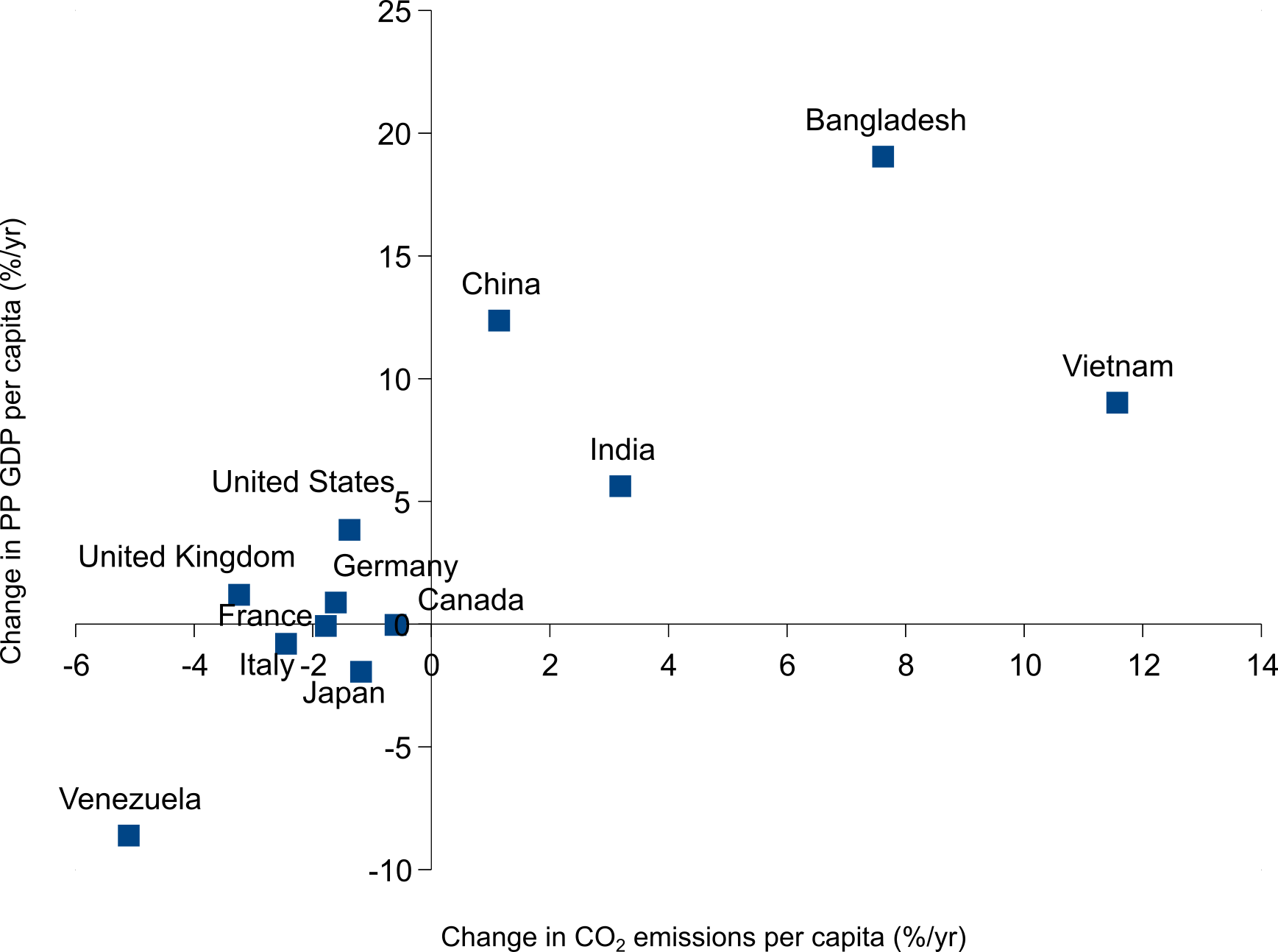
Anyone who thinks the UK unilaterally promising Net Zero by 2050 makes sense is mistaken. If every country had made the same reckless promise, at least we’d all be in the same boat. Because carbon dioxide emissions, unlike most real forms of pollution, do not preferentially affect the place they are produced, our competitors gain as much from our cuts as we do. This is the opposite to reducing local pollution, like, I dunno, tetraethyl lead in petrol. We removed it, and we benefited from the removal. If other countries wanted the same benefit, they had to make the same change. With carbon dioxide, we make the change, and other countries benefit (as stated above, I do not believe there is a measurable benefit). The freeloader effect is real, because the freeloaders are able to avoid the costs of reducing CO2 emissions.
So it would be rational for the UK, rather than acting unilaterally, to have driven a hard bargain, to offer its cuts up in exchange for cuts from others. And those cuts ought not to have been with a target of 2050, or 2060. Distant but impossible promises are easily made, and those who made the promises and set them in law will have left the scene long before the deadline. What if instead all countries had committed to measured, annual cuts? A per capita allowance for everyone on the planet? The UK’s per capita emissions are now not much above the global average (5.37 t CO2/cap/yr vs 4.92 t CO2/cap/yr). We might have pledged to reach the global average. The United States, incessant lectures from the eternally internationally perambulating John Kerry notwithstanding, has emissions of 15.31 t CO2/cap/yr, so you can more or less ignore any promises from that quarter. (I’ll have more to say about alternative approaches in a later blog.)
Costs and benefits of drastic climate action are never mentioned. What is the cost in terms of “damage” to the climate of a tonne of CO2 emitted? Considering the quantities of CO2 emitted (35 Gt per year at the moment – that’s 35,000,000,000 t) the actual damage caused by each tonne has to be trivial, right? Let’s be generous and call it the cost of a pint. £4. The UK’s emissions are 313,000,000 t – less than 1% of the total now. If we could spend £4 X 313,000,000 on eliminating our emissions to zero, the sum would balance. That would cost a pretty penny – just over a billion quid. But the cost of Net Zero is going to be orders of magnitude higher. The subsidies to renewables alone in the UK account for £10 billion – and that’s every year, and it has hardly dented our emissions. The cost of Net Zero is hard to calculate, but it certainly runs into the trillions, just for the UK’s tiny share of the world’s emissions.
Fuel duty, VAT on fuel and the duty itself and vehicle excise duty mean that the UK’s car drivers (petrol and diesel) contribute over £30 billion a year to the Exchequer. That’s a thousand quid a year per household on what is effectively a “carbon tax”, or very approximately £100/tonne CO2 emitted. Electric car drivers pay no duty on their energy, nor duty on their vehicles. They pay 5% or 20% VAT on their electricity, depending on whether their cars are charged at home or at public chargers. This seems like a good way to make the poor poorer to me. So much for levelling up.
When I mentioned installing an air conditioner in the old folks’ home, you probably thought I was being flippant. But it comes down to the logical idea of taking local actions to address local problems. Everywhere you look, humans are having negative effects on the environment, effects that often synergise with whatever effect climate change is having, if any. Examples: using an aircon contributes to the urban heat island. All the concrete and tarmac and brick in our built environment absorbs more solar energy than the leaves of a forest’s trees, thereby causing local heating, again adding to UHI. There is no surprise that the recent record temperatures were mostly at RAF bases or Heathrow airport. Covering the ground with tarmac also exacerbates surface water flooding after heavy rain. Building homes in floodplains leaves us vulnerable to the river overspilling its channel.
Should you reduce carbon dioxide emissions to Net Zero in the hope of reducing future flooding… or build flood defences and upstream catchment water storage? It’s the choice between doing a giant thing that will have a very diffuse impact, if any at all, and a relatively small thing that will have a measurable impact now.
3. Reaching Net Zero will not cause undue harm
So far, the objections to Net Zero are that it is not needed, will not have the desired effect, and is not a solution to real problems. Neither of these objections matter unless there is a cost to Net Zero. The bigger the cost, the more they matter. If Net Zero was free, it wouldn’t matter that we didn’t need to do it, and it wouldn’t matter that it wouldn’t have the desired effect.
But it won’t be free, will it?
To the sceptic, it is very obvious that Net Zero will cost a lot. I personally think it will consume most of the UK’s wealth, if we follow through on it. You may think I’m exaggerating, but I’m not. In my view some reductions in carbon dioxide emissions are easy – or were. We’ve already done those (swapping out coal power stations for gas). Then we have the reductions that are mere accounting tricks and not reductions at all, like relocating manufacturing to China. Then we get to the hard stuff, when the pips start squeaking, like decarbonising electricity. After that, we reach very hard stuff, stuff that causes crippling reductions in wealth, freedom and equality, like decarbonising heating. Then we reach a nugget of almost impossible stuff, like decarbonising transport.
And the 10 billion quid the UK throws at renewables every year – providing handsome profits for their owners, added without our permission to the utility bills of us plebeians – has a massive opportunity cost. Boris promised to build 40 hospitals. At last count he was putting a new coat of paint on three or something. According to a quick search of the web, The Guardian thinks that 40 real hospitals would cost 20 billion quid. So, with advanced maths skills, we can deduce that our subsidies to stupid energy are equivalent to 20 new hospitals – every year.
The fact that renewables are the electricity equivalent of returning to subsistence agriculture is obvious to me but not it seems to our lords and masters. The cheap energy – the good energy – the concentrated energy we are throwing away or gleefully blowing up produced our wealth. The weather-dependent energy we are replacing it with may allow us to linger. That’s as much as I’ll say for it.
The UK’s plan is to ration energy. They won’t call it rationing, but that is what it is. Because for all the hype, energy use and carbon dioxide emissions have not yet been decoupled.

Forget any propaganda about green jobs. Increasing jobs in energy supply are evidence of a declining efficiency of electricity supply. Unless they are jobs in building machines for export. But that ain’t what they are, is it?
No country has ever managed Net Zero. Perhaps we might do an experiment? Perhaps we could get a smallish country to go first and see if it’s possible? Of course not. Instead, we simply set a date in law and expect it to happen with no evidence that it can be done without crippling the country.
Here are some of the places where cuts to nil will have to be made before we reach Avalon:
- Electricity generation. I have no principled objection to solar power or wind farms. But ask yourself this: if I add, let’s say, 1 GW of solar power to the UK’s electricity grid, how many watts of gas generation can I retire? Ask the same question about adding 1 GW of wind. The answer in each case is the same: none. A big fat 0. The weather-dependent “renewables” require backup equivalent to their entire capacity. They require far more cabling to bring power from far-flung places to where people actually live. They require Heath Robinson devices like giant flywheels to balance the grid frequency. In the brave new world, we will need to manufacture our turbines with electricity made solely from carbon-dioxide free generation. We will have to make our concrete for the foundations, by some magic, without emitting CO2 either. But that’s impossible. Don’t believe for a second that turbines or solar panels or concrete will be made in the UK (we’ll just pretend that the stuff we’re importing is CO2 free). International transport of the ones we buy from China will somehow have to be CO2 free. All the rare earth elements will have to be mined without emitting CO2, and refining will have to be carbon neutral too. So far, adding renewables has come at eye-watering, but relatively low cost because there is still gas to pick up the slack. Once it is just them and their backup, presumably here representing millions of lithium-ion battery racks (guess where they are going to be made and using what source of electricity?), your electricity is going to be vastly more expensive than it is now. What’s that, gas is more expensive than wind? Dream on. Investment in gas extraction has been blocked for climate reasons, resulting in a shortage – and this shortage does pre-date Putin’s latest incursion into Ukraine. Curbing exploration and exploitation of new gas resources inevitably leads to such shortage. And shortage leads to inflation, because the demand is still there and is chasing a scarcer resource. It ain’t the science of the rocket.
- Transport. We’ll buy electric cars! Sure. And electric HGVs? (The diesel version of which is to be banned by 2040.) OK again, so our mining, refining, and manufacturing operation has to produce no CO2. Even if cars are assembled in the UK, using power from a fully carbon-dioxide free grid, the lithium will be mined and refined elsewhere, as will the copper, cobalt and all the other necessary metals. We could pretend that China is doing this without emitting CO2, but we’d be kidding ourselves: using an accounting trick to prove our own virtue. There will be no electric planes of any size or range, so we’ll have to forget about a week in the Med. Our lords and masters will still travel the world of course, they’ll just hop in a private jet, presumably fuelled by expensive and inefficient biofuel. And all those folk without off-street parking will have to use expensive public chargers rather than domestic electricity for their third hand EVs. Don’t worry. The wealthier among us have our own driveways, so we’re OK. What will international shipping do? Run on ammonia? Use sails?
- Industry. Manufacturing won’t be done in this country. It will happen in China, where electricity is produced by coal and costs next to nothing. We can still import their stuff and follow our usual business model, which is to simply mark it up and make a profit that way. At least, we can until the public runs out of money. What about all the gas used as feedstock for chemicals? What of fertiliser? Plastic? Rubber?
- Land use. We’ll plant some trees and everything will balance out. Nope. If we covered the entire UK in a new forest it would hardly dent our emissions. And even then, the forest would only draw CO2 out of the atmosphere until it is mature. At that stage, it will be in balance, and emit just as much carbon as it fixes.
- Food and farming. No fertiliser (well, we’ll still have bull***t). No diesel tractors or harvesters. Large areas covered in solar panels. Need I go on? What about imports, which are the lion’s share of our little island’s food? Will they be grown without impact on the environment too? As asked above, what will power the ships that bring our food here? How the **** will we pay for our food imports when we grow nothing, mine nothing, and manufacture nothing?
- Home heating. I have no objection to heat pumps, but it is clear that they are inferior to a gas boiler. They cost far more than a gas boiler. They must be on at all times, won’t work in old houses, and will require supplementary resistive heating either when it is actually cold (i.e. when you need heating) or to raise hot water to a temperature hot enough to kill Legionella. This is supposed to replace the present instant 30 kW hot water on demand provided by your combi boiler? Oh, and I forgot that because electricity supplies will be increasingly tight, if not patchy, you’ll be charged more to make a cup of tea at 5pm than you will at 11am. A Thermos flask is in order. (Or don’t let them install a “smart” meter in your home.)
It is clear that our government in its thirst for Net Zero is asking us to replace good products with worse products. No, scratch that: not asking, telling. You don’t prove United are a better football team by banning City. If you do that, you prove City are better. The same applies to banning gas boilers, petrol cars, and gas power stations. All of them beat the “zero emission” opposition on price as well as utility, so they have to be banned. Did anybody besides the activists ask for this? Was there a national consultation? A referendum? No. All the major parties stitched it up between themselves. For now they will tell us they are for it, whatever they think in their heart of hearts. Support for Net Zero has become a badge of virtue, such that for a politician to argue against it is only possible at serious personal cost. I really don’t know how they’re going to explain it to us when the pain begins to bite, which it will. (The present utility bill crisis is a taster.)
And all these efforts to reach Net Zero will have widespread negative consequences on the world around us. By fixating on carbon dioxide, we take our eye off the real problems facing the planet. Net Zero will make health, poverty and inequality worse wherever its ideology takes root. The number of people dying each year of TB is higher than will ever be killed by climate change. Our direct effects on biodiversity also dwarf whatever effect increasing CO2 levels will have on biodiversity.

Many – perhaps most – rational and honourable people presently support Net Zero. But in my view, those who support Net Zero also unknowingly support locked-in decline for the UK and increasing poverty and inequality for its people.
Conclusion
Climate change is not an existential threat. Net Zero, and in particular unilateral Net Zero in the UK, will have no effect on the problems they say it is supposed to answer. And it will plunge the UK into a permanent decline. The pain will fall predominantly on the poorest among us. There are no answers about how we will feed ourselves, or what will become of our freedom, or our children.
That is why I am against Net Zero.
Featured Image:
The tribulations of farming in the Victorian era. From: Thirsk & Imray (eds). Suffolk Farming in the Nineteenth Century, Suffolk Records Society Vol. 1, 1958


The arguments for net zero, like the policies themselves, seem to look more and more like those of Stalin, Mao and Pol Pot.
LikeLike
I hope you feel better. I could feel the anger and frustration drain from you (or alternately build up) as I read what you had written in this excellent piece. Many of us only know too well the material, but perhaps only you could write it with such justifiable vehemence.
LikeLike
Masterful. Packed with logic. Should be compulsory reading for all Parliamentarians.
LikeLike
Well I do (.not deny the role of carbon dioxide as a greenhouse gas) And I will explain why. Co2 is only .04 of the whole atmosphere.
https://news.climate.columbia.edu/2019/07/30/co2-drives-global-warming/
Now in a real Greenhouse, if we remove the windows, the greenhouse gets much cooler. But if we remove a speck of dust or sweep the floor, how much cooler will be be verses removing the windows. Another example.If we remove 411ppm atoms from our front door it the door still there. Please give examples where a tiny change makes a huge difference. If you remove 411ppm water atoms from a wave, does that stop the wave?
And fighting nature is a VERY VERY BAD idea. It is always best to let nature take care of itself. Nature can evolve and fix itself. And again the little bit man does carbon wise is a speck of dust compared to what nature itself does. IT is the arrogance of man that feels nature needs a hand. The nature take care of itself. It already has a plan in motion. And of plans of man make problems much worse. Man and nature have been around together for a long time. Man’s “NET ZERO” might be natures plan for getting rid of the problem (MAN) After all man has a history of making mountains out of ant hills
.
Want more proof of this flawed science Look at the Year without Summer. And what happened before that?
https://www.almanac.com/year-without-summer-mount-tambora-volcanic-eruption
A volcano erupted and released MORE CARBON and instead of the year of “no winter”, we got the YEAR OF NO SUMMER. So if man got to net zero, it would not cool the planet. It would turn this planet into another Venus like planet. Baked Human anyone?
LikeLike
Hunterson, we in the West still live in democracies, so that in theory Net Zero can still be overturned. Personally I don’t doubt that it will. At the moment the ploy seems to be to point the finger of blame for our troubles at things other than Net Zero. To some extent this might be working, but I don’t see how it can continue to work indefinitely.
Alan, this piece was revised a few times, usually by the addition of something I had forgotten to mention and/or to tone down the language. For as I said, the advocates for Net Zero are not in fact anti-human. They no doubt believe that the path we are on is the best path. So as tempting as it is to be angry with them, I don’t think it’s fair to. Perhaps we should be angry instead with human nature, which has allowed this moral snowball to develop into such a juggernaut.
Mark, thanks for the kind words, but I fear a bit more revision would have improved things. The trouble is, you can tinker endlessly, particularly when a piece reaches a certain size.
Steve, experiment shows that gases absorb radiation. That includes CO2 absorbing IR and ozone absorbing UV (the latter particularly useful for humans). How a photon interacts with an electron is something I do not fully understand. The greenhouse effect is poorly named, but we’re stuck with it. The point about CO2 being a trace gas is true, but there’s enough to absorb lots of upwelling IR. In Denierland I made a toy model of the Earth’s atmosphere, and my very crude calculation was that only 26% of IR made it “directly” to space. Of course adding more CO2 to the atmosphere brings diminishing returns in reducing that number.
LikeLike
I should have added a request that if anyone has any reasons to oppose Net Zero that I’ve overlooked, to please let me know here. Also if on the other side there are measurable co-benefits, or if I have exaggerated some of the downsides.
LikeLiked by 1 person
Hello JIT,
Was the timing of your article prompted by the GWPF’s recent report on the EU’s costly green experiment in unilateral energy policy? I ask since your essay seems to complement the latter so well.
Click to access EU-Climate-Policy-Failure.pdf
Since the GWPF’s report is rather long – some 70 pages – I had begun to put together a note on some of the key points from it. However, I will not put them up here while we are discussing your essay.
Regards,
John.
LikeLike
John, I have read John Constable’s report and a summary of it is on my to-do list. One or two of the figures are very striking.
The above piece was genuinely prompted by a question from someone who has not been as focussed on this craziness for as long as we have. We tend to forget that the climate-obsessed are a minority. (But as energy costs bite, more people are sure to ask why, and the answer is not entirely “Putin.”)
LikeLike
Thank you Jit for your comments.
While almost the whole of John Constable’s EU climate/energy report is chilling I was particularly struck by this from page 3, “A change in course is inevitable and will be forced on member states sooner or later, but the deeply embedded harm of nearly thirty years of error means even a prudent policy correction towards fundamentally cheaper energy will require substantial reductions in European living standards. Failing to undertake this correction as soon as possible will result in still deeper damage and even more costly remedial action. Explaining this to the European people will form the
greatest political challenge of the next fifty years.”
Click to access EU-Climate-Policy-Failure.pdf
I look forward to your review of Constable’s report. But for the moment I think I might simply say, “Advantage, China!” or “Pity about the EU.”
Regards,
John.
LikeLiked by 1 person
“The Headlong Rush to ‘Net Zero’ Makes a New Great Depression a Racing Certainty”
https://dailysceptic.org/2022/09/29/the-headlong-rush-to-net-zero-makes-a-new-great-depression-a-racing-certainty/
LikeLike
A good article today by Benny Peiser and Andrew Montford in the Daily Sceptic:
“Net Zero is Being Mugged by Reality and the People Are Waking Up”
https://dailysceptic.org/2023/04/26/net-zero-is-being-mugged-by-reality-and-the-people-are-waking-up/
LikeLiked by 1 person
I do sometimes wonder if there is a little too much hopium on “our” side. I’ve long thought that Net Zero would crash and burn when it began to bite. But evidence seems to show that folks are quite gullible and have bought into various gaslighting schemes – such as that the high cost of gas is because we have too much of it, or that wind/solar power must be cheap because everyone says it is. No doubt a tipping point is inevitable, but Peiser & Montford seem to be too optimistic here.
LikeLiked by 1 person
If Net Zero doesn’t crash and burn this side of an election, then I fear the UK will crash and burn and regardless of how many people subsequently wake up to the disaster which has been inflicted upon us by the Net Zero cult, the path back to liberty and prosperity will be extremely arduous and long, even supposing by then it is possible. A Labour-lite Starmer government will seal the fate of the nation, for sure.
LikeLike
Speaking of reasons to oppose net zero:
“Energy: the road to madness”
https://www.turbulenttimes.co.uk/news/front-page/energy-the-road-to-madness/
LikeLiked by 1 person
It’s hard not to think now that the attempt to get to Net Zero is the goal, not Net Zero itself, which is obviously unattainable, nationally, and totally pointless anyway because even if it was achievable, China and India – who have no intention of decarbonising their economies – would make up for our lost emissions in the space of a few days, weeks or months. Even thick as mince politicians must realise this by now. Something else is driving them to push this country to the brink of economic destruction and social disintegration.
LikeLike
Jaime, of course Net Zero as a physical thing is not the goal, it is just the salvation half of a fairy-tale cultural narrative, the other half of which is a millenarian global catastrophe not even supported by mainstream science (however bad it may be) let alone anything sceptical. The ‘goal’ is only the continued survival and expansion of the culture of climate catastrophism. Except in that it’s a route of attack, which Robin remorselessly pursues, it is completely irrelevant what is happening in China or India; cultural narratives have no logical justification, and in fact the more fantastically distanced they are from reality, the better they work at convincing emotively and bypassing rationality. And the politicians, plus still a great majority of all public authorities, despite reality biting much harder in the last two years, are not keeping their hand on the tiller merely because they are thick, I doubt very much that the average IQ of politicians is any different to that of the general population. Communally, their hand remains firm because, unfortunately along with many millions of others who are *subconsciously* co-ordinated through the culture, they *believe*. If this was a merely a case of an embarrassing lack of IQ in some quarters, it’d all be over by tea-time. Sadly, lots of very intelligent people are giving it their all, which is one reason why it’s so damn hard to defeat.
LikeLiked by 1 person
“Batteries Will Not Solve Renewable Energy Storage Problem, Says Royal Society”
https://dailysceptic.org/2023/10/03/batteries-will-not-solve-renewable-energy-storage-problem-says-royal-society/
LikeLiked by 1 person
I doubt that even hydrogen would leak from “porous salt caverns” except via the access point into and out of the cavern. Cavern walls would not be porous because they would be formed of bedded salt which has survived for many tens of millions of years without contact with water (which would have dissolved it). Any porosity would have allowed contact with groundwater.
There have been floodings of salt mines in various parts of the world. Water enters via the artificial entrance (poor design) or by mining too close to the edge of the salt (crass stupidity, insufficient planning).
LikeLike
This storage cavern has been running for about 30 years according to Wiki:
“The Chevron Phillips Clemens Terminal in Texas has stored hydrogen since the 1980s in a solution-mined salt cavern. The cavern roof is about 2,800 feet (850 m) underground. The cavern is a cylinder with a diameter of 160 feet (49 m), a height of 1,000 feet (300 m), and a usable hydrogen capacity of 1,066 million cubic feet (30.2×10⁶ m3), or 2,520 metric tons
(2,480 long tons; 2,780 short tons)”
LikeLike
Sorry, Mike. It happened again…
LikeLike
No worries, Mark.
Odd that this should start happening when I have been an intermittent poster here for quite a while.
Another odd thing I’ve just noticed, I can no longer put in paragraph breaks – bizarre!
LikeLike
““Net Zero Fanaticism Won’t Attract Investment to Britain””
https://dailysceptic.org/2023/10/07/net-zero-fanaticism-wont-attract-investment-to-britain/
For those who aren’t affected by the Telegraph paywall, the original article can be found here:
https://www.telegraph.co.uk/news/2023/10/06/net-zero-fanaticism-wont-attract-people-to-britain/
LikeLike