One of my favorite celebrity scientist targets for mocking has just died: Paul Ehrlich. I don’t want to piss on his grave, but I do think a little good natured mocking is in order for someone this infamous and besides, I had a great idea for a cartoon. Most of the tweets I’ve been responding to have been extremely scathing. As far as my cartoon image goes, I seem to be in a marathon spamming race with someone posting an image of the check that Ehrlich sent to economist Julian Simon. Just to recap his famous bet, in 1980 Ehrlich and Simon bet on the inflation adjusted rise or fall in the price of a $1000 basket of five commodity metals in ten years. Simon let Ehrlich pick the metals with Simon winning the the amount if the price decreased and Ehrlich winning the price if they increased. Future Obama science adviser, John Holdren, helped Ehrlich pick the metals: copper, chromium, nickel, tin, and tungsten. In 1990, Ehrlich quietly sent Simon an envelope containing a check (nothing else) for $576.07. For those interested in a book length treatment, there’s Paul Sabin’s, The Bet.
I read The Bet when it came out in 2013 and it’s a good read with a lot of back story on the two men and even some surprises. Simon was lucky in the timing of his bet. He would’ve lost at many other starting points (not all) in their careers. I never got around to writing an Amazon review for The Bet, because I kept delusionally telling myself I was going to draw a cartoon to include with Amazon’s picture feature. When I was younger in high school and college, I could draw fairly well but never really pursued it and broke my mom’s heart. My skills had sort of atrophied, I’m by nature sort of lazy and shiftless and getting faces right is really hard. But now we’ve got AI imaging to act as our personal art department and I already had this great cartoon idea. I had Chat GPT make a panel of Ehrlich writing the check with Holdren looking on and a panel with Simon getting the check at his mailbox. I stacked them together so they’d be easily visible in a tweet:
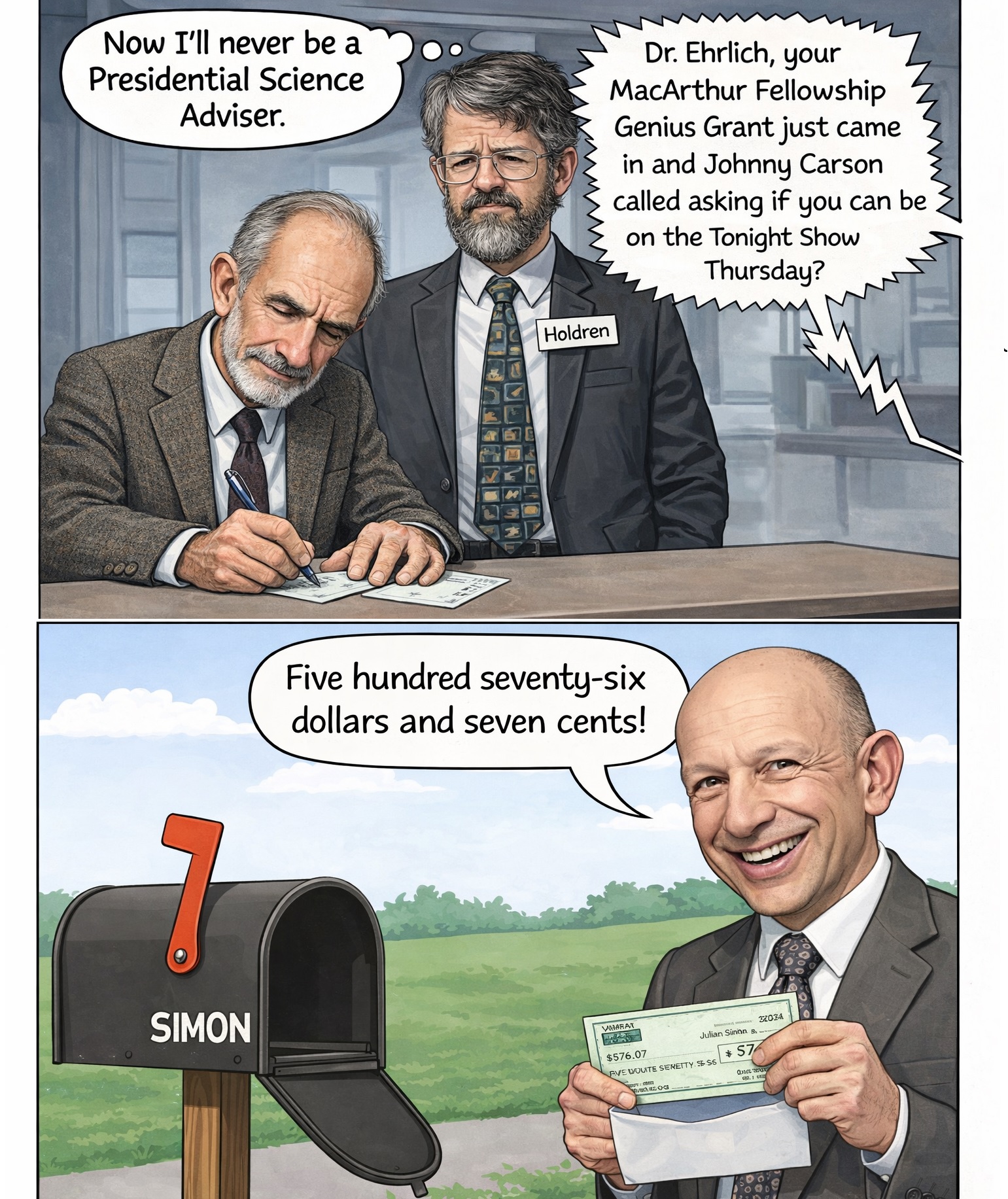
I managed to get in just under Chat GPT’s image limit for the day. I might’ve been able to do it with Grok Imaging, but I think it would’ve taken forever to rearrange and refine slop like this:

I’m grateful to the AI industry for allowing me to put my cartoon idea to use. As much as I disliked his ideas, Paul Ehrlich has always been a source of amusement and a target for making light of the green blob. Here’s something I used to like to post in comment sections:

Michael Shermer of Skeptic Magazine probably did the last interview with him:
About Shermer and Ehrlich, back when Bjorn Lomborg published The Skeptical Environmentalist, Shermer was organizing and hosting a lecture series at Cal Tech and wanted to do one with Lomborg, but wanted it to be a debate. He was having trouble finding someone who’d debate him and when he tried Ehrlich:
.. I contacted all of the top environmental organizations, and to a one they all refused to participate. “There is no debate,” one told me. “We don’t want to dignify that book,” said another. I even called Paul Ehrlich, the author of the wildly popular bestselling book The Population Bomb — another apocalyptic prognostication that served as something of a catalyst in the 1970s for delimiting population growth — but he turned me down flat, warning me in no uncertain language that my reputation within the scientific community would be irreparably harmed if I went through with it. So of course I did because (A) truth is more important than reputation, and (B) no one threatens me and gets away with it. ..
One of Ehrlich’s longtime critics has been Reason’s Ronald Bailey. He has a fairly concise post noting his death and listing his most famous prediction bombs:
The author of The Population Bomb was never right but never in doubt that the world was about to end.
..
Instead of a population collapse due to mass starvation, the world population grew from 3.5 billion in 1968 to 8.3 billion today. Instead of a substantial increase in the world death rate, it fell from 12 per 1,000 people in 1968 to 8 per 1,000 people in 2023. Farmers deploying modern tech have boosted the number of daily calories per person by more than a third since the 1960s. Consequently, rather than millions starving, the proportion of undernourished people in developing countries declined from 37 percent in 1969–71 to 8.2 percent in 2024. Global average life expectancy at birth rose from 57 years in 1968 to 73 years in 2023.
I have a copy of an old podcast called The Libertarian Dime that’s no longer available online where they interview Ronald Bailey. In the late 80s, he went and revisited a bunch of doomsayer predictions such as the Club of Rome’s Limits to Growth, Rachel Carson’s Silent Spring and Paul Ehrlich’s The Population Bomb:
I called up Paul Ehrlich and I quoted various lines back to him and he got very impatient with me and informed me that he was still right, that he just got his timing wrong and that the famines would occur around the year 2000. I note it’s 2010 now.
I’ll certainly miss having Paul Ehrlich around for his amusingly absurd takes on what’s happening, but we still have Michael Mann:
On a final note, there were so many tweets in my feed trashing Ehrlich that I was posting my cartoon to that Twitter/X started limiting its visibility due to spamming. Also, one of the problems with Grok was that I forgot to upload my reference photos titled Bet-01 thru Bet-02, but still ..


But Ehrlich was a ‘scientific crusader’, don’t you know? At least that is what The Conversation is telling me:
https://theconversation.com/paul-ehrlich-often-called-alarmist-for-dire-warnings-about-human-harms-to-the-earth-believed-scientists-had-a-responsibility-to-speak-out-178492
Essentially, the article goes like this: He was a scientist warning of doom in order to influence political opinion, and we can never get enough of such individuals. And whilst his predictions regarding the future may have always been wrong factually, they always remained right in principle.
Personally, I think the factuality of predictions should be the true hallmark of an expert. Standing by principles in the face of overwhelming evidence is for losers. At least that is what we climate sceptics keep getting told.
LikeLiked by 4 people
John,
Remained right in principle? We really are dealing with religious faith!
LikeLiked by 2 people
John,
ALso from that articel at The Conversation, about Paul Ehrlich:
These stark warnings, while overstated, seemed at least plausible at the time.
Remind you of anything?
LikeLiked by 1 person
False alarm, Ehrlich is fine.
Latest reports are he’ll be dead by 2030. Ten years at the absolute most.
LikeLiked by 3 people
Brad – that was funny, worthy of a Josh cartoon.
ps – not heard from Josh cartoon man for a while!!!
LikeLike
Crusader extraordinaire.
https://en.wikipedia.org/wiki/Don_Quixote_%28Picasso%29#/media/File:Don_Quixote_(1955)_by_Pablo_Picasso.jpg
LikeLike
Poor old Paul, who will replace him as the punching bag for failed prophets now?
From Wikipedia
Ehrlich wrote in The Population Bomb that, “India couldn’t possibly feed two hundred million more people by 1980.” In 1967, Ehrlich called to cut off emergency food aid to India as “hopeless”.
In 1967, the population of india was about 515 million, it is now nearly 1.5 billion and its economy (thanks to being relatively democratic, English speaking, tech savy, and politically independent) is likely the mega geopolitical force of the next century.
LikeLiked by 1 person