Just a quick one from me. I got to wondering, now that we have a Zero-Emissions Vehicle Mandate, has this changed how many cars different manufacturers are selling? There are an increasing number of EVs on the road around these parts, and some of them are from manufacturers I’d never heard of until last year at the earliest. One might suspect that, thanks to the ZEV mandate, manufacturers who only make EVs would be caning it right now. What is happening to the legacy car makers? [Calling them “legacy” almost makes it seem as if they are already written out of the script, but what I meant was manufacturers that didn’t just appear last week.]
To investigate this question, I got the data on vehicle registration, stratified by cars (noting at this point that there are plenty of errors in the “official” data table, and that a very small number are old vehicles imported or re-registered), and tallied up the cars registered in the most recent available quarter – Q2 2025 – compared with the same quarter a decade ago, in 2015. (The table, df_VEH0160_UK, only goes back to Q3 2014. No doubt older data is available somewhere.) The figure shows the change in the number of registrations between the two quarters, a decade apart, for each manufacturer with at least a thousand cars in one or both quarters. Which manufacturers sell more than before, and which sell fewer?
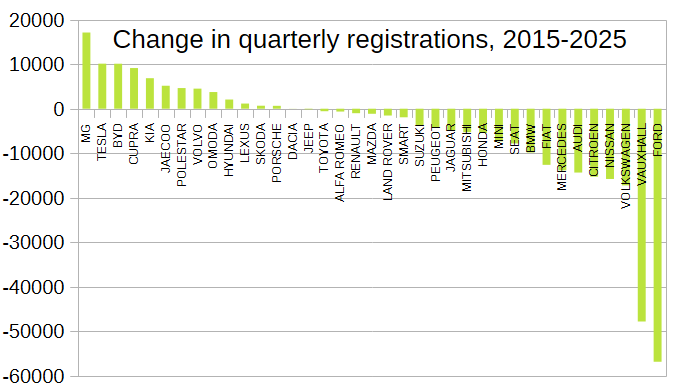
The biggest winner is MG, selling 17k more in a quarter than ten years ago. The biggest loser is Ford, selling 57k fewer in a quarter than a decade ago.
Caveat: this says nothing about profitability. It just shows the number of cars registered. Some might note particular characteristics of the growing and shrinking manufacturers, too. I should probably mention that some of the winners did not sell a single car in the UK in 2015. Also, that Cupra is a Seat. So the gain in one and the loss in the other do not really tell a tale on net.
Also available is manufacturing data from the SMMT. The version I have goes back to 2019. Looking at the above figure I wondered whether the proportion of cars registered in the UK, and manufactured here, might be declining.
This figure shows UK car production, for the domestic market, as a percentage of overall registrations, averaged for the year as a whole. In 2019, domestic production was 10.5% of registrations; in 2024, 8.8%. This year (first six months only) it is 8.4%. [It isn’t. The “SA” means “seasonally-adjusted” by the boffins at ONS. Nevertheless, this is their smoothed number.]

The final figure shows the total car production in the UK, as reported by the SMMT, whether for domestic supply or export, by month. I think I see a trend there. If you put a line through the data since the ZEV began, the slope is -6500 cars per month per year. That puts the UK car industry as extinct by 2035.

Zero Emissions Vehicle mandate? Or Zero Vehicle mandate?
[Image: Ford workers postcard, c.1918. The following one, “a single day’s output,” is probably cooler:]

 Climate Scepticism
The final graph is, of course, the most significant.
Surely the people at the Department for Business and Trade are aware of this? Do they care? Does Peter Kyle speak to Ed Miliband? Do either of them care?
LikeLike
They wont care as they will have a lovely chuaffuer driven car courtesy of joe public.
LikeLike
Zero Emissions Mandate thought up by people with zero knowledge of business, implemented by people with zero knowledge of business and ultimately the fact that at the stroke of a pen, 1,250,000 people are out off high value work…….still there’s always shelves to fill on minimum wages at the supermarkets.
LikeLiked by 1 person
On this morning’s BBC:
Ford boss: ‘Now is not the time to tax electric vehicles’
As we know, EVs have various advantages tax wise: no duty on fuel. Until recently, lower VED. Lower tax rates when used as business vehicles. And recently, a reinstated grant for purchasers.
But now is not the time to level the playing field. Because this year, Ford has to hit 28% EVs, or be fined.
Saith one of Ford UK’s bosses,
They’ve gone from being “a great thing” to something that they can’t shift.
Saith the BBC, misinforming:
As I still have the spreadsheet on registrations open, I can Cliscep Verify their statement. Stand by for that in the next comment.
LikeLike
Cliscep Verify can confirm that Pumas are the top-selling UK car in the last available quarter, at 11,350 registrations. However, in 2015 Q2 Fiestas outsold Focuses: 32,251 vs 22,727. (I haven’t checked other quarters. Fiestas no longer exist, and 2025 Q2 was the end of the Focus.)
That figure of 11,350 sales of Pumas deserves some context. In 2015 Q2, 8 models sold more. In descending order: Fiesta, Focus, Corsa, Golf, Qashqai, Astra, Polo, Fiat 500.
Meanwhile, the Ford boss is pictured in a back alley somewhere holding the plug in her new black Capri that no-one wants (sales Q2 2025: 1,158). I’m sure you used to see bosses doing similar things at fuel pumps. The difference being, they were posing for something that didn’t involve leaving and coming back an hour later. Then, they were selling freedom. Now, they are selling inconvience.
LikeLiked by 2 people
Jit,
That story (about now not being the time to tax EVs) exposes the economic illiteracy at the heart of the current Labour government. They add to costs of employment (employers’ national insurance, high electricity prices, carbon taxes on gas) while claiming their mission is to grow the economy. The economy (surprise, surprise) fails to grow, so the Chancellor of the Exchequer (who a year ago said that last year’s tax rises were the last – she wouldn’t be coming back for more) now has to come back for me.
But who and what to tax? EVs are an obvious target, since motoring taxes must now be falling, thanks to reduced revenues from fuel duty and VED, given the privileged position extended to EVs until now. But even with the tax perks and subsidies, EVs remain unpopular, and look increasingly unlikely to achieve the government’s Stalinist target for EV take-up. What to do? Tax them to fill the (self-created) black hole, and watch take-up decline? Not tax them, in a desperate attempt to achieve the Stalinist target, but watch revenues continue to decline?
Truly, the adults most certainly are not back in the room. The toddlers have taken over the nursery, and are busy smashing it up, effectively unsupervised.
LikeLiked by 3 people