I’m not going to editorialise about this, because I will end up ranting incoherently and/or break the keyboard. Instead, I’m just showing the BBC’s headline, and the data that support it. The latter comes from the Australian Institute of Marine Science.
Here’s the data as presented by AIMS:
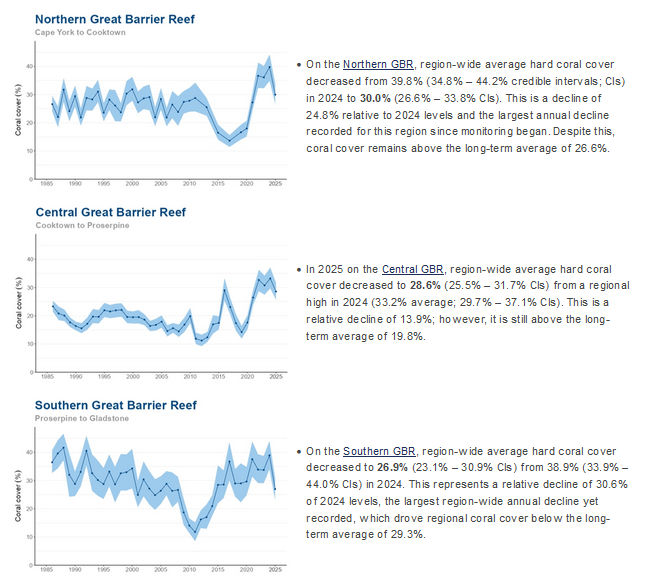
The “worst coral decline on record” is the final downtick in the figures. The BBC headline:
Great Barrier Reef suffers worst coral decline on record
The headline is, in many respects, accurate. But its story is very partial in its presentation. No-one reading it, without any other source of information, would have any idea that the reef’s coral is presently relatively high, certainly very high compared to the situation 13 years ago. The reader “well-informed” by the BBC would be fearful of the reef’s hopes of survival from this year to next. (Do let me know if you disagree.)
As I said below my survey of alarmist headlines about the GBR three years ago,
My prediction is that the Great Barrier Reef will continue to be destroyed, year in and year out, but that it will nevertheless endure for millions of years to come.
Alan injected a note of caution into my optimism; but he was more afraid of falling sea levels during future glaciations than the reef cooking during today’s climate panic.


Thanks for this – I didn’t have time to write anything, but if I had I would have been tempted to do so. Here’s Toby Young on the subject:
https://x.com/toadmeister/status/1953141307896946865
And Chris Morrison at the Daily Sceptic a week ago:
https://dailysceptic.org/2025/07/31/mainstream-naysayers-gather-as-hopes-rise-for-fourth-year-of-record-coral-on-the-great-barrier-reef/
LikeLike
“Coral on Great Barrier Reef at Fifth Highest Level Since Records Began – but Mainstream Media Still Spin ‘Tipping Point’ Narrative”
https://dailysceptic.org/2025/08/07/coral-on-great-barrier-reef-at-fifth-highest-level-since-records-began-but-mainstream-media-still-spin-tipping-point-narrative/
LikeLiked by 1 person
Thanks for noting this particular journalistic malfeasance yet again pointed at the Great Barrier Reef. We Australians are almost too wearied to the bone marrow with these reptititions to be much bothered.
I agree with Alan Kendall that lowering sea levels (such as has occurred since the Holocene Max) are a bigger long term threat than ENSO to the GBR. Deeper mapping of the GBR has demonstrated this over its’ measured history,
LikeLike
No comment:
“‘If the reef had a voice, it would sing’: could legal personhood help the Great Barrier Reef?”
https://www.theguardian.com/environment/2025/aug/09/great-barrier-reef-legal-rights-personhood
LikeLike
It’s worth re posting a map that I used in the earlier GBR note.
This is why climate change does not spell doom for coral reefs: because they are confined to the hottest part of the oceans at the moment. Also note their presence in the Red Sea, hotter than the Coral Sea.
Also: Jo Nova’s coverage.
LikeLiked by 1 person
Jit,
I’m sure you’ll love this:
https://www.theguardian.com/media/commentisfree/2025/aug/08/pretty-bloomin-what-the-great-barrier-reef-is-a-picture-of-health-the-australian-assures-us
Guardian journalists need to look at facts, not headlines, I would suggest.
LikeLike
Mark – what a weird article
LikeLike
don’t these “nut cases” realise that 20,000 years ago the present Barrier Reef didn’t exist because sea level was 120 metres lower than present towards the end of the last glaciation when half of the northern hemisphere was covered in ice!!!
LikeLiked by 2 people
This article in my old friend The Conversation is not about the GBR but is initially focused on Caribbean coral reefs. However it expresses serious concern about global coastal ecosystems and notes that this has implications for us all.
Three extracts:
I posted a comment two days ago. And, as nearly always happens, none of the three ‘distinguished’ authors has deigned to reply. One of them is Chris Perry, Professor in Tropical Coastal Geoscience at the University of Exeter. I have his email address and, if he doesn’t reply, I’ll email him repeating my comment.
LikeLiked by 1 person
“The science is blunt” . . . . like the intellect of the people promoting it.
LikeLike
“Planet’s first catastrophic climate tipping point reached, report says, with coral reefs facing ‘widespread dieback’
Unless global heating is reduced to 1.2C ‘as fast as possible’, warm water coral reefs will not remain ‘at any meaningful scale’, a report by 160 scientists from 23 countries warns”
https://www.theguardian.com/environment/2025/oct/13/coral-reefs-ice-sheets-amazon-rainforest-tipping-point-global-heating-scientists-report
The earth has reached its first catastrophic tipping point linked to greenhouse gas emissions, with warm water coral reefs now facing a long-term decline and risking the livelihoods of hundreds of millions of people, according to a new report.
The report from scientists and conservationists warns the world is also “on the brink” of reaching other tipping points, including the dieback of the Amazon, the collapse of major ocean currents and the loss of ice sheets….
Risking the livelihoods of hundreds of millions of people? Really? And hasn’t coral thrived in past periods that were much warmer than now? Oh yes, hang on a minute:
…But some experts have questioned the report’s claims about the fate of coral reefs, with one saying while they are in decline there is evidence they could remain viable at higher temperatures than suggested.…
Funnily enough, that huge question mark didn’t make it in to the apocalyptic headline.
LikeLiked by 1 person
You only have to look at the distribution of coral reefs globally – map a few comments above – to know that what these scientists claim is simply not possible. They could argue that some places will be too warm for coral. But that would be a far more nuanced story. Plus, there is coral in the hottest sea, the Red Sea.
LikeLiked by 2 people
https://notalotofpeopleknowthat.wordpress.com/2026/08/02/2026-great-barrier-reef-statistics-they-told-us-a-fairy-tale/
LikeLike