Previous instalments in this occasional series:
| Iceberg | Calved | Notes |
| A68 | August 2017 | Reached South Georgia December 2020; broke up in February 2021; BAS (November 2020) says it might be stuck at South Georgia for 10 years; penguins in peril, according to the alarmist media |
| A38 | October 1998 | Reached South Georgia December 2003; broke up October 2004 |
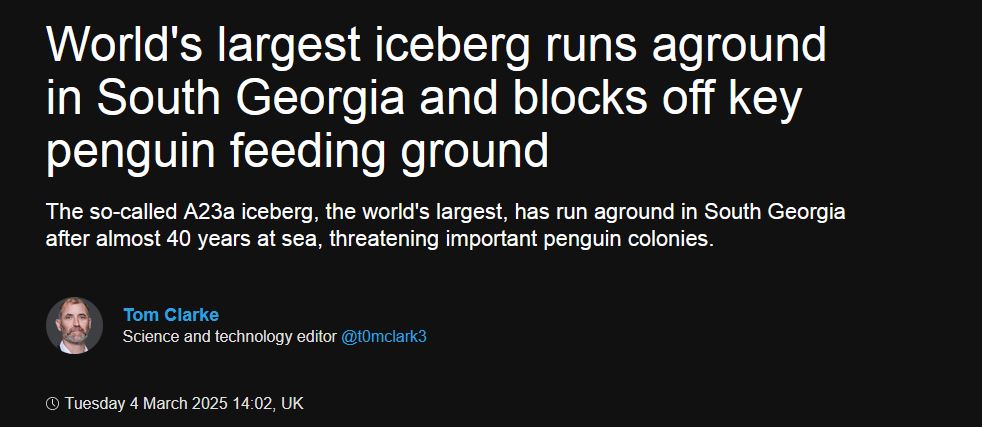
| A23 [See comments below A38 story.] | 1986 | Grounded in the shallows near South Georgia in March 2025; “Blocks off key penguin feeding ground.” |
There was another giant iceberg, which is said to have killed penguins, and to have hung about for a decade. And that might make the reader think that the 10 year hype about A68 might have had some foundation. It didn’t.
The iceberg in question was given the terrifying name B9 when it split from the Ross Ice Shelf [160W, 79S] in October 1987. According to Keys et al (1990), its size was as follows: 154*35 km = 4540 km2, maximum draught 250 m, freeboard 50 m, >1000 km3.
Two years later (August 1989), B9 broke into three pieces by Cape Adare. B9B was 100*35 km, and was the penguins’ nemesis.
B9B drifted anticlockwise along the Antarctic coast, and reached the Merz Glacier [145E, 67S] in February 2010. Still 90 km long, it knocked off a 70 km-long chunk of the Merz Glacier tongue.

It then drifted on a little further, breaking up, the pieces becoming lodged outside Commonwealth Bay [143E].

What about the poor penguins?
B9B did not cause the trouble directly, by parking in the way of the penguins. Rather, it blocked the anticlockwise flow of pack ice, which piled up and froze solid. Another factor may have been that the position of B9B meant that the usual very strong winds blowing seaward from Commonwealth Bay were no longer able to blow the ice away from shore. At any rate, the usually reliably open water was jammed up, and the Adelie penguins of Commonwealth Bay were imperilled. That’s because their usual brief slip-slide-skip-jump to open water from the nesting grounds suddenly became a marathon, even after B9B broke up into 3 large chunks.
In the southern summer of 2013-14, intrepid explorers arrived to assess the sitch. Readers of a climate-sceptical bent might recognise the term “Ship of Fools” – and indeed it was members of the ill-fated holiday, er, scientific expedition, who managed to get a day ashore to count penguins, just before their ship froze into the ice. [See Steve McIntyre’s timeline of the debacle.] The Commonwealth Bay penguins were observed on 20 December, and the Hodgeman Islands penguins [ice-free, and population unaffected] on the 23rd, the very day the Ship of Fools got stuck.
The results of the surveys were reported in Wilson et al, which includes a thank you for the Guardian’s Alok Jha, who presumably carried a spotting scope ashore or something. They are not controversial, I think: naturally, the more onerous is your trip to reach open water to catch fish, the lower your fledging success is going to be.
By 2016, some iceberg fragments were still present (including the largest), but the bay was fairly open.
The larger of the three pieces of B9B is still close by in 2025, but it has been pushed offshore somewhat, and in this image, Commonwealth Bay is open, and the penguins are (presumably) happy again.

The impact of B9B on the Adelie penguins of Commonwealth Bay probably lasted half a decade. But there is a huge difference between a giant berg stuck in Commonwealth Bay, and stuck in the shallows by South Georgia. The former is much further south, and stuck in fast ice for large chunks of the year. The latter is open to wind and wave all the time. Yes, the water by South Georgia is cold – but not as cold as the water off Commonwealth Bay. In sum, there is the prospect that a drifting iceberg may get lodged in a position to offend penguins for a decade on the coast of the Antarctic continent itself – but no prospect of a similar occurrence off South Georgia. Note also that the problem with B9B was the way it backed up drifting ice and changed the usual system of polynyas. No such problem can possibly occur at South Georgia.
I might also note that such problems will have occurred since time immemorial, out of the eye of humans looking for something to alarm one another with.
What about A23, the berg now stuck in the shallows by South Georgia?
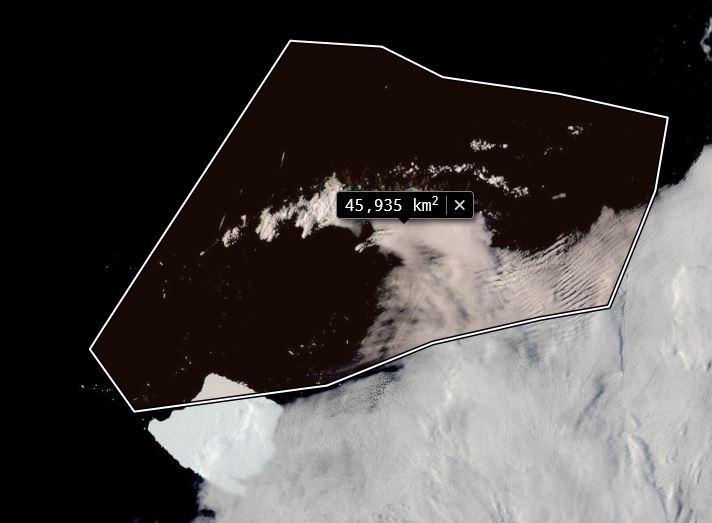
I took this snip of a satellite (Terra / Aqua again) pic on the very day Sky’s Science and Technology Editor made this pronouncement, so that readers can see just how much of the penguins’ feeding grounds are “blocked off” by “so-called A23a.” The polygon shown roughs out the shallow waters around South Georgia. ‘Nuff said?
 Climate Scepticism
In fairness to the BBC (words I don’t type very often) its reporting on the latest grounded glacier is almost balanced:
https://www.bbc.co.uk/news/articles/c20d1xp6046o
... In 2004 an iceberg in a different area called the Ross Sea affected the breeding success of penguins, leading to a spike in deaths.
But experts now think that most of South Georgia’s birds and animals will escape that fate….
Having said that, the article does end in the inevitable and utterly predictable way:
...The life cycle of icebergs is a natural process, but climate change is expected to create more icebergs as Antarctica warms and becomes more unstable.
More could break away from the continent’s vast ice sheets and melt at quicker rates, disrupting patterns of wildlife and fishing in the region.
LikeLiked by 1 person
What’s this? A positive headline?
“World’s biggest iceberg runs aground after long journey from Antarctica
Scientists are studying whether the grounded A23a iceberg might help stir nutrients and make food more available for penguins and seals”
https://www.theguardian.com/environment/2025/mar/05/a23a-iceberg-runs-aground-south-georgia-climate
…However in its current location, the iceberg could offer benefits to wildlife.
“Nutrients stirred up by the grounding [of the iceberg] and from its melt may boost food availability for the whole regional ecosystem, including for charismatic penguins and seals, Meijers said….
LikeLike
“World’s biggest iceberg breaks up after 40 years: ‘Most don’t make it this far’
‘Megaberg’ known as A23a has rapidly disintegrated in warmer warmers and could disappear within weeks”
https://www.theguardian.com/environment/2025/sep/02/worlds-biggest-iceberg-crumbles-apart
…Iceberg calving is a natural process. But scientists say the rate at which they were being lost from Antarctica is increasing, probably because of human induced climate change.
LikeLiked by 1 person
Here’s a satellite view from a couple of days ago, with the shallower water roughed out. Source: Terra here.
LikeLike
“This iceberg was once the biggest in the world. Now it has just weeks left”
BBC quite excited by the demise of A23.
Sure.
LikeLiked by 1 person
Jit – you forgot the context “But first we have to go back to 1986. That year, a nuclear reactor exploded at the Chernobyl power plant in what is now northern Ukraine, Gary Lineker won the golden boot at the Fifa World Cup in Mexico, and Whitney Houston received her first Grammy award.”
Back to the article, it mentions “Iceberg Alley” & “While it’s likely icebergs have lived longer in the Earth’s distant past, A23a is thought to be the oldest iceberg in the world today, at least among those picked up by satellites and tracked by scientists.
“Its journey is really pretty impressive, just for sheer longevity,” says Dr Christopher Shuman, a retired scientist formerly with the University of Maryland, Baltimore County, in the US. He likens tracking its path to watching a TV drama “where you don’t know what you’re going to see next”.”
Well most TV drama’s are predicable, as was the melting.
LikeLiked by 1 person