I like lithium batteries. My 2019 iPhone has a lithium battery, and it shows no signs of degrading just yet. But when it comes to grid-scale batteries, is it a case of horses for courses?
In response to a comment by Mark, where he quoted the Guardian as saying
The NatPower investment would lead to the construction of 60 gigawatt hours of battery storage
I visited the internet, wondering not so much at first how much said storage would cost… but how much mass it would be. The cost was there in the quote – £10 billion, ’twas said. Not that much. Hardly enough to buy a couple of aircraft carriers (with or without the appropriate launch facilities for the best version of the available planes).
So, what about the mass? I mean, 60 jiggawatt-hours of battery is probably heavy enough to cause Britain to capsize or something.
Naturally, the internet is reluctant to divulge its secrets. But according to Electrek, a Tesla Megapack of 3.9 MWh is 83,996 lbs “max,” or, if you prefer, 38,180 kg. (This is for an LFP battery, which in September 2022 Electrek seemed to think Tesla had begun to use.)
However, it is a little difficult to work out what that mass comprises. It’s about 1% lithium, according to somewhere else on the internet.
What about if you scale up to 60 jiggawatt hours? You get 587,384,615 kg, which I’m writing in full because it’s a nice number.
In searching for this number, I came across several pages referencing the Pillswood battery energy storage system, “the biggest in Europe.”
According to the BBC, this collection of sessile Teslas cost £75,000,000, and is
said to be able to store enough electricity to power 300,000 homes for two hours
(at about 300 watts).
Pillswood, at 196 MWh, is 1/306th of the 60 GWh promised by GnatPower. I mean NatPower. Helpfully, its creator, Harmony (sic) Energy, have a case study on their website where more details of the project can be gleaned.
For instance, because the site was in a flood-sacrifice zone, they had to raise the entire thing 1.8 m off the ground.
In January 2022, we began to prepare the battery site itself, which involved the installation of 478 individual piles, each to a depth of around 15m. These were installed to support the steel frame elevating all of the electrical equipment approximately 1.8m off the ground.
Harmony Energy
Gotta say, I think I would have looked for a place I could have put the batteries on the ground, but hey. Reading further down, this caught my eye:
The project will continue to be operated through Autobidder, Tesla’s algorithmic trading platform. Autobidder has demonstrated a strong track record over the past two years in managing both the Holes Bay and Contego BESS projects. These are two existing battery storage projects also developed by Harmony Energy Limited in conjunction with FRV.
Ibid.
Autobidder? Sounds to this cynic like a trading algorithm trying to maximise the value of sales of energy from the battery rather than optimise the grid. What is it? According to Electrek again,
It’s a real-time trading and control platform for energy assets, like Tesla’s Powerpacks, Powerwalls, and Megapacks, optimized through machine learning to better use and more directly monetize the assets.
Electrek
The algorithm had apparently “made” $330,000,000 for the owners of its batteries (worldwide) by September 2023. (And by that time had grown to manage 7 GWh.)
Obviously, offering a service to stabilise the UK’s grid and running an algorithm to maximise profit while doing so are two different things. Are they compatible? The situation is complex, but I invite the reader to consider a situation where say 30 GW of battery power is controlled by a merciless algorithm whose sole criterion for success is profit. If some proportion of this power is vital, i.e., if without it, a power cut will occur, we end up where the offer price can rise to crippling levels, and our grid managers are forced to bid up to it, knowing that the cost of an outage is far more.
Now, I’m not saying this is going to happen, because there is no evidence that battery owners will collude – each agreeing not to trigger sales until a set price is reached. Nevertheless, it makes me a bit twitchy. [And if one company has a large proportion of the supply, collusion is unnecessary.]
ASTERISK: What if they all use the same algorithm, but independently?
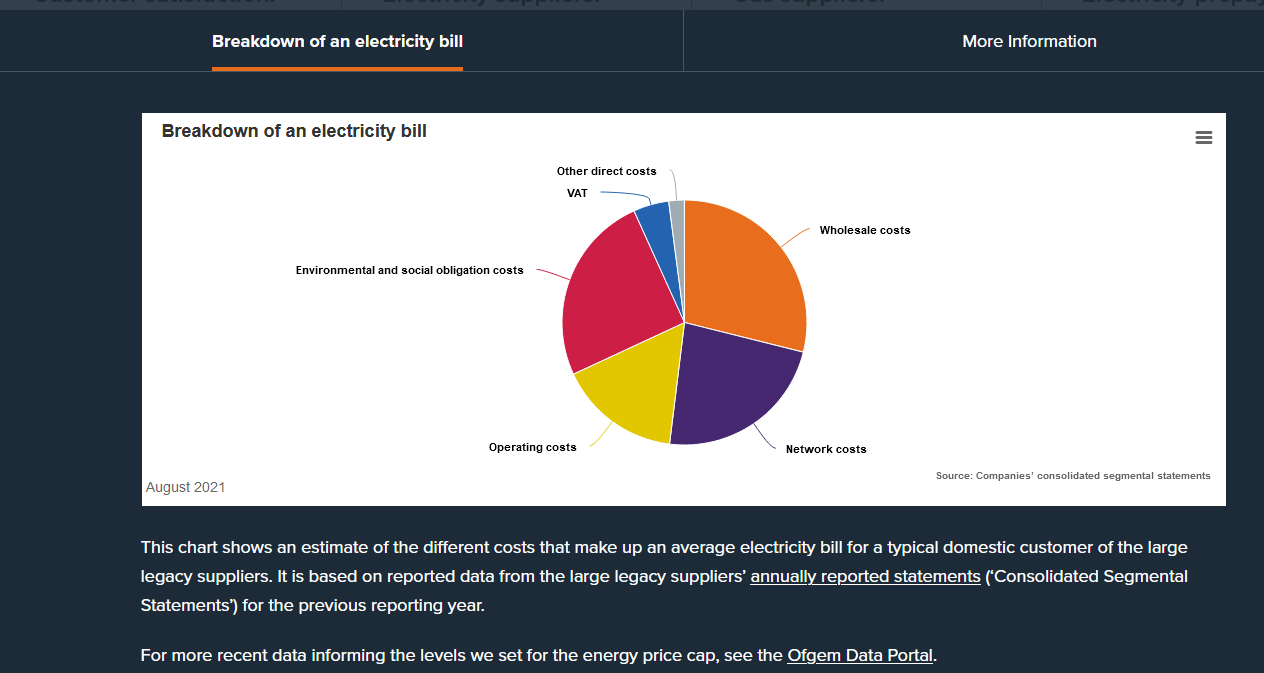
Generally, increased production causes a reduction in profit. Hopefully for the sake of household bills, this rule applies here. It is important to realise that the £10 billion for the Gnatpower batteries will have to be paid back within the ten-year lifespan of the batteries, with allowance made for interest and maintenance. (Assuming 4,000 discharges, I get a value of 10p/kWh to pay back the 75 mil for the Pillswood battery, without repaying interest, without operational costs, with free leccy to charge up with, and without profit.) (Context: the latest leccy price cap from Ofgem is 24.5p/kWh; there is a significant inflation between wholesale costs and the number on the bill. This figure from Ofgem is well out of date, but is the best I can find.)
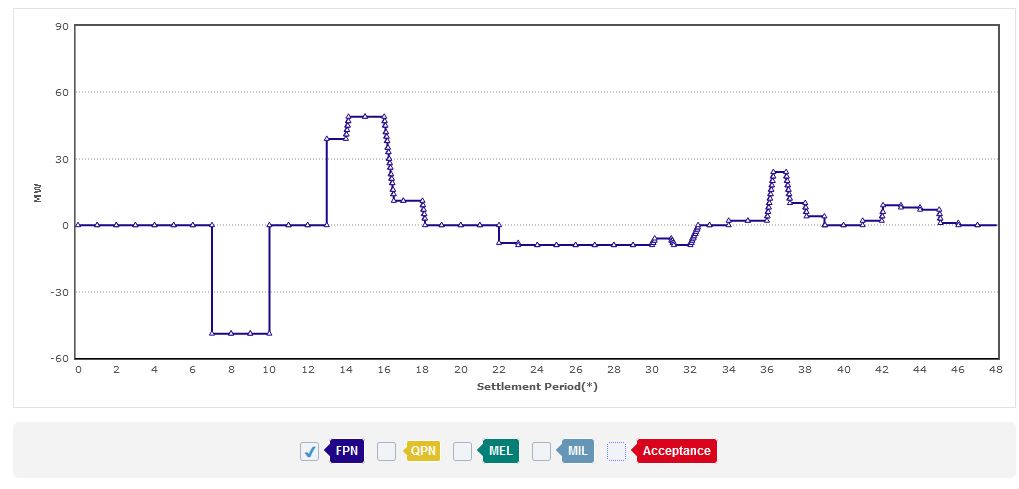
The figure below shows Pillswood’s battery 1 (of 2) charging and discharging on 8th March 2024. Note that the day is divided into 48 half-hour blocks. Positive numbers are when the battery is sending leccy to the grid (maximum 50 MW).
Here you can see a list of grid-connected batteries in the UK, with who their owners are. At the moment we are up to 4 GW for an hour and a bit flat out. “Optimiser” tells you whose mighty algorithm runs the show.
Megapacks seem to be springing up all over the place. My prediction is that adding them to grids will not save citizens any money (although adding a solar installation and a battery might save a household money eventually – it’s obvious that the more expensive electricity gets, the more attractive off-grid solutions become). Electrek, cited here several times, are fans of Megapacks. This headline of theirs made me chuckle:
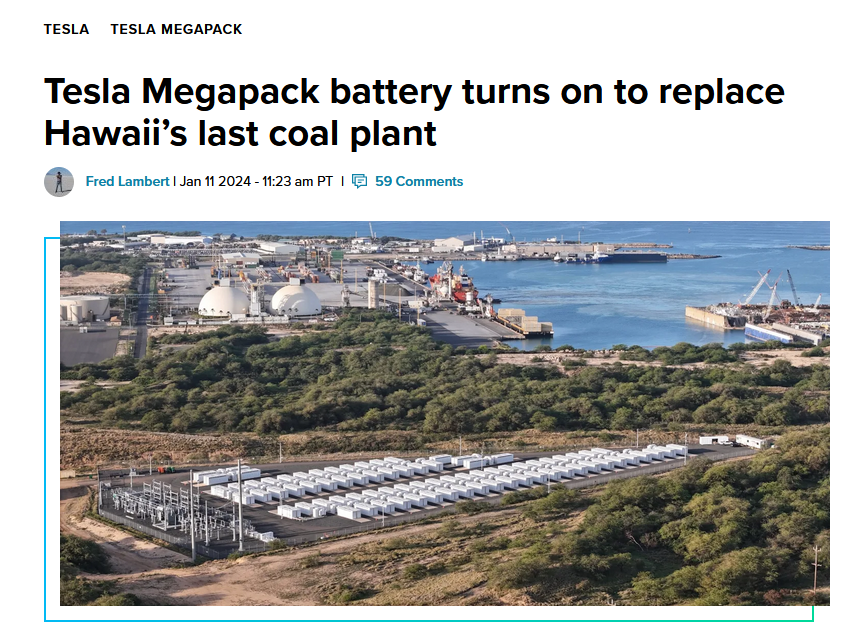
Because the battery is not replacing a coal plant: it’s replacing a heap of coal. Now, I know what you’re going to say: the battery extracts its own energy, so it’s better than a heap of coal. You still need a coal plant to convert the chemical energy in the coal into electricity. That is true. But the coal plant can produce electricity on its own, indefinitely, while the battery can only return what it borrowed, less a little lost in the conversion. The battery is not there to supply a baseload of power like a coal plant… it is there to contribute a little at peak times and to stabilise a grid that is made unstable by too much renewable electricity and not enough baseload.
What about the UK’s attached batteries?
These projects are not supported by taxpayer subsidy and will play a major role in contributing to the Net Zero transition, as well as ensuring the future security of the UK’s energy supply and reduced reliance on foreign gas imports.
Paul Kavanagh, Harmony Energy
I’m not really convinced by those claims.
See also friend of the channel Francis Menton’s pieces on battery storage, including this recent post where, among other points, he notes the unfortunate frequency of fires associated with grid storage batteries.
 Climate Scepticism
On the matter of energy storage, and those so-called ‘big’ batteries, it’s worth having some perspective.
Ofgem informs us that Britain’s *underground* natural gas storage capacity is 3,130 million cubic metres (mcm). 1mcm of natural gas is approx 11GWh, so 3,130mcm ~34,430GWh.
Click to access 2023%20Gas%20Storage%20Report1673878197123.pdf
In addition, England & Wales has ~13,000GWh of LNG storage capacity.
This means we have >47,000GWh / 47TWh of Nat Gas storage capacity.
It was only last week that the ignorant House of Lords Science & Tech Committee told the world “The UK stores around 10 TWh of natural gas …”
See ‘Box 1’ here:
https://publications.parliament.uk/pa/ld5804/ldselect/ldsctech/68/6805.htm#_idTextAnchor003
If only one of the expensive members or witnesses to the HoLS+T committee had the knowledge & foresight to just look at National Gas’s Daily Stock charts for underground & LNG as shown on the ‘Storage’ tab at the top right of its Daily System Status report
https://data.nationalgas.com/gas-system-status
LikeLiked by 3 people
Speaking of lithium battery fires, this is from my local paper’s website:
“Recycling Lives thank emergency services after fire at Workington site5 hrs ago”
https://www.timesandstar.co.uk/news/24198145.recycling-lives-thank-emergency-services-fire-workington-site/
“A RECYCLING company have thanked emergency services following a fire involving a building containing lithium batteries at their Workington recycling site.At around 2:50pm yesterday, March 19 eight fire engines, the aerial ladder platform, water bowser and a joint incident command unit attended a fire at the Recycling Lives facility on Isabella Road in Workington.The fire at the recycling site, involved a 25 metre squared building which housed lithium batteries, with fire warning nearby houses to keep their windows closed at the time of the blaze…”
LikeLiked by 1 person
300 watts? That’s the consumption of accidentally left-on lights in this unLEDed household.
LikeLike
Geoff, Ofgem’s “typical” household uses 2700 kWh/yr. If you divide that by 8766 hours in a year, you get a rate of ~300 W.
Maybe your leccy is cheaper? Most citizens of the UK could not afford to leave incandescents on!
LikeLike
“Battery factory ditched in favour of data centre”
https://www.bbc.co.uk/news/articles/cw4rx2zxy7wo
“Plans to build a giant battery plant have collapsed after more than three years of uncertainty.
Britishvolt planned to build a £3.8bn car battery factory in Cambois, Northumberland, but the company fell into administration in January last year.
Northumberland County Council said it was now considering allowing the site to be developed in to a computer data centre...”.
You would struggle to make this stuff up. From being a net zero dream creating jobs and helping to solve the problems associated with net zero, now it appears that it’s to be a huge consumer of electricity instead. Brilliant!
LikeLike
More on this in the Guardian:
“Britishvolt ‘gigafactory’ site to be sold for £110m to US private equity firm
Blackstone’s plans for data centre unlikely to generate thousands of jobs failed startup promised with Northumberland battery plant”
https://www.theguardian.com/business/2024/apr/15/britishvolt-gigafactory-site-sold-110m-us-private-equity-firm-blackstone-data-centre-northumberland
Inevitably there’s a somewhat risible attempt to put a green “spin” on things:
“…Analysts expect demand for data centres to continue to grow rapidly as households and businesses stream and send ever more digital content and information, and demand for cloud internet services and artificial intelligence also increase.
The deal will secure the future of a large brownfield site in a relatively deprived part of the UK. It will also be able to make use of local green-power generation including from offshore wind.…”.
“…“Its scale and location make it perfect as the location for a European data hub, and the plans put forward will hopefully kickstart an entire tech industry cluster in the north-east from the site.”“
Very green!
LikeLike
“Global battery rollout doubled last year – but needs to be six times faster, says IEA
Energy watchdog warns pace must accelerate to hit targets after new batteries increased capacity by 130%”
https://www.theguardian.com/environment/2024/apr/25/global-battery-rollout-doubled-last-year-needs-six-times-faster-iea
“The rollout of batteries across the global electricity industry more than doubled last year but will need to be six times faster if the world hopes to meet its renewable energy targets, according to the International Energy Agency (IEA).
A report from the global energy watchdog found that new batteries totalling 42 gigawatts (GW) were plugged into electricity systems around the world last year, increasing total capacity by more than 130% from the year before to 85GW.
However, the IEA warned that an estimated 1,500GW of energy storage would be required worldwide by the end of the decade, including 1,200 GW from batteries, to avoid stalling the global clean energy transition and help meet the UN’s net zero targets.…”
By the way, when did the IEA get promoted to being “the global energy watchdog”?
LikeLike
In the Manhattan Contrarian this morning (https://www.manhattancontrarian.com/blog/2024-4-27-a-shockingly-inept-report-on-battery-storage-of-energy-from-the-iea) Francis Menton launches a scathing attack on what he describes as a ‘shockingly inept’ report on battery storage by the International Energy Agency. This extract epitomises his view:
LikeLike
Mark; “By the way, when did the IEA get promoted to being “the global energy watchdog”?”
Paul Homewood had a post up a few days ago about the US Congress Energy committee writing to the IEA asking why the organisation has strayed from its intended role.
I’ve tried to post a link but it doesn’t work; I get the little spinning disc.
LikeLike
Then it goes and works anyway!!
LikeLiked by 1 person
“Fears battery plant plan a ‘ticking time bomb'”
https://www.bbc.co.uk/news/articles/cn03e40v0nzo
Residents are urging council bosses to reject plans to build a battery energy storage system (BESS) next to their homes.
Harmony Energy has applied to build 72 containers storing lithium ion batteries on greenbelt farmland in Heath Common, Wakefield.
Wakefield and District Travellers Association said it would be like living next to a “ticking time bomb”, as a similar site owned by a different company in Liverpool caught fire in 2020, external.
Wakefield Council said the plan would be assessed in line with all relevant national and local planning policy.
In September 2020, a fire at a BESS site owned by Orsted, in Liverpool, took 59 hours to extinguish following an explosion…
LikeLike
Fears that have proved to be well grounded elsewhere:
“Energy Storage Fire Near Otay Mesa Calms Down After 10 Days“
Apparently pouring water on the first battery on fire shorted out the others and caused more fires (I think the storage facility was roofed).
LikeLike
“RWE launches pre-application consultation for RWE Pembroke Battery”
https://pembrokeshire-herald.com/94260/rwe-launches-pre-application-consultation-for-rwe-pembroke-battery/
The whole article is a cut and paste of a very positive press release. This is the nub of it:
The proposed development would be located on a 5.1 hectare area to the south of the current power station and would comprise 212 Battery Containers, 106 Power Conversion Systems (PCS) enabling connectivity to the grid, and associated infrastructure.
LikeLike
Here’s another BBC article straight from the PR press release:
“Plans for battery storage to power 162,000 homes”
https://www.bbc.co.uk/news/articles/c3ggdp10e90o
Plans have been submitted for a battery storage facility which could power up to 162,000 homes.
Net Zero Seventeen Ltd wants to create the facility on agricultural land in Aspatria, Cumbria.
It has applied to Cumberland Council for permission to build the site on fields at West Farm, West Street, off the A596.
Those behind the plans said the project would “support the move towards a low carbon energy network”, as it would help release electricity at periods of high demand and store it at times when it is not needed.
Net Zero Seventeen said the proposed development would store enough electricity to power about [sic] 161,897 [sic] homes for two hours [sic].
The 7.4-hectare (18.3-acre) site would be operational for 40 years, after which time it would be decommissioned and equipment removed from the land...
…It added battery storage facilities helped ensure “cost minimisation” and increased efficiency “by reducing power losses”.
Cumberland Council has launched a consultation on the plans, which is open until 24 June.
Nothing is questioned, nothing is put into context. We are not told how many MWh are being talked about so that we can assess whether the claim for the number of homes and the number of homes is accurate or fanciful.
One final point – not the BBC’s point – the consultation seems extraordinarily short-lived, expiring in just five days’ time.
LikeLiked by 1 person
Mark,
Application submitted 22/04. Looks like there are no major objections so more of our green countryside will likely be swallowed up by useless Green projects and their associated infrastructure. The persistent ‘hum’ from the batteries on site will be minimised by a 5 metre high fence around the perimeter. That will be nice to look at – just like living next door to a prison. Possible Roman artefacts on site. Recommended archaeological excavation prior to development. Can’t see that happening.
https://cumberlandcouncil.my.site.com/pr3/s/planning-application/a3XbG0000001t5hUAA/ful20240085?c__r=Arcus_BE_Public_Register
LikeLike
about 161,897
That’s precious 🙂
LikeLiked by 2 people
“Consultation opens for 50-acre battery park”
https://www.bbc.co.uk/news/articles/cd11r45yxygo
The public is being asked to have its say on a 50-acre (0.2 sq km) battery site which could support the national power grid for half a century.
NatPower is planning to build Teesside Gigapark on the Lang Acres section of the Teesworks site, near Redcar.
Up to 1GW of power could be stored at the park during periods of low usage, which would be diverted back into the National Grid when needed.…
At least we aren’t treated to any dubious claims about it being able to power x million homes for y hours.
LikeLike
Typical BBC, claiming that power (rather than energy) can be stored.
LikeLiked by 1 person
In a rare win for locals, planning permission has been rejected for a battery storage site on Greenbelt land in South Tyneside:
South Tyneside ‘battery energy storage system’ plans refused over Green Belt fears
Quite a nice little number WES Ltd would have had going there: Buy energy cheap when there is a surplus, sell it back to the grid at top dollar when the wind isn’t blowing, and claim that you are ‘saving the planet’ in the process!
Who cares about Greenbelt land and local safety and noise and visual detriment issues when you’re saving the planet, right?
Because it would help ‘save the planet’, South Tyneside planning dept. actually recommended granting permission, but councillors voted against:
Those “very special circumstances” keep cropping up again and again and most of the time they override local planning concerns. When Labour get in, they intend to trash Green belt protections and such “special circumstances” will more than likely override local planning considerations all of the time. The Net Zero nutters will have their way.
Arguing with the Net Zero nutters citing legitimate concerns and using rational arguments is a complete waste of time too:
https://x.com/LewisStanding1/status/1807493446560555309
Say what? You can’t argue with Net Zero zealots on the necessity of infrastructure, nor on the basis of its individual merits, and pretty soon locals will not be able to argue effectively against the granting of planning permission for NZ infrastructure because of those overriding planet-saving “very special circumstances.”
Those “very special circumstances” explicitly and implicitly rely upon a deferral to the ‘settled science’ which says that ‘carbon emissions are dangerously heating the planet and must be urgently reduced.’ So you see if you cannot argue against The Science, then you cannot dispute the “very special circumstances” and therefore you will get Net Zero infrastructure erected in your Green Belt backyard, whether you like it or not and companies like Whirlwind Energy Storage Ltd will make obscene profits as your energy bills spiral even higher.
This is why I keep banging on about the importance of challenging the Science (the necessity argument) as well as challenging Net Zero employing more practical arguments (ie. its safety and effectiveness). Until the whole stinking rotten edifice is brought down, nothing is going to change. More likely, harsh reality will eventually intervene in this very lucrative (for some) fantasy, but by then I imagine it will be too late for the economy, society and the environment.
Victory for locals in South Tyneside, based on very local considerations, may be short lived:
LikeLiked by 1 person
Those comments from supporters of the application confirm that they don’t care about the environment. Soi-disant environmentalists are now frequently enemies of the environment.
LikeLike
This sort of thing is happening all over the place now. Here’s a massive-sounding development in Pembrokeshire, yet for all its scale, the best that it claims is “Once fully operational, RWE Pembroke Battery would be capable of storing enough electricity to meet the average daily domestic energy needs of more than 72,000 typical UK homes.“
“RWE Pembroke Battery”
https://uk.rwe.com/innovation/pembroke-net-zero-centre-pnzc/pembroke-battery/
RWE Pembroke Battery would be located on a 5.1-hectare area on RWE’s land adjacent to Pembroke Power Station and would comprise of 212 Battery Containers, 106 Power Conversion Systems enabling connectivity to the grid, and associated infrastructure.
The battery would have a maximum charge / discharge power of 350 MW, and will connect via underground cables to the grid at the adjacent National Grid 400 kV substation….
LikeLiked by 1 person
“Why Scotland is at the heart of a global vanadium battery revolution”
https://www.heraldscotland.com/news/24477540.invinity-grows-vanadium-battery-revolution-motherwell/
This was a chemistry demonstration that did not go bang and pop. In a factory in Bathgate, two test-tubes of vanadium electrolytes were mixed, one purple and the other orange, and all that happened was the thermometer reading rose to 33C.
But that lack of explosivity, said Dr Elisha Martin, lead research scientist for Invinity Energy Systems, is the point. “With lithium batteries, there are many concerns about excessive heat generation, thermal runaway and eventual issues with fire and explosions. But this demonstration is designed to show that with our systems, we don’t have the same concerns.” …
The rest is unfortunately behind a paywall.
LikeLiked by 1 person
Mark – thanks for the link, sounds like an interesting & safer alternative to “lithium batteries“.
Found their website – Vanadium Flow Battery Energy Storage – Invinity which links to – Vanadium Flow Battery Fire Safety – Invinity Energy Systems
Partial quote from the last link –
“Battery safety, especially fire safety, is becoming an increasing concern in the deployment of grid-scale lithium battery arrays. Compared with lithium batteries, the Invinity™ Vanadium Flow Battery has no fire risk and very low electrical fault risk, and has been independently assessed as providing a lower risk profile to facility operators and first responders.
It seems like almost every week there’s a report of a lithium battery fire in the news and no application of those batteries seems immune from problems. In just the past few months, fires in grid-scale lithium battery arrays, storage facilities, automotive battery packs, and single cells used in consumer devices have made the headlines.”
They also have a link – Utility-Grade Energy Storage for Utilities & Developers / Invinity
Which is the sales pitch I guess, partial quote –
“Invinity’s non-degrading vanadium flow batteries are ideally suited for trading energy on day-ahead, intraday and balancing markets, without concern for the opportunity cost of lost capacity per discharge cycle typical of lithium batteries. Our products thrive on heavy utilisation, allowing our customers to take advantage of growing wholesale market price volatility by generating significant revenue from resulting arbitrage opportunities.
Our negligible degradation per cycle and discharge durations ranging from 2 hours to 10 hours allow asset owners to trade tighter price spreads and capture greater value from price imbalances. And we provide all of these capabilities over a 25+ year asset life, maximizing present value and return on investment.”
LikeLike
“Energy storage plants planned for Highland sites”
Highland Council has proposed constructing battery energy storage systems in Caithness and Wester Ross.
The facilities store excess power when wind farms and hydro-electric schemes generate more than is needed and the energy is released at times of high demand.
Systems with capacity for up to 200MW have been proposed for near Mey, Caithness, and Garve, Wester Ross.
A 49.9MW-capacity site has been suggested for Forss, near Thurso....
...Last year, the local authority said it was exploring the potential of generating and storing its own power.
It believes solar and battery storage could bring widespread [unspecified] benefits to communities [sic], and help it achieve [pointless] climate change targets....
...But in a report to councillors last May, officials said developing and managing renewables projects would require major investment….
Translation – officials said this is going to cost an awful lot of money.
LikeLike
Tamarindo is one of the many organisations pushing renewable energy at us:
At Tamarindo we provide the intelligence, connections and communications to inspire investment and accelerate global energy transition and decarbonisation.
That being the case, the fact that even they find negativity about battery storage among people who they claim to be broadly supportive of renewables, is I think rather interesting:
“Energy storage’s biggest public relations battle still to come
There is widespread support in the UK for renewables projects, but backing for energy storage is less robust due to perceptions regarding safety”
https://tamarindo.global/articles/energy-storages-biggest-public-relations-battle-still-to-come/
…However, despite a general consensus regarding the importance of renewable energy, many local communities are less supportive of energy storage’s role in the journey to net zero. There are countless examples of communities voicing opposition to energy storage projects. For example, in Wakefield in West Yorkshire in the UK, protestors launched a campaign to stop an energy storage project saying it would be a “bomb waiting to go off”. Concerns about the proposed site posing a serious fire or explosion risk led to 1,400 people objecting to the project….
LikeLike
“Third battery fire at the same site in Germany
It’s the third time in two months that a battery fire has broken out on the premises of Suncycle in Germany.”
https://www.pv-magazine.com/2024/08/13/third-battery-fire-at-the-same-site-in-germany/
A group of batteries has caught fire at Suncycle, a solar and storage service company located in the German state of Thuringia. The fire marks the third time in two months that fire services were called to the site for a lithium battery fire on Sunday, August 11. Police again suspect a technical defect as the cause of the fires.
“The batteries were intended for disposal and were temporarily stored,” Suncylce managing director, Christian Straub, told pv magazine. “We work with several manufacturers, so unfortunately I cannot provide more precise information.” Unlike the incidents in June, the new fire only affected a group of batteries, but not a container. “Therefore, the damage was significantly smaller,” Straub continued.
The attending fire brigade said fumes and smoke slightly injured an employee, via its Facebook page. A report from the German press agency dpa stated that the injured employee used a forklift to drive the burning storage unit out of the area where they were stored to prevent flames from spreading. According to the fire department, the damage is estimated at 30,000 euros.
Due to the heavy smoke, a warning was issued for residents to keep windows and doors closed, which remained in place until Monday.
This is the third fire involving a battery storage unit stored at Suncycle since June 7th. The first time, the damage was estimated at around 700,000 euro, and similar toxic air warnings were also issued to residents.
LikeLike
The fire brigade’s Facebook page injured the employee? /pedantry
One imagines that the property insurance at this site is cranking up to unaffordable levels. There is also a question mark over pollution via smoke or the water used to fight the flames.
LikeLike
“Lithium-ion battery fire at SDG&E facility in Escondido prompts school closures, evacuations
The fire is burning in the 500 block of Enterprise Street in Escondido, just a few blocks from where Interstate 15 crosses paths with state Route 78″
https://www.nbcsandiego.com/news/local/lithium-ion-battery-fire-in-escondido-prompts-large-response/3615328/
…Escondido Fire Department Battalion Chief Tyler Batson told NBC 7 that officials put together a plan to evacuate the nearby area, which includes approximately 500 businesses. About 1,500 SDG&E business customers were also affected, Batson added.
According to fire officials, police officers were going door-to-door to make sure everybody has left in the approximately six-square-block area.
Those who are evacuated will have to remain out of the area until the fire is out, which could take hours or longer. As of 4:30 p.m., Batson said that the best case scenario for the fire would be 12 hours, but it could take as long as 48 hours before evacuation orders are lifted.
“Immediate threat to life,” a notification on the city’s website states, in part. “This is a lawful order to leave now. The area is lawfully closed to public access.”…
LikeLike
LikeLike
Looks like whistling in the dark to keep spirits up:
“Hopes remain for gigafactory investment”
https://www.bbc.co.uk/news/articles/cj6ez17yr1lo
…Wearmouth said: “There is the potential for some benefits from some of the new government’s policies.
“We hold out the hope for attracting another gigaplant operator to our area.
“The government have reinstated that target. We will watch that space with interest.”…
LikeLike
This sub-headline from the FT suggests they will be whistling for a very long time:
“Europe’s battery darling runs out of juice Battery start-up raised more than $15bn but is struggling to secure the funds amid low production”
LikeLike
“Sutherland community fights battery farm plan”
https://www.bbc.co.uk/news/articles/cj6e8r1nnwyo
Every aspect of this is appalling, right down to the biased nature of the reporting. How do you “farm” batteries? Of course, you don’t, but the very word sounds bucolic and is an attempt to downplay their industrial and toxic nature.
LikeLike
“Battery storage facility plans submitted”
https://www.bbc.co.uk/news/articles/cglkx7gkwkdo
Plans have been submitted to build a battery energy storage facility in South Yorkshire.
Applicant YLEM Energy Group hopes to build on land located off Brinsworth Road in Rotherham, which is currently used for equestrian purposes.
The development would include battery clusters, a site office and a substation within a fenced compound, with the scheme yet to be considered by Rotherham Metropolitan Borough Council planners….
There seem to be several of these applications a week. A very expensive, damaging and ineffective solution to this problem:
Between 2015 and 2021, the UK discarded more than 13% of wind energy generated…
The other problem, of course, is represented by all the times when the wind isn’t blowing and the sun isn’t shining.
LikeLike
It would be interesting to canvas the press releases of these proposed batteries, to see whether the purpose “to help tackle climate change” is wheeled out more frequently than “to store electricity when it is cheap or free, and sell it when it is expensive.”
LikeLike
Slightly off topic, but vaguely relevant here, I suppose:
“‘Huge losses’: Sweden fears for future of batterymaker Northvolt
Government rules out bailout for key project in European green industrial transition as job cuts announced”
https://www.theguardian.com/business/2024/oct/01/sweden-fears-for-future-of-batterymaker-northvolt
…The arrival of the battery manufacturer was not only supposed to be a flagship project for Sweden’s “green industrial revolution” but hailed as Europe’s big hope against dependence on oil and imported batteries from China.
Since its foundation in 2016 to build “the world’s greenest battery”, Northvolt’s rapid rise has attracted billions of dollars of investment and orders from the world’s biggest car companies including Volkswagen, BMW and Volvo.
But as Europe’s electric car market struggles, much of this enthusiasm is starting to look like fantasy. In June, BMW cancelled a $2.5bn contract with Northvolt. And last week, amid a spiralling cashflow crisis, the battery manufacturer announced it was making 1,600 redundancies and suspending expansion of its Northvolt Ett factory in Skellefteå.
Rumours swirl of potential imminent bankruptcy and even Chinese sabotage – both dismissed by Northvolt as “speculation”. Meanwhile, police are investigating the death of a 25-year-old man at the factory amid suspicions that workplace violations may have led to his death.
The mood among employees, known as “Northvoltare” (Northvolters), is said to be one of deep concern as they await redundancy details, while workers hired from outside Sweden are faced with the prospect of having to leave the country….
LikeLike
From Net Zero Watch:
https://static1.squarespace.com/static/656f411497ae14084ad8d03a/t/66fd2383b56dbc6906390297/1727865736681/Fannon-Batteries.pdf
…This paper examines some of impacts of batteries on communities, using as an example, Statera Energy’s proposed 400-MW BESS at Chickerell, South Dorset, recently approved by the local council over the objections of the majority of residents. In particular, it examines the potential impact of BESS fires, considering how similar conflagrations overseas might affect people in the relatively densely populated countryside of southern England.…
LikeLike
“UK’s largest battery energy storage site goes live”
https://www.bbc.co.uk/news/articles/cy94y7vrj2wo
The UK’s largest battery energy storage system has gone live in North Yorkshire.
Lakeside Energy Park is a 100MW facility in Drax, near Selby, which can provide power to about 30,000 homes a day across England and Wales…..
That last sentence is remarkably information light and potentially misleading. What does it mean, in reality?
LikeLiked by 1 person
There’s already a 100 MW system according to bessanalytics. So it depends on how much energy the new battery stores… which the BBC doesn’t say.
Statera link for Dollyman’s Farm BESS.
LikeLike
Behind a paywall, unfortunately:
“Questions raised over Scotland’s new energy storage parks”
https://www.heraldscotland.com/news/24647677.questions-around-scotlands-new-energy-storage-parks/
The need for large-scale energy storage has been underlined as the UK Government set out its plans to support the industry.
However, concerns have been raised around scale and safety of storage facilities including lithium battery parks.
LikeLike
“Plan for battery farm in middle of wood”
https://www.bbc.co.uk/news/articles/cy4dkpmlw08o
Plans to turn part of a woodland into an industrial energy storage plant have been submitted.
Root-Power (North) wants to build a complex off the M65 near Oswaldtwistle.
It has applied to Hyndburn Council for permission to build a 60 megawatt Battery Energy Storage System (BESS) at Knuzden Moss Farm off Stanhill Road.
The five-acre (two-hectare) site would see energy stored in batteries and put back into the National Grid at times of high demand....
A battery “farm” (there’s a bucolic euphemism if ever I saw one) inside a wood. What could possibly go wrong?
…The plant would include 14 battery clusters, substations and transformers within a compound with two car parking spaces, two water tanks and a fire hydrant.
Oh good, a fire hydrant. That’s all right, then.
LikeLiked by 1 person
“Battery storage site application given green light”
https://www.bbc.co.uk/news/articles/cq646lre45po
Plans to build a battery energy storage site in West Sussex have been approved despite opposition.
The application for the 27-acre facility on land at Coombe Farm, Bob Lane, Twineham, was unanimously granted by Mid Sussex District Council....
Of course it was. 27 acres!
LikeLike
Relying on batteries is stupid. But if they’re determined to do it, this seems like a more appropriate location, for once:
“Battery storage farm plans at new homes site”
https://www.bbc.co.uk/news/articles/cr4l3d666kno
LikeLike
Just what the hell is a battery storage ‘farm’? Is it where they grow batteries? What is a wind farm for that matter? This abuse of the term ‘farm’ by eco-communists comes at a particularly inauspicious juncture in the imposition of the regressive Green agenda where its supporters, pushers, grifters and hangers-on are destroying actual food producing farms (and farmers’ livelihoods) by sequestering valuable agricultural land for the construction of so called ‘renewables’ and associated industrial scale infrastructure. If the BBC and others think they can con us into believing that toxic batteries and solar panels and wind turbines constitute the spread of some sort of rural eco-utopian farm-like presence across our landscapes, in opposition to the industrialisation of our rural landscapes, then they are perilously deluded. What next? Pylon farms? Oh wait, no, they’re not called pylons anymore, they’re ‘towers’. So, tower farms.
LikeLiked by 3 people
Jaime,
I love it when you’re on a roll. And you’re quite right, too.
I get similarly wound up when people call wind turbines windmills. They’re not mills – they don’t mill anything. And calling them windmills creates a bucolic impression, something out of a Constable painting. Nothing could be further from the truth.
LikeLiked by 1 person
Must admit, I’m guilty of calling them windmills Mark. I do it not to create some bucolic impression of them, but to derogate them as mediaeval contraptions which will take us back to the Dark Ages. But point taken.
LikeLike
Mark, are not windmills only too good at milling to death any birds, bats and insects that come too close? Or is that munching?
As a technical point, reducing the blade speed would make the blades less of a life threatening encounter for (some) flying fauna, which might be considered advantageous in some quarters. However, reducing the rotational speed of the blades would reduce the electrical power generated by direct-drive generators. By contrast, with indirect drives (i.e. using a gear box), blade speed reduction could be compensated for by increasing the gearbox speed input:output ratio, albeit at the cost of a larger, heavier, more expensive gearbox. Regards, John C.
LikeLike
Maybe Ed should propose a Battery storage site under the Houses of Parliament as a backup for London when the lights go out. Switch on has to be 5th November.
LikeLike
John C: to get the same power output at lower blade speed the torque would have to be increased given that power = torque x revs. Not sure how that could be achieved other than by increasing the blade length but that would raise the tip speed, counteracting the slower rotation.
LikeLiked by 1 person
“Plans for battery energy storage park criticised”
https://www.bbc.co.uk/news/articles/c4g2dqdr134o
Campaigners have criticised plans for a 58-acre battery energy storage park on green belt land in North Yorkshire.
Green energy company NatPower has unveiled the plans for a site near Thirsk, which also include creating a nature reserve on the remaining two thirds of the 173-acre site.
The company said the plant, which would be one of the largest of its kind in the UK, could power up to 3.9 million homes for up to four hours at a time.
However, Thirsk Against Battery Storage (TABS) said it had concerns about the suitability of the proposed location and called for the facility to be built on brownfield land…..
LikeLike
“Third battery storage plan approved near village”
https://www.bbc.co.uk/news/articles/c99xm474pj7o
A third battery energy storage system (BESS) development has been approved near a small village in the Borders.
The local community council had opposed the latest scheme close to the Eccles substation as it argued that two already approved in the area were sufficient.
However, the Scottish government has concluded that the latest project can proceed.
Residents of nearby Leitholm have said they fear the heart will be ripped out of the local community if all the battery developments proposed for the area go ahead….
LikeLike
“Council rejects 33-hectare electric battery site”
https://www.bbc.co.uk/news/articles/cn4xjz9w81wo
Plans to build an electricity storage station have been rejected by a council after hundreds of people objected.
A committee at Buckinghamshire Council voted by a majority of seven to two to throw out proposals for the 500MW storage facility near Granborough, a village between Buckingham and Aylesbury.
Statera Energy wanted to store batteries in 518 shipping containers on what would have been a 33-hectare site.
The company said it was “disappointed” by the decision and would look at next steps.
At the meeting of the Strategic Sites Committee on Thursday, external, the council rejected the plans on the grounds that they would harm the landscape and its character.
Conservative committee chairman Alan Turner told fellow councillors: “It is a business opportunity rather than providing any green energy.”…
LikeLiked by 1 person
“Are Battery Energy Storage Systems (BESS) Safe?”
https://www.cpreherts.org.uk/news/are-battery-energy-storage-systems-bess-safe/
LikeLike
Mark; I can’t find a thread but I think you have posted a few times about the windfarm on Shetlands? This caught my eye:
https://www.shetnews.co.uk/2024/12/23/improvements-burn-lunklet-condition-remains/
Makes me wonder how widespread/frequent this problem is?
Apologies for the off-topic post.
LikeLike
Mike H, I think this may be the one you mean:
https://cliscep.com/2021/06/29/for-peats-sake/
The environmental unfriendliness of the massive eyesore that is the Viking Wind Farm on Shetland continues to anger a lot of people, understandably so. As do the massive constraints payments that SSE have received already. The turbines seem to be static as often as they’re moving.
LikeLike
“‘Europe’s biggest battery farm’ built on coal mine”
Skating close to the edge of the facts there by omitting the necessary context. The batteries are being built across the UK to balance the grid BECAUSE it is increasingly powered by random generators.
EDIT: link: https://www.bbc.co.uk/news/articles/c5yd18q248jo
LikeLiked by 2 people
Jit – thanks for the link, partial quotes –
“The giant batteries will operate for two hours at a time before being depleted”
“Visiting the Coalburn 1 site, first minister John Swinney said the investment would deliver a significant contribution to the growth of Scotland’s energy transition infrastructure.
“By helping to supply reliable and secure power to our homes and businesses, well-located storage systems, such as batteries and pumped hydro storage, can move us closer to net zero and directly support the communities around them.”
“The developers – Copenhagen Infrastructure Partners (CIP) – have confirmed that construction will begin shortly on stage two”
Notice that no cost is quoted or how many “green jobs”. Wonder why!!!
LikeLike
“Council advised to oppose battery storage scheme”
https://www.bbc.co.uk/news/articles/ckgr6yy44n0o
Councillors have been advised to oppose plans for another battery energy storage scheme in a rural corner of the Borders.
If agreed, the plan near the Eccles substation could meet the electricity needs of more than 30,000 homes.
Three similar developments have already been approved in the area prompting some residents to say the heart is being “ripped out” of their village.
Scottish Borders Council’s planning officer has recommended councillors object to the most recent project, although the final say will lie with the Scottish government…..
Sadly, that probably means it will be rubber-stamped in due course.
LikeLiked by 1 person
Batteries do not meet electricity needs. They are not generators. Good ol’ BBC.
LikeLiked by 2 people
“Battery storage site plans for solar farm”
https://www.bbc.co.uk/news/articles/ckgy90z7g1xo
A battery storage site the size of almost nine football pitches could be built on farmland near a Kent hamlet.
Sky UK Development has submitted a planning application for a battery energy storage system (Bess) by Canterbury Road, 0.5km (0.3 miles) from Calcott, near Sturry.
The 227.5 megawatt facility is planned to be “temporary and reversible,” with a lifespan of 40 years after which all the facilities will be removed.
Any development which would generate more than 50MW needs permission directly from the government to be built.
Bosses for Sky UK Development argue the 10.6 acre plot is ideal for the project because it is close to “an available and viable point of grid connection” and located in an area with some existing industrial elements.
The project would require a long underground cable to connect to the grid at the Canterbury North substation about 4km south….
LikeLike
“Plans for battery energy storage plant approved”
https://www.bbc.co.uk/news/articles/c2k549wpzkzo
Plans for a new battery energy storage plant next to a substation have been given the go-ahead, despite objections from residents and councillors.
Developers said the facility, earmarked for green belt land on Hinksford Lane in Swindon, Staffordshire, could provide power to more than 26,000 houses.
Local MP Mike Wood and four Dudley councillors are among those who objected to the plans on Hinksford Lane near Kingswinford, amid concerns around fire risk and its impact on wildlife….
There’s a useful job here for BBC Verify. Instead of the BBC simply repeating the PR blurb put out by the applicant company, they would perform a useful service if they analysed the claims about the power that could be provided. If they’re going to claim that power would be supplied to “more than 26,000 houses” (how many more?) then the crucial piece of missing information is for how long? 5 minutes? An hour? Two hours? A day? Without that additional information, the claim is meaningless. I am sure BBC editors, who aren’t stupid, know this, so why do they play along? It couldn’t possibly be because it’s all part of the agenda that the BBC supports, could it?
LikeLike
Quite right. The BBC should know that batteries don’t produce power; they store energy that has been generated elsewhere. In their own right, they power zero homes.
LikeLiked by 1 person
“Plans for ‘fire-risk’ battery station rejected”
https://www.bbc.co.uk/news/articles/cly480v2lq7o
Plans to build a battery energy storage site near a busy residential area have been rejected over safety concerns.
Somerset Council refused Trina Solar UK HoldCo’s application to build the facility on land north of Styles Close in Frome, next to an existing substation.
The move follows residents campaigning against the proposals, claiming they posed a “fire risk and put those living in neighbouring properties in jeopardy”.
Councillor Helen Kay told a planning meeting on Tuesday: “The consequences of this going wrong are very high.”...
LikeLike
“Fire risk’ fears over battery energy storage park”
https://www.bbc.co.uk/news/articles/clyze0vnlqpo
A proposed battery energy storage system (BESS) on farmland would have a “very high risk” of catching fire, campaigners have said.
Green energy company NatPower has unveiled plans for the plant near East Rounton, between Northallerton and Yarm.
However, members of the Against Battery Storage: East Rounton, Picton, Crathorne, West Rounton Area group said the facility would have a 27% chance of catching fire in any one year.…
LikeLike
“Concerns over battery energy storage fire risks”
https://www.bbc.co.uk/news/articles/c74epnqx153o
Firefighters should be consulted more over planned battery energy storage (BES) sites because of the risks of fire and explosion as well as electrical hazards, Staffordshire’s police, fire and crime commissioner has said.
Ben Adams said planning applications for the storage facilities were becoming increasingly common as part of the drive towards net zero.
He said while risks were not as great as some residents feared, it was a growing concern.
Mr Adams said some developers were not engaging with the fire service during the planning process.
According to the fire service’s community risk management plan, BES systems present “significant risks” to fire services because of the potential for fire and explosion, and the presence of ‘”complex electrical hazards”....
LikeLiked by 1 person
There seem to be increasing numbers of these stories. Here’s the latest:
“Fire breaks out at Aberdeenshire battery storage facility
Two fire appliances are currently at the scene.”
https://www.pressandjournal.co.uk/fp/news/6698557/fire-rothienorman-battery-storage/
According to the report, the battery storage site is still in the process of being built. Funnily enough, that’s also true of a fire yesterday in another one:
“Firefighters respond to battery storage site Fire in East Tilbury”
https://www.essex-fire.gov.uk/incidents/firefighters-respond-battery-storage-site-fire-east-tilbury-2025-02-19-15-51
LikeLiked by 2 people
“Principal of school beside Galway battery maker Xerotech raises safety concerns after blaze led to evacuation”
https://m.independent.ie/business/irish/principal-of-school-beside-galway-battery-maker-xerotech-raises-safety-concerns-after-blaze-led-to-evacuation/a1193761962.html
The principal of a Galway school is demanding that safety of his 1,300 pupils be prioritised over financial returns by liquidators who’ve taken control of a stricken battery-start up shut after a potentially toxic blaze.
Investors face losses of €48m in bust Irish start-up Xerotech but it is the potential health costs associated with storing volatile lithium ion at the site that is stoking the greatest fears after liquidators took charge of the business and now seek a buyer.
Coláiste Bhaile Chláir principal Alan Mongey is awaiting responses after writing to the local county council, the EPA and local TDs to seek clarity about the removal of lithium-ion batteries stored close to the school’s playground.
One witness described how an army bomb disposal robot had been needed to deal with a runaway thermal reaction that shut the area for three days and the situation has raised major questions about the planning of the site….
LikeLike
“Lithium Battery Plant Fire Reignites Posing Danger to Residents”
https://uk.news.yahoo.com/lithium-battery-plant-fire-reignites-112046693.html
Residents in Monterey County, California, were told to close their windows and door overnight after a fire reignited at the Vista Energy lithium-ion battery storage facility near Moss Landing on Tuesday evening, February 18.
According to the county’s alert page, “light smoke” appeared to be coming from “a previously burned section” of the Vistra Battery Facility in Moss Landing and fire services were on-site.
The smoke did not appear to be near the unaffected battery modules that survived the January 16 fire incident, the county said.
On January 17, the facility saw a massive fire after its internal fire suppression system failed. The fire prompted evacuations because of unknown hazards posed by the smoke.…
LikeLike
They’re coming in thick and fast now, mostly rubber-stamped:
“Battery storage project gets the green light”
https://www.bbc.co.uk/news/articles/cwyj2p90lkgo
The Scottish government has approved plans for a major battery storage plant in the south of Scotland.
The complex on a grassland site near Gretna Green will house almost 400 units – similar in size and design to shipping containers.
It is one of a growing number of such projects which it is claimed will help to support the transition to Net Zero and boost the UK’s energy security.
Permission for the plant was secured by the applicant – Energy Hub Developments. Its application was approved by the Scottish government’s Energy Consents Unit….
I suppose it’s called the Energy Consents Unit because it seems to consent to almost everything and hell will freeze over before it refuses an application for BESS, wind or solar farms.
LikeLike
What could possibly go wrong?
“Plan for woodland battery farm set to be approved”
https://www.bbc.co.uk/news/articles/c1jxnp486nzo
A controversial battery storage farm in woodland in Lancashire is set to be approved by councillors…
LikeLike
“Battery farms are ’emerging risk’, says fire chief”
https://www.bbc.co.uk/news/articles/clyrmy61967o
A fire service wants more power to enforce safety measures for battery energy storage systems (BESS).
BESS stockpile green energy by using thousands of lithium-ion batteries in storage containers, but there are concerns about fire safety.
Henry Griffin, Suffolk’s deputy chief fire officer, described the sites as an “emerging risk” and said communities were worried....
...Mr Griffin warned the scale of BESS meant firefighters were having to learn new techniques.
“There can be complications with vapour clouds and fires will last a long time,” he added.
“It is an emerging risk for us and we are alive to it.”…
LikeLiked by 1 person
Meanwhile, how about this?
“Ramsay to meet fire chief over battery farm safety”
https://www.bbc.co.uk/news/articles/cgr59jxyqjvo
The Green Party co-leader said he wanted to know how fire risks could be managed if plans for one of Europe’s largest battery storage sites were approved.
Developers want to install more than a thousand battery containers on land on the outskirts of the small village of Rushall, near Diss in Norfolk.
Whilst the company behind the plan – Elmya – has said safety measures will be in place, residents fear the site could catch fire.
MP Adrian Ramsay – whose Waveney Valley constituency includes Rushall – said he did not “want to scaremonger” but would be meeting with Norfolk’s fire chief to discuss their concerns….
…the lithium used in the batteries can cause explosions if it overheats.
A fire at a small BESS site in Liverpool in 2020 took fire crews 59 hours to extinguish, whilst a blaze at a huge site in California was left to burn on the advice of fire experts….
LikeLiked by 1 person
“Residents fear fires from battery storage sites”
https://www.bbc.co.uk/news/articles/cdx5e97pjnpo
Residents living near proposed battery energy storage systems (BESS) say they fear massive fires and environmental pollution.
BESSs are being built across the UK to help balance the electricity grid, which is becoming increasingly powered by renewables.
But there are no laws that specifically govern the safety of BESSs, and people living near proposed sites in South Hetton, County Durham, have voiced concerns.
Some experts are calling for a pause in their deployment until Health and Safety regulations are established. The government said it had “high safety standards in place for the industry”….
...For Lisa Miller, who lives 300m (965ft) away from one proposed site called West Lane BESS, fire safety is her biggest concern.
“These things can burn for days,” she said.
The government maintains battery storage fires are rare in the UK
Mrs Miller said she was also worried about toxic gases and respiratory issues.
She has set up a national petition to push for safety legislation and to keep BESS sites off agricultural land.
She said it was “an absolute lie to say that this is going to benefit the environment”.…
...Retired Oxford University engineering science professor Peter Dobson has warned BESSs could become the next legacy fire safety issue, with major risks to the public.
“The energy stored in one container is the equivalent of three tonnes of TNT,” he said.
“As soon as the thing goes critical and starts burning or exploding, you’ve got all the chemical potential of those volatile liquids in the batteries.”
Fires can start in lithium batteries if they overheat or are damaged, and lithium is difficult to extinguish, he said.
Prof Dobson said it would be like “putting a chemical refinery right next door to somebody’s house“.
“I think it’s irresponsible and crazy.”
He has called on the government to halt all BESS installations until mandatory safety regulations were in place….
LikeLike
“Council attempts to guide mega solar farm plans”
https://www.bbc.co.uk/news/articles/c0j42zqgj2xo
A council has put together a new guide for developers of mega solar farms amid fears the area is being “disproportionately targeted”.
South Norfolk Council’s document will inform its response to proposals in the hope of “minimising adverse effects” on the landscape.
The area has been earmarked for several large projects, including what could be the biggest solar farm in the UK.
Conservative council leader Daniel Elmer said the district had become a “nexus” of energy infrastructure applications due to its flat landscape and location along a grid connection to London….
.…Suzanne Wateridge, Green councillor for Bunwell, said: “The village is starting to look completely encircled – the news about Tasway was the final straw for many residents.
“I wholeheartedly support renewable energy projects, but every county across the country should be hosting its fair share.
“There is no doubt that South Norfolk is being disproportionately targeted by energy companies.”…
Hmmm. When will these people ever learn? “I wholeheartedly support renewable energy projects, but…” is not the right answer. Opposition to them in principle is what is required.
LikeLiked by 1 person
“Council urges action over battery farm fire fears”
https://www.bbc.co.uk/news/articles/cnvm4j76668o
Energy secretary Ed Milliband will be asked to fund training and equipment for fire services in areas where large battery farms are planned.
Norfolk County Council voted in favour of asking for government support for emergency services because of concerns they may have to deal with blazes at battery energy storage systems (Bess).
A number are planned for Norfolk, and Conservative council leader Kay Mason Billig said she fears “they pose a serious risk”, whilst calling for fire services to be consulted on battery farm planning applications.
The Department for Energy Security and Net Zero said “fires at storage sites in the UK are rare” and “high safety standards” were already in place.…
LikeLike
“Want to import toxic chemicals into Britain with scant scrutiny? Labour says: go right ahead
Jacob Rees-Mogg’s Tory fantasy of a post-Brexit bonfire of regulations is coming true. Our bodies and ecosystems will pay the price”
https://www.theguardian.com/commentisfree/2025/jul/23/britain-toxic-chemicals-labour-tory-brexit-regulations
Anything to say about BESS, George?
Forever chemicals? How about wind turbines?
LikeLike
“Green belt battery storage unit gets go-ahead”
https://www.bbc.co.uk/news/articles/c3d1dv1k2nko
An energy storage scheme on Oxford green belt that was rejected last year has been given the green light after a planning inspector overturned the decision.
The 500MW facility on land north-west of Culham Campus was turned down by South Oxfordshire District Council (SODC) in August over concerns about its impact.
The council said it would be an “urban industrial development” in the countryside but a planning inspector said the drive to net zero carbon emissions meant it must go ahead….
….Planning inspector John Braithwaite acknowledged the application did not adhere to some of SODC’s planning policies but said he had given “significant weight that must be afforded” to the need for the battery facility.
He said that outweighed the “moderate/minor harm” that will be caused to the area’s character.
He added the “urgent need for electrical storage” to support the growth of renewable energy means the facility will be a “critical element” in that effort.…
Is net zero now top trumps? Does it mean that we ignore normal planning issues now?
LikeLiked by 1 person
You know the answer Mark. As Planning inspector John Braithwaite said “urgent need for electrical storage”. They are like headless chickens spinning plates & should be on Britain’s Got Talent, since most acts aren’t from the UK anyway
LikeLike
“Battery storage a ‘wild west’ amid net zero drive”
https://www.bbc.co.uk/news/articles/cly634lz0y3o
The drive to reach net zero is leading to a “wild west” of applications for potentially dangerous battery storage sites across Wales, a politician has said.
Llyr Gruffydd MS said applications for battery energy storage systems (Bess) were often “speculative punts” that were “coming forward in an unmanaged way”.
There are currently 87 Bess applications in Wales, but campaigners say they pose a safety risk after serious fires across the globe.
The Welsh government said the systems would assist the increasing use of renewable energy to “provide the low-carbon flexibility we require”.…
LikeLike
“Plans lodged for battery farm on city outskirts”
This one’s near sunny Norwich. Alas, the BBC’s dim reporters aren’t aware that there is a difference between energy and power.
LikeLike
“Trump Admin Sounds Alarm Over Green Tech Climate Zealots Are Counting On”
https://dailycaller.com/2025/08/18/trump-admin-sounds-alarm-over-green-tech-climate-zealots-are-counting-on/
The Trump administration on Monday released the first federal safety guidance for battery energy storage systems (BESS), citing safety concerns as several of the green energy facilities have caught fire in recent years.
Environmental Protection Agency (EPA) Administrator Lee Zeldin addressed BESS concerns as he announced the first federal safety guidance for the technology from Long Island, New York, where residents and officials have been protesting over an impending BESS facility. While the Trump administration hasn’t pushed for a build out of BESS like former President Joe Biden, several blue states — including New York — as well as green energy advocates touted the technology as a key tool to eventually phase out fossil fuels and accelerate the green energy transition.
“Many New Yorkers, especially in New York City and on Long Island, have made their voices clear – they do not want Battery Energy Storage Systems built in their neighborhoods. Residents are looking across the country where dangerous lithium battery fires at BESS facilities have caused widespread damage, and they are concerned with New York’s partisan push to fill yet another delusional ‘green’ goal, which the state itself admits it cannot meet,” Zeldin said….
LikeLiked by 1 person
Mark; hopefully that EPA safety guidance will be picked up by objectors to these schemes in the UK. Assuming they are sensible and science & engineering based, they could adopted here since we already use many US standards, at least until we generate our own.
LikeLiked by 1 person
Via, I think, Notalot.
Lars Schernikau on the pros and cons of grid-scale battery storage at the Unpopular Truth.
There are rather more cons than pros, as you might imagine.
LikeLike
“‘We are playing with fire’: Fears persist over battery storage”
https://www.bbc.co.uk/news/articles/czjvdpzw71po
...Bess technology is far from perfect. The biggest issue – and the one concerning protesters the most – is the installations’ potential vulnerability to fire.
In the UK, a fire at a Bess facility in Essex back in February took almost 24 hours to extinguish. A similar fire in Liverpool in 2020 took 59 hours to put out.
And in January of this year, a fire at one of the world’s largest Bess plants in northern California led to the evacuation of around 1,500 people and the closure of a major highway.
The cause of such blazes is a process called thermal runway. This can be triggered by events from short-circuits to physical damage and manufacturing defects, and which allows heat-producing chemical reactions to start within the battery. This can lead to the release of flammable (and toxic) gases, which can then explode.
And Bess facilities contain millions of battery cells that, if not shielded or widely-enough separated, allow fires to spread fast.
Meanwhile, when fires do occur, contaminants can be released into the air and water – although a recent review of large-scale Bess fires in the US since 2012 found that emissions are largely confined to the immediate vicinity of the fire.…
LikeLiked by 1 person
“Plan for battery site on farmland given approval”
https://www.bbc.co.uk/news/articles/cr709glrykno
Plans to create an energy storage facility on eight hectares (20 acres) of farmland in East Sussex have been given the go ahead.
Wealden District Council’s majors planning committee approved an application seeking permission to erect a battery energy storage system (BESS) on land associated with Moor Hall Farm, near near Ninfield, which is accessed via the B2095.
The proposals, from Balance Power Projects Ltd, had seen objections raised by Ninfield Parish Council and a small number of neighbouring residents.
The objections also raised concerns about fire safety, light pollution and highway safety…
…Some of these concerns were shared by ward councillor Mark Fairweather, who had called in the application for debate on the grounds the facility would harm the appearance of an area of “unspoilt and remote countryside”.…
…Planning officers acknowledged the development would result in some “localised landscape harm”, loss of high quality agricultural land and “less than substantial harm” to the setting of a nearby listed building….
But…recommended approval regardless.
LikeLiked by 1 person
Some rare evidence of common sense:
“Council pulls plug on battery storage unit plan”
https://www.bbc.co.uk/news/articles/cvgrvvnep3zo
A bid to build a battery storage farm in Surrey has been thrown out after councillors decided it did not justify building on green belt land.
Sunbury BESS Ltd wanted to install 50 industrial-scale battery units – each the size of a shipping container – on 3.5 hectares (8.6 acres) of land in Shepperton, between the M3 and a railway line.
Officers previously said its climate benefits outweighed the harm to the green belt, but Spelthorne Borough Council’s planning committee threw out the application, arguing there were not “very special circumstances” to justify bulldozing into green belt land….
…residents wrote more than 40 letters objecting to the proposal, raising concerns about fire risk, noise, health hazards and what they described as “the industrialisation” of Shepperton’s countryside…
LikeLike
“Mega battery energy storage facility approved”
https://www.bbc.co.uk/news/articles/cx27kmdl5ydo
A 200-megawatt battery facility has been approved after council officials decided the scheme’s national benefits outweighed local concerns.
The four-hectare complex, seen as a vital part of the UK’s net zero ambitions, will see 612 batteries, each 3m tall, installed on farmland near the village of Walpole, west Norfolk.
The scheme, covering an area of up to eight football pitches, has already generated strong opposition in the surrounding area….
LikeLike
“No objection advised to sixth energy storage scheme near village”
https://www.bbc.co.uk/news/articles/c17x5z1dedqo
Councillors are being advised not to object to plans for a sixth battery energy storage system (BESS) development near a Borders village.
Since 2022, four schemes have been approved near Leitholm while Scottish Borders Council (SBC) has opposed a fifth – triggering a public inquiry into the plans.
Residents of the village – between Coldstream and Greenlaw – warned last year that the heart of their community was being “ripped out” by such schemes....
…The area has become a hotbed for applications due to its proximity to the Eccles substation which is being expanded.
The latest project would see 96 container-sized storage systems, a substation and fencing and new entrances put up.
It has attracted significant opposition due to safety concerns, visual impact and the loss of farmland.
However, SBC is being advised not to lodge an objection.
A report to councillors said a “significant increase” in BESS developments was required nationally to help meet net zero greenhouse gas targets….
LikeLiked by 1 person
“Villagers ‘fed up’ of battery storage schemes”
https://www.bbc.co.uk/news/articles/cze8w9l8g1zo
Villagers near a string of battery energy storage system (BESS) schemes in southern Scotland are “fed up with the industrialisation of their community”, a council has been told.
Scottish Borders Council’s planning committee narrowly voted not to object to the latest application near the Eccles sub-station by Bishops Dal Energy Ltd.
Donald Moffat, who represents Mid Berwickshire, said he had concerns about the use of “prime agricultural land”.
However, the committee agreed not to object to the scheme...
…The area has become a hotbed for applications due to its proximity to the Eccles substation which is being expanded.
The latest project would see 96 container-sized storage systems, a substation and fencing and new entrances put up.
LikeLike