Discounting volcanoes and meteorites, there are two types of ignition sources for wildfires – dry lightning and humans. We may further sub-divide human ignition sources into accidental and deliberate.
Deliberate fires, including wildfires, are nothing new, and examples abound. But there are some key questions about wildfire arson that it would useful to have answers to. What proportion of fires are arson? Is it increasing? What motivates arsonists? Is their motivation changing?
The question of what proportion of wildfires are arson has become a minor skirmish in the climate wars. One side likes to emphasize arson as a way of diminishing the role of climate change; the other side likes to diminish arson as a way of emphasizing the importance of climate change. As usual, I prefer to find out the truth. The truth, after all, is the only useful answer, except as propaganda.
Naturally this topic is going to take up more than a single blog post – it wasn’t when I started, but then the earth started falling away beneath my feet. So my explorations will emerge in bite-sized digestible chunks, I hope, of which this in an introductory.
My starting point was the 2019-20 Australian bushfires – “Black Summer.” What did the 2020 Royal Commission say about arson? I obtained the 594-page document, went CTRL-F, typed “arson”, and found two hits… both relating to the name “Carson.” The word “arson” is not in the Royal Commission report, anywhere. You would think the Royal Commission might find it worthwhile to report what it found about the causes of fires. But they don’t. Beyond the boiler-plate climate change genuflections, there is nothing at all about ignition sources. [A slight exaggeration; they note that pyrocumulonimbus clouds can create dry lightning far ahead of fire fronts, and start new fires there.] [Note: New South Wales’s own Inquiry found that most of the largest fires were started by lightning, and that none of the large ones were arson.]
But we know that arson played at least a small role in the 2019-20 bushfires, so this seems a strange omission on the part of the Royal Commission. Perhaps the deliberate fires were small and easily contained? It would be useful to know. It would also be useful to know what motivated the arsonists. Pyromaniacs, or motivated by self-interest, thrill-seeking, or acting out a role in an apocalyptic cult?
I wonder what Wiki says. Wiki is a trustworthy source, isn’t it? Its page on the 2019-20 bushfires has a subsection titled “Exaggerated extent of arson,” which is not matched by an equivalent subsection titled “Exaggerated extent of climate change.” In these paragraphs, Wiki takes pains to discount the role of arson. Arson, it is claimed, is a denialist ploy. Its first excerpt (from The Guardian) makes clear its position:
The Guardian reported “Bot and troll accounts are involved in a ‘disinformation campaign’ exaggerating the role of arson in Australia’s bushfire disaster, social media analysis suggests… The false claims are, in some cases, used to undermine the link between the current bushfires and the longer, more intense fire seasons brought about by climate change.”
Well, we will get to the longer and more intense fire seasons brought about by climate change another day. Suffice it to say that according to Wiki we need to move on from discussion of arson.
Giovanni Torre wrote for The Telegraph that “Australia’s bushfire crisis has led to what appears to be a deliberate misinformation campaign started by climate-change deniers claiming arson is the primary cause of the ongoing fires… Social media accounts, including Donald Trump Jr’s Twitter account, circulated the false claim that 183 people had been arrested for arson during the Australian fire crisis…”
To its credit, Wiki immediately admits that 183 people were in fact arrested in connection with the fires – but only 24 in connection with arson. But up and down and front to back, arson as a potential cause is diminished.
Without knowing anything about the frequency of arson, an obvious default assumption is that it is generally increasing. That is because, if we take as an assumption that a constant low proportion of people start fires, then as the population grows, so will the population of firestarters. We might also guess that, being human, arsonists are lazy. They won’t drive for hours into the bush and then hike ten miles from the nearest track to start a fire there. They’ll start one closer to home. If true, this has two consequences. First is that the fire is likely to be discovered faster and dealt with before it gets out of control. Second is that it begins in proximity to people, and has the direct potential to cause harm immediately, whereas remote natural fires have to gain quite a head of steam before they interact with people. In fact, in a modern technological society, a fire that starts in a remote place should be incapable of killing civilians in a not-remote place, as there should be plenty of time for evacuations. Something else we might wonder about is how easy it is to decide whether a particular fire was arson or not. (More on which on another day.)
Searching back through the archives of wildfiretoday.com, it is easy to find anecdotes about arson. Before Black Summer, Australia’s ABC ran a story about copycat firestarters in Western Australia:
“Bushfire media coverage causes ‘copycat’ fires, WA firefighter says”
Some guy’s ipse dixit, even if he knows what he’s talking about, is not great evidence. But what does he say?
Bushfires have dominated the news in Western Australia since the new year, but for volunteer firefighters, the 24-hour media coverage has a dark side. It is called copycat syndrome, which they believe is at least partly responsible for a spate of deliberately lit fires this season. “The more media exposure you get, you just seem to see the copycat syndrome, as we commonly call it, starting to come out,” said Dave Gossage, a volunteer firefighter for 34 years. “Sadly, in this space of deliberately lit fires, no matter who lights them, they often don’t understand the consequences. “You’ve only got to look at the Roleystone fires 12 months on and people are still rebuilding their homes.”
Via Wildfiretoday.com
…
Dr Katarina Fritzon from the Centre for Arson Research at Queensland’s Bond University said about a third of fires nationally were deliberately lit but she believed only a small sub-group of arsonists fully understand the damage they can do. She described these offenders as people who are “particularly drawn to fire and get very excited by the stimulation that they get from setting fires”.
Ibid.
Going back further, to the “Black Saturday” fires of the 2008-9 bushfire season, arson was blamed for the death of ten:
Brendan Sokaluk, 39, appeared on Tuesday in Melbourne Magistrates’ Court in Australia via video link from prison. He is facing 191 charges related to one of the fires that burned across Victoria on February 7, including 10 counts of arson causing death, intentionally causing a bushfire, criminal damage, recklessly causing injury, and possessing child pornography.
Via Wildfiretoday.com
Sokaluk was thrown in jail, and may by now have been released, according to these news snippets:
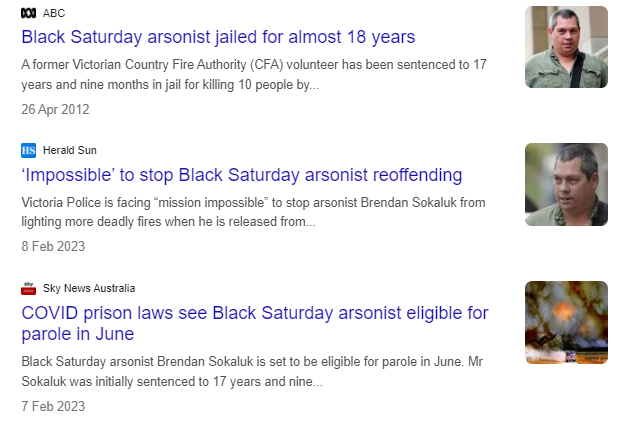
And another from Black Saturday:
Two teenage boys were arrested for starting a fire in Australia on Black Saturday last February 7 in which a disabled resident burned to death. The Maiden Gully fire near Bendigo killed Kevin “Mick Kane, 48, destroyed 60 homes, caused $29 million in damages, and burned 875 acres.
Via Wildfiretoday.com
Nevertheless, there is a lot less evidence for widespread arson in the 2019-20 season. Searching for news on this you will find that climate change is squarely blamed; and as with Wiki, many outlets place any mention of arson as a mark of denialism.

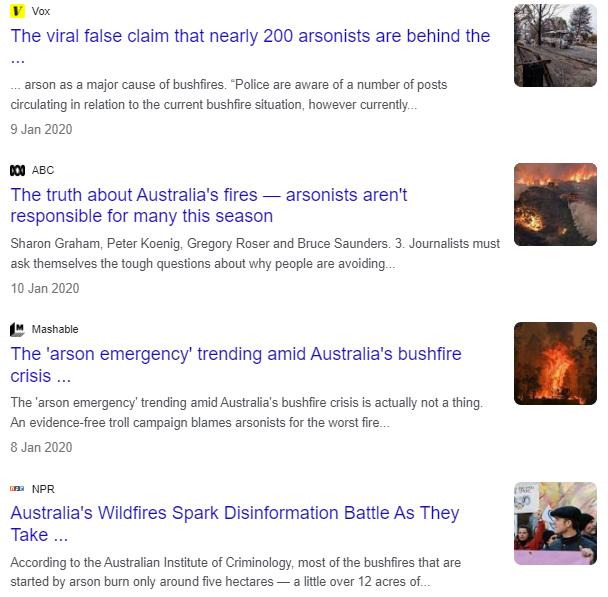
But if you delve into the archives, it was not always thus. The Sydney Morning Herald was willing to run an article on arson in New South Wales in January 2020 (i.e. in the middle of Black Summer).
A data collation and investigation plan has been developed to review the cause and impacts of the more than 1700 bushfires already reported to police; and consider the 12,000 fires recorded by the Rural Fire Service since August 2019,” police said in a statement released on Friday. Of those 1700, police say that 716 were deliberate lit.
…
Another 745 were of an undetermined cause, while 156 were caused naturally, police believe.
…
New figures provided by police on Friday showed that legal action has been taken against 55 people for fires that were allegedly deliberately lit since August 1. That figure includes people dealt with under mental health provisions, those given cautions and those charged with criminal offences. Legal action has also been taken against 126 people for allegedly failing to comply with a total fire ban, against 41 for throwing out a lit cigarette and against 70 juveniles for bushfire-related offences.
SMH, op. cit.
Note that the numbers of different causes do not add up to the total number of bushfires, even given that one of the “causes” is “undetermined.” But the upshot appears to be that the largest fires of Black Summer were started by lightning. Quite a few fires were started by arsonists, but (reading between the lines and applying Psychology 101) these were close to human habitation and quickly spotted and stifled. There is always the lurking possibility that a truly nefarious human could be bothered to drive 20 miles out of town and start a fire in such a way that it would be later ascribed to the weather, but we have no evidence of that.
More on arson in a future episode. I will also hopefully get around to covering dry lightning and how it is likely to change in frequency going forwards, if at all. There are also one or two other things to clear up.
But for now, I leave you with a Wednesday bonus story from the 2019-20 bushfire season. Not a story about arson, but about how bovine stupidity can cause a rapid conflagration when the conditions are right (with apologies for the language; I’m sure there are actually fruitier exchanges between the parties on record but I can’t find them any more):
“Are we authorised to land in some of these areas for the guys to get out and have a piss?” [an anonymous presumably male major] said.
The Guardian
Well, the guys landed their chopper and got out – but their bladders were not full enough to counter what happened next:
Smoke and visibility issues meant the landing light was switched on, but “the heat from the aircraft’s landing light caused the dry grass which the aircraft came in contact with to ignite”.
“Within 3-5 seconds of touch down a fire was ignited underneath the aircraft, which was fanned by the rotor wash,” Defence documents said.
ABC
The guys hot-footed it back aboard, and by now apparently bursting, made a bee-line straight back to the airfield. They arrived 45 minutes [According to the ABC; The Guardian says 17 minutes] later, and mentioned in passing to some guy leaning on a broom that they might have started a fire somewhere, while vaguely waving in the direction of Namadgi. Meanwhile smoke had already been seen, and spotters were running around like decapitated chickens trying to find the source. By the time they did, it was too late to snuff the fire out.
The fire, which burned for five weeks, was declared out of control after 6pm [4.5 hours after it was started] when more than 1,000ha were alight and would eventually grow to burn 87,923ha throughout the ACT.
The Guardian, op.cit.
Note: refer also to John’s piece from two years ago on the Greek wildfires, and comments below.
 Climate Scepticism
Good luck with that. Truth, so they say, is the first casualty of war, and I very much regret that far from being in the middle of a civilised discussion about climate change, we in the western world seem to be in the middle of climate change wars.
Those who claim that there is a lot of misinformation about arson claims might – just might – be correct, but ti would be nice to see an objective information-gathering exercise on their part, rather than the knee-jerk response of circling the wagons, which we also see when anyone suggests that increasing wind farm activity might have a connection with increasing whale, porpoise and dolphin deaths and strandings.
What we need to do is to find out what is causing wildfires and what is causing whale strandings, and to try to work out, having done so, what – if anything – we can do to reduce or end them. Sadly, there seems little chance of that approach in the MSM in the midst of the climate change wars.
LikeLiked by 3 people
I wrote about the possibility of arson playing a significant role in the Australian bushfires in Jan 2020, when the BBC were strenuously trying to debunk claims of arson by climate change deniers and conspiracy theorists. We all know how dedicated the BBC is to uncovering the truth.
LikeLiked by 3 people
“Wiki is a trustworthy source, isn’t it?”
This would indicate otherwise:
“Jimmy Wales is an internet entrepreneur and co-founder of Wikipedia and Wikia. He is a non-executive director of Guardian Media Group, owner of the Guardian and the Observer”
https://www.theguardian.com/profile/jimmy-wales
LikeLike
Thanks to Jit for examining the role of arson in the more recent Aus bushfires.
I’ve lived in a bushfire-prone area of NSW now for over 40 years. In that period, there have been 5-6 bushfire seasons of note, including two that had me leave work and go home to form defence.
While the left-wing media always squash down on arson as a cause of ignition, Jit has it correct in that the deeply entrenched fires are generally ignited by dry lightning well inside National Parks, although I’ll note a spectacular exception to that below, while the smaller ignitions nearer to hamlets and villages are generally lit by humans (deliberate or not) and are more easily contained.
Evolution of the eucalypts (gums) in a dry environment has resulted (so far) in vegetation that actually produces an aromatic, flammable hydrocarbon vapour exuded through the leaf stomates. What possible advantage could that have for a specific vegetation in a bushfire ? The answer lies in the long-term wind patterns from El Nino oscillations, which are not caused through “excess” CO2. A harsh, extremely dry and strong westerly wind pattern (which occurs every few El Ninos) drives bushfire across the eucalypt forest at a huge rate, with burning clumps of foliage pushed by the wind up to a kilometre ahead of the firefront. The hydrocarbon vapour helps accelerate this, so pushing the front through at speed and allowing the eucalypts to recover more quickly. This next is a hard observation from the 40 years: whenever a strong westerly arises (and they can blow for up to a week), it is guaranteed that small fires will suddenly ignite over large areas peripheral to the hamlets in less than 24 hours. Since dry lightning can be observed in these cases, and almost never is, the suspicion is that firebugs will light them just to watch them run in the wind; I have to agree it is a truly atavistic sight. The firebugs themselves are almost never to be convicted, since there is no direct evidence, although arrests are plentiful.
One spectacular arrest and conviction occurred about 15 years ago when a box kite was seen to be floating off a line way out over forest canopies during a heavy bushfire season. The police carefully tracked down the line controlling the kite and found a 16 year old boy floating his kite out over the canopy in a huge wind – with the tail(s) dripping kerosene from a small tank secured to his trail bike. Wet lightning, perhaps ?
LikeLiked by 3 people
Small, gratuitous point about natural causes of fires: minor causes are related to iron pyrites. Pyrite can create sparks when struck and some fires have been caused during rock falls that include pyrites. More common are ignition sources involving the oxidation of iron pyrites. This is a strongly exothermic reaction (causing other materials to ignite) and many fires have been attributed to this source.
Pedantry is rife.
LikeLike
Jit,
Thank you for highlighting these issues and thank you for the callout. I find the propaganda used to dismiss the importance of arson particularly annoying. As is often the case, an undemonstrated assumption is used as the basis for dismissing a counterview. In this case, the assumption is made that the only thing that has changed is the climate, and so arson has to be a red herring. The frustrating thing is that the numbers must be out there to enable a settlement of the issue, and yet no one is doing the research. When looking into the Australian bushfires, I did find this:
“Australian arsonists: an analysis of trends between 1990 and 2015”
https://www.ncbi.nlm.nih.gov/pmc/articles/PMC6762153/
But it opens with the following disappointing statement:
“There have been few studies to date focused on identifying the characteristics of Australian arsonists, and a distinct absence of any analyses of trends in arson offending over time.”
Even more disappointing is that the paper then only covered trends in characteristics and not trends in offending, thereby leaving the ‘distinct absence’ unaddressed. The paper did, however, point out that mental health and drug abuse had become more prevalent within arsonists, and so trends relating to those social problems do hint at a trend in offending. I also found this after a little more research:
“There was a 22.8 pct increase in the number of forest fires that broke out in 2016 compared with the previous year causing a more devastating effect with the area of burnt land rising by 124.5 pct, the Fire Brigade Operations Center in the Athens suburb of Chalandri reports. The latest reports released also reveal that there was a sharp rise in the number of confirmed cases of arson discovered by investigators, making intentional arson the top causal factor for wildfires in 2016.”
https://greekreporter.com/2016/11/13/fire-brigade-operations-center-reports-increase-of-arson-cases-and-wildfires-in-2016/
So there is enough out there to debunk the debunkers, but I fear the propaganda war is already lost.
LikeLiked by 1 person
P.S. Whilst there is a dearth of academic research on this issue, I should have acknowledged that there are amateur sleuths like Jaime Jessop who are prepared to dig out the relevant data, as she remined us earlier in this thread.
LikeLiked by 1 person
Jaime, I am sorry to have forgotten your piece and should have acknowledged it. I see WordPress associated it with this story thanks to the keywords anyway. I have more reading to do to find out about some of the 2019-20 fires.
Ianl, thank you for the info from the region. I have only theoretical knowledge of bushfires. My only brush with a real wildfire was a stubble fire that got out of control. Not in the same league.
Regarding the volatiles, ecologists propose additional reasons for them. Neither seem entirely realistic. The first is that the shimmer of volatiles above the plants weaken the sunlight. The second is that in evaporating from leaves, the volatiles cool the plant. One thing that definitely does not slow down fire is the presence of highly-flammable litter, which as you will know, some eucalypts produce in abundance.
As a local, did you hear whether Sokaluk was released? The internet does not seem to tell me.
Alan, if I ever knew that, I had forgotten. Pedantry is excusable under all circumstances, except when the correction is wrong, so no worries there.
John, one thing I have not mentioned here, but will discuss later, is the dearth of literature on arson and wildfires. It is matched by an abundance of literature on climate change and wildfires. Spooky that.
LikeLiked by 1 person
No problem Jit, it was a while ago now, so I thought I would just mention it because obviously I remember writing it, but it even took me more than a few minutes to locate the article.
LikeLike
Jit, perhaps it’s already on your list of forthcoming segments, but arson is not the only “far right wing climate denial conspiracy”. Fuel load is another. Of course you will know that; but I raise it to direct you to Vic Jurskis, who has written about the politics of it a number of times in Quadrant, for the Australian scene.
LikeLike
ianalexs – this is a topic I intend to investigate. I read somewhere regarding the 2019-20 fires that the typical return period of a fire is 50 years (=2% of land burnt per year), Then it was claimed that 20% of the land was burnt in 2019-20, showing that the total was unexpectedly atypical.
My question: what is the “natural” fire frequency?
LikeLike
Re-reading Jit’s article has reminded me of another point I have recently mused upon. In the wake of the Black Summer there was indeed a lot of talk of bots and denialist propaganda seeking to exaggerate the role of arson in starting wildfires. Back then it seemed very important to downplay human causation and attribute the causation primarily to climate change. More recently, however, I have sensed that the form of argument has changed. We are now told that the role of arson was always a denialist red herring, indeed the mechanism for ignition is largely irrelevant. We are now told that human causation has always been accepted as primary but the real point has always been that climate change has created conditions that make fires worse. I am sure I am not imagining this shift in position, but does anyone else share this impression?
Also, whilst I’m on here, I’d like to point out that the lack of research regarding trends in non-climate causations was one of the technical reasons given by Patrick Brown for his admitted failure to tell the full truth in his attribution study. A full truth has to address the questions asked by Jit at the head of his article and Brown and his climate science colleagues are no more able to answer them than are we here on Cliscep. Or perhaps I should wait to see what else Jit can discover.
LikeLike
This comment seems to not have been loaded via your webpage, so added via W/Press site.
[I’ve learnt to copy comment content before posting on your webpage, for this very reason! 😉 ]
If it’s a duplicate trapped in spam, feel free to delete the redundant copy:
———————–
Hi Jit, I remember this from around that time:
Click to access Media-statement-bushfires.pdf
LikeLiked by 1 person
Joe P, apologies – your comment was stuck in spam. I’ve now deleted it. Thanks for your ingenuity and patience.
LikeLiked by 1 person
Wildfires with natural causes may be more frequent that many people believe. In the 1970s I spent several summers field mapping in Northern Saskatchewan – a region of mostly virgin northern forests, home to very scattered indigenous people and Metis. In all the time I spent there (in total perhaps 14 weeks) we never met anyone, except floatplane pilots.
There was much concern for our safety, especially our exposure to possible wildfires. Each day we were contacted from homebase and given a report of the nearest wildfires. If one had threatened us we would have been extracted by floatplane.
Without that reassurance I feel sure that no one would have deliberately conducted arson, it would have just have been too dangerous. Flushing out game would have been unlikely as this was extremely scarce. Yet almost every evening we were informed of new fires, especially after storms.
LikeLike
Jit, you are asking tough questions! I’d again defer to Vic Jurskis. But as a sketch answer here’s a few comments. There are different forest management paradigms in Australia. There’s the National Park, approach, where fire is not introduced. As VJ points out, that leads to accumulating fuel loads, and as IanL in comments above pointed out, that beautiful blue haze over the forested mountains on a glorious summer day, is an explosive eucalypt hydrocarbon. So national parks do burn, but in an uncontrolled way. It was probably always so for the closed canopy tall forests. There’s early accounts of burnt forests and their regeneration.
But then there’s the role of Aboriginal fire. No doubt, open forests were burnt in a continual patchwork of deliberate low intensity fire. Yo some extent that approach is micked on public land throughout Australia as so-called “burn-offs” but probably not done nearly often enough. And VJ says, it’s too high intensity and doesn’t properly mimic the low fire temperature approach of the earlier Aborigines.
The degree to which high forests were burnt as part of Aboriginal fire regimes is more contentious though. There are early accounts of explorers in say, the Otway Ranges in southern Victoria, where it’s clear there’d been no “firestick farming” producing a clear understorey, though there were signs of wild fire. (The forest margins though, did show signs of deliberate fire use). And then, you’ve got earlier European practices in those forests, before national parks: grazing licences — if you look at 1940s aerial photography (that’s the first available), you’ll see a relatively open understorey, due to cattle grazing. The understorey became much more dense once those areas became national parks in the 1970s. That’s floristically desirable in my opinion as an amateur botanist, but does make for a risky summer.
Fire frequency: you’ve got me there. But that’s why past Aboriginal practices need to be considered. Vic Jurskis and others persuade me that many forests, particularly open forests, are artefacts of Aboriginal firing practices, and *not* firing them is neglect; leading to an altered lower frequency, higher intensity fire regime. As I say above, I’m more reserved about deep mountain forests. For those areas, I suppose it’s possible to calculate an average. From my own knowledge of the Otway Ranges in southern Victoria, I’ve seen historical fire maps (as best as can be drawn: the extent of fires in colonial times are only guessed from old newspaper accounts and perhaps limited landscape studies), and I would probably peg fire recurring in any one area of the forest at about 70 years.
I don’t think I’ve got a sophisticated understanding, or at least, not a broadly based understanding of this topic. I’ll be interested, and no doubt informed, by what you write.
PS Mark Hodgson — your point that the narrative has changed from “arson is a far-right conspiracy theory, that never happened” to “actually, humans are the evil factor (or more accurately, white settlers — not indigenous firestick farmers) but the fires caused by their evil settler ways are now exacerbated by climate change” is perceptive. I can’t say if that narrative evolution tracks exactly through media accounts (it’s possible the record is messier, and both narratives may have coexisted but the emphasis has changed), but it’s a very plausible observation.
LikeLiked by 1 person
Ianalexs, thank you for the comment. It was unwise of me to ask for a number! But a single number was what was reported – perhaps we the public are not to be trusted with complex answers.
What you are saying makes sense in that ecological communities shape their environment just as the environment shapes them. So fire frequency determines the make-up of the community, and the make-up of the community determines fire frequency. If fire frequency drops, non-fire-adapted species may eventually transform the community into one that is not as flammable and vice versa. When someone says “eucalypt” to me, I think of the flammable kind, and then think a 50-year period is long. More to read as usual.
John, I have not noticed the change you speak of, but as I will no doubt be canvassing news archives for a bit such a pattern might become evident. I will report back.
LikeLiked by 1 person
Alan, it sounds like quite a trip! Any old photos you would like to share?
LikeLike
JIT no photographs I’m afraid, but we camped in the Clearwater valley an absolutely wonderfully beautiful area. So much so that upon returning to Regina I campaigned forcefully for the entire valley to be made into a provincial Park. Apparently with no success, but several years later I saw a map of Saskatchewan with the entire valley now a Park. Can’t say I was responsible but at least was an early proposer.
Forgot to mention that our camp had a 3person helicopter and it’s pilot staying with us (which would not be much good if we were threatened by wildfire – for that we would have needed the floatplane).
If you thought that was “quite a trip” you would have even more enjoyed my summers in subsequent years that I spent in a motel in Banff and Jasper(Alberta) flying all over the Rocky Moutains. This was when I was employed by Amoco.
Although those years sound fabulous (and they were) they also used up those summers, which on the Prairies were short and very precious. I had a young family that I very much missed, although when based in Banff they visited and were taken up in the helicopter (= huge bragging rights at School the following fall).
LikeLike
Alan,
I have visited Banff, Jasper and Clearwater, and share your wonder at the beauty of such places. I believe the lake at Clearwater sits atop the fault line that stretches down to California.
LikeLike
Mark. There are many Clearwater Rivers in Canada. I suspect you are referring to Clearwater Lake Provincial Park rather than Clearwater Valley PP. can’t find much about it but the main feature (probably the reason for its park status) is its rapids. I remember deliberately avoiding these until my last day when I shot the rapids in our canoes. Absolutely fabulous! Thank you for causing me to remember that memorable day.
LikeLiked by 1 person
Jit,
I still haven’t found anything that properly quantifies the trends in the various factors that contribute to the growth in the numbers and intensities of Australian bushfires, but I have started to look at the work of the criminal psychologist Dr Paul Read of Monash University. In particular, I have found this presentation in which he took part:
Click to access Climate_Convo_bushfires.pdf
The presentation is in three parts, but it is the second part to which I draw your attention (the introductory part is just a conventional focus upon the climate change problem, concluding that “Climate change [is] sitting behind so much of this!” The final part focuses upon planning issues).
The central part is Dr Paul Read’s contribution and it is titled, “Climate + Arson; Interactions and new ideas”. In particular, note the slide labelled ‘Firestorms?’ It’s a not very scientific graph but it claims, nevertheless, that there has been recent growth in the following contributory factors: Poverty, autism, domestic violence, ICE (don’t know what this means), youth unemployment, ghetto estates, recession, record temperatures, fuel load, and above all, complacency. I also suspect that he could have added an increase of care in the community for the mentally ill and an increase in drug abuse.
I know it doesn’t help a great deal in answering your questions because, as Dr Paul Read points out in another slide, “Ignition analysis needs a nested hierarchical regression model”. Nevertheless, it is the first example I have found of an academic directly linking the rise in wildfire occurrence to rises in various societal problems. You will note, of course, that of the above list, only one of the trending causal factors is related to climate change.
LikeLiked by 1 person
“How big are the fires burning in Australia’s north? Interactive map shows they’ve burned an area larger than Spain”
https://www.theguardian.com/news/datablog/ng-interactive/2023/nov/15/bushfires-in-australias-north-this-year-have-burned-an-area-larger-than-the-size-of-spain
Arson isn’t mentioned here, but this is nevertheless interesting:
LikeLike
Of course the Guardian won’t write this, think about it, and row back from its alarmism about forest fires and climate change:
“Canadian man who claimed wildfires were a federal conspiracy admits arson
The country saw record-breaking blazes during the summer and Brian Paré pleaded guilty to lighting more than a dozen fires”
https://www.theguardian.com/world/2024/jan/16/canada-wildfires-conspiracy-man-pleads-guilty-arson
LikeLiked by 2 people
Firefighter ‘who wanted to be hero’ arrested over deadly Chile blaze
…
BBC link
LikeLike
The BBC buried that story deep in their website. Well done for digging it out!
LikeLike
“California fire agency engineer arrested on suspicion of starting five wildfires
Cal Fire says Robert Hernandez ignited blazes while off duty in forest land in north of state”
https://www.theguardian.com/us-news/2024/sep/20/cal-fire-engineer-arrested-arson
and
“‘It’s guerrilla warfare’: Brazil fire teams fight Amazon blazes – and the arsonists who start them
Firefighters and police in Rondônia battle fires intensified by both the climate crisis and a criminal assault on the rainforest”
https://www.theguardian.com/world/2024/sep/20/amazon-brazil-firefighters
LikeLike
Mark,
That second article offers a perfect example of the sort of duplicitous journalism in which the Guardian engages. The article is quite clearly stressing the role played by organised, criminal gangs of arsonists in the Amazonian jungle, and the day-to-day stresses this places upon the firefighters (based upon interviews with a chap called Baldoini). Any reasonable reading of it would point to the conclusion that the recent trend in fires may have a lot more to do with this trend in arson rather than climatic trends. But, of course, the Guardian journalist would not be happy with the reader drawing such a conclusion, and hence he finishes with:
How the hell is the author supposed to know what Baldoini was reflecting upon as he referred to biblical scenes he had personally witnessed? What are the odds that he was engrossed in Amazonian firefighting but in reflective mood chose to remember Canada and Portugal? It is obvious that an editorial position taken by the Guardian has been sneakily made to look like one shared by their eye-witness. If I were a mind-reader like the Guardian journalist, I would be assuming that, after a day spent fighting fires started by arsonists, he would be reflecting upon arson, pure and simple.
LikeLiked by 2 people
Forthcoming BBC or Guardian headline. Betcha. Watch this space.
LikeLike
A strange article from the Guardian, and despite its climate alarmism, I think one paragraph in particular undermines that case:
“Can a 15th-century Indian singing tradition help stop wildfires?”
https://www.theguardian.com/global-development/2025/jun/03/15th-century-indian-singing-tradition-help-stop-wildfires-sankirtan-mandali
…Forest officials are enlisting devotional song-and-dance troupes – sankirtan mandalis – to help in the fight against fires in the dry deciduous woods of Odisha state in soaring temperatures. Fires have already affected more than 4,500 hectares (11,120 acres) of forest in Odisha this year, up from about 4,000 hectares in 2024. Officials are using technology such as AI cameras and satellite data to track blazes but are also turning to the appeal of song to ask villagers not to burn leaves in the forest, apractice believed to benefit the soil, but which has led to uncontrollable wildfires in recent years.…
The forest fires, it appears, are largely man-made, and when the locals are encouraged to desist from burning leaves in the forest, the number of fires has gone down – despite the demon climate change.
LikeLike
Mark – seems to me this article is more about Woman power in India, with climate crisis tagged on.
I have no problem with highlighting Indian Woman taking more control of there lives, but this partial quote spoiled that –
“Nayak was married at 10. Now 25, she has two children aged eight and 10. “These days, girls are studying, even working as pilots,” she says. “I had never thought that I had talent, that I would go out and sing and people would bless me.””
LikeLike