As you know, Zen is my middle name. But a mini-tempest swept over my equanimity this week when I caught a bit of Thursday’s PM. The item that set me off balance was based on the paper by Fretwell et al in Communications Earth and Environment. It began thusly:
EVAN DAVIES: Very sad news which is the catastrophic death of something like 10,000 young emperor penguins. They were being raised on a piece of sea ice, it broke up, before they had developed enough to be able to swim…
Davies introduced Norman Ratcliffe, seabird ecologist at BAS and one of the study’s authors, who talked about the complete loss of sea ice in November 2022 in the Bellingshausen Sea, resulting in the loss of 4 of 5 emperor penguin colonies… “pretty tragic news for emperor penguins.”
Davies asked for perspective, and Ratcliffe informed him that 10,000 represents “about 4% of the global population,” [it’s 2% but who’s counting, and the adults are not dead] but that the Bellingshausen is not a central part of their range… “this is the first time we’ve seen a regional loss of emperor penguin breeding success.”
Ratcliffe went on to say that these types of events are normal in emperor breeding ecology but not hitherto observed on such a scale (almost complete failure in an entire region).
EVAN: And this comes back down to global warming, and Antarctic warming, which seems to be occurring at a much more extreme rate than global, than globally it does.
NORMAN RATCLIFFE: Errrrrrrrrrrrrrrrr…. It is warming faster in the West Antarctic Peninsula yes, so it is quite difficult to disentangle the effects of natural climate variability from anthropogenic climate change. So at the moment there is quite a strong La Nina event in the Pacific, and that has global repercussions, but in the Bellingshausen Sea that leads to low pressures and more windy conditions. That makes the sea choppier, the sea ice tends to get broken up and moved around more. But the long term predictions are that with warming, sea ice will disappear more around Antarctica. So this observation we’ve made may become a more usual observation in the future, and that will have big impacts on emperor penguin distribution and population size.
Thank you, Norman Ratcliffe, for having the integrity not to nod along with Evan’s instinctive misattribution. But I do wonder just how good the long term predictions are. Antarctic winters are still going to be quite cold, I think; I find it hard to believe that sea ice will not form, even under the most extreme scenario, or that what remains will be wholly unsuitable for breeding.
The Guardian managed to imply that global warming was to blame, without quite nailing its colours to the mast:
Scientists have said emperor penguins face an uncertain future under global heating because they are so reliant on sea ice, which is projected to decline as the world’s oceans heat up.
It also reminds us that the film “Happy Feet” was based on an emperor penguin. I don’t think we needed to know that, but thanks.
““It’s a grim story,” said Dr Peter Fretwell, a researcher with the British Antarctic Survey and the lead author of the research. “I was shocked. It’s very hard to think of these cute fluffy chicks dying in large numbers.
“We had predicted it for a long time. The sea ice loss has been unprecedented and far quicker than we imagined.””
Right, Doc: You were shocked. You had predicted it for a long time. But it was quicker than you had imagined. The way off the stage is over here.
Dr Jeremy Wilkinson, a sea ice physicist at the British Antarctic Survey, said the research “dramatically reveals the connection between sea ice loss and ecosystem annihilation”.
Gosh. Ecosystem annihilation? You mean there’s nothing there any more?
“Fretwell said: “What’s most devastating for me is that we know this will get worse before it gets better. This is the trajectory that we are on.
“It’s only by changing our behaviour and the amounts of fossil fuels we use will we reverse the trajectory for these emperor penguins, and many other species.
“How bad it gets is still up to us.””
Well, I’ve got a suggestion for a little bit of behaviour change. How about we pull all the scientists out of the Antarctic? Getting all those dudes and dudettes up and down the world on their seasonal jollies comes with quite a carbon footprint.
They can still tell us all how **** the world is from the office, using their satellites.
Australia’s ABC know what happened…
This sort of sudden collapse of populations driven by climate change has been documented and projected before.
“Those sorts of biological tipping points are actually quite common,” said Professor Lesley Hughes, an ecologist and climate scientist from Macquarie University.
“And the problem with climate change is that we’re seeing those biological thresholds starting to be exceeded for lots and lots of different species,” said Professor Hughes, who is also a director at the Climate Council, which advocates for stronger action on climate change.
“So, things just sort of … fall off some sort of climate cliff.”
…
Professor Hughes said it was clear what needed to be done to minimise the destruction.
“We just have to … very, very rapidly transition out of digging up fossil fuels, exporting them and burning them,” she said.
LOL. I really must read her paper.
Now, I’m going to surprise you by admitting that I could write everything I know about penguins on the back of a stamp. But I had a look to see what a proper birder knew about emperors. This is a quote from Roger Tory Peterson’s book Penguins (from 1979, when oil pollution was more of the zeitgeist).
Blizzards and foul weather are greater hazard to these ponderous penguins. When Edward Wilson investigated the Emperors at Cape Crozier during the Scott expeditions of 1902 and 1911, he noted a very high mortality of eggs and chicks, both years due apparently to unstable ice conditions, which kept many parents from feeding their chicks. The little things became emaciated and eventually froze to death. On the basis of these two expeditions, one could have deduced that either Emperor Penguins had the longevity of humans (70 years or more) or else were a vanishing species. Neither conclusion is correct. Today, we know that those two years recorded by Wilson were not typical. There are years, however, when there may even be a total wipeout of reproduction. This may happen when the sea ice breaks loose from the Ross Ice Shelf prematurely during a storm, and the half-grown young are carried to their destruction.
According to Wiki, only 19% of emperor chicks survive their first year. The source for this seems to be one old French study that I have not read. But it is likely to be representative I think. With emperors we are dealing with an immense cull of chicks every year. The pairs attempt to rear a single chick, and have a lot of goes at it, since the adults, once established, are quite long-lived. Wiki says 20 years.
So much so useful, ta Wiki. However, it lets itself down by picking up on the new study in a quite erroneous fashion.
A 2023 study found that more than 90% of emperor penguin colonies could face “quasi-extinction” from “catastrophic breeding failure” due to the loss of sea ice caused by climate change.
The 2023 study “found” no such thing. It said this:
Recent efforts to predict emperor penguin population trends from forecasts of sea ice loss have painted a bleak picture, showing that if present rates of warming persist over 90% of emperor colonies will be quasi-extinct by the end of this century7
In other words, the reference to 90% of colonies going “quasi-extinct” comes not from Fretwell et al but their Ref. 7, Trathan et al 2020. However, the expression is not used there, either. This is:
A climate-dependent demographic model without emigration, projected that many emperor colonies would decrease by >50% from their current size by 2100, resulting in a dramatic global population decrease (Jenouvrier et al., 2014).
*Sigh.* Let’s go and have a look at Jenouvrier et al, shall we? Here is their Figure 4, which seems to show the range of outcomes from their computer model. I will leave it to the reader to decide how well he or she believes this model describes the emperor penguin population in 2100.
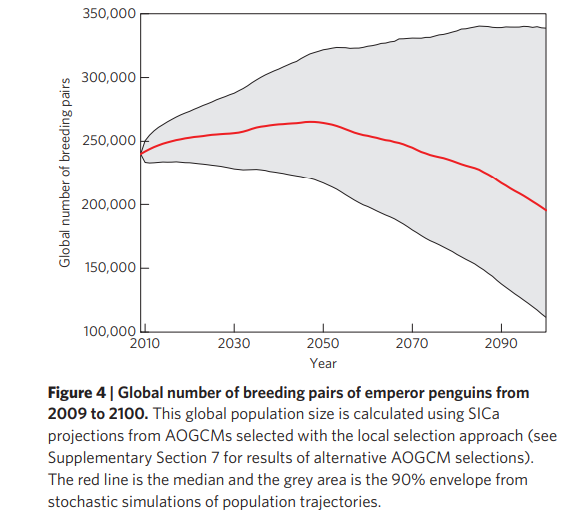
I like computer games. I really do. This group of researchers are perfectly entitled to get excited about the imminent doom of their favourite flightless bird. But the rest of the world is not obligated to join the excitement, particularly if the evidence is computer games with outputs along these lines. (I don’t think “calculated” is the right verb to use.)
I don’t believe the models can accurately capture the future of sea ice off Antarctica. Sorry. But even if I did believe that, I would still snort in derision at such figures as Jenouvrier et al’s Figure 4 because, knowing nothing about penguins, I would simply tell you that the colonies will move to more secure locations, such that unless sea ice vanishes utterly, there will be no noticeable decline. Naive of me I know.
According to a press release from the Australian Antarctic Division, in the past, when there was more ice, the emperor penguin apparently had a far more restricted range than today.
…the research team discovered that conditions were too harsh even for emperor penguins during the last ice age and that the population then was roughly seven times smaller than today and split into three refugial populations.
Emperor penguin numbers only increased over the last 12,000 years as sea ice decreased around Antarctica throughout the Holocene warming period. This finding suggests that current sea ice conditions may be optimal for emperor penguins.
So – if it gets any hotter… they’re dead. If it gets any colder… they’re dead too. Poor little mites. How lucky for them that the time that is now just so happens to be the sweet spot. What are the odds? And while we’re giving up our SUVs to freeze the sea ice decline, can we ban tourist cruises from flying helicopters over the emperor colonies? Oh yeh. And let’s have no more factory fishing of krill within a couple of hundred miles of the Antarctic coastline.
Oh, the paper itself? Perhaps the reader can explain this paragraph from it to me:
Between the initial collection of Sentinel2 data in Antarctica in 2018 until 2022 the archive of imagery shows only one of the five colonies had witnessed sea ice break up earlier than December (Bryant Peninsula; 2010). One instance of break up in the five colonies in the 4 years of imagery is a likely hood on 0.04. In 2022 the loss of four out of the five sites led to an early break-up a likelihood of 0.80. [Assume “sic” for everything there that looks wrong.]
“Quick, Kevin, press the “ACCEPT” button! This one’s a keeper!”
Paragraph 2 of the Introduction included this little typo:
Their populations have never been subject to large-scale hunting, or suffered from habitat loss, overfishing or other local anthropogenic interactions in the modern eara. [sic.]
NOBODY READ IT before submission, not even the authors, is my conclusion.
This is what Fretwell et al. say about the five colonies, the top four of which had complete breeding failure.
| Colony Name | Discovery Year | Approx. no. of Pairs |
| Verdi Inlet | 2018 | 3000 |
| Smyley Island | 2009 | 3500 |
| Bryant Coast | 2014 | 2000 |
| Pfrogner Point | 2019 | 1200 |
| Rothschild Island | Not stated (since 2009) | 700 |
Great news guys! We’ve discovered five new emperor colonies!
Oh no, four of them had total breeding failure in 2022! If only we hadn’t found them with our shiny new satellite we wouldn’t be so depressed now! Ignorance is bliss.
[Edited before publication to remove a ranty page about sentimentalism in the way humans think about Nature. This was already way overlong, so that particular sub-rant will have to wait for another day.]
PS. Wait, you cry. Jit can’t fly the coop yet. He hasn’t told me what “Quasi-extinct” means.
Oh yeh. Well, it means not extinct. If you were “Quasi-dead” you’d still be alive. (It’s described as a 90% population reduction.)
References
Fretwell et al. https://www.nature.com/articles/s43247-023-00927-x
Trathan et al. https://www.sciencedirect.com/science/article/pii/S0006320719309899
Jenouvrier et al. cebc.cnrs.fr/wp-content/uploads/publipdf/2014/JNCC4_2014.pdf
“Emperor penguins – survival through the ages” https://www.antarctica.gov.au/news/2015/emperor-penguins-survival-through-the-ages/
Roger Tory Peterson (1979). Penguins. Houghton Mifflin, Boston (available at Archive.org).
Wiki page on emperors: https://en.wikipedia.org/wiki/Emperor_penguin
PM, Thursday 24th August, 2023. https://www.bbc.co.uk/sounds/play/m001ptdz
ABC coverage: https://www.abc.net.au/news/2023-08-25/antarctica-sea-ice-loss-affects-emperor-penguin-breeding/102765634
Guardian coverage: https://www.theguardian.com/world/2023/aug/25/emperor-penguins-thousands-of-chicks-in-antarctica-likely-died-due-to-record-low-sea-ice-levels


Well, in a stable population, a penguin couple will have exactly two offspring surviving to procreate themselves. So most of the chicks just don’t survive. I’ve been watching four oyster catcher breeding spots for about 10 years now, and only one chick survived to almost adulthood. It’s a hard life for wildlife.
LikeLike
So the question is WHY? Why is the breeding pair fails? And of course, Global Change. Any thus the ice melting is blamed.
BUT remember the ASSUME. … out of you and me. Just because you think something does not make it so.
Here a thought for you. They want to blame CO2. But what has also changed since the Industrial Revolution? CITIES, less green plants, more roads. Do you know that different surfaces absorb or reflect light differently? Black top absorbs more light energy and reflects less. Green plants and grass do the opposite. They reflect more energy. An experiment. Stand in a green park for about 30 minutes and take a temperature reading. Then do the same thing is the middle of a parking black top lot. I know and you will find out that the green grass is cooler then the parking lot. Got a new word for you to learn.
https://en.wikipedia.org/wiki/Albedo
Alerdo which is the fraction of sunlight that is diffusely reflected by a body. It is measured on a scale from 0 (corresponding to a black body that absorbs all incident radiation) to 1 (corresponding to a body that reflects all incident radiation).
This is just one reason why the planet might be warming. And yes that would be people caused. But it has nothing to do with CO2. It simply less forest and green plant areas.
So those breeding pairs failing might have nothing to do with melting ice. it could be their diet has more mercury in it. It a funny thought. But instead of making assumptions, how about for a change doing a study by watching and not doing a study set up in such a way as to bias the data results.
LikeLike
This story now covered by Jim Steele at WUWT:
LikeLike
Jit,
When the BBC and the Guardian first “broke” the story, I noted that the Bellingshausen Sea is an area of considerable volcanic activity. I have no idea whether this (as opposed to climate change) has anything to do with the break-up of the ice, but one might have thought that scientists with enquiring minds would contemplate the possibility. But no, whatever happens, it’s climate change – it just has to be.
“Reconstruction of changes in the Amundsen Sea and Bellingshausen Sea sector of the West Antarctic Ice Sheet since the Last Glacial Maximum”
https://www.sciencedirect.com/science/article/pii/S0277379113004101
LikeLike
Of course, the Guardian has more:
“I have studied emperor penguins for 30 years. We may witness their demise in our lifetime
Barbara Wienecke
As Antarctica warms and sea ice disappears, the breeding of emperor penguin chicks is in peril – a hostile environment even they cannot overcome”
https://www.theguardian.com/commentisfree/2023/aug/28/emperor-penguin-extinction
“Antarctica is getting warmer.”
Yeah, right, OK.
https://climaterealism.com/wp-content/uploads/2021/01/Antarctic-temps-bitmap-2.bmp
https://climaterealism.com/2021/01/peer-reviewed-study-confirms-antarctica-has-not-warmed-in-last-seven-decades/
LikeLike
Thank you for this JIT: a terrible story put into context. Perhaps another big story is that it is a one of scientists with a lust for power (ability to attract attention and funding) grabbing a tale and bigging it up, regardless of the truth. I half expected that this Emperor Penguin tale would change as scepticism took hold but it affecting only 2 to 4% of the total population and statements that similar events have occurred in past years without much comment; well they put the whole matter into perspective. I also appreciate Franz’s comment about the breeding potential of penguin pairs.
My comments should not detract from the horribleness and enormity of the loss of thousands of chicks, all of which we humans view as adorable (Happy Feet did not help!)
LikeLiked by 1 person
Jit,
When I read about this tragedy my first thought was ‘oh, this is awful’. My second was that this is a story that is crying out for context. Thank you for providing it.
LikeLike
Alan, I suppose the context I should have provided is that, given 250,000 pairs of penguins, and letting 80% be breeding pairs, then we would expect 200,000 chicks every year, which if the 19% survival rate holds, means 160,000 of them do not see their first birthday.
LikeLike
Jit – sure I watched a BBC documentary showing the long walk chicks had to make to the sea over sea ice. less sea ice = shorter waddle.
what am I missing?
LikeLike
JIT. Appreciation of Franz’s comment was just that and in no way any criticism of your context. I happen to think your article was one of the best and certainly one of the most needed.
I also recall the BBC programme mentioned by DFH about the penguin chicks’ long marches and the fate of many of them when they finally reach the open sea. The sight of many being skinned by being tossed into the air by sea lions and orcas still lives with me. Mother Nature probably finds Antarctica too cold for her.
LikeLike
Apsley Cherry-Garrard’s book* “The Worst Journey in the World” includes a vivid description of the mid-winter trek to Cape Crozier in search of Emperor eggs. The aim, iirc, was to recover some embryos which a theory of the time said might show the developmental “missing link” between birds and dinosaurs.
The book is an epic of polar exploration, probably the best I have read for conveying the hardship, isolation and endurance.
*As it was written a long time ago, the book may well be out of copyright and therefore free on Kindle, etc..
LikeLike
Alan/Dougie – think of it this way. If the ice breaks up late, you have a long walk to open water. If the ice breaks up early, you drown. No doubt the ideal situation – in which the ice breaks up at the moment the chicks have fledged – is quite an unusual one.
LikeLike
JIT. My admiration and sympathies lie with the penguin parents who are required to fed their chick. This necessitates multiple transits of the ice between their chick and the sea, involving two traverses of the gauntlet lying at the edge of sea patrolled by predators. With such a perilous lifestyle it is difficult to imagine how it evolved.
The bottom line, however, is that Emperor penguins (or their predecessors) must have successfully negotiated the Climate Optimum when, presumably, floating sea ice must have been even less abundant/more unstable than it is today.
LikeLiked by 1 person
“Climate change: Four new emperor penguin groups found by satellite”
https://www.bbc.co.uk/news/science-environment-68071718
LikeLike
Thanks Mark. Another excuse to trot out the usual BS about emperors being under threat. It would be refreshing to have Fretwell and his chums admit that they’re fine, but I guess that’s not going to happen. And every time a colony gets washed away, someone will be wheeled out to tell us to rapidly transition away from fossil fuels.
LikeLike
Perhaps this quote should be the positive takeaway from the article:
“It just shows this is a species that has to be dynamic,” said Dr Fretwell.
“When we do get future ice losses, emperors can and will move. It’s in their nature.”
Replacing the loaded “has to be” with “is”.
LikeLike
from the BBC article with a nice BAS map – https://ichef.bbci.co.uk/news/976/cpsprodpb/11800/production/_132408617_map_antarctica_penguin_2x640-nc-2x-nc.png.webp
we get this quote –
“At least one of the newly identified colonies – named Lazarev North – is likely a grouping of birds that had to abandon a nearby site to take up a more favourable home.
The new Gipps colony, too, shows evidence in the satellite record of having shifted its position over time.”
If true & sounds likely, seems emperor penguin groups are a bit smarter than Jonathan Amos
Science correspondent at the BBC would have you believe, But he still gets the warming narrative in.
“It’s vital information for conservationists monitoring a species that’s under increasing pressure as a result of climate change.
Emperors court, mate, lay and hatch eggs, and then bring up their young on the sea-ice connected to the coast – so-called fast ice.
But this type of ice has diminished in parts of Antarctica and become more variable, certainly in recent years, putting a big question mark against the long-term viability of the species in an ever-warming world.”
The message with pics of cute little penguins about to die (maybe) ticks all the boxes for the BBC.
LikeLike
“Penguin chicks survive tearaway iceberg”
https://www.bbc.co.uk/news/articles/c3wp4qnljd1o
In May a huge iceberg broke off from an Antarctic ice shelf, drifted, and came to a stop – right in front of “maybe the world’s unluckiest” penguins.
Like a door shutting, the iceberg’s huge walls sealed off the Halley Bay colony from the sea.
It seemed to spell the end for hundreds of newly-hatched fluffy chicks whose mothers, out hunting for food, may no longer have been able to reach them.
Then, a few weeks ago, the iceberg shifted and got on the move again.
Scientists have now discovered that the tenacious penguins found a way to beat the colossal iceberg – satellite pictures seen exclusively by BBC News this week show life in the colony....
...But how they survived remains a mystery….
So many mysteries. So much to worry about:
…But Antarctica remains a rapidly changing region affected by our warming planet, as well as natural phenomena that make life difficult there.
The MacDonald Ice rumples where the penguins now live is dynamic and unpredictable, and Antarctic seasonal sea ice levels are close to record lows.
As A83 moved, it changed the ice topography, meaning the penguins’ breeding site is now “more exposed”, Peter says.
Cracks have appeared in the ice and the edge with the sea is getting closer day-by-day.
If the ice breaks up under the chicks before they are able to swim, in around December, Peter warns they will perish.
LikeLiked by 1 person
“Penguin chicks survive” somehow, but forget that “Happy Feet” news because “If the ice breaks up under the chicks before they are able to swim, in around December, Peter warns they will perish.“
Seems BBC & Peter (maybe) just have to end with “our warming planet” to make sure readers are reminded not to be happy just yet for the loveable Penguin chicks.
LikeLike
Jo Nova on some more Antarctic hysteria. Something terrible is definitely going to happen, but no-one is quite sure what it is. But they are sure that Net Zero Now is the appropriate answer.
LikeLike
Climate change is a problem, apparently, whatever the outcome, and even if they’re not actually sure climate change is the reason:
“Antarctic penguins have radically shifted their breeding season – seemingly in response to climate change
Changing temperatures may be behind change in behaviour, which experts fear threatens three species’ survival”
https://www.theguardian.com/world/2026/jan/20/antarctic-penguins-shift-breeding-season-climate-change
Penguins in Antarctica have radically shifted their breeding season, apparently as a response to climate change, research has found.…
Apparently. Well, I welcome the recognition that there is uncertainty as to the reason. Then there’s this:
...The changes threaten to disrupt penguins’ access to food, increasing concerns for their survival. “We are very concerned because these penguins are advancing their season so much, and penguins are now breeding earlier than in any known records,” said the report’s lead author, Dr Ignacio Juarez Martínez.
“The changes are happening so fast that the penguins could end up breeding at times when their prey is not available yet. This could result in a lack of food for the penguin chicks in the first weeks of their life, which could be fatal. Even if the penguins could match their prey’s behaviour, we can’t expect them to keep this pace up much longer.”…
Yet:
…“Gentoos are a more temperate species and are already benefiting from the milder conditions that climate change is bringing to Antarctica,” said Juarez. “They’re already expanding their colonies throughout the peninsula…”…
Difficult to imagine them doing that if there was a shortage of food. Perhaps they’re responding to food being available earlier?
…It is unclear what the specific mechanism is that is moving the penguins’ breeding dates forward – they could be prompted by warmer temperatures (as many animals and plants are), by the earlier breaking of the ice, the earlier melting of the snow, the earlier phytoplankton blooms or other factors.…
…“Chinstrap and Adélie colonies are, unfortunately, in clear decline throughout the area and there’s no reason to believe this is going to reverse anytime soon,” said Juarez. “Emperor penguins also breed there and also look like they are going extinct. We want to preserve penguin diversity in Antarctica at all costs. The Antarctic ecosystem is a network with very few links – losing several species of penguins before the end of the century, as models predict, could be a fatal blow to its functioning and its resilience.”
I take the point. But they don’t know that climate change is causing some penguin species to decline and others to expand. Also, records go back only a short time. Perhaps fluctuations in the populations of different penguin species have always been with us, we just didn’t know about it.
It’s a bit ironic though – declining populations bad. Expanding populations bad. It’s like Goldilocks and the three bears where the porridge had to be just right.
LikeLike
Mark, My immediate suspicion would be that massive over-fishing of krill in Antarctic waters is disturbing the food chains, causing penguins to adjust their behaviour.
LikeLike
Over to you Jit:
“Why scientists fear Emperor penguins’ annual moult may be killing them”
https://www.bbc.co.uk/news/articles/c204626888zo
LikeLike
Thank you Mark. I hadn’t clicked on that, to preserve my zen. It’s the same incoherent dude as before – the author of “we predicted it, but it happened much faster than we predicted,” or whatever he said in the head post.
Too much ice – bad. Too little ice – also bad. Ice breaks up too early – bad. Ice breaks up too late – also bad. Goldilocks – good. Satellite voyeurism – bad things are seen to happen every year in one of the most hostile environments in the world.
Add a god complex (human ecologists can do nothing about this, other than torture themselves by watching it happen) and you end up with a nice selection of cut’n’paste for the BBC.
LikeLiked by 1 person