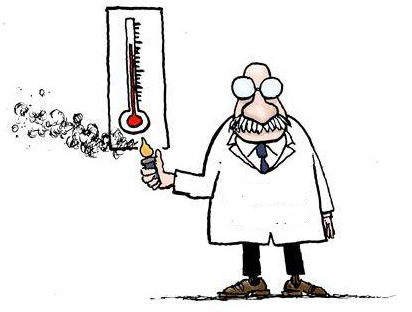
There’s nothing new about mainstream climate scientists conspiring to bury papers that throw doubt on catastrophic global warming. The Climategate leaks showed co-compiler of the HadCRUT global temperature series Dr Phil Jones emailing Michael “Hockey Stick” Mann, July 8, 2004:
I can’t see either of these papers being in the next IPCC report. Kevin [Trenberth, a colleague] and I will keep them out somehow — even if we have to redefine what the peer-review literature is!
Thanks to a science whistle-blower, there’s now documentation of a current exercise as bad as that captured in the Jones-Mann correspondence. This new and horrid saga – again involving Dr Mann – sets out to deplatform and destroy a peer-endorsed published paper by four Italian scientists. Their paper in European Physical Journal Plus is titled A critical assessment of extreme events trends in times of global warming and documents that extreme weather and related disasters are not generally increasing, contrary to the catastrophists feeding misinformation to the Guardian/ABC axis and other compliant media.
The witch-hunt has Australian elements. Last September, The Australian’s environment writer, Graham Lloyd, highlighted the paper (paywalled) and its conclusion that the “extreme events emergency” was overblown. Sky News Australia, which twice reported the study, picked up more than 400,000 views and thousands of comments.
The green-left Guardian countered with a hit-pieceby in-house cataastrophist Graham Readfearn featuring professors Lisa Alexander and Steve Sherwood, both of NSW University. They alleged cherry-picking and misquoting. Their main specific complaint was that the Italians’ paper had drawn on the 2013 5th IPCC Report rather than the recent 6thReport. (The Italians say they submitted the paper before the 6th Report emerged).
The Guardian’s fuss caught the attention of Agence France-Presse’s (AFP) Marlowe Hood, who modestly styles himself “Senior Editor, Future of the Planet”and “Herald of the Anthropocene”. He penned his own diatribe for The Australian (paywalled but also here) against the Italians’ paper. Jumping the gun on any editorial inquiry, AFP branded the study “faulty” and “fundamentally flawed”, involving “discredited assertions” and “grossly manipulated data”. This abuse was normal since AFP and The Guardian are leaders of the Covering Climate Now (CCN) coalition of some 500 media outlets with reach to a 2 billion audience. These outlets signed the CCN pledge to hype catastrophism and rebut and censor any scepticism about our planet’s forecast fiery fate.
The whistle-blowers’ documents reveal how this media pile-on – as distinct from reasoned scientific complaint — led the journal’s owner, Springer, to demand “action”. Springer’s aim was to force the editor to publish at least an erratum and, preferably, retract it altogether, restoring climate right-think.
The publishers have now decided on the retraction and the axe will fall any day now. But the process was ratbaggery in place of the normal rigorous and honourable protocols. Meanwhile, unabashed Italian authors Alimonti and Mariani successfully published last week an updated version of their paper, also peer reviewed and in a different scientific journal.
Chapter and verse on the controversy is available at The Honest Broker blog of Dr Roger J. Pielke Jr., a world-leading expert in monetary loss trends from extreme events.
Noted climatologist Dr Judith Curry tweeted,
Reprehensible behavior by journal editors in retracting a widely read climate paper (80,000 downloads) over politically inconvenient conclusions. Journal editors asked me to adjudicate, and my findings were in favor of the author.
The controversy turns on how the IPCC 6th Report is interpreted, as it seems to place two bob each-way on trends in extremes. In all fairness, you can read a detailed argument here by an advocate for the paper’s retraction. But even Andy Revkin, a leading US journalist of warmist persuasion, has explained,
Despite headlines and spin, it’s still tough to disentangle global warming and natural variability in long-term heat wave patterns in the United States. That might seem surprising but was a clear conclusion of both the last U.S. National Climate Assessment and IPCC reports.
I’ll now background the Italian defendants in this politicised fracas. They enjoy prestigious reputations, but that doesn’t mean, of course, that they’re right.
♦ Professor Gianluca Alimonti, Milan University, and senior researcher, Italy’s National Institute of Nuclear Physics. Many of his papers involve work on the 7000-tonne ATLAS detector at CERN’s Large Hadron Collider. He lists 300+ publications and presentations.
♦ Renato Angelo Ricci, Padova University, Padua. He’s worked with Legnaro National Laboratories, one of the four major research centers of the Italian National Institute for Nuclear Physics(INFN).[1]He’s of such prestige that INFN dedicated to him its tenth annual Varenna Conference on nuclear reaction mechanisms.[1] The corrupted Wikipedia Italydismisses him as a climate sceptic.
♦ Luigi Mariani, Milan University, also of INFN. He’s with the Lombard Museum of Agricultural History and has published 137 papers.
♦ Franco Prodi, National Academy of Science, Verona and Italian National Research Council – Institute of Atmospheric Sciences and Climate. 193 publications, 2300 citations: “Main fields of interest are physics of clouds and precipitation, hail and precipitation growth, aerosol physics, atmospheric radiation, severe storm studies and radar-meteorological investigations, satellite meteorology and nowcasting [very short term weather forecasting].”
The Guardian noted that three of the four Italians had signed a “no emergency” sceptic declaration last year, as if that disqualified them from proper research. The Guardian didn’t mention that the same declaration, with its 1600 signatories, was led by two Nobel Laureates in Physics, John Clauser (2022) and Ivar Giaever (1973).[2]
The comments of Michael “Hockeystick” Mann, of Pennsylvania University, about Alimonti and Ricci are illuminating. He described their journal article as
another example of scientists from totally unrelated fields coming in and naively applying inappropriate methods to data they don’t understand. Either the consensus of the world’s climate experts that climate change is causing a very clear increase in many types of weather extremes is wrong, or a couple of nuclear physics dudes in Italy are wrong.
Mann himself is a connoisseur of wrong (and self-evidently in need of remedial courtesy classes). His notorious 1999 Hockeystick paper purportedly proved unprecedented 20th century global heat. His 1000-year graph was used as a corporate logo by the IPCC in its 2001 Third Report[3], which subsequently downplayed it to near-invisibility in its Fourth Report six years later.
Mann had committed the scientific no-go of furtively patching measured global temperatures from 1961 to his proxy-reconstructed temperature graph derived from tree ring sampling.[4] This was done, in the Climategate words of Dr Phil Jones (Nov 16, 1999) to “hide the decline” of the 20th century proxy trend, which threatened to render Mann’s entire temperature reconstruction spurious.[5]
Australia’s top catastrophist is Macquarie University’s Distinguished Professor of Biology Lesley Hughes, whose specialty is entomology e.g. ant-tended butterfly ejaculations, though more recently she’s been publishing on Lethal consequences: climate change impacts on the Great Barrier Reef. (It’s had record coral cover for the past two years). Her Climate Council colleague and dud prophet Tim Flannery is a mammologist.
The Italians’ desk review spends 20 pages arguing from 82 relevant papers. Their English is well expressed though the syntax is slightly unusual. It’s their conclusions (below) that have generated such recursive fury[6] among the anointed climate crowd:
From the Second World War, our societies have progressed enormously, reaching levels of well-being (health, nutrition, healthiness of the places of life and work, etc.) that previous generations had not even remotely imagined. Today, we are called to continue on the path of progress respecting the constraints of economic, social and environmental sustainability with the severity dictated by the fact that the planet is about to reach 10 billion inhabitants in 2050, increasingly urbanized.
Since its origins, the human species has been confronted with the negative effects of the climate; historical climatology has repeatedly used the concept of climate deterioration in order to explain negative effect of extreme events (mainly drought, diluvial phases and cold periods) on civilization. Today, we are facing a warm phase and, for the first time, we have monitoring capabilities that enable us to objectively evaluate its effects.
Fearing a climate emergency without this being supported by data, means altering the framework of priorities with negative effects that could prove deleterious to our ability to face the challenges of the future, squandering natural and human resources in an economically difficult context, even more negative following the COVID emergency. This does not mean we should do nothing about climate change: we should work to minimize our impact on the planet and to minimize air and water pollution. Whether or not we manage to drastically curtail our carbon dioxide emissions in the coming decades, we need to reduce our vulnerability to extreme weather and climate events.
Leaving the baton to our children without burdening them with the anxiety of being in a climate emergency would allow them to face the various problems in place (energy, agricultural-food, health, etc.) with a more objective and constructive spirit, with the goal of arriving at a weighted assessment of the actions to be taken without wasting the limited resources at our disposal in costly and ineffective solutions. How the climate of the twenty- first century will play out is a topic of deep uncertainty. We need to increase our resiliency to whatever the future climate will present us.
We need to remind ourselves that addressing climate change is not an end in itself, and that climate change is not the only problem that the world is facing. The objective should be to improve human well-being in the twenty-first century, while protecting the environment as much as we can and it would be a nonsense not to do so: it would be like not taking care of the house where we were born and raised.
While a tad sentimental, it’s not over the top compared with say, the IPCC’s UN head Antonio Guterres announcing last month that we’re now suffering “global boiling”. And the late Professor Will Steffen, who steered Australian federal climate policy for two decades, alerted the Royal Society that climate change might well end the Homo Sapiens species.[7]
The Guardian’s attack piece quoted Professor Lisa Alexander, a UNSW rainfall-extreme specialist, saying that, contrary to the paper’s “selective and biased” claims, “there is definitely an increase in precipitation extremes” and it’s “attributed to human activity”. The paper had “totally misrepresented” her own papers’ findings, she said. She wanted the paper rejected or heavily revised.
So far so trenchant, but when you look up one of her two co-authored papers cited by the Italians, you discover that it messed up its Figures 2,3,4,5,7,8 and 9 – which is all but three of its ten Figures.[8] The journal had to run a corresponding erratum and update. An unkind critic might mention pots calling kettles black. Incidentally, Alexander’s UNSW team, led by Andy Pitman (famed for his inadvertent candour that “warming doesn’t cause droughts”) attracted a giant ARC taxpayer grant of $32,134,273, no less. Her other paper, with no corrections, was supported by an ARC grant of only $356,402.
In both papers, Professor Alexander commendably stresses the massive data uncertainties in her field of rainfall extremes, caused by unreliable rain recording, missing data across swathes of entire continents, and too-short records. As she warned,
Despite our best efforts, there are still parts of the world where data are sparse or the temporal coverage is inadequate for a data set designed for long-term monitoring … Efforts are underway to augment current global collections of data to improve the data available for all users.
As for allegedly misrepresenting her work, I don’t see it. In the Italian paper’s first reference, it accepts her conclusion about rain generally increasing.[9] In the second reference, the Italians show concern – as she does — about data quality for extreme downpours. (The Italians mention inter alia that bugs often climb into the gauges and their corpses upset the mechanism).
AFP’s Marlowe in his hit piece quotes Richard Betts (UK Met Office) bagging the Italians. In a masterpiece of bitchy innuendo the AFP snarked, “Betts stopped short of calling for withdrawal, drawing a distinction between cherry-picking data and outright fraud.”
Other critics quoted were Friedericke Otto, of UK’s Grantham Institute, along with Stefan Rahmstorf from the dark-green Postdam Institute. Otto complained the Italians were writing “in bad faith” — whatever that means. Rahmstorf’s gripe was that the research was published in a physics journal rather than a climate one (the latter, of course, 97 per cent captured by the catastrophe crowd as peer reviewers). “I do not know this journal, but if it is a self-respecting one it should withdraw the article,” Rahmstorf said. Otto agreed, demanding that it be withdrawn “loudly and publicly”, presumably to scapegoat the authors. An Exeter University professor said he wouldn’t go that far, fearing bad publicity about censorship – a good point.
Now for the whistleblower’s documentation:
September 29, 2022. Christian Caron of Springer Nature and the editorial manager of the Italian Physical Society, Barbara Ancarani (why her?) contacts Alimonti et al. to let them know that, based on the two media stories, an investigation had been opened of their paper. She cc’d the journal’s co-editor-in-chief, Beatrice Fraboni:
We are sure you and your co-authors are already aware of the public dispute this has generated. Included in these reports are numerous concerns of scientists who are considered highly expert in this subject. As a result of these circumstances it is now necessary that the journal carry out an investigation to assess the validity of these concerns, in line with good practice when concerns of this type are brought to a journal. An editorial note on the homepage of the above mentioned article will be added stating:
‘Readers are alerted that the conclusions reported in this manuscript are currently under dispute. The journal is investigating the issue.’
September 30, 2022. Fraboni, co-chief-editor, contacts the associate editor responsible for handling the review process of Alimonti et al., Jozef Ongena.
“. . . we are facing some issues with a paper in your area. The publishers have asked the Editors to take action.”
Ongena immediately responds:
The article has undergone the usual peer review. There should be no blame and shame… Peer reviewing is the common practice. That there is a discussion seems not abnormal and seems a very healthy thing…I would invite the colleagues that have objections to send in their objections and to pass them on to the authors. To start a discussion in the press as they already did is certainly worse than publishing a critical paper. They could later also be invited to publish a comment. We should as a journal not refrain or be afraid from a scientific discussion, but it should be in a correct way.
October 4, 2022. Author Alimonti:
Dear Dr. Caron, after confronting [sic] with the other authors, we believe a possible correct way to criticize a scientific paper would be to write a detailed summary about what is supposed to be not correct and complete it with references; in other words a paper with precise counter arguments or at least a detailed report…
…the authors of the criticized paper may give detailed answers and the journal may decide further steps. Have Springer or [the journal] been somehow formally contacted with a detailed counter analysis? If so, please forward us any comment so that we can properly answer; if not, we believe that considering “under discussion” a scientific paper that underwent a peer review process just on the basis of interviews appeared on online newspapers or blogs, even if authoritative, is not what a scientific method requires…
…Prof. Prodi, a distinguished climatologist, not just “a nuclear physics dude”, reminds me that he also served as Editor of Springer for many years: criticizing him as author would be a critic[ism] to Springer in selecting reviewers and editors. The Publisher should defend its scientific integrity in a resolute way, in order not to lose prestige itself, by moving at the request of newspapers or by denying its role.”
Co-chief-editor Fabroni initially appears to have accepted this proposal.
October 9, 2022: After having received various feedbacks we have decided to contact the colleagues who expressed concern on the paper to provide a scientific comment that we will then send out to independent reviewers. If and when the Comment will be approved by them, we will share it with the authors so that they will be able to address the issues raised. Also their reply will be peer-reviewed.
None of the eight critics (including UNSW’s Alexander and Sherwood) come good with considered rebuttals. However, the investigation proceeds.
November 17, 2022. Alimonti emails Fabroni to ask for an update on the investigation. Fabroni responds
The reply has been drafted with the assistance of the Springer Research Integrity Department, after carefully taking into consideration the feedbacks received from the colleagues who criticised the paper in the media. Thank you very much for your patience – we have analyzed the case now in-depth. While we acknowledge that the media coverage has certainly made the case temporarily bigger than necessary, it has also uncovered a clear weakness of your paper that we believe must eventually be addressed.
The “clear weakness” is the failure to reference the IPCC Sixth Report, which the authors say was not published when they submitted their article. The Italians were given an ultimatum to prepare an “erratum”.
1/ You will submit an Erratum taking the final, published version of AR6 into account, where the above criticism is explicitly addressed and any conclusion that needs to be revised will be detailed. This Erratum paper, where we expect ample references to the published AR6, will be thoroughly assessed by also involving scientists from the cited parts of AR6. The Erratum has to be submitted before Dec 31st, 2022.
2/ If you decide not to submit such an Erratum or the Erratum is not submitted by the above deadline, the journal will publish an Editorial where we summarize our findings, very much as outlined above and the present Editorial Note on your article will be changed to a permanent Editorial Expression of Concern that will refer to this Editorial.
November 23, 2023. Alimonti writes, quoting Springer guidelines, that it should be an “Addendum” not an “Erratum”. They lodge it and it goes out to four reviewers, with a fifth as “adjudicator”. The reviewers are 3:1 in favour of publishing the Italians’ addendum, but for some reason the Adjudicator is forwarded only one favourable review (which says the piece is quite consistent with IPCC 6th) and one review damning it. That review includes, strangely,
Especially considering that typical readers of EPJP [Physics] journal are not climate experts, I think editors should seriously consider the implications of the possible publication of this addendum. (emphasis added).
So much for science integrity. The third reviewer wrote:
The original article is a straightforward recitation of credible, key data about several types of extreme weather events. I find nothing selective, biased, or misleading in what they present. While there’s hardly anything written that isn’t well-known to experts, it’s useful for non-experts to see the underlying data, which are most often obscure in the IPCC reports. . .
The addendum is an on-point discussion of the extent to which the original paper agrees with the IPCC on three types of extremes. The document is up to professional standards -specific, detailed, and with citations.
Reviewer 4 wrote:
The most important contribution of the authors is to look further back into the climate record (including early 20th century), when many types of extreme events were comparable to today. The paper doesn’t specifically focus on the attribution (cause) of any trend (or lack thereof).
I don’t see any grounds for criticizing this work. Further, most of their conclusions are supported by the IPCC AR6 WG1.
The Adjudicator exceeds his/her terms of reference by bagging the original paper, as distinct from the draft addendum, calling for its retraction and, therefore, the binning of any proposed addendum.
July 13, 2023. Editor Fabroni advises handling-editor Ongena that the paper will be retracted in full, citing the Adjudicator’s view.
After an in-depth consultation with the publishers we came to the conclusion that a retraction is inevitable, a decision fully backed by the publishers.
In my opinion, no reputable science journal, let alone top publisher Springer Nature, should be concerned for one second about big-shots moaning in the media about a non-conformist climate paper. But follow the money: Springer’s revenue is solidly from the left-captured academic sector.
As top UN official Melissa Fleming put it last September about climate, “We own the science, and we think that the world should know it.” Her unspoken sub-text, relevant to the censorship of Professor Alimonti, “Rock the boat and you’ll regret it.”
I’ll borrow Mark Steyn’s book title and say this is all “a disgrace to the profession”.
Tony Thomas’s new book from Connor Court is Anthem of the Unwoke – Yep! The other lot’s gone bonkers. $34.95 on-line from Connor Court here
[1] “Prof. Ricci was alumnus of one of the most prestigious University Institutions in Italy, the Scuola Normale Superiore di Pisa, and after graduation completed his studies under Louis De Broglie and Frederic Joliot-Curie. He introduced in Italy the experimental study of nuclear spectroscopy… He was one of the leaders of the experiments made at CERN with the antiproton beams and started there the relativistic heavy ion physics. Not less important has been his activity as Administrator of Science, as President of Italian and European Physical Societies, as Director of Legnaro National Laboratories, as Vice-President of the National Institute of Nuclear Physics and Chairman of many other important Institutions and Committees.”
[2] There were 166 Australian signatories, mainly professionals rather than academics, and including myself.
[3] The “hockey stick” conveniently erased the awkward Medieval Warming and Little Ice Age from the record, which could then show 1000 years of stability followed by a 20thC uptick from CO2 emissions.
[4] See Steyn, Mark. “A Disgrace to the Profession” Stockade Books. Kindle Edition. From P37.
[5] UEA’s Phil Jones: “I’ve just completed Mike’s [Michael Mann’s] Nature trick of adding in the real temperatures to each series for the last 20 years (i.e. from 1981 onwards) and from 1961 for Keith’s [Keith Briffa’s] to hide the decline.”
[6] “Recursive” just means “repeated”. The term “recursive fury” became a meme from the title of a bizarre climate paper by psychologist Dr Stephen Lewandowsy which his editors had to retract .
[7] “The ultimate drivers of the Anthropocene if they continue unabated through this century, may well threaten the viability of contemporary civilization and perhaps even the future existence of Homo sapiens.” Will Steffen, et al., “The Anthropocene: Conceptual and Historical Perspectives,” Philosophical Transactions of the Royal Society A: Mathematical, Physical and Engineering Sciences 369, no. 1938 (2011): p862.
[8] “Erratum: In the originally published version of this article the uncertainty range in panel c of Figures 2, 3, 4, 5, 7, 8, and 9 was incorrect. In all cases the uncertainties were shown for the full dataset rather than the subset from which the time series have been calculated… the equivalent panels have been updated in the supplementary information. There is no change to the conclusions drawn in the paper.”
[9] Alimonti: “Global observational datasets indicate an increase in total annual precipitation which appears at first sight consistent with the increase in global temperatures and the consequent increase in precipitable water stored in the atmospheric reservoir…the diagram in Fig. 4 shows that global rainfall is increasing since about 1970.”


Ooh, now I get it. This is a Post – Modern climate methodology befitting AGW
cli-sci con-sens-sus and not the former fuddy-duddy, test-your- data, climate
methodology imposing objectivity!
*Post-Mod Climate Methodology, PMCM):
Now faith based science. Science = religion.
– Frederick Otto.
If the data doesn’t agree with the theory, change the data.
– Michael Mann.
De-platform publications of papers by scientists who challenge the con-sens-sus.
– Phil Jones.
LikeLiked by 1 person
A timely and very concerning article written by David Marks:
“The cancellation of Professor Norman Fenton’s presentation at the UK’s NHS Health and Care Analytics Conference indicates a deeply disturbing increased level in the censorship of science.
The gravity of current developments is onerous. It is important to recognize parallels from the past and understand the initiating factors — including intolerance of ideas threatening state-approved ideology — that eventually allowed the rise of totalitarianism.”
https://reportfromplanetearth.substack.com/p/science-and-the-rise-of-totalitarianism
LikeLike
So much for scientific debate. If you’re not with us, not only must you be against us, but in addition, you will not be heard. Interested lay people will not be allowed the opportunity to hear or see an alternative narrative.
If the study has arrived at incorrect conclusions (so much for peer review), the way to deal with it is to respond with another paper explaining why it is wrong, so that readers can understand the nature of the dispute. It can rarely if ever be right to censor an alternative view.
LikeLiked by 1 person
Mark. “ If the study has arrived at incorrect conclusions (so much for peer review) “
We have discussed peer review before you and I. It is not what you seem to be implying it is. It would be most unusual if the author(s) not to be the most familiar with the subject under review or to have thought more about the subject matter. The job of a peer reviewer is to judge whether the style and subject matter is consistent with the journal, not whether or not the subject matter is correct.
I suspect that the authors might have predicted the reception they might have got, given their conclusions. I would hope there is no withdrawal of their paper unless one or more of their conclusions can be proven to be erroneous. Given this anticipation of the reception, perhaps they should have presented an even more detailed case.
LikeLike
Alan, thanks for the reminder (it had slipped my mind). Of course, if that’s what peer review signifies, then it makes nonsense of claims often made by alarmists to the effect that only peer reviewed papers carry value or validity, and that no notice should be paid to papers that are not peer reviewed. That argument itself is rather undermined by the fact that this peer reviewed paper needs to be withdrawn.
LikeLike
There you go:
“Scientific journal retracts article that claimed no evidence of climate crisis
Publisher Springer Nature says 2022 article ‘not supported by available evidence’ as editors launch investigation”
https://www.theguardian.com/environment/2023/aug/26/scientific-journal-retracts-article-that-claimed-no-evidence-of-climate-crisis
A rather different version of events, but which version you believe depends on what you think about censorship, I suppose.
LikeLike
Interesting. When I acted as a journal editor (quarter of a century ago);the thought was that errors and other controversial content in a scientific paper was to be cherished because it stimulated controversies that would result in other papers submitted to the journal that in turn would result in replies and continued interest. We have similar results here at Cliscep when we have a troll who stimulates multiple responses from regulars
The last thing we would have done as a journal editor, even had it been possible, would be to retract a controversial paper for any reason.
LikeLiked by 1 person
E pur si muove?
LikeLiked by 2 people
Here’s the Daily Sceptic’s take on the story:
“Shock Retraction of Climate Science Paper Showing No Climate Emergency Draws Comparisons with Climategate Scandal”
https://dailysceptic.org/2023/08/26/shock-retraction-of-climate-science-paper-showing-no-climate-emergency-draws-comparisons-with-climategate-scandal/
LikeLike
This story has now been highlighted at Notalot, WUWT, Kip Hansen at WUWT and the Daily Sceptic.
The retraction is reported at Retraction Watch.
LikeLike
The end is nigh according to the Guardian interviews with “45 leading climate scientists from around the world”
https://www.theguardian.com/environment/2023/aug/28/crazy-off-the-charts-records-has-humanity-finally-broken-the-climate
But the good news is that the science is NOT settled:
“Numerous scientists also highlighted the difficulty global climate models have in assessing extreme weather events.”
“The biggest reason was that extremes are by definition rare, meaning there were few examples on which to base models. “It is difficult to model something that you have almost no physical evidence for and, in the case of unprecedented extremes, no physical evidence,” Hayhoe said”
“Prof Tim Palmer, of the University of Oxford, UK, raised another reason: the relatively coarse resolution of global climate models, where each data point usually represented an area of 100km by 100km.“Climate models do such a poor job at simulating regional extremes of weather that I don’t think scientists were especially surprised that observed weather extremes were becoming more intense than predicted by the models,” he said. “We need much higher resolution climate models if we are to stand a chance of simulating these extreme weather events.”
It is astonishing to me that these catastrophic assertions are based on 100 km by 100 km resolution climate models rather than statistical analysis. Time series analysis of actual data can easily demonstrate whether “humanity has finally broken the climate”. The paper highlighted by Tony is correctly based on time series trend analysis of real data and comes to a quite different conclusion:
…..global trends in heatwave intensity are not significant. Daily precipitation intensity and extreme precipitation frequency are stationary in the main part of the weather stations. Trend analysis of the time series of tropical cyclones show a substantial temporal invariance and the same is true for tornadoes in the USA. At the same time, the impact of warming on surface wind speed remains unclear. The analysis is then extended to some global response indicators of extreme meteorological events, namely natural disasters, floods, droughts, ecosystem productivity and yields of the four main crops (maize, rice, soybean and wheat). None of these response indicators show a clear positive trend of extreme events.”
LikeLiked by 1 person
“Retraction of Paper Saying There is No Climate Emergency Illustrates How Dependent Climate Activists Are on Scaremongering”
https://dailysceptic.org/2023/08/29/retraction-of-paper-saying-there-is-no-climate-emergency-illustrates-how-dependent-climate-activists-are-on-scaremongering/
LikeLike
“Free Speech Fears Grow After Springer Nature “Meekly Obeys” Activist Demands For Alimonti Climate Paper Retraction”
https://dailysceptic.org/2023/09/07/free-speech-fears-grow-after-springer-nature-meekly-obeys-activist-demands-for-alimonti-climate-paper-retraction/
LikeLiked by 1 person
Mark,
Far be it for me to question Pielke Jr. but I find the notion that ‘300,000 science papers assert a climate crisis’ somewhat hard to believe, even in the current frenzied, hysterical academic climate. That’s a huge amount of studies. I need to look into this because my belief was that very few actual academic studies explicitly used the term ‘climate crisis’; that it was a term invented and mainly used by journalists and increasingly by activist scientists, informally mostly. But I could be wrong.
LikeLike
Jaime, typing “climate crisis” into Google Scholar returns 318,000 hits. But if you filter by date blocks, it looks like you don’t get anywhere near enough hits to total 318,000. For example, if you only select the date range 1980 – 2023, you get 154,000 hits. Then if you go crazy and select the range 1900 – 2023, you get… 146,000 hits, which makes absolutely no sense at all.
Part of the 318,000 must be undated material. Beyond that I have no idea.
LikeLiked by 1 person
Jit,
I just used Google Scholar advanced search for the exact phrase climate crisis anywhere in the article and got 9770 results for any period, most of which are not climate science studies. Maybe I’m doing something wrong.
https://scholar.google.com/scholar?as_q=&as_epq=climate+crisis&as_oq=&as_eq=&as_occt=any&as_sauthors=&as_publication=&as_ylo=&as_yhi=&hl=en&as_sdt=0%2C5&as_rr=1
LikeLike
This query returns 281,000 (I removed citations this time):
https://scholar.google.com/scholar?as_q=&as_epq=climate+crisis&as_oq=&as_eq=&as_occt=any&as_sauthors=&as_publication=&as_ylo=&as_yhi=&hl=en&as_sdt=0%2C5&as_vis=1
It appears to vary slightly from yours. Mine ends “as_vis=1”, yours “as_rr=1”.
LikeLike
If you search Google Scholar for ‘climate crisis’ between 1900 and 1930 sans citations, all 16 hits are crazily misdated and many of them are from blogs and NGOs, not academic journals. If you click on ‘Review articles’, the 1900-1930 tally goes to zero.
The ‘Scholar’ in ‘Google Scholar’ got polluted a while back.
LikeLike
The Spectator published an outstanding article this morning by Carl Heneghan (professor of evidence-based medicine at the University of Oxford) aptly described by one commentator as ‘the most masterful and brilliant summary of the entire Covid fiasco, and this wretched apologia of a so-called “enquiry”…’ (I believe it’s available for public access.) Heneghan’s concluding comments are relevant here as they surely apply equally to climate science:
LikeLiked by 2 people
The government is spending £250m of our money to conclude that the models were fine, that lockdown works and that the only thing the government got wrong was not to lock down sooner and perhaps harder – i.e. politicians were too tardy in ‘following the science’. A total farce of course, but it was never going to be a valid inquiry. So, when the government signs the UK up to the WHO pandemic treaty, all that will change when the WHO decides that there is a PHEIC, is that the WHO will decide when to lockdown and how hard to lock down and UK politicians will be legally obliged to implement their decision. That’s what we’re being set up for.
LikeLike
Robin,
Many thanks for the link. I was able to read Carl Heneghan’s excellent Spectator article as one of my two free articles this month. It’s well worth a read. And, of course, as you point out, the implications regarding climate change science too are very real.
LikeLike
How Inquiries are done these days. Simon Jenkins, one of the few article writers at the Guardian I still have any time for:
https://www.theguardian.com/commentisfree/2023/nov/02/covid-pandemic-blame-inquiry
LikeLike
Robin – thanks for that link, which I was able to read in full.
For those who can’t access, some other quotes that stick out to me as relevant to Climate Science/Net Zero –
“It is the way in which dissenting voices, even in academia, are dismissed as malign or confused, or just brushed off as ‘sceptics’. When scepticism becomes a dirty word, science is in deep trouble.”
“The KC argued that, as a generalist, my work counted for little alongside the epidemiological modellers (who have been given a fawning reception by the inquiry). To me, part of the problem with the government’s response to Covid is that it was overly influenced by modelling, despite its well-known past failures. This was accompanied by a failure to consider the wider implications of policies such as lockdown.
The pandemic desperately needed generalists who understood medical decision making. To my knowledge, there has never been an overall cost-benefit analysis of lockdown.”
From above quote, just replace Covid with Climate Change & lockdown with Net Zero.
LikeLiked by 1 person
seem to have a comment in limbo?
LikeLike
Apologies. I have set it free.
LikeLike
Mark – I Agree Simon Jenkins gives a balanced article, which sums things up well.
then below his article we get this –
“The Guardian has spent the past 13 years tirelessly investigating the shortcomings of the Tories in office – austerity, Brexit, partygate, cronyism, the Truss debacle and the individual failings of ministers who behave as if the rules don’t apply to them.
Our work has resulted in resignations, apologies and policy corrections. Our continued revelations about the conveyor belt of Tory dysfunction are the latest in a long line of important scoops. And with an election just round the corner, we won’t stop now. It’s crucial that we can all make informed decisions about who is best to lead the UK.”
wonder who they back to win?
LikeLike
dfhunter,
The Guardian is a campaigning media organisation – as is its right, which I defend without hesitation. And, of course, if people who share its political opinions wish to be preached at, then it’s absolutely the newspaper/website for them to read.
I was a Guardian stalwart for decades in my youth, but I tired of being hectored, lectured, and of facts being spun to make political points. I ceased to buy it, but I still visit its website every day for two reasons – firstly to see what nonsense it’s spouting now, but secondly to read those serious journalists who are still capable of some fine work and analysis (which seems to be permitted so long as they avoid certain topics where the Guardian line must be followed at all costs).
The Guardian, for all its lack of objectivity, seems to have disproportionate influence with the BBC and in the corridors of power, which bothers me greatly. A newspaper of record it ain’t.
LikeLiked by 1 person
“Quantifying the climate crisis: a data-driven framework using response indicators for evidence-based adaptation policies”
https://www.tandfonline.com/doi/full/10.1080/17477891.2025.2571708#abstract
…The Mann-Kendall trend test applied to RIND time series reveals that most indicators do not exhibit statistically significant worsening trends. This challenges crisis narratives in specific contexts and highlights the need for localised, data-driven adaptation strategies rather than generalised alarm….
LikeLiked by 1 person
Mark – wonder how this article dated – Received 17 Apr 2025, Accepted 02 Oct 2025, Published online: 22 Oct 2025 has gone unreported until you picked it up!!!
It’s late, so no time to read it all, so a quick initial quote stood out to me –
“1. The climate crisis concept
The concept of crisis has a long history; it is polysemic and highly multifaceted, as shown in Supplementary Material Appendix 1. It is used across various contexts and scales with differing meanings, to the point that extending the concept of crisis to climate becomes arbitrary in the absence of a rigorous metrics.
The IPCC itself acknowledged this issue and considers ‘climate crisis’ a media term:
Also, some media outlets have recently adopted and promoted terms and phrases stronger than the more neutral ‘climate change’ and ‘global warming’, including ‘climate crisis’, ‘global heating’, and ‘climate emergency’. Google searches on those terms, and on ‘climate action’, increased 20-fold in 2019, when large social movements such as School Strikes for Climate gained worldwide attention. (IPCC-AR6-WG1, Citation2021, p. 173)”
Will read further when time permits, but for now, thanks for the link.
LikeLike
Mark, dfhunter,
I interpret this research article as a long and somewhat anguished appeal to scientifically quantify and define the emotive, media driven term ‘climate crisis’ (which the Guardian almost single-handedly invented in 2019), to bring the term into line with ‘the science’ so it can be justifiably employed, rather than, as currently, loosely employed as an alarmist tool. But the authors come to the somewhat irritating conclusion that the ‘climate crisis’ does not in fact exist! However, they’re keeping the door open in the hope that one day it may exist. LOL.
LikeLiked by 1 person
Ah, this puts it into perspective. Alimonti previously authored a study which the Guardian, Mann and other climate hysterics managed to get retracted because it ‘denied’ an increase in extreme weather.
So perhaps Alimonti has been a lot smarter this time and carefully constructed his paper in such a way as to show that a ‘climate crisis’ does not in fact exist – as evidenced by quantitative metrics – but that there is no reason not to suppose that it might exist in the future, and that we should establish a rigorous scientific methodology to track its emergence. That would be clever.
https://dailysceptic.org/2025/11/19/retracted-by-nature-traduced-by-michael-mann-gianluca-alimonti-is-back-and-hes-taking-no-prisoners/
LikeLiked by 2 people
Well spotted Jaime – that’s why I posted the link under this article. 🙂
LikeLiked by 2 people
Jaime – thanks for the link. I mentioned that retracted study on another post recently, but can’t remember which 😦
I think your comment above nails it.
LikeLiked by 1 person
Mark, thanks, yes, I really should have checked what the article was about. Guilty of just reading the last few comments!
LikeLike
Story is now up at NALOPKT:
https://notalotofpeopleknowthat.wordpress.com/2025/11/20/alimonti-is-back/#comment-324232
LikeLiked by 2 people