
Climate journalists are confessing they need psychological counselling: reporting on the climate’s supposed death-spiral is damaging their mental stability. As one Stanford academic puts it, “This is quite similar to what happens with investigators of international crimes, human trafficking, rape, abuse and people who’ve been tortured. I think very seriously that that needs to be paralleled in environmental sciences and environmental journalism, because it’s incredibly taxing.”
Try seeing life through these reporters’ eyes. Rainy? “That’s an unprecedented climate-fuelled rain bomb”. Not rainy? “The Science tells us that climate-fuelled droughts are the new normal.”
For those who write daily about the climate’s crisis/emergency/breakdown/collapse (I use here The Guardian’s style book), extra grief must arise when their doom-laden predictions do not come to pass. The smart ones now shun short-term forecasts and report earnestly on disasters due in 2050 or 2100.
Climate journalists’ grief includes the hip-pocket variety, where their cash-strapped bosses decide the climate round is the easiest to ditch. Those reporters get re-assigned to mundane reporting or, even worse, pushed from salaried to freelancer status. No wonder Associated Press grabbed a $US8 million payola last year from leftist billionnaires to boost its climate coverage.
Europe’s climate correspondents are suffering too. For a statement from the heart by a typically traumatised environment reporter, you can’t go past veteran US climate scribe and eco-socialist Eric Holthaus, who now also runs a meteorology business. ‘I lose sleep over climate change almost every single night,” he explained in 2018.
I can’t remember how long this has been happening, but it’s been quite a while, and it’s only getting worse. I confess: I need help… I’ve spent most of the past year alternating between soul-crushing despair and headstrong hope… For now at least, the good days are enough to keep me going … But there are also days when I’m paralyzed.
Over the past several months, I’ve stopped talking about climate change with my parents, my wife, and my sister in order to avoid heated dialogue about what I think is the most important issue in the world. Instead, I’ve privately sought out personal advice from other scientists and journalists, and often commiserated with strangers. …. I know that I need to preserve my own well-being to continue to fight for the planet.
In 2013 Holthaus made a splash in mainstream media over his pledge, “Vows: Why I’m never flying again – goodbye to all that”, with a pic of himself “boarding my last flight”. As both a pilot and frequent flyer, he notched up 75,000 air-miles in the previous year. He had just dipped into the 2013 IPCC report – which he called “a death warrant written in stark, black-and-white data.” In tears, he phoned his wife from San Francisco Airport, saying, “If anything is to change, it will have to come from individuals taking ownership of the problem themselves … Individual gestures, repeated by millions of people, could make a huge difference.” He also vowed not to have any children, for the same CO2 reason: “no children, happy to go extinct.”
However, his zeal apparently waned and without any media publicity he mentioned seven years later (at 20min30sec) that he was taking one or two round-trip USA-Amsterdam flights a year for family reasons. Meanwhile he’d fathered a boy.
Wolfgang Blau is a veteran woke media executive (Guardian, of course, and Zeit Online) and former president (International) and COO of lifestyle magazine empire Conde Nast. Two years ago he co-founded with Reuters the Oxford Climate Journalism Network to coach climate journalists and provide them with their necessary misinformation.[1]The Network has been funded by about £450,000 a year from the net-zero-promoting European Climate Foundation with its 280 staff and the Laudes Foundation. Blau wants just about every media articleto stress global warming, including sport, food, travel, fashion, health, culture, gardening, real estate, technology and personal finance, “to mention a few,” he said. “It [climate] changes everything.” In a long speech, he said,
When it comes to the mental health of climate journalists, though, there is a cultural element to consider: In general, the news industry has quite a lot of institutional knowledge about how to protect the mental health of its war and crisis reporters who are about to or have already witnessed horrible events. Not as much is known, though, about the health effects it can have on journalists to work on climate change full-time or also to feel marginalised or simply not understood in their own newsrooms, regarding the seriousness of the climate situation.
I had the privilege of getting invited into the meetings of various newly-founded self-help networks of climate journalists in different European countries. In all of these meetings, I was surprised by the degree to which these journalists expressed their need for a peer group that would also provide them with the emotional support their own news organisations were not giving them, even if this meant sharing knowledge with your direct competitors.
Some climate reporters stress out when their editors and readers fail to pay attention to their work because of “subtle mental and emotional constructs” such as denial and avoidance. Blau explains, “I have seen journalists pointing fingers at their own readers or viewers after they did not engage with their climate journalism as much as these journalists thought their audience should have … Denial needs to be addressed with empathy, precision and a degree of patience.”
Blau, who is also a climate adviser to the UN, cites favourably Agence France Presse (AFP), which is “beginning to adjust to the climate reality … in their news selection.” AFP, with 1700 reporters globally, has literally signed the pledge of the Covering Climate Now global group to hype climate alarm and suppress news involving “denialism”. He also wants climate reporters to add “solutions” to their stories so readers won’t despair and switch off. He doesn’t spell out any “solution” to China and India ramping up their reliable coal-fired energy.
Blau even worries that his minions have been toosuccessful:
A related sentiment of despair or disenfranchisement of younger people also came through in the ‘European Moments’ study by Professor Timothy Garton Ash. In this representative study, 53 per cent of young Europeans across 27 EU nations and the UK between the ages of 16 and 29 agree or somewhat agree with the idea that authoritarian states are better equipped than democracies to tackle the climate crisis, a finding that should worry any news organisation that defines its role as informing a democratic public sphere.
Blau wants newsrooms’ ethics code expanded to stop cynical colleagues accusing their climate colleagues of being activists, just because they keep bleating about the (mythical) climate “emergency”. He cautions: “Journalists should not speak pejoratively of ‘activism’ because past activists gave us the vote, freedom of speech and press freedom.”
He describes how newsrooms have become hellscapes with climate reporters jostling with their non-climate colleagues for by-lines. One climate journalist told Blau: “I have the full support from my chief editor. I have even been given a budget increase. My problem is now the foreign editor who doesn’t give me access to our foreign bureaus when I need them because my stories — supposedly — are never as urgent as other breaking news stories — and my other and bigger problem are the news desk editors who don’t give my story a prime time slot or never quite promote it on social media at the right time of day because they think it won’t perform well”.
Meanwhile academics frown as they draft points-earning research papers about stressed-out journos, most commonly citing the well-known associations between journalists and alcohol. One such is Dr Britt Wray of Stanford[2] writing “about climate change, the mental health crisis it is predicted to induce and how climate reporters can cope with the difficulties of the beat.” She writes:
One [journalist] was talking about the three young kids that she has, and she’s starting to face up to new thoughts that they’re not going to get to live out a fully expected human lifetime, according to what she’d normally taken for granted. And she just looks at them and feels hopeless…
[Climate journalists] also ask about how to reframe despair. “Do I have to prepare to be able to deal with that kind of grief in a situation that I can’t at all control?” They are looking for psychological coping tools to not just spiral around having brought kids into the world, but to shift to thoughts of, ‘What can I do to support them to develop the grit that’s needed to endure the future that they’re inheriting?’…Journalists can benefit from being educated on ways to soothe their nervous systems in moments of high emotional drama, stress or teetering on burnout. This is where contemplative/meditative practices can be super helpful.
I mentioned earlier the sinister media influencer Covering Climate Now (CCN). It happens that CCN’s own executives are also losing it mentally from their tireless efforts to warp the West’s climate reporting. Mark Hertsgaard, CCN’s executive director, is quoted,
We risk burning ourselves out if we don’t take care of ourselves and take care of one another… In the spirit of full disclosure, let me begin by confessing that my colleagues at Covering Climate Now and I are as in need of help on this front as anyone.
And we felt like we just had to step up to those [issues] so we pushed onwards until our own exhaustion finally made us look in the mirror and say, ‘Dude, you need help.’
He sympathised with climate reporters “seeing climate problems as overwhelming and urgent, carrying the burden of knowledge that society as a whole is either unable or unwilling to face. It’s really those people who are so passionate and committed to their work that tend to have a higher risk of burnout when the organization is set up to not give resources in time for it.”
His panellist Brian Kahn, managing editor of Eartherat Gizmodo Media explains:
Kahn: There are people dying, suffering, climate change is 100% bad. But sometimes a way to cope with it is to find either that dark humor or just something to help break up the real down-the- dumps darkest thoughts that you have, and find ways to push through and report the stories that really matter.
Hertsgaard: “One of my big frustrations is when there’s a new story that clearly has a climate angle, but climate is not or barely included in the story. How do you work with colleagues who just don’t get it or with editors refuse to do it?… In the midst of all that, how do we deal with the fact that many managers still assume 150% productivity and focus and all of that at all times despite the fact that internally, you’re dealing with climate despair and knowing too much about the climate emergency?”
Kahn: So, I think I’ve been lucky enough to work in newsrooms where … people want to do more climate reporting. So, I’ve been lucky enough to be approached by other editors at our sites, other writers wanting to actually contribute to climate and do more on that front, which is really wonderful to see.
Against recalcitrant editors, Kahn suggests climate reporters operate like “climate ambassadors”, politely urging them to include more hype, rather than “using the stick” against them: “Hey, you didn’t cover this. What the heck?” Hertsgaard suggests going over their head to their superiors – “of course, there’s risks to that as well.”
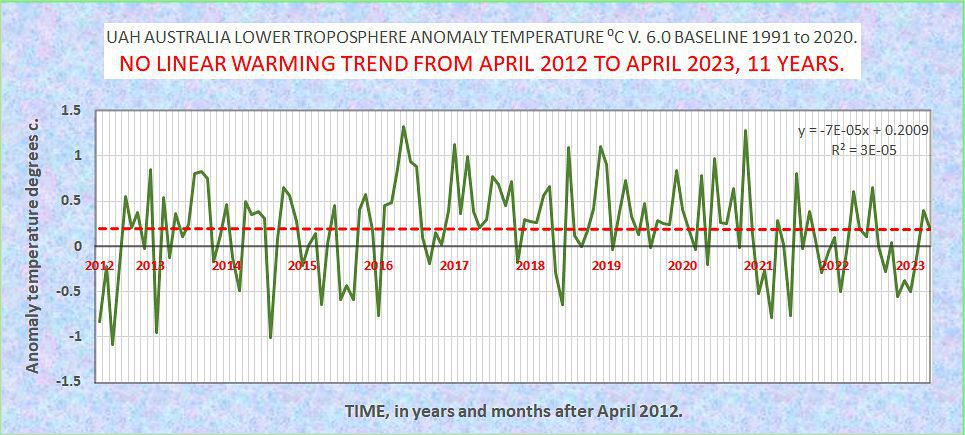
I haven’t found much about Australian climate journalists’ health and equanimity, but it must be stressful for them to read how, for example, the UAH (University of Alabama, Huntsville) satellite readingsnow show no Australian warming for the past 11 years. The NASA satellites provide complete cover of our continent, unlike the BoM’s thin scatter of land-based readouts. And the UAH data is transparent, unlike the BoM’s series which is subject to concealments from FOI and mystery upward adjustments. Plus, all the Aussie climate journos’ wailing about the Great Barrier Reef’s demise is now outed as retailers of utter nonsense.
Take the ABC’s national science and environment reporter, Michael Slezak. In his previous job with The Guardian (or course), he won the United Nations’ Association Climate Reporting Award in 2017 for a giant 5300-word piece bewailing the imminent climate-caused loss of the Great Barrier Reef –“A catastrophe laid bare … smell of death on the reef…”.[3]
Mike’s dilemma is how to hand back the award and return any cash component to the sponsors, since data last August from the Australian Institute of Marine Science shows the Reef has burgeoned to record coral cover. Contrast this with what Slezak wrote seven years ago: “Bleaching caused by climate change has killed almost a quarter of its coral this year and many scientists believe it could be too late for the rest.”
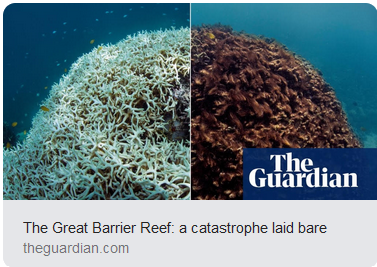
He fretted about “murder on the reef” by carbon emissions and global warming: “little chance of full recovery within the next 10 years” (it’s recovered already); “catastrophic” loss; “extreme ecosystem meltdown”; “utter devastation”; “half the coral cover on the Great Barrier Reef has been lost – and that’s before the mass bleaching this year is taken into account” and “We may have already made its death inevitable.” As in that 1975 movie Jaws, he unmasked the Reef’s supposed guilty parties:
It’s clear that a cabal of climate change deniers, worried tourism operators, and a conservative government have tried to whitewash the environmental disaster unfolding over the Great Barrier Reef.
It’s much the same with Nick O’Malley, national environment and climate editor for The Sydney Morning Herald and The Age. I loved the drama of his contribution,
How heat became the ‘silent killer’ stalking Australia … heat already kills far more Australians than all other extreme weather events combined. The death toll is only set to grow.
What? A table in The Lancet estimating Australian deaths from hot weather versus cold weather found cold deaths were 6.5 per cent of mortality vs only 0.5 per cent from heat. That is, cold is 13 times more deadly than heat.[4] Another study put cold at six times deadlier. Data from the UK Office for National Statistics shows that during the past 20 years of warming temperatures, 509,555 fewer people died in the UK as a result of cold temperatures. Bravo, global warming. But who can even imagine the stress such data must cause climate reporter O’Malley?
It’s ironic that the world’s climate journos, advocating for the destruction of the world’s fossil-fuel energy, turn to jelly when they notice some pushback on their social media accounts. Says Wolfgang Blau,
I have spoken with a few climate journalists who told me there were considering leaving climate journalism again as they felt worn down or left alone by their newsroom in defending themselves against climate trolls…For newsroom managers and social media editors, it is important to not view all trolling or outright hate speech against their journalists across all topics as one and the same phenomenon. To discredit climate journalism is a key part of orchestrated climate disinformation campaigns that oftentimes are very well funded. [5]
Sadly, Blau doesn’t clarify how and by whom sceptics’ writings are “orchestrated”, and how we can apply for our cheques from fossil-fuel tycoons.
I noticed a newsletter reporter, Emily Atkins, who goes in for “climate accountability journalism” writing a shocker[6], “In defence of politicising hurricanes – there’s nothing wrong with tying unfolding tragedies to climate change”. She got well-deserved pushback, causing her promptly to “mute her feed”. Another climate journalist, Nate Johnson, 44, of Grist, stressed out so much last year about the uselessness of his reporting that he took up a new career as a van-based electrician. “If I was at the right age during World War II, I probably would have enlisted. And now the great challenge of our time isn’t Nazi Germany, it’s climate change … And being an electrician feels like a useful way to enlist…”
In public-esteem polling, journalists typically run third-last. In Australia, the latest Readers’ Digest pollput us second-last, just ahead of politicians. Climate journalists? Don’t even ask.
Tony Thomas’s new book from Connor Court is Anthem of the Unwoke – Yep! The other lot’s gone bonkers. For a copy ($AUD35 including postage), email tthomas061@gmail.com
[1] Graham Lloyd, writer for Murdoch’s The Australian, is among the tiny number of the mainstream’s fair and rigorous climate correspondents.
[2] Dr Wray is described as the “Lead of the Special Initiative of the Chair on Climate Mental Health in the Department of Psychiatry and Behavioral Sciences of Stanford Medicine.” She opines, “Negative environmental change is becoming more widespread, and people are feeling a variety of negative feelings: terror, grief, anxiety, dread, worry, concern, rage, fear — all these things that are actually very reasonable because our life support systems are being attacked and undone.”
[3] “The Guardian’s use of powerful photographs, video, data visualisations and strong interactives made for stunning journalism. Slezak’s reporting on the devastation climate change has wreaked on the Reefhas held the Australian government to account, and led the world in raising the profile of the issue to one that leads news bulletins internationally.”
[4] The large-scale study published in 2015 involved 384 locations in 13 countries. The Australian data was deaths from 1988 to 2009.
[5] Strangely, examples given of “disinformation”include that “renewable energy can’t work” (especially during wind droughts) and “the ice isn’t melting” (Arctic sea ice has stabilised in the past decade and the Antarctic has shown no warming for 70 years and sea ice has modestly expanded).
[6] Atkins wrote, “Democratic candidates who represent Americans affected by these historic weather events have a unique opportunity to adapt to this new reality, and highlight the consequences of climate denial on voters’ lives. Republicans might call them insensitive. But voters deserve lawmakers who would rather protect them from disasters than protect them from the truth.”


Interesting and thought-provoking article on the mental toll climate journalism can take on reporters. It’s important to recognize the challenges they face and the need for support.
founder of balance thy life https://balancethylife.com
LikeLike
“Climate journalists are confessing they need psychological counselling: reporting on the climate’s supposed death-spiral is damaging their mental stability.”
Alas, they needed psychological counselling BEFORE they became climate journalists; then they would, in all probability, not have become climate journalists and they would not have then reinforced the doom-laden, catastrophe-driven confirmation bias which likely afflicted them even prior to taking a job where they report daily on environmental catastrophes caused by ‘climate breakdown’. Worse, when the ‘catastrophes’ they have reported on turn out to be nothingburgers, they are confronted with having to accept that they are just mentally ill and that their self-sacrificial efforts to inform the public of the imminent existential crisis facing humanity and the planet were at best deluded. They’re not going to be able to square that circle and I think the loony bin awaits many respected alarmist ‘environmental correspondents’.
LikeLike
I guess the hardest thing for these poor climate journalists is that they feel like victims and yet don’t qualify for protected identity-group status. Bummer.
But this is the tidbit that I want to try and remember: “53 per cent of young Europeans across 27 EU nations and the UK between the ages of 16 and 29 agree or somewhat agree with the idea that authoritarian states are better equipped than democracies to tackle the climate crisis”.
So, a bit over half of young adults in the rich West are fully done with liberal democracy and feel that dictatorship is where it’s at. Cool. And yet somehow I’m the fascist, because I read dissident websites like this.
LikeLiked by 1 person
“Lead of the Special Initiative of the Chair on Climate Mental Health in the Department of Psychiatry and Behavioral Sciences of Stanford Medicine”
No comment!
LikeLike
I never lose any sleep over climate change. I don’t even lose sleep over net zero, the greatest threat facing the UK (apart from the possibility of nuclear war), certainly a far greater threat to the lifestyles of my generation and especially those following on behind. Why lose sleep over it? We can’t change climate change, but we might yet be able to change the rush to net zero. Plug away at it, get your sleep, have a life.
LikeLiked by 3 people
There are always two sides to every story, so at best we all just get confused! I expect we’re all more likely to die from stupidity. Humans… What a silly bunch of Apes! Take money out of the equation. THEN see what they have to say.
LikeLike
Tony – thanks for “West leaning Climate journalists” overview.
as usual too many quotes to pick out, but this is worth repeating –
“Another climate journalist, Nate Johnson, 44, of Grist, stressed out so much last year about the uselessness of his reporting that he took up a new career as a van-based electrician. “If I was at the right age during World War II, I probably would have enlisted. And now the great challenge of our time isn’t Nazi Germany, it’s climate change … And being an electrician feels like a useful way to enlist…”
LikeLike
Df — just to clarify about Nate the climate journalist’s quote — he says if he were in WWII, he’d enlist. Did you pick out this quote because there’s a legitimate doubt over which side he’d enlist for?
LikeLiked by 2 people
Fed on a diet of imminent catastrophe, it’s not surprising that tyro journalists want to enlist in the Climate Brigade. Why would they not? And they won’t get a gig unless they trowel on the apocalyptical language. When they investigate, they will find no dearth of experts willing to provide money quotes about how this or that is caused by our addiction to fossil fuels and how the end of everything is inevitable. Hence the drivel from young reporters like Slezak.
Hence also, those outside this death-spiral narrative will often push back with derisive comments that the journalists have well earnt. And it is only natural to suppose that the critical comments are from trolls who either know nothing or have nefarious reasons for lying about the extent of the danger. No doubt such comments can damage egos. Then it is also natural to shut out those voices, and only be receptive to encouragement and adulation.
This leaves our young journo in a difficult spot. If they dig deeper and find an alternative narrative, a nuanced one, they won’t be thanked for it. And for psychological reasons, they must be terrified of looking in the wrong place – just in case. Their path to success lies in badging any catastrophe as climate-driven (i.e. Western Civilisation driven), or in finding portents of inevitable doom. What to do?
Well, there are 3 ways our journo could go. The first is to double down, to seek climate hype stories, approach only voices that you know will give the approved answers, and shut out the voices who disagree. The second is to always search for the alternative explanation – and yes, it will usually ruin the climate story, and it might cost you your job, but you’ll have your integrity intact. The third is to switch to the sports beat.
LikeLiked by 1 person
i would hate to be a climate journalist because i would be stifled from telling the truth. so much of the ideology is a means to redistribute wealth rather than address the so called problem. any truth will come out when the money and power are removed. good luck if that ever happens.
LikeLike
As I climbed upon the stair today,
I met the Health Chair, Dr Wray.
She’s worried by the dread and rage
Brought on by fear of Climate Change.
As Lead of Climate Mental Health,
She feels, she must proceed with stealth.
First plant the Climate fear and guilt
Then counsel victims how to deal with it,
‘Talk about the climate threat
and their ‘normal’ response to such an
existential, eco threat…
Which is, after all, the New Normal.
Yes it’s taxing, ( but in an economic way,
Doctor Wray. )
LikeLiked by 2 people
“BBC Complaints Director Takes Six-Month Sabbatical to Learn How to Promote ‘Climate Crisis’”
https://dailysceptic.org/2025/07/02/bbc-complaints-director-takes-six-month-sabbatical-to-learn-how-to-promote-climate-crisis/
The BBC Complaints Director Colin Tregear has enrolled on the green grooming course run as a six-month sabbatical by the Oxford Climate Journalism Network (OCJN). The course is funded by the Green Blob and aims to make the ‘climate crisis’ a central element in the journalism of the attendees. Tregear is said to have responsibility for climate complaints at the BBC. Quite why the British TV taxpayer should fund this activist boondoggle for a man who is supposed to independently consider matters that often involve disputed areas of science is not immediately clear. In the past, attendees have been asked to consider that fruit such as mangoes aren’t as tasty as a year ago due to climate change. A previous speaker is on record as speculating on the need for “fines and imprisonment” for those expressing scepticism about “well supported” science.…
LikeLiked by 1 person
Mark,
I’m not sure why I liked your last comment. It has to be the most depressing and scariest thing I have read for a long time.
LikeLike
John, we need more emoticons, like Facebook. However, I will accept a “like” for drawing it to the attention of Clisceppers. The BBC (and others) need to know that we are watching them and we know what they are up to.
LikeLiked by 1 person