Cleve Hill Solar Park was granted development consent in May 2020 by the Secretary of State (that would be Alok Sharma, who later became the President of COP26). May 2020 was lockdown city, and most of us probably didn’t notice, having apocalypse on our minds. Most of us probably haven’t noticed yet.
Personally I had noticed Cleve Hill, but my reaction to it was a shrug. To me, there was no way on this fair planet that Cleve Hill would be permitted. That meant I could just ignore it and wait for it to go away, not that any intervention on my part would have made the slightest difference.
What is, or will be, Cleve Hill? It’s an array, or a set of arrays, of photovoltaic panels – 884,388 of them is an indicative figure, each capable of a maximum of 395 watts. Yes, when it’s sunny in June. Although maybe not even then because of the particular design – see below. If you multiply the two numbers together you get about 350 MW. Each module is 2 square metres, so they cover 1.7 square kilometres. But the whole thing covers 3.6 square kilometres altogether.
OK, it seems like a pretty dumb idea to build such a monstrosity in a world where an electricity generator has to compete against other electricity generators for business in a fair battle. But that’s not the world we live in, and it’s not a reason that would make Jit shrug and assume it would be knocked back.
That shrug was because of its location. It’s near Faversham in Kent, or some of it is at least. But that’s not the problem. The problem for the developers was that the site was also right next to The Swale SPA and Ramsar site, which is also partly an SSSI, if you like that sort of thing (see featured image). SPAs and Ramsars are “international” sites, along with SACs, and they are the highest designation of protection afforded to biodiversity in the UK. SPA = Special Protection Area, and is designated for birds, SACs are at an equivalent level but for other species, and Ramsars are wetland areas named for the Iranian town where the Ramsar convention was signed. [In practice the three designations often overlap.] Developers often have to consider the effect that their plans will have on international sites at several kilometres distance (for things like increasing visitor numbers from a housing development, nutrient enrichment etc). When it comes to disturbing birds, the distance is lower, but it is still greater than zero. The distance to the SPA was zero as the featured image makes clear. Therefore, the development was bound to affect the integrity of the international site. Therefore, the Secretary of State was bound to refuse the development. Jit could shrug and concentrate on the unfolding viral apocalypse.
Except that isn’t what happened. Alok Sharma gave the nod. If I had thought about it for a minute, it might have occurred to me that being next to the SPA did not necessarily mean that the development would disturb birds on it. Because there is a ruddy great embankment keeping the sea out. There won’t be added visitor pressure. And after construction, there isn’t likely to be any issue with pollution (unless the battery goes up in flames).
Still, there is a strong case that the fields the solar panels will be built on are “supporting habitat” for the SPA, even if they are outside it. Birds that like mudflats have to go somewhere when the tide comes in, right?
There was also the possibility of collisions. As regular readers know, I often bang on about the long losing streak birds have in their battles with wind turbines. They also have a long losing streak in their battles with solar panels. Such battles, we might guess, are exceptionally rare. But when carpeting 360 hectares of land right next to a region with the highest possible protection for birds, it should at least warrant a discussion. Right?
I had always assumed that there was a chance – albeit a small chance – of water birds mistaking a solar farm for water. A solar farm might resemble water because it reflects the sky. It doesn’t have a diffuse reflection like a brick wall. It has a specular reflection like a mirror. Birds can be unwise enough to see a mirrored surface as another bit of sky (mirrored skyscrapers) or as water (solar farms, potentially).
Cleve Hill, as a “Nationally Significant Infrastructure Project” – a generator of over 50 MW, if you’ve been paying close attention – had a lot of hoops to go through. On the Planning Inspectorate’s website, there are 986 documents related to the development, of which 221 documents relate to the Environmental Statement.
One of these is the Ornithology chapter. How does Cleve Hill deal with the issue of collision risk? As part of the planning process, they put out a PEIR – Preliminary Environmental Information Report for public comment. Of all the public and private bodies who responded, including Natural England, the RSPB and the Kent Wildlife Trust, it was left to the Swale Green Party to raise the issue of collisions.
The solar panels themselves may present a challenge to birds who may see them as a “watery surface.”
Swale Green Party, responding to Cleve Hill’s PEIR
This is awkwardly put, but the relevant point is made. Here is the developer’s response:
Section 0 of this chapter assesses the potential effect of collision to birds; Natural England guidance states that there is no scientific evidence of collision risk associated with solar PV arrays.
[There is no Section 0. I think they meant 9.5.2.7.]
In Section 9.5.2.7, Paragraph 174 says:
Natural England has published a review of the impacts of solar farms on birds, bats and general ecology8 . The review concluded that there is no scientific evidence of collision risk associated with solar PV arrays and the risk of collision with solar panels is likely to be very low but not impossible, although there could be risk associated with overhead power lines.
[The footnote reference is missing. Is this important, or not? No-one cares. Find it yourself.]
Well, that was rather interesting. Natural England guidance sweeps collision risk off the table? Before continuing, let me just highlight the use of the word “scientific” in a “scientific” document. It is an obvious redundancy. A cynic might conclude that it is designed to produce a rhetorical effect. And note that there is no risk of collision with solar PV arrays, but (bizarrely) a “very low but not impossible” risk of collisions with solar panels, which are what solar arrays are made of.
What does – once we have tracked it down – the evidence review say? First of all, it relies heavily on a single paper for its conclusions on collision, one by DeVault et al (2014). This assesses the use of PV arrays at airports. The review notes (my bold):
In terms of collision risk, DeVault et al (2014) observed no obvious evidence for bird casualty caused by solar panels, despite conducting 515 bird surveys at solar PV sites.
While this statement is true, it omits a little bit of nuance. DeVault et al were interested in “implications for aviation safety”. Airports are installing solar arrays because they have lots of flat land, mostly grass, that can’t be used for anything else. They want to know whether birds are attracted by the PV installations. According to DeVault et al, birds are not attracted to PV installations near airports (nor are they repelled). But they weren’t looking for carcasses, they were surveying flying birds at range. I don’t think this survey tells us anything about what will happen at Cleve Hill.
In any case, in point ix of its Executive Summary, the NE evidence review says:
Some scientific and grey literature data, based upon carcass searches around solar PV developments suggests that bird collision risk from solar panels is very low.
I think there is a leap between the Ornithology Chapter’s (accurate quote) “bird collision risk from solar panels is very low” and its (apparently distorting the review’s description of DeVault’s finding as if it was the review’s settled conclusion) “no scientific evidence of collision risk associated with solar PV arrays.”
So in the NE review, the phrase is “no obvious evidence” of collision risk in a particular study near airports. In the Cleve Hill Ornithology Chapter, this becomes “no scientific evidence” at all.
The Natural England review sees little danger from direct collisions. It’s a pity that the Natural England review did not bother to include Kagan et al 2014.
Kagan et al is well known for describing the in-flight immolation of birds at the concentrating solar plant Ivanpah. But it also reported on deaths at a solar PV plant, imaginatively named Desert Sunlight. Kagan et al walked up and down the rows of solar panels and picked up the dead birds. Then, when possible, they autopsied them. The image below shows the top part of one of Kagan et al’s tables, which shows the ex-water birds they found on the ground. Some of the birds had died from flying into the panels – 8 of 19 birds dying of impact trauma were water birds. Others had been killed by predators:
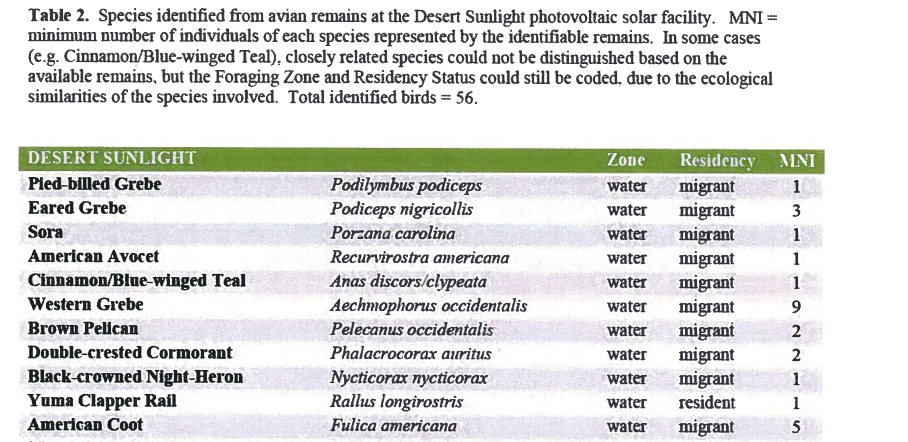
Predation is likely linked to panel-related impact trauma and stranding. Water birds were heavily over-represented in predation fatalities at Desert Sunlight. Of the 15 birds that died due to predation, 14 make their primary habitat on water (coots, grebes, a cormorant, and an avocet).
Kagan et al, 2014
That study was observational: no conclusions could be made on death rates. It reported the factual observation that solar farms kill birds – and it ought to have been considered in the NE review, and in turn by the Cleve Hill developer’s ecologists. Since 2014 there have been further studies, mostly showing a small but measurable problem:
Penniman & Duffy presented their own best practice guidelines for solar farms on Hawaii in 2021, in which they stated:
There is a clear body of evidence from the mainland USA and internationally, that birds can confuse solar arrays with water sources due to the “lake effect” and attempt to land on them, dying in the process or being injured and/or subsequently depredated.
Penn & Duffy, 2021
(The lake effect being the hypothesis coined by Kagan et al to explain why water birds would fly into solar panel arrays.)
Kosciuch et al have published two recent studies (2020, 2021), showing a relatively minor effect:
The idea of “lake effect” in which birds perceive a PV USSE facility as a waterbody (or the facility creates a lake effect) and are attracted is likely a nuanced process as a PV solar facility is unlikely to provide a signal of a lake to all aquatic habitat birds at all times. The results from our study suggest that some species of aquatic habitat birds could be attracted to PV USSE facilities, and if attraction occurs, it is likely context dependent. The most compelling evidence for attraction is the mortality of water-obligate species (e.g., loons) found at PV USSE facilities in desert environments that lack water, as these species perish on dry land.
Kosciuch et al, 2021
Last, we found that annual fatality rates never exceeded 2.99 fatalities/MW/year (1.03 fatalities/hectare/year) in the SMD BCR, were highest in the CC BCR where the rate was 9.26 fatalities/MW/year (5.17 fatalities/hectare/year), and that fatality rates did not correlate with nameplate capacity.
Kosciuch et al, 2020
9 fatalities per MW per year? Hell, Cleve Hill is only 350 MW. That’s only 3000 birds a year. Hardly worth even talking about.
Now, I’m not suggesting that 9 birds per MW per year is a realistic figure. It’s likely to be much lower. One reason why Desert Sunlight might have culled so many birds is that – as its name suggests – it’s in the desert. Thus we can imagine a migrant bird flying by, seeing the gleam of water, and thinking, “Thank God, some water at last,” and then finding out the hard way that what it thought was water was not water at all. Cleve Hill, being next to some actual water, might therefore be far less attractive. But I do think it would have been worth at least considering.
Cleve Hill is though likely to look more like a lake than your typical solar array. The ones we are mostly familiar with face south, at an angle to take advantage of the sun’s zenith angle. Something like these near Tuxford on the A1:
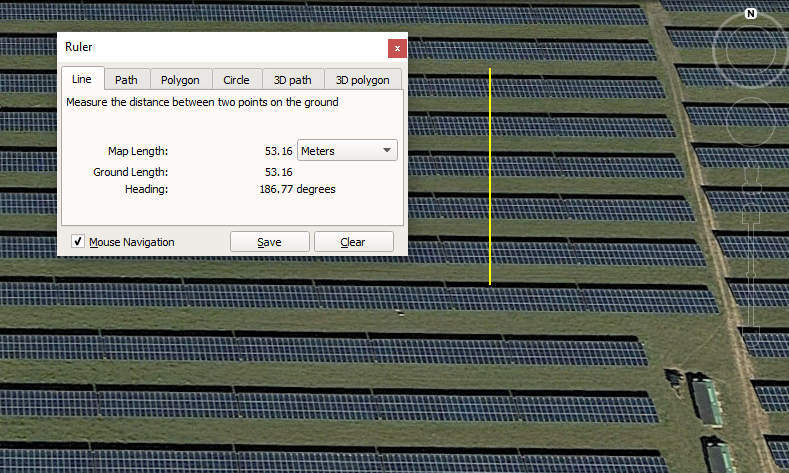
The kind we are talking about at Cleve Hill aren’t like that. According to the developer, “In the candidate design, tables will be located continuously from north to south without substantial gaps between them”. In other words, the panels will not be in banks facing south with large areas of grass between them. They will be quite flat and butted up together to more or less cover the ground completely. No sort of life can exist beneath them, except maybe troglodytes. They’ll be like these at Cestas in France:

As things stood, the potential for bird collisions was dismissed by the developer, and was not mentioned in the HRA (Habitats Regulations Assessment: a test by the appropriate authority of whether a development will have any effect on the integrity of an international site). The HRA mentioned disturbance, dust, and the loss of habitat for brent geese, golden plovers, lapwings and marsh harriers (if you are particularly interested to read this, go to infrastructure.planninginspectorate.gov.uk, search for Cleve Hill, pick documents, and then search for “habitats” – it’s the first hit. I know, you really can’t wait.)
Final point. Whatever risk there is, mitigation is straightforward. Kagan et al recommend retrofitting visual markers to break up the reflection from the solar panels at 28cm intervals, noting that at 10cm intervals impacts with windows – and by analogy, solar panels – are eliminated. The way to stop wigeons flying into solar panels is the same as the way to stop pigeons flying into skyscrapers. All the skyscraper architect has to do is to divide that vast mirrored surface into 10 cm squares. My guess is that instead of sullying their grand design like that, they’re brave enough to let the pigeon take the risk. One imagines that a solar developer would not be too keen either. (The Cleve Hill modules are about 2 m by 1 m, so you’d have to split that into quite a large number of squares, depending how wide the “visual markers” would be.)
Cleve Hill was successful in bidding for a CfD in Allocation Round 4, offering 112 MW at £45.99:

However, the developer thought that Cleve Hill was not a very warm and fuzzy name, and has now decided to call it “Project Fortress.”
This is perhaps a more apt name, because none of its neighbours seem to want it, afraid that the attached battery storage system might go up in flames one day. The Faversham Eye has more despairing commentary, if you’re not miserable enough already.
Note to diary: stop calling these things solar “farms”. They don’t farm sunlight, they collect it.
Conclusion
The risk of bird collisions with Cleve Hill’s Project Fortress’s solar arrays is probably low, but it isn’t zero. It should have been considered seriously for its effect on the integrity of the SPA rather than dismissed out of hand.
References
You can find pdfs of all these via Google Scholar.
DeVault, T. L., Seamans, T. W., Schmidt, J. A., Belant, J. L., Blackwell, B. F., Mooers, N., Tyson, L. A. and Van Pelt, L. (2014) ‘Bird use of solar photovoltaic installations at US airports: implications for aviation safety.’ Landscape and Urban Planning. Elsevier, 122 pp. 122–128.
Kagan, R. A., Viner, T. C., Trail, P. W., & Espinoza, E. O. (2014). Avian mortality at solar energy facilities in southern California: a preliminary analysis. National Fish and Wildlife Forensics Laboratory, 28, 1-28.
Kosciuch, K., Riser-Espinoza, D., Gerringer, M., & Erickson, W. (2020). A summary of bird mortality at photovoltaic utility scale solar facilities in the Southwestern US. PloS one, 15(4), e0232034.
Kosciuch, K., Riser-Espinoza, D., Moqtaderi, C., & Erickson, W. (2021). Aquatic Habitat Bird Occurrences at Photovoltaic Solar Energy Development in Southern California, USA. Diversity, 13(11), 524.
Penniman, J. F., & Duffy, D. C. (2021). Best Management Practices to Protect Endangered and Native Birds at Solar Installations in Hawaii.
 Climate Scepticism
Jit, thanks for a fair and balanced piece. And so much for claims that solar arrays are compatible with farming and growing food (quite an important issue just now, I should have thought).
LikeLike
Jit,
Thanks for this. The WordPress algorithm failed to do a particularly good job when looking for related articles, so I will do it for myself:
More to the point, it is worth citing the Wired article I had found to substantiate my concerns:
https://www.wired.com/story/why-do-solar-farms-kill-birds-call-in-the-ai-bird-watcher/
Two key quotes:
“In 2016, a first-of-its-kind study estimated that the hundreds of utility-scale solar farms around the US may kill nearly 140,000 birds annually…but the researchers expected that number to nearly triple as planned solar farms come online.”
“The link between solar facilities and bird deaths is still unclear. One leading theory suggests birds mistake the glare from solar panels for the surface of a lake and swoop in for a landing, with deadly results.”
So how do we go from the above to ‘Natural England guidance states that there is no scientific evidence of collision risk associated with solar PV arrays’?
LikeLiked by 1 person
John, I can hardly believe I forgot about that, considering it was practically last week. Insert embarrassed face.
LikeLike
I’ll look up the application if the CC’s planning portal is up to the job. It must have been <50 MW and therefore not a matter for the SoS.
LikeLike
This is what the NE review said about Walston et al (John’s reference).
LikeLike
Whoops, I didn’t mean to press on “post.” What I meant to add was that I took the review’s words at face value and did not read Walston et al.
I have now skimmed Walston et al… and CSP and PV are NOT pooled in the study. The estimate of mortality at the California Valley Solar Ranch PV (250 MW) station is 0.5 birds/MW/year… for mortality of known cause. For mortality of unknown cause – birds found dead on the site – the number was 10.2 birds/MW/year.
The inescapable conclusion is that the Natural England review was not a very good review, and its blithe conclusions on PV facilities and bird collisions have been lapped up by solar developers.
Edit: Walston et al can be read at https://www.sciencedirect.com/science/article/pii/S0960148116301422#!
LikeLiked by 2 people
Somewhat off the topic here, but on the subject of bird casualties from renewables … there is a current application in the Scottish Borders named Scawd Law.
On the highest ground in the Moorfoot Hills … now recently there has been a major project to reintroduce golden eagles to southern Scotland. And hey, a pair have set up on these very hills — actually Windlestraw, the highest of the Moorfoots. And so the developers have been pedalling furiously to make out the eagles and the turbines will do just fine together. And this is what the SBC Ecology officer has to say…
The report on the Golden Eagles mentions that Golden Eagles are generally good at avoiding turbines (it does specifically refer to fledglings); the collision modelling calculated 0.1 collisions per season, assuming avoidance behaviour. This rises to 1.97 predicted mortality per season with no avoidance behaviour. Considering that golden eagle fledglings could be in close vicinity to the turbines I am currently inclined to consider the 1.97 predicted mortality per season more realistic. Which would mean any breeding success at the beginning of a season could be wiped out by the end of every season. Under these circumstances, I would question whether proposal would conflict with the Nature Crisis part of NPF4 policy 1, which aims to create nature positive places and drive nature restoration.
Oh, she questions, well that’s alright then. I am just dumbfounded that she cannot use the word “object”. But a source tells me the Ecology officers at SBC never object to any wind farm. Well, there’s hope that the South of Scotland Golden Eagle project might…. they are very active here and are having real success.
And on another subject a couple of articles back you were all discussing the Scottish OWPS. That and NPF4 are being taken by the wind industry as a carte blanche to develop anywhere and everywhere, I’m just writing two major objections at present — and having to think up counter arguments for these two new policies. So not a lot of hope for stopping the Kent array either I think. It’s all going one way at present. But don’t give up, I really appreciate your articles!
LikeLiked by 1 person
“Note to diary: stop calling these things solar “farms”. They don’t farm sunlight, they collect it.”
I think they farm subsidies…
LikeLiked by 1 person
…and stop calling them ‘renewables’ since neither turbines nor solar panels produce enough energy during their lives to ensure they can be replaced without using other fuels.
LikeLiked by 1 person
So, unreliable, unsustainable subsidy farms it is then.
LikeLike
“Controversial Chippenham solar farm plans to be decided”
https://www.bbc.co.uk/news/uk-england-wiltshire-64798843
Another person saying, in effect, I support net zero, but not where I live. As I have already written I am grateful for NIMBYs, because nobody is better placed to understand the damage to a location than local residents, but I don’t have much time for those who campaign for these environmentally destructive projects everywhere except where they live. I don’t have much time for this comment, either:
Is any part of that statement accurate? And even if we really are at risk of irreversible climatological breakdown, does anyone seriously think that a solar farm near Chippenham will solve (or even make a meaningful contribution towards solving) the problem while most of the developing world is cheerfully and rapidly increasing its use of fossil fuels?
LikeLike
Thanks Mark. I just looked it up. Have a guess what the installed capacity will be…? 49.9 MW.
https://uk.edenrenewables.com/forest-gate-solar
LikeLike
49.9MW eh? Now there’s a surprise….
By the way, I thought the first of the listed community benefits listed on their website is borderline risible:
Take a fun day out for all the family and make a circular walk around a solar farm before extending it with a walk along the A4. What’s not to like?
LikeLike
That’s a circular walk with an impenetrable deer fence on one side the entire way along. Practically like prison exercise.
LikeLiked by 1 person
“Manuden solar farm bid to be decided by planning inspector”
https://www.bbc.co.uk/news/uk-england-essex-64892138
And guess what?
LikeLike
49.9 – it’s the magic number. Meanwhile, there are a number of schemes above the magic number on the planning inspectorate website, including Tween Bridge, whose “site extends to over 1500 hectares”. That’s 15 square km, or about 4 Cleve Hills. Here is the list:
Tween Bridge Solar Farm
Byers Gill Solar
Tillbridge Solar Project
East Yorkshire Solar Farm
Mallard Pass Solar Project
Stonestreet Green Solar
West Burton Solar Project
Cottam Solar Project
Heckington Fen Solar Park
Oaklands Farm Solar Project
Tween Bridge was just the first one I looked at – it was top of the list. I will investigate the size of the others in due course!
LikeLike
I wasn’t expecting that:
“Gloucestershire solar farm plans turned down”
https://www.bbc.co.uk/news/uk-england-gloucestershire-65013672
LikeLike
What is the point of Conservation Areas and AONBs when solar farm developers see nothing inconsistent with such areas and their own greedy developments? OK, so this application has been pulled, but they obviously thought it was worth trying it on in the first place:
“Chickerell solar farm plan in conservation area scrapped”
https://www.bbc.co.uk/news/uk-england-dorset-65261370
LikeLike
I never thought I’d see this in the Guardian. Sometimes I wonder – if they understand the implications of their endless campaigning re climate change, net zero, etc – why don’t they stop, given things like this:
“How solar farms took over the California desert: ‘An oasis has become a dead sea’
Residents feel trapped and choked by dust, while experts warn environmental damage is ‘solving one problem by creating others’”
https://www.theguardian.com/us-news/2023/may/21/solar-farms-energy-power-california-mojave-desert
And much, much more.
LikeLike
“We feel like we’ve been sacrificed,” says Mark Carrington
That’s because you have. Your lives and the life of the desert itself have been offered up in sacrifice to the Green gods of the Sustainability Religion, aka the climate change cult. We think we’ve become civilised. We think we’ve become rational and guided by science, not religion. Maybe we were for a short time. We’re not now. What we’ve done is find new ways, more sophisticated justifications, to kill in order to appease the gods. We’re no different from the Aztecs or the Vikings, or any other superstitious peoples who sacrificed animals and human beings to bring favour and good fortune to their tribe, their township or their nation.
LikeLiked by 1 person
Jaime,
The Weather Gods are angry.
LikeLiked by 1 person
Mark, the weather gods are chaotic and supremely indifferent. It’s us who are bloody angry.
LikeLiked by 1 person
“Solar farm in Essex rejected over green belt and reserve concerns”
https://www.bbc.co.uk/news/uk-england-essex-65894953
Well, what to make of that? A Council that seeks to protect its own countryside but spends hundreds of millions of pounds virtue-signalling by blighting other areas’ countryside with solar panels. The Environment Agency, Essex Wildlife Trust, Historic England and Natural England, all happy so see the countryside blighted by these things. Locals have to object instead. But despite all that the Council gives the right answer, despite the damage it has inflicted elsewhere. What a mad country this has become.
LikeLike
This Thurrock Council? https://www.bbc.co.uk/news/uk-england-essex-63780096
It sounds like they had a rogue financial officer who borrowed from other LAs to “invest” in solar farms and other risky green ventures, landing them with a billion in debt that they couldn’t service.
Their experience probably tells them never to touch a solar farm again, either by funding it or permitting it!
And the level of illiteracy on the part of the BBC report you cite is – well, I would call it unexpected, but it ain’t.
A *maximum* of 49.9 MW would be supplied to the National Grid each *second*, probably averaging out to 7 MW over the year.
LikeLiked by 1 person
“Solar park means farm land will be lost says residents”
https://www.bbc.co.uk/news/uk-england-suffolk-66399105
LikeLike
There’s that magic number again. 49.9 MW. It seems the way to get around the 50 MW limit is just to break up what you want to build into bite sized pieces that don’t trigger the Nationally Significant Infrastructure limit.
LikeLiked by 1 person
It looks as though solar farms are the next blight on the environment:
“New solar farm adds to ‘carpet’ of similar schemes”
https://www.bbc.co.uk/news/articles/cv2ny0171gko
And:
“Large solar farm proposed for west Cumbria”
https://www.bbc.co.uk/news/articles/cp4n9ggq1d7o
And:
“Bid to block solar farm at High Court fails”
https://www.bbc.co.uk/news/articles/c6pwk021e87o
LikeLike
A SQUARE MILE of virtually useless solar panels! Where once was green, green grass, there now will be blinding, glaring glass. Where sheep once grazed will now be glazed.
In planning documents, the company said the land was rural and mostly used for sheep grazing but was “not an unspoilt landscape as the site is affected by the presence of pylons, overhead lines and wind turbines”.
So that’s an admission that wind turbines spoil a landscape then. So if the countryside has already been spoilt by useless wind turbines, then we might as well totally trash it with even more useless solar panels – “cos ‘net zero’ and ‘saving the planet’ innit and we’ll bung the local council half a million if they give planning consent.”
LikeLiked by 1 person
“Renewable energy: Minister blocks solar farms on Gwent Levels”
https://www.bbc.co.uk/news/uk-wales-politics-66359688
I haven’t looked into these schemes, but if the BBC reporting is accurate, both had a footprint entirely within SSSIs, and both were approved by inspectors.
And
Now that the planning inspectors don’t know what they are doing, I don’t know what hope there is left.
LikeLiked by 1 person
If we have to have solar power, with all the problems of unreliability and being of least use when most needed (in winter) this seems more sensible than many of the huge solar arrays on agricultural land:
“Portsmouth: Work to put in 8,900 solar panels at business park starts”
https://www.bbc.co.uk/news/uk-england-hampshire-66578554
LikeLike
“Hertfordshire public inquiry begins into solar farm on green belt land”
https://www.bbc.co.uk/news/uk-england-beds-bucks-herts-66807309
LikeLike
Greg Smith
(Buckingham) (Con)
12. What recent discussions he has had with the Secretary of State for Energy Security and Net Zero on the use of land for renewable energy generation. (900444)
The Minister for Housing, Planning and Building Safety
(Lee Rowley)
The Government have in place a framework, developed in collaboration with the Department for Energy Security and Net Zero, that supports the deployment of renewable energy technologies. That is balanced by national planning policy, which is clear that land assets such as farmland must also be protected.
Greg Smith
On current usage, 2,000 acres of solar panels are required to power around 50,000 homes, whereas a small modular reactor requires just two football pitches and powers 1 million homes. Does my hon. Friend agree that solar is a highly inefficient land use, and can he confirm that the provision to protect land used in food production remains in the new national planning policy framework?
Lee Rowley
I know that my hon. Friend has a long-standing interest in this issue. We will be publishing more on the NPPF shortly, but he is absolutely right that we need a variety of different energy sources that can support the UK’s future energy needs.
Today in the Commons
https://hansard.parliament.uk/commons/2023-12-04/debates/C41929AD-A5E7-4E8B-A8F9-64C6A9ECCB22/LandUseRenewableEnergyGeneration
LikeLiked by 1 person
“Massive solar farm in mid-Cornwall narrowly approved”
https://www.bbc.co.uk/news/uk-england-cornwall-67731007
But it’s OK because:
LikeLike
“Derbyshire farmer fears he will be turfed off land for solar farm”
https://www.bbc.co.uk/news/uk-england-derbyshire-67836727
LikeLike
“More than 70 responses over £600m solar farm”
https://www.bbc.co.uk/news/articles/cv2w52nl0e8o
LikeLike
“Solar farm plan rejected by South Holland council”
https://www.bbc.co.uk/news/articles/c2v43d1wzlxo
LikeLike
“Fears over solar farm effect on wildlife sanctuary”
https://www.bbc.co.uk/news/articles/c4nvweqnn9xo
LikeLike
Mark, as well as wrecking the landscape, this solar farm is going to have very low productivity in a very wet part of the country and at such a latitude. A truly bizarre choice for location, and a bizarre decision to allow it to go ahead.
LikeLiked by 1 person
The Daily Record says that a Hyderabad-based company is behind the Great Cumbrae* solar scheme but I don’t think that’s true. I hope I’m wrong because that Indian company’s main business is shipping vast amounts of coal around the world but I reckon the actual instigator of the scheme is a big Scottish construction company run by a very rich Irishman. That company has illegally dumped thousands of tonnes of toxic waste** and has felled a copse of old trees without permission, damaging castle ruins*** in the process, which isn’t very green, but that’s not as neat a story as a globetrotting bulk coal-shipper being behind a supposedly green scheme to build a solar farm on a protected part of a tiny Scottish island.
===
*More on Great Cumbrae:
https://archive.org/details/s01e02millportlineage
I haven’t listened to that sitcom for a while but an old note says that the dog is the most entertaining character, so it’s perhaps not all that great.
**On land it thought was owned by a convicted murderer but was actually owned by an ex-jockey.
***The castle collapsed in 1773 after a severe storm. That’s global warming for you. We’re all doomed, doomed, I tell you! Even big strong thighs won’t save us!
[Sorry, I got my e-mail address wrong on the first attempt.]
LikeLike
Jit, bizarre, disappointing, and demonstrative of the contempt the SNP/Green coalition has for the very real concerns of local people.
LikeLike
“Approval for large solar farm near Ulceby”
https://www.bbc.co.uk/news/uk-england-lincolnshire-68272816
LikeLike
Been to Great Cumbrae a couple of times as a really nice get away for the day on a bike ! I have clipped the CALMAC ferries quicky on the island below.
More about Cumbrae
Ideal for:
Outdoor adventure Nature & wildlife Cycling Water sports
Ten minutes from the mainland and best explored by bike
Cumbrae is just a short hop from the mainland, and there’s plenty to do once you’re there. You can hire bikes at Millport, and cycle the ten-mile route round the island – taking in the beaches and coastal views. You’ll be quieter on a bike, so you’ll see more of the wildlife, which includes owls, polecats, kestrels, and the occasional sea eagle. You can also play a round of golf at Millport’s 18 hole golf course while enjoying stunning views of the Firth of Clyde.
Cumbrae is great for kids, too – you can’t miss the painted Crocodile Rock in the bay at Millport, and if you wait for low tide you can take them to sit on it, if they dare. There’s a water sports centre, and you can also hire kayaks in Millport, if you fancy exploring some of the smaller islands in the bay. Keep an eye out for the island’s festivals and events, which range from country and western music to a scooter rally.
The island is tiny single track road , why would you build a solar farm needing diggers, lorries cable laying and undersea work ???/
LikeLike
I could have posted this against a few articles, but this seems to be the most appropriate place:
“Warwickshire solar farm row pits ‘builders against blockers'”
https://www.bbc.co.uk/news/uk-england-coventry-warwickshire-68383298
It’s worth a read generally, IMO, but the bit that sticks in my craw is the unquestioning parroting by the BBC of the lie that renewable energy = cheap energy:
LikeLiked by 2 people
Jit,
I would be interested in your views with regard to this:
“Weatherwatch: how solar farms benefit bees and butterflies
Research shows pollinating insects thrive in solar parks, particularly where a variety of plants are flourishing”
https://www.theguardian.com/news/2024/mar/01/weatherwatch-how-solar-farms-benefit-bees-and-butterflies
LikeLike
Mark, that is a topic for a post on its own – something I meant to do but forgot about. It’s true but also not true. It’s true because the solar farm has more wildlife on it than the arable land it replaced, which I characterize as desert. But if you compare it to the same land… just without the solar panels… the panels obviously make things worse.
There is another matter, which is that the photos of solar farms as biodiversity hotspots are usually in the first or second year of the solar farm’s existence. Disturbed ground naturally has a lot of flowers, and they often sow wildflower mix. The flowers will generally dwindle after that as coarse grasses take over.
LikeLiked by 1 person
“West Norfolk solar farm gets go ahead after planning appeal”
Local councillors said no. The Planning Inspector said yes.
https://www.edp24.co.uk/news/24172089.west-norfolk-solar-farm-gets-go-ahead-planning-appeal/
The councillors objected, quite rightly, to the loss of prime agricultural land. The inspector laughed at their objections. And for the developer, it’s not about the dosh!
Oh, the power? 49.9 MW. The size? “86 football pitches.”
LikeLiked by 2 people
Jit,
I have “liked” your last comment on this thread, but we could really do with a social media set of emoticons to go with “likes”, so that I could be crying or angry instead.
LikeLike
“Northamptonshire solar farm plan met with protest from councillor”
https://www.bbc.co.uk/news/uk-england-northamptonshire-68517550
“A councillor has launched a petition protesting over the size of a proposed solar farm.
A developer wants to build the project on roughly 950 hectares of land in Northamptonshire.
Martin Griffiths, an independent councillor on North Northamptonshire Council, said he wanted “a reduction in the sheer scale of these plans”.
The company Green Hill Solar Farm says the scheme is necessary to help the UK reach its net zero targets.
Mr Griffiths pointed out the proposed size would make it the largest solar farm in the UK.”
950 hectares! For pity’s sake. By the way, is there a reason why the BBC chose to report it in hectares? I suppose it sounds less than approximately 2,375 acres.
LikeLike
“Net zero meets the NIMBYs: Inside the battle for the UK’s biggest solar farm
U.K. politicians have pledged to quadruple solar generation by 2035. There is one problem — no one wants to live next door to acres of fields crammed with solar panels.”
https://www.politico.eu/article/net-zero-climate-change-nimbys-uk-solar-energy/
“…Botley West is quite a beast.
It will cost £900 million to build, according to developers Photovolt Development Partners (PVDP), and has the potential to generate 840 megawatts of power. It includes 2.5 million solar panels (coming from five manufacturers in China.) …
…“The predominant opposition is a belief that, while there is climate change, this is not the answer to it, and the reason we’re building is simply commercial greed,” Owen-Lloyd said…”
Yes, I’d say that’s a reasonable summary.
LikeLiked by 1 person
As so often, folk only realise the problems of Net Zero when it comes calling in their neck of the woods.
“This is what the greens call saving the environment! As plans for a massive solar farm in the picturesque Wiltshire countryside provoke uproar, writer JAMIE BLACKETT says the project will sacrifice a slice of paradise to the god of Net Zero”
These guys should have opposed such things more widely before the solar developers came for their patch. It’s too late for them now. The divide and conquer approach to Net Zero development has worked well so far.
Daily Mail
LikeLiked by 2 people
“Giant solar project plans blocked by government”
https://www.bbc.co.uk/news/articles/c03d83jyekwo
“Plans for a solar farm the size of 179 football pitches have been blocked by the government.
According to Local Democracy Reporting Service, Enso Energy submitted proposals for two joined sites between Watford and Borehamwood in Hertfordshire.
Planning Minister Lee Rowley, on behalf of Levelling Up secretary Michael Gove, ruled “very special circumstances do not exist”, external to justify the project in the green belt on the edge of London.
He added that it could also harm the landscape, including nearby Hilfield Castle which dates to the late 1700s...
…While the letter from the Department for Levelling Up, Housing and Communities (Dluhc) highlighted the importance of green energy, it said the development did not outweigh potential harm to the area.
The document said: “The secretary of state considers substantial weight should be applied to collective green belt harm, including inappropriate development, harm to both spatial and visual openness and harm to green belt purposes.”…”
Anyone might think that a general election was imminent!
LikeLike
“The Shocking Solar Farm Bird Deaths the Mainstream Media Aren’t Telling You About”
https://dailysceptic.org/2025/02/04/the-shocking-solar-farm-bird-deaths-the-mainstream-media-arent-telling-you-about/
Solar farms, coming soon to a field near you, are an ecological disaster turning productive land into a nature dead zone. Birds frequently fly into the panels mistaking them for water, while electrocution and incineration are common. Blanketing large areas once open to sunlight causes massive habitat disruption and reduced insect numbers. Like the heavily-shaded ground beneath the miles of often Chinese-made panels, all of this is hidden by a mainstream media and governing class that are desperate to keep the Net Zero kite flying high.
“Bird mortality has become an unintended consequence of renewable energy development,” notes Hannah Vander Zanden, an Assistant Professor of Biology at the University of Florida. Little work has been done specifically on bird mortality at solar farms, although it is known that millions of bats and large birds of every kind are killed every year by giant wind turbines and their associated high power electricity lines. In recent work in California, Vander Zanden found that the birds killed at solar farms were often non-local, with peak kills during migratory periods in April and September. Britain, of course, is a haven for many migratory birds, large and small.
In 2023, the US Association of Avian Veterinarians published a “Conservation Note” titled ‘Solar Energy Production’s Toll on Wild Birds‘. It reported the estimate from the US Fish and Wildlife Services that yearly avian mortalities due to electrocution averaged 5.6 million and that some eight to 50 million bird mortalities may occur following collision with electrical lines. The construction of solar farms can lead to habitat destruction, the authors observe, and changes to plant composition and insect abundance, causing shifts in the diets of insectivorous birds….
LikeLiked by 1 person