How do you get a charity whose raison d’être is keeping birds safe to endorse the wholesale destruction of those self-same birds? It’s a question I found myself asking in response to a comment by Ray Sanders on Notalot a fortnight ago.
Ray linked to two Guardian articles, the first an opinion piece by the RSPB’s CEO Beccy Speight, and the second a response to it from someone at Sizewell C.
Here’s some of what Speight said in her piece:
Make no mistake: our natural world is in crisis, and we are far beyond the point where words alone will fix it. For proof, you need only look to the annual Big Garden Birdwatch, which has shown a catastrophic decline over the past 14 years. And if you look for them in late spring, you’ll see that nightingales, turtle doves and swifts have almost vanished from our skies.
I would hazard here that most of us see swifts, while few indeed see turtle doves or nightingales. That’s by the by. Speight could have picked a third bird that is genuinely rare. She didn’t.
So the publication of today’s more detailed route map to delivery [the environment plan] is positive – but its policies must permeate through all aspects of government. Last year alone we saw approval of the Sizewell C nuclear plant, which will be built on top of one of the UK’s most important wetland nature reserves.
A quite extraordinary phrasing, I think you’ll agree: “Last year alone…” implies a list is beginning. But Speight only finds one thing to object to: Sizewell C – which is in fact being built next to, not “on top of” Minsmere.
Protected areas must be more than lines on a map. We have seen protected areas declared on land and at sea, but without the funding needed to restore, maintain and improve their condition, these spaces won’t reach their potential.
Send money now. Wild places do not need money. They need leaving alone.
At our own farms and on the land of the farmers we work with, we have seen how encouraging wildlife can lead to reduced use of pesticides as well as allowing natural pollinators to thrive.
I’m afraid this is the wrong way about. Reduce pesticides and get more wildlife. You don’t get more wildlife and then reduce pesticides, because the wildlife dies.
The commitment to support landowners who set aside 10-15% of their farmland for nature by 2030 is welcome – but the plan will need to be much more ambitious to deliver this. Developing nature-based solutions to the climate crisis and protecting land and marine habitats will also be vital.
Whoops – now suddenly Speight casually drops in that fateful term, “climate crisis.” There is no “climate crisis.” Point to where it is described as such in the IPCC’s AR6. You can’t, because, as pointed out by Joe Public in a comment here, they didn’t. This is not the language of a serious person (see my previous article on alarmist language). And the CEO of the RSPB should be a serious person.
Above all we must see measurable progress by 2030. Not flattening the curve, but progress. This means a fully realised plan for how we will protect 30% of our land and seas, with assurances that these spaces will not just be given a certain status on paper, but will actively work to help nature’s recovery.
Why would we protect 30% of our land and seas? We don’t protect 30% of our people from crime. Altogether a singularly bland and partly wrong comment by Speight, who if she cared about birds, should be spitting feathers.
What about the pushback from Sizewell C? This comes from Julia Pyke – director of financing and economic regulation. First Pyke criticises the characterisation of Sizewell C being “on top of” Minsmere – as mentioned above, it’s next door. “On top of” is imprecise vernacular. Then Pyke claims that habitat creation will lead to a 19% net gain in biodiversity via the Sizewell C project. They are going to turn some arable land into wetlands, so they might well have a point.
Then:
The RSPB themselves state that the greatest threat to nature is climate change. We agree. That is why we need to stop burning fossil fuels by developing an affordable, low-carbon energy mix mostly made up of renewables and nuclear, including Sizewell C.
Just when I was agreeing with her, she had to go and drop that little hand grenade. I didn’t know what the RSPB thought was the greatest threat to nature – more on that in a moment. But “we agree” tells me that Pyke knows as little about the topic as Speight.
If the RSPB thinks climate change is so serious, they should be supporting Sizewell C. The fact that they aren’t is telling. We need energy, so where do RSPB propose we get it from while balancing the need for energy to be low-carbon and the needs of the birds they exist to protect? (The clue’s in their name.) Of course wind turbines are out, and the only viable alternative is… nuclear.
Not so fast. Speight opposes Sizewell C, and by implication, the RSPB does too. Does it oppose wind farms? With the honourable exception of their (lost) battle against Neart na Gaoithe, my answer was no. But I thought I would search the RSPB’s site for a policy position on wind turbines. Here’s what I found under “Policy Spotlight”:
Powering Healthy Seas
Powering Healthy Seas is an RSPB report looking at how we can work in harmony with nature as we expand offshore wind. Experts in wind energy and conservation come together to painting a picture [sic] where seas are full of life and energy sources are secure and sustainable.
I couldn’t quite believe what I was looking at. When I clicked to read the report, things only got worse. The full title of the report, dated last August, is
Powering Healthy Seas: Accelerating Nature Positive Offshore Wind
If you are wondering now whether “Nature Positive” and “Offshore Wind” belong next to one another in the same sentence written by the RSPB, me too. How has a charity whose only job is to protect birds (clue still being in the name) managed to twist itself into this particular pretzel?
The contents of the report are as bad as its title suggests. Here’s another horrifying juxtaposition on the contents page:

In the Foreword, Kerry ten Kate (RSPB trustee and Chair of Conservation Committee) says this:
We are at a crossroads for nature and for the climate. To achieve net zero and national energy security, we need rapid decarbonisation, leaning heavily on renewable technology and particularly on offshore wind.
Dear Kerry, you don’t know what you are talking about, and for that reason you shouldn’t be anywhere near any Conservation Committee, let alone be its Chair. You are endorsing the wholesale destruction of birds. You are supposed to be protecting them.
This report, Powering Healthy Seas: Accelerating Nature Positive Offshore Wind, is a collaborative effort between industry and conservation groups.
You mean a collaborative effort between an industry that kills birds and a charity created to protect them. Message received.
I’m not going to dwell on the contents of this report. Read it for yourself if you have a strong stomach. You could summarise it by saying that it acknowledges that wind turbines are terrible for birds, but that there is a “climate emergency,” so offshore wind is necessary, so we’re going to do all these other things (a “Nature Positive” approach) to make sure that the pressure on birds goes down in sum. Unfortunately the only premise that makes any sense is that wind turbines are terrible for birds. The rest is nonsense. You cannot justify any generation technology that kills birds UNLESS there is no viable alternative that DOESN’T kill birds. [We have seen that the CEO opposes Sizewell C.] Thus, even if we WERE in a “climate emergency,” a BIRD CHARITY could still advocate nuclear energy, and not hitch its wagon to a technology that KILLS BIRDS. And this “Nature Positive” approach of theirs lists a lot of things that have nothing whatsoever to do with wind turbines – like removing rats from islands – which we should be doing anyway. I suppose the argument here is that the funding for such schemes will come from wind farm developers. Nevertheless, it is nothing short of pathetic.
It’s very simple for the RSPB, or it should be. If the question is “Wind farm?” the answer is “No. Nowhere, never, not while we still draw breath, not while we live to prevent harm to the beautiful and amazing feathered animals we share this planet with.” The RSPB should hate wind farms like Ahab hated the white whale. They should fight them on sea and land, everywhere. There are no excuses, no exceptions and no grey areas. There are no right places to site wind farms. The wrong place is the sky. No amount of carbon dioxide “savings” from wind power can outweigh the direct losses from the birds it kills.
The RSPB, we note, has more than a million members. I judge that its members hope and believe that the RSPB exists to protect birds and that their subs contribute to that aim. Therefore, by endorsing wind farms, the RSPB is betraying its members.
Remember in the Foreword Kerry ten Kate mentioned the report was a collaborative effort? This is from the Acknowledgements:
We have worked with RenewableUK in the development of this report, taking on board their views and advice to refine its key messages, and for which we are very grateful.
RenewableUK sounds like a fairly bland organisation, doesn’t it? Who they? The wind industry’s trade association, which exists to promote wind power. At least they know what they’re for.
Oh, and then:
This publication has been produced with the financial contribution of European Climate Foundation.
Now, I doubt that a report produced with the wind power trade association could ever have come out with my opinion about offshore wind. I also doubt that ECF would have funded it unless they thought they were going to get an answer that was acceptable to them. Cynical of me, I know. The ECF’s funders include the bland-sounding Children’s Investment Fund Foundation, as well as all the usual billionaires. CIFF has also funded XR, and the Centre for Climate Integrity, which exists to litigate against fossil fuel companies. [Useful info on these groups at influencewatch.org]
The RSPB also lists a suite of organisations that endorse their report:

These organisations have also betrayed their members. When it comes to wind power, they should be getting their nails out. Instead, they’re getting their tongues out.
Conclusion
Dear RSPB, it’s simple. Protect birds. Oppose things that kill birds.
Dear Ms. Speight, you are the CEO of the RSPB. The ‘P’ stands for Protection, not Prevention. If you genuinely care so much about carbon dioxide emissions, endorse nuclear power.
Featured Image
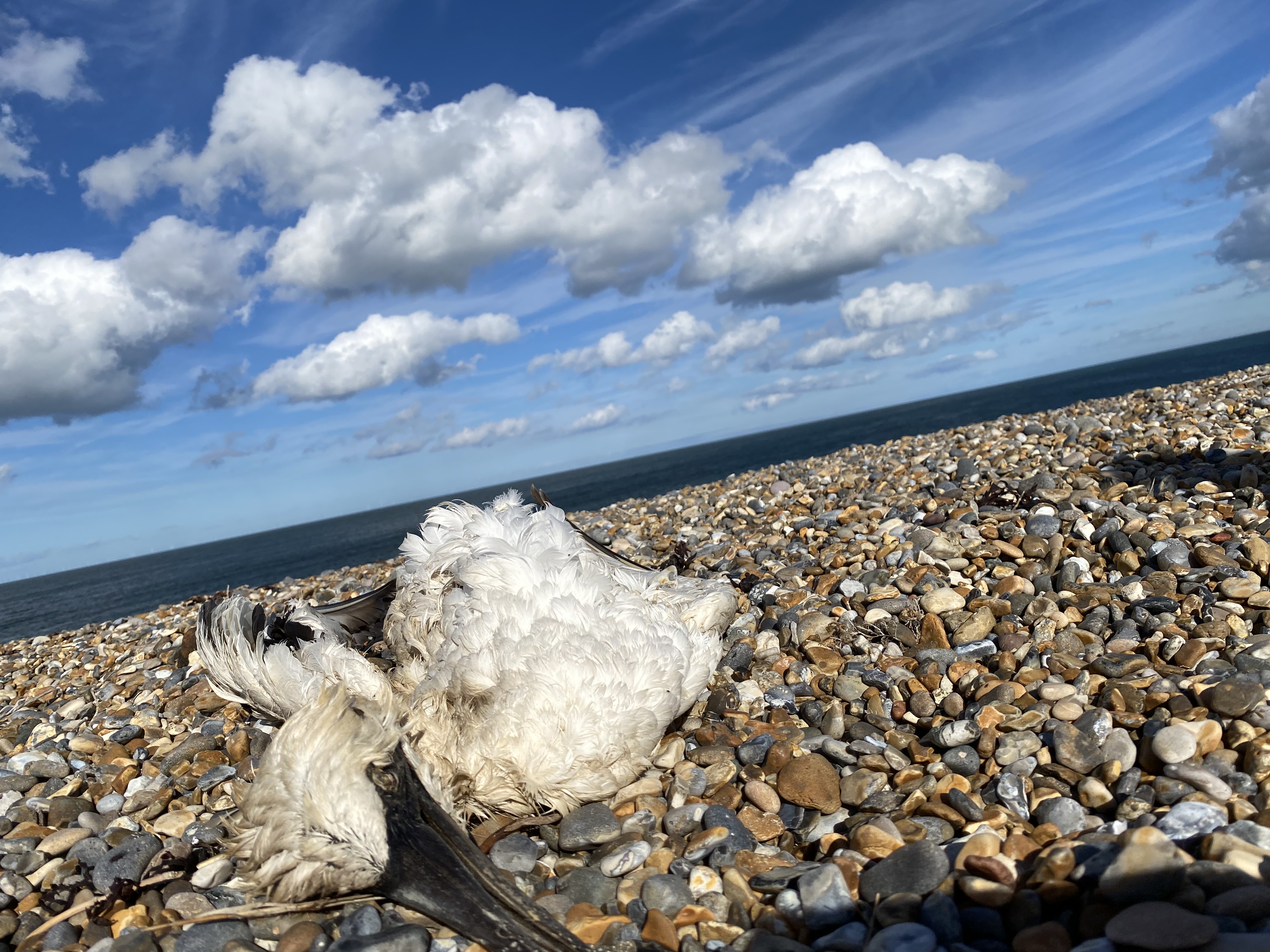
A photo of a beautiful not-dead gannet, with kind permission of Adrian R Yallop. The photo of the not-alive gannet was by YT. On the horizon, too small to see, is the Sheringham Shoal windfarm. Coincidence? I did not undertake a post mortem, so perhaps.
 Climate Scepticism
And then there’s the damage to whales, dolphins, porpoises and orcas by the various frequencies of sound, and the emerging damage to crustaceans caused by the EMF of interconnects.
All in all, a thoroughly bad idea.
LikeLiked by 1 person
All my life I have loved birds. From a small boy in East London marvelling at occasional visitors from the countryside- like woodpeckers.
My sister imprisoned several and their chatter or song burnished my life. Later I have marvelled at hefty gannets powering Into the sea, clouds of parakeets blot out the sun and fill the air with sound.
I used to fill out forms listing the different bird species in my gardens. Not any more, it’s too embarrassing/ depressing. When sparrows dropped from my list, I gave up compiling them. Since my town and it’s immediate surroundings lack wind turbines and anyway garden birds don’t fly in their vicinity or at their height I doubt if it is wind farms that are causing most of the demise. Chemical gardening perhaps.
LikeLiked by 1 person
Heartbreaking.
Brilliant writing, thank you.
LikeLiked by 2 people
“You read it so I didn’t have to” doesn’t wholly apply because you also quoted from it, including this:
Your point throughout is that the RSPB, through its very name, sets up a crucial division – between protecting birds and destroying them. The singular emergency for them should be that birds are being destroyed.
But “the indivisible emergency” got me thinking more widely. How indivisible is it really? How come the evil proposed solution of Sizewell C is divided from good and perfect offshore wind? What about energy prices worldwide going up, partly due to so-called renewables? As Jordan Peterson says to Judy Curry that means millions of lives of the poorest lost right now. Is that part of the indivisible emergency? Not on your nelly.
The way they tell it, it’s a highly divisible emergency. And indeed a very divisive one.
LikeLiked by 1 person
JIT, thanks for exposing the hypocrisy behind the RSPB. As for the skies being empty of swifts, turtle doves and nightingales, I can’t comment on nightingales (I have neither heard nor seen one, seen they don’t normally venture this far north, and the “climate crisis” hasn’t yet persuaded them to do so). However, last summer the swifts returned as usual, in the usual numbers so far as I could tell (ditto house martins, sand martins and swallows). As for turtle doves, this is from the RSPB’s own website:
https://www.rspb.org.uk/birds-and-wildlife/wildlife-guides/bird-a-z/turtle-dove/
As is so often the case, it rather sounds as though the problems the turtle dove is encountering have an awful lot to do with habitat loss and precious little to do with climate change.
LikeLiked by 1 person
Alan, there may not be sparrows in your garden, but I’m sure they are nearby. The RSPB’s website gives the UK population of the ‘umble sparrer as 5 million pairs.
The sparrow went from the green list to the red list in a single jump between the first red list in 1996 and the second in 2002. You can see the latest (version 5) here.
You can buy sparrow terraces that might attract a family back into your garden, for example this. Schwegler are the cream of the crop, but cheaper ones are available.
Many, perhaps most species of birds are unaffected by wind turbines, especially the giant ones. But quite a few iconic species most certainly are.
LikeLike
Meanwhile, we should not be selling products like this as long as swifts are on the red list.
LikeLike
Mark, I didn’t want to get into the causes of bird declines themselves! But I will in a future post.
Cat, I have been reading about noise associated with turbines (mostly piledriving). I haven’t got to the bottom of it yet.
Richard, I think protecting the wildlife you can see in front of you is orders of magnitude more important than trying to curtail carbon dioxide emissions in individual territories in some faint hope of some eventual indirect positive effect on that selfsame wildlife. When the latter approach also includes directly killing the wildlife you seek to protect, it becomes insanity.
LikeLiked by 3 people
It’s no just the piledriving Jit, the infrasound is a problem too, as it is for humans also, of course.
https://patch.com/massachusetts/falmouth/wind-turbines-killing-whales-save-polar-bears
Click to access infrasound_508.pdf
Nasty stuff, infrasound – as the automotive industry found out around 1970.
LikeLike
Jit: Insanity at all possible levels. It’s actually quite an achievement.
LikeLiked by 1 person
“Isle Of Man seabird populations plummet as wind farms overwhelm the Irish Sea ”
https://www.wind-watch.org/news/2019/12/01/isle-of-man-seabird-populations-plummet-as-wind-farms-overwhelm-the-irish-sea/
LikeLiked by 2 people
Net Zero is an existential threat to humans and non-humans. Populations of both will decline rapidly if the Net Zero agenda is allowed to progress to its inevitable conclusion.
LikeLiked by 1 person
Net Zero is a Marxist-Leninist fantasy — Central planning for the whole world. If enough of us ignore it it will disappear up its own fundament, and we will all be happier for that.
LikeLiked by 1 person
Hello JIT,
I have just completed a long on-line survey received today from the RSPB. The survey ended with questions about me, including my sexual orientation. However, I included as my final comment a link to this Cliscep essay and I explicitly quoted your very powerful paragraph as follows:-
“It’s very simple for the RSPB, or it should be. If the question is “Wind farm?” the answer is “No. Nowhere, never, not while we still draw breath, not while we live to prevent harm to the beautiful and amazing feathered animals we share this planet with.” The RSPB should hate wind farms like Ahab hated the white whale. They should fight them on sea and land, everywhere. There are no excuses, no exceptions and no grey areas. There are no right places to site wind farms. The wrong place is the sky. No amount of carbon dioxide “savings” from wind power can outweigh the direct losses from the birds it kills.”
My final words to the RSPB were that they had completely lost their way and needed to return to bird protection as a matter of urgency (because I am not sure how my sexual orientation can affect bird welfare).
Regards,
John.
LikeLiked by 3 people
“t weren’t nevah about the science,
‘t weren’t nevah about the critters,
‘t was evah about the politicks!
LikeLiked by 1 person
John, thanks for the kind words. I only hope someone reads your comment and sees at least a little bit of logic in it.
Beth, a theory that I subscribe to is that conservation organisations start out their lives with a hard core of people who are very dedicated to their chosen cause, but that this direction and vigour declines over time, until the principle purpose for the charity’s staff is their salary, and the principle motivation for senior staff is its continued existence/expansion. Some – such as the RSPB’s CEO – make their careers by flitting from one charity to another. I don’t mean to suggest that many of the rank and file staff are not dedicated to the cause. They are. But it must be dispiriting to watch their charity drift away into becoming the very thing they despise – so obsessed by signalling virtue regarding the demon CO2 that they are willing to advocate for bird-killing machines.
LikeLiked by 3 people
Wind turbines DO kill migratory birds – the Dutch government admits it. Great idea; slow them all down when birds are migrating. “Sorry folks, no electricity this week, we’ve got migratory geese on the move. Oh, and, consumers not consuming will have to pay the wind farm operators for not generating.”
“The Netherlands’s heavy reliance on wind turbines for clean energy has come at the expense of thousands of migratory birds that get chopped up by the fast-spinning turbine blades.
To solve this problem, the Dutch government plans to slow the blades of some wind parks in the North Sea twice a year during bird migration periods to provide safe passage for millions of birds. The pilot project will start during the fall. Researchers can accurately predict bird migration up to two days in advance, giving wind farms time to adjust their speed.
“The turbine blades will slow to just two rotations per minute for 12 to 48 hours, enabling birds to avoid being hit, according to the government’s plans. About 50,000 birds die in the Netherlands every year due to windmills, according to Amsterdam Wind, an initiative of four energy companies,” reports Bloomberg. “It’s not clear how much the plan will cost wind park operators, who will have to bear the financial consequences of producing less energy. If successful, the pilot project could be rolled out to all wind parks and apply to all windmills built in the future.”
The Dutch government wants to scale up offshore wind capacity from its current 4 gigawatts to 21 gigawatts by 2030.”
https://www.gridbrief.com/p/china-increase-nuclear-power-652-2060-dutch-wind-turbines-slow-save-birds-germany-pushes-hard-lng
LikeLiked by 1 person
My email to the RSPB (16 ix. 2013):
LikeLiked by 2 people
Robin,
Excellent email. Just one question – is the UK responsible for 1.7% of global emissions? I thought it was nearer half that level.
LikeLike
Mark: note the date.
LikeLike
Wind farm construction activities and operation are without doubt harmful to both birds and marine life. But I’ve learned this morning that we have to be careful to check the facts about just how harmful. CFact has a published article claiming that NOAA is considering authorising 706 ‘takes’ of North Atlantic Right Whales to the wind farm surveying and construction industries.
https://www.cfact.org/2023/04/24/noaa-proposes-hammering-208-of-vanishing-right-whales/
Picked up by WUWT:
Wojick claims that SouthCoast Wind construction have applied to ‘take’ 216 Northern Right Whales. But as far as I can see, from their application, they have applied to incidentally ‘take’ a total of 33 of this whale species over several years, via Level B (non lethal) harassment activities.
Click to access AtlanticShoresOWF_2022_Application_OPR1.pdf
I could be wrong on this and might have missed something, but the claim that NOAA have or will authorise a ‘take’ of 208% of the existing Northern Right Whale population does seem somewhat dubious. So caution advised when assessing all claims of environmental harms either by the wind industry or by those opposed to the wind industry.
What is not in doubt is that approximately 14 Northern Right Whales have recently washed up on the shores of New Jersey and Rhode Island, coincident with the start of wind farm construction and surveying in that area. So even Level B harassment may be a step too far for these creatures.
LikeLike
Robin,
Ah, I see. You were ahead of the game. Did your email elicit a response?
LikeLike
In their enthusiasm to support the bird-munching, whale-killing offshore and onshore renewables industry, the RSPB are spinning false figures about UK electricity generation. They claim:
“We strongly support the UK and European commitments to reducing greenhouse gas emissions. Meeting these commitments requires rapid deployment of low carbon technologies (particularly renewable energy) and the phasing out of fossil fuels, which are the main source of emissions in the UK and the EU.
In fact, energy generation accounts for almost 40% of the UK’s greenhouse gas emissions, so decisions about power generation could have a large impact on the climate and biodiversity – for good or for worse.”
https://www.rspb.org.uk/get-involved/campaigning/climate-change-effects-on-nature-and-wildlife/rspb-climate-change-campaign/renewable-energy-campaign/
40%? In fact, in 2019, electricity generation accounted for just 24.6% of total GHG emissions from all sectors. It will probably be less now with the expansion of renewables capacity. But even if it got to zero, 75% of UK GHG emissions from primary energy consumption in the UK will still come from sources other than electricity generation and it will be VERY difficult to reduce that figure without major disruption to our lives. The RSPB is lying to its members, basically. They are now just another crony capitalist green organisation pretending to be concerned about wildlife.
Click to access 2020_Provisional_emissions_statistics_report.pdf
LikeLiked by 1 person
Sadly, but unsurprisingly, no response.
LikeLike
I think the situation regarding birds is pretty clear. Whether or not we can blame offshore turbines for killing whales (perhaps via confusing their sonar) is more complex and less clear-cut. Correlation is not causation and all that, but there do seem to be an awful lot of stories like this in the news these days, both in the UK and the east coast of the USA:
“Dead sperm whale found washed up on Poth Neigwl beach”
https://www.bbc.co.uk/news/uk-wales-65530854
LikeLike
When the ‘fact checkers’ get going on any issue, and when accusations of ‘misinformation’ start flying, it should always ring alarm bells. There are numerous articles purporting to ‘fact check’ claims that wind farm development and operations have a detrimental impact upon whales, most of which arrive at the conclusion that there is ‘no evidence’ to support such claims. But it turns out that the lack of evidence is not as a result of an exhaustive effort to try and FIND evidence, rather the opposite: a notable lack of robust studies designed to interrogate potential evidence of harms.
https://jaimejessop.substack.com/p/clean-energy-saving-the-planet-by
https://www.energy.gov/articles/addressing-misinformation-offshore-wind-farms-and-recent-whale-mortalities
LikeLiked by 2 people
Thanks for the link to your article. Well worth a read.
LikeLiked by 2 people
“Time to end war on birds and find a way to coexist, say experts
Discovery that some species build nests from anti-bird spikes highlights growing awareness in UK that deterrents don’t work”
https://www.theguardian.com/environment/2023/jul/14/time-to-end-war-on-birds-and-find-a-way-to-coexist-say-experts
Oh the irony. Not a single mention of the bird lives lost to wind farms and solar parks, excluding wildlife from ever greater areas.
LikeLiked by 2 people
How about this?
https://www.energy.gov/articles/addressing-misinformation-offshore-wind-farms-and-recent-whale-mortalities
LikeLike
Catweazle,
Thanks for the link – very interesting.
Regarding whale (and dolphin & porpoise) deaths and strandings, it is of course true that correlation is not necessarily causation. However, there are sufficient cases all around the world (not just off the east coast of the USA) to justify asking questions as to the possibility of a link.
But do “greens” care? Only to the extent that they care that nothing must get in the way of renewable energy. They are desperate to rebut any suggestion of a link. They don’t seem even remotely curious as to whether or not there might be a link. The determination of the climate cult to cover our planet, both on- and -offshore, with wind turbines, trumps any concern for the planet and the creatures living on it. The casual attitude of the US DOE, as evidenced in the link you supplied, is rather worrying. It’s one thing to say that there is no evidence, it’s another entirely to be uncurious as to why the spate of whale deaths and strandings – a new phenomenon at this scale, taking place at the same time as the activities of the wind industry are ramping up offshore – is taking place. They say:
But that’s it. That statement is followed by 5 paragraphs extolling the virtues and necessity of wind energy, which rather gives the game away.
LikeLiked by 2 people
Mark, as I said in January:
“Let’s be even more unambiguous shall we. NOAA claims that since Jan 2016, 178 whales have washed ashore between Maine and Florida. That’s 7 years, i.e. 84 months, meaning an average of about 2 whales per month have washed up along a stretch of eastern coastline thousands of miles long. Since December 1st, 2022, fourteen whales have washed up on a far more limited stretch of the north east coastline where it just happens that wind farm work is taking place. That’s seven a month along a stretch of coast measuring maybe 50 miles or so! Spot the difference NOAA? No, of course you don’t. You’re paid not to. Absence of evidence, or the refusal to even look for evidence, is not evidence of absence.”
https://jaimejessop.substack.com/p/clean-energy-saving-the-planet-by
The fact that they label ‘speculation’ as ‘misinformation’ is the dead give-away; this is the type of speculation which the feds have been actively censoring online and will continue to do so, having got their bent judges in the 5th circuit to now reverse the injunction on federal government colluding with Big Tech to censor ‘misinformation and disinformation’ online.
LikeLiked by 2 people
Now we have this from the BBC:
“Entire pod of 55 whales dies after mass stranding on Lewis”
https://www.bbc.co.uk/news/uk-scotland-highlands-islands-66215683
What’s the analysis for why this happened?
Could it have anything to do with wind farms? I honestly have no idea. But it doesn’t look as though anyone is looking to find a connection. I don’t know if preparatory work for the farm planned and mentioned in the article below (which is a year old) has commenced. If not, then obviously it can’t be blamed. But if it has?
“Storm brews over Isle of Lewis offshore windfarm”
https://www.heraldscotland.com/news/23637051.storm-brews-isle-lewis-offshore-windfarm/
LikeLiked by 1 person
Here’s the Guardian report on that whale stranding:
“More than 40 pilot whales dead in mass stranding on Isle of Lewis in Scotland
Human influence on marine environment has been blamed for an increase in the number of strandings”
https://www.theguardian.com/environment/2023/jul/16/pilot-whales-dead-mass-stranding-isle-of-lewis-scotland
The increase in strandings is blamed on human influence, but can you guess which offshore human activity doesn’t get a mention?
LikeLiked by 1 person
XR’s Roc Sandford also thinks that the RSPB is betraying its members, but not quite in the same way:
https://www.telegraph.co.uk/news/2023/07/15/national-trust-must-become-like-extinction-rebellion/
(Possibly paywalled.)
The self-unemployed millionaire, who spends a third of the year living off-grid on his private island and the rest of it at his house in central London, doesn’t actually say what he wants the RSPB and the National Trust to do, just that they ought to be more outraged about the climate crisis.
LikeLiked by 2 people
Mark, they started surveying in May this year. 😦
https://northlandpowerscotwind.co.uk/offshore-surveys-commence-at-spiorad-na-mara/
LikeLiked by 1 person
Jaime,
Thanks for digging that out. I have to keep repeating that correlation is not necessarily causation, but it’s interesting (and worrying) that it might be. And it’s equally interesting (and worrying) that so much of the mainstream media is determinedly looking the other way, if not actively seeking to repudiate the possibility that there might indeed be a connection (even as worrying numbers of correlations keep increasing).
LikeLiked by 2 people
How about this from the Guardian?
“Energy industry uses whale activists to aid anti-wind farm strategy, experts say
Unwitting whale advocates and rightwing thinktanks create the impression that offshore wind energy projects endanger cetaceans”
https://www.theguardian.com/environment/2023/jul/17/anti-wind-farm-whale-defenders-fossil-fuel-industry
LikeLiked by 1 person
Still not a mention of preliminary works for a proposed offshore wind farm. Move along, nothing to see here:
“Stranded Western Isles whales may have been helping pregnant female”
https://www.bbc.co.uk/news/uk-scotland-highlands-islands-66260172
LikeLiked by 1 person
“Experts to examine why whales died on Fife beach”
https://www.bbc.co.uk/news/uk-scotland-edinburgh-east-fife-66325594
They’re investigating all sorts of possibilities, but guess what they aren’t considering?
LikeLiked by 1 person
On Friday Radio 4’s PM went to the beach in Suffolk, where the locals are revolting. They are revolting about the cable landfalls and substations and DC/AC converters etc etc from the quite stupid quantities of wind turbines that are going to be banged in offshore.
Evan Davies interviewed an RSPB guy, who was concerned about landfalling cables disturbing the birds of his reserve. (North Warren, not far to the south of Sizewell.) He showed Evan some geese and swans (no mention of the perils of wind turbines, of course). In fact, the RSPB guy had nothing bad to say about offshore wind, just so long as installing the cable did not disturb his birds. And they were standing in view of Sizewell!
Quite pathetic. An embarrassment of a charity.
Listen at the BBC’s website, available for a few weeks:
https://www.bbc.co.uk/sounds/play/m001vby6
And fast forwards to 23:00 ish.
LikeLike
This article contains some rather disappointing comments from RSPB, and it seems to me to be less than logical in places:
“RSPB Birdwatch 2024: Fewer wild birds visiting UK gardens”
https://www.bbc.co.uk/news/science-environment-68099428
So far so factual. But then (of course) we get this (with rather dubious justification for the statement):
Then a few paragraphs that seem to contradict the “logic” of that statement:
So we’re told (endlessly, elsewhere) that climate change is getting worse now, yet the biggest decline (because of climate change) was more than 20 years ago. Perhaps, then, this is the real reason, and nothing to do with climate change:
Then there are bird feeders. Responsible both for the decline and growth in bird numbers simultaneously, apparently:
And climate change is good too!
LikeLike
Do we add the British Trust for Ornithology to the list?
“Red kites: Wind farms ‘unlikely’ to halt species recovery
“https://www.bbc.com/news/uk-wales-68625708
“…Callum Macgregor, senior research ecologist for the BTO and study author, said: “There’s fairly good data that not many red kites get knocked out of the sky by wind farms, and most of them are quite good at seeing wind turbines and flying round them, though not all.
“Given the history of the species in Wales, there’s understandably a precautious approach to anything that might harm that recovery.”
Dr Macgregor said the study found “building these future wind farms that are in various stages of development will probably slow the growth, but it’s not likely to slow it down so much that you end up with the population stabilising or declining”…”
LikeLike
On the approval of more bird choppers off Norfolk:
Pathetic.
LikeLiked by 1 person
We’ve got to kill endangered birds and other marine life constructing and operating ‘clean energy’ wind turbines around our coasts in order to prevent gays from going extinct in coastal towns:
https://dailysceptic.org/2024/04/18/the-insane-world-of-intersectional-climate-change/
Now that is pathetic, in the extreme. Farewell Sheringham and Cromer. I have fond memories of visiting your quaint villages and sun-drenched sandy shores but the prospect of the imminent construction of another 95 Eiffel Tower sized wind turbines ensures my continued absence.
As for the RSPB, they supped with the Devil and now they are paying the price for their treachery of the environment and wildlife which they were supposedly set up to protect. Actually, no, they’re not paying the price: the birds are.
LikeLike
The RSPB has now got into bed with Extinction Rebellion and Chris Packham. They are no longer worthy of public support. Same with the National Trust and other major wildlife and environment/conservation charities.
https://www.restorenaturenow.com/supporters
LikeLiked by 1 person
The RSPB and United Utilities (who supply my water) are now intent upon destroying sheep farming in the Lake District and altering the landscape in the process, to become more ‘sustainable’ and climate resilient’. I bet they’re not opposed to putting up wind turbines and bastard solar panels though.
The Lake District and surrounding farmland is fast emerging as one of the front lines in the war against farming and the countryside being waged by eco-fascists and climate grifters.
LikeLiked by 1 person
Jaime,
Perhaps they’ve been listening to George Monbiot, who describes the Lake District as “sheep wrecked”.
LikeLiked by 1 person
Sheep are a nuisance if you’ve got a dog who is fanatical about ‘saying hello’ to them! But I wouldn’t want to see them gone from the countryside. In a real sense, they are what makes the countryside – and they feed us and provide wool. Besides, the climate fanatics will be coming for my dog soon enough.
LikeLike
See my 2013 email to the RSPB HERE.
LikeLike
Soon those climate sustainability policies
will succeed, resulting in entirely
unsustainable societies
LikeLike
BBC Radio 4 PM today @about 5.34pm a discussion on the news that Berwick Bank’s biggest-in-the-world wind farm had been permitted by the Scottish Government.
An RSPB representative came on to say that the development would be catastrophic for birds – but that climate change was worse, of course. Other wind farms in other places were fine. But this one? A wind farm too far.
Anita Anand spoke of the “kittihawks” that were going to be slain by these monstrous obscenities. And the gannets, etc, etc; even the humble puffin did not escape the toll of death, one presumes owing to it being displaced from the enormous footprint of the development.
Then on came Professor Sir Brian Hoskins to say he was terribly sympathetic but that the deployment of the wind farm would be beneficial on net to the birds it was mangling, because of the climate crisis. Of course, readers may recognise his name and that he is not neutral in these matters – though the BBC did not disclose his climate-alarmist credentials.
Your correspondent was left howling in rage at the radio, which as usual, ignored him.
LikeLiked by 2 people
A link, if anyone can use it: https://www.bbc.co.uk/sounds/play/m002gg7r
LikeLike
Jit,
The BBC article on this story is here:
https://www.bbc.co.uk/news/articles/c74dxm1jzp8o
It (as do all media reports on it) contains a note of the condition that needs to be met. The BBC puts it this:
…The Scottish government said the approval was subject to the company producing a detailed seabird compensation plan outlining how any adverse impact would be tackled.…
I have read that SSE’s own analysis suggests the windfarm will kill 31,000 seabirds over the course of its life. What can mitigate against that? Something like this?
https://cliscep.com/2025/06/18/screwing-the-tern/
In fairness to the RSPB (though I disapprove of their overall support for wind turbines if they are “in the right place”) I suspect they are considering a judicial review. The Scottish Seabird Centre says this:
The developer’s own documents suggest that Berwick Bank will kill tens of thousands of seabirds over its lifetime – including gannets, puffins, kittiwakes and guillemots. And their consent is conditional on finding a way to compensate for this enormous impact. We don’t think that’s credible and won’t be giving up the fight for Scotland’s seabirds. We’ll be in touch soon with next steps. If you want to help even more please join us if you’re not already a member!
LikeLike
I’m hoping that the Scottish government has overreached itself this time. There is huge anger about the Berwick Bank approval in Scotland. Even people who vaguely think renewable energy is a good thing can see that this approval is beyond stupid. It’s an ill wind that blows no good, so let’s hope that this appalling development is the one that really kick-starts opposition to net zero.
LikeLiked by 1 person
There are depths, but there is a bottom – so let’s hope you’re right on this one.
Meanwhile, the Scottish Seabird Centre is an ally of the RSPB – its logo can be seen among the list of those endorsing the report that was the subject of the head post. It still supports “nature positive” wind farms, whatever they are. Opposing Berwick Bank is a small step in what is quite obviously the right direction – time that they took a proper stand for seabirds.
LikeLike