I got to thinking what sort of things the UK has too much of, goods that it has a net surplus in balance of trade terms. The spur for this question was something I read in a government document (more of which in a moment).
Anyway, before I tell you what we have too much of, let me first tell you what we have too little of. Now, there are numerous caveats to this data. It only deals with goods, and while we know we have a deficit in goods, we have a surplus in services. So this table may make things look worse than they really are. And yes, describing exports as things we have too much of is flippant and not really what is going on. But bear with me. The data are in ascending order of 2025 trade balance, so the goods we have the worst balance on are at the top.
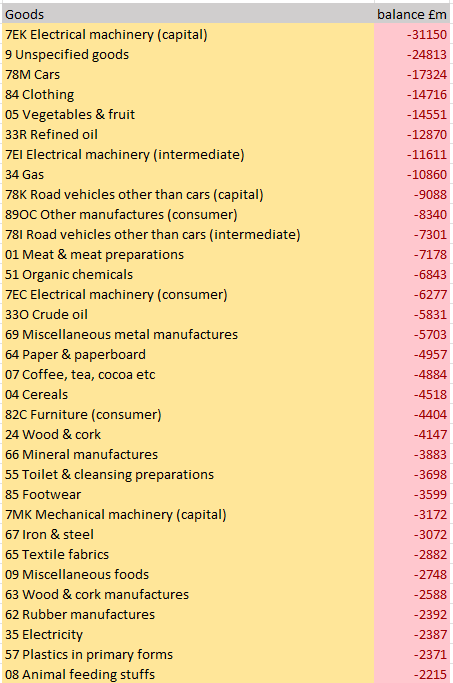
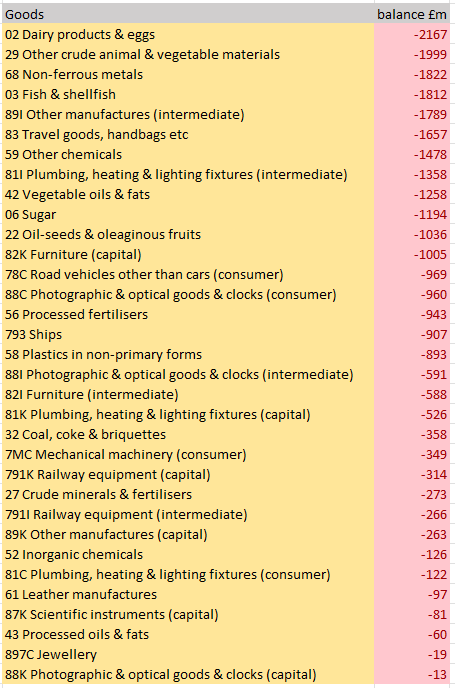
As to the thing that I read that was so disturbing? Well, it was the UK’s Food Security Report 2024. I’m going to cut in a case study from there in its entirety. Please read it all.
Case Study 1: Flour fortification and calcium carbonate
The Bread and Flour Regulations 1998 mandate the compulsory addition of calcium carbonate, iron, niacin, and thiamin to non-wholemeal wheat flour to help protect against nutrient deficiencies within the population. Previously, the supply of calcium used for flour fortification in the UK was sourced from a quarry in England, Steeple Morden. While this met the purity criteria for calcium carbonate in the Bread and Flour Regulations 1998, it was not compliant with the criteria set out for calcium carbonate in EU food law. Hence, industry has moved to a new calcium carbonate source which is compliant with both domestic laws and EU laws enabling single lines of production and giving the ability to serve both domestic and export markets. Calcium carbonate composition is determined by the natural geological makeup and is therefore unvarying and very difficult to change, meaning that existing UK quarried supply of calcium carbonate cannot meet EU criteria as they stand. Additionally, calcium carbonate used in flour has other requirements such as particle size which is needed to be suitable for purpose. The multinational supplier of calcium carbonate has since decided to rationalise their business model which has led to a reliance on a single quarry site in France to source all calcium carbonate for UK flour. Since this shift, the quarry in England has ceased production of food-grade calcium carbonate, meaning that domestic production is no longer a contingency option should supply of calcium carbonate from France be disrupted. Even if this were a contingency option, there could be significant challenges around supplying flour fortified with calcium carbonate that is not compliant with EU food additive requirements. Events such as the widespread protest in France in early 2024 have demonstrated knock-on effect to supply chains, pointing to the potential vulnerabilities of reliance on this single source.
Due to the scale of flour production in the UK and restrictions of storage space, frequent deliveries of calcium carbonate are required with some larger mills receiving tanker load deliveries 1 to 2 times per week. This is the JIT model whereby raw materials are purchased to align with production schedules and large stockpiles are not held. While enabling efficiencies in supply, it means that a disruption in the supply of calcium carbonate could lead to the depletion of stocks quickly with immediate effects on UK millers’ ability to produce flour complaint with UK law. While there has been no break in the supply of compliant flour in the UK, this example highlights that there are areas where highly specialised ingredients and inputs are required by the UK food system, and limited suppliers producing to this specification. This, combined with an industry model that does not encourage stockpiling beyond immediate needs, presents a risk to the UK food system. Bread is a staple food for the UK population with a short shelf life and any disruption would be felt immediately by the population and would likely affect public confidence in the UK food system.
This issue is not exclusive to calcium carbonate and could also be true for most of the mandatory nutrients required to be added to flour. Thiamin and niacin are obtained exclusively from China due to difficult synthesis and low profit margins. A short-term issue with thiamin supplies was seen at the beginning of the COVID-19 pandemic but the effects were minimised, and stocks of worldwide supplies were redirected to the UK in time.
Now, also in ascending order, so the things we are doing best at are at the bottom, come the goods we have a surplus in.
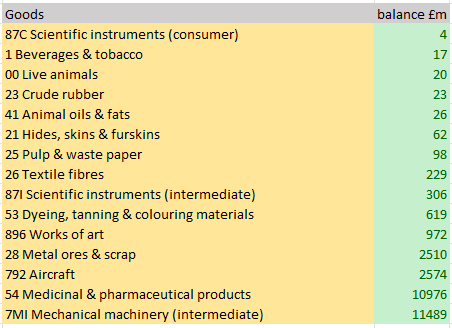
Yes, it’s a shorter list. But Metal ores & scrap! Get in. We’re winning there. And we made a net £20 million exporting live animals, something I lived for decades thinking had been banned.
There’s at least one more thing we have too much of, I think:

/message ends
The data come from this location at ONS. There’s one table for exports, one for imports, and a summary one showing the net, although there the commodities are collapsed into larger groups.
 Climate Scepticism
Today we read that deliveries of syringes, gloves and IV bags to the NHS are at risk due to the Iran conflict. There are also warnings about deliveries of diesel and jet fuel.
LikeLike
I am no prophet, but I have been banging on for ages about the all-too obvious problem of being reliant on imports for things that are of great importance. One might have thought politicians would have learned that lesson during the U-boat campaigns in the First and Second World Wars, but it seems they haven’t.
Autarky as a concept might seem a little too Hitlerian for people to be comfortable with it. And yes, global trade can be beneficial – it makes sense for countries to focus on what they’re good at, thereby driving up efficiencies and driving down costs; also some things can only be found in certain locations, so it also makes sense to be able to provide something that others want/need in order to get the things that you don’t have, but want/need.
However, as soon as there’s a snag with international trade, those countries that are overly dependent on supplies from other countries find themselves in great difficulties. Sadly, and problemmatically, for us, the UK must be a country that is near the top of that list.
It’s all very well for Miliband to bang on about renewables providing us with energy security in an uncertain world, freeing us from fossil fuel dictators etc, but he’s wrong. Those academics and green charities/lobbyists writing earnest leader articles and producing studies saying as much are, IMO, charlatans peddling the Emperor’s new clothes. Renewables are unreliable, need back-up, and have made us hugely dependent on others for our energy. Not least, we have an increasing dependence on China, a country which the Labour government in Westminster and the SNP government in Holyrood, seem to be very comfortable with. I have nothing against the Chinese people. I’m less keen on the CCP. And I’m decidedly unhappy about making ourselves increasingly dependent on them.
And as you say in your article, energy is just the beginning. We are reliant on the rest of the world for so much really important stuff, it’s truly terrifying. It’s certainly a lot scarier than climate change.
LikeLiked by 1 person
The NHS supply story can be found in the Telegraph:
“NHS boss fears supplies could run out in days
Deliveries of syringes, gloves and IV bags at risk over Iranian blockade of Strait of Hormuz”
I hope this is an accessible link:
https://archive.ph/6ycxO/again?url=https://www.telegraph.co.uk/news/2026/03/31/nhs-days-away-from-supplies-running-out-iran-war/
ALso, note this:
…The UK imports about three-quarters of its drugs, but even those that come from the EU or closer to home are often made from materials shipped from countries such as China or India.…
LikeLiked by 1 person
By the way, Jit, it seems some of his own constituents agree with you regarding Mr Miliband:
“The voters in Ed Miliband’s own constituency enraged by his net zero crusade
As fuel prices soar, Doncaster residents find the Energy Secretary’s opposition to North Sea oil and gas bewildering and infuriating”
https://archive.ph/uVcGQ#selection-2151.4-2210.0
…Hardy, who started out as a home-bred pig wholesaler and developed Marr Grange Farm into a hub for home-grown and responsibly sourced meat, needs these fuels to power his tractors, vans and machinery. “I reckon this has already cost me £6,000, and the war’s only been going a month,” he says.
“But what I really can’t understand is how we’ve become so reliant on these fuels from the other side of the world when we’ve got it right on our doorstep. It’s in the North Sea, for goodness sake, so why not use it like Norway does? It’s common sense – which is something our local MP doesn’t seem to have a lot of.”…
LikeLiked by 1 person
So just how much bread do we export, if zero, then why are we complying with a rule that does not have a material effect on a product, if however we do, then simple- the export bread is manufactured in a bespoke unit and exported.
In any manufacturing business, you never have a single source of supply, this leaves you 100% vulnerable to the vagaries of life- strikes, price gouging, transportation, export/import tax hikes, export/import embargo, or plain old competition from a rival who is determined to wipe you out by bulk ordering the complete production for forward delivery.
The fact that this Government lied about respecting the Brexit vote, a 50+% vote which considering almost 73% of those eligible voted, compare that to the “landslide” vote turnout of 59%- more people wanted out but Starmer wants in and is doing everything you would expect a sly lawyer to do- adopting rules and regulations to “smooth” business whilst not putting any of these “changes” to Parliament.
Expect no less from a Fascist who is determined to crush this Country under the jackboot of Authoritarian rule.
LikeLike
So just how much bread do we export, if zero, then why are we complying with a rule that does not have a material effect on a product, if however we do, then simple- the export bread is manufactured in a bespoke unit and exported.
In any manufacturing business, you never have a single source of supply, this leaves you 100% vulnerable to the vagaries of life- strikes, price gouging, transportation, export/import tax hikes, export/import embargo, or plain old competition from a rival who is determined to wipe you out by bulk ordering the complete production for forward delivery.
The fact that this Government lied about respecting the Brexit vote, a 50+% vote which considering almost 73% of those eligible voted, compare that to the “landslide” vote turnout of 59%- more people wanted out but Starmer wants in and is doing everything you would expect a sly lawyer to do- adopting rules and regulations to “smooth” business whilst not putting any of these “changes” to Parliament.
Expect no less from a Fascist who is determined to crush this Country under the jackboot of Authoritarian rule.
LikeLike