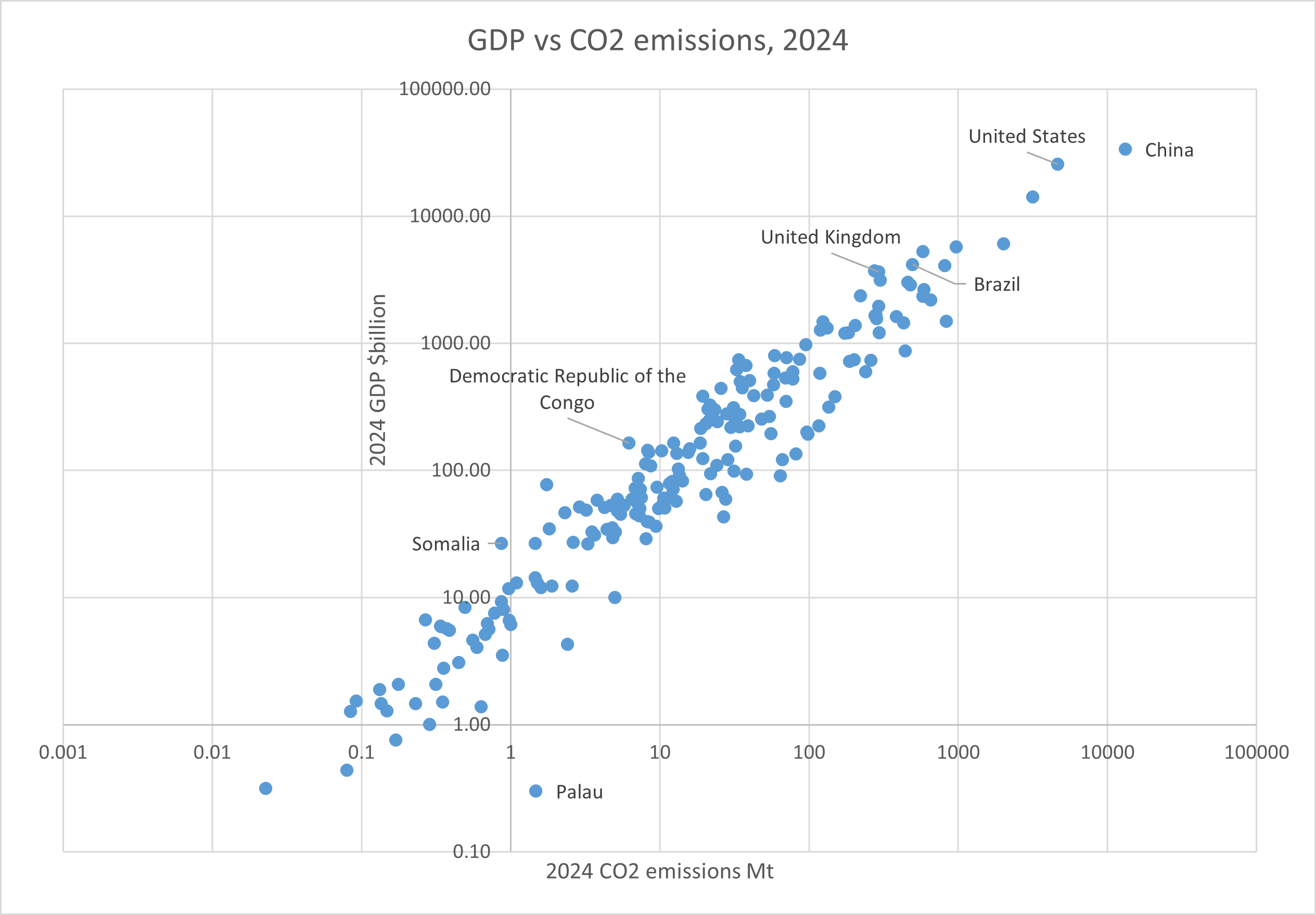
About 3 months ago – all right, exactly 3 months ago – I showed a figure on Cliscep indicating an almost total positive linear relationship between GDP and CO2 emissions. The two are inextricably linked. The prosperity cake is baked with energy, and the vast bulk of energy comes from combustion of fossil fuels. So the relationship is unsurprising. Here it is, as a refresher (note the log-log scale):
Nevertheless, there are those who wish it were otherwise, and if you wish hard enough, sometimes those wishes come true. For Net Zero to be viable, the GDP – CO2 relationship has to be neutralised. If it is not, then the people running countries adopting Net Zero pathways are chumps at best. In fact, if you were of a cynical disposition, you might argue that the only plausible explanation for enacting Net Zero policies is that, since such people are not dim enough to be chumps, they must be operating deliberately against their fellow citizens’ interests. We have a name for such people, which I will not utter here. I may add that I don’t believe the label applies; rather, leaders of countries such as the UK believe in the viability of their Net Zero project.
Now, I would like it to be the case that GDP can be made independent of emissions. That’s because in a hundred years, or two hundred, things will get tight, re: fossil fuels, and then civilisation will either proceed in a merry low-emission way, or else it will collapse and our descendents will end up hunting rats the size of cats in the ruins of crumbling cities while dodging mosquitoes the size of sparrows.
When Mark drew my attention to this article in the Guardian:
“Economic growth no longer linked to carbon emissions in most of the world, study finds”
…my reaction was, “I looked at 2024 data, and that isn’t the case. This is pure hopium.” [Note that, to make an analogy with elementary mechanics, I looked at “speed,” output, and growth would be the equivalent of “acceleration.” My look at growth was brief in September, but I have looked at it before, and found that, unsurprisingly, the fastest growing countries increase their emissions. While it is possible to grow and reduce emissions, the growth is clearly much slower than for countries also growing their emissions. Comparisons are difficult because of the developmental stage of different countries.]
But we mustn’t be too hasty, as Treebeard might say. Maybe the study in “study finds” is really onto something. So what did the study find?
Countries representing 92% of the global economy have now decoupled consumption-based carbon emissions and GDP expansion, according to the report by the Energy and Climate Intelligence Unit (ECIU).
Learning the name of the report’s sponsor doesn’t fill me with any confidence in the truth of the findings. In fact, it makes me more confident in the “pure hopium” hypothesis.
46% of global GDP in countries that have expanded their economies while cutting emissions
Well, I call horsey apples on this one. Looking at the 2023 to 2024 changes in GDP and CO2, only 24%, not 46%, are growing and cutting CO2. Yeh, Jit, mebbe, but that’s old data, 2024 data, these cats have last month’s data, somehow. Well, we’ll see what the numbers are when we have official data for 2025. The top two countries, China and US, alone outweigh all the “cutting CO2 while growing economy” countries put together. The largest of this group is Japan, with a $6 trillion GDP (the big two sum to over $50 trillion, and all the cutters+growers sum to about 42).
The next claim is that China’s emissions are plateauing, and may have peaked. The local chatbot tells me this claim was first made in 2013. It used to garner a headline. Now it’s like taking the defibrillator to King Tutankhamun. Nothing happens. You can run up and down on the street naked shouting, “China’s emissions have peaked!” and no-one will notice. Too, some say that the Chinese economy will still be growing at 5% per year, even when the locals are hunting rats the size of cats while dodging mosquitoes the size of sparrows in the ruins of their megacities.
21 countries have “improved” in the last decade, claims the Guardian, which I make about 10% of them, not “most of the world.” But I don’t know what “improved” means exactly.
Among them are Australia, the United Arab Emirates, Colombia, Egypt, Italy, Mexico and South Africa
Aha, just below that it says these 21 countries have grown, while reducing emissions. I’ve plotted the stats on this for all the countries named in the article on the figure below (I have plotted all the countries named for whatever reason in the article. The population shown is not the 21 countries they speak of here, as they do not give all 21 names. I hope that’s clear). As you can see, only one of the 7 named countries has grown, while reducing emissions (Italy). The other 6 have all grown, while growing emissions. More horsey apples.
In the figure, most countries named in the article are in the positive-positive quadrant: they are both growing their economies and their CO2 emissions. This is the opposite of the Guardian’s tale. Only 3 countries named in the article are growing their economies while cutting their emissions.
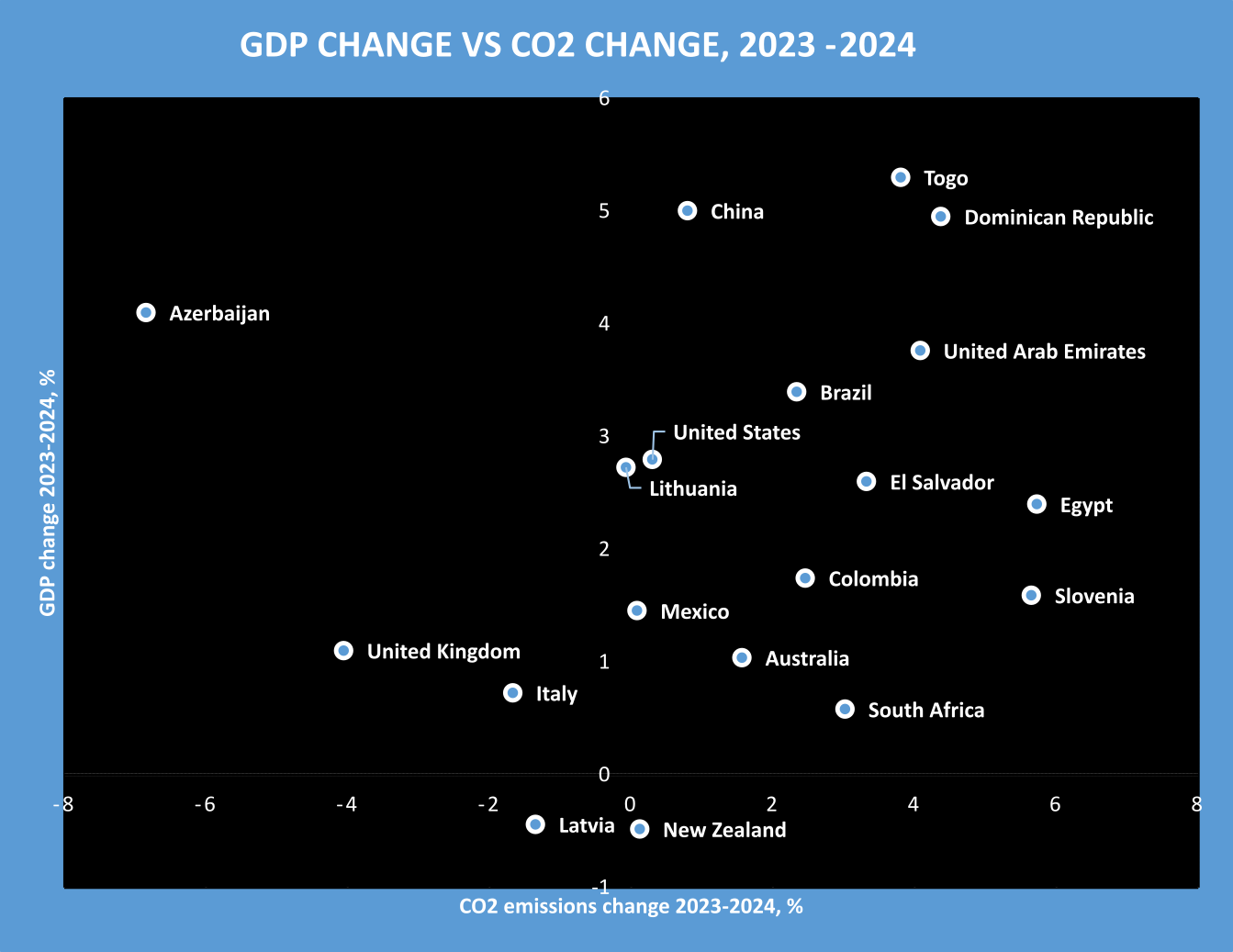
New Zealand, Latvia, Slovenia, Lithuania, the Dominican Republic, El Salvador, Togo and the host of Cop29, Azerbaijan, had all decoupled before 2015, but their growth has since again become dependent on fossil fuels.
Azerbaijan is the outlier on the figure! It has grown substantially, while cutting emissions substantially. It should be the Guardian’s poster child for this alleged decoupling. (ASTERISK: might one speculate that Azerbaijan’s 2024’s emissions, or 2024’s GDP, may have been influenced a little by COP29?)
John Lang, the author of the ECIU report, said: “I’m definitely encouraged. Looking back shows how much progress we have made over the past 10 years. The world is now in a pre-conditioning stage ahead of structural decline. We are approaching a historic point when emissions start to go down. That is super exciting.”
Structural decline? In living standards, or…? I strongly doubt that global CO2 emissions are going to go down next week. The only times it has gone down so far have been the financial crisis, and Covid. Every other year, it has risen. Just as 2024’s emissions were higher than 2023’s; the most recent official data shows the opposite reality to the Guardian’s claim.
One final point: I’ve only just noticed that the first quote I gave used the phrase “consumption-based carbon emissions.” Surely the author must know that, as of the latest data, the UK is increasing its consumption emissions? So when the article says…
The most pronounced decouplings occurred in the UK, Norway and Switzerland
…it’s pure disinformation?
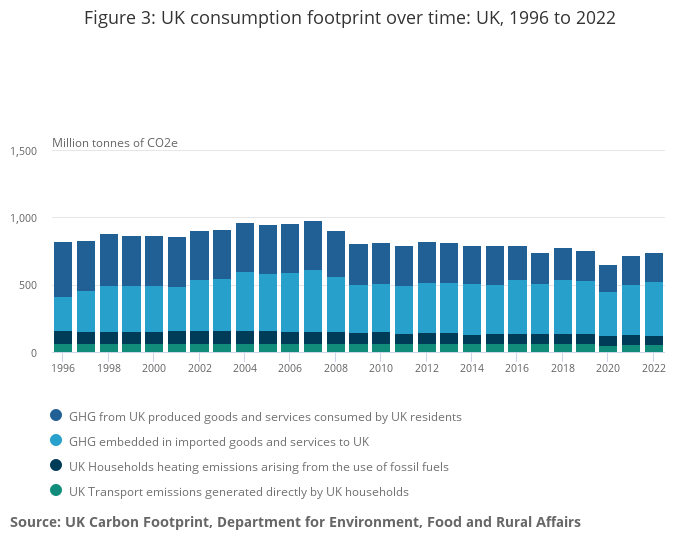
Figure from this page, and yes, 2022 is the most recent official data.
Well, I’m sure I’ve spent long enough in Guardianalala land. Is the world consciously uncoupling – I mean, decoupling – from fossil fuels? I doubt it very much.
/message ends
 Climate Scepticism
‘Guardianalala land‘
Oh yes – perfect. Thanks Jit: the article you found there deserved that analysis and those comments.
LikeLike
Thank you Jit. When I spotted the article, I thought it was crying out for a de-bunk. Sadly, I lack the time to write any articles just now, but you were just the person for the job. And you did it so much better than I would have done. Excellent.
LikeLiked by 1 person
By the way, the ECIU website page linking to a download of its report is here:
https://eciu.net/analysis/reports/2025/10-years-post-paris-decoupling-globally
I found the report to be desperately short on detail, given the dramatic claims it makes. But don’t take my word for it – read it for yourself and make your own assessment. It won’t take long!
LikeLike
IPAT identity has been a useful way of unpicking such trends through time and across countries. “Decoupling” and year-on-year focus here suggests something rather more rapid than the cumulative effect of the T term in increasing bangs per buck. CO2 remains a natural proxy for the I (Impact) left hand side of the identity given its ubiquity across all human activities and its chemistry (lowest Gibbs free energy). If you’re not emitting CO2 then you’re doing something wrong as it implies you have not extracted every last erg of benefit from the raw material inputs.
LikeLike
On the subject of CO2:
“Climate leaders condemn Trump EPA’s biggest rollback yet: ‘This is corruption’
Leaders promise to fight back with court challenges as Trump rescinds finding foundational to US climate rules”
https://www.theguardian.com/us-news/2026/feb/12/climate-trump-epa-biggest-rollback
Cue massive hysteria.
LikeLiked by 1 person
Well, CO2 is not dangerous at the concentrations the Earth’s atmosphere will ever reach. Also, as a well-mixed gas, there is no point making unilateral endangerment findings, as the US’s own emissions must have a trivial effect on the atmosphere of the US.
This is in direct contrast to actual pollutants.
The entire thing was a giant scam, which deserves to be thrown into the dustbin of history, and set fire to, just in case.
LikeLiked by 2 people
On PM today, came the news that China’s emissions in 2025 were lower than 2024. Have they decoupled growth from CO2?
LikeLiked by 1 person
The story emanates from research conducted on behalf of Carbon Brief, so I treat it with caution. A suitably caveated version of the claim can be found here:
“China carbon emissions ‘flat or falling’ in 2025: analysis”
https://uk.finance.yahoo.com/news/china-carbon-emissions-flat-falling-032808786.html
It includes things like this:
China’s emissions of planet-warming carbon dioxide were “flat or falling” in 2025, analysis showed Thursday, but progress remains fragile and it is not yet clear that emissions have peaked.…
…CO2 emissions likely declined 0.3 percent for 2025.
There is some uncertainty about figure because of margins of error around some of the numbers involved, including coal consumption.
“Because the relative drop is so small, we can’t say with certainty yet that it’s a fall, therefore the ‘flat or falling,'” explained CREA lead analyst Lauri Myllyvirta….
…Still, the progress is fragile.
Emissions from the chemical industry grew sharply in 2025, and are set to continue rising.
While the sector is still a relatively small emitter compared to other industries, it is having an outsize impact because of how fast its emissions are growing, the analysis found.
And while emissions have now been trending downwards or stagnant for almost two years, any decline is not yet substantial.
“This means that a small jump in emissions could see them exceed the previous peak level,” the analysis warned.
That would scupper hopes of China peaking emissions earlier than a 2030 target, something analysts say could easily be achieved….
LikeLiked by 2 people
The BBC is a bit less hysterical than the Guardian about the reversal of the EPA’s endangerment ruling:
“Trump revokes landmark ruling that greenhouse gases endanger public health”
https://www.bbc.co.uk/news/articles/cn0zdd7yl4vo
Its concluding paragraphs are very interesting:
...a challenge in court on the reversal of the endangerment finding may well be what the Trump administration is now looking for.
Many legal experts believe that they want the proposal to be tested in the Supreme Court before Trump’s term ends, believing that if they win, the endangerment finding will be consigned to history.
“This is really different as the EPA is exiting the space entirely and wants to do it on a permanent basis,” said Meghan Greenfield.
“If they were to win that issue as they framed it before the Supreme Court, a new presidential administration could not change that position, in the absence of new legislation.“
LikeLiked by 1 person
Perhaps I spoke too soon. One article wasn’t enough for the BBC, and this one is rather hostile and less balanced than the first one:
“Analysis: Trump takes victory lap after biggest climate rollback yet”
https://www.bbc.co.uk/news/articles/cvg8xjm8932o
LikeLike
The BBC’s on a roll now:
“Six possible effects of Trump’s climate policy change”
https://www.bbc.co.uk/news/articles/cd03ee39945o
Fewer greenhouse gas emissions restrictions
Cheaper cars in the US (but they’ll be harder to export)
Nuisance lawsuits
Public health
Falling behind in the global renewables race [sic]
Less industry regulation
This being the BBC, John Kerry gets the last word, thus:
“It’s very clear the administration is trading facts and trading science for denial and the wilful negligence that will cost lives and health and countless taxpayers dollars.”
LikeLiked by 1 person