The “New Tab” on Firefox offers, as well as a grid of your favourite haunts, some curated stories from around the world. I once tried to get to the bottom of who selected them, perceiving a rather left-climate bias in the selections. However, despite a polite interaction with a volunteer, I ended up none the wiser. Probably the staff picks the stories. The staff is left-climate. Hence, so are the stories.
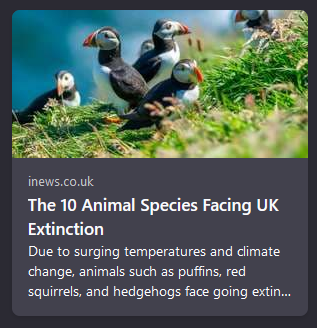
Today [actually by the time you’re reading this, it’s two days ago], one such story had the headline of this note, saving the snark quotes. Ten animal species were facing UK extinction, thanks to surging temperatures and climate change. The two factors are seemingly divisible now. It’s rather like saying a murder victim died of a 45 calibre bullet through the heart, and a gunshot wound.
What are these ten species? I wondered. I thought I’d try to guess, but before I could action that thought, I’d already read the sub head, which as you can see gives away three of the victims: puffins, red squirrels, and hedgehogs. [The featured image might be a clue to one of the other 7 too.]
Now I only had to guess the rump. The guessing involved a certain amount of second guessing, because I had to put myself in the mindset of someone determined to find peril in the most innocuous things. Should I stick to birds and mammals? What about insects, or fish? The idea that one of our few reptiles might suffer from surging temperature was of course ludicrous. Well, here’s what I came up with for the missing 7.
- Ptarmigan
- Capercaillie
- Kittiwake
- Swallowtail butterfly
- Killer whale
- Salmon
- Char
A good spread of taxa, but who knows, might be well off the mark. Are any of them genuinely threatened by climate change? Well, the best shout is the ptarmigan, thanks to its high altitude life. When you live on the tops of the highest mountains, there’s nowhere to go if it gets any warmer. How many do I score out of 7?
Note that quite an impressive list could have been made along these lines:
- Northern right whale
- Large blue butterfly
- Large copper butterfly
- Lynx
- Brown bear
- Elk
- Reindeer
- Beaver
- Wolf
- Great auk
- Sea eagle
Whoops! That’s eleven, not ten. An astute reader will know that these are species that are or have been driven to extinction in the UK in historical times. [One or two have been re-introduced on a small scale.] Note that none, so far as I know, suffered their fate at the hands of surging temperatures, or climate change; they were either hunted out, or met their fate due to land-use change. I wonder whether the iNews author is aware of all of them?
Asterisk: the large blue went extinct after the drought of 1976 – see Dead Butterfly Blues – but it had already been reduced down to a tiny remnant population by that time. Such populations are incredibly vulnerable to the vicissitudes of chance, and almost inevitably dwindle to nothing.
So, how did I do? Here is iNews’s list:
- Turtle dove
- Cuckoo
- Red squirrel
- Scottish wildcat
- Hedgehog
- Peregrine falcon
- Short-eared owl
- Barnacle goose
- Puffin
- Manx shearwater
Well, of the 7 I didn’t already know from the headline, I guessed exactly 0 of them. Are any of the 10 actually threatened by climate change? No, I don’t think so. Ptarmigan was a much better shout.
The iNews has its climate scientist to go to for absurd quotes. His name is Dr. Jesse Abrams. Quoth he:
“As the planet continues to warm, some of Britain’s most beloved wildlife face imminent threats: the turtle dove population has declined by 98 per cent since the 1950s and may disappear entirely, while hedgehog numbers have crashed by 95 per cent since the 1950s, with almost a third of the population lost since 2000 alone. Red squirrels are already all but extinct in England and Wales and the Scottish wildcat is critically endangered,” Dr Abrams said.
Those stats may be true, but it is disgraceful to try to stamp them with “Because teh climate.” The turtle dove has declined thanks to the sterilisation of the countryside. See all those weeds in the fields of wheat as you drive by them? Thought not. That’s why there are no turtle doves. The turtle doves can’t see them either, or eat their seeds. It would actually be quite easy to go through the list and explain the real reasons for the other species’ declines too.
But I’m not going to trouble you with that. [We have already discussed puffins.] I’m just going to pick one, and no I’m not going to pretend I chose randomly. I cherry picked! How evil of me. I want to pick…
Peregrine falcon
This species, which is allegedly threatened with extinction in the UK “because teh climate” is found all around the world. Literally. Here’s a distribution map from wiki (numbers represent different subspecies):

Somehow they manage to survive in tropical Africa, but in the UK, teh climate is gonna do for them! Nope: crass misinformation. Or probably disinformation, since the iNews is supposed to be an authoritative source. Well, it blew it. You can find peregrines in Australia, Fiji, India, Japan, South Africa, California…
But I want to draw your eye to a little * on the map. Do you see it? What might that represent? What about the green Es nearby? Well, I’ll tell you. Let me quote from an old book of mine, Leslie Brown’s Birds of Prey (1976). My bold:
In all developed countries of western Europe, Britain included, and North America it has become scarce or even – in eastern North America – extinct…
The primary cause of this decline seems absolutely clear. It is not due to persecution by gamekeepers, egg collectors, or pigeon fanciers, which the peregrines survived in a mild way until the fifties of this century. It is primarily due to pesticides used in agriculture…
And these tyros have the audacity to deliver lectures on the perils of teh climate.
Asterisk: peregrines have been re-introduced to eastern North America. That’s what the asterisk means. The Es show localised extinctions, thanks to DDT.
Here’s the EBBA 2 (European Breeding Bird Atlas) map of the peregrine’s present range in Europe:

It’s clinging to the extreme far north! Any sniff of more warmth, and it’s toast! Oh… wait… maybe we’re just talking BS to scare people into supporting pointless climate policies? [Note there is still a large gap in Eastern Europe, presumably a legacy of communist times.]
Now showing the change between the two atlases: 1980s for EBBA 1 and 2013-17 for EBBA 2. The blue shows where the bird is found in EBBA 2 but not EBBA 1 – i.e., where it has expanded from the 1980s onwards, from its nadir under the pummelling of our little friend DDT:

The lesson here is that when you stop poisoning birds, their population stops declining, and they start recolonising places where they’ve been wiped out.
Summary: Humans have laid waste to vast swathes of the Earth, but their attempts to kill things by increasing the CO2 concentration of the atmosphere have so far come to naught. This is just rubbish by iNews and its pet climate scientist. Guys, learn some ecology. Read some history. It did not begin when you were born. Don’t make authoritative statements unless you are damn sure what you are talking about. First, identify the real problems. Then, you can help to find the real solutions.
/rant over
 Climate Scepticism
You could drill down on any of those, and readily find that climate change has nothing – or very little – to do with declining numbers. Ironically, Scottish wildcats are endangered by wind farms, which are supposed to be part of the mad plan to save us all (and presumably our wildlife) from climate change:
“Appeal against wind farm ruling thrown out”
https://www.bbc.co.uk/news/articles/cy5l92y4p1zo
A conservation group’s legal bid to stop a wind farm in Aberdeenshire from going ahead has been dismissed for a second time.
In June last year, minsters approved Swedish energy giant Vattenfall’s Clashindarroch II project.
Wildcat Haven challenged the Scottish government’s decision at a judicial review, but a judge threw out the legal challenge, and Wildcat Haven then appealed that decision.
Judges at the Court of Session have now dismissed that resulting appeal, external….
...Wildcat Haven said in a statement: “Wildcat Haven maintains its position and belief that this is the wrong development at the wrong site and that if it were to go ahead, it would have potentially catastrophic impacts on the critically endangered Scottish Wildcat population.
“We will be reviewing the judgement in detail and will be continuing our fight to protect the priceless Clashindarroch wildcats and their forest home.”
I heard somewhere (though I can’t find an online report) that the Supreme Court has now also dismissed the appeal.
LikeLike
I once saw a turtle dove in Lincolnshire, along the Nene, near Sutton Bridge. It’s the only time I’ve seen one of these beautiful birds which prefer to live in rural locations and feed on fruits, grains, seeds and berries. They might have become less endangered in some mixed rural/suburban locations if they could have exploited the food on offer from humans living in such locations, but my guess is they have been outcompeted by collared doves and wood pigeons, which are ubiquitous and whose numbers have exploded since the 1950s, in direct contrast to Turtle Doves.
LikeLiked by 2 people
If you google ‘peregrine falcon climate change UK’, you will be presented with the following AI Overview:
The implication is clear. These people do not think that species numbers are relevant when deciding whether climate change is having an impact. What they do respect, however, is a good narrative.
LikeLiked by 2 people
For information:
“Wildcat Haven Community Interest Company (Appellant) v The Scottish Ministers and another (Respondents)”
https://supremecourt.uk/cases/uksc-2025-0074
LikeLike
The Puffins seem to be doing OK down here in Pembrokeshire.
I’ve provided a link to the local paper’s report on the record numbers.
And just in case you run upagainst a paywall, I’ve cut and pasted the main part of the article.
https://www.westerntelegraph.co.uk/news/25174571.record-numbers-puffins-pembrokeshires-skomer-island/
There are many thousands of visitors who don’t need to book a boat trip to land on Pembrokeshire’s Skomer Island.They are the who fly to the island to make it one of the best seabird sites in Britain.The island is renowned for its iconic Atlantic Puffins, who are particularly precious as their numbers are in decline in most of their habitats.But happily, that is not the case on Skomer.The island’s recent annual Puffin Count has tallied 43,626 of the species, whose colourful and comical appearance has led them to be dubbed ‘the clowns of the sea’.Skomer Island and the Wildlife Trust of South and West Wales announced the results of the count in a recent Facebook post.
They said: “The numbers are in and it’s another record breaker!
“We’re thrilled to announce that 43,626 Puffins were recorded on Skomer Island as part of our annual Puffin Count.”
LikeLiked by 1 person
The good news is that Lazarus species appear to be thriving. 😉
https://en.wikipedia.org/wiki/Lazarus_taxon#:~:text=Finally%2C%20the%20term%20%22Lazarus%20species,taxon%20is%20applied%20in%20neontology.
LikeLike
The good news is that Lazarus species appear to be thriving. 😉
https://en.wikipedia.org/wiki/Lazarus_taxon#:~:text=Finally%2C%20the%20term%20%22Lazarus%20species,taxon%20is%20applied%20in%20neontology.
LikeLike
There’s a bit of an irony that WordPress somehow duplicated my comment!
LikeLike
When I moved from London to rural Hertfordshire in 1964, the countryside was replete with interesting wildlife: hedgehogs, grey partridge, skylarks, peewits, cuckoos (one used to sit on a Ash tree right outside our bedroom and annoy us by calling loudly at 4am every morning), goldfinches, sparrows, starlings, gold crests, yellowhammers, treecreepers, nuthatches … and a lot more. By the 1970s it was all disappearing – long before any hint of a climate scare. And today we have plenty of foxes, badgers, crows, blue tits, crows and wood-pigeons, some hares, game birds … but little else. Sad.
LikeLiked by 1 person
I notice that red squirrels are on the list too, which isn’t a surprise. I am lucky enough to live in one of the parts of England where we still have decent numbers of red squirrels. Our last house, out in the countryside, was in a red squirrel hot spot, and we had a number of feeder boxes for them. They cost us a small fortune, but it was worth it. Of course, their greatest threat is the presence of grey squirrels and the pox they carry. It has absolutely nothing to do with climate change.
https://www.cumbriawildlifetrust.org.uk/about/what-we-do/wildlife-conservation/red-squirrel-conservation
What is the main threat to the UK’s native red squirrel population?
Squirrel pox has decimated red squirrels
The non-native grey squirrel was introduced to England in the late 1870s from America and is the primary cause of decline of the red squirrel. Red squirrels have been found in England since the end of the last Ice Age and are part of our native fauna.
It does so by out-competing red squirrels for food in deciduous and mixed woodlands and by transmitting a disease ‘squirrelpox’, the squirrel Parapoxvirus, which is lethal to red squirrels.
LikeLiked by 1 person
Cuckoos?
https://bou.org.uk/blog-jo-decline-of-the-cuckoo/
In summary, the declining Cuckoo population is associated with a heathland habitat where the Meadow Pipit is the main host species. In the lowlands, the Cuckoos are shifting from agricultural habitats to wetland areas that house the Reed Warbler as a host species. Moreover, the resulting Cuckoo distribution follows the changing abundance of prey, namely moths. These findings can be used to devise an effective management plan to halt the decline of the Cuckoo.
Or try this:
https://www.woodlandtrust.org.uk/trees-woods-and-wildlife/animals/birds/cuckoo/
You’re a lot less likely to see, or hear, a cuckoo these days. A combination of a loss of habitat and the knock-on effects to their host species affect them here in the UK, but deforestation and hunting on migration routes are also thought to have had an impact on numbers.
LikeLiked by 1 person
Short-eared owls?
Try this:
https://peregrinefund.org/explore-raptors-species/owls/short-eared-owl
In company with the Peregrine Falcon and the Osprey, the Short-eared Owl is one of the most widely distributed birds in the world. It is found on every continent except two: Australia and Antarctica. In fact, no birds of prey at all are found on the latter continent! It is also found on a number of islands and island chains including Iceland, Hawaii and Galapagos.
Apart from being widely distributed around the world, the Short-eared Owl also lives in a wide array of open country habitats with scattered vegetation – as long as there is plenty of prey nearby to sustain it. The Short-eared Owl has been documented in meadows, rangelands, grasslands, cultivated fields, heathlands, tundras, moors, marshes and other similar habitats. It has even been found living quite comfortably in city parks and even golf courses. In some parts of its range, scientists have documented Short-eared Owls moving into once-forested areas that had recently been cleared.
The Short-eared Owl is a nomadic species – meaning it tends to move around quite a bit. For its survival, it needs to make sure there is plenty of prey around for it to feed on. When prey numbers are low in a certain area, or during a certain time of year, this owl can’t afford to to sit idly by and wait for prey to appear. It needs to migrate or move to locations with more options for rustling up a good meal. Scientists believe that during years when prey is abundant, at least some individual Short-eared Owls won’t migrate at all. Instead, they will stay put to take advantage of the local food source.
Given its adaptability and its wide range of climatic habitats, it doesn’t sound as though climate change has anything to do with declining numbers in the UK. What, then, might be the explanation?
Though scientists are uncertain about the current Short-eared Owl population numbers, it appears that they are declining in some areas throughout their range, while remaining stable in others. The Short-eared Owl is particularly vulnerable to habitat loss, fragmentation and alteration. They rely on large expanses of open habitats in order to nest and hunt. Habitat conversion to housing developments, businesses, livestock pastures, and other uses can have a detrimental affect on this species.
I once had the privilege to see one of these beautiful birds hunting in daylight on the Pennine moors to the east of Manchester. It was, ironically, on a blisteringly hot day.
LikeLiked by 1 person
“Barn owls have ‘worst breeding season in decades'”
https://www.bbc.co.uk/news/articles/cx204gjx8xdo
Amazingly, the article doesn’t mention climate change and basically admits they don’t have a clue what the problem is. But the RSPB thinks it knows what the problems are:
https://www.rspb.org.uk/helping-nature/what-we-do/influence-government-and-business/farming/advice-for-farmers-helping-bird-species/barn-owl-advice-for-farmers
The Barn Owl population decline is largely a result of reduced food supply, with fewer areas of rough grassland available for hunting.
The loss of old barns and increased road deaths are also significant in many areas.
The loss of old barns is definitely a thing. In our last house, in the country (the one where we fed the red squirrels) we had an old barn next door to us and barn owls nested in it. We used to enjoy watching them emerge at dusk to set off hunting. Before we sold our house the owner already had plans to turn the barn into a house. I don’t know if they carried out a survey as to wildlife that would be affected, but if they did they either played fast and loose and ignored the presence of the owls, or they evicted them summarily. The owls aren’t there now, and the barn is occupied by humans instead.
LikeLiked by 1 person
Hedgehogs? The British Hedgehogs Preservation Society have produced a helpful leaflet, and it doesn’t mention climate change:
https://www.britishhedgehogs.org.uk/leaflets/HEMP-Leaflet.pdf
Instead, we find the following factors affecting hedgehog numbers adversely:
Roads – up to 335,000 killed on the roads annually.
Habitat loss and fragmentation in the countryside.
Habitat loss and fragmentation in cities and suburbs.
Pesticides, herbicides and rodenticides.
Machinery.
Drowning (ponds are a problem if hedgehogs can’t get out once they’ve fallen in).
Entanglement – litter, wire fencing, fine vegetable netting.
Disease, injury and ailments.
Predation – by foxes, dogs and badgers.
LikeLiked by 1 person
Thank you Mark for investigating the other species on the list. Shame that the author of the piece, and the climate scientist who supplied the soundbites, will never see the real problems described here. It’s yet another case of a fantasy climate apocalypse, promoted as fact by a mainstream media desperate for clicks on anything. Alas, as much as we set the record straight here, the iNews readers will never know.
LikeLike
Barnacle Geese?
Cumbria Biodiversity Data Centre has a small leaflet on geese and swans wintering on the Solway, and this includes barnacle geese:
The greatest threat to these species comes from development that affects their feeding grounds, especially wind farms.
That seems clear enough – the greatest threat they face is from development affecting their feeding grounds. Especially wind farms.
LikeLiked by 2 people
Mark, we should perhaps remind ourselves of this wonderful prose from Jit’s trenchant criticism of wind farms:-
“It’s very simple for the RSPB, or it should be. If the question is “Wind farm?” the answer is “No. Nowhere, never, not while we still draw breath, not while we live to prevent harm to the beautiful and amazing feathered animals we share this planet with.” The RSPB should hate wind farms like Ahab hated the white whale. They should fight them on sea and land, everywhere. There are no excuses, no exceptions and no grey areas. There are no right places to site wind farms. The wrong place is the sky. No amount of carbon dioxide “savings” from wind power can outweigh the direct losses from the birds it kills.” https://cliscep.com/2023/02/18/the-rspb-is-betraying-its-members/
Regards, John C.
LikeLiked by 1 person
Yet again, it’s habitat, not climate:
“Peatland restoration aiding important bird species”
https://www.bbc.co.uk/news/articles/cd9jg1w2jj7o
The restoration of peatlands on Exmoor is helping it remain a stronghold for several important bird species, a report has said.
The Moorland Bird report by the Exmoor National Park Authority (ENPA) has identified population increases for the grasshopper warbler, the reed bunting, the whinchat and the snipe, which oppose trends of national decline.…
LikeLike
I wasn’t expecting this:
“Red squirrels ‘resistant to climate change'”
https://www.bbc.co.uk/news/articles/c4gznnl41mxo
Red squirrels appear to be resilient to climate change in Europe, a new study has found.
Scientists at Bournemouth University used climate models to help assess the ability of the species to survive when faced with different climate change predictions.
It revealed that temperature changes and lack of rainfall do not have a direct influence on the survivability of red squirrels.
Habitat, food availability and disease were found to have more of an impact on the species which, in the south of England, has been confined to islands such as the Isle of Wight and Brownsea Island in Dorset.
The native species have largely been wiped out in the UK following the introduction of grey squirrels from the US in the 19th Century...
...They live in coniferous forests and deciduous wood across Europe from Spain, Italy, northern Greece, Scandinavia and into parts of western Russia.
Their broad distribution means they can live in a range of climates….
I suspect the same is true of many species, especially these words:
Habitat, food availability and disease were found to have more of an impact …
LikeLike
By happy coincidence, I have just watched a red squirrel run across the road and into a neighbour’s garden. 😊
LikeLike
“Red squirrel population thriving on Isle of Wight and could almost double, study finds
Researchers mapping how red squirrels would fare under climate breakdown scenarios found ‘a natural ability to adapt’”
https://www.theguardian.com/environment/2025/sep/19/red-squirrel-population-thriving-on-isle-of-wight-and-could-almost-double-study-finds
Red squirrels are thriving on the Isle of Wight where they have enough food and a suitable habitat to support a population that could almost double, a study has found.
Using climate models, the researchers mapped how the red squirrel population would fare under different climate breakdown scenarios such as temperature changes and low levels of rainfall, finding no direct impact on their survivability and “a natural ability to adapt to a range of climatic conditions”….
LikeLiked by 1 person
Thank you Mark. Does this not give the authors any pause re: the appropriateness of the term “climate breakdown”?
LikeLiked by 1 person
It’s not just the UK, it’s Australia too:
“Going extinct ‘right under our noses’: the quiet plight of Australia’s rarest bird of prey
Restricted now to the tropical north, the mysterious red goshawk is fast disappearing as a result of climate change and habitat loss””
https://www.theguardian.com/environment/2025/oct/06/going-extinct-right-under-our-noses-the-quiet-plight-of-australias-rarest-bird-of-prey
…“I worry about climate change and particularly the immense heat and thermal threat risk for the young birds.…”
There’s just one problem with that narrative. The Guardian article includes a map showing the parts of Australia where the red goshawk is no longer to be found and those areas where it’s hanging on. It’s disappeared from areas further south, and is hanging on in the sub-tropical north. So, if climate change-induced heat is the problem, how come it’s surviving only in the hottest parts of Australia? Methinks habitat loss is the answer:
…“…Then there’s the ongoing threat of habitat loss from agriculture, logging and mining.”…
...Just why the species has suffered such a rapid collapse in its range isn’t clear, but Seaton says fragmentation of habitat is likely to blame.
“They look for the tallest tree in the tallest stand, and those stands of trees aren’t that common any more,” he says....
Not climate change, then.
LikeLiked by 1 person
“New population of rare dormice found in Sussex”
https://www.bbc.co.uk/news/articles/cy7ex3m2346o
...The tiny nocturnal species has already disappeared from 20 counties in England since the 19th Century.
The loss of traditional skills such as coppicing has led to their habitats being lost, which also makes it more difficult for populations to travel between locations…..
But, inevitably:
…Climate change has also disrupted their hibernation patterns.….
The BBC can apparently report that climate change is a part of the problem with a straight face just two weeks after it posted this article:
“Dormice count reveals ‘bumper’ breeding season”
https://www.bbc.co.uk/news/articles/cyv61my4v9mo
The summer has been a “bumper” breeding season for dormice in Hampshire, conservationists have said.
Volunteers from the Hampshire Dormice Group, who have been carrying out surveys to monitor the tiny mammal, said the warm, dry summer had allowed them more time to breed.
Group member Catherine Hadler said it contrasted with last year’s summer, when the animals had to contend with cooler weather conditions….
Once again, habitat loss is their biggest problem:
…Now listed as vulnerable, the loss of hedgerows and changing woodland management practices have seen hazel dormouse numbers plummet in the last two decades.…
Even then, though, it seems almost any weather combo is bad news:
...She described 2024’s cooler summer as “terrible news”, meaning dormice were prone to torpor – a shorter version of hibernation, when their metabolism shuts down for a few hours or days in response to cold conditions or food scarcity.
“Warmer winters also mean they do not hibernate properly. They keep rousing and using up precious energy reserves. It can be a disaster.”
“Any decent summer followed by a warm wet winter could well wipe out any benefit,” she added.
LikeLiked by 1 person
“Conservationists celebrate barn owl increase”
https://www.bbc.co.uk/news/articles/ckg10g2d7g9o
Volunteers are celebrating a rise in their local barn owl population.
Tees Valley Wildlife Trust said in 2025, the area it covers saw a 34% increase in the number of barn owls ringed, rising from 249 in 2024 to 354.
Colin Gibson, volunteer barn owl coordinator and a retired police officer, said he believed the increase could be down to increased habitat protection, improved nesting sites and favourable climate conditions…..
Favourable climate conditions?!!! Perhaps the BBC has taken criticism regarding its impartiality to heart!
LikeLike
“Bumper year for breeding wader birds on Upper Lough Erne”
https://www.bbc.co.uk/news/articles/c5yle8e72d4o
As so often, forget climate change – it’s all about habitat:
Breeding waders have had one of their best years ever on Upper Lough Erne, with lapwing successfully breeding on Inishroosk after major habitat restoration by RSPB NI.
Snipe had their most successful year since 2019, with 66 pairs counted.
And redshank bred for a second consecutive year on land around Upper Lough Erne after being absent for five years.
The success showed the value of schemes to help farmers support threatened species, according to Seán Woods, the charity’s conservation manager in the west of Northern Ireland....
LikeLike
“The species at risk of extinction named in UK-first report”
https://www.bbc.co.uk/news/articles/c1e48e5p8dlo
We are told:
…Three thousand species were found to now exist in five places or fewer, making them highly vulnerable to habitat loss, climate change and sudden catastrophic incidents like storms, it said.…
Read the article, however, and the solution is habitat restoration – climate change doesn’t get a look-in.
LikeLiked by 1 person
It’s a pity the BBC employs people who don’t read their copy back before posting it.
Elsewhere, the “Snowdon” leaf beetle is on its first appearance called the “Snowden” leaf beetle.
I actually doubt whether 3,000 species exist in five or fewer Welsh sites. Most of them must be invertebrates, and the surveys of other places are likely to be inadequate or non-existent: entomologists go to the best places, hoping to get interesting results. If they are paid by Natural Resources then that will likely be to monitor places already known to be high-quality sites (e.g. SSSIs).
But the focus on restoration is good – although I would suggest that in most cases, simply removing the damaging activity would be ample, and would have the additional merit of costing nothing.
LikeLiked by 1 person
Last month, a Beeb story about bumblebees said that Kent’s Romney Marsh is ‘in an area south east of the county’ – which’d be Calais or thereabouts, no?
A basic proof-reading error? Not entirely. Only DFLs would think that Romney Marsh is in the ‘south east of the county’. It’s in the south – or, as the Beeb might have it, ‘in an area south of the county’, so perhaps somewhere near Dieppe.
LikeLike
Found these links over on the Lucia’s Blackboard by Tom Scharf interesting. Can’t recall if others have covered this from 2018, so old news –
David Attenborough has betrayed the living world he loves | George Monbiot | The Guardian
David Attenborough: too much alarmism on environment a turn-off | Wildlife | The Guardian
Much I could quote from both 7yr old articles, but probably already covered.
LikeLike
“2025 is ‘year of the octopus’ as record numbers spotted off England’s south coast
Milder weather led to a bloom in the invertebrates in south Cornwall and Devon, wildlife charity says”
https://www.theguardian.com/environment/2025/dec/22/2025-is-year-of-the-octopus-as-record-numbers-spotted-off-englands-south-coast
Record numbers of sightings of one of the world’s most intelligent invertebrates over the summer have led the Wildlife Trusts to declare 2025 “the year of the octopus” in its annual review of Britain’s seas.
A mild winter followed by an exceptionally warm spring prompted unprecedented numbers of Mediterranean octopuses to take up residence along England’s south coast, from Penzance in Cornwall to south Devon.
“The scale of the catch [recorded by local fishers] was of the order of about 13 times what we would normally expect in Cornish waters,” said Matt Slater, a marine conservation officer at Cornwall Wildlife Trust. “When we added up the numbers, approximately 233,000 octopuses were caught in UK waters this year – that’s a huge increase from what you would normally expect.”...
…The last time an octopus bloom of the size observed in 2025 was recorded was 1950, with records from the UK’s Marine Biological Association showing the last bloom recorded prior to that was in 1900.…
…The Wildlife Trusts noted some of the other “surprises, successes and joyful moments” around the UK coastline included a record number of grey seals observed by the Cumbria Wildlife Trust, as well as record numbers of puffins on Skomer, an island off the coast of Wales famed for the birds.…
LikeLiked by 1 person
So in an article from Mon 26 May 2025 – “Ian Perkes, who has owned a fish merchant in Brixham harbour for 49 years, said it was the first time in his career he had seen the giant molluscs.
“It’s down to climate change because it’s only this year that they’ve been here,” he said. “We’ve not seen them before, this time last year, they were on the French side of the water and the French were filling up with them.”
Perkes said octopuses were normally caught off the coast of Morocco and Mauritania, where it is a “massive, massive business” but they have been coming north as the water off the coast of England was much warmer.”
I can almost hear the question to Ian – “do you think climate change might be a factor, don’t worry about making outlandish claims, that’s exactly what we want from your quote”
LikeLike
“Endangered bird numbers boosted on Dartmoor”
https://www.bbc.co.uk/news/articles/clyk5rnzw98o
Breeding numbers of a bird species which was “close to disappearing” in part of Devon have recovered, organisers of a project have said.…
…Methods used in the project include headstarting – the collection of endangered bird eggs from the wild to be incubated in captivity until the chicks are strong enough to fly – and the restoration of moorland and meadow habitats.…
…“The progress made over these five years shows how nature can respond when the right conditions are restored and when land managers, farmers and conservation partners work together.”…
Nothing to do with climate change, then.
LikeLike
Who’d have thought it?
“UK’s warmest spring on record led to rise in songbirds breeding, data shows
Dry and warm 2025 spring gave glimmer of hope for threatened wild birds but many remain in long-term decline”
https://www.theguardian.com/environment/2025/dec/30/uk-warmest-spring-on-record-led-to-rise-in-songbirds-breeding-data-shows
The warmest and sunniest spring on record this year led to an increase in the breeding of some of Britain’s best-loved songbirds, data has shown.
Scientists said the dry and warm spring had provided a glimmer of hope for threatened wild birds. In the 2025 breeding season, from May to August, there were higher than average breeding successes for 14 species including the chiffchaff, garden warbler, whitethroat, coal tit, blue tit, great tit and robin.…
LikeLike
“‘On a knife edge’: can England’s red squirrel population be saved?”
https://www.theguardian.com/environment/2026/feb/06/england-decimated-red-squirrel-population
As the article notes, reds are in trouble because of the introduction of grey squirrels and:
…Red squirrels also face habitat loss as they thrive in the ancient woodland that has been cleared from most of the UK. Because of this, there are estimated to be only 287,000 left.…
Quite rightly, not a mention of climate change. Reds face a two-pronged attack from grey squirrels and habitat loss. This sort of thing is almost always the explanation for population decline – not climate change.
LikeLiked by 1 person
Not a UK animal under threat, but still of interest:
“Bermuda snail thought to be extinct now thrives after a decade’s effort
Special pods at Chester zoo helped conservationists breed and release more than 100,000 greater Bermuda snails”
https://www.theguardian.com/environment/2026/feb/07/bermuda-snail-thought-to-be-extinct-now-thrives-after-a-decades-effort
…The snails, which are only found in Bermuda, had been hit by global heating and habitat loss, but their decline was accelerated by the introduction of predatory “wolf snails” and carnivorous flatworms, which ate the smaller native species.…
Of those issues for the snails, habitat loss and new predators sound like a rather large problem. I wonder how much “global heating” really was to blame for their near demise?
LikeLiked by 1 person
Quite moronic, aren’t they, at the Guardian? Or is the problem that they are not allowed to write a story without inserting “global heating” somewhere? Meanwhile, their non-sceptical readers have their propaganda topped up for another 24 hours.
LikeLike
“Elusive nightjar birds making remarkable comeback, conservationists say”
https://www.bbc.co.uk/news/articles/c7952d4dwd8o
The number of nightjars recorded in a national park is thought to have doubled in the past five years following conservation efforts.
Seventy eight of the elusive birds, which are known for their “churring” song at sunset, were recorded last year in an ecological survey within the South Downs National Park.
A spokesman for the South Downs National Park Authority (SDNPA) described it as “a remarkable comeback” and was “thanks to nature recovery efforts and better habitat management”….
...The nightjar is listed as an amber species under the Red List for Birds, external, meaning it is a species of “conservation concern”.
Their numbers fell by 51% between 1972 and 1992, following loss of woodland and heathland to agriculture and development.
The SDNPA spokesman described them as “one of Britain’s most elusive birds” and said the current rise in numbers followed work focused on protecting and increasing lowland heath which provides the habitat for the nightjar ground-nesting sites...
…He added their resurgence had been paralleled by revivals in woodlarks and Dartford warblers, “which are also showing promising increases in numbers”...
…“These lowland heaths were once widespread across the South Downs but now make up just 1% of the national park.”…
Yet again, it’s all about habitat, not climate change.
LikeLiked by 1 person