There are only three certainties in this world: death, taxes and the BBC exploiting every weather-related tragedy in order to heighten anxiety over climate change. The recent Texas flooding, in which over 100 people lost their lives, provides the most recent example. The horror of the event cannot help but cause distress to anyone prepared to pause for a moment to contemplate the fate of all those poor children. This is surely not the time to argue the toss over the science behind the tragedy. But I’m afraid I am going to have to do so, if only because the BBC has already beaten me to it with its most recent report.
As is often the case nowadays, the report initially gives no clue as to where it is headed; seemingly providing a straightforward account of the weather conditions leading to the event, together with a recognition that the area is notorious for flash flooding (hence the local name, ‘Flash Flood Alley’). It would seem that history, geography and local weather conditions, combined with highly questionable decision-making, do more than enough to explain the cause of the horror that unfolded. Not, however, enough for the BBC. Despite opening with the headline, “Volatile weather, unusual humidity and the Texan landscape all contributed to scale of destruction”, the article closes with:
The influence of climate change cannot be ignored as another factor in extreme weather events like this. Whilst it is difficult to directly attribute the influence of the warming planet to one particular weather event, sea surface temperatures in the Gulf of Mexico, where some of the air originated from, continue to be warmer than normal. Warmer waters mean more evaporation and so more available moisture in the atmosphere to feed a storm.
Nice theory, but scepticism is all about resisting the “theorizing disease”. The empirical sceptic prefers instead to focus upon the data, to see if there has been a recent trend that supports the idea that this tragedy has all the hallmarks of a climate change catastrophe. As Cliff Mass reports, this is what the precipitation history data looks like for nearby San Antonio:
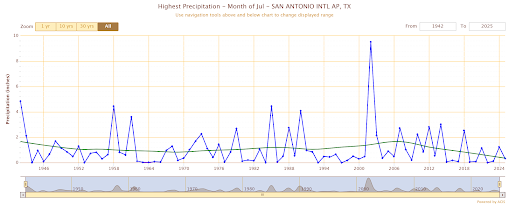
I’m not going to dwell on this; the data speaks for itself and I’m finding the whole idea of discussing such matters whilst the death toll is still rising quite distasteful. We should instead just pause to reflect upon the human dimension; a dimension that most certainly encompasses human frailty, grief and horror, but must also involve a determination to learn from obvious failings. A failure to meet Net Zero may be uppermost in the minds of the average environmental journalist, but surely the proximate failure of those in charge to respond to the more than adequate weather alerts should, at least for the time being, be the greater concern.
Meanwhile, anything the BBC can do, the Guardian can do much better. Even as the bodies and teddy bears still float down the river, the Guardian takes the opportunity to attack Trump, with the suggestion that “Deadly floods could be new normal as Trump guts federal agencies”. As the article explains:
It remains unclear why the early warning system failed to result in the timely evacuation of Camp Mystic, where 700 girls were camped on a known flood plain on the Guadalupe River, but there is mounting concern that the chaos and cuts instigated by Trump and his billionaire donor Elon Musk at the National Weather Service (NWS) and Federal Emergency Management Agency (Fema) may have contributed to the death toll.
Why do I feel sickened by this?
 Climate Scepticism
Having had another go at the BBC, it is important that I now give them credit where credit is due. After writing my article, I came across this BBC Verify analysis:
Did US government cuts contribute to the Texas tragedy?
https://www.bbc.co.uk/news/articles/clyndrwz00xo
It is a well-researched, thorough and balanced investigation that does a very good job of debunking the narrative that the Guardian seems so keen to promote.
LikeLiked by 2 people
John,
You rightly feel sickened by this, as all right-thinking people should do. A tragedy is a tragedy, and first thoughts should be with the families and friends of those who have lost their lives.
Only when a respectable amount of time has elapsed should people start asking why it happened. The first question should be regarding whether warnings weren’t issued or, if they were issued, weren’t heeded – because that line of questioning might provide a quick fix answer which could lead to reforms which ensure, so far as possible, that nothing like this happens again (at least, in that part of Texas). The last question (because if the answer is positive, there are no quick fixes) should be whether climate change made this more likely.
For the BBC to weaponise a tragedy with its routine tagging on to the end of an article its usual cut and paste job about warmer air holding more moisture, therefore, nudge nudge, it must be climate change wot dun it, is pretty contemptible, especially when they haven’t even had the decency to wait for all the bodies to be recovered.
LikeLiked by 1 person
Yesterday, Paul Homewood suggested this piece by ROGER PIELKE JR.
“The Texas Flash Floods”
https://rogerpielkejr.substack.com/p/the-texas-flash-floods
Roger’s reference to this paper “Flood alley: An environmental history of flooding in Texas” makes interesting reading
https://www.proquest.com/docview/305320646
LikeLiked by 2 people
Joe,
That Pielke Jr articles covers all the bases nicely.
LikeLiked by 1 person
John – at least the BBC article had the decency, as you note, to include in reporting this tragedy –
“Kerr County is in the heart of the Texas Hill Country, a popular holiday destination due to its scenic rolling hills, countless rivers and lakes, as well as an abundance of wineries. But there is a menace too – due to the recurring threat that has devastated local communities over the years, the region is also known as “Flash Flood Alley”.”
Before tagging the usual obligatory “The influence of climate change cannot be ignored as another factor in extreme weather events like this.” at the end.
As for that Guardian article. No empathy for victims, just an excuse for Trump bashing & Global Warming hysteria. This partial quote stood out for me –
“More than 100 are dead and dozens more remain missing after flash floods in the parched area known as Texas Hill Country swept away entire holiday camps and homes on Friday night – in what appears to have been another unremarkable storm that stalled before dumping huge quantities of rain over a short period of time, a phenomenon that has becoming increasingly common as the planet warms.”
As you say, sickening.
LikeLiked by 1 person
dfhunter,
They say the influence of climate change cannot be ignored, but I can’t think of a better occasion when it could. And even if it couldn’t, there is still the small matter of respect for the deceased.
LikeLiked by 2 people
Joe – thanks for that 2nd 2006 “Flood alley: An environmental history of flooding in Texas” link you give. Far to long to read tonight & comment on, but this caught my eye “Streamside gallery forests were exploited for building materials, and later a more subtle ecological alteration of the region’s grasslands began.”
LikeLiked by 1 person
OK – read as far as could before paywall. So last partial quote –
“Central Texas has had some truly prodigious rates of precipitation. A storm in
September 1921 produced a U.S. record with thirty-two inches of rain in twelve hours. Over
twenty-four hours it saw 38.2 inches. At the end of May 1935 an intrusion of moist air from
the Gulf of Mexico overrode the Balcones Escarpment at D’Hanis along the southern rim of
the Edwards Plateau. A U.S. record twenty-two inches of rain fell in two hours, forty-five
minutes”
Gives some context to the many deaths after this human tragedy.
LikeLiked by 1 person
The main issue is not flood warning or climate change. It is wilfully ignoring a known hazard area. From the New York times today:
https://www.nytimes.com/interactive/2025/07/09/us/camp-mystic-texas-cabins.html
“Many of those cabins were built in designated flood zones, records show, and some were so close to the river’s edge that they were considered part of the river’s “floodway” — a corridor of such extreme hazard that many states and counties ban or severely restrict construction there. Texas’ Kerr County, where Camp Mystic is located, adopted its own stringent floodway rules, which required that construction in such areas be limited in order to better “protect human life.”
But six years ago, when Camp Mystic pursued a $5 million construction project to overhaul and expand its private, for-profit Christian camp, no effort was made to relocate the most at-risk cabins away from the river. Instead, local officials authorized the construction of new cabins in another part of the camp — including some that also lie in a designated flood-risk area. The older ones along the river remained in use.
Around the country, construction is highly discouraged in river floodways, where deep and fast-moving waters are expected to travel during flood events, said Anna Serra-Llobet, a researcher at the University of California, Berkeley, who specializes in flood risk management.
She said it was particularly problematic to build a camp that houses children in an area so susceptible to flooding, and that efforts should have been made to relocate the cabins.
“It’s like pitching a tent in the highway,” Ms. Serra-Llobet said. “It’s going to happen, sooner or later — a car is going to come, or a big flood is going to come.”
LikeLiked by 3 people
Unsurprisingly, The Conversation has decided it also wants to benefit from the trough of misery:
“Trump’s budget cuts are adding to risk in life-threatening floods and emergencies”
https://theconversation.com/trumps-budget-cuts-are-adding-to-risk-in-life-threatening-floods-and-emergencies-260710
What makes this article worse than others is that the author (Clodagh Harrington, Lecturer in American Politics, University College Cork) appears to acknowledge that what she is doing is wrong:
Yes, it damn well does! And yet nothing is going to stop her:
However, when she gets down to it, the ‘uncomfortable conversation’ that she couldn’t wait to have still can’t ignore the lack of evidence that federal cuts were a factor in the Texas flood death toll:
The rest of the article just complains about attacks on climate change research and a supposed inability to deal with long term risk under a Trump administration. This message is delivered, of course, with more crocodile tears – just to make her “immediate political blame game” seem suitably respectful and sympathetic:
‘Ambulance chasing’ just doesn’t do it justice!
LikeLiked by 1 person
John – seems “Trump Derangement Syndrome” overrides fact checking/rational/critical thinking for many.
Link from 2019 – Is “Trump Derangement Syndrome” a Real Mental Condition? | Psychology Today
Partial quote – “Many have argued that some people have been seriously disturbed and distressed by the policies, speech, behavior, and tweets of President Trump, so much so that it has affected their cognitive, affective, and behavioral functioning. Such people may need mental health support.”
LikeLike
“Texas camp buildings were removed from map showing flood risks, US media reports”
https://www.bbc.co.uk/news/articles/ce8zjk5yx8wo
US regulators reportedly granted appeals to remove many Camp Mystic buildings from official flooding risk maps years before 27 children died in severe floods.
Citing official records, the New York Times and Associated Press said maps by the Federal Emergency Management (Fema) in 2011 had initially considered the popular summer camp to be at high risk of flooding.
But they say that Camp Mystic – located in a low-lying area by the Guadalupe River – then successfully challenged those designations.
The BBC has contacted Fema and Camp Mystic, neither of which have commented publicly on the issue.
Fema describes flood maps as “a tool that communities use to know which areas have the highest risk of flooding”.
Syracuse University associate professor Sarah Pralle, who has studied the Fema flood maps, said she found it “perplexing” that the riverside camp had been granted exemptions from the maps….
LikeLike
A bit strange link to read – How the Tragedy at Camp Mystic Unfolded, Cabin by Cabin – WSJ
LikeLike
“A deadly 1987 flood foreshadowed the Texas disaster. Survivors ask, ‘why didn’t we learn?’
The Fourth of July tragedy was described as something no one could have seen coming. But in ‘flash flood alley’, an eerily similar event 40 years ago holds important lessons”
https://www.theguardian.com/us-news/2025/jul/14/texas-floods-early-warning-system
...Hill Country is no stranger to these disasters, and has even earned itself the moniker “flash flood alley”. Its chalky limestone cliffs, winding waterways and dry rocky landscape have made it ground zero for some of the deadliest flash floods nationwide. Hill Country’s proximity to the Gulf of Mexico and its ocean moisture have also made it a prime target for drenching thunderstorms.
The US Geological Survey calculates that the Guadalupe has experienced noteworthy flash floods almost every decade since the 1930s. In 1998, it recorded a flood that surpassed even 500-year flood projections. Other rivers in Hill Country, including the Pedernales and Blanco, have also seen deadly flash floods....
LikeLiked by 1 person
“The long road to tragedy at the Texas girls camp where floods claimed 27 lives”
https://www.theguardian.com/us-news/2025/jul/18/camp-mystic-texas-flood-warning
LikeLike
“Texas Flood Hysteria: Media’s Climate Blame Drowned by History and Data”
https://wattsupwiththat.com/2025/07/20/texas-flood-hysteria-medias-climate-blame-drowned-by-history-and-data/
LikeLike