A week ago, the compliant media was happily swallowing, and regurgitating, yet another “worse than we thought” study, this time on the topic of how future climate change was going to starve humanity.

“Worse than we thought” is, when you pop your ten-gallon sceptic’s hat on, a synonym for “exactly what we thought.” By which I mean, the news has to be terrible, and worse than the previous news, for it to get traction in today’s world of transient thought bubbles.
The study, “Impacts of climate change on global agriculture accounting for adaptation,” was published in the once-great magazine Nature, and is authored by Andrew Hultgren and a motley crew of divers others, too many to count at a blink (i.e. more than nine). One of the authors, Soloman Hsiang, was quoted in one story as saying the losses due to climate change were going to be equivalent to us all giving up breakfast, or words to that effect – though I can’t find that page any more, it is now buried in the others that I visited to read up on how the study was being reported.
According to this press release by Rutgers, the more than nine researchers spent eight years on the research. Time well spent, I say, especially as the answer was so surprising.
What of the study itself? As we know, most of us don’t read the study in “study says…”: we simply take the media’s regurgitation of its talking points at face value. Well, I wanted to (skim) read it, because my sceptic’s radar was picking up strong echoes of bullshit. Was 50% loss of yield remotely plausible? Instinct says no. What of the CO2 fertilisation effect? This should counteract some of the “climate” yield losses. What of the climate model used? RCP8.5, or something remotely plausible?
Hultgren et al, et al, can be found here, and some respect is due to the authors for making the study free to read. (I have long been of the opinion that all science should be free to read. Of course, it means that the gatekeepers, Nature et al, would no longer have a business case. How would we differentiate gold-standard science from frass? Perhaps a system of voluntary readers could be set up, and studies could get reviews and star ratings, like in Amazon. Impossible of course, owing to the politicisation of science today.)
Skim skim skim…
Search for “fertilization” with a z…
Several references to fertiliser of the non-gaseous kind, then a mention in Figure 2’s legend. The figure is the first showing results. Its title is: Projected end-of-century change in crop yields resulting from climate change, accounting for adaptation to climate and increasing incomes. [I’m only showing the wheat panel here. Looks bad for the U.S., huh? But at least we can grow wheat in Mongolia, and on the north coast of Norway….]
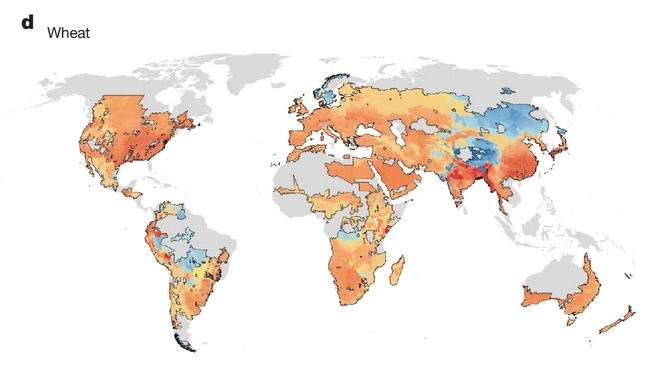

The relevant parts of the legend read:
Colours indicate central estimate in a high-emissions scenario (RCP 8.5), net of adaptation costs and benefits, for maize (a), soybean (b), rice (c), wheat (d), cassava (e) and sorghum (f) for 2089–2098.
And
See Extended Data Fig. 7 for a moderate-emissions scenario (RCP 4.5) and Supplementary Information, section J for results adjusted by CO2 fertilization.
So, if we are to get what might be termed, “plausible” results, we cannot even read the paper itself: we have to delve into Supplementary Information, and Extended Data. The authors have presented something here that they must know is wrong, and that any reviewers must have known was wrong, and that Nature’s editors must have known was wrong. Who cares? It got a headline. Or eleventy-six.
The Supplementary Information runs to nearly 100 pages. Am I alone in thinking that Supplementary Information is out of control these days? Anyway, searching for “fertilization” again finds table S11 on page 66. The column of numbers to take notice of is the one furthest right, showing the model’s prediction of yields under the realistic RCP4.5, with CO2 fertilisation, and with farmers actually doing their job, not growing crops that won’t make them money. The first number next to each crop is the prediction of average yield changes. The numbers in square brackets are the 5% and 95% ends of the distribution. [Note: this means that 90% of the distribution is within the brackets.]
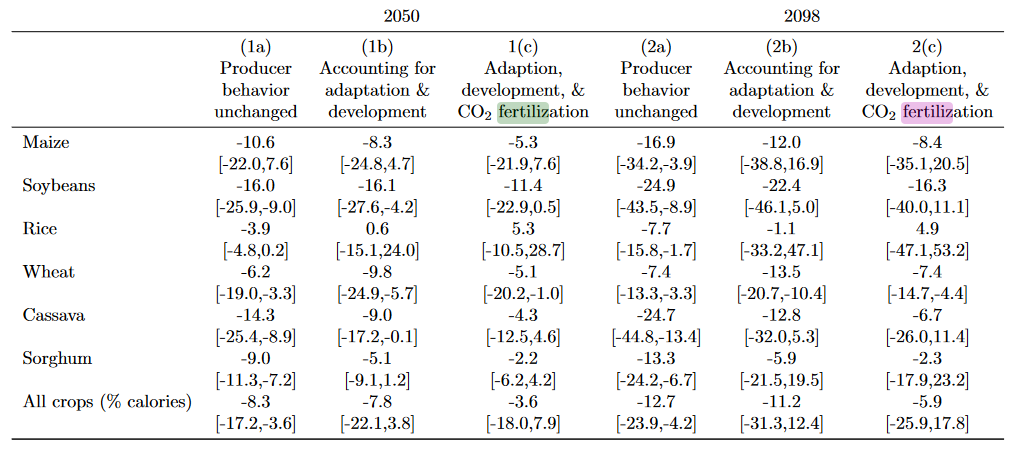
Here we see that the predicted yield distributions for five of six crops overlap 0. In other words, they are not significantly different from zero, and that no change in crop yield is a viable interpretation of the results. The exception is wheat, which is negative (but we can’t say for sure it is significantly negative, thanks to the extra margin on the confidence interval).
So: production could drop by 50%.
Or: production could remain the same.
Next: is the fertilisation effect realistic?
We know that CO2 is plant food, although the alarmists hate the idea with zeal. It’s easier to photosynthesise when there is more CO2, and that is not a controversial statement. It’s also non-controversial that C3 plants like wheat and rice will benefit more from CO2 enrichment than C4 plants like corn. [C4 plants can be thought of as plants that have evolved to eke out a living in a world where the food supply – CO2 – has dwindled over aeons until plants are half-starved.] The authors’ treatment of CO2 fertilisation is described on p.69 of the S.I.: does it pass the fairness test? Or did they pick a fertilisation model that downplays the likely effect?
At end-of-century, the CO2 fertilization effect under RCP8.5 increases yields by 9.8% and 5.2% for C3 and C4 crops. Under RCP 4.5 end-of-century yields increase by 5.8% and 3.5% for C3 and C4 crops.
I’m sorry – what? RCP8.5 increases yields by a mere 10% for C3?
Hultgren et al draw their CO2 fertilisation model from a meta-analysis by Moore et al. 2017. [The link takes you to their response function.]
Moore et al present revised damage functions from climate change – and you guessed it! They told us what we already knew. Things are “worse than we thought.” Is Moore et al’s CO2 fertilisation model fair? Only a cynic would suspect otherwise, right?
Well, it might be fair, I’m not sure about that, but it’s clearly wrong. Here’s how the modelled relationship works:
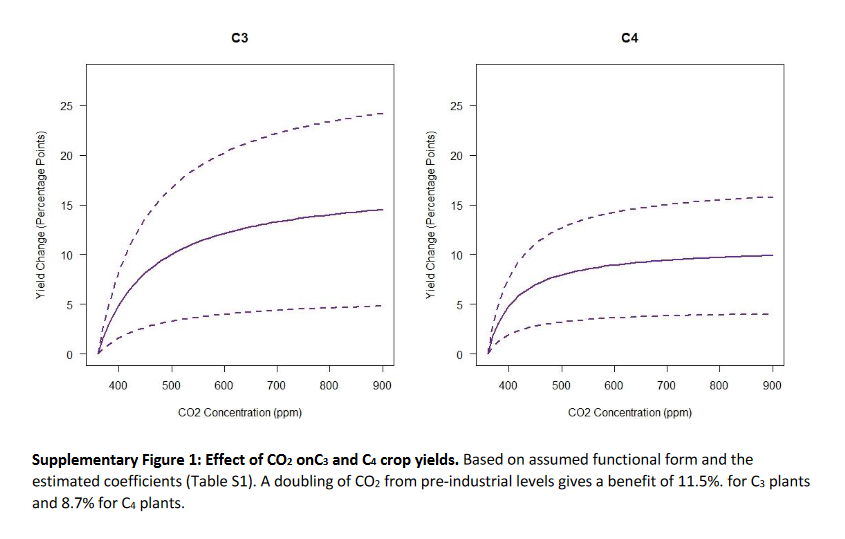
The baseline CO2 is 360 ppm, which is not “pre-industrial,” usually given as 280 ppm. The result is that at 360 ppm the change in yield is 0, by definition. The parameters used mean that half of the CO2 fertilisation for C3 plants occurs in the first 100 ppm (from 360 to 460 ppm) and rapidly tails off thereafter. Starting at 360 ppm is mad, because if you trace the curve back to 280 ppm, you end up with a yield of about -70% of the “modern” baseline of 360 ppm. In other words, if this figure represented reality, everything was dead in the pre-industrial era. Here’s my emulation of their figure for C3 plants, but going back to 280 ppm.
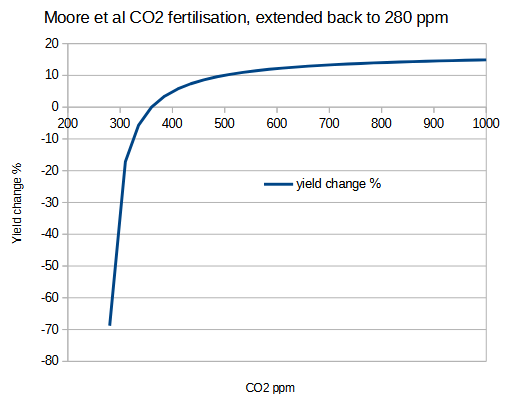
Now, you might say that the figure is and should only be valid in the range it is modelling. Maybe; but it clearly shows that the beginning of the curve is too steep. Here’s a different view of CO2 fertilisation, what you might call an ecologist’s view, as annotated by Dave Burton of sealevel.info:
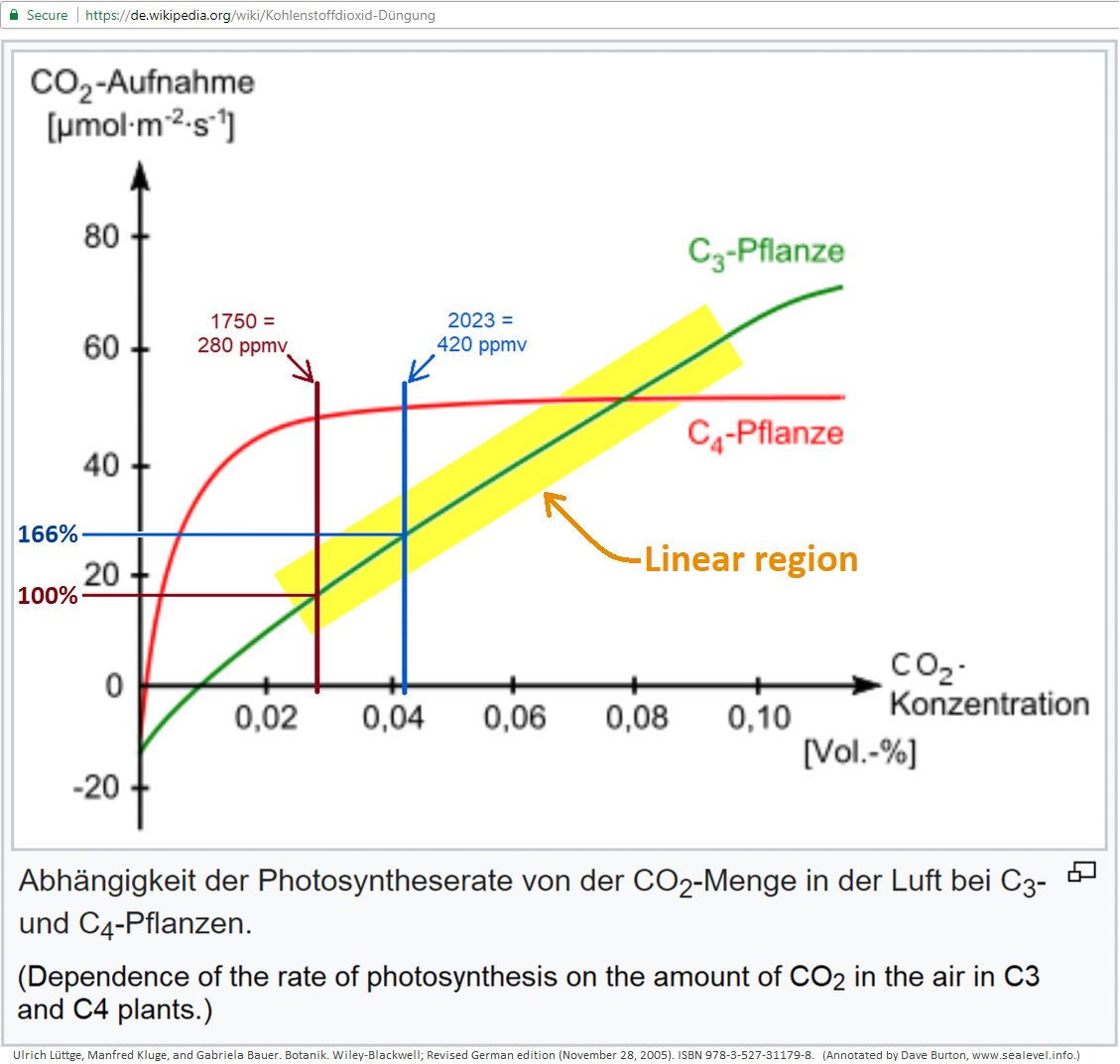
Here, C3 have plenty of gains in their pockets as the ambient concentration of CO2 goes up.
Note also that using 360 ppm as a baseline for yields means you have banked quite a bit of CO2 fertilisation and effectively zeroed it out: the benefits of increasing CO2 from 280-360 ppm are null.
Here’s what Hultgren et al did:
To apply these estimates of CO2 fertilization to our projections, we estimate this CO2 fertilization effect for each future year using RCP-specific CO2 concentrations from [201], and we subtract off the CO2 fertilization effect for the year 2015 (the end of our baseline period).
So most of the CO2 fertilisation has been banked and zeroed out, and what is left is not enough to balance out the “climate” impacts.
At end-of-century, the CO2 fertilization effect under RCP8.5 increases yields by 9.8%
This figure shows the CO2 concentration in 2100 under the RCP8.5 scenario (Figure reproduced from Denierland, data from climatechange2013.org (AR5). [Ignore “jit’s simple model”; one of these days, I’ll check to see how it is doing prediction-wise.]
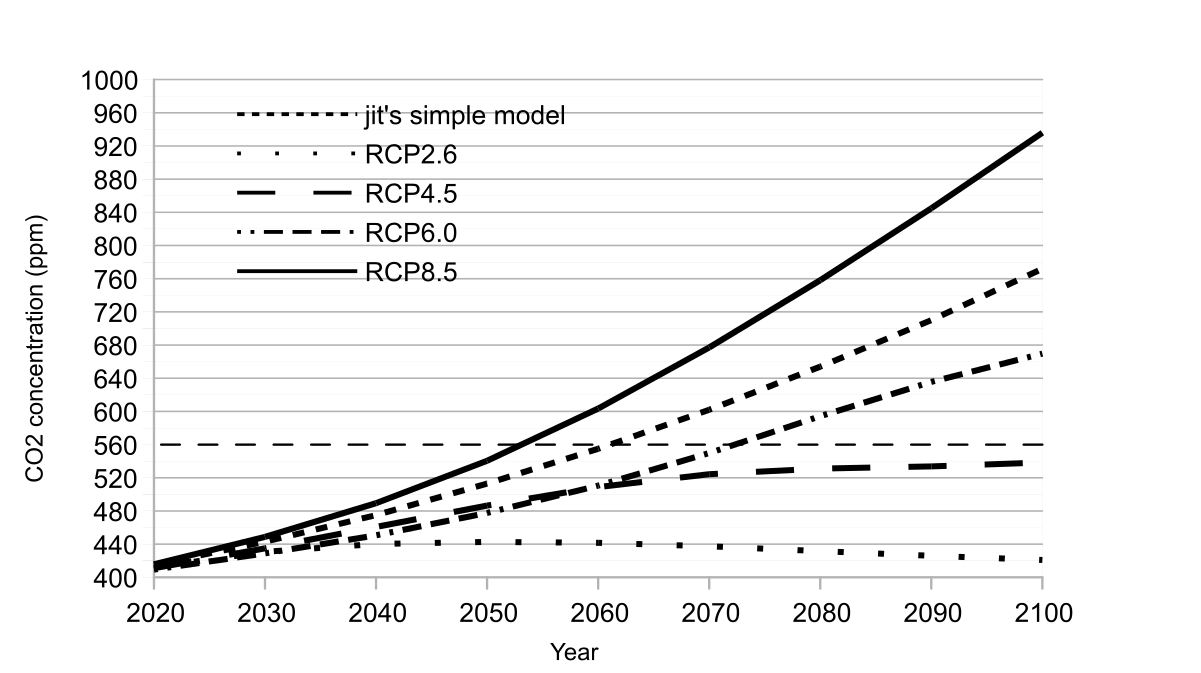
The 2100 concentration under RCP8.5 is 936 ppm, up from the baseline year (2015 for Hultgren et al) of 400 ppm. And the effect of CO2 fertilisation, they say, for that change (more than a doubling) is only +10%? I think this is low.
This NBER paper (“not peer reviewed”) by Taylor & Schlenker (2023) found that we are still firmly in the linear response phase (cf. the figure annotated by Dave Burton above):
We consistently find a large CO₂fertilization effect: a 1 ppm increase in CO₂ equates to a 0.4%, 0.6%, 1% yield increase for corn, soybeans, and wheat, respectively.
Now, Taylor & Schlenker’s numbers may be optimistic. I wouldn’t be surprised (their response curve is more of a cloud – it’s one of those where if you have enough data, a cloud can have a significant slope). But this range in interpretations is somewhat concerning. After 40+ years of climate research, we still don’t know what effect CO2 will have on crop yields.
As to the story about agricultural apocalypse, it’s another case of paper published, hysterical headlines published, good job well done, move on to the next “worse than we thought” headline-hunting journal article.
Meanwhile, what are Hultgren et al, et al’s results for the more realistic RCP4.5, with their (in my eyes) questionable CO2 fertilisation bonuses?
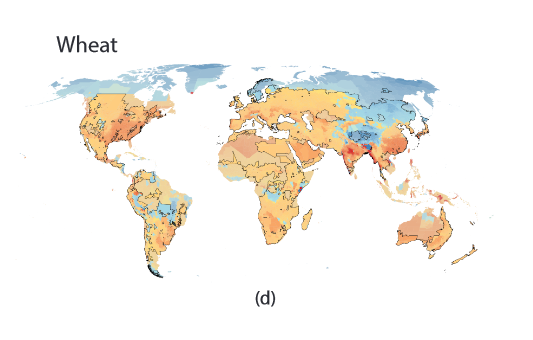
[Same key as above.] Thankfully, under the realistic scenario we can grow wheat on the Himalayas, Svalbard, and Kaffeklubben Island off the north coast of Greenland. [Snipped from Supplementary Figure S.14, p.71 of the S.I.]
/message ends
 Climate Scepticism
I had to read this twice to make sure I fully understood it, and also to apply a sceptical mind-frame to it, rather then blithely accepting what you say just because I trust you and tend to agree with you.
If your analysis is correct (and I can’t work out why it wouldn’t be) then it’s another shocking indictment of the headline-grabbing alarmist nature of these things. Exaggerate the down-sides and down-play the upsides in order to produce a terrifying headline.
If you (and now I, thanks to your analysis) can see the issues, why can’t others? Why aren’t those people who believe in the climate crisis assessing the evidence in the round? Why does the news always have to be unremittingly bad – worse than we thought? No wonder increasing numbers of young people apparently have mental problems.
LikeLiked by 1 person
There is a natural inclination for a scientist to present the worst case when picking something to say about a study that, like this one, considers a hundred different cases. The journal is not likely to accept something that does not have a striking finding – it has to be a novel result. Thus, presenting data from RCP4.5 with CO2 fertilisation and farmers not robotically planting the same failed crop year after year… would get nowhere, because it has no story to tell.
Small wonder that, at the next stage, the media merely regurgitates the selected headline and ends up drumming doom into us all – save for the minority who take the trouble to read behind the headlines, or those who are instinctive sceptics after a glance at the latest doomy headlines. The legacy media, as we know, is dying from the internet and social media, so will be grateful for any story that gets clicks, that they don’t have to employ someone to spend hours researching.
Obvious problems, no answers.
LikeLiked by 2 people
Mark,
It is the ever-present search for the simple narrative. The empirical sceptic’s resistance to draw simple conclusions, preferring instead to live with the messy data is relatively rare because it takes effort. As Nassim Taleb put it:
LikeLiked by 2 people
There is a statement that seems ambiguous
The abstract states
We estimate that global production declines 5.5 × 10¹⁴ kcal annually per 1 °C global mean surface temperature (GMST) rise (120 kcal per person per day or 4.4% of recommended consumption per 1 °C ; P < 0.001).
This implies that the daily recommended calorie consumption is 2730 per day. The NHS recommends a daily consumption of 2500 for men and 2000 for women. “However, these are averages and can fluctuate significantly based on individual needs.” From “Our World in Data” (OWID) global daily average calorie was 2960. The top two continents were North America 3570, and Europe 3450. The bottom two were Africa 2530, and Asia 2930. The comparable 1961 figures are North America 2760, Europe 3050, Africa 2010, and Asia 1815.
From AR6 WG1 SPM Figure SPM.8 on page 22, RCP8.5 will produce about 4.7 °C of warming relative to 1850 or about 3.5 °C from now. That is a 420 Kcal a day decline if you do not allow for population growth. This would take the average African’s back to levels of the 1960s when famines were common. But if per capita calorie intake is based on global calories divided by global population, it is the calories in a year, divided by the population in that year. In 2100, the UN estimates the global population will be 10.4 billion, a 29% increase on 2023 population of 8.06 billion. So under RCP8.5, total calories produced in total could
Increase by 9.2% (giving 15.4% decline per capita), due to allowing for population growth.
Decrease by 15.4% due to fudging the distinction between total and per capita calories.
Decrease by 34.4% (940 Kcal per day) due to not allowing for population growth.
LikeLiked by 2 people
Somewhat ironically, although obviously unconnected:
“Supermarkets told to cut 100 calories from shoppers’ baskets”
Telegraph link.
It seems that we are eating more than we should already, and if the fantasy climate change famine comes true, it would actually bring health benefits.
Note that the flippant comment in the line above does not take into account the fact that all famines are political in the 21st century. In other words, there is plenty of food to go around, if humans chose to distribute it evenly.
Regarding productivity gains in poorer parts of the world, these are potentially huge, if there is a shift from subsistence farming to industrial agriculture.
LikeLiked by 2 people
Whenever I hear or read the oft-repeated claims to the effect that climate change means crop yields will decline or even plummet, I remember the news during my youth and early adulthood. Famine was a recurring theme, often caused by drought or other weather-related issues. Not so today. We have never fed so many people with so few problems. As you say, any issues today are political, not climate-related.
On any objective basis the situation is improving, rather than deteriorating. It certainly isn’t collapsing.
LikeLiked by 1 person
This Hultgren et al article piqued my interest somewhat. How can global yields fall in the next 73 years, and hence production, when in the last 60 years production and yields have massively increased far outstripping population growth. Our World in Data nicely presents UN data on dozens of agricultural products, including for all the major crops in this article. First take a look at Figure 1 for maize (corn).
You will observe in the little charts of log (Maize yield) to temperature that there is a tipping point at 30C. Yields drop beyond this point. Imagine my surprise when I looked up OWID corn yields. The top 4 countries (with tonnes/hectare) are UAE (23.31), Qatar (20.98), Kuwait (18.2) and Israel (17.34). The combined production might be less than 0.1% of the global total, but it shows can be done in a desert with desalinated water. Globally, I have compared maize production and yields for 1961 and 2023 for major producing countries and continents.
In the last 63 years production has risen 6 times through a doubling of land area and a trebling of average yields. Note that African yields have only doubled and is still just a third of the global average.
A bit more can be gleaned from my tables for wheat and rice data.
In high school Geography I learnt that the UK had intensive agriculture, whilst the North American plains and the Russian Steppes had extensive agriculture. For wheat, this was both the case in 1961 and 2023 for UK and North America. So although North American yields have increased 2.4 times, they are still below the levels of the UK decades ago.
I learnt later that subsistence farming produces low yields. I would suggest that China has benefited from the movement from subsistence to intensive agriculture along with taking advantage of the huge advances in crop technology. India has made lesser advances.
Moving onto rice production, there does not seem to be as much distinction between extensive and intensive agriculture as for wheat. However, there has been huge increases in average yields. Like for maize, Africa lags behind. Compare India and China, both famous rice consumers. Production has grown by 285%, whilst India’s population has grown by 222% and China’s by 114%. But maize and wheat production has increased by larger amounts. That means if one crop fails there will not be famine. If much more expensive growing techniques are needed due to climate change, people will be able to afford the greater expense, and/or can consume more of less affected crops, and/or import foodstuffs from more temperate climates. Most of the world has broken away from the dependency on a few crops, or even spending a majority of their income on, or time producing, the food to survive.
Massively increased temperatures and much more volatile weather is unlikely to be a serious problem in a world where living standards are increasing, especially for the poorest. My one major concern, with or without climate change is for Africa. Yet even 40 years ago, when there were frequent famines, based on the available technology there was enough land not only to feed Africa, but the rest of the world as well. The problems are political and economic, not of physical geography and climate.
LikeLiked by 2 people
Thank you Kevin for delving more deeply into the foundations of this study. As is often the case, it seems they were made of sand.
These fantasy tales leave a mark in the mind of those who read them uncritically. I’m sure if someone were to poll people who were exposed to the mainstream media coverage of this topic, they would discover that the (false) belief in impending agri-apocalypse is widespread.
There is no hope of the mainstream media ever applying a critical eye to these stories, and it is left to a handful of sceptics with no time to spare to supply the debunks, which are then only seen by a small fraction of the number who saw the original breathless announcement.
The only plausible solution I can see is a c. 90% reduction in the number of climate scientists, to try to slow the flood of nonsense down. 🙂
It’s an interesting stat on the yield of British wheat. Another query over the wisdom of more solar. Of course, it may well help to explain the death of the countryside, too.
LikeLiked by 2 people
“Rising food prices driven by climate crisis threaten world’s poorest, report finds
High cost of staples due to extreme weather could lead to more malnutrition, political upheaval and social unrest”
https://www.theguardian.com/business/2025/jul/21/rising-food-prices-driven-by-climate-crisis-threaten-worlds-poorest-report-finds
Climate change-induced food price shocks are on the rise and could lead to more malnutrition, political upheaval and social unrest as the world’s poorest are hit by shortages of food staples.
New research links last year’s surges in the price of potatoes in the UK, cabbages in South Korea, onions in India, and cocoa in Ghana to weather extremes that “exceeded all historical precedent prior to 2020”….
...The high price of staples can have an impact on public health as low-income households cut back on expensive fruit and vegetables, according to the report from a team including the UK’s Energy & Climate Intelligence Unit (ECIU), the European Central Bank (ECB), the Food Foundation, the Barcelona Supercomputing Center and Potsdam Institute for Climate Impact Research.
The study investigated examples across 18 countries between 2022 and 2024 where price spikes were associated with heat, drought and heavy precipitation....
I think it’s fair to say that the Guardian is at it again. It reports on an alarmist report by the usual suspects, but doesn’t provide a link to it, which would enable interested readers to analyse the report and critique it for themselves. Insofar as one can tell anything at all from the Guardian’s limited reporting of a report prepared for propaganda purposes, it appears to involve a lot of cherry-picked data and to ignore the reality, which is that we have never before so successfully fed so many people on the planet, and that such starvation as does exist tends to be the result of conflicts and other political problems (which are not caused by climate change) rather than was the case 40 or 50 years ago.
LikeLiked by 3 people
“Climate Change Is Reducing, Not Increasing Food Costs, Mainstream Media”
https://climaterealism.com/2025/07/climate-change-is-reducing-not-increasing-food-costs-mainstream-media/
LikeLiked by 1 person
Mark – great link above, ends with –
“Never before has it been so easy for the media to report on various weather disasters and crop failures globally, and this certainly has an impact on peoples’ perceptions as well as the ability for studies to try to draw connections that aren’t really backed by data. This Bloomberg piece is nothing more than climate fearmongering; taking disconnected crop shortages from around the world from localized weather events and trying to blame them on climate change, when the truth is that there have always been crops failing somewhere in the world at any given time.”
But she will be ignored – Linnea Lueken is a Research Fellow with the Arthur B. Robinson Center on Climate and Environmental Policy. While she was an intern with The Heartland Institute in 2018, she co-authored a Heartland Institute Policy Brief “Debunking Four Persistent Myths About Hydraulic Fracturing.”
LikeLike
“‘Excellent size’: UK blueberry crop up nearly a quarter after warm spring”
New technology also helps fruit yield, while strawberry, raspberry and blackberry output has risen”
https://www.theguardian.com/business/2025/jul/26/uk-blueberry-crop-up-fruit-yield
British blueberries are the latest fruit to benefit from the warmest spring on record, with the harvest up by almost a quarter so far this year.
Growers say the weather has produced an early crop with more and larger berries, while new varieties can bring higher yields and better resilience. About 5,133 tonnes are expected by the end of August, up significantly from almost 4,187 tonnes by the same point last year.
Sales of the spherical fruit are already 9% ahead year on year as growing awareness of the health properties and a healthy crop bolster demand.
Daniel Martin, the group commercial director at S&A Produce, says: “This blueberry season has seen a really positive early start, about two weeks ahead of schedule, thanks to strong light levels and an absence of rain.
“As a result, we’re seeing excellent fruit size and nice, even ripening across the crop. In summary, we are optimistic about the season and expect to see excellent flavour and shelf life from this year’s crop.”…
LikeLiked by 2 people
“‘Climateflation’ could push up UK food prices by more than a third by 2050, report says
Exclusive: Increasingly extreme weather a threat to production and supply chains in Britain and elsewhere”
https://www.theguardian.com/business/2025/jul/28/climateflation-could-push-up-uk-food-prices-by-more-than-a-third-by-2050-report-says
…Warning that rising temperatures affecting major food producers in Europe and beyond stood as a major risk to household finances, the report said by 2050, under a high-emission “worst-case” scenario, food prices could rise by 34%.
Under a “best-case” scenario, whereby global heating would be limited to 1.5C by 2100 rather than 4C in the worst-case, it warned that cumulative food price inflation could still reach 25% by 2050....
Do those claims mean anything at all? CPI in the UK is currently running at 3.6% p.a. while CPIH (including housing costs) is running at 4.1% p.a.
It’s yet another dodgy dossier, so far as I can see:
…Drawing together climate data, analysis of international and domestic trade flows, and economic modelling, the Autonomy researchers said that increasing numbers of heatwaves and droughts would imperil staple crops, disrupt supply chains and intensify inflationary pressures.…
LikeLiked by 2 people
Have they thought this through? How about the loss of methane-based fertiliser? How much inflation is having to use electric farm equipment going to cause? Their solution is destruction.
LikeLike
“University farm to test climate-smart agriculture”
https://www.bbc.co.uk/news/articles/cy7pk6j51vjo
A farm belonging to the University of Leeds is taking part in a project to research and test ways of reducing agricultural emissions.
The site, which is between Leeds and York, is one of 10 across Europe taking part in the Climate Smart Research project.
The university hopes it can find ways to reduce the farm’s carbon footprint by 55% over the course of the five-year project.…
…It will receive £1.1m from the Horizon Europe programme to help fund the research over the next five years.…
…The university is one of 33 partners from 26 European countries taking part in the £11m Climate Smart Research project.…
Aye, where there’s muck, there’s brass.
LikeLiked by 1 person
It’s a terrible thing, climate change:
“National Trust reports bumper apple and pumpkin crops at its sites
Near-ideal conditions have led to high yields at some of the country’s best loved orchards and walled gardens”
https://www.theguardian.com/uk-news/2025/sep/23/national-trust-reports-bumper-apple-and-pumpkin-crops-at-its-sites
…Fruit and squashes have ripened weeks earlier than normal in many places and yields are higher thanks to near-ideal conditions, including 2024’s wet weather followed by a warm and dry spring and plenty of summer sun this year.…
Wonderful, but wait – climate change!
…The National Trust’s plant health and sustainability consultant, Rebecca Bevan, said: “Climate change has brought us some very challenging growing conditions over recent years with extremes of wet and dry weather and many storms.…”
LikeLiked by 1 person
The Plant Health and Sustainability Consultant knows nothing about climate change.
LikeLiked by 1 person
I’m posting this here because of the subject-matter:
“Hedgerows and mob grazing: Can farming fix its carbon black hole?”
https://www.bbc.co.uk/news/articles/c75q0dr2w09o
However, it reveals a closely related issue, namely the absurdity of UK and devolved governments’ targets on the way to net zero, how the low-hanging fruit has already been picked, and how it gets much harder from hereon in:
...In the coming days, we expect to find out what Scotland plans to do to play its part in limiting global warming.
However, ministers have already blown a huge hole in how that can be achieved.
This summer, First Minister John Swinney promised farmers at the Royal Highland Show that they would not have to reduce livestock numbers....
...The CCC report says 48% of that 2.5 million tonne cut in emissions should come from reducing livestock numbers.
That leaves a gap equal to about 1.2 million tonnes of planet-warming carbon dioxide by 2035.
Livestock numbers have been declining and are expected to fall further – but not at the rate needed to meet the CCC’s targets...
…The current presumption is that 60% of cars on Scotland’s roads will be electric by 2035….
…More engineered removals would also help plug the gap. That would involve mechanically sucking carbon dioxide out of the atmosphere and burying it underground.
This technology is in its infancy and is really designed for offsetting areas such as aviation, where emissions cuts are difficult.
Ministers have caused themselves a predicament but the targets for cutting planet warming emissions are legally binding and they need to set out how they will achieve them.
The Climate Change Committee has previously been critical of plans which are vague on policies and light on detail.…
LikeLiked by 1 person
How to report bad news, while burying it:
“Methane-cutting cow feed trials brought to an end”
https://www.bbc.co.uk/news/articles/cvgvkppx4kko
A major UK trial of a controversial feed additive designed to reduce emissions of planet-warming methane gas by dairy cows has ended.
Arla Foods, owner of the UK’s largest dairy co-operative, is now reviewing the results of the tests on 30 farms before any decision on future use is made.
The launch of the Bovaer supplement trial last year saw concerns raised over food safety, as well as misinformation and conspiracy theories posted online...
The nature of the “misinformation” isn’t identified, but read on:
…About 1,400 out of 2,000 dairy farms in Denmark are currently using Bovaer.
Jannik Elmegaard, of the Danish Food and Veterinary Administration, told the BBC they were “very aware that some herd owners have reported animals showing signs of illness after being fed with Bovaer” but it was “unclear how many cows were affected”.
He added that they were “closely monitoring” the situation and collecting data so that they could determine the cause of the illnesses but emphasised that Bovaer had “undergone a long and thorough approval process”.
Denmark’s Aarhus University has conducted several studies on the feed additive, external as part of its research into reducing methane emissions from cows and gives advice to the Danish authorities.
Professor Charlotte Lauridsen, from the university’s Department of Animal and Veterinary Sciences, said of the concerns raised: “The pattern of disease now being described in the media – with fever, diarrhoea and, in some cases, dead cows – has never been observed in our extensive studies.“
But she added that the reports were being taken seriously and researchers were now collecting samples from herds where problems had been reported….
LikeLiked by 1 person
“Bovaer Bovine Stupidity
UK Bovaer trials stopped after problems in Denmark”
https://davidturver.substack.com/p/bovaer-bovine-stupidity
LikeLiked by 2 people
Mark – thanks for the David Turver link. Liked his “BBC Very Iffy” label which links to 3 Dec 2024 BBC Verify article. Some partial quotes –
“However, experts have told the BBC that the additive “does not pose any food safety issues”.”
But notice the careful wording, with no mention about “the impact of Bovaer on livestock”.
“How the debate unfolded online?
Debates about Bovaer appear to have started to spread almost immediately after Arla announced its planned trial on 26 November.
Its post on X announcing its partnership with Tesco, Aldi and Morrisons has nearly 6 million views and attracted thousands of comments as of 3 December.
Users with a history of spreading conspiracy theories latched onto the trial within hours. Some of those posting have in the past shared anti-vaccine and climate-change denying content.
Other users, however, appear to be sharing posts about the additive out of genuine concern.”
Bold by me. Wonder how Verify know certain “Users” are genuinely concerned, but others are anti-vax/climate denying scum?
LikeLiked by 1 person
“UK farmers lose £800m after heat and drought cause one of worst harvests on record
Many now concerned about ability to make living in fast-changing climate after one of worst grain harvests recorded”
https://www.theguardian.com/environment/2025/dec/04/record-heat-drought-2025-cost-uk-arable-farmers-estimated-800m-climate-crisis-grain-harvest
A pretty shocking-sounding report from the Guardian, based on yet another study by yet another outfit with a narrative to push – in this case the ECIU:
…This year Britain had the hottest and driest spring on record, and the hottest summer, with drought conditions widespread. As a result, the production of the five staple arable crops – wheat, oats, spring and winter barley, and oilseed rape – fell by 20% compared with the 10-year average, according to the analysis by the Energy and Climate Intelligence Unit (ECIU). The harvest in England was the second-worst in records going back to 1984.…
Official government figures don’t tally with this claims, however. While they do report reduced yields in 2025 overall, it’s a mixed bag, and the narrative is not one about problems with drought, but with increased rainfall at harvest time, which caused problems:
https://www.gov.uk/government/statistics/cereal-and-oilseed-rape-production/provisional-cereal-and-oilseed-production-estimates-for-england-2025
…Initial good weather meant that the 2025 harvest progressed quickly, with many growers finishing ahead of a typical year. However, in September, wet weather hindered the ability to harvest remaining crops towards the end of the season, resulting in a mixed picture across the country with considerable variability in yield between regions.…
Areas being used to grow crops are declining, and this is a large part of the problem with regard to reducing production:
…The wheat area in 2025 increased by 8.8%, while spring and winter barley saw decreases of 16% and 7.2% respectively. The area planted with oats rose by 9.4%, from 148 thousand hectares to 162 thousand hectares (Figure 1). All cereal crop areas were below their five-year averages, with the exception of oats.
The area planted with oilseed rape decreased by 18% in 2025, falling from 250 thousand hectares in 2024 to 204 thousand hectares. This area sits below the five-year average and continues the downward trend observed since 2012....
Yields are variable from year to year, but they don’t show any significant trends between 2003-2025, other than perhaps a downward trend with regard to oats. See figure 2 on the government website.
LikeLiked by 1 person
Assuming that the UK yield for wheat turns out to be 7.0 t/ha then in a series of 140 years beginning in 1895, 108 of those harvests were worse than 2025’s. Every harvest prior to 1984 was worse. But it’s “one of the worst harvests on record.”
I wonder whether there might also be non-meteorological reasons for declining yields? The cost of employing staff, or purchasing fertiliser and pesticides, or perhaps even the cloud of despair that has settled over the sector since the townies took charge.
LikeLiked by 1 person
I still have regular chats with farmers I played rugby with back in the 70’s and 80’s, they range from sheep farmers on the hills to 100% arable on the best of land. They all agree weather can cause major problems but market trends can also have a big influence. When brewing and distilling demanded a large percentage of the spring barley (malting barley) crop good money could be made, look at all the foreign beer in the supermarkets and pubs, not the demand now. Perthshire was yellow with oilseed rape flowers every spring/summer not so much now, not the weather, demand. Even the French market for early spring lamb is difficult with legislation. The area around Dundee is now covered with fruit and vegetable fields, it was always known for fruit for jam making, now it’s fruit and veg for the table. At one time a lot of quality wheat was grown, not so much now.
LikeLike
JamesS,
Your mention of oilseed rape is interesting, given this on the government website:
…Oilseed rape saw a 29% increase in yield compared to 2024 and was 17% above the five-year average. This resulted in a 5.5% increase in production to 722 thousand tonnes in 2025.…
It’s despite this:
…The area planted with oilseed rape decreased by 18% in 2025, falling from 250 thousand hectares in 2024 to 204 thousand hectares. This area sits below the five-year average and continues the downward trend observed since 2012.…
LikeLike
The Guardian’s at it again:
“How climate breakdown is putting the world’s food in peril – in maps and charts
From floods to droughts, erratic weather patterns are affecting food security, with crop yields projected to fall if changes are not made”
https://www.theguardian.com/environment/ng-interactive/2025/dec/18/how-climate-breakdown-is-putting-the-worlds-food-in-peril-in-maps-and-charts
The article presents a series of graphs showing record crop production, that is feeding a larger human population than ever before, with fewer famines than I remember in the 1960s and 1970s (and with such famines as there are, largely resulting from war and civil strife).
It then goes on to rely on “multiple projections” and “experts say” in order to fearmonger. Very unimpressive.
LikeLike
“Food becoming more calorific but less nutritious due to rising carbon dioxide
Researchers noticed ‘dramatic’ changes in nutrients in crops, including drop in zinc and rise in lead”
https://www.theguardian.com/environment/2025/dec/19/higher-carbon-dioxide-food-more-calorific-less-nutritious-study
More carbon dioxide in the environment is making food more calorific but less nutritious – and also potentially more toxic, a study has found.Sterre ter Haar, a lecturer at Leiden University in the Netherlands, and other researchers at the institution created a method to compare multiple studies on plants’ responses to increased CO2 levels. The results, she said, were a shock: although crop yields increase, they become less nutrient-dense. While zinc levels in particular drop, lead levels increase.
LikeLike
I should have added some more quotes from that Guardian article. They do rather undermine the scary headline (surprise, surprise).
…There are, however, other factors such as fertiliser application that play an important role in how nutritious our crops are, said Jan Verhagen, a researcher on climate change and sustainable agriculture at Wageningen University.
“Indeed, nutrient levels in plants are changing,” he said. “Whether this is only related to CO2 is, I believe, less clear … we know that nutrition is a key factor in food security and health in general, so it makes sense to shift the focus on this topic.”
…The meta-analysis raises as many questions as it answers, said Ter Haar – who wants to do further study on climate change and nutrients.
“Our goal isn’t to scare people,” she said. “The first step in solving a problem is acknowledging it, and with that, we think our study could be a useful puzzle piece.”
Your goal may not be to scare people, but that does seem to be the Guardian’s objective.
LikeLiked by 1 person
Speaking of the Guardian’s attempts to scare people – here’s another one:
“‘Borrowed time’: crop pests and food losses supercharged by climate crisis
Heating means pests breeding and spreading faster, warn scientists, with simplified current food system already vulnerable”
https://www.theguardian.com/global-development/2025/dec/20/crop-pests-food-losses-climate-crisis
The destruction of food supplies by crop pests is being supercharged by the climate crisis, with losses expected to surge, an analysis has concluded.
Researchers said the world was lucky to have so far avoided a major shock and was living on borrowed time, with action needed to diversify crops and boost natural predators of pests.
The key global crops, wheat, rice and maize, are expected to see the losses to pests increase by about 46%, 19% and 31% respectively when global heating reaches 2C, the scientists said.
Global heating is helping insects such as aphids, planthoppers, stem borers, caterpillars and locusts thrive. Greater warmth enables pests to develop faster, produce more generations each year and attack crops for longer as winters shorten. Rising temperatures are also helping pests invade places further from the equator and on higher ground that were previously too cold.
As a result, the climate-driven flourishing of pests will be worst in temperate places, such as Europe and the US, the researchers said.….
Actually, the study says:
…At mid–high latitudes, warming and intensified agriculture might exacerbate pest damage, especially that associated with migratory pests….
For anyone wanting to know more, the study can be found here:
https://www.nature.com/articles/s43017-025-00652-3.epdf
LikeLiked by 1 person
Unfortunately for the alarm-mongers, we now have insecticides that work. Try being a potato farmer in the eastern U.S. the mid 1800s.
So went the Colorado beetle from the late 1850s. The remedy that was discovered? Paris green, which has a “colourful” history, and contains arsenic and copper. If you think living with a degree of warming is bad, trying living in pre-industrial times.
Link to Lodeman’s book on ancient pesticides.
LikeLiked by 2 people
Mark, your Guardian link on the 18th is seemingly based on the same paper as the head post here. It has now been discussed at WUWT. Looks like the Guardian are doing a series on this topic, perhaps to link it in people’s minds to Christmas blowouts.
LikeLike
Wonder if this post & latest study/paper has relevance to this Cook comment by me – https://cliscep.com/2025/12/18/generative-debunking/#comment-164199
LikeLike
“‘A big burden for farmers’: Gulf shipping crisis threatens food price shock
Iranian blockade of the strategic strait of Hormuz is hitting global fertiliser supply chain”
https://www.theguardian.com/business/2026/mar/05/big-burden-for-farmers-gulf-shipping-crisis-threatens-food-price-shock
…Between a quarter and a third of the global trade in the raw materials for fertiliser passes through the strait, as well as a fifth of seaborne crude oil and gas.
The de facto closure of the strait is affecting the transport of ammonia and nitrogen, which are key ingredients in many synthetic fertiliser products.
Roughly half of global food production depends on synthetic nitrogen and crop yields would fall without fertiliser. The resulting shortages would push up the prices of household staples such as bread, pasta and potatoes, and make animal feed more costly….
LikeLiked by 1 person
Much worse than anything climate change might do…War (UN, please take note):
“‘Cost to supply potatoes has risen 40%'”
https://www.bbc.co.uk/news/articles/c8957234108o
...Paul Brown, who farms potatoes near Eccleshall, Staffordshire, has said the cost to buy new supply has risen by up to 40%, casting doubt on upcoming yields.
Iran’s continued blockade of the Strait of Hormuz has led to higher costs for fuel and fertiliser, both crucial elements of food production….
LikeLiked by 1 person