The new levels of the default tariff cap have been announced by Ofgem.
Leccy: was £882.08, will be £840.28
Gas: was £878.79, will be £797.36
The breakdown’s components have altered; in case there was anyone left who was still following, there probably isn’t now.
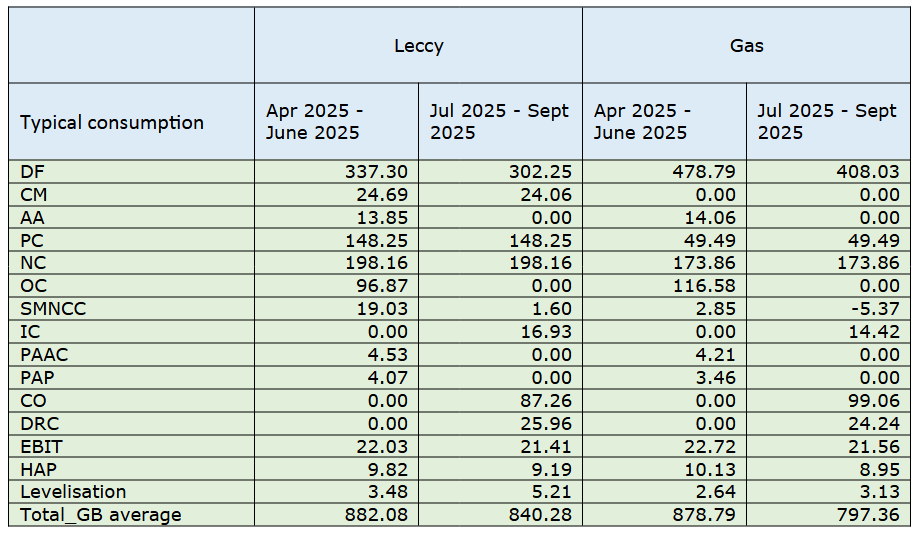
Source: from tab 1c Consumption adjusted levels on “Final levelized cap rates model (Annex 9) 1 July to 30 September 2025_0.xlsx” from this page.
So, OC (operating costs) have gone, PAAC and PAP have gone (Payment method Adjustment Additional Charge and Payment method Additional Percentage); the smart meter net cost charge (SMNCC) has shrunk markedly, AA (adjustment allowance) has gone; new in the charts are IC, CO and DRC. “Industry charges”, “Core operating costs”, and “Debt-related costs.”
To this we must add VAT at 5%, which gets us:
Old tariff cap: £1849
New tariff cap: £1720
Miliband’s original, and I have decided, impossible (under his own terms) promise was to reduce bills by £300. That, I said, was off the July-September 2024 tariff cap of £1568. The bill, in other words, needed to go down to £1268 to fulfil the promise. The present £1720 means that an additional £452 savings are necessary to achieve it.
Finally, I may note that at the previous tariff cap, you could not slide a plastic £5 note between the “typical” household’s gas and electricity bills (£923 and £926 inc. VAT, respectively). However, we now can slip said fiver between, and much more.
| Apr-Jun ’25 | Jul-Sep ’25 | |
| Leccy | £926 | £882 |
| Gas | £923 | £837 |
Gas is now £45 cheaper than leccy. Of course, a fall in the price of gas has a larger effect on the cost of a domestic gas bill, as it is a far larger proportion of the bill. That makes it difficult to see how a war on gas exploitation in this country is going to drive down the overall domestic energy bill.
Note
The above costs are based on 2.7 MWh of leccy and 11.5 MWh of gas. [Lower usage than originally used for the price cap: was 3.1 MWh / 12 MWh.]
And yes, heat pumps are more efficient than gas, but here we are looking at a typical household using 4 X as much energy from gas as it does from leccy. [And the typical household is not yet suffering the heat pump blues.]
Featured image
I asked the AI to draw me a Penrose triangle. It replied with a square, but I kinda like it.


The electricity price for domestic consumers is now back to about 4x the price of Natural Gas per (purchased) kWh.
https://www.ofgem.gov.uk/information-consumers/energy-advice-households/energy-price-cap
So much for Mad Miliband Jnr’s “NINE times cheaper” click-bait claim. (Albeit he was referring renewables-generated electricity vs Nat Gas generated ‘leccy. But he was too dim to qualify that he meant Nat Gas generated ‘leccy)
https://x.com/Ed_Miliband/status/1562444641236316161
LikeLiked by 1 person
Here’s what ChatGPT came up with:
LikeLiked by 1 person
Jit,
If I wasn’t tired after a long drive (as well as being lazy) I could probably track down the remaining acronyms cited in the new cost levels. However, can we still establish from these figures whether the cost of renewables is still playing a substantial role in the price of our energy, and can we establish if that’s a cost that is going up or down?
LikeLiked by 1 person
I think this goes a long way towards answering my question:
“Net Zero Restricts Bill Cuts in Price Cap Change
Although bills have fallen, electricity bills have fallen by less than gas bills.”
https://davidturver.substack.com/p/net-zero-restricts-bill-cuts-in-price-cap-change
…gas bills that have fallen 9.3% or £81 since the last price cap was announced. Of the (ex-VAT) total of £797, £408 is the actual price of gas, £351 is other costs such as the cost of the gas network, operation costs of the suppliers and profit. Our gas bills also include £39 of Net Zero related costs. These form part of the Policy Costs in our gas bills and include the Energy Company Obligation (ECO) partly designed to reduce carbon dioxide emissions and the Green Gas Levy that funds the production of biomethane.
Electricity bills (ex-VAT) have fallen by only 4.7% or £42 since the last price cap to £840. Note that the percentage reduction is only about half the reduction in our gas bills, which indicates that factors other than gas are having a significant impact on electricity bills.…
…Net Zero costs have risen by £167 from October 2018 to £389 in the latest price cap. ROC and FiT costs have remained stable, whereas the estimate for CfD costs have gone up from £2.3bn to £2.5bn in the latest price cap. When the gas price falls, the subsidies from CfDs increase so the generators maintain their fixed strike price.…
…Conclusions
The gas price certainly has an impact on our electricity bills. However, Net Zero is having a much bigger impact. In fact, we can argue that Net Zero has led to a smaller reduction in electricity bills than we might have expected from the fall in the gas price.
We can expect Net Zero costs to increase substantially as more intermittent renewables are added to the network and the grid is expanded to accommodate them. It certainly looks like Miliband wants to step off the roller coaster and board a rocket to the moon.
LikeLiked by 1 person
Joe, from the data up top, we have: Leccy cost = £882, energy used 2.7 MWh, => £0.327 / KWh.
Gas cost = £837, energy used 11.5 MWh, => £0.073 / KWh.
0.327 / 0.073 = 4.49
So the ratio of costs as provided to the householder is, as close as dammit, 4.5 : 1. Therefore only an idiot would use electricity for direct heating. (And unless your heat pump is very efficient, you’re still losing there.)
LikeLiked by 2 people
Mark, you ask about the contribution of renewables. As you know, CfD is included in the wholesale price of leccy, which has gone down. However, the cost of the CfD component has gone up slightly (about £2). The Network Costs and Policy Costs as estimated by Ofgem are unchanged for the quarter.
Regarding the new abbreviations, I hope I explained them all.
LikeLike
Robin, your AI is better than the one built into WordPress. However, its image has disappeared. It was certainly a triangle, and I think it was close to a Penrose in most places, but not all.
LikeLike
Jit, I asked it again and got this:
Simpler than its last effort, but more accurate.
LikeLike
“Ofgem Asleep at the Wheel
Consumer energy debt rising as energy suppliers fail financial resilience tests”
https://davidturver.substack.com/p/ofgem-asleep-at-the-wheel
LikeLike
“What is happening to gas and electricity prices?”
https://www.bbc.co.uk/news/articles/cdd29v8mp9jo
IT’s an interesting article, given that it’s completely unenlightening regarding the fact that the price cap for gas is going down while that for electricity is going up. Ofgem’s own reporting is obscure:
https://www.ofgem.gov.uk/news/changes-energy-price-cap-between-1-january-and-31-march-2026
To discover that although they are increasing (yet again) standing charges for both gas and electricity, the unit prices for electricity are increasing (again) but those for gas are going down, you have to persevere to here:
https://www.ofgem.gov.uk/information-consumers/energy-advice-households/get-energy-price-cap-standing-charges-and-unit-rates-region
The BBC does at least tell us this:
...In December, Ofgem said it had approved a £28bn investment to improve the electricity and gas grids in Great Britain.
It says this will strengthen the energy supply, and better shield customers from volatile energy prices. It will also reduce Britain’s dependence on gas.
Customers will foot part of the cost, through an additional £108 added to energy bills by 2031. Bills will start to rise from April 2026….
LikeLike
“Ministers urged to curb energy costs as Great British homes face 13% bill surge
Quarterly Ofgem price cap rises to equivalent of £1,862 a year from 1 July amid growing consumer energy debt”
https://www.theguardian.com/business/2026/jun/28/ministers-urged-to-curb-energy-costs-as-great-british-homes-face-bill-surge
LikeLiked by 1 person
Last week – can’t remember which day, or whether it was lunch or tea – R4 had someone on arguing earnestly for a social tariff on energy – with absolutely no push-back from the presenter, who could have tried something like, “But that will mean everyone else paying more.”
LikeLike
“Energy price cap rise ‘will push millions in Great Britain into fuel poverty’
Typical bill will surge by £220 a year from Wednesday, forcing 13.5m homes to spend over 10% of income on fuel”
https://www.theguardian.com/money/2026/jul/01/energy-price-cap-rise-will-push-millions-in-great-britain-into-fuel-poverty
Disinformation, surely? UK natural gas prices are twice as high as they were three years ago, granted, but are much lower than they were during the early stages of the war in Ukraine, and have fallen significantly from a peak three months or so ago when markets pushed prices up due to Trump’s war in Iran:
https://tradingeconomics.com/commodity/uk-natural-gas
Meanwhile (from the quote above):
Policy costs are far more responsible for high electricity bills than any link to the price of gas.
LikeLiked by 1 person
Mark, I can’t – won’t – read the article but, from the excerpts you posted, the Minister appears not to understand how the price cap works. The hit to annual bills will be 13% only if today’s rise in the cap is maintained for the next year. That could – and probably will – change when the cap is re-assessed every 3 months. So the annual hit could be more or less than he says, depending mainly on Hormuz. (I expect I’m preaching to the choir – apologies).
Secondly, domestic energy consumption is typically very low over the summer months: I’ve read that it accounts for only 10% or so of the annual total. So the actual hit, over the next 3 months, will be around £22. The crucial stage for our bills will be the evolution of the cap in September and then December.
Sceptic that I am, I also suspect that the individual rises for gas and electricity have been skewed, with the former rising by ~25% and the latter by ~8%. We are told that the gas price rise is driven by geopolitics, etc and we are also told that “gas sets the price” of electricity. So the disparate rises look unbalanced, in favour of electricity.
LikeLiked by 1 person
The wholesale price is a larger proportion of a gas bill than an electricity bill, for perhaps obvious reasons, so changes in wholesale will cause larger changes in cost on gas bills than leccy. When I get a moment, I’ll look into whether the changes in cost of gas bills have been disproportionate.
LikeLike
Jit, You may well be right. My line of thinking was that the price of gas must comprise virtually all of the costs of gas-fired plants since they are nearly all pretty old and hence fully-amortised. So, if the rise in the domestic price of gas is market-driven, I would expect the price of gas-fired electricity to increase by a similar margin. Maybe that price is a smaller part of the overall price of electricity that I thought?
I happily admit that the workings of the market price of electricity have me befuddled. For example, does it include subsidies? I would assume not because, aiui, wind and solar generators on the ROC system can bid negative prices, using their ROCs to gain positive revenue. If that’s correct then the “market price” does not reflect the actual cost to the purchaser.
LikeLike