In Denierland, I bemoaned the way policy makers evaluate success when it comes to climate. There is a level of abstraction in climate policy success that is not found elsewhere – or at least, not to the same degree.
How do you – or how should you – measure climate policy success? Obviously, the most direct measure is the temperature change avoided by a certain date, say 2050. No single policy can ever create a significant difference in the temperature of 2050, and unsurprisingly this metric is not used. Next down in the hierarchy is emissions avoided. This is also a stat that is hard to obtain. Then there are more abstract measures like the quantity of “green” energy generated by a scheme, or the number of “green” jobs created by a scheme, or at the sad end of things, the amount of cash “invested” in (not spent on) a scheme.
All such measures have innate problems. In particular, jobs in “green” energy are a cost, not a benefit… unless the energy is being exported. If the jobs of a hundred men with shovels can replace the work of a single machine, then destroying the machine is a great job creation scheme. (The famous remark said to have been made by Milton Friedman that if jobs were wanted from such a program, then the workers should have been issued with teaspoons rather than shovels apparently originated far earlier from an unknown source.)
Anyway, all this is a roundabout introduction to the news that the UK government gave the wink to a new carbon capture and storage scheme this week, one whose benefits could almost be calculated by the announced figures.
The Liverpool City Region Combined Authority’s (puff, puff) website has the costs and benefits of the scheme, which is called HyNet (the particulars are not given there, and are not really germane here. The CO2 could be being captured by any means and pumped anywhere for our purposes.) The BBC has somewhat different numbers, which I also provide.
The cost is given as £21.7 bn over 25 years. (LCRCA does not say when the scheme is supposed to begin operation. The BBC says 2028.)
The jobs are 6000 in construction and presumably a far smaller number in operation. (The BBC says 4000 direct jobs and supporting 50,000 in the long term.)
Reduction of emissions of CO2 are “up to” 10 million tonnes per year. (“…the equivalent to removing four million cars from the road.”) (BBC: 8.5 million tonnes.)
Let us assume that the annualised cost will be £1 bn/yr, and that the 10 million tonnes CO2 removed per year is true. However, some of that CO2 would never have been emitted, since extra energy is used to capture it. Ecosia chat says 15-30% of energy is wasted in the snaffling, so to be scrupulously fair, let’s call it 20%. That means that on net we are capturing 8 million tonnes CO2/yr, and the cost is simple to calculate at £125 per tonne of CO2. [Absent the obviously inevitable over-runs.]
Again referring to Ecosia chat, I get a range of estimates for the social cost of carbon (SCC) from $50 to $200 per tonne of CO2, and the chatbot refers to the possibility that extreme climate change outcomes might mean it is up to $400. At the present exchange rate of $1.3 = £1.0, our cost of £125/tonne is about $160/tonne, so it’s close to the higher end.
This is assuming that it all goes swimmingly.
The next issue with the scheme is an obvious one. The social cost of carbon is a cost spread across every human on the planet. The population is >8 billion. Therefore the benefits of the new scheme will be funded by the ~70 million population of the UK, but benefit everybody equally: the cost to outsiders is nil, but they stand to benefit as much as we do.
In fact, if the SCC is $200/tonne, then every tonne pumped where the sun don’t shine is worth an inconsequential amount to each human alive. 40 million times 200 = 8 billion, so quickmaths tells me that each human benefits to the tune of one 40 millionth of a dollar every tonne of CO2 we save. That includes each of us. So the UK’s total savings per tonne sequestered under the Irish Sea are ($200 * 70 million) / 8 billion = $1.75.
To recap: it’s costing us ~$160/t CO2 to bury the stuff, and the climate benefits to us are ~$1.75 using the higher end of the estimate of SCC. You could argue that the true benefits amount to 40 cents, or nothing.
Now let’s ask one final question. What will the temperature change avoided by 2050 be? Given a successful project storing 8 million tonnes of CO2 over the years from 2028-2050 (22 years), we have saved by that point 8 * 22 = 176 million tonnes.
Quoting myself from last year, I said:
1 ppm CO2 ≈ 8 Gt (billion tonnes)
So our project will have saved 176 / 8000 = 0.022 ppm CO2 by 2050.
For Denierland, I used a model that gave an atmospheric CO2 concentration at 2050 of 512.64 ppm. [It used a quantity of emissions increasing linearly by 0.1 GtC each year.] Using this figure in the standard calculation with transient climate response a generous 2 K gives a temperature change from pre-industrial in 2050 of +1.745 K. After the UK’s tremendous efforts with HyNet, the concentration of CO2, ceteris paribus, will be 512.62 ppm, and the temperature change from pre-industrial will be
+1.745 K.
No, your eyes do not deceive you. The numbers are the same. In fact, the saving from the £22 billion will be 0.0001 K, making the cost to save a single degree easy to calculate: £22 billion / 0.0001 K = £220 trillion / K. Let me just say that again, in case you didn’t hear me.
£220 trillion / K
Here I was going to excoriate some of the platitudes that various political figures have er, emitted, over this project, but I won’t bother. The soundbites of these dimbulbs are easily found, if you have the urge. I will dwell for a moment on two things. First, Mark Poynting and Justin Rowlatt yesterday asked the question at the BBC,
Will carbon capture help the UK tackle climate change?
I read it with interest, but I have to tell you, that they didn’t tell me. Singularly lacking was any context of cost vs. benefit such as I have provided here. I invite the reader to scrutinise it and tell me if there was anything there worth his or her time.
Second, at the BBC’s announcement of the scheme, comments were allowed. I was interested in the top one:
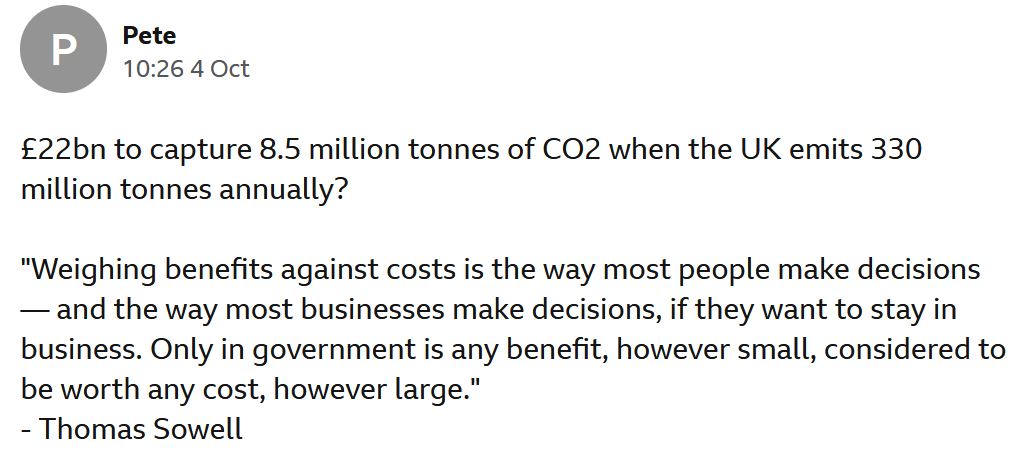
A rather important point, I would say. It is worth dipping into these comments, if you have a mo.
So a black hole is created: but is it a black hole for CO2, or cash?


There you go again, using facts and logic, when there’s a planet to be saved. How dare you?
LikeLike
Carbon capture wouldn’t work anyway with a Labour government: as soon as the storage facilities at Teeside and Merseyside looked like they were nearing capacity, the government would announce an early release scheme.
LikeLiked by 1 person
Now that you’ve done the figures, it’s far worse even than how appalling it looked at first. Unfortunately, nothing like this kind of analysis will appear in the mainstream media.
LikeLike
As always Jit, brilliant stuff. Thank you.
One thing. As I’ve said elsewhere, the costs will of course – as with all government projects – be vastly greater than £22bn.
LikeLiked by 1 person
CO2 Capture and Storage is not only impractical, it aims to deprive the biosphere of plant food.
More dreams from the techno-challenged.
LikeLike
An unproven technology is being projected as a relevant factor in the frankly impossible goal of Net Zero by 2030 or 2035 or whenever. These politicians are totally misinformed ( shorthand for thick) and will impoverish our country. CCS will never make a significant difference to our climate which is largely influenced by the Sun, clouds, the ocean currents, volcanic eruptions, etc. Wind and solar can only provide a small percentage of our energy needs. Oil, gas and coal are essential for energy security, all the essential ingredients for our 21st Century civilisation.
LikeLiked by 1 person
Ron, your comment raises a question: how would human civilisation have developed had the atmospheric concentration of CO2 been 560 ppm rather than 280 ppm? My answer is that we may well have fared better and developed faster. But it’s wild speculation, of course.
==
I might have mentioned up top that 8 million tonnes of CO2 represents a large chunk of the UK’s industrial process heat, a chunk that will grow as time goes by and we increasingly revert back to 18th century living. The implication is that the utilisation rate of the CCS system will be below the badged level.
LikeLike
Old Soviet saying: “The future is certain; it’s only the past that keeps changing.”
LikeLiked by 1 person
Worth a read:
“Civil War Breaks Out in the Green Blob But Don’t Expect the BBC to Report it”
https://dailysceptic.org/2024/10/06/green-civil-war-breaks-out-over-carbon-capture-and-hydrogen/
LikeLike
Andrew Orlowski (Telegraph, magic curtain) doesn’t like the scheme:
“Ed Miliband’s latest net zero wheeze is a load of hot air”
LikeLike
Thanks Jit. The article concludes magnificently:
The list of poor technologies the Government is choosing – those that either don’t work, are unproven or only work at great expense – grows ever longer.
Alongside the giant flywheels The Telegraph reported were being considered to maintain grid inertia are the Emperor’s New Renewables, a massively expensive grid scale battery storage network, and hydrogen.
One bad idea begets another.
Our political class made a catastrophic error of judgment in chasing impossible net zero targets and CCS helps maintain the delusion that any of it is achievable without pain, if at all. That’s the biggest capture of all.
LikeLike
“£22bn for ‘unproven’ green tech could raise bills, MPs warn”
BBC link.
LikeLike
Endlessly repeating a mantra doesn’t make it true:
The government said that it would formally respond to the committee, but that CCUS was a “necessity not an option” for reaching its climate goals.
It said in a statement that this type of technology would make Britain’s energy system secure, something that would lower electricity costs and bills.
LikeLike
It’s interesting that the BBC article cited Dr Stuart Jenkins, research fellow at the University of Oxford, who said, “I really don’t like the phrase “unproven” technology, it is not representative of the status of the technology as an engineering problem,” he said. Although there are no commercial CCUS sites in the UK, there are 45 commercial facilities already operating globally capturing around 50 million tonnes of CO2, and there are more than 700 being proposed or developed, according to the International Energy Agency.
If he’s right, it would seem to invalidate my claim in the Case Against article that the technology is ‘very expensive … and commercially unproven at scale’. However in my endnote 10 I cite a report by the IISD titled ‘Unpacking Carbon Capture and Storage: The technology behind the promise‘ indicating that, although Dr Stuart’s comments may be accurate, they only tell half the story. Thus the report begins with this: ‘Despite the substantial interest that has been stirred up around the technology, many questions remain about its feasibility, persistently high costs, and track record to date.’ And it concludes with this: ‘Despite the hype, the science behind CCS technology doesn’t measure up. The technology is incredibly expensive, captures relatively minimal amounts of CO2, and is heavily reliant on large government subsidies.’
(However I’m bound to point out that that too should be treated with care as the IISD is a renewable energy advocate that sees CCS as a potential ‘excuse’ for continuing with fossil fuels.)
LikeLiked by 1 person
Yet another captured academic who doesn’t like the dictionary definition of a word, so seeks to redefine it in terms which are more aligned with his/her ideological attachment.
LikeLike
Robin; I don’t think you need to revisit your claim about CCS. 45 projects world-wide is an utterly trivial number against the thousands of plants of all types which are significant emitters of CO2. Furthermore, following the links to the IEA material, that 45 number includes DAC (Direct Air Capture) projects of 1000+ tons per year capacity – not much more than a couple of Dyson hairdryers blowing through a filter.
Here’s what I found on the IEA website: “There are now around 45 commercial capture facilities in operation globally, with a total annual capture capacity of more than 50 Mt CO2. Close to ten large-scale (capture capacity over 100 000 tCO2/year, and over 1 000 tCO2/yr for DAC applications) capture facilities entered operation in 2023, including the Blue Flint ethanol project, Linde Clear Lake capture facility, and Heirloom and Global thermostat’s first 1,000 tCO2/yr facilities in the United States, and four projects in China (the Jiling Petrochemical CCUS facility, the CNOOC Enping oil field, the first phase of the Guanghui Energy CCUS integration project and the China Energy Taizhou power plant). It also includes the capture facility at the Petra Nova plant in the United States, which restarted operations after a 3-year suspension.”
CCS (and CCUS) can work in the right circumstances. There’s a synfuel plant in Saskatchewan which has been capturing CO2 for decades and exporting it via a 300 km pipeline to an oil field in N. Dakota where it is used to enhance oil recovery. I’m guessing that some of the projects in that IEA para might be similar in concept (cba to follow all the links!).
However, from my weak grasp of the processes involved, CCS struggles with the specific case of power plant exhausts which is the target application for the UK. Aiui the high flow rates and presence of large volumes of nitrogen create “challenges”. Afaik there isn’t a full-scale plant working anywhere in the world – and I rather think the good professor would have mentioned it, if there was one. The Norwegians had two tries and gave up. The Boulder Dam (?) project in the US has cost billions and never worked consistently. The White Rose project in NE England was abandoned by the participating companies despite the govt putting a £1 bn bung on the table.
Oddly I didn’t see any mention of the growing activity in this area in the US. A couple of Gulf Coast states are offering subsidies for sequestering CO2 in offshore saline aquifers so there are efforts underway with “industrial” CO2 – not power plant emissions, aiui. Apparently there are 2500 miles of CO2 pipelines in use but I believe they are mainly supplying geologic CO2 to oil fields.
There’s one wrinkle which I really like as it must be anathema to greenies: “carbon-negative”oil. This is where captured CO2 is injected into oil fields to enhance recovery and the amount sequestered is greater than the emissions from producing, refining and burning the oil. The company pioneering the concept was bought by Exxon for $4 bn…….watch this space!
LikeLiked by 2 people
Mike H,
Apologies – I have just found your comment lurking in spam and set it free.
LikeLike
Mark; thanks. I realised after posting that there are a lot of links which, aiui, gives WordPress conniptions!
LikeLike
MikeH: very interesting and helpful – thanks. I thought the IISD article painted a pretty damning picture and now you’ve confirmed it.
LikeLike
“Carbon capture site could affect habitats – report”
https://www.bbc.co.uk/news/articles/cze1r1lge51o
Potential effects on air quality, noise, and local biodiversity have been identified in a report for a new carbon capture facility.
Rookery South Ltd hopes to construct the facility next to the Rookery South incinerator near Stewartby, Bedfordshire.
The Rookery Carbon Capture Facility would capture carbon emissions from the incinerator and prepare them for storage or transport.
As part of the planning process, an Environmental Impact Assessment (EIA) found the development could affect habitats of importance and create a risk of noise.
In the cover letter, the applicant’s agent said “due to the sensitivity of the environment and the characteristics of the proposed development, the applicant intends to voluntarily undertake an EIA of the proposed development”.
It also acknowledges the noise risk during the four-year construction period, and the possibility of increased emissions – including from road transport, if a CO₂ pipeline cannot be delivered and lorries are used instead.
Although the site sits within a non-statutory wildlife designation, the report said development could affect hedgerow and reedbed habitats…
…A full planning application is expected in due course.
Is there any aspect of net zero that isn’t extremely damaging?
LikeLike
From the “utter waste of time” department:
“Project to suck carbon out of sea begins in UK”
It involves sucking up the water, acidifying it, maybe agitating it – not clear about that – then neutralising it – then pumping it back into the sea.
BBC link.
LikeLiked by 1 person
Jit – saw that on BBC news the other day & thought the same as you.
The BBC article is a fun read, with so many interesting partial quotes I could lift.
Will settle for the closing one –
“Guy Hooper is a PhD student at Exeter University and is researching the possible impacts of the project. He’s been exposing marine creatures to low-carbon water under laboratory conditions.
“Marine organisms rely on carbon to do certain things,” he says. “So phytoplankton use carbon to photosynthesize while things like mussels also use carbon to build their shells.” Hooper says early indications are that massively increasing the amount of low-carbon water could have some impact on the environment. “It might be damaging but there might be ways to mitigate that – for example through pre-diluting the low-carbon water. It’s important this is included in the discussion early on.”
So “pre-diluting” with CO2 (or carbon as they prefer to call it) I assume he means.
LikeLiked by 1 person
“CO2 capture project hopes to bring ‘quality’ jobs”
https://www.bbc.co.uk/news/articles/cvg70g14qjvo
A company behind one of the UK’s first carbon capture projects hopes to provide “high quality green jobs” in the region.
Mission Zero’s direct air capture plant at Wretham in Norfolk will remove carbon dioxide (CO2) from the atmosphere and use it to create limestone building materials….
...It previously had to import manufactured CO2, but will now also be able to use the gas captured on site by the Mission Zero system, which the two companies claim is a European first.…[MY emphasis].
LikeLike
“Swiss firm that captures carbon from air to cut workforce by more than 10%
Downsizing at Climeworks comes amid economic uncertainty and ‘reduced momentum’ for climate tech”
https://www.theguardian.com/environment/2025/may/17/swiss-firm-that-captures-carbon-from-air-to-cut-workforce-by-more-than-10
A Swiss startup that has led the way in sucking carbon out of the air has announced plans to cut its workforce by more than 10% amid economic uncertainty and “reduced momentum” for climate tech.
The downsizing at Climeworks, the company that built the world’s first direct air capture facilities, comes one week after journalists in Iceland revealed its two flagship plants have captured far less carbon than their advertised capacity. A spokesperson said the timing of the redundancies was unrelated….
…Direct air capture is one of the most expensive forms of cutting carbon concentrations but has increasingly gained traction among companies seeking more credible ways to compensate their emissions than traditional offsets – which analyses have repeatedly found to be riddled with junk projects. In recent months, Climeworks has signed deals to permanently remove carbon dioxide from the atmosphere with Morgan Stanley, TikTok and British Airways.
But the technology is still struggling to grow out of the pilot phase. The Icelandic investigation found that both plants had drastically underperformed on their promises. The company’s flagship Mammoth plant in Iceland, which has a nameplate capacity of 36,000 tons of carbon dioxide a year, captured 750 tons in the first 10 months since opening, according to Climeworks, with net removals after accounting for emissions in the supply chain coming to just 105 tons. The carbon savings amount to as much as eight average Americans will have emitted over the same period.
The smaller and longer-running Orca plant, which is designed for net removals of 3,000 tons per year, has failed to reach 1,000 tons of net removals in any year since it began operations in 2021….
…Climeworks initially said it could get the high costs of direct air capture down to $100 per ton of carbon by 2030 – the “holy grail” for carbon removal companies – but the company has since scaled that ambition back to $250-350 per ton. The cost of the energy-intensive process today is roughly triple that.…
LikeLiked by 1 person
I can’t help feeling that all these direct air capture outfits are missing a trick. The industrial gas business has been processing air for over a century, mainly to extract oxygen for a multitude of processes. These days a large oxygen plant produces about 5,000 MT per day which means taking in c. 25,000 MT of air.
The first process step is the removal of CO2, water vapour and various other gases which would otherwise freeze out and block the systems. This is done using molecular sieve filters, typically on a duty/regen cycle, using heat to drive off the unwanted trace contaminant gases.
The “waste” stream from 25,000 MT of air would contain about 10 MT of CO2 (hoping I’ve got the maths right!) mixed with around 500 MT of water vapour plus some other trace gases. As the feed for CO2 extraction that has to be a far better starting point than atmospheric air, mainly for the dramatically reduced volumes.
There are thousands of oxygen plants all over the world. Imho CO2 capture is insane but, if they are going to try it, why not start with a readily-available, concentrated feed where the major, unwanted atmospheric gases have already been removed?
LikeLiked by 1 person
Mark – from your BBC link above –
Dr Chadwick is not daunted by the scale of the task.
The UK emitted an estimated 406.2 million tonnes of, external greenhouse gases in 2022, external, whereas Mission Zero’s plant is able to remove 250 tonnes of CO2 per year.
“It’s a real working chemical plant sucking CO2 out of the atmosphere and locking it away so it can’t warm the planet again.
“You need to prove the tech, scale it, make it cheap.
“The 2020s is about demonstrating this is real, not a magic far-flung thing that could happen in decades to come,” he said.”
What a joke
LikeLike
“Acorn carbon capture project to get £200m, Miliband confirms”
https://www.bbc.co.uk/news/articles/cvgvx0xd16po
UK Energy Secretary Ed Miliband has confirmed that £200m will be provided to progress the Acorn Carbon Capture and Storage (CCS) scheme in Aberdeenshire.
Miliband – who has been visiting the St Fergus gas terminal where the project will be based – said he had told the company behind the project that he expected it to make a final investment decision by the end of the parliament.
He said he wanted to see significant progress “by the turn of the decade” but would not commit to a firm timetable….
LikeLike
Thanks Mark. It’s disappointing to see more money being splurged on white elephants by this dim-bulb government.
LikeLike
Another public money capture and storage scheme:
“Reeves pours millions into Peak District carbon capture scheme”
Telegraph link.
Well, they chose the name well at least.
Unfortunately, this Cluster will produce nothing of value. It is disgraceful for politicians to be spending the public’s cash on such white elephants.
LikeLiked by 2 people
Jit,
Ah, but if you read it carefully, they are not spending anything — they are investing.
LikeLiked by 1 person
John,
If they bought fool’s gold, instead of the real thing, I wonder if that would be an investment too?
LikeLike
The National Wealth Fund puts its “investment” into the Peak Cluster like this:
“National Wealth Fund invests in Peak Cluster to secure a resilient future for cement and lime manufacturing in the UK”
What I am not clear about is how the investment in carbon capture and storage is a good use for a national wealth fund. It is, in effect, an investment in a set of shackles on cement manufacture – spend millions to make it less efficient and more expensive. Without a carbon tax at the border, it’s not going to be viable, and even if it is viable, it’s going to cause inflation.
Just what is going on?
LikeLiked by 1 person
Isn’t there going to be a carbon tax at the border? Hasn’t Starmer signed up to the EU’s CBAM as part of his plan to take us back into the EU without admitting it?
By the way, Trump tariffs bad, carbon tariffs good. It’s a funny old world.
LikeLike
Andrew Montford analysing the official figures on rising energy prices and references Professor Gordan Hughes on Net Zero- more to come like 60% apres le deluge.
LikeLiked by 1 person
https://notalotofpeopleknowthat.wordpress.com/2025/08/05/more-subsidies-announced-for-carbon-capture/
LikeLike
https://notalotofpeopleknowthat.wordpress.com/2025/09/25/pouring-money-down-the-co2-drain/
LikeLike
“Is there a future for carbon capture and storage in Scotland?”
https://www.bbc.co.uk/news/articles/cr5zqnyde27o
It’s long been seen as a vital technological solution to dealing with our hard-to-tackle greenhouse gas emissions.
But a catalogue of issues have led some academics to believe the Acorn carbon capture, usage and storage (CCUS) project in Aberdeenshire is facing an uncertain future.
Technical problems in potential storage fields, the loss of two key industrial sites in Scotland and funding are all identified as stumbling blocks.
One of the major stakeholders, Storegga, has put its share up for sale – but project leaders insist that should not be interpreted as a sign of wider problems.
It comes as the regulator, the North Sea Transition Authority (NSTA), has launched a fresh round of licence applications for storing the planet warming carbon dioxide in the seabed.
The second licensing round offers 14 new locations in Scottish and English waters with a storage capacity of two gigatonnes of CO2.
The Acorn project aims to decarbonise Scotland’s high polluting industrial sites by capturing and transporting emissions using redundant underground gas pipes.
It has long focused on Grangemouth and Mossmorran as the two main sites for capturing that carbon dioxide.
But the refinery at Grangemouth has now closed and the chemical works at Mossmorran will follow suit in the new year….
LikeLiked by 1 person
Mark – thanks for the BBC link. A few quotes stood out for me –
“It’s long been seen as a vital technological solution to dealing with our hard-to-tackle greenhouse gas emissions“
“A DESNZ spokesman added that it was “working closely with the Scottish government and industry to secure a buyer and realise the site’s potential to create thousands of jobs and drive industrial renewal in Scotland.””
“But Nic Braley, Acorn’s general manager, said the areas they have identified still provide a huge amount of space to store carbon dioxide. He believes the project is vital to enable the decarbonisation of Scotland’s industries and enable future growth into technologies like sustainable aviation fuels.
He added: “We can bring in revenues from overseas and we maximise the benefit of what is a UK national resource. So, I don’t see failure as a risk.”
“The Acorn project was so-named because of the visual to create ‘mighty oaks'”
Words fail me.
LikeLike
Words fail me….
Me too!
LikeLiked by 1 person
An interesting article from George Monbiot today. I genuinely like George – sometimes I think the stuff he writes is utterly delusional, and completely wrong, but he is always interesting, and this article is in respect of a subject where – for once – sceptics and climate worriers can agree:
“The great carbon capture con: behold the wasted billions Burnham could claw back”
https://www.theguardian.com/commentisfree/2026/jul/08/carbon-capture-con-andy-burnham-fossil-fuels-renewables
Now, if only Guardian journalists can begin to apply the same rigour to an analysis of the costs of net zero (and persuade politicians regarding the stupidity and futility of it all), we really might start to save some serious money.
LikeLiked by 1 person
“Pipeline’s route revised after plan sparked anger”
https://www.bbc.co.uk/news/articles/cqvgyjjen8lpo
Yes, you read that correctly. £5bn.
LikeLiked by 1 person
“Fourth council opposes £5bn CO2 pipeline plan”
https://www.bbc.co.uk/news/articles/cr93zyqdx1e0o
LikeLiked by 2 people
“Supporters say it could cut emissions from hard-to-decarbonise industries and protect jobs”.
Or put another way, In a thinly veiled threat, “this Is needed to reach our NZ targets, If voted against say goodbye to UK cement and lime plants in Derbyshire and Staffordshire, we can always import the products anyway, the jobs lost will find places in the Green economy anyway”
LikeLike