It’s been quite awhile since I’ve posted about one of my favorite climate/energy subjects — Stanford professor Mark Z. Jacobson. Back when he dropped his lawsuit against Chris Clack and a bunch of other authors on a paper critiquing his work, I wrote a blog post profiling his legalistic mindset and concluding that he would be soldiering on. Well, he’s certainly been soldiering on and even putting his legalistic mindset to use. He testified in the Held v Montana climate lawsuit case which ruled that a bunch of Montana school children have a right to a safe and stable climate. You can read dueling expert witness PDFs between him and Judith Curry.
While Jacobson’s Clack lawsuit has set him back a bit, he still has lots of acolytes who quote his work, kind of like Michael Mann, but not to the same ridiculous extent. BTW Jacobson and Mann appear to be kindred spirits who quote and retweet each other. Back in 2021 Jacobson did a paper with Robert Howarth (Manhattan Contrarian profile) about blue hydrogen that got a lot of attention from people such as the Just Have a Think guy. Lately, if you manage to view his Twitter/X feed, you’ll see a lot of graphs that look like this:

The big yellow areas that look like gumdrops are California’s electricity demand that is supplied by solar. The left graph is percentages contained under a square red demand box. On the left side of both gumdrops are what look like little black dirt specs of a battery portion which is what they look like on most such graphs if they show up at all. But California is a rich state with determined green policies, so on the right side of the gumdrops they have grown into what might be called dust bunnies. The colored bands that blanket the gumdrops are hydro, wind and other renewable energy sources. All the fossil, nuclear and imported electricity is somehow mixed into the spacious upper white corners. I suppose with enough time, money and hieght added to the gumdrops, those dust bunnies can grow to cover that white space with, I dunno, a big moldy compost pile. All kidding aside, there is a lot of progress being made adding batteries to the grid which is probably a good thing as long as you’re not living next to a bank of them that catches fire. Apparently, one of them recently had a fire that lasted nearly two weeks.
These gumdrop graphs have been showing up at places such as the nearly dormant Rabett Run in this post by Brian Schmidt. Brian is a very civic minded Californian and some time ago he and I were contemplating making a bet over what proportion of California’s electricity would be generated by gas at some predetermined point in the future. Twitter/X advanced search doesn’t seem to go back that far and I don’t recall the exact details. I’m not a rich Californian so I chickened out. I offered to bet a case of his favorite craft beer, but he insisted on a more substantial sum. The bar graph on the bottom shows a significant drop in California’s gas share from 222.1 GWH/D in 2023 to 161.3 GWH/D in 2924 (March 7 to September 28) and I very likely would have lost. It’s not clear how much impact batteries will have on the grid. There will certainly be advances. Right now China is making EVs with sodium ion batteries that don’t offer very good energy per weight but may offer a significant cost advantage for the grid. Batteries, of course, still have to be charged and I would think that nuclear energy would be a more reliable and constant source than wind or solar.
In other Jacobson news, he recently wrote a letter to the editors of the Wall Street Journal claiming that states with high proportions of renewable electricity have lower rates. Francis Menton of the Manhattan Contrarian noticed it and wrote a post on it. He came up with quite different numbers than Jacobson. As the main example, Jacobson found South Dakota getting 95% of its electricity from renewables and having the 9th lowest rates. Menton found it getting 77% and having the 22cnd lowest rate. He found the “publicly-available data for South Dakota are quite inconsistent and contradictory, but however you look at it they don’t come close to backing up Jacobson’s claim.” In a comment, I suggested that Jacobson might be counting only residential and not industrial users.
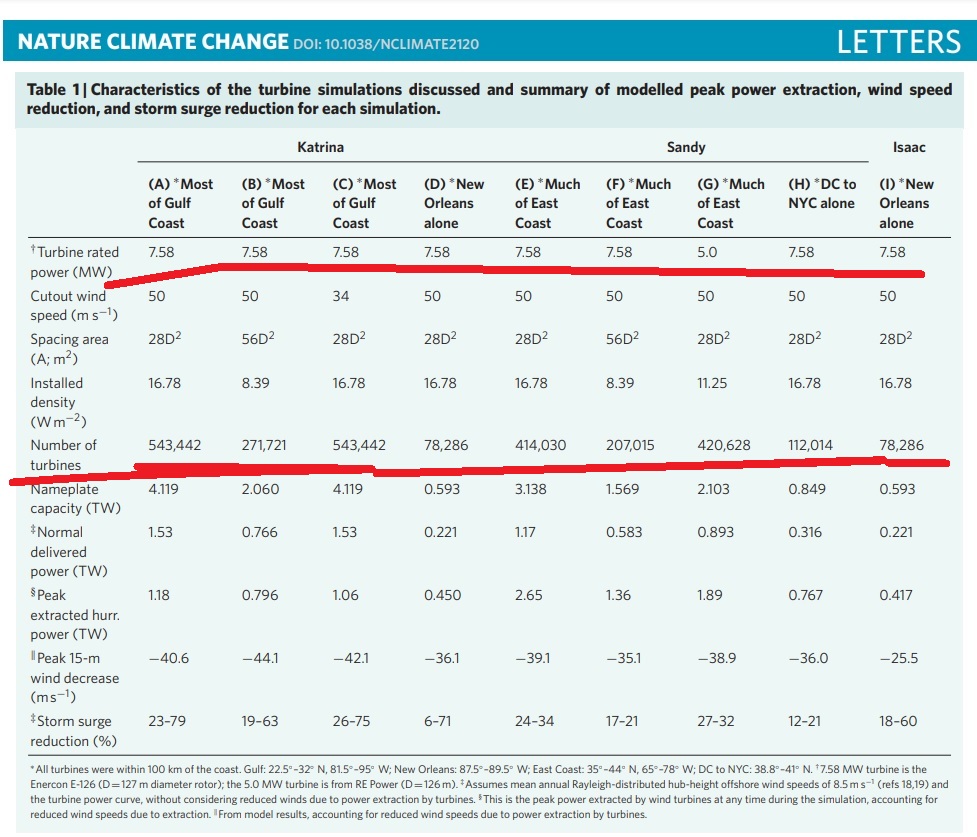
There’s one more thing I have to get in. Jacobson made a tweet where he said Florida should think twice about banning offshore wind. He quotes one of his studies about “taming hurricanes with arrays of offshore wind turbines”. It’s from 2014 and I’ve taken a brief look at it before and been suspicious of it. I just looked it over again and found the money shot! He has a table where he has various scenarios for several hurricanes where he blankets the Gulf of Mexico with about half a million 7 and a half MW offshore wind turbines:


Jacobson is such a charming fellow. On Twitter he said that you can’t trust any scientist who is funded by “Big Oil”.
I pointed out that Exxon/Mobil funded the Stanford University climate department (where he works) to the tune of ten megabucks, and asked if that meant he can’t be trusted …
… he immediately blocked me.
Can’t have people posting the truth in Markworld.
w.
LikeLiked by 2 people
I actually had to work to get blocked by Jacobson. Looking back I wish I’d been more polite:
https://canmancannedcomments.blogspot.com/2016/07/mark-jacobson-has-blocked-me-on-twitter.html
LikeLike
Interesting. Two thoughts:
LikeLike
“In other Jacobson news, he recently wrote a letter to the editors of the Wall Street Journal claiming that states with high proportions of renewable electricity have lower rates.”
Considering Jacobson’s charts are of California and boasts about its renewables, it’s amazing that California’s electricity prices are so high.
By far the highest of the contiguous states, at 32.56c/kWh for residential customers. Compared with the US average of 16.62c/kWh. The only state with higher prices is Hawaii.
https://www.eia.gov/electricity/monthly/epm_table_grapher.php?t=epmt_5_6_a
LikeLiked by 1 person
Mark, I think batteries do have value for the grid by offering fast response buffering. While light water nuclear plants can be ramped up and down, it’s better to run them flat out and in most cases they are.
LikeLiked by 1 person
Very serious fire at a California gas plant and Lithium battery plant — Moss Landing facility:
https://apnews.com/article/battery-storage-plant-fire-california-moss-landing-7c561fed096f410ddecfb04722a8b1f8
Lots of YouTube videos including live feeds:
LikeLiked by 2 people
Reports say the fire is burning in the battery storage area. People are evacuating. Say it’s much worse than previous fires. Say it escalated very quickly.
LikeLike
WUWT has a detailed post:
https://wattsupwiththat.com/2025/01/17/massive-fire-engulfs-moss-landing-battery-plant-triggers-evacuations/
LikeLiked by 1 person
Who would insure a lithium battery plant? I hope no-one has inhaled any of that gunk.
LikeLiked by 1 person
Mark Jacobson plays down the Moss Landing fire in a radio interview:
https://www.audacy.com/podcast/kcbs-radio-on-demand-011f4/episodes/a-professor-weighs-in-on-lithium-battery-fires-d277f
LikeLike
The absolute best comprehensive explanation of what happened at Moss Landing entertainingly delivered by the inimitable John Cadogan:
LikeLiked by 3 people
An evaluation of the “Toxic materials” that “blanket(ed) communities, farms, and a sensitive estuary” is discussed here-
https://tucoschild.substack.com/p/a-net-zero-chernobyl-california-battery
LikeLiked by 1 person
Kakatoa, thanks for that link to an interesting Substack newsletter. Here’s another guy who has a good YouTube channel on Li-ion battery fires:
LikeLike
Mguy has a Moss Landing video where it looks like the EPA is trying to whitewash the lingering after effects. Apparently, Erin Brockovich has taken an interest in the case:
LikeLike