A couple of weeks ago, I was sent a link to a story on ITV.com.
‘It made me cry’: Viral photos of Swiss glacier taken 15 years apart show impact of climate change
It was somewhat surprising to see that a melting glacier had the power to wring tears from someone’s eyes. Landscapes around the world have been trashed on epic and far more emotionally-wrenching scales [insert your own examples here]. At least once a glacier recedes, it leaves behind a landscape that is still wonderful to behold.
I found myself wondering whether the recession of this particular glacier needed to be put in the proper context. And so here we are.
The glacier in question is the Rhonegletscher, or Rhone glacier if you like. Luckily for the seeker after context, there is plenty of history recorded for this particular river of ice. From the evidence of the photographs, the glacier has receded. To find out how much, we need to know the vantage point. I place it at the entrance to the ice grotto (now defunct) just outside the hairpin where the Hotel Belvédère sits. [I could be a little off.] [According to the text at the link, the hotel closed permanently in 2016, “one of the first Swiss victims of climate change.”]
Unfortunately, the most recent Google Earth image is from 2009. Fortunately, that year is also the date of the first photograph of the pair. The glacier’s tongue looks to be about 200 m from the viewpoint, and the glacial lake has hardly begun.
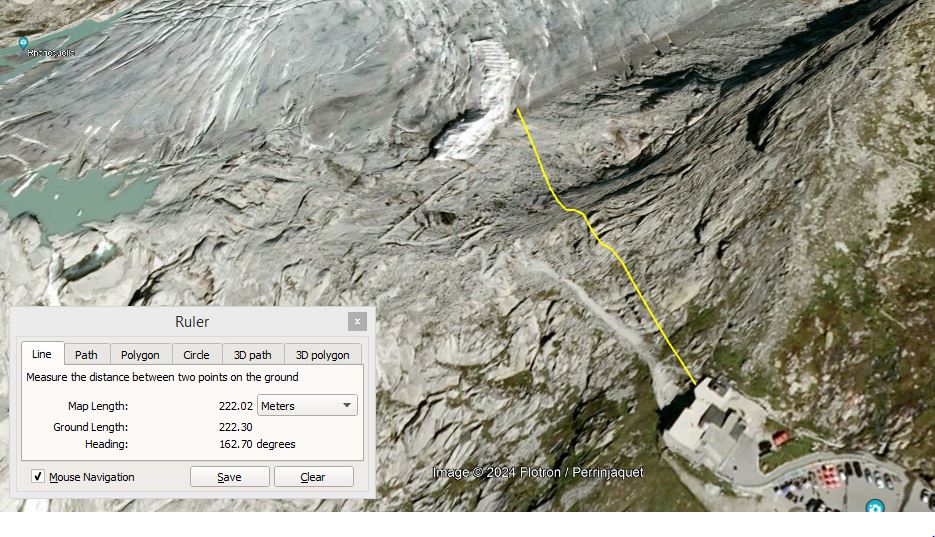
For 2024, I had to resort to the EU’s Copernicus website to get a measurement. Don’t adjust your set! The resolution is now only 20 m, so things are a little foggy. But there’s enough detail to see that the glacier has gone back quite a way, perhaps 300 m. In 15 years, that makes about 20 m per year. The tarn is now quite sizeable.
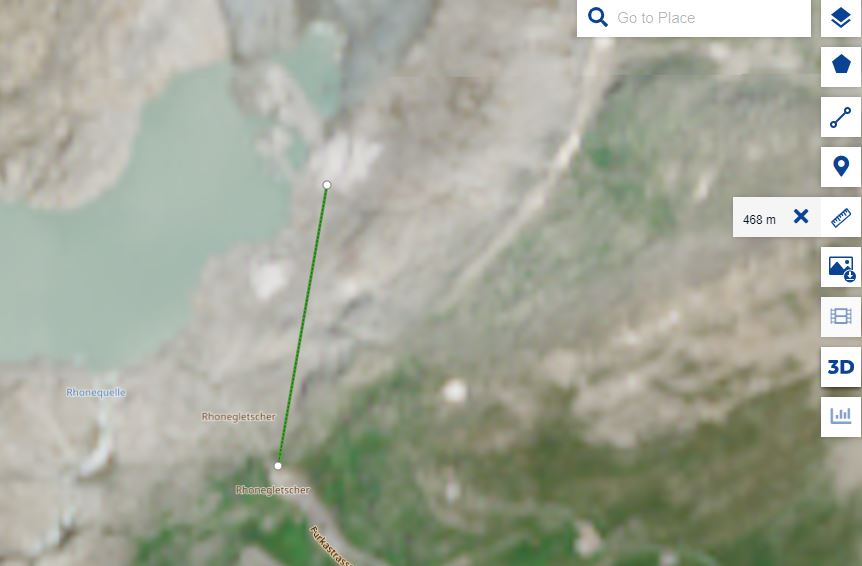
As you can see from this snip, there is a large chunk of the Rhonegletscher left. (Same scale bar at the bottom.)
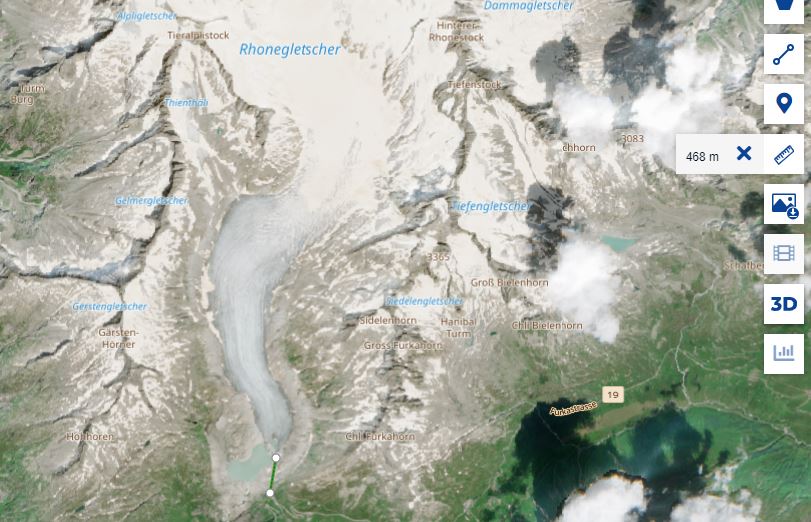
Now for the context.
There is good data on the Rhonegletscher since the late 1880s, and plenty of intermittent observations prior to that. And naturally, there is further context pre-dating the direct record.
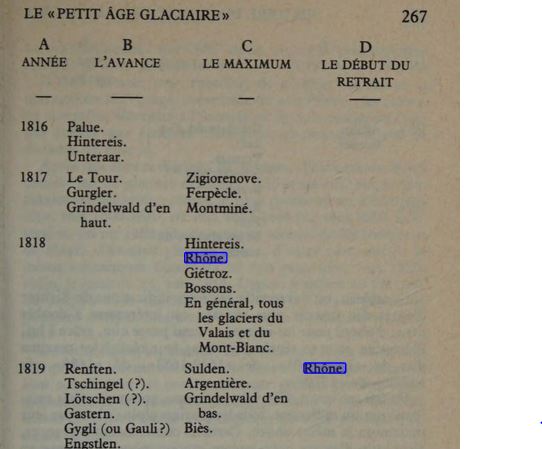
According to Le Roy Madurie [you can read his excellent book on climate since the year 1000 on Archive.org], the Rhonegletscher reached a recent maximum in 1818, & began to recede after that.
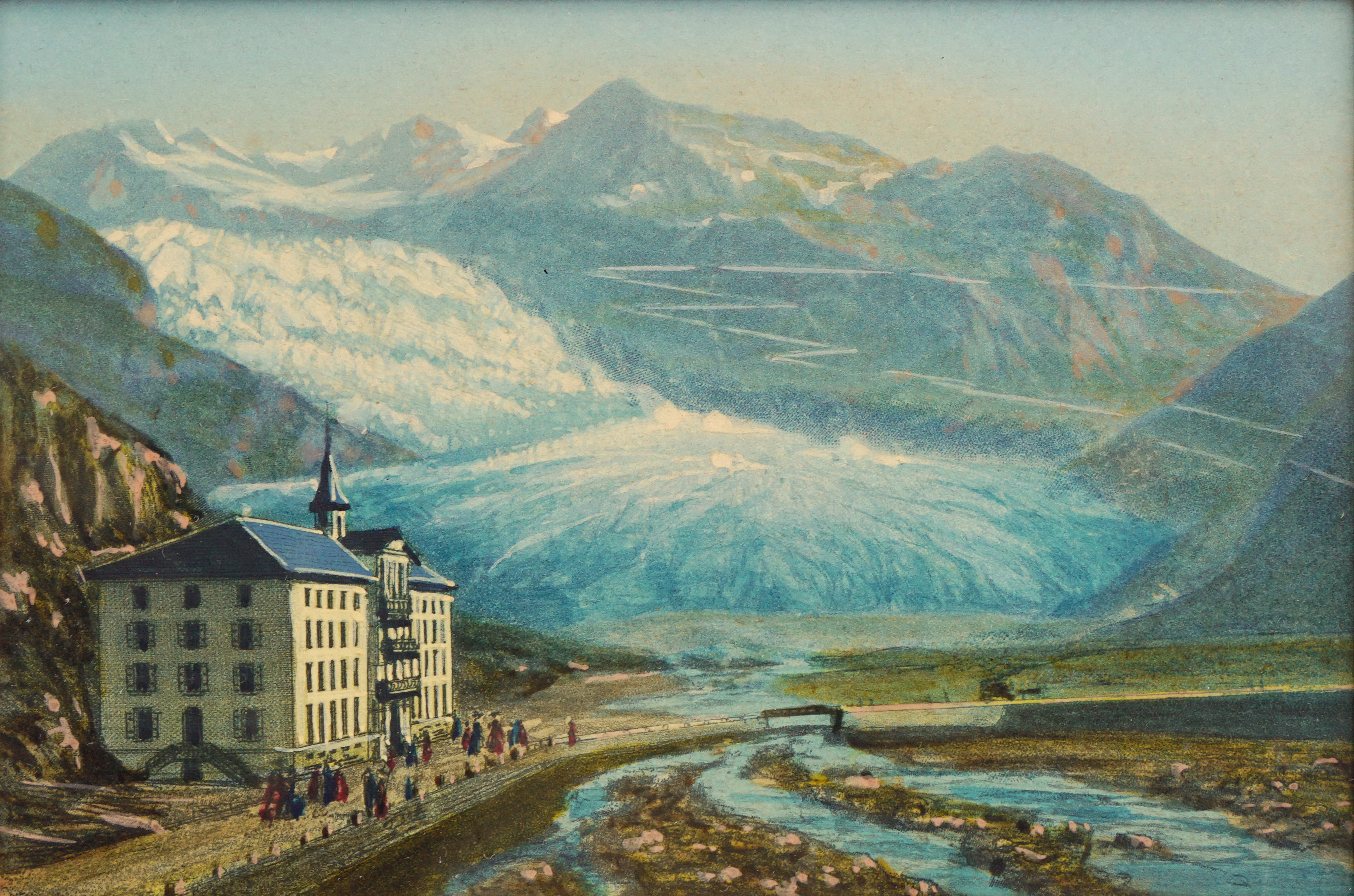
Wiki provides this landscape by Müller in about 1880. In the background, you can see the road leading over the Furka Pass (the Hotel Belvédère, and the modern photographs’ location is at about the third zigzag – the hotel’s construction and the landscape are close to contemporaneous). The location of Müller’s work is a place called Gletsch, which back when consisted of a chapel and the Hotel du Glacier du Rhone.
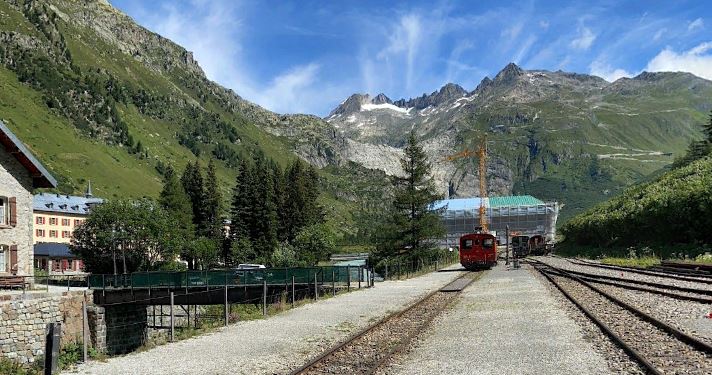
Several helpful souls have uploaded panoramas from modern Gletsch onto Google Earth. From this one by Laurin Eberhard you can still see the hotel, but it no longer has rooms with a view of the glacier. The tongue of the glacier and the tarn is behind the rock sill.
Le Roy Madurie also helpfully provides old maps showing the front of the glacier – the first from about the same time as Müller’s painting, and the second from 1955. By the second map, the glacier’s tongue has rolled back almost to the level of the Hotel Belvédère, as marked.
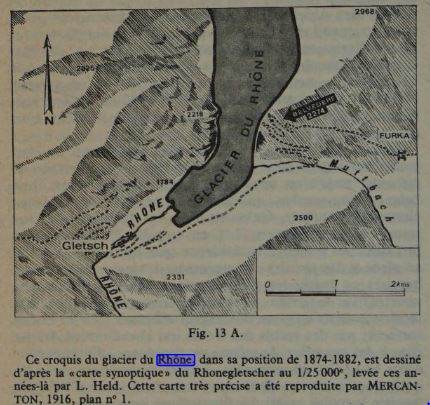
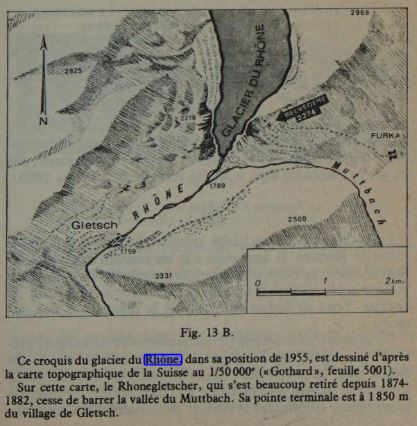
So far, the context we have is of not 15 years of recession, but two centuries.
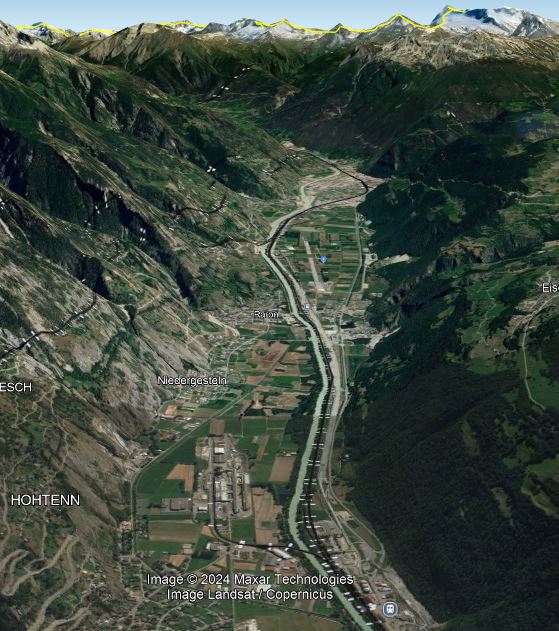
Next, if we zoom out, away from Gletsch and the Hotel Belvédère, we can see the rather impressive Upper Rhone valley in its entirety [Google Earth again]. Students of geography will recognise the landscape. The valley is >100 km long, descending westwards away from the glacier before turning right & opening out into Lake Geneva.

It should not need spelling out, but the settlements and farms that fill the bottom of this rather marvellous U-shaped valley depend for their existence on glacial retreat. Woe betide them if the ice began to advance.
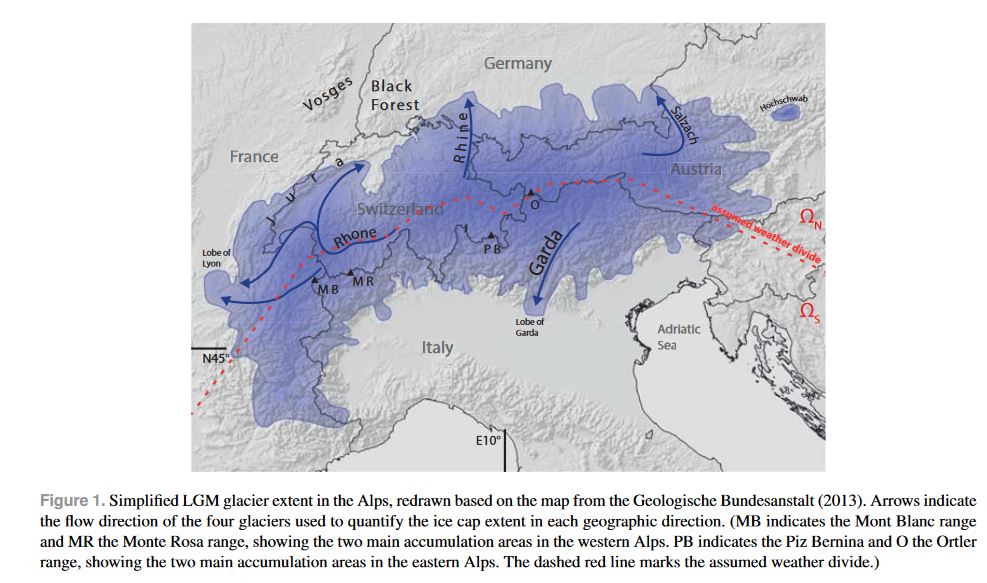
Zooming back still further, and deeper into time, we reach the scale of thousands of years and hundreds of kilometres. 20,000 years ago, the entire Alps was a single vast block of ice. Of course the Upper Rhone valley is filled, and Lake Geneva, Montreux and Geneva itself (where the little isthmus of Switzerland pokes into France under the J of Jura) are under the ice. Smoke on the Water? Not so much. (Figure from Becker et al, 2016.)
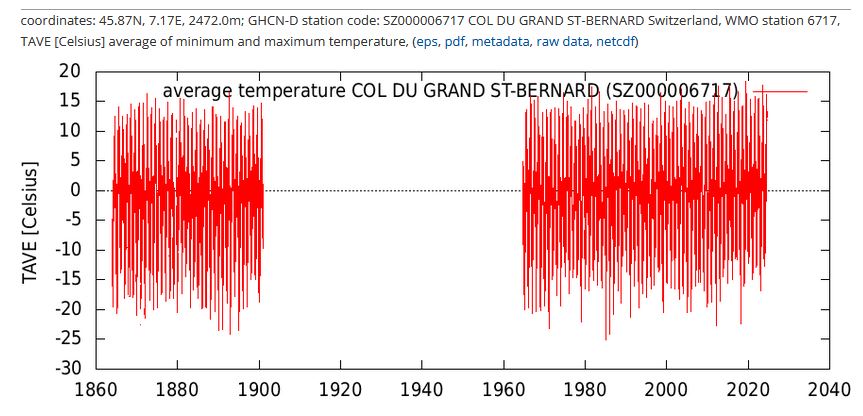
What has caused the recession of the Rhonegletscher? The beginning of its retreat in 1820 could not have been due to a surfeit of SUVs. And yes, temperatures have risen in the last 40 years, but not necessarily everywhere – the below image from KNMI shows the temperature record for the Col du Grand St-Bernard, at the other end of the Rhone valley and to its south, and at about the same elevation as Hotel Belvédère.
Then what? The old glaciologist’s answer is precipitation. The glacier is a conveyor belt loaded with ice at one end, and ablated and melted as it goes before dwindling to nothing. Naturally, storm tracks from the Atlantic vary in their average latitude, determining how much snow falls where. But I cannot help but wonder whether downslope land-use changes have a role to play in reducing the available precipitation: speculation, and something to investigate another day.
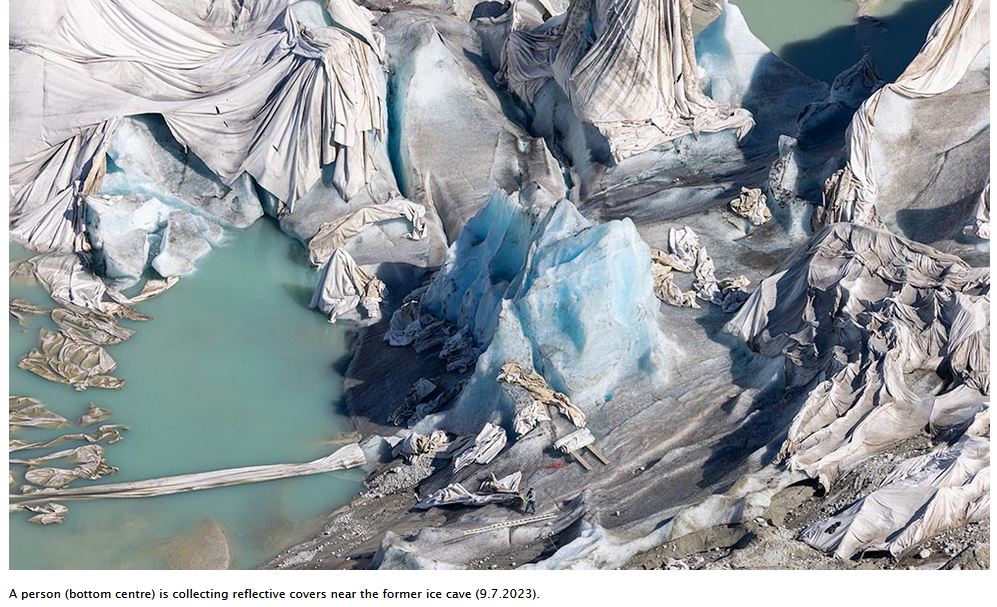
Finally on this topic, I present a futile attempt to wrap the Rhonegletscher in blankets to keep it cold. File under “trashing the planet to save it.” No doubt the proprietor of the ice grotto was upset that the ice receded and ruined their tourist attraction. But in general, few people lose out when the ice retreats.
The owners of the Hotel du Glacier du Rhone may be cheerful should the glacier once again peek over into their part of the valley. But we should be careful what we wish for.
Changes on human timescales can be dramatic, but they are dwarfed by what has gone on before we appeared on the landscape, and what will go on once we have departed it. Our perspective may be that Nature is static, or ought to be. But it never is. Change is the norm, and if the ice isn’t going…
…it’s coming.
 Climate Scepticism
Do you get any sense that the glacier surface is less white now than in the old days? It may be the artists’ fancy or maybe they painted what they thought ought to be there, but my impression from old alpine landscapes is that glacier albedo, especially near the tongue, was a lot higher than nowadays. In the Barber Institute in Birmingham there’s a striking painting by Thomas Fearnley of the Grindewald glacier which he depicts more like a meringue than a glacier. Anyway, grubby glaciers especially down near their outlet could be a factor in modern retreat and possibly testable by comparison with more pristine parts of the world. Has it ben looked at?
LikeLiked by 1 person
This is some of the best research on Alpine glaciers
LikeLiked by 1 person
More on European glaciers here
https://rclutz.com/2022/06/07/europes-alps-from-white-to-green-and-back-again/
LikeLiked by 1 person
A long-term view certainly helps. This article, written almost 40 years ago, provides some useful perspective:
“Don’t Build On A Glacier’s Right-Of-Way”
https://www.gi.alaska.edu/alaska-science-forum/dont-build-glaciers-right-way
The spectacle of a glacier bulldozing its way through an Alpine village or a freeway may be great stuff for a TV melodrama, but how plausible is such a scenario in reality? Perhaps surprisingly, the answer is that it has happened quite a few times in recorded history.
Most documented cases involve medieval villages that had first been settled before the “Little Ice Age” of the 17th century. Although the glacial hazards of the Little Ice Age originated with the beginnings of climatic deterioration in the 13th and 14th centuries, it was not until around 1600 that advancing ice started to damage and destroy buildings in the French and Swiss Alps.
When colonization of the Alps began, the decision to settle and farm seemed reasonable because the glaciers at the time were small and far away. But between 1600 and 1650, at least half a dozen villages in the Chamonix valley of France were overrun. Many others suffered damage due to glacial flooding and avalanches, and some were simply abandoned out of despair.
Somewhat later, during the first part of the 18th century, the cycle of glacial advance arrived in Norway and Iceland. Here, as in the Alps, homes and buildings were abandoned as the ice approached. One tragic incident involved the occupants of a farming community that was threatened by Norway’s Abrekkebreen glacier in 1728. The entire group moved to a location that the people thought was safer, only to have their new homes wiped out by an avalanche. There were only two survivors….
And glacial advance has occurred in Alaska surprisingly recently:
...In more recent Alaska history, the most worrisome threat posed by glaciers was probably that faced by the Copper River and Northwestern Railway during the early part of the century. This railroad, which connected Cordova with the Kennicott Copper Mines in the Wrangell Mountains, followed the Copper River valley on which Miles and Childs glaciers were encroaching in a pincers movement from the east and west. Geological evidence showed that the glaciers had coalesced on the right-of-way at least once during the past several centuries. As recently as 1885, the nose of Miles glacier had stood only about 120 yards from the site of the “Million Dollar Bridge” across the Copper River. (The bridge was so named because of the extreme difficulty with which it was built during the period from 1906 to 1910 — actually, it cost more.)
Between 1885 and 1908, both glaciers had receded to provide a gap of over three miles, but rapid advances during construction of the bridge narrowed this to about two, and Childs glacier surged to within less than 500 yards in June of 1911. If the larger Miles glacier had advanced at the same rate, the ice front would easily have engulfed the bridge….
LikeLiked by 2 people
“Switzerland and Italy redraw border due to melting glaciers”
https://www.bbc.co.uk/news/articles/cgk7r0rrdnmo
…Large sections of the Swiss-Italian border are determined by glacier ridgelines or areas of perpetual snow, but melting glaciers have caused these natural boundaries to shift, leading to both countries seeking to rectify the border….
LikeLike
This is very sad, though no worse, in its way, than when Alpine villages were engulfed by expanding glaciers during the Little Ice Age:
“Glacier collapse buries most of Swiss village”
https://www.bbc.co.uk/news/articles/cnv1evn2p2vo
...Climate change is causing the glaciers – frozen rivers of ice – to melt faster and faster, and the permafrost, often described as the glue that holds the high mountains together, is also thawing.
Drone footage showed a large section of the Birch glacier collapsing at about 15:30 (14:30 BST) on Wednesday. The avalanche of mud that swept over Blatten sounded like a deafening roar, as it swept down into the valley leaving an enormous cloud of dust.
Glaciologists monitoring the thaw have warned for years that some alpine towns and villages could be at risk, and Blatten is not even the first to be evacuated....
Undoubtedly it’s climate change, but some of us remain sceptical, given the time period over which glacial retreat has been taking place, as to the extent to which it’s man-made rather than natural.
LikeLiked by 1 person
“Melting glaciers threaten to wipe out European villages – is the steep cost to protect them worth it?”
https://www.bbc.co.uk/news/articles/cj4w9ggzxv4o
LikeLiked by 2 people
The BBC, however, does want to talk about it. Every day, if possible.
Yet again a distant observer can’t help but think that valley-bottom villages are going to be more afraid of advancing glaciers than retreating glaciers. However, it seems to be the notion that, were it not for evil humanity’s addiction to fossil fuels, the glaciers would neither be advancing nor retreating. We’d be in the Goldilocks zone of everything perfect, all of the time.
LikeLiked by 3 people
“‘Like walking through time’: as glaciers retreat, new worlds are being created in their wake
As Swiss glaciers melt at an ever-faster rate, new species move in and flourish, but entire ecosystems and an alpine culture can be lost”
https://www.theguardian.com/environment/2025/sep/13/switzerland-alps-fiesch-aletsch-glaciers-retreat-ecosystems-mountains-culture-aoe
…People here once feared the monstrous ice streams, describing them as devils, but now they dread their disappearance...
…At a place called Baseflie, a cross still stands, erected in 1818 to banish the Aletsch glacier when it threatened pastures. Today, the wooden silhouette against a blue sky seems like a memorial to all that may be lost as glaciers vanish.…
It seems that, like the temperature, glaciers have to be “just right”. I wonder how we manage to fix the temperature and the size of glaciers on a 4.5 billion year old planet, where both have constantly fluctuated?
I live on the edge of the Lake District. My walks regularly take me on to the hills via the formerly glaciated valleys – the whole place is a lesson as to the effect of glaciation. It’s worth bearing in mind that perhaps as recently as 20,000 years (or less) ago, the place where I type these words was covered by an ice sheet half a mile deep.
LikeLiked by 2 people
Whole ecosystems at the margins of continental glaciers were wiped out in Europe and North America as the glaciers receded, sometimes slowly, sometimes very rapidly at the end of the last Ice Age. In the ice carved u-shaped valleys and the peaks which separated them, following their complete disappearance, whole new ecosystems evolved and thrived. But you can’t expect Guardian journalists to understand nature, evolution or natural climate change – they’re too fixated on climate communism to worry about science and data. Me, I’m just worried about entire ecosystems on south facing glacial slopes being covered in glass and lined with towering monstrosities made of steel and fibre-glass – in order to prevent ‘entire ecosystems being lost to climate change’. Weird, I know. But Nature will have her wicked way in the end and the vainglorious fingerprints of a race of men who arrogantly thought they could tame Nature will be erased from an ever-changing landscape; in fact, they already have been, in a far distant future we cannot perceive because we are trapped in our own little bubble of illusory Time. Pity this poor race of men. Pity us, if we cannot escape their grasping lies and grand delusions. So when I look out across the green valleys and shimmering clouds edged with the glow of the sun, I worry, but I see the eternal and the everchanging glory of a natural landscape which triumphs always over the human fleas which live on its back and which bite occasionally.
LikeLiked by 2 people
“The before and after images showing glaciers vanishing before our eyes”
https://www.bbc.co.uk/news/articles/ce32ezzq6zlo
The before and after photos are undeniably dramatic. But then, as the BBC acknowledges:
…Glaciers have grown and shrunk naturally for millions of years, of course.
In the cold snaps of the 17th, 18th and 19th Centuries – part of the Little Ice Age – glaciers regularly advanced.
During this time, many were considered cursed by the devil in Alpine folklore, their advances linked to spiritual forces as they threatened hamlets and farmland.
There are even tales of villagers calling on priests to talk to the spirits of glaciers and get them to move up the mountain.
Glaciers began their widespread retreat across the Alps in about 1850, though the timing varied from place to place….
It’s difficult to reconcile that with this (later in the same article):
...Without humans warming the planet – by burning fossil fuels and releasing huge amounts of carbon dioxide (CO2) – glaciers would be expected to be roughly stable.
“We can only explain it if we take into account CO2 emissions,” confirms Prof Marzeion....[my emphasis].
LikeLiked by 1 person
Of course, the devil of the day is carbon dioxide, and everything can be blamed on that. Precipitation fuels the glacier. Sunshine melts it. But changes in those forces cannot be blamed on middle-class humans driving a petrol SUV.
LikeLike
Today’s PM, and the peril of avalanches. Are they getting worse because of climate change? asked Evan. Yes, said the professor from the Royal Met Soc (I missed her name). She then gave several obviously spurious reasons that climate change has definitely made avalanches work.
I say “spurious” based on the logic that the boundary between snow and not snow might change its position over time “with climate change”, but just as when the sea creeps up or down the shore, the extent of that interface is rather similar. Snow falls in winter, and melts in spring, and sometimes it collapses in large chunks.
Of course, if our children ever forget what snow is, then maybe there’ll be fewer avalanches?
LikeLike
Avalanches being made worse or more likely by climate change? Pull the other one:
“Lewes Snow Drop 1836
The deadliest avalanche in British history took place, not in the mountains of Scotland or Wales as you may expect, but in 1836 in the town of Lewes, Sussex, just a few miles from the south coast of England…”
https://www.historic-uk.com/HistoryUK/HistoryofBritain/Lewes-Snow-Drop-1836/
LikeLiked by 1 person
“More than 90 deaths this season: Are we seeing more avalanches?”
https://www.bbc.co.uk/news/articles/cn4gjqv7vl3o
The answer would seem to be “no”:
…Though the recent spike in avalanche deaths in Europe is worrying, it is not exceptional – according to European Avalanche Warning Services, 95 have died so far this season, compared to 70 in the whole of 2024-24 and 87 in 2023-24. The 2020-21 season, when 131 died, and 2017-18, when the figure was 147, seem comparable.…
The the BBC asks whether climate change is to blame, and sets out to suggest that it is:
…Is climate change to blame?
Climate change might seem an obvious culprit for the unstable weather conditions that have brought them about.
“There is evidence that climate change will lead to sharper, more intense precipitation followed by long periods without,” Simon Mason, senior scientist at SEI US, told the BBC.
This would seem to be the case in Europe, which has recently had several seasons with lower than average snowfall, and some dry periods in the early part of this season.…
But then it goes on to pull the rug from beneath that argument:
…“However, since many factors control avalanche risk and precipitation is only one controlling influence, it is difficult to conclude how risks may evolve with future climate change,” Mason said.
Climatologist Christoph Marthy told Swiss outlet SRF the current Alpine winter – with weather until recently dominated by high pressure and several long, dry periods – is exactly the opposite of a typical climate change winter….
My conclusion regarding the article – reasonably balanced overall, and fairly well-researched and quite interesting. But the attempt to link avalanche risks to climate change is pretty shabby. Try reading this:
“Avalanche fatalities in the European Alps: long-term trends and statistics”
https://d-nb.info/1140618458/34
…During the last four decades, about 100 people lost their lives each year in the Alps. Despite considerable inter-annual variation, this number has remained relatively constant in the last decades. However, exploring fatality numbers by the location of the victims at the time of the avalanche revealed two partly opposing trends. The number of fatalities in controlled terrain (settlements and transportation corridors) has decreased significantly since the 1970s. In contrast to this development, the number of fatalities in uncontrolled terrain (mostly recreational accidents) almost doubled between the 1960s and 1980s and has remained relatively stable since then, despite a strong increase in the number of winter backcountry recreationists. Corresponding to these trends, the proportion of fatalities in uncontrolled terrain increased from 72 to 97 %. These long-term trends were evident in most national statistics.…
LikeLiked by 1 person
Seems to me Skiing Off-Piste is the main factor in deaths. No expert on this, but get the thrill of Skiing away from the crowd, but it always has dangers.
LikeLike
“Austrian glaciers disintegrating due to climate change, say scientists”
https://www.bbc.co.uk/news/articles/cd038pgrr1yo
…“Climate change has long been a reality in the Alps, and we are experiencing its consequences… right now,” Nicole Slupetzky, Vice-President of the Austrian Alpine Club said.…
Climate change has long been a reality in the Alps. That’s true. There is no doubt that the glaciers are shrinking. I climbed Mont Blanc back in the early 90s with someone who had then been climbing in the Alps for perhaps 30 years, and he was clear then that the climate in the Alps was changing. Things have certainly changed since I was there then, and that’s a dramatically short time scale. But is it all bad news? I suspect the Alpine villagers whose homes and livelihoods were threatened by the advance of glaciers in the Little Ice Age would be more than a little bemused by the hysteria about their retreating. For anyone who would prefer to know about history, this makes an interesting read:
“Alpine Glacier Reveals Ecosystem Impacts of Europe’s Prosperity and Peril Over the Last Millennium”
https://agupubs.onlinelibrary.wiley.com/doi/10.1029/2021GL095039
LikeLiked by 1 person