Recently, Paul Homewood and Ray Sanders have been pointing out the unfortunate positioning of some of the Met Office’s temperature stations (e.g. here). A particular issue that has arisen is that of siting a station in the vicinity of a solar farm.
It seems obvious that such a placement is inappropriate and that the temperature sensor there will read high. Will it? An elementary understanding of physics (all I claim to own) leads to the conclusion that it will. However, there are complications. A primer follows, with reference to a couple of papers from the literature.
The Sun
The Sun sends a lot of energy whizzing through space. The idea of solar panels is to capture as much of it as possible – hence the name. Photons that come from the Big Yellow Thing strike the ground, or the solar panel if there is one. It seems axiomatic that the solar panel is darker than the ground, i.e. it has lower albedo. It’s designed that way. Because it reflects less sunlight, more energy is absorbed by the solar panel than the ground nearby, or the ground before. Therefore, without even thinking about it, it’s obvious that a solar farm is hotter than the field it sits on would have been otherwise. Right?
What happens when you absorb energy? You get hotter. The solar panels get hotter than the ground does. Three factors are favouring that trend: the solar panel has a lower albedo and absorbs more sunlight; it is thin and has a low thermal mass; and it is oriented closer to perpendicular to impinging sunlight than the ground is. If the solar panel gets hotter than the air, it transfers energy to the environment by convection and by emitting infrared photons.
Complication 1
The solar panel sends some of the energy it has absorbed out of our reference frame. The generated electricity might be 10% of the incident light. Naturally the exported energy reduces the heat island effect. It may even be potent enough to cancel it out altogether.
Complication 2
The solar panel shades the ground below it, which is therefore likely to be cooler than it would have been before the solar panel was there. It is now warmed, not by the visible light from the Sun, but by the IR emitted from the back of the panel, plus by contact with the warmed air between panel and ground.
On the other hand, at night, IR photons emitted from the ground are likely to bang into the solar panel above them, and the replacement rate of the air will be lower. These effects result in throttling the night time temperature drop: the open ground will cool faster than the ground under the panel… even though it didn’t get as hot in the first place.
Complication 3
The ground has a higher thermal mass than the solar panel, which results in it gaining and losing temperature more slowly anyway. The ground is likely to be wet, and energy will be diverted into evaporating water molecules (latent heat). Rooted plants are likely to be present, and will lose energy by transpiration.
Finally, if the solar farm was built on an actual farm… well, some of the time the field was in fact bare soil, with a low albedo (depending on soil type). In the summer of course, when records are there to be broken, the field may well have been straw yellow, with a relatively high albedo.
Data-free upshot
The result of these elementary thought bubbles is that solar panels will get hot during the day and transfer some of that heat to the air, thereby creating a photovoltaic heat island. At night, the panels will cool rapidly and cool the air around them, but will slow the cooling of the ground. I would predict that maximum temperatures measured near the solar farm will be higher than over a nearby field.
Leaping energetically out of the armchair and into the real world
What has been measured, and does it confirm my predictions? The only research I was aware of was Barron-Gafford et al 2016, which did indeed find a photovoltaic heat island effect:
We found temperatures over a PV plant were regularly 3–4 °C warmer than wildlands at night, which is in direct contrast to other studies based on models that suggested that PV systems should decrease ambient temperatures.
And this is at night, when there are reasons to suppose that the solar farm would represent a “photovoltaic cold island.” Given what I’ve outlined above, we can guess that although the ground beneath the panels in Barron-Gafford et al was shaded and cooler by day, it was also sheltered and slower to cool at night. How does this translate into such a large effect, if this is its cause? Unfortunately, Barron-Gafford et al are not completely clear on that themselves. With only a thermometer for company, much of what happened had to be inferred. What is clear though is that in the hottest months – July snipped here for an example – the solar farm was hotter all day and all night (red); in contrast, the car park (open) had a much lower heat island effect (compare to desert, closed).
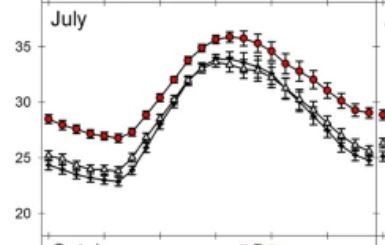
This more significant warming under the PVHI than the UHI may be due to heat trapping of re-radiated sensible heat flux under PV arrays at night.
Yes, but the ground is likely to be cooler in the day because it is shaded from the sun, and there should be less energy to re-radiate as infrared. It’s a confusing picture. But if you belong to one of the many groups trying to halt solar farms in their neighbourhood, it’s certainly a study to cite. Although it seems that the SoS is inclined to ignore evidence. 2016 was a long time ago: someone must have picked up Barron-Gafford’s baton and run with it?
Searching through articles that cited Barron-Gafford et al, I came across Fassbender et al 2023. Fassbender et al wanted to investigate the effect of photovoltaic panels on roofs in the built environment, and compared two green roofs in Munich, one with solar panels and one without, and otherwise identical. They covered the roofs with thermistors and installed a hygrometer, an anemometer, a pyranometer, a pyrgeometer, heat flux plates, thermocouples and something to measure soil water. After assessing the obvious things – whether the PV array created a heat island – they used the data from their sensor array to infer energy flows. Fassbender et al is what you might call a mini Meisterwerk of basic science. Well done to them for actually measuring stuff.
The air above the PV roof was hotter during the day, and colder at night:
The differences reached an absolute maximum of +1.35 K (daytime) and –1.19 K (nighttime) on a warm day (maximum air temperature: 28.3 °C) with a maximum downwelling shortwave radiation of 661.8 W/m2.
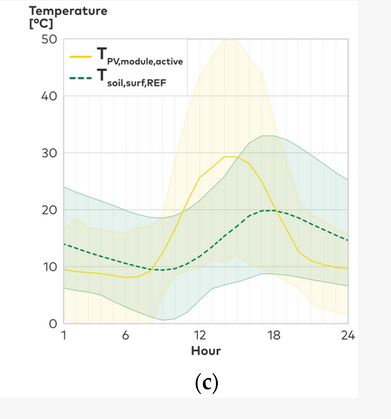
Their Fig 9c shows the surface temperature of the PV modules vs the control roof. The PV modules heat up rapidly in sunlight, but cool rapidly at night. The green roof has a more damped response (but one that is probably a lot more rapid than natural soils, because of how shallow the green roof soil is).
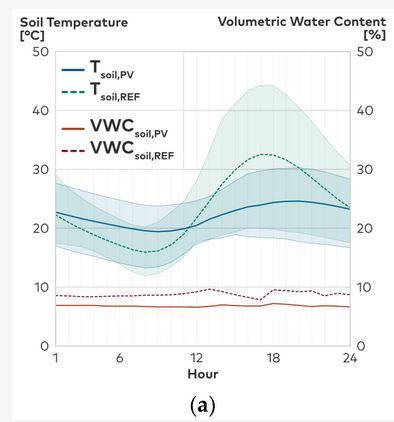
In Fig 14a, Fassbender et al show the effect of shading by PV panels on the (green roof) soil temperature. Daytime shading keeps it cooler under the panels, but reduced sky view means that it loses less temperature by night, and is warmer than the control roof then:
The chief way that energy is transferred to the air is by convection (Fassbender et al’s Figure 12a snipped):
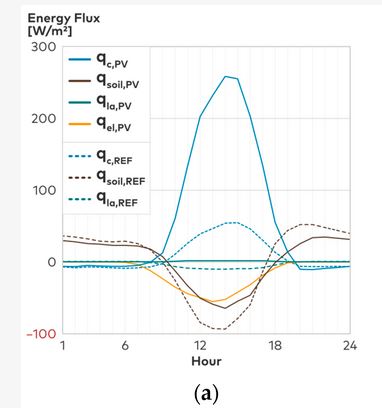
The sensible heat fluxes of the PV roof (qc,PV) are higher than those measured on the reference roof (qc,REF), reaching positive values of up to 254.91 W/m2 (monthly average) in September at 2 p.m. during the day.
Well, it would be fair to say that Fassbender et al’s findings are what I would expect as a bubble head: day time heating and nocturnal cooling.
Next, and finally, I read Xu et al, an even more recent publication (2024). Xu et al used the MODIS instrument on the Terra and Aqua satellites to compare the land surface temperature at solar farms and adjacent sites. Their result?
SFs produced a strong cooling effect of −0.49 ± 0.43 K in the annual mean land surface temperature during the daytime and a weaker cooling effect of −0.21 ± 0.25 K during the nighttime.
This curious result sent me rifling through MODIS algorithm documentation to explain it. I won’t bother you with that here; this is already long enough. Part of the problem may be the relative emissivity of the surfaces (as Xu et al note). They put the night time cooling down to the processes I summarised above, and the day time cooling down to the exported electricity (they measured a very small decrease in albedo across their sites, which was more than offset by the photovoltaic effect).
But also perhaps significant is that the MODIS instrument is measuring the infrared emitted from the ground, not the temperature of the air. While this should (bubble-headed) show a marked increase from the baseline during the day, the heat island effect will be mostly caused (as seen above) by convection. Even if the solar panels were, in fact, hotter than the nearby open ground, MODIS may not read the (day time) solar farm as hot. Not all the solar farm is solar panels, and the part that is not solar panels is probably in shade (it’s shaded by the panels themselves). Also, the solar panels are set at an angle, such that the amount of energy reaching the instrument 700 km up is reduced (it’s the cosine of the angle of the solar panels from the horizontal, which is controlled by the latitude of the solar farm). The pixel size of the sensor is huge – it’s either 500 m or 1 km, I can’t remember which. Thus even a pixel which entirely consists of a solar farm is going to be partly the shaded ground between the panels.
TL;DR
There are basic reasons to suppose that solar farms will produce a photovoltaic heat island, particularly during the day. If you dig around in the literature, you can find publications that support that premise, as well as publications that counter it. The articles discussed above found the following:
Barron-Gafford et al, 2016: warming by day and night.
Fassbender et al, 2023: warming by day and cooling by night.
Xu et al, 2024: cooling by day and night.
 Climate Scepticism
Science, eh?
Warming by day and night; warming by day and cooling by night; or cooling by day and night.
Whichever conclusion is correct, or whether they are all correct at different locations at different times, there does seem to be one firm obvious conclusion: these are not appropriate places to locate Met Office weather stations.
LikeLike
“Science Shock: Met Office Continues to Site New Temperature Stations in Junk Locations”
https://dailysceptic.org/2024/07/18/science-shock-met-office-continues-to-site-temperature-stations-in-junk-locations/
…Ray Sanders has been diligently researching the siting of Met Office stations. The situation at Neatishead clearly appals him since its recent siting was in a heavily-shaded location adjacent to a radar dome. Another new site in Kent is next to agricultural poly tunnels that change throughout the year. Others include sites in walled gardens deliberately intended to form micro climates of enhanced warmth, co-located with National Grid sub-stations, surrounded by newly-installed solar farms, in car parks and, “most absurdly, in exceptionally close proximity to aircraft”….
LikeLike
Needless to say today’s high temperature (the hottest day of the year so far) was at Heathrow. They really are shameless.
“UK’s hottest day of the year so far”
https://www.bbc.co.uk/weather/articles/cn07jrm86l4o
LikeLiked by 1 person
What exactly is wrong with identifying Heathrow as the location with the hottest temperature? Surely we are not challenging the fact that the temperature recorded there was the highest in G.B? In all the years where Heathrow has been so identified, I have never heard the measurement identified as being “natural”, and often mention is made of the unusual character of the neighbourhood.
If I were still flying out of Heathrow I would be reassured that local temperatures were measured and predicted. Air temperatures do have significance in terms of predicting airworthiness.
if I still lived in London, I would hope that temperatures predicted would include their heat island component, because it would be that which I would experience.
LikeLike
Alan, as it happens the story has moved on, with St James’ Park in London now said to be the hottest place today, which is fair enough (though being in the centre of London, there will still be some UHI effect).
The point about complaining that Heathrow is so often the place cited in support of “record” temperatures (this time the hottest day so far this year) is that they are really “false” records. Why is Met Office equipment even sited at inappropriate locations? If it’s getting hotter, and if that’s due to man-made climate change, so be it, but the Met Office, BBC et al shouldn’t pretend it’s worse than it is by citing temperatures at locations that don’t meet WMO standards.
LikeLiked by 1 person
I suspect the average man in the street (especially in London) would be marginally interested in how hot it got and where the maximum temperature was experienced. And regardless of the contributory causes. In the same way that during the winter the lowest temperatures are identified.
LikeLiked by 1 person
The wind turbine heat island also exists apparently, according to this piece in the Harvard Gazette, 6 years ago:
Also this…
I have not read the source publication. I suppose there is a good chance this was on the radar back when, but that I have missed/forgotten it.
LikeLike
This thermal image of a damaged solar farm in Florida shows hotter areas in yellow that are no longer exporting electricity (from Ric Werme at WUWT under this story: Lake Placid Solar | Hurricane Milton damage).
LikeLike