Giant wind farm (2.4 GW) Hornsea 3 was permitted by the BEIS SoS (Alok Sharma) at the end of 2020. Despite acknowledging that the wind farm was going to kill kittiwakes (among other things), he felt that other matters overrode such lightweight concerns.
One of these reasons was IROPI – Imperative Reasons of Overriding Public Interest.
In arriving at his conclusion, the Secretary of State has reviewed how the Development provides a public benefit which is essential and urgent despite the harm to the integrity of the kittiwake feature of the Flamborough and Filey Coast SPA…
Why?
The conclusion is predicated by the principal and essential benefit of the Development as a significant contribution to limiting the extent of climate change in accordance with the objectives of the Climate Change Act 2008. The consequences of not achieving those objectives would be severely deleterious to societies across the globe, including the UK, to human health, to social and economic interests and to the environment.
So much bullcrap. Eff the kittiwakes.
Some number of kittiwakes were going to be killed – not, in the SoS’s view, a serious number. But “in combination” – i.e. with the damage caused by other whirligig developments considered in toto – Hornsea 3 was going to contribute to population decline of the kittiwakes of the Flamborough and Filey Coast SPA. (An SPA is a “Special Protection Area” put in place to protect birds – these were designated as part of the EU’s Natura 2000 network. The UK retains its SPAs as among its highest conservation designations.) To permit Hornsea 3, the SoS had to be confident that there would be no adverse effect on its integrity.
The SoS also had to satisfy himself that “no alternative solutions” were available. Unfortunately, “alternative” here meant a different offshore wind farm. Well, he satisfied himself. I mean, there were no alternatives to Hornsea 3.
The final leg of the journey to a big fat affirmative to Hornsea 3 was compensation. Yes, the SPA’s integrity was going to be compromised. But could the developer show the SoS that it could compensate for the swatted kittiwakes by some cunning scheme?
Well, their first try was Rat Eradication. Give us the wind farm, Hornsea 3 said, and we will kill the rats that infest seabird colonies, and in so doing, improve kittiwake breeding success.
Which might have been a winning proposal for something like puffins, which live in burrows that rats can access; it was not persuasive for the kittiwake’s supporters, who noted that for a bird nesting on sheer cliff faces and whose chicks were therefore not accessible to rats, the Rat Eradication Scheme was irrelevant. It was like a burglar offering to make amends to you by fixing someone else’s window.
Rebuffed but undeterred, Hornsea 3 came back with another offer, this time to develop 4 artificial nesting structures for the kittiwakes. These would in due course be found by birds that could not find any room at the inn on the cliffs at Bempton etc, which would set up home there, and the productivity of the population overall would go up. Perhaps an appropriate analogy this time is that it was like offering to compensate for the building of a dangerous road by also constructing new homes nearby; off-setting mortality by raising fertility.
The SoS’s consent letter specified an
…implementation timetable for the delivery of the artificial nest structures that ensures all compensation measures are in place in time to allow four full kittiwake breeding seasons prior to the operation of any turbine…
He wanted annual reports on
…birds colonising the site; evidence of birds prospecting; nesting attempts; egg laying; hatching; and fledging.
By November 2022 Hornsea 3 wanted to compress the timetable. Four artificial nesting structures available for four breeding seasons was what had been consented. Hornsea 3 wanted
…to allow three full kittiwake breeding seasons in respect of two artificial nest structures prior to the operation of any turbine forming part of the authorised development, and to allow two full kittiwake breeding seasons for the other two artificial nest structures prior to the operation of any turbine…
So instead of 4 structures for 4 years, it’s now 2 structures for 3 years and 2 for 2. In “site-years” it goes from 16 to 10. The SoS said yes. (The RSPB, to their credit, pushed back. Too little too late? Having invited the tiger to tea, how do you object to him putting an extra spoonful of clotted cream on his scone?)
It was in February last year that Hornsea 3 came back with a KIMP – no, nothing to do with a guy in a rubber suit, a “Kittiwake Implementation and Monitoring Plan.” This was developed with Natural England, RSPB, and possibly others. Four locations for kittiwake hotels, or whatever you want to call them, were identified – one off Lowestoft, one off Minsmere (also in Suffolk), one off Hartlepool and a fourth whose location was redacted.
Three artificial nesting structures were built last year by Red7Marine, two off Lowestoft and one off Minsmere.
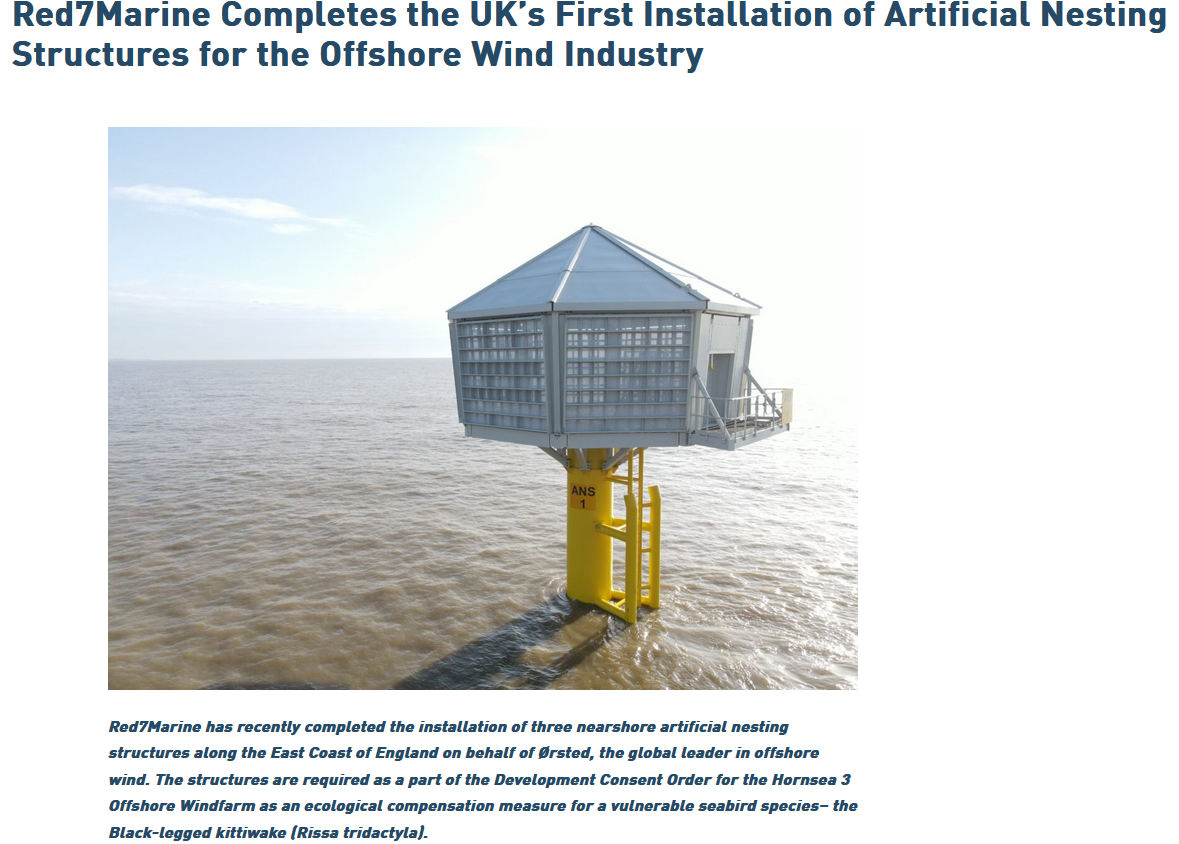
Then, in December last year, Orsted made the decision to proceed with the development. There will be some – ahem – variation in its previously-agreed strike price.
Orsted was last year offered a price for power production at Hornsea 3 of 37.35 pounds ($47) per megawatt hour (MWh) in inflation-indexed 2012 prices. In response to a September auction that failed to attract any offshore bids, the British government announced it will increase the price offered at its next renewables auction, with offshore wind projects to be offered 73 pounds per MWh. Orsted has permission to submit up to 700 MW of the project’s capacity in future bidding rounds, potentially allowing it to double the offtake price. Shares in Orsted, which have more than halved this year after massive writedowns on U.S. projects, rose as much as 5% on Wednesday.
Reuters
This year, Hornsea 3 came back with another variation: three structures for three years, and a fourth before a turbine is switched on (so we’re down to 9 “site-years”). Well, 3 of the structures are already in place. So we wait to see whether they will be used – and more importantly, whether they will arrest the decline of the UK’s kittiwake population. My guess is that the structures will be used, since there are already kittiwakes in Lowestoft using suboptimal nesting locations at the moment (window sills and the harbour wall). Kittiwakes are known to readily use offshore structures like oil rigs already (yes, this does imply that simply not decommissioning an end-of-life rig would have offered prime nesting habitat). I blame the overfishing of sand eels for the decline of this beautiful bird (more on this another day; it’s a complex story, and as well as fishing, there are reports of various climate issues – as a primer, see The Puffin’s Tale). The proliferation of three-horned devils in the seas around this island will make matters worse.
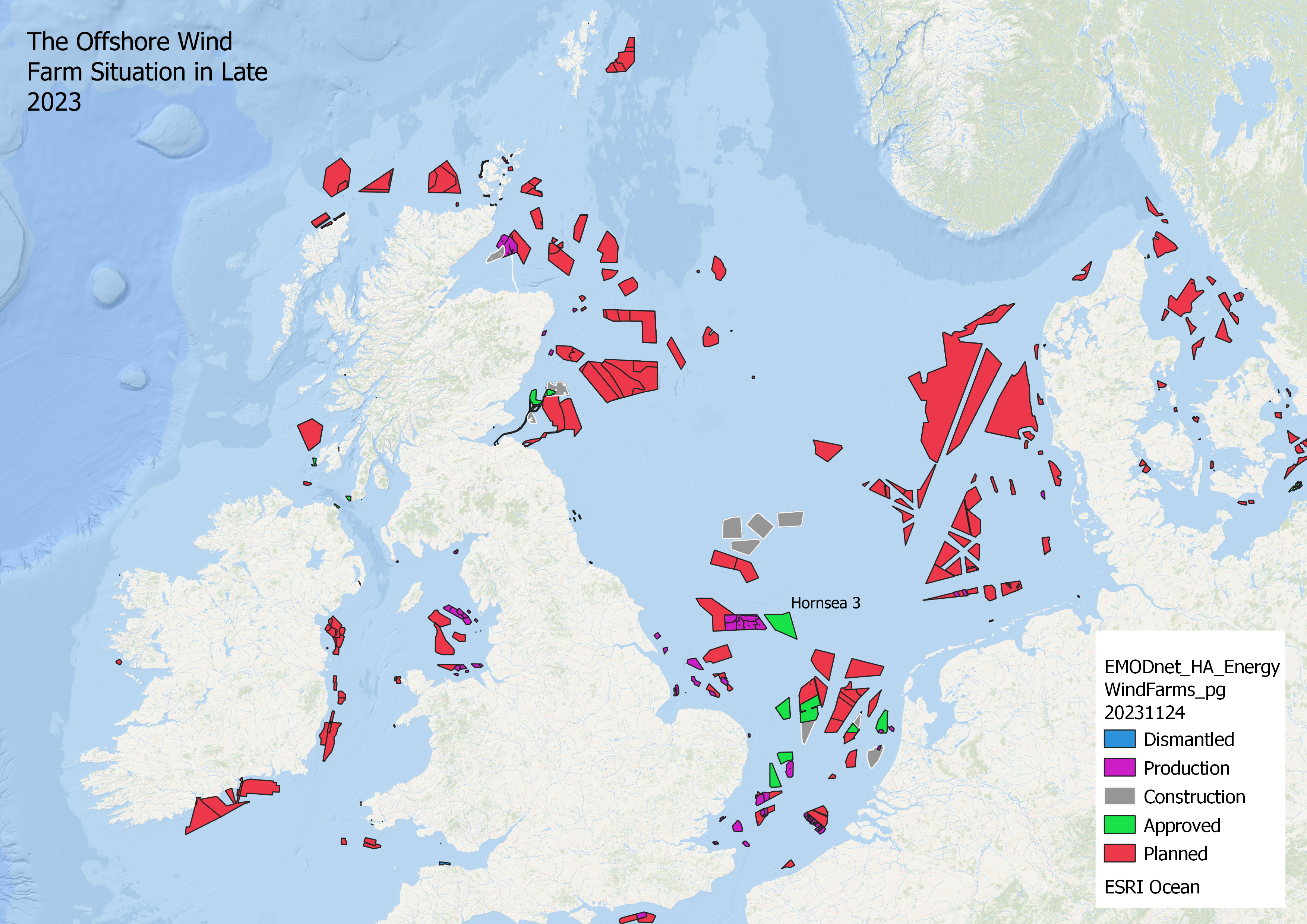
Hornsea 3 is the kite-shaped green polygon (“approved”). Itself a giant, it hardly stands out at all amongst all the planned projects (in red). I don’t know about you, but I become incoherent with rage just looking at this map.
And don’t get me started on the onshore wind farms.


Will the Kittiwake hotels discriminate against other species wishing to avail themselves of luxurious accommodations?
Will there be e.g. bouncers ready to deny access to say human migrants arriving by dinghy?
LikeLike
Thanks for the map – appalling when the industrialisation of our seas is shown so clearly.
LikeLike
Causing actual harm to the environment today in order to save the climate of the future from a non-existant crisis in the future…
LikeLiked by 1 person
Looks like a true case of Air B&B!
LikeLike
Speaking of Hornsea:
“Hull energy boss calls for faster rollout of wind farms”
https://www.bbc.co.uk/news/uk-england-humber-68468759
The BBC, it seems, is always happy to publicise a bit of special pleading:
“The boss of a Hull turbine manufacturer has said the UK is not moving fast enough to build offshore wind farms.
Darren Davidson, head of Siemens Energy, said with the present speed of development, the target of 50 gigawatts of offshore power “won’t be achieved”.
The firm employs 6,000 people across the country, including more than 750 at its Hull factory in Alexandra Dock.
The government said it had a “clear strategy to boost UK industry and reach net zero by 2050”.
Mr Davidson told the Press Association: “I think what we need to do is be at the front end, leading and helping our customers and the Government to come up with plans as to what we can to achieve because, if I’m brutally honest, we’re not fast enough.”…
…As well as the Hull turbine factory, East Yorkshire is home to the world’s largest offshore wind farm off the coast at Hornsea….”
LikeLike
How are wind developers attracting East Anglian kittiwakes
The author of the piece gives a little too much credit to the developers re: the kittiwake hotels – probably leaving the typical reader unaware that they were compelled to build the hotels, rather than doing so pro bono oecologia.
I’ve mailed the journalist with a bit of context.
LikeLiked by 2 people
I’ve just not long since finished watching BBC Look North and an article reporting the first successful nesting of a pair of kittiwakes at a recently built tower at Gateshead. The tower was funded by the Dogger Bank South (DBS) offshore windfarm to mitigate anticipated turbine kills. However, the BBC reporter stated quite clearly that the tower was built to help protect the kittiwakes from population decline caused by climate change. There was no mention of windfarms.
The BBC is a dead loss, and I don’t mean it is pining for the fjords.
LikeLiked by 3 people
Duly hearted, with a heavy heart.
LikeLike
The EDP reports that a single chick has been produced on one of the hotels. It’s late in the year, so it’s perhaps too early to be celebrating. The time to do that is after it fledges.
LikeLike
“Five seabirds added to UK red list of most concern”
https://www.bbc.co.uk/news/articles/c78ljx5lez1o
The casual reader, who doesn’t get beyond the first few paragraphs of the article, would take away this message:
The UK is known for its colonies of seabirds nesting in huge numbers on cliffs – but populations are plummeting amid a host of pressures, from climate change to a lack of food.
It’s only if one persists well down the article that one reads this:
Seabirds are in trouble because of climate change, unsustainable fishing practices, offshore renewable-energy development and habitat loss. [My emphasis].
LikeLike
Mark, on Radio 4 this morning I did NOT hear them mention the off-shore renewables as a factor. Were my ears deceiving me? But I did hear the SSE(?) spokesman talking unchallenged (of course!) about the new wind farms his company had the OPTION to build. Was he hinting, I wonder, that subsidies are still not high enough? Regards, John C.
LikeLike
Energy voice reports on the challenge of discouraging seabirds from nesting on oil platforms which are due for decommissioning:
“Falcons are supporting firms to decommission oil and gas assets in the North Sea, not by supporting those working at heights but by moving along birds who have nested.
NBC Environment brought its gyrfalcon Khaleesi to the show floor of Offshore Energies UK’s Offshore Decommissioning conference on Tuesday to explain how avians like her are keeping sea bird populations safe while UK operators prepare to scrap platforms.
The firm assisted Three60 Energy in the decommissioning of DNO’s Schooner platform last year.
An assessment of the asset in 2021 found there were 224 kittiwake nests, 316 eggs and 307 chicks on the platform and the use of falconry assisted in moving the birds from the site.”
It’s a shame they can’t leave a residual structure as it would provide an excellent seabird habitat, as would the underwater structure for fish. A lot of habitat is going to be cleared as the N Sea operations shut down.
LikeLike
I agree Mike: the platform should be left to the birds – rig nesting is actually a significant proportion of the kittiwake population. And as the rigs are stripped, the nesting area shrinks, until the poor blighters have nowhere to go.
It’s against the law to disturb any nesting bird (Wildlife and Countryside Act 1981), so I hope they knew what they were doing.
LikeLike
A change of tune from the RSPB (at last)? Headline on the website:
“World’s deadliest windfarm? Help save our seabirds from Berwick Bank. The go-ahead for Berwick Bank is a death knell for thousands of seabirds. With many already in crisis, it must be stopped. “
LikeLike
Mike, see my diatribe from a couple of years ago: https://cliscep.com/2023/02/18/the-rspb-is-betraying-its-members/
LikeLike
Jit; thanks for the link to your post which I had not seen before (possibly predates my finding CliScep). It’s an excellent condemnation of the RSPB – and those other organisations. Many moons ago I was a member but resigned in disgust when they endorsed a wind project near their HQ (in Sandy, Bedfords?). I seem to remember they benefitted in some way.
LikeLike
“New project to protect endangered seabirds”
https://www.bbc.co.uk/news/articles/cede35g72d8o
A new programme to protect one the UK’s most endangered seabirds has been announced in Scarborough.
The ‘Protecting Our Urban Kittiwakes’ project is a joint venture between the RSPB and Northern Powergrid.
As part of the project, the birds will be monitored in urban environments where they have made nesting sites on buildings rather than traditional cliff faces.
RSPB senior conservation officer Natalie le Brun said: “The kittiwake is a globally vulnerable red listed species, which means it is of the highest conservation concern.
“Kittiwakes are often misunderstood due to their similarity to the herring gull….“…
I’ve an idea. Stop building offshore wind farms, which kill them.
LikeLiked by 1 person
“Seabirds are abandoning waters with wind turbines, and 256,000 have already vanished without a trace”
https://www.ecoportal.net/en/seabirds-avoid-wind-turbines-altogether/20500/
…The reason seabirds are leaving these waters
The answer is not a single cause, but a combination of factors tied to the presence of wind turbines.
First, there is disturbance.
The constant movement of turbine blades, combined with noise and vibration, creates an environment that many seabirds perceive as unsafe.
Then there is visibility.
Large structures rising from open water act as barriers. For species that rely on clear, open horizons to navigate and hunt, this changes how they interact with the space.
But perhaps most important is habitat displacement.
Wind farms are often built in areas rich in marine life—places where fish gather and seabirds feed. When turbines occupy these zones, birds do not always adapt.
They leave.
One estimate suggests that up to 256,000 seabirds have disappeared from zones near offshore wind farms….
Not scientific, possibly propaganda, but I suspect for all that, logically there will be some truth to it.
LikeLiked by 1 person
I don’t think many people would confuse a large, ungainly, aggressive-seeming gull with a beady eye and an uncouth voice with a slender and graceful kittiwake sitting on a window sill!
Meanwhile, I have seen “scientific” evidence of displacement, and must update myself with more recent work.
LikeLike
A friend who is a member of the RSPB passed on the latest magazine. I was rather surprised to read a small note stating that the organisation is strongly opposed to the proposed Berwick Bank windfarm off the Firth of Forth. There was no real detail on the reasons, just a general comment about disruption of wildlife, especially sea birds. Is it too much to hope that realisation may be dawning?
LikeLike
MikeH,
The RSPB is torn, between its climate change hobby horse (which means that it in principle supports wind farms and other forms of renewable energy in order to “deal with” climate change) and its active opposition to some wind farms which it knows full well will be particularly destructive to bird life. Berwick Bank is one of the most badly-sited offshore wind farms imaginable in terms of its adverse effect on bird life. The RSPB knows this and it does oppose it.
It would, however, do well to drop its general support in principle for renewable energy, given that wind farms are more of a problem for birds than climate change could ever be, and also given that it doesn’t matter how many wind farms we build in the UK, it will make no difference to climate change (while killing a lot of birds).
LikeLike
Mark, I agree, totally. Skimming the mag reminded me why I cancelled my membership many years ago. Virtually every article included nebulous references to the “threat” or “challenge” of climate change. It would be interesting to ask these folk how do they think that the nature which surrounds us today survived the last ice age, the – much warmer – interglacial before it and the – also warmer – Holocene Optimum which followed it. Also, in the space of a few thousand years, nature re-populated the huge areas scraped clear by ice sheets which makes today’s slight movements in species ranges look pretty trivial.
LikeLiked by 1 person