I have a theory – which I may have mentioned before in these pages – that a sizeable chunk of the threat that climate change poses to the natural world could be demonstrated to be an illusion by pure logic, if anyone had the time, or as importantly the inclination, to collect the data.
There is a well-known principle in human life that looks matter. You can call this “beauty bias” if you like, or “ugly people are unfairly deemed malevolent at a glance.” Something similar occurs in the human perception of animals. Cute things are vulnerable, and horrible things are dangerous. It’s an instinct we have. See here for a discussion. There are odd-balls like me who like spiders. But that just means that the horror most people have of arachnids then rubs off on the arachnologist.
I allege that because scientists are humans and not disinterested automatons, they are more likely to look for threats against cute animals, and to look for reasons why horrible animals will spread. So goes my theory. And it would be easy to test, simply by canvassing the literature.
The climate “crisis” being the alpha and omega of threats to the natural world now, horrible creatures will swarm in the warm future, while cute things will inevitably dwindle in overbearing heat.
An example of a creature that unequivocally falls into the “horrible” caste is the mosquito, which, given the above, will therefore become more abundant and invade areas it is presently absent from, bringing with it nasty viruses or protozoans.
A BRIEF ECOLOGY LESSON (FEEL FREE TO FAST FORWARD)
You can describe the available places that a particular species might live using the concept called the “niche.” There are two main kinds.
The first is the fundamental niche, which can be thought of as an n-dimensional space with each dimension defined by some environmental parameter or another. The most obvious would be the maximum and minimum temperatures that a particular species can tolerate. There are also things like salinity and humidity and rather more intangible meteorological phenomena like rainfall. This envelope encloses the range of environments that our species could potentially inhabit.
The second kind is the realised niche. This is the subset of the fundamental niche that is actually occupied by the relevant species. As an example, there are some kinds of plant that are restricted to saltmarsh. But most of these could happily grow inland given the chance. Inland, they are easily crowded out by more vigorous species; but on the saltmarsh, their higher environmental tolerance gives them a place they can grow where the more vigorous species cannot.
END OF ECOLOGY LESSON
Using climate models, if you believe that sort of thing, you can map the present and future fundamental niche of a particular species, given information about its environmental tolerances. You can also map its realised niche from existing occurrence data, and give an impression of what its realised niche might be given a particular climate change scenario.
This is not as easy as it sounds. To take another saltmarsh example: if we think sea level is going to rise, that might mean that the realised niche of sea aster will move up the marsh. Will it though? The places into which we think sea aster is going to spread are already occupied by coarse grasses. Perhaps these will be less vigorous with an inundation or two a year – but perhaps not. Whether the community will change is not an easy matter to decide.
With that as a preamble, you’re probably beginning to wonder What The Hell Jit is on about this time. Well, I’m on about this:
The Star: Killer mozzie takeover
Daily Mail: Dengue fever ‘to reach UK’
The Scotsman: Climate change could bring fever
Daily Record: Tropic bugs to strike UK
Daily Express: Tiger mosquitoes could bring dengue fever to UK as climate heats up
The Guardian: Health Agency says climate crisis could cause 10,000 extra deaths a year in UK
A couple of weeks ago the UK Health Security Agency put out a giant report about the effects of climate change on health in, er, the UK. It can be had here. There was lots in it. But most of the papers picked up on the killer mosquito angle.
The story goes like this. There is a mosquito called Aedes albopictus, (the Asian tiger! It’s stripy, and comes from Asia, and it bites humans, get it? However, there are other stripy kinds, which could cause confusion to the non-specialist punter) which is known to transmit dengue, which will become established in the UK because Teh Climate Crisis will make the UK climate suitable for it, which will therefore lead to it transmitting dengue to hapless UK citizens minding their own business.
As it happens, the report itself is not as hysterical as the headlines. But it does itself no favours.
Here is the chain of reasoning:
A. albopictus is not in the UK.
The UK is currently not within the fundamental niche of A. albopictus, which is why it is not here.
A. albopictus has arrived in the UK and will arrive here again and again but has not established itself because it is too cold here, and would not, except…
With climate change, the UK will become suitable for A. albopictus, so that one of these colonisation events will result in the mosquito finally establishing itself.
Because A. albopictus is known to transmit dengue, it will transmit dengue when it becomes established here.
Dengue will become established in the UK, and people will die needlessly.
We have to reduce “carbon” emissions.
There are a number of problems here. According to the estimate of Proestus et al 2015, the UK is already almost entirely suitable habitat for the UK. Under those estimates, climate change makes no difference to the probability of establishment of the mosquito, even using the deprecated RCP8.5 Armageddon scenario (spot the difference in the two maps below). And if it is true that the UK is not currently suitable, it perhaps would have been better if the UKHSA had not also used RCP8.5 scenario to predict future temperatures.
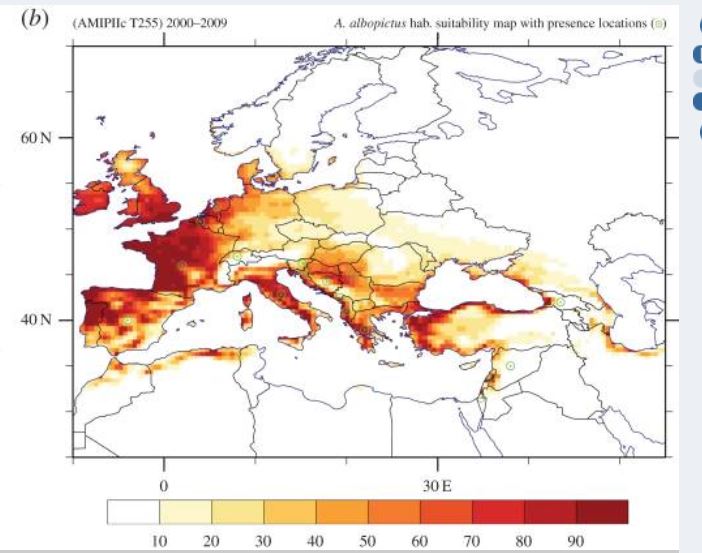
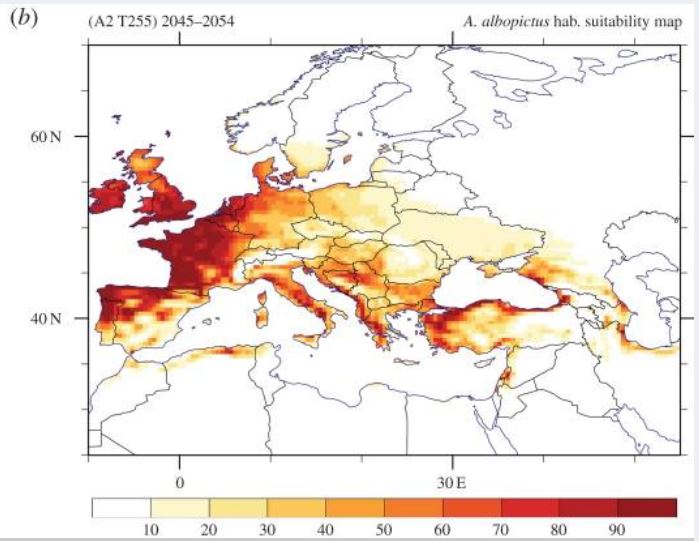
The next point is that even though a habitat is physically suitable (remembering the fundamental niche concept) it does not follow necessarily that a species will become established, because ecological interactions come into play (the realised niche). There are already plenty of mosquitoes in the genus Aedes in the UK, and it is at least plausible that the newcomer will fail to establish because of competition with the incumbents, particularly through the production of low-fitness hybrids (so-called “satyrisation” – discussed in relation to this species and A. aegypti by Lounibos & Juliano 2018). If the mosquitoes do become established, there is no reason to suppose that dengue will become established. One particular problem is that to transmit dengue, a mosquito has to bite an infected human, and then bite a non-infected human. As the only source of dengue is imported humans, this process is inevitably a rare and therefore unlikely occurrence. Humans in the UK just do not get bitten as much as people in some parts of the world, because we have better-quality housing (pro tem) than many parts of the world. There may be little flare-ups of dengue based around one individual, but it seems unlikely that this will persist. This is particularly the case because we have this thing called winter, which would enable infected individuals to clear the virus before mosquitoes become active in the following summer. That is the case come hell, high water, or RCP8.5.
In my estimation, there is not a cat’s chance in hell that dengue will become established in the UK. I would not, however, be surprised if A. albopictus becomes established here. But there is no need to panic. Introduced species are by and large not as terrifying as they are predicted to be. What proportion of introduced species live up to the hype around their arrival is another interesting topic.
As for satyrisation reducing the fitness of invasive mosquitoes: do satyrs have low fitness? Remember folks, it has nothing to do with their looks. It’s all about how well they play the flute.
Featured image
A snip from “Mosquito Extermination in New York City” by George A. Soper


Thanks for another interesting post JIT & Merry Christmas to you & yours.
“Cute things are vulnerable, and horrible things are dangerous”
funny you should say that, just watched a charity ad on TV – “Adopt an orca” by – https://uk.whales.org/the-team/
seems you can adopt anything for a few quid.
LikeLike
Yes it is another feature of magical climate change and the CO2 pollutant
LikeLiked by 1 person
“Every species will adapt to changing conditions as they always have. Those at their upper limit will decline, not increase, and their place will be taken by others. Of course, if it gets colder, the opposite occurs. Don’t let them scare you that insects are taking over.’ .
i’m *bug*gered if I’m gonna worry about this mini-War of the Worlds .
LikeLike
Thanks for highlighting something of which I have been vaguely aware for a while, but have never really articulated, namely the idea that as well as climate change only bringing bad news and never good, the corollary is that “nice” animals will die out while (only) “nasty” ones will flourish. It’s all bonkers, of course, but it fits the agenda, and so they spout it relentlessly.
LikeLike
Interesting that climate change will, it is argued, transform the U.K. into a dengue fevered country like Bangladesh, something to be greatly feared. Whereas, at the same time, masses of us travel each year to mosquito-ridden lands around the Mediterranean with scarcely a quarm.
LikeLiked by 1 person
The unconscious bias towards nice, cuddly animals displayed by the saviours of the planet does not appear to operate when it comes to mitigation of the man-made climate change which is alleged to be wiping out nice animals at the expense of the multiplication of the nasty ones. Wind farm developers are quite happy to bulldoze cute, cuddly koala’s homes and smash them over the back of the head if they inconveniently get seriously injured in the process. They’re quite happy to kill millions of cute little bats and drive Rudolf the Reindeer and pals away from their traditional migratory routes. Everybody loves whales, porpoises, seals and dolphins – except wind farm developers – they’re happy to make life hell for these creatures and even kill them when they get in the way of lucrative offshore wind farm developments.
Merry Christmas everyone.
LikeLiked by 1 person
Anyone who hasn’t seen it should watch the film ‘Idiocracy’, a darkly humerous tale of the progression of human development, it is rather crass in places being American but the message gets across.
Seasons greetings from darkent kent.
LikeLike
I haven’t read the report — and I dont intend to! But if it is discussing mosquitos thriving in the UK, does it anywhere mention malaria? I’m sure you all know it used to be endemic in East Anglia before the fens were drained — known as the “ague” and one of the effects was sufferers became opium addicts as one of the few ways to relieve their agonies. But also in those days the fens were extensive, and huge numbers of wildfowl were harvested every year, and were then sold in Leadenhall market. “Blinds” were used to lure the birds into tunnels — often a dog would just trot along the bank and the curious birds would follow it into the tunnels and then be slaughtered. Digression by a keen wildfowler….. but that species of mosquito is already well established in the UK. However, the fens are largely drained and carefully channeled now. So where would mosquitos thrive? It seems to me the whole story is ignoring history — conveniently of course. Happy Christmas!!
LikeLiked by 1 person
Some choice words from John Robson on global warming’s selection of nasty over nice creatures:
“Nor is it plausible that every single new study says it’s worse than scientists thought. (Especially if “the science is settled”). If it were real science somebody would occasionally discover there’s a bit more time, climate somewhere will improve in the short run, some species that doesn’t have you fumbling for the Raid will flourish briefly. But no.
Even if climate change is going to have wiped out “sea spiders as large as a dinner plate” (Ottawa Citizen 2002) it’s the tragic loss of a unique species. But mostly it’s bumble bees (NBC 2015) or the coelacanth (Ottawa Citizen 2001), which cruised through the Permian-Triassic and Cretaceous-Paleogene mass extinctions but now dangles by a rhetorical thread. Oh, and the emperor penguin gets it too (NBC 2014). Plus plankton (Globe and Mail 2000). And walruses (NBC 2014).
As for the rats, one pregnant female will send 15,000 loathsome offspring a year straight to your suburb. None of their natural enemies will flourish. And “Rats are just the beginning … populations of dangerous crop-eating insects are likely to explode … Similar horrors lurk offshore … a population explosion of purple sea urchins — ‘cockroaches of the ocean’ — is choking out other denizens of Pacific kelp forests … we’re all sharing this warming planet, and at the very least surely we can unite against a future filled with rats.”
Or one filled with imaginary horrors? No? Rats.
https://nationalpost.com/opinion/john-robson-why-will-global-warming-only-kill-the-cute-animals
LikeLiked by 1 person
As a child I had mice for pets and lusted after rats (which my mother hated). They taught me about early death and love, so climate change, for me, would not allow those adorable rodents to flourish.
LikeLike
“Tiger mosquitoes behind dengue fever rise in Europe”
Believe the hype.
LikeLike
Slightly O/T, but the Guardian has this story this morning:
“Global heating will increase risk of parasite outbreaks, say South West Water owners
Pennon Group annual report lists dangers to water quality posed by higher temperatures”
https://www.theguardian.com/business/article/2024/jun/12/global-heating-will-increase-risk-of-parasite-outbreaks-say-south-west-water-owners
To me it reads suspiciously like a water company that has been letting its customers down playing the get out of jail free card, namely “it’s not out fault, it’s climate change”.
LikeLike
“Mosquito-borne killer disease threatens blackbirds”
https://www.bbc.co.uk/news/articles/cj3x6v05ly6o
A mosquito-borne disease freshly arrived in Britain has spread large distances, with scientists racing to understand the risks to wild birds.
Infected insects can spread the deadly Usutu virus to blackbirds, raising fears for the famous songsters.
New data shows Usutu has spread across much of southern England in five years, and has been linked to declines in some blackbird populations.
Scientists are monitoring its spread amid warnings that mosquitoes and the diseases they carry may expand their range under climate change.
“We’ve seen that the virus has spread further than we thought it might do, and it’s persisted,” Dr Arran Folly of the Animal and Plant Health Agency (APHA) told the BBC.
Scientists at the APHA in Weybridge, Surrey, have been tracking mosquito-borne diseases in wild birds for decades, amid warnings, external that climate change is turning Europe into a potential breeding ground for the insects.
Longer summers, hotter temperatures and heavy rainfall are creating conditions for the nuisance insects to move into areas that were previously inhospitable to them….”
Read on, and it’s obvious that this has nothing to do with climate change:
…Usutu virus was first detected more than half a century ago around southern Africa’s Usutu River
It has since spread around the world, reaching Europe three decades ago, and was picked up for the first time in the UK in 2020…
It’s difficult to see how that can be linked with climate change, especially given that mosquitos have been present in the UK in larger numbers than today than in the past. But it doesn’t stop the BBC pushing the misinformation.
LikeLiked by 1 person
Mark, did we not have the mosquito-borne disease known as “the ague” here in the UK until, perhaps, early in the 20th century? Regards, John C.
LikeLike
John, (bird) malaria is still present in the UK. There’s a long-term study on this at Wytham Wood, where 25% of blue tits are infected.
I have not had the time nor inclination to delve into the facts behind today’s headline, but I would predict that the spread of the disease has nothing to do with the spread of mosquitoes but the spread of the virus within mosquito populations by normal processes (i.e. nothing to do with climate change).
As to this:
Unutterably stupid. For a moment there I was going to libel the APHA guys, but it seems the second part of the comment comes from somewhere else.
LikeLiked by 1 person
The mosquito story has reappeared, at both the BBC and the Guardian:
“Mosquitoes found in Iceland for first time as climate crisis warms country”
https://www.theguardian.com/environment/2025/oct/21/mosquitoes-found-iceland-first-time-climate-crisis-warms-country
“Mosquitoes found in Iceland for first time after record heat“
https://www.bbc.co.uk/news/articles/clyz3vv62pgo
Both articles do their best to link heat/climate change with the arrival of mosquitos in Iceland. There’s just one problem – it’s globalism that’s responsible. The Guardian article makes no attempt to explain how the mosquitos arrived, but if you persevere with the BBC article, you read this:
...Hjaltason, meanwhile, has speculated on the origin of the specimens he observed.
“One always suspects Grundartangi – it’s only about six kilometers from me, and things often arrive with ships and containers, so it’s possible something came in that way,” he told Morgunblaðið.
LikeLiked by 1 person
Mark – noticed your comment after link by Jit on his post. How low will they stoop to promote the “climate crisis” message I wonder.
As you note, the BBC article does the usual & tags a probable explanation at the end.
LikeLike