When I first started studying ecology, the island of Surtsey off the southern coast of Iceland was quite inspirational.
Surtsey rocked up out of the sea in November 1963, and instantly became a mine of ecological data.
Here comes the science part [elementary ecology]:
In ecology, groups of species living in the same place at the same time are called communities. Communities change over time, even if there is no external influence. Eventually, in the absence of external influences, the community in question will converge on something called a climax community, which means that in the absence of external influences, no new changes will occur. Lots may be happening, but nothing changes. In practice this means a succession of species over time, from opportunistic types to more competitive types. If you abandoned London right now, the bare concrete would eventually end up becoming oak/ash woodland, which would be permanent until a new ice age or maybe catastrophic global warming.
I used the word succession there, and in ecology there are considered to be two types: primary and secondary. Secondary succession is like abandoning London. There are already plenty of trees around and plenty of other plants growing in gardens which would form the basis of the first ecological communities after the capital’s abandonment.
The other kind is primary succession, and for that, you need a completely blank slate. You need to start with nothing. Succession still occurs but every part of the community has to find its way in from outside. Such situations are quite rare in the real world.
[End of elementary ecology lesson.]
So, this is where Surtsey is so important, and so inspirational. Ecologists generally have an idea about how primary succession might go, without being able to observe it happening. But as soon as Surtsey began to cool enough for something to survive on it, primary succession began. We had a sterile surface, an island, onto which new life could only arrive by sea or by air.
Since its birth 60 years ago, plenty of ecologists have devoted a lot of time to the study of Surtsey. It has its own research society. Visitors are few, and they have to ensure that they do not accidentally contaminate the island with a new species. [According to Wiki, the first visitors were French journalists, who landed on the island almost exactly 60 years ago (6th December, 1963). They claimed it for France as a bit of a laugh.]
Interestingly most of the early species to arrive on Surtsey would have been familiar to any British ecologist as plants of the strandline – the difference in climate not seemingly too relevant. Later arrivals were potatoes – planted by some boys as a jolly jape and dug up by indignant scientists – and a tomato plant (again via Wiki):
An improperly managed human defecation resulted in a tomato plant taking root, which was also destroyed.
I don’t think they needed to bother there. I can’t ripen tomatoes in my back garden reliably. They ain’t gonna ripen on Surtsey. But the presence of a tomato plant is a useful indicator of a sewage spill on British beaches: worth taking note of when you see toddlers playing in that little stream of water coming out of the storm drain.
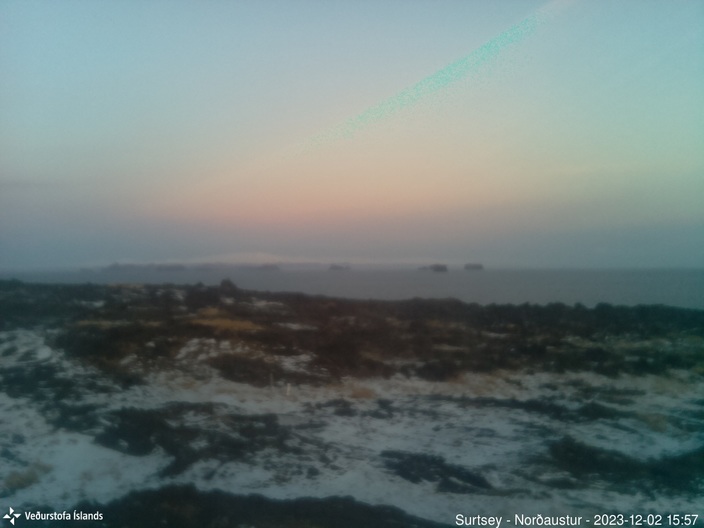
The Iceland Met Office has a webcam on Surtsey (available via the Research Society link). This is what it looked like at 3 minutes to four yesterday:
Surtsey is legendary in ecological circles. So it should not be too surprising to learn that this student of ecology was interested to read the news that a new island had breached the ocean’s surface near Japan. Here is a headline from the Japan News on November 10th:
New Island Created near Iwoto Island from Undersea Volcanic Eruption, Japan Meteorological Agency Says; May Disappear as Eruption Dies Down
It would be rather disappointing if the new island disappeared as soon as the eruption finishes. Why might that be? [Caveat: I know nothing about geology. I am prepared to be corrected if I abuse the nomenclature.] Well, when the molten rock hits the ocean water it is immediately quenched and turns to what is basically glass. But this material is not consolidated. It’s in bits. They call it tephra, which comes from the Greek for ash, and it is easily washed away.
But Surtsey is still there after 60 years. What gives? Well, if the eruption reaches the surface, the lava will not be instantly quenched, and may set as fairly sturdy lava flows. The tephra, given time and hot water, can become glued together to form tuff – which is rather more resistant to erosion.[Not very tough. Not granite. In fact it’s soft.] Surtsey has in fact shrunk markedly over the decades, but it is thought that its solid core of tuff will remain resistant to the briny for another thousand years or so. [Other islands in the Westman Isles are of similar or greater antiquity, and have become reduced to stack-like kernels of their former selves.]
After that very superficial overview, I wanted to mention that I had no idea where the island of Iwoto mentioned in the Japan News story was. The BBC covered the story and left me no less confused:
An explosive eruption last week sent volcanic rock hurtling into the sea around Niijima Island, located 970 km (600 miles) from the Japanese capital Tokyo.
Now, I admit to misreading this the first time, and to thinking that Iwoto and Niijima referred to the same island. But they don’t. The BBC was helpful in translating the meaning of the word Niijima as “New Island.” They also said it appeared ten years ago, but that is wrong. Maybe it’s a mistranslation.
The volcanic island was formed 10 years ago. Its name translates as “new island”.
Astute readers, even those with no passing acquaintance with Japanese, might have recognised parts of those two names. [My only knowledge of Japanese comes from watching large amounts of anime, with subtitles on and original voices, but sadly I am not learning much. I recognised parts of the names and merely thought them commonplace nouns that often form compound names. However, looking up Iwoto, I found that it is actually the island formerly known as Iwo Jima.
Everyone has heard of Iwo Jima – I’m sure every Cliscep reader has, at any rate – thanks to the events of February 1945, when the U.S. Marines stormed the beaches of the tiny island. Brutal is not a sufficient adjective for the ensuing fighting. What I was not aware of, or had forgotten, was what happened on Iwo Jima in 1985, 40 years later.
Veterans of both sides, and widows of the Japanese defenders, met on the island to commemorate the anniversary of the battle. Former bitter enemies shook hands and hugged. A monument was unveiled, inscribed in Japanese on the landward side, and English on the seaward side, representing the direction in which the fighting occurred. [This according to Wiki; they might in fact be separate monuments on the same site, and may pre-date the 40th anniversary.]
You can see part of the commemoration here, at the end of this contemporary documentary. [Should take you to the right moment.]
What this rabbit hole reminded me is that there are two kinds of war. The kind that ends, and the kind that never ends. Thankfully the war in which Iwo Jima featured was one of the former.
Iwoto a year ago from dataspace.copernicus.eu:

Iwoto a few days ago, ibid.:

 Climate Scepticism
Thanks Jit,
It’s great if Cliscep can draw attention to interesting new developments, however fascinating my endless take-down of Guardian articles might be. 😉
There does seem to be an unusual amount of volcanic activity going on just now. Whether that is true, or whether it’s a reflection of 24/7 news, global internet coverage and ubiquitous smart phones is anyone’s guess. If Alan K can get past WordPress’ commenting issues, I’d be very interested to learn if what we’re currently witnessing is in any way unusual or is just par for the cause.
Whichever it is, it’s a safe bet that volcanoes are emitting more CO2 than the UK is.
LikeLike