An issue that we hear about increasingly is energy security. The oxymorons in government broke off a bit of DBEIS (they liked to call it “Bays” rather than “debase” for some reason) to form DESNZ, the Department for Energy Security and Net Zero, whose titular motives are firmly at cross purposes. The mooted successor is supposedly DUNCE, the Department for Unicorns and No-Carbon Energy. (Whenever I see DESNZ written down, my brain makes a connection to the word “denazify,” but that’s just me I guess.) My advice to our government is that renaming things generally does not help. It just confuses everyone. MAFF survived for a long time (50 years?) before there was DEFRA. After that, departments have split and merged and been renamed at an accelerating rate, almost as if making acronyms was their ultimate purpose. From DEFRA was born DECC, which gave rise to BEIS, and now Denazify, I mean DESNZ. But I digress. What about the actual stats? These are as the previous edition in this series taken from Energy Trends tables available here.
1. Energy security; import dependency
Since 2010, DECC and its successors have reported statistics on the UK’s import dependency. How much of our energy are we reliant on other countries for, and how has this changed over time? Well, we flipped from a net exporter to a net importer in 2003:

After 2013, the worst year (so far) when we depended on imports for 48% of our energy, things have settled down to a stubborn mid to high 30s percent.
Another way to look at this is to have exports and imports on the same figure. The net is closely similar to the import dependency percentage in the form of the graph.

Energy demand has not gone up; in fact it has gone down. Our increasing demand for imported energy came not from a rapacious hunger for more, but from a withering of home-grown production – coupled with an overall decline in energy use. From 2001, the consumption of energy in the UK has gone down quite markedly (-25% ish). Some might call this a success story based on improved efficiency. I think it is more likely a tragedy of deindustrialisation.

In fact if you look at the energy consumption by sector over the past half century, it’s clear that energy use in industry has gone down quite markedly. It is now at about a third of the level it was in 1970. Domestic consumption meanwhile has stubbornly resisted attempts to cut it. Perhaps those attempts are bearing fruit for individual dwellings, but there are now more dwellings, so the net decrease is small.
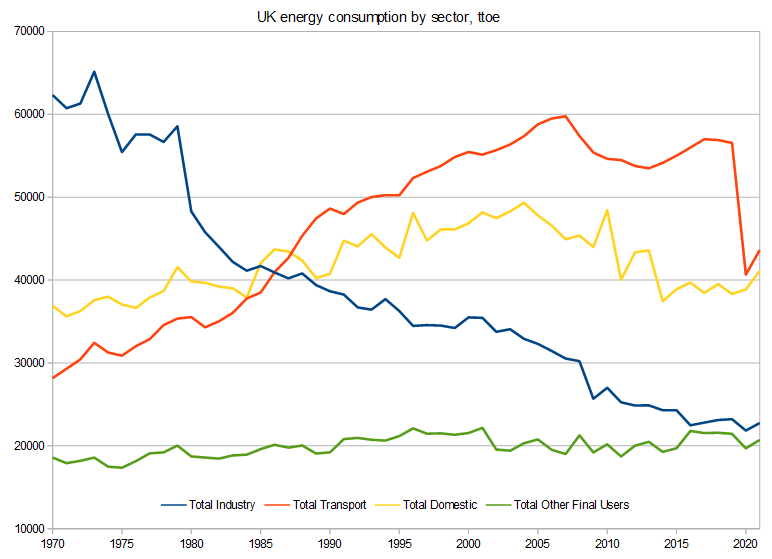
2. Fossil fuel dependency
The other critical indicator of our energy system’s performance is supposedly our dependence on fossil fuels. Two statistics are presented in Energy Trends: the “low carbon” share of energy, and the “fossil fuel dependency” of energy.


The two proportions do not add up to 1, because net imports of leccy and the contribution of “non biodegradable waste” are not included in either.
Those with an eagle eye might be thinking that there is something missing even so. That certainly seems to be the case: here, burning woodchips and waste for electricity counts as low carbon. Together they make up about 10% of overall energy consumption in the UK. So depending on whether you believe they are low carbon sources of energy, the low carbon share is either 20.1% (DESNZ’s preferred figure), or 11.0% (excluding energy from waste and bioenergy).
It is possible to argue the toss on whether burning rubbish and/or woodchips is “low carbon.” I don’t think it is, since it emits carbon dioxide at the point of generation – that’s fairly obvious. The other low carbon generators like wind turbines might have plenty of carbon dioxide emissions along the way, but when they actually turn wind into leccy, they don’t produce any.
So to my way of thinking at least, the UK’s energy system is 11% of the way to Net Zero.
There is of course another minor issue, which is that the embodied carbon dioxide in imported goods is not counted as energy. However, it used energy in its creation, and that energy was unlikely to be “low carbon.”
3. Dispatchable vs. Non-Dispatchable Electricity
One factor that the stats bods at DESNZ do not find time to dwell on in their time series is how our electricity generating mix has evolved towards weather-dependent sources. The following figure shows that we are increasingly dependent on the whims of Aeolus for our juice. Non-dispatchable is wind and solar; hydropower is counted as dispatchable.

Conclusion
As the North Sea gas fields have begun to deflate, our dependence on imports of energy has risen to worrying levels. We have also made little progress towards “decarbonisation”, unless you count burning trees as a low carbon enterprise. I find myself wondering, if so little has been achieved after so much pain: will we ever see the farthest shore?
Featured image
Dall.E: A pylon being struck by lightning
 Climate Scepticism
Thanks JIT. Interesting and important.
LikeLike
Here are graphical comparisons of the various power generation technologies
https://edmhdotme.wordpress.com/comparing-power-generation-technologies/
Some simple calculations that show that the use of imported Biomass (fror example at Drax) entirely eliminates all and any CO2 savings from all German and UK Weather-Dependent “Renewables”
https://edmhdotme.wordpress.com/the-inconsistencies-in-green-policies-to-limit-co2-emissions/
LikeLiked by 2 people
Jit,
Thank you for a clear and easily understandable summary of the problems with the agenda.
I find it deeply worrying that those in charge (and those who want to replace them in order to be in charge themselves) all seem to believe the arrant nonsense that expensive, unreliable and unpredictable energy which is destabilising the grid and which can be compromised by bad actors attacking the cables from offshore wind farms equates to energy security. And either they really do believe it or they’re culpably dishonest. Since I like to attribute positive rather than negative motives to people, I suspect (and fear) that they really do believe it, even though it takes some heroic assumptions to get to that belief. Here’s an example of an energy minister in action:
“Lower electricity prices not too far off, energy minister claims”
https://www.shetnews.co.uk/2023/05/11/lower-electricity-prices-not-too-far-off-energy-minister-claims/
Absolute twaddle, IMO.
LikeLike
A great article, thanks Jit.
Energy storage is a key issue relating to Energy Security & Fossil Fuel Dependence.
Britain has just 29GWh of electricity storage capacity.
We’ve 40,000GWh of natural gas storage capacity, plus direct connections to many off-shore gas fields.
We also have a legal obligation for strategic Emergency Oil Stocks.
More info here – with various conditions and variances:
Click to access Guidance_for_Stakeholders_version_FEBRUARY_2015.pdf
I’m unsure how much firewood Drax stores, but if push comes to shove, we’ve still plenty of trees available if the enviros permit them to be felled.
LikeLike
**Mods**
Hi
A couple of minutes ago I posted a reply that may be trapped in spam! (It had 2 or 3 links)
I’ve since refreshed the page a few times.
Is there any WD-40 available to release it from the WordPress prison? 😀
LikeLike
Done now. Sorry about that, Joe.
LikeLiked by 1 person
For comparison, here are the world electric generation proportions:
LikeLike
No need to apologise Mark, but thanks.
LikeLike
Ron, I presume “renewables” includes burning trees? I wonder how the renewable generation splits between wind/solar/burning trees? Something else to look up.
Mark, the minister is clueless, but he can say what he likes – there is no-one to challenge him, and when the promised savings fail to materialise, he will be long gone – or else find some other way to blame our obsession with fossil fuel.
Joe, replacing that gas storage with batteries is likely to be cost and materials prohibitive, if not impossible. Another sum for another day. But don’t worry, it will all be fine, if we keep saying it will; probably while whipping our shoulders with a bundle of birch twigs.
LikeLiked by 1 person
“UK could be starved of energy, warns North Sea boss”
https://www.bbc.co.uk/news/business-66019291
Meanwhile, in Fantasy Land:
Is the worm turning? That’s an article on the front page of the BBC’s website, and it’s reasonably balanced. I can’t imagine either of those things happening just a few months ago.
LikeLike
“A gas shock – not an oil shock – from the Iran war looks more threatening
Europe and Asia will take an economic hit if the supply of Qatari LNG is halted by the closure of the strait of Hormuz”
https://www.theguardian.com/business/nils-pratley-on-finance/2026/mar/02/gas-shock-oil-iran-war-qatari-lng-strait-of-hormuz
…The key variables, of course, will be how long Qatari production is shut, and how long Hormuz is effectively closed. Even the difference between a week and a month matters.
In terms of numbers, UK gas was 75p a therm last Friday and hit 114p on Monday. It would still have to go 250p – and stay there for a while – to match the intensity of the 2022 crisis. But suddenly it is not unimaginable, as Stifel warns, that household energy bills could spike again, causing a fresh set of problems for a government (like the last one) that has placed the reliability and affordability of LNG at the heart of its energy policy.
In its “security of supply” report last year, the government highlighted declining domestic North Sea production of gas but said “over the next four years specifically, we expect this changing supply mix to coincide with a robust, oversupplied global LNG market”. That market looked neither robust nor oversupplied on Monday.
North Sea gas, anyone?
LikeLiked by 1 person
Mark – thanks for the link to Nils article, liked this partial quote –
“Europe – and Asia – are indeed in the eye of the LNG storm because they are the big buyers of the frozen gas. About a quarter of Europe’s gas supply came as LNG in 2025; Britain’s average has been 21% over the past five years, according to government statistics.
Meanwhile, gas storage levels in Europe are low after a cold winter. The US, by contrast, sits pretty as an LNG exporter after its shale gas revolution over the past couple of decades.”
UK fracking, anyone?
LikeLike
The answer is staring us in the face, if only we did not have malicious morons in charge of the country. Drax has 6 boilers, two lying idle, which should be immediately re-commissioned to burn coal again. Any existing viable coal fired power stations moth-balled by the Tories (excluding the ones they blew up, of course) should be re-commissioned. North Sea gas fields should be re-opened, de-regulated and the punitive tax regime relaxed. The remaining 4 boilers at Drax should be converted back to coal burning. UK coal mines should be reopened. The fracking ban should be removed and existing wells re-commissioned – that is, if they haven’t managed to spike all the formerly operational wells by pouring millions of tons of concrete down them. The nuclear energy regulatory minefield should be blown up and small modular reactors brought online as quickly as possible. ALL expansion of renewables should be terminated and subsidies slashed (‘binding’ contracts be damned – we are facing a national emergency).
Make British energy and industry great again!
LikeLiked by 1 person
Claire gets it – way too late. The tacit admission of past Conservative failure is the understatement of the century.
https://x.com/ClaireCoutinho/status/2029131914196480307
LikeLiked by 2 people
Nils Pratley once more writing more sense than most of his Guardian colleagues:
“The UK sleepwalked into this energy price shock
Many of the decisions predate this government but the notion that Britain was better prepared for this crisis is fanciful”
https://www.theguardian.com/business/nils-pratley-on-finance/2026/mar/23/the-uk-sleepwalked-into-this-energy-price-shock
… two statistics in the Dukes report – the Digest of UK Energy Statistics, published annually by the energy department – should be required information for government ministers. In 2024, says the latest Dukes, the UK got 75.2% of its primary energy needs from fossil fuels, mainly meaning oil and gas (think transport and heating primarily). The proportion, says the report, was a “record low”, but the point is that it wasn’t a low by much. The previous year was 76.6%. In 2020, it was 76.8%. Energy transition takes time, in other words.
The other notable Dukes statistic is that net import dependency in 2024 was 43.8%, 3.4 percentage points higher than in 2023. It has been hovering around the 40% mark since 2010. Again, the lesson is that while “homegrown” energy in the form of renewables, nuclear and batteries may be the eventual desirable destination, salvation is not arriving tomorrow.…
…the government has chosen to ignore calls from many directions – even the head of RenewableUK recently – to drill more in the North Sea. Greater domestic oil and gas volumes wouldn’t move market prices much, if at all, but there would be benefits for things the UK’s lenders tend to notice – the balance of payments, medium-term tax receipts, jobs, security of supply and so on. That debate will only intensify, especially given the higher carbon emissions associated with imported LNG gas versus domestic supplies.…
LikeLiked by 1 person