Early this afternoon, I was pondering a report whose subject need not concern us here. As often happens, my attention wandered. I threw down my pencil stared out at the slate-grey sky. For a moment I wished I could fast-forwards four months to the bright days of May.
Then I made the mistake of clicking on the BBC News website when I should have been getting on with what I was supposed to be getting on with. There it was, in black and white, or black and 10% grey:
Could floating solar farms survive out at sea?
Well, my answer was no.
But I compounded my mistake by clicking on the story.
First, we are told that small islands in Indonesia need electricity.
“Those people who don’t have electricity are living on remote islands, so in this situation it’s hard to connect a cable to them and it’s hard to install other expensive solutions such as wind turbines,” says Luofeng Huang, a lecturer in mechanical engineering at Cranfield University.
Something is coming through… wait, I’ve got it! We give the remote islands diesel generators.
Solar power is one option to provide those islands with energy. It has become much cheaper in recent decades – the International Energy Agency (IEA) says that it is becoming the cheapest option for new electricity power plants.
No, I haven’t followed the link to see what rat hole it wriggles down. Solar electricity migh be cheap, but I wouldn’t want to power my house by it, and neither would the BBC reporter. Half the time it is dark.
At any rate, solar does have acknowledged problems: slavery, non-recyclability, sourcing rare earths, etc. And it takes up a lot of room. [Is this something that the BBC has noticed re: solar farms in the UK?]
So scientists and engineers are working on ways to install solar panels on the ocean surface, providing power to those living onshore nearby.
“Floating solar is very convenient because it can just be put on top of the water, and if you need more electricity you can put on more solar panels,” says Mr Huang.
Yes. And if my pint glass is empty, I can sashay to the bar and purchase another beer, albeit at the outrageous cost of about four quid. Science moves on apace. At this stage the BBC reporter acknowledges that waves and sea water are likely to smithereen your attempt at installing solar panels on the ocean surface. But wait! All is not lost! There are answers.
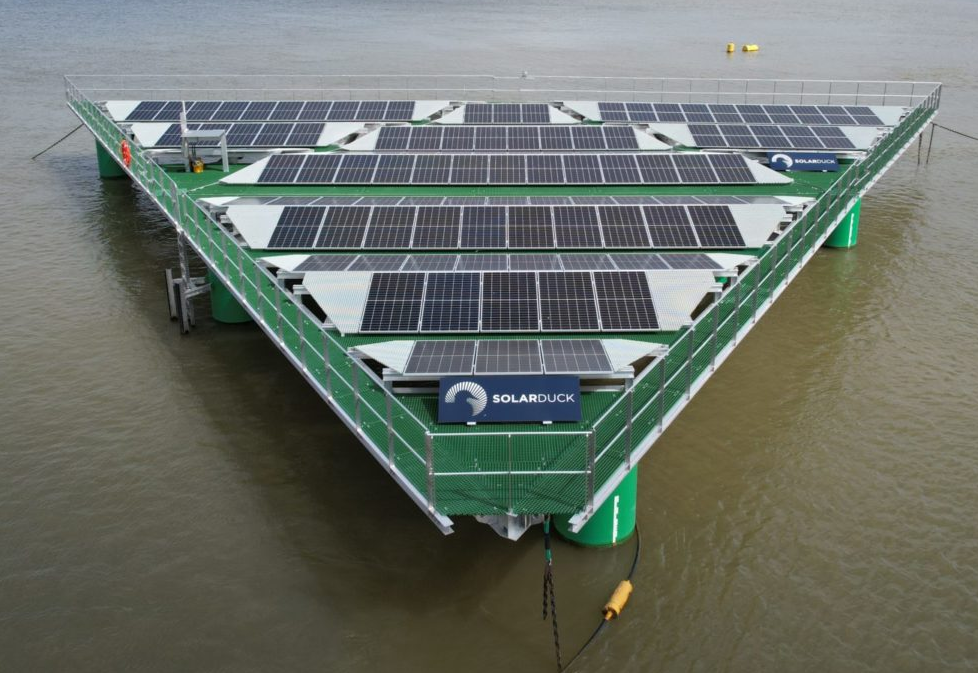
First we have SolarDuck, which is planning to install solar panels in the North Sea, raised above the damaging waves. The Duck farm is going to be attached to a wind farm to share export cables, and is due to begin operations in 2026. Good luck finding a mug who will pay for that. Wait, it’s probably us.
Meanwhile, we have Ocean Sun, who are making circular floats covered in solar panels (see featured image). It’s a sort of electrified swimming pool cover and flexes with the waves, thereby avoiding being damaged by them.
Huang, the expert from Cranfield dismisses both designs. One will be expensive because it is raised up so high. The other will be bashed to bits. I agree with him. These are two solar fantasies. But Huang has a fantasy of his own, called the Solar2Wave system (where do they get these wonderful names?). Solar2Wave swings into the swell, and has a wavebreak at what will hopefully always be the leading edge. The demonstration project will be floating in the Indian Ocean in 12 months’ time.
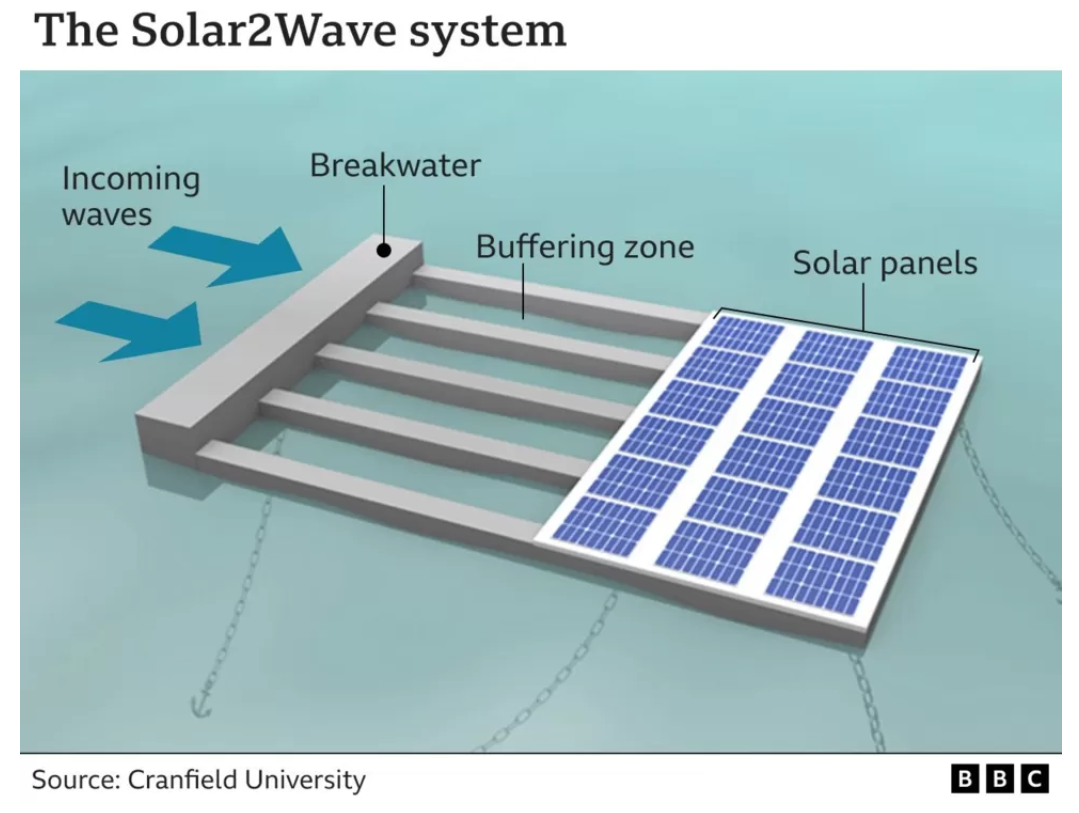
Sorry, no. This one is going to fail too. Or am I just being cynical? Perhaps. Would I have willingly boarded the USS Monitor?
A final ecological note:
The pH of open water varies diurnally. During the day, algae fix CO2 and produce O2 as a “waste product.” The consequence is increasing pH. At night, no photosynthesis is possible, only respiration. This results in increasing amounts of dissolved CO2 and, you guessed it, a decrease in pH. Now let’s imagine you cover most of a bay with solar panels. What happens to the pH?
The BBC report ends with:
Solar farms could even be sited far out at sea where they could serve as refuelling points for electric ships.
If you believe that, you will also believe that spaghetti grows on bushes, or that your iPhone can be made waterproof by a software update.


There is an excellent discussion of solar photovoltaics at Randall’s sub stack blog – https://bfrandall.substack.com/p/uncle-rubes-pv-solar-is-an-energy
Here he points out that the ERoEIEXT (Extended energy return on energy invested) for solar photovoltaics in areas of moderate insolation, i.e. all of Northern Europe is less than 1. The energy expended in the production of photovoltaic panels is greater than the energy they produce.
As you say JIT solar photovoltaics, whether on land or sea really is a fantasy.
LikeLiked by 3 people
How are they going to keep them clear of the salt which will inevitably coat the surfaces?
Then there’s the well established dislike of electricity and salt water…
LikeLiked by 2 people
Hang on a minute – the BBC reported an engineer talking about “expensive solutions such as wind turbines”?
LikeLiked by 3 people
“Could floating solar farms survive out at sea?”
Floating solar farms can’t necessarily survive on an inland lake! 😉
LikeLiked by 2 people
“First we have SolarDuck, which is planning to install solar panels in the North Sea, raised above the damaging waves.”
Who amongst your readers, is old enough to remember the ‘Tomorrow’s World’ prophesy that by now Salter’s Ducks would be generating all the electricity we need by absorbing energy from those waves?
https://en.wikipedia.org/wiki/Salter%27s_duck
Sadly, those very waves effectively destroyed the machines specifically designed to withstand them & harvest their energy.
LikeLiked by 1 person
Reminds me a bit of the wonderful and completely impractical mechanical inventions you come across while browsing nineteenth century volumes of the Specifications for Patents. Just as nutty, and then as now, just a chance someone with the money will be carried away with the spirit of the age and actually fork out.
LikeLike
https://rclutz.com/2023/01/11/esg-fell-to-earth-in-2022/
E,S.G -Environmental, Social and Governance Investing
down in 2022.
LikeLiked by 1 person
Re-read your introduction Jit and wondered if you you had rendered us liable to complicity to sexism. The potentially offending title : “If it sinks, we can always walk away whistling with our hands jammed in our trouser pockets” suggested sexism related to clothing. But then I realised just how much I would have offended “she who must be listened to” and how out of date I had become. Nevertheless…
LikeLike
Alan, I probably had in mind something along the lines of Charlie Chaplin – but as it turns out, I was right, entirely by coincidence.
LikeLike
“Oxfordshire: Space solar farm could be operational by 2035, firm says”
https://www.bbc.co.uk/news/uk-england-oxfordshire-67028625
That’s another £11M of taxpayers’ money casually thrown away on net zero.
LikeLike
I’ll make a bold prediction and say that this array will not be operational in 12 years’ time. Not mentioned in the snippet, and presumably in the piece, are all the engineering challenges of space solar which make it a A1 stupid idea.
They are referring to microwaves, but are presumably afraid of scaring the punters off by using the word, which might conjure up unpleasant images of ruined picnics etc.
LikeLike
More evidence, if any was needed, that floating solar is a crashingly stupid idea at WUWT.
LikeLike
“Plans lodged for ‘largest’ floating solar farm”
https://www.bbc.co.uk/news/articles/crew52qw0vdo
Plans have been submitted for what has been described as the UK’s largest floating solar farm.
Associated British Ports (ABP) said it wanted to install 47,000 panels covering around a third of the available water area of Cavendish Dock in Barrow, Cumbria...
…The panels would be mounted on “floating pontoons fixed at an optimum angle for solar generation,” which would be secured to the bottom of the dock by “an anchoring system”…
…It is estimated it will take about nine to 12 months to complete.
Watch this space, then. Will it happen? Will it work? Will the BBC bring us a follow-up report if it flops?
LikeLiked by 1 person
“Bird club objects to floating solar farm plans”
https://www.bbc.co.uk/news/articles/c20xle67940o
Plans for what has been described as the UK’s largest floating solar farm have been opposed by a bird club.
Associated British Ports (ABP) previously said it wanted to install 47,000 panels covering about a third of the available water area of Cavendish Dock in Barrow, Cumbria, and connect it to the BAE Systems network.
Cumbria Bird Club objected to a planning application, stating the area forms an “important” habitat for birds.
The applicant said potential adverse effects on the Site of Special Scientific Interest would be “insignificant”, the Local Democracy Reporting Service said.
In a planning consultation, Cumbria Bird Club said the water body had a “long history” of birds, such as waders and wildfowl, using it as a feeding and resting place.
“It forms an important part of the habitat not only for resident species but also for migrating birds that depend on stopover sites to rest and feed on their migratory journeys,” the club’s response read.
However, plans stated the proposed development would provide “enhancements” to improve roosting and breeding conditions.
These included increasing foraging resources and refuge areas for certain bird species.…
Yeah, right. Having trashed their stopover site, those “enhancements” will make everything right. And by the way, why do you want a solar farm north of 53N? Subsidies, I suppose.
LikeLiked by 1 person
From solar fantasies to rice fantasies. Someone saw someone coming, etc.
“Bawburgh farm to host innovative UK-first rice trial”
So far, so normal. Then the reek of stupidity begins to fill the air.
Then we see their own concept of what their seafaring rice is going to look like:
I wonder how much the rice is going to cost by the kilo? Answers on a postcard.
LikeLike
Doesn’t look much like Norfolk to me. Not flat enough – and where are the offshore wind turbines? (sarc).
LikeLike
“MP wants floating solar panels on UK reservoirs”
https://www.bbc.co.uk/news/articles/c39zjzw72e0o
An MP is calling for more solar panels to be located on the UK’s reservoirs.
Lincoln Jopp, the Conservative MP for Spelthorne in Surrey, claimed in the Commons that putting the panels on just 15% of the country’s reservoirs would double the UK’s solar energy production.
As well as avoiding the use of arable land, he said, they would be more efficient due to the cooling effect of water.
However, while agreeing the idea has “potential”, the government said it had not backed any floating solar bids because the cost of the floating structures and underwater cabling make it 10 to 15% per cent more expensive than ground mounted panels....
LikeLiked by 1 person
As noted above, covering lakes with solar panels may well increase their acidity and reduce oxygen levels as well. There’s always a cost.
LikeLiked by 1 person
“Miliband to Cover Britain’s Lakes in Floating Solar Panels”
https://dailysceptic.org/2025/07/01/miliband-to-cover-britains-lakes-in-floating-solar-panels/
LikeLike
“‘Biggest’ floating solar farm approved for dock”
https://www.bbc.co.uk/news/articles/cjw6q949ndeo
Plans have been approved for what is being touted as the biggest floating solar farm in the UK.
It is set to be included in the £100m redevelopment the Grade II-listed Ice Factory complex at Grimsby docks.
The project had already been granted permission for a 1,000-seat events venue, a conference centre, offices and a 161-bedroom hotel.
Developer Tom Shutes, from GY 1900 Ltd, said the solar farm and other renewable resources would provide free heating and power to tenants of the site for 25 years. [Good luck with that in the winter].
The floating solar panels would cover an area larger than the pitch at Wembley Stadium, the Local Democracy Reporting Service said….
LikeLike
“UK’s ‘largest’ floating solar farm given go-ahead”
https://www.bbc.co.uk/news/articles/cpd6n8x31zlo
A floating solar farm described as the UK’s largest is to be built in the north of England after planning permission was approved.
The 46,500-panel array will be installed at the Port of Barrow’s Cavendish Dock in Cumbria and will be capable of producing enough energy to power 14,000 homes a year.
It will be built by Associated British Ports (ABP) and will be used to power the area’s advanced manufacturing sector, including submarine-maker BAE Systems...
…The application was approved by Westmorland and Furness Council on Monday despite an objection from the Cumbria Bird Club over concerns it would disturb lapwings and curlews, which used the dock to rest and feed….
LikeLiked by 2 people
Powering 14,000 homes a year! How many homes per month?! Where do they dredge these imbeciles up?
I predict that the scheme will not go to plan. Let’s be generous and give it five years.
LikeLiked by 1 person
I predict a 1000 seagulls will find it irrespirable as a new home, ooh sh*t.
LikeLike
From the Telegraph (with accessible link):
“Labour plans to blanket lakes with floating solar farms
Ed Miliband to consult on easing floating power plant rules to boost UK energy security”
https://archive.ph/eBsJu#selection-2233.4-2237.91
Ed Miliband is preparing to blanket reservoirs and lakes with solar farms as part of Labour’s push towards net zero.
The Energy Secretary will launch a consultation to make it easier to build floating solar power plants, following a report that hailed their potential as a clean energy source.
Floating solar schemes use the same panels as land-based projects but are mounted on platforms floated in freshwater bodies such as reservoirs, lakes, quarry lakes and industrial ponds.
According to new research commissioned by energy investor Bluefield, there is potential to build up to 58.6 gigawatts of capacity by 2050, enough to power millions of homes at peak sunny conditions. [My emphasis – obviously, they’ll produce next to nothing i the middle of winter, when demand is greatest].
Under the most ambitious scenario, the solar farms would cover approximately 33,500 hectares – about five times the area of Loch Lomond, Scotland’s largest freshwater lake.
The CBI Economics report said the floating plants would be mostly built on reservoirs operated by water companies and other privately owned man-made lakes.
But it also predicts that up to 2.5pc or 7,375 hectares of the country’s natural lakes could be covered – about five times the size of Windermere in the Lake District, Cumbria..…
What could possibly go wrong?
LikeLiked by 1 person
Is there no end to this madness. Lets throw another in the mix from 2023 –
UK and Saudi eye investments in space-based solar power | AGBI
As Mark remarked on above idea – “What could possibly go wrong?”
LikeLike
It would be of academic interest to revisit the startups in the head post, to see if they disappeared like the dew of the morning once the grant money ran out.
LikeLiked by 1 person