Don’t build downwind, chump
Because wind turbines take energy from the air that flows over their blades, there is the obvious possibility of wake effects, i.e. where downwind turbines experience lower wind speeds. (The power at the turbine is related to the wind speed by a cubic function, so a small decrease in wind speed could lead to a large loss of power.)
Bearing in mind the incipient industrialisation of the North Sea, I wondered what the scale of such effects might be. Instinct said that they would be negligible. Are they?
Wind turbines are well spaced within farms. The wind farm visible from the beach at Gt Yarmouth (Scroby Sands) is fairly old and small. Its turbines are 60 m tall and have 40 m blades. Their files, as you look from shore, are 350 m apart, and the ranks are 500 m apart. These distances, a casual observer might surmise, are chosen to minimise or eliminate interference between turbines, and that the layout is chosen to favour performance from the prevailing wind direction. So you might think that if the wind blows directly from shore along the line of two turbines 500 m apart (about 6 turbine diameters), that the second turbine would suffer no performance loss.
Searching Google Scholar for an answer to this question I came across Nygaard et al 2020. The first thing these authors present is a within-farm wake model. The previous standard apparently represented a wake as an expanding regular cone, whereas a better fit to real-world data was obtained by Nygaard et al using a model where wake expansion slowed down over distance. Anyway the relevant observation for me was that in the real world (Westermost Rough wind farm), second and subsequent turbines only had 80% of the power of the foremost turbine if the wind was blowing directly along the line (ranks at Westermost Rough, like at Scroby Sands, are 6 turbine diameters apart, which for turbines with a 154 m diameter, means they are 900 m apart).
That sounds quite a large drop in performance, but the wind is not likely to be blowing exactly perpendicular to the ranks or files of turbines. What about cluster wakes: the effect of one wind farm on a completely different wind farm? One might naively think that if the power loss at 6 turbine diameters (c. 900 m in the case of Westermost Rough) was 20%, that when you start putting clear blue water between them the effect will end up being negligible.
Well, Nygaard et al have data on this too. There is another wind farm fairly close (15 km) to Westermost Rough: Humber Gateway, a set of 73 turbines with a rotor diameter of 112 m. That makes Westermost Rough 130 (15000/112) turbine diameters from Humber Gateway. What happened when the wind blew through Humber Gateway before it reached Westermost Rough?
This is the surprising (to me at least) result:
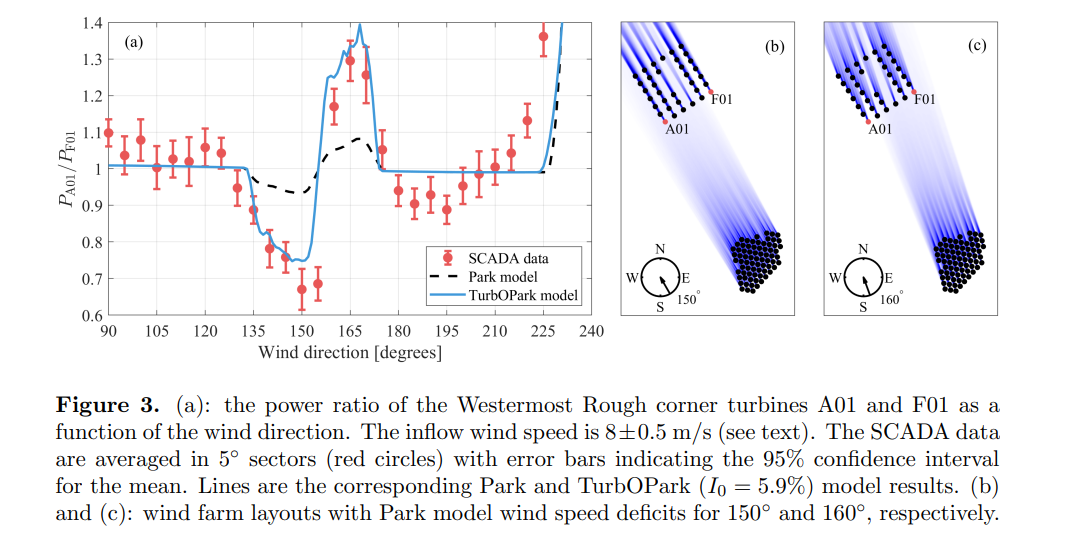
Humber Gateway is to the south, & Westermost Rough is the square with some turbines missing from the centre. The graph shows the power ratio between the two end turbines as the wind direction changes. Real world data is orange dots, their emulations are the lines. Of particular interest is where one and not the other is in the Humber Gateway’s cluster wake: a 30% loss of power results.
Nygaard et al go on to model blockage (the upstream effect of wind turbines on wind speed), which seems to be a minor problem compared to wakes, & then they combine the two effects to try to get a better estimate of wind speeds at turbines. They point out that neglecting wind turbine interactions, and even interactions between different wind farms, will lead to overestimation of energy production.
Conclusion
Presumably as the North Sea fills up with bird munchers, everyone will want their farms to upwind of their competitors.
Featured image
A snap of a casualty on Gt Yarmouth North Denes taken about a year and a half ago. Scroby Sands wind farm is barely visible on the horizon. It is, however, close enough that the juxtaposition of the two were rather suspicious, in my eyes, at least. I think it’s a female sparrowhawk, but I didn’t flip it over to check.
Reference
Nygaard et al is available here.


Funnily enough, I can’t remember anyone in Government, mainstream media, wind turbine companies, “environmental” pressure groups or anyone else pushing wind turbines at us, mentioning Nygaard et al, and the potential negative implications for the great claims being made on behalf of offshore wind.
I’m sure the wind turbine companies themselves must be very well aware of it, on the other hand, yet the seem to be keeping quiet. Funny that.
LikeLike
There’s the memorable image of the wake at Vattenfall’s Horns Rev Offshore Wind Farm, Denmark:
LikeLiked by 1 person
I always thought that there needed to be 10D spacing to stabilise the flow downstream of obstructions. That is what it is for orifice plates in compressible fluids. The data you analysed indicates that this rule of thumb seems correct.
LikeLike
It seems to me that any rule governing the required spacing of wind turbines not only has to offset the downwind turbulence caused by upstream turbines but also the loss of energy within the wind; energy extracted from the wind by the upstream turbines. Or is the turbulence in the wake caused by this extraction? I seem to recall that no more than a third of the energy within the wind intersected by the turbine blades can be extracted.
LikeLike
Alan, the Betz limit is at the maximum value of 4a(1-a)^2 where a is the fractional decrease in wind velocity at the turbine. It maxes out at 0.59 ish when a = 1/3, which is when the wind speed has been reduced by 2/3. But I don’t know how well this works in the real world.
Chris, I suppose the spacing used is a compromise between the available area and the wake effect. If there are fewer turbines in the same space, each will perform better, but additional turbines might still be profitable.
LikeLike
“Long-Range Wake Losses Offshore Much Greater Than Expected, New Study Shows”
https://www.offshorewind.biz/2022/08/18/long-range-wake-losses-offshore-much-greater-than-expected-new-study-shows/
“Commonly used engineering wake models vastly underpredict energy losses due to external wakes, the US-based technical services provider ArcVera Renewables has found in a new study.
According to ArcVera Renewables, the study confirms the severe under-prediction of long-range wake losses by engineering wake loss models in common use and investigates long-range wake loss potential at the New York Bight offshore development sites.
Velocity deficits, as high as 1 m/s or 10 per cent, persist up to or greater than 100 kilometres downwind of large offshore arrays, leading to long-range energy deficits much greater than expected by most subject matter experts in the industry, ArcVera said.
ArcVera used the Weather Research and Forecasting (WRF), a high-fidelity numerical weather prediction model, to carry out the research. The Wind Farm Parameterization (WFP) was added to the model to account for the effects of the wind turbines in the domain.
”This new study provides an important cautionary lesson as the wind industry proceeds to ever-larger wind turbine models with greater farm density across the globe,” said Greg Poulos, CEO of ArcVera Renewables.
”WRF-WFP’s results here show that engineering wake or WFAI models currently under-predict long-range wake losses by a significant margin. Unexpected losses are likely to accrue from wind farms once thought to be too far away to be material to project performance.”…”.
LikeLiked by 2 people
Mark, that is an extraordinary stat if true: 10% at 100 km. That would make the turbines capable of local climate change on their own.
LikeLiked by 1 person
Yes, if true. It relies on models, and we here tend to be sceptical of models. However, it’s definitely worth a read, IMO.
LikeLike
Net Zero Watch have commented on the ArcVera analysis: https://www.netzerowatch.com/offshore-wind-its-more-expensive-than-we-thought-2/
LikeLiked by 1 person
“Offshore wind farms are projected to impact primary production and bottom water deoxygenation in the North Sea”
https://www.nature.com/articles/s43247-022-00625-0
LikeLike
Mark, presumably the hypothesis is that the lower wind speed causes less mixing in the surface layer. There are already huge natural diurnal and seasonal changes in North Sea chemistry. My “gut feeling” would be that the turbine wakes would not cause measurable changes. But that is arguing from ignorance. I’ll read the paper when I have a mo. I really hope these guys are wrong, because even if they’re right, it won’t result in the build out of wind being curtailed.
LikeLike
Mark; it’s models all the way down…as the saying goes.
There have been some very large wind farms in the N. Sea for some years so a bit of real-life sampling should have been possible. That would show clearly whether the models have any validity. Of course, the authors may not want to face such testing!
LikeLike
“New Understanding of Wind Farm Efficiency”
https://www.trinity.ox.ac.uk/news/new-understanding-wind-farm-efficiency
https://www.cambridge.org/core/journals/journal-of-fluid-mechanics/article/twoscale-interaction-of-wake-and-blockage-effects-in-large-wind-farms/89DDB33925C5A6F4A3E0F387587FDE0A
LikeLiked by 1 person
“Scroby Sands wind turbine fire off Norfolk coast self extinguishes”
https://www.bbc.co.uk/news/uk-england-norfolk-66510193
Fair play to the BBC for reporting this, and on the front page of its website too. However, no marks for finishing with the usual piece of propaganda from the German wind farm company about how much installed capacity the wind farm has (as opposed to how much electricity it actually generates) and how many households it can power (as opposed to how many it does power, when, and how intermittently):
LikeLike
Well, that’s very environmentally friendly:
“Scroby Sands: Investigation into wind turbine fire ‘may take weeks'”
https://www.bbc.co.uk/news/uk-england-norfolk-66525400
As usual, the article concludes with the usual advert for renewables, quoting installed capacity, rather than actual output:
LikeLike
“Talks needed over density of offshore windfarms in Europe, warn experts
Turbines can ‘steal’ energy from those downwind and neighbouring projects could lead to conflicts of interest”
https://www.theguardian.com/news/2023/nov/10/talks-needed-over-density-of-offshore-windfarms-in-europe-warn-experts
LikeLiked by 1 person
Thanks Mark. I’m firmly not an expert, but “don’t build downwind, chump” probably counts as a valid warning. Nice of the experts to catch up with the other experts who wrote the paper discussed in the OP.
LikeLiked by 1 person
“As the blades of each individual turbine go round, they take strength out of the wind, researchers have found” – are the researchers school kids I wonder, as adult researchers must have thought about this?
maybe they did, and can/could see subsidy money rolling in any way.
LikeLiked by 1 person
Dougie, that’s why they are called “researchers” not “sceptics”.
Meanwhile, another story on turbine wakes at Jo Nova’s.
LikeLike
STOP PRESS: ‘Wind turbines act as wind breaks!’
Scientists have rediscovered the Law of Conservation of Energy as they realise that energy absorbed from a moving air mass by turbines in order to generate electricity is not miraculously replaced downwind.
OMG – wind energy is not quite so ‘renewable’ as we were led to believe!
LikeLiked by 2 people
There must be some tricky effects downwind of one of these beasts. As well as extracting some of the wind’s energy, the airflow probably ends up with a spiral motion. I wonder whether, for the prevailing wind direction, the arrays use alternate directions of rotation for the blades?
LikeLiked by 1 person
Mike H. There is a wonderful aerial photograph of an array of wind turbines, each of which disturbs the air for hundreds of metres downwind by causing condensation clouds. It clearly demonstrates the need for spacing of the turbines both side to side and downwind.
There also is a formula, whose name I forget, that determines the maximum percentage of wind energy that may be extracted. I presume that a turbine downwind of another might be able to extract its own percentage of the depleted wind energy.
LikeLiked by 1 person
Further to above
I failed to find the photograph I mentioned but similar may be found from Google putting in “wind turbine turbulence, North Sea”
the formula defines the Betz Limit which states that the maximum energy that theoretically can be extracted by a wind turbine is just under 60%.
LikeLiked by 1 person
Alan; is this the photo you were thinking of:
It’s the Horn’s Reef windfarm. Quite spectacular!
LikeLiked by 1 person
Mike H. Yes it is. Note that with this wind direction, disturbed air affects downwind turbines which for this wind direction appear to be far too close. Downwind turbines are extracting energy from air streams that must already be energy depleted from interaction with the upwind turbines. The downwind turbines must be operating at much lower efficiency.
LikeLiked by 2 people
Guys, just scroll up in the thread a little way 🙂
LikeLike
JIT. My apologies. Memory loss due to age (two years ago is a long long time) but no real excuse. Nevertheless the picture is worth a repeat.
LikeLike
“Switched on for the first time the largest wind turbine in history: It has caused an unexpected effect”
https://www.eldiario24.com/en/switched-on-the-largest-wind-turbine/2206/
Despite having a reputation for contributing to global warming and toxic emissions, China turned the tables and is now one of the nations going green. Mingyang Smart Energy installed a 20 MW offshore giant wind turbine in August 2024, which is the largest wind turbine in the world. With its 128-meter blades and 242-meter height, it can produce enough electricity each year to power 96,000 homes.
However, the activation of the turbine has brought about an unforeseen consequence: changes in the microclimate surrounding the installation site. Although wind turbines typically change airflows, the structure’s unparalleled size is enhancing these impacts, leading researchers to investigate how such enormous installations can affect regional weather patterns….
...By reducing the amount of space needed for wind farms, the higher efficiency also makes it possible for fewer turbines to produce the same amount of energy. Notwithstanding the successes, the turbine’s enormous size has had unanticipated environmental effects. Studies have shown that turbines of this size modify the immediate microclimate and local wind patterns, resulting in changes to wind speeds and temperature distributions surrounding the installation....
…However, preserving a balance between energy and local ecosystems will depend on making sure that such technologies don’t unintentionally disturb them. With the potential to smash records, this is the biggest wind turbine ever made. In actuality, its height is the least of its many advantages because energy efficiency is rapidly increasing and it has far more potential than the nuclear power plants that America wishes to “resurrect”.
The concept is straightforward: decarbonise and, as we have shown in New York, do so over the sea if there is no room (Garcia, 2024). Environmentalists and scientists are investigating the potential effects of these shifts on coastal climates, bird migration patterns, and marine ecosystems. The turbine’s energy benefits are indisputable, but it also serves as a warning that advancements in renewable energy have their own set of drawbacks.
LikeLike
Mark; it’s hard to see why these effects should be news. The dramatic photos of Horn’s Reef windfarm generating a fogbank have been widely publicised.
Also the statement: “By reducing the amount of space needed for wind farms, the higher efficiency also makes it possible for fewer turbines to produce the same amount of energy” is wrong, according to Prof David MacKay in his excellent book on Sustainable Energy. He showed that wind turbines need to be spaced at least 5 times the rotor diameter from each other to minimise losses. So bigger turbines will mean fewer units but the area required will be the same, whatever the machine size.
Incidentally there’s a 26 MW machine in development, also in China.
LikeLiked by 1 person
Slightly O/T, but this seems like as good a place as any to post this:
“Climate Changing: Germany’s 30,000 Wind Turbines Causing Local Rainfall Droughts”
https://stopthesethings.com/2023/06/09/climate-changing-germanys-30000-wind-turbines-causing-local-rainfall-droughts/
...There is already plenty of evidence to show that wind turbines are causing local nighttime temperatures to rise by as much as 1.5°C. Which would be no surprise to grape growers who use banks of large frost fans to stir up the air at nighttime, and thereby prevent frosts from forming and protect their crops.
Now a German study suggests that its 30,000 industrial wind turbines are causing droughts of the conventional kind (as in a lack of precipitation, not a lack of wind)….
LikeLike
“‘Catastrophic’ wake losses threaten existence of Orsted Irish Sea wind farms
Danish developer owns 1.85GW of operational wind farms in Irish Sea but says wakes from planned projects could ‘shorten life’ of assets whose revenues would be hit”
https://www.rechargenews.com/wind/-catastrophic-wake-losses-threaten-existence-of-orsted-irish-sea-wind-farms/2-1-1785911
Orsted says that wake losses from offshore wind farms planned by EnBW, BP and RWE pose an existential threat to its Irish Sea assets, as a former project CFO at the Danish developer tells Recharge of the “catastrophic” impact they could have based on recent modelling.
An assessment commissioned by Denmark’s Orsted has found that four planned wind farms in the Irish Sea could result in wake losses and a drop in annual energy production (AEP) of up to 5.34% for its operational assets nearby.
LikeLiked by 2 people
Mark – not much detail in that link, wonder if it will affect “offshore wind farms planned” around the Isle of Man? Mooir Vannin Offshore Wind Farm | Ørsted & Size of Isle of Man offshore wind farm reduced after feedback – BBC News
LikeLike
dfhunter, I think in the end, the issue will affect pretty much all offshore wind farms, but sadly, not before they have trashed the seas and oceans.
LikeLike
Not news to readers of Cliscep:
“Blowout! Windfarms blocking each other…
Researchers will investigate how nearby offshore windfarms can reduce each other’s energy output”
https://www.energylivenews.com/2025/03/13/blowout-windfarms-blocking-each-other/
Scientists are about to investigate a new phenomenon – how offshore windfarms block each other from generating power!
The University of Manchester boffins have secured funding to tackle the growing challenge of how wind farms affect each other’s energy output as they expand.
The research project, known as POUNDS (Prediction Of UnqualifieD losseS from offshore wind farm wakes), will run for 12 months to assess how energy production is impacted when wind farms are built closer together…..
Aye, where there’s an acronym, there’s brass.
LikeLike
“Wind theft’: The mysterious effect plaguing wind farms”
https://www.bbc.com/future/article/20250506-renewable-energys-trouble-with-wind-theft
…Simply put, as the spinning turbines of a wind farm take energy from the wind, they create a wake and slow the wind beyond the wind farm. This wake can stretch more than 100km (62 miles) for very large, dense offshore wind farms, under certain weather conditions. (Though more typically, the wakes extend for tens of kilometres, according to researchers). If the wind farm is built upwind of another wind farm, it can reduce the downwind producer’s energy output by as much as 10% or more, studies suggest….
LikeLiked by 1 person
Mark – just as well I read your link before commenting on this “mysterious effect”.
“Colloquially, the phenomenon is known as wind theft – though as Eirik Finserås, a Norwegian lawyer specialising in offshore wind energy, notes: “The term wind theft is a bit misleading because you can’t steal something that can’t be owned – and nobody owns the wind.”
“We have seen wake effects for years, and knew they happen,” says Ouro. “The problem is that in order to achieve net zero, we need to deploy a given amount of offshore wind capacity. So for 2030, we need to have three times more capacity than we have now, which means that in less than five years, we need to deploy thousands more turbines,”
“If operators or countries try to avoid these wake effects by securing the best spots for themselves, it can create another risk, he warns: wake effects may cause what’s known as “the ‘race to the water’ phenomenon, whereby states rush development in order to reap benefits from the best-yet available wind resources”. Rushing development could then increase the risk of ignoring other important aspects of wind farm planning, such as protecting the marine environment, he says.”
I despair sometimes/often. Only one quote on “protecting the marine environment” I could find.
LikeLiked by 1 person
“Miliband backs Orsted in wind theft row with BP and EnBW
Energy secretary tells BP and EnBW to assess how wake losses from new offshore wind project will affect Orsted sites, although whether he will order mitigation or compensation remains to be seen”
https://www.rechargenews.com/wind/miliband-backs-orsted-in-wind-theft-row-with-bp-and-enbw/2-1-1818415
UK energy secretary Ed Miliband has sided with Orsted on a key issue in its wind theft row with BP and EnBW over a planned offshore wind farm in the Irish Sea, a decision with implications for numerous other disputes developers are fighting over wake losses.
Orsted is currently involved in several disputes with fellow offshore wind developers over wind wakes that could stretch from new planned UK projects to existing assets owned by the Danish developer.
LikeLike
“The ferocious wind wars being fought in the middle of the North Sea”
It would be funny, if it wasn’t so stupid. Telegraph link.
LikeLiked by 1 person
“Britain is running out of space for offshore wind, warns Miliband’s energy tsar”
Unfortunately, we still have plenty of room for idiots.
According to Dan McGrail, the interim chief of the quango that everyone was demanding be created prior to the election 2024, Great British Energy Off, every turbine put up post 2030 is going to have to be a floater.
[It’s never going to happen. No populace is so stupid to acquiesce in their own destruction, surely?]
Inevitably, the floaters will cost an arm and a leg, but never fear. We can just soak the public.
Vast amounts of cheap electricity? Costs plummeting? Energy security?
I’m sorry, no. It will enable some folks to make vast amounts of money, until the public wise up to just how stupid is the idea of erecting giant floating turbines out in the middle of a hostile environment.
Telegraph link.
LikeLiked by 2 people
It’s also worth noting that CfD AR6 produced a strike price (at 2012 prices) for floating offshore wind at £139.93 per MWh, which is almost three times higher than other wind farms. How increased reliance on one of the most expensive forms of UK electricity production will see “costs plummeting” is something of a mystery.
LikeLiked by 2 people
Can’t wait for BBC Verify to expose this as UK nonsense/stupidity. Will have to wait until Trump drops down the agenda, may be a long wait.
LikeLike
“Wind Wars
The cost of wind wake effects to the offshore wind industry and marine ecosystems.”
https://sealetters.substack.com/p/wind-wars
An interesting read.
LikeLiked by 1 person
“Offshore wind turbines steal each other’s wind: yields greatly overestimated”
WUWT link.
LikeLiked by 1 person