Three weeks ago I made note of the Defra report,
Global biodiversity loss, ecosystem collapse and national security
It was the note that The Conversation said had been slipped into the public domain under the cover of darkness or something*, which is why they didn’t notice it, or write an article about it.
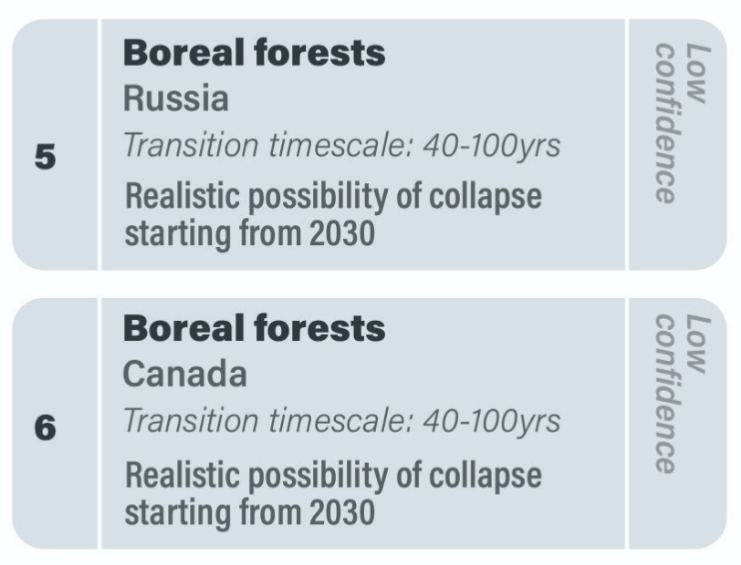
Anyway, in my note, the only ecosystem I mentioned was the Amazon Rainforest. However, the document itself listed 6 ecosystems that were at risk of collapse, and 2 of them were the Boreal forests of Canada and Russia. This snip comes from page 8 of the assessment. “Realistic Possibility” means a 40-50% chance. “Low” confidence means something which is not defined in the document. Note also the start date of “from 2030” – i.e. in 4 years.
[In the interests of fairness I must note that it is not completely off the wall to propose that global warming might cause forests to gradually disappear under some circumstances. The centre of continents are usually dry, after all, and the Boreal forests do occur in such places. So if things grew warmer, moisture deficit might mean that new trees could not become established. However, we have to take note too that thanks to CO2 fertilisation, the pleasant side effect of fossil-fuel use that only climate deniers have noticed, photosynthesis would be easier than before.]
Following closely behind the excitable nonsense of the Defra report, stamped with the highest imprimatur known to this blessed kingdom, came another news item on the Boreal forest. Said Jo Nova,
Climate pollution causes boreal forests to grow 12% — recklessly spreading greenery in Arctic
Since the advent of Landsat coverage in 1985, things have got greener. Quoting Phys.org**, she says:
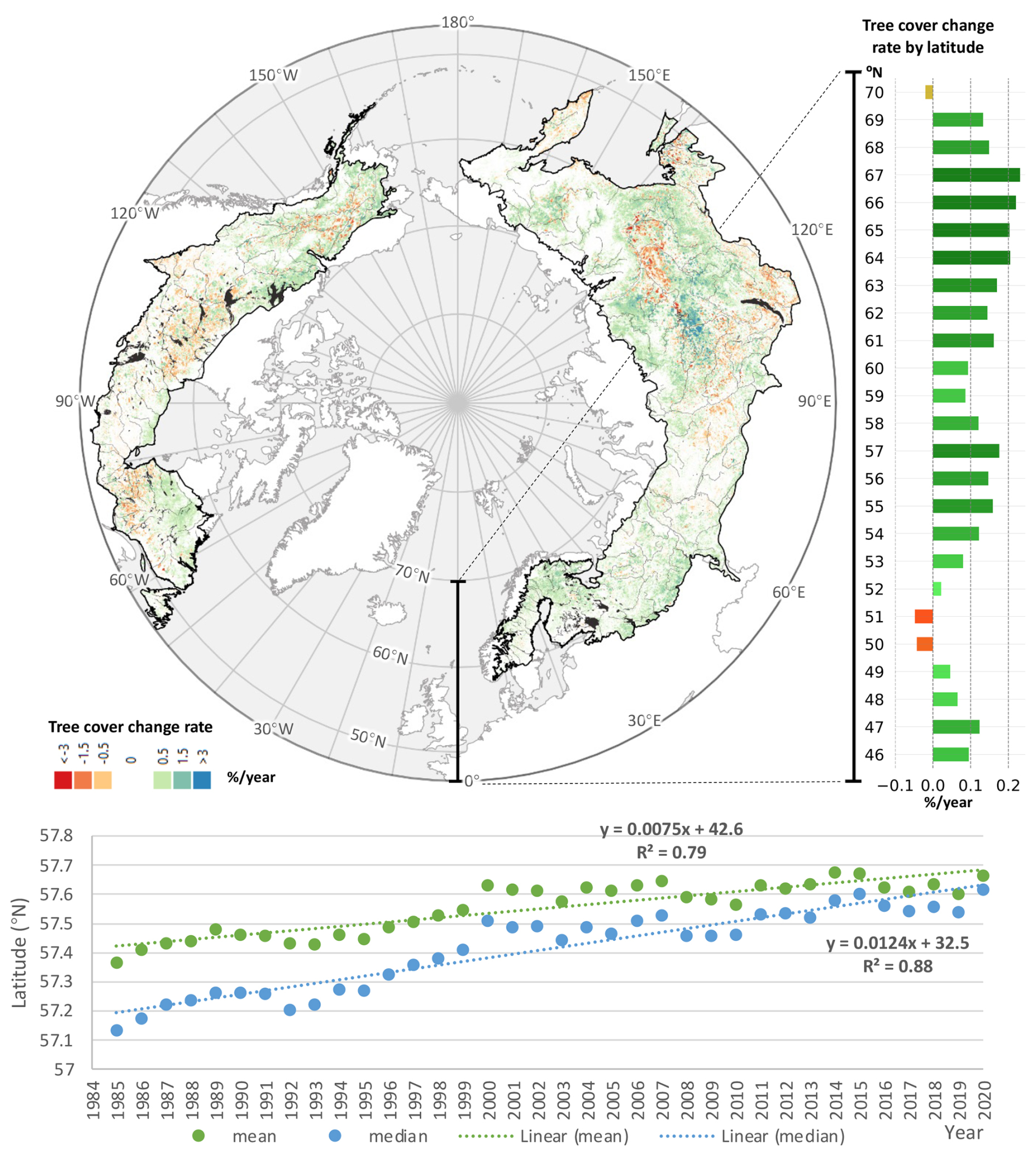
The analysis revealed that boreal forests both grew in size and moved northward. The forests expanded by 0.844 million km² (a 12% increase) and shifted northward by 0.29° mean latitude, with gains concentrated between 64°N and 68°N.
It seems unrealistic to propose a collapse beginning in 4 years, if this new evidence has any merit. Rather, it smacks of the danger being imminent only because it is necessary to alarm the public on a regular and compounding basis.
My question to Clisceppers: in what universe is current improvement portrayed as imminent doom? What on Earth would they say if the data on the Boreal forest was actually bad?
Notes
The featured image comes from Figure 2 of Feng et al. This is a more complete look at it.
*They actually said, “A UK climate security report backed by the intelligence services was quietly buried – a pattern we’ve seen many times before.” The author, whose name I forget, made a witless crack about climate deniers. Robin engaged in comments, but the article’s originator ceded the field.
**Only 3 years ago Phys.org were running with another article, this one saying that
Boreal forests may be on verge of contraction: New study
Here, the Canadian Boreal was on net contracting, because even as it grew northwards, it was eroded southwards.
/message ends
 Climate Scepticism
I believe two other arguments have been made for why a growing boreal forest is a bad thing. Firstly, the migration northwards has resulted in a drop in the average age of the trees (young trees sprouting up whilst old trees die off). This has been said to have reduced the boreal carbon sink effect, notwithstanding an increase in boreal coverage (although how they have been able to make such a calculation is beyond me). Secondly, more trees just means more fuel to burn as climate change increases the number of fire risk days. It’s a bit like saying that warmer winters are bad thing because they cause more oldies to survive, placing them at greater peril from the summer heatwaves.
So you see, nothing good could ever possibly come out of a warming climate. Not ever possible.
LikeLiked by 3 people
It’s not science, nor is it serious research, but I just asked ChatGPT what are the effects of climate change and increased CO2 volumes on boreal forests. It largely agrees with Jit’s conclusions:
The boreal forest is currently undergoing a significant northward shift, characterized by simultaneous expansion into northern tundra and retreat or thinning at its southern borders. Recent satellite analysis spanning 1985 to 2020 indicates the total boreal biome has increased in size by approximately 12% (about 0.844 million km2), with the average forest cover moving north by 0.29 degrees of latitude.
Effect of CO2
Fertilisation
Increased CO2 can lead to greater wood volume by increasing photosynthesis efficiency. One study in Alberta, Canada, found a 1.0% increase in lifetime CO2 exposure led to a 1.1% increase in wood volume.
Nutrient Limitations
The positive effects of CO2 are often constrained by soil nutrient availability (like nitrogen and phosphorus). Climate warming can sometimes alleviate these limitations in boreal regions, helping trees use the extra CO2.
Interaction with Stress
While CO2 combined with warmth can enhance performance if water is sufficient, these benefits are often weakened or negated by drought. If a forest is water-stressed, the fertilisation effect of CO2 may be limited.
Species Differences
Hardwood species (like birch and aspen) appear to respond more strongly to CO2 fertilisation than softwoods (conifers), which may lead to a restructuring of forest composition.
The Defra report does seem to be a very poor effort, bordering on the nonsensical.
LikeLiked by 1 person
That’s interesting, if true – it’s an over-unity ratio of supplement to response.
LikeLike
Sorry to bring Climate Audit up again, in another interesting Jit post.
But as I remember, it was a tree in Yamal (core of a dead tree I think) that Steve identified as the originator of the hockey stick. He also had lots of comments about treeline & climate as I recall.
Anyway, “Increased CO2 can lead to greater wood volume by increasing photosynthesis efficiency. One study in Alberta, Canada, found a 1.0% increase in lifetime CO2 exposure led to a 1.1% increase in wood volume“.
Think it was the BBC the other day had a wood merchant on saying the best timber comes from tree’s in cold climates, as they grow slowly, but global warming means the tree’s will grow faster & therefore be less dense.
LikeLiked by 1 person
So, is it still, “worse than we thought”?
LikeLike