The phrase “ecosystem collapse” seems to be in the news a lot lately. However, I have never investigated what stories threatening “ecosystem collapse” are all about. Why not? Surely as an ecologist, I should be more interested in this than non-specialists?
Well, no. I sneeringly made the assumption that the authors of these pieces did not know what an ecosystem was, let alone what a collapsing ecosystem would look like. “Ecosystem collapse”, I reasoned, was just another emotive term to get us all panicking about the next few added ppm of CO2 in the atmosphere. No doubt, I said to myself, the source material for these articles was alarmist claptrap. However, there came a point when I wanted to prove to myself that there was nothing to the latest stories. No, I did not approach it with an open mind. Rather, my aim was to glance at one of the stories, find the source document, glance at that, pick out the keystone, and watch the edifice crumble. Then come here and tell you about it.
What is an ecosystem?
That’s a bit of a sore point. My ecology textbook does not define it, nor does it refer to an ecosystem as any of several scales of ecological organisation. Why not? Well, the subtitle of Ecology by Begon, Harper and Townsend is “Individuals, Populations and Communities.” Where does an ecosystem fit into that scheme? Under “Communities.” We all know what an individual is, though sometimes in ecology that is not so easy to define. Similarly with populations. It’s obvious what one is, though yet again, once you begin your study of ecology, you soon find that a population is sometimes not easy to delineate either. What about a “community” – what is one of those? Think of it as all the lifeforms interacting in a certain place, with a scale of your choosing. You can translate straight across from “community” to “ecosystem”, with the addition of exterior abiotic forces. The two are the same, because the “community” can only be understood in the physical environment in which it is placed.
But “community collapse” probably doesn’t sound as scary.
What about the latest “ecosystem collapse” story?
The BBC reported on a document published by Defra, which ultimately came from the Joint Intelligence Committee, 10 days ago.
The decline in the health of nature around the world poses a threat to the UK’s security and prosperity, an intelligence committee has concluded in a long-awaited report.
If there was an opener likely to deter me from proceeding, this was probably it. Nevertheless, this time, I proceeded.
Pointing to the UK’s reliance on ecosystems that are “on a pathway to collapse” – such as the Amazon rainforest – the report warns of rising food prices and says that UK food security could be at risk.
The UK does not rely on the Amazon rainforest. In any way. At all.
The report…
…highlights six ecosystem regions which it calls “critical for UK national security”, based on the likelihood of these ecosystems collapsing and the impacts were they to do so.
They include the rainforests of the Amazon and the Congo basin, the boreal forests of Russia and Canada, the coral reefs and mangroves of South East Asia, and the Himalayas.
These ecosystems are on the “pathway to collapse”, the report says, if current rates of nature loss continue. But exactly when this would happen – and how long it would take – is uncertain.
The risks to the UK are:
Rising migration
Geopolitical competition
Higher risk of pandemics
Economic insecurity
Lower food security
If major food-producing regions were hit, some foods would become scarcer, driving up prices globally and potentially restricting choice, the report says.
But the report warns that the UK is “unable” to be food self-sufficient at present based on current diets and prices – and full self-sufficiency would also require “very substantial price increases” for consumers.”
The UK will never be self-sufficient in food, not until the next plague kills half of us. It hasn’t been self-sufficient for a long time. Easily-accessible Defra statistics go back to 1956, and we have not been self-sufficient in all that time. The recent peak was in 1984, when we grew the equivalent of 78% of what we ate. In terms of fruit, we’re down to a sixth of what we currently eat. Let’s cover more land in solar panels, that’s my theory. Then we can eat polysilicon wafers.
Gareth Redmond-King, head of international programme [sic] at the Energy and Climate Intelligence Unit, said that weather extremes fuelled by climate change were already hitting food production in some parts of the world.
Dear BBC. Please call some other “think” tank when you need a soundbite. This bunch have a one-track mind, and their soundbites are not trustworthy.
Defra said the UK’s food system was resilient, blah blah.
Yeh, but not if you like tomatoes.
Naturally, the BBC don’t link to the Defra report. So let me just find that. OK, you can read it here.
Glad to see that they define “Ecosystem Collapse.”
Ecosystem collapse: refers to a critical threshold beyond which an ecosystem is potentially irreversibly changed and can no longer maintain essential structure or function.
OK, well, it sounds serious. How might this be achieved? Let’s read on.
The first section is on biodiversity loss.
The world is already experiencing the impacts of biodiversity loss, including crop failures, intensified natural disasters and infectious disease outbreaks.
Biodiversity loss does not lead to crop failures. This is so dumb, I find it hard to believe that anyone serious would write it down on an official document. This is supposed to be an intelligence committee? Crops are grown in near-sterile conditions. Compare a Victorian wheat field to a modern wheat field. Which is more diverse? Yields have increased as other species have been progressively excluded. That is how the game works.
Aha! You ****ing idiots. See what they say further down the page?
Food production is the most significant cause of terrestrial biodiversity loss.
Yes. Not climate change. Modern agriculture. You cannot combine the two, biodiversity and farming. What you have to do is permanently set aside areas that will not be subject to any human impacts. These will be where your reservoirs of biodiversity are. How do we stop biodiversity loss? Defra give five bullets and a rider, and the only bullet that makes sense is the first one – broadly saying what I just said. Put land aside and keep it safe. Of course, the rider is none other than, “It would also be necessary to meet the Paris climate agreement target of limiting warming to 1.5°C.”
No it wouldn’t, you idiots. That’s just the thing that you have to say all the time now, whether it helps or not.
The next section should be a doozy. It’s
Biodiversity loss impacts national security
I can’t wait to see what they’ve cooked up here.
Oh. That’s disappointing. It’s the same stuff as before.
The impacts will range from crop failures, intensified natural disasters and infectious disease outbreaks to conflict within and between states, political instability, and erosion of global economic prosperity.
So somehow, the increase in crop growth, displacing biodiversity, will in fact decrease crop growth.
It all makes sense, if you think about it.
The case study is of Central American coffee farmers suffering from coffee rust disease (a fungus) and losing crops, and migrating to the US.
Well, here’s what Wiki says on the topic of the cited outbreak:
The reasons for the epidemic remain unclear but an emergency rust summit meeting in Guatemala in April 2013 compiled a long list of shortcomings. These included a lack of resources to control the rust, the dismissal of early warning signs, ineffective fungicide application techniques, lack of training, poor infrastructure and conflicting advice.
Let me just say to the author(s) of this report, that it is a trivial task to go back through written history and find devastating crop outbreak after devastating crop outbreak. You can find sawfly devastation of UK turnip crops going back to Regency times (I won’t say what they called the sawfly larvae back then). The Irish potato famine has recently been mentioned in these pages.
I wonder how the potato famine would have proceeded, with large modern farms, equipped with modern machinery, and chemical fungicide? I think we all know the answer to that. Modern farming has adapted to every pest and disease it has encountered, thanks to the miracle of chemicals (in which the UK is, or at least was until very recently, self-sufficient).
I really can’t be bothered to read the rest, but before I go, I must just find out how the “collapse” of the Amazon rainforest is going to affect the UK.
…
Disappointingly, it doesn’t say. It does mention that deforestation could lead to a snowball effect, a diagnosis with which I concur. The obvious response is to stop deforestation. I mean, how hard can it be? You could save the rainforest for the cost of one new wind farm, if you wanted to, if your priority was actually doing something to help.
Final note. Why is this ecologist so insistent that “ecosystem collapse” is not a thing, when considering climate change? The reason is, that the fundamentals of these communities, without human impacts, will be the same after 1.5C of warming as they are now. Here, let me show you a cool figure showing the distribution of the world’s biomes (large areas occupied by a similar community) by mean temperature and humidity. There’s a simpler version in my ecology textbook, but here’s an earlier version by Whittaker:
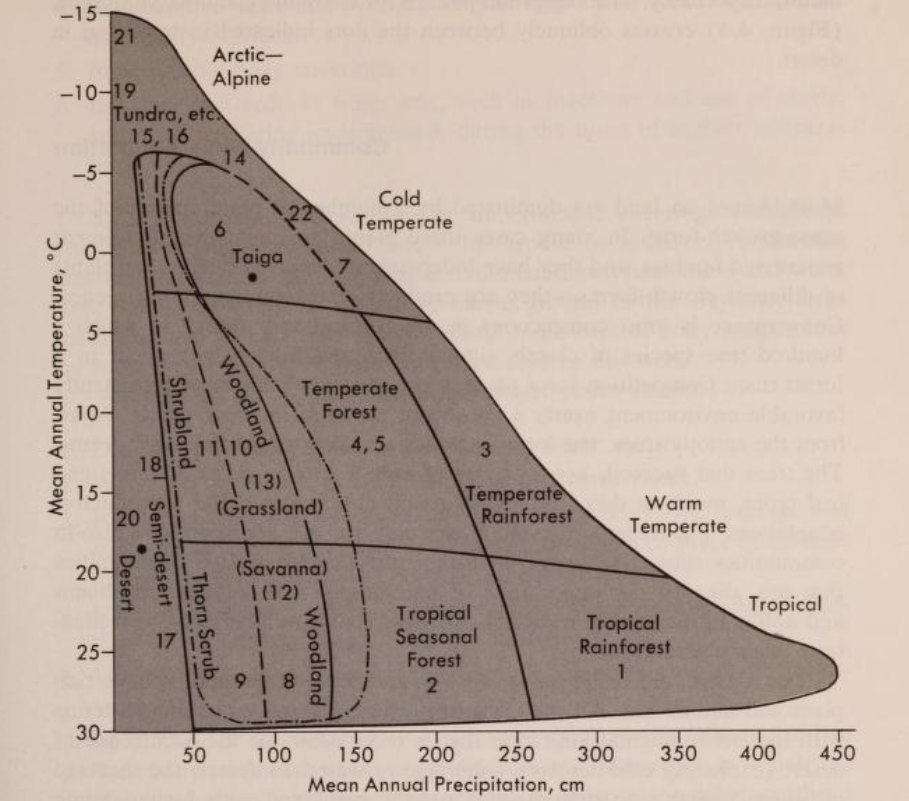
Now, I would like you, in your mind’s eye, to add a degree and a half to the world. Heck, make it 2.5 if you like. How many biomes have collapsed? And if you think they have collapsed – what do you think is there now? Is it just a lifeless wasteland, the air freighted with grey dust collecting in drifts on the skeletons of cattle? Or, is it actually still teeming with life?
Final distraction
I’ve just found something else objectionable on the internet. Damn the internet for being full of such things. Further down my search on “ecosystem collapse,” comes this article in The Ecologist, 2 years ago:
Forests’ ‘catastrophic ecosystem collapse’
The text begins:
Experts predict ‘catastrophic ecosystem collapse’ of UK forests within the next 50 years if action not taken.
This dozy lot, more than many, should realise that if the human population debarked from the UK tomorrow, then in 50 years there would be a damn sight more forest here than there is now, and if you waited even longer, the good ship UK would ultimately be covered by forest from stem to stern, 400 ppm CO2 or 800.
/rant over
 Climate Scepticism
Jit,
Thank you. I found the report and linked to it here a few days ago. As Ben Pile has written elsewhere, it’s a staggeringly lightweight piece of work that could have been produced by AI in seconds. I wonder what it cost to produce such unmitigated rubbish? And, perhaps more to the point, why did someone in the establishment think it was important to produce it?
LikeLiked by 1 person
It’s odd. but a lot of the time the “latest terrifying threat”, according to some people, is Ed Miliband…
LikeLiked by 1 person
Meanwhile:
“Record harvest sparks mass giveaway of free potatoes across Berlin
From zoos to soup kitchens, people are hauling away tonnes of surplus spuds after the biggest crop in 25 years”
https://www.theguardian.com/world/2026/jan/31/record-harvest-berlin-giveaway-potatoes
LikeLiked by 1 person
The five ‘risks’ listed above are all things that recent governments have actively promoted. So the best way of mitigating these risks would be to have period without a government, at least until wanabe politicians come to their senses and start acting sensibly.
LikeLiked by 1 person
Here seems to be as good as anywhere to post this:
“Rare fungus spotted for first time in 50 years”
https://www.bbc.co.uk/news/articles/cj0ng7ymlv7o
…Liz Charter, founder of the Isle of Man Fungus Group, said the increase in sightings is thanks to more people looking for it and ideal weather conditions….
LikeLiked by 2 people
The word “ecosystem” as it appears in such reports and the green media is just a fancy way of saying “life, the universe and everything” providing a sciencey gloss with a view to discourage close examination.
Donning my nerdy hat, and taking seriously the “system” part of ecosystem, it is capable of a more precise location within the individual – population – community – … biome hierarchy.
As Jit writes, it sits somewhere close to the “community” point on the scale though with the added ingredient of self-sustaining. One splits all the elements of an ecosystem into its boxes containing individual biotic elements with the chemical transformations they perform. Add arrows between the boxes showing resource flows of nutrients, water, energy, genes, all overlain with a who-eats-what food web. Then some big arrows pointing in at the top of energising photons and abiotic elements like C,N,S,P,K,H2O and pointing out of the bottom with the ineluctable puffs of CO2 and heat thanks to the final detritivores. The “self” prefix that merits this qualifying as an ecosystem is the preponderance of vertical exchanges between the boxes and the relative absence of horizontal exchanges with the next-door ecosystem, and a minimal loss of those sustaining abiotic elements.
The scientific focus is on the functional role of the communities (the within-box transformations) comprising the ecosystem so that the chains and exchanges persist when one of the community members goes AWOL. There’s always another that steps in to do the needed jobs. Such systems would tend to be more on the nature reserve scale though others are available. The really big ones would tend to be called biomes like on that Whittaker diagram Jit shows or the Koppen-Geiger climate zones.
LikeLiked by 2 people
Mark – that BBC fungus article is a bit O/T, but, as I live on the sunny Isle of Man thought it worth a read. A few quotes jumped out at me –
“They play a massive role in the rotting down of dead flies or the horns of dead sheep as well as wood and plant materials.”
“Despite the fungus first being recorded in the 16th Century by French naturalist Jean-Baptiste Lamarck, little is known about how Cobalt Crust, first spotted on the island near Lezayre in 1976, is transported.
Charter said: “It’s very difficult to know how fungi has come to the island, perhaps on peoples feet or in the airstream – it’s one of those mysteries”.
Well it’s left me mystified as well, wonder how many “dead flies or the horns of dead sheep” it has been observed rotting down?
LikeLiked by 2 people
You can always count on the Guardian editorial:
“The Guardian view on risks from biodiversity collapse: warnings must be heeded before it’s too late
Inadequate food supplies and collapsing rainforests must be recognised as national security threats – not pigeonholed as green issues”
https://www.theguardian.com/commentisfree/2026/feb/01/the-guardian-view-on-risks-from-biodiversity-collapse-warnings-must-be-heeded-before-its-too-late
The document is a national security assessment, not a scientific report. The data that it relies on comes from other sources. But the warnings that it contains about the UK’s heavy dependence on food and fertiliser imports, and the probable consequences of nature depletion, must be heeded. Originally due to be published in the autumn, the review appears to have had some sections removed. An earlier version is reported to have included warnings about the risks of “eco-terrorism” and the growing likelihood of war between China, India and Pakistan due to competition over a shrinking water supply from the Himalayas.The climate secretary, Ed Miliband, is one of the cabinet’s most experienced politicians. On carbon emissions targets, Labour has largely stuck to its guns and not allowed the siren voices of the populist right to undermine the UK’s green transition. By contrast, Kemi Badenoch’s pledge to repeal the Climate Change Act was arguably her most reckless decision since becoming Tory leader…
LikeLiked by 2 people
The UK’s “green” “transition” is undermining food security. Take for example the high energy costs and carbon taxes that led to the closure of the UK’s last producer of ammonia. This closure means that ammonia now has to be imported (to be transformed into ammonium nitrate in the UK). Funny that the BBC seems to be obsessed by fringe mavericks and their magical “green” ammonia products.
LikeLiked by 1 person
Dougie, I don’t know why the local expert wandered off onto the topic of flies and sheep horns, which have nothing to do with this particular fungus, which digests woody plant material. But decay processes generally are dominated by fungi, and without them, plants would have piled up, and sequestered so much carbon dioxide, that they would end up starving themselves.
This is what Max was referring to above – things like fungi perform a “service” in an ecosystem. But for some reason, the alarmists seem to think that if the ecosystem “collapses” then the service would not be performed. In reality, of course, there is a fungal spore in every cubic cm of air, and many of them are waiting to land on the right surface, to start digesting it. If the community changed, the fundamentals of photosynthesis and decay would remain the same.
LikeLiked by 2 people
Food shortages , eh?
LikeLike
weather extremes fuelled by climate change
Alarmist mumbo-jumbo.
LikeLike
Jit – Thanks again for your posts, always an informative read & comments it invokes.
Thanks to your enthusiasm, I have now read books on Fungi & Ants & how they have interacted for millions of years, which give me a deeper understanding of what happens in the ground us newcomers walk on.
LikeLike
The Conversation (i.e. Marc Hudson again) has this to say about the report:
“A UK climate security report backed by the intelligence services was quietly buried – a pattern we’ve seen many times before”
https://theconversation.com/a-uk-climate-security-report-backed-by-the-intelligence-services-was-quietly-buried-a-pattern-weve-seen-many-times-before-274325
The bulk of the article is dedicated to the idea that, throughout history, for reasons not properly explained, the UK government has conspired to hide the horrible truth of climate change from us. It finishes with:
“Here’s the final irony. Conspiracy theorists and climate deniers insist governments are exaggerating the threat. In reality, the evidence increasingly suggests the opposite.”
No, here’s the final irony. An author who is peddling a conspiracy theory seems to think himself quite different from those he accuses of engaging in conspiracy theory.
LikeLiked by 3 people
Thank you John. That was an appalling essay. It would take an essay twice as long to go through it paragraph by paragraph explaining why it is wrong. I see Robin has commented, as has one Norman Rides.
LikeLike
John – thanks for the link. I am always open to rational debate on this topic.
Like Jit, so much I could comment on, but will settle for a end quote from his bio –
“For what it is worth, I think we’re not going to get out of this mess, to the extent that I had a vasectomy back in 2004. True story.”
LikeLike
I see Robin is soldiering on. More evidence, if it was required, that it doesn’t matter how wrong you are, if you don a cloak of virtue. On the other hand, denialist talking points generate revulsion in the bien pensant, even when they’re completely correct.
LikeLiked by 1 person
From these comments I guess it’s a relief for the world that this chap won’t have any descendants!
LikeLike
Apparently it’s not just ecosystem collapse, we’re facing an economic crash of devastating proportions too:
“Flawed economic models mean climate crisis could crash global economy, experts warn
States and financial bodies using modelling that ignores shocks from extreme weather and climate tipping points”
https://www.theguardian.com/environment/2026/feb/05/flawed-economic-models-mean-climate-crisis-could-crash-global-economy-experts-warn
It’s interesting that economic models can be flawed when they’re not gloomy enough, but climate models are never flawed when they’re incredibly gloomy.
Flawed economic models mean the accelerating impact of the climate crisis could lead to a global financial crash, experts warn.
Recovery would be far harder than after the 2008 financial crash, they said, as “we can’t bail out the Earth like we did the banks”.
As the world speeds towards 2C of global heating, the risks of extreme weather disasters and climate tipping points are increasing fast. But current economic models used by governments and financial institutions entirely miss such shocks, the researchers said, instead forecasting that steady economic growth will be slowed only by gradually rising average temperatures. This is because the models assume the future will behave like the past, despite the burning of fossil fuels pushing the climate system into uncharted territory....
LikeLike
More on food shortages (though as is increasingly the case with the Guardian these days, no link to the study in question that might help us form our own views):
“‘Tinderbox’ UK may be one shock away from food riots, experts say
Weakened food security could tip into unrest after a cyber-attack, extreme weather or conflict, analysis finds”
https://www.theguardian.com/food/2026/feb/23/uk-food-security-cyber-attack-riots-tinderbox-analysis
…The group first identified a series of issues that are making access to food vulnerable in the UK, including the climate crisis, low incomes, poor farming policy and fragile just-in-time supply chains. These have left the UK dangerously exposed, the researchers said.…
No mention of the folly of giving up prime agricultural land to solar farms.
LikeLiked by 1 person
“UK must stockpile food in readiness for climate shocks or war, expert warns
Prof Tim Lang says country produces far less food than it needs to feed population and is particularly vulnerable”
https://www.theguardian.com/global-development/2026/mar/07/uk-stockpile-food-climate-shocks-war
…Prof Tim Lang of City St George’s, University of London said the UK produced far less food than it needed to feed itself, and as a small island that relied on a few large companies to feed its giant population, it was particularly vulnerable to shocks.
The first UK Food Security Report in December 2021 found the country was 54% food self-sufficient. Other rich countries such as the US, France and Australia are all food self-sufficient, meaning they grow enough food to feed their populations without imports if required.
The UK is one of the least food self-sufficient countries in Europe. The Netherlands, for example, which is densely populated, is at 80%, and Spain is at 75%….
…Other countries have emergency stockpiles in case of war, food contamination or climate shocks. Switzerland still has a stockpile sufficient to feed its entire population for three months and is increasing it to a year. The UK government’s advice to households is to have three days’ worth of food in their cupboards.…
…the 12,284 supermarkets around the UK are “fed” by just 131 distribution centres.
These were a “sitting duck” for drone or cyber-attacks by malign states, he said: “The nine big retailers account for 94.5% of all retail food. That’s nine companies, using just 131 distribution centres. In drone war, that’s a sitting duck.”
According to his report, Tesco, which provides nearly a third of UK retail food, operates via only 20 distribution centres. He said: “When four of the 10 big retailers account for three-quarters of retail food, if one or two of these megafirms was hit in some way, or their tight system of distribution centres was disrupted, the impact on the public would be considerable.”…
…Lang said: “Climate change, the floods and droughts, these are part of vulnerabilities to the just-in-time logistics system of the food system. The key finding of my report was that we created a food system in the name of efficiency, which is now inappropriate for where we are, a concentration of big companies dominating, being the choke points. This creates vulnerability. Drone warfare and software dependence make it doubly vulnerable.”…
I don’t agree that climate change is much of a threat to food supplies – the world is producing more food than it has ever done, despite the ongoing hysteria about climate change and alleged tipping-points. However, I do agree that as a country we are extremely vulnerable to bad actors, possibly more so than ever before. Food and energy are probably the two main things any country needs, and we are increasingly dependent on foreigners for both. What we do about this is another matter. Mr MIliband says we need to carpet the country in solar (and wind) farms in order to achieve energy security, but this damages food security, and the sun provides very little energy to the UK in winter, when demand is greatest. All renewables require back-up. As things stand, fossil fuels are the only practical answer in terms of supplying adequate back-up. Refusing to exploit our own fossil fuel resources at a time of global uncertainty and vulnerability makes no sense to me. For all the talk of global markets, and North Sea oil and gas being sold abroad, in a crisis a government could temporarily nationalise oil and gas extraction and/or mandate that all such domestically-produced supplies be diverted solely for domestic use. If we don’t have the ability to extract fossil fuels (whether because fracking wells have been capped with concrete or because oil and gas companies have given up on the UK due to a combination of windfall taxes and a policy of not granting new licences), then it seems to me we’ll be right royally stuffed when the next energy crisis arrives – as it might just have done.
LikeLiked by 1 person
Regarding the necessity to sell gas on the open market, that is something that politicians like to say, but it is not like saying “If the apple falls from the tree, it will accelerate downwards at 9.82 metres per second per second.” There are ways of ensuring that any gas extracted could be purchased by the UK, at a price that has been agreed in advance.
LikeLiked by 1 person
Indeed – the government is perfectly happy to commit to 20 year contracts to buy electricity generated by renewables at guaranteed index-linked prices. It shouldn’t be beyond the wit of man (or woman) to do something similar for oil, gas and (dare I say it?) coal.
LikeLiked by 1 person