OK, so it’s that time of year.
Gosh, that was a miserable way of starting, wasn’t it?
Let me begin again. Seasonal greetings to all Cliscep readers. I hope you are warm, healthy, happy and well fed.
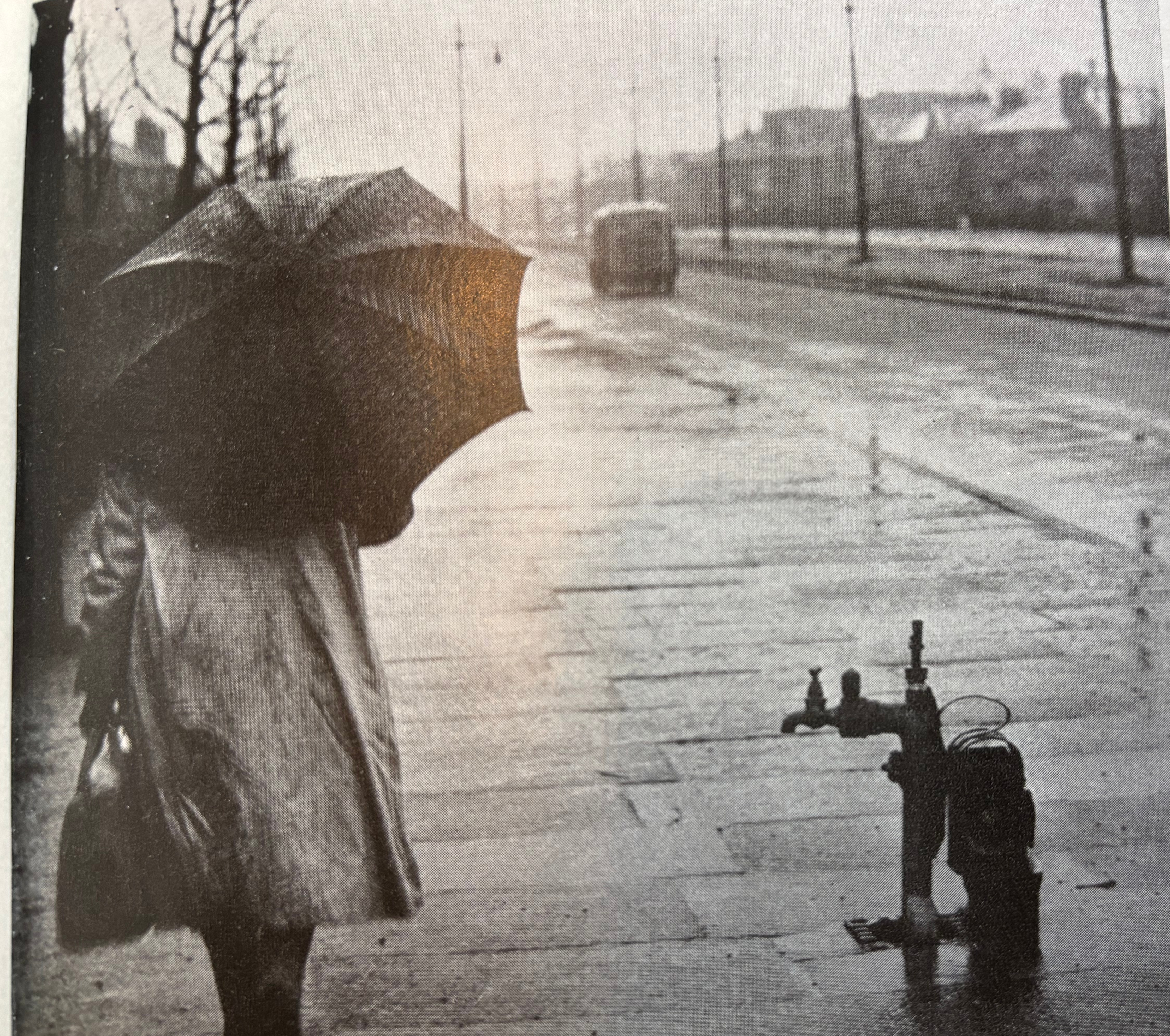
Now here’s this year’s quiz photo. There is a point if you get the decade, and another for the city. (I don’t think there’s anything to key in on to give away the city, so maybe this should be two points.) In the event you are a true historian, then if you know the exact year, you’d better have two points for that.
Five bonus points if you know the story that the photographer was trying to tell, back then, whenever and wherever this was.
Answer on Boxing Day.
 Climate Scepticism
Mrs H and I have collaborated, and are still struggling. We’re going to say 1950s, Manchester, but we don’t know the story. Is it something to do with the irony of a water storage (is that a water hydrant?) in such a rainy city?
LikeLiked by 1 person
And a Merry Christmad to all Cliscep contributors and visitors. 🙂
LikeLiked by 2 people
I’m going to go for Birmingham, Small Wood, early September 1976, two weeks after Denis Howell, who was MP for that area was appointed Minister for Drought.
John
LikeLiked by 1 person
I cheated and put the problem to CoPilot which identified the photographer, location, and motivation. I won’t spoil it by telling but anyone can do what I did. Seemingly though the irony contained by the juxtaposition of bucket and standpipe passed by both the photographer and CoPilot. Innocent days.
LikeLiked by 1 person
I was going to say 1963 and south London somewhwere But I see in the comments previous I have been out gunned!
Best wishes all.
LikeLiked by 1 person
London, North Circular, or other main roads in the area (I’m not from round those parts) mid 50’s? Heavy rain breaking a drought.
LikeLiked by 1 person
It’s winter (no leaves on trees). It’s raining. There is no record of standpipes being used on British streets prior to 1976 during the drought in summer, so I’m guessing this was a one-off rare event at a specific location. Can’t really think what though? Why would a standpipe be installed during a wet winter? There appears to be lagging on the pipe and some device next to the standpipe with a wire connected. Could this be for heating? The vehicle and photo look old, circa 1950s. I’m going to have a wild guess at spring of 1947, just after the very severe winter/early spring, when many water pipes froze in the severe conditions. When the thaw came, it rained heavily. Perhaps this standpipe was installed during winter when most of the pipes froze, in order to provide at least some fresh water to residents. That’s my guess anyway.
Merry Christmas everybody.
LikeLiked by 2 people
That’s am intriguing puzzle Jit. I would say Britain in the 1950s or early 1960s – probably the former. If I must identify a city I would guess Birmingham or Coventry. The strange features are the empty but two-lane street with no parked vehicles at all. And the very wide pavement with a standpipe positioned in an extremely hazardous position in the middle of it. I would guess the standpipe was a hangover from the war when not everyone had mains water – it doesn’t look like a temporary arrangement for a drought. That’s all I can think of. Not much I’m afraid.
LikeLiked by 1 person
PS: I would add that the almost total lack of other vehicles or pedestrians on such a wide (arterial?) road in the daylight suggests a Sunday morning (few shops or businesses open in the 1950s). That also reinforces my view that it was a Midlands city and not London. And, as Mark pointed out, it was in the winter.
LikeLiked by 1 person
I will go for a variant of Jaime’s answer: March 1963, immediately post-freeze, Port Sunlight … but it is not a city.
That raincoat looks plastic, and the umbrella and handbag have a more modern look (to my untutored eye) than austerity/ration book ’50s Britain. Other interesting points: very wide pavement + wide dual carriageway road = new town concept?, very little traffic (Water Board? van with no lane discipline), no H- or X-shaped TV aerials?, only one pedestrian too, street lamps are converted gas standards?, no shops, no factory chimneys, hint of lagre non-industrial buildings in background, 10/10 cloud, is the hand gloved?, testing box for water contaminants or electrical conductivity?
I have many more questions than answers. I’m intrigued … but essentially clueless! I look forward to tomorrow’s reveal.
Cheers! John C.
LikeLiked by 1 person
Like Max above, I tried CoPilot to cheat. But unlike Max got no answer!!! wonder how Max got it to work?
Anyway, I reckon Glasgow 1947 – Winter of 1946–47 in the United Kingdom – Wikipedia
Regarding the “device next to the standpipe with a wire connected”. Looks like a old uk road/hazard lamp that I vaguely remember, tied to the standpipe & sitting on top of the standpipe access plug. Elf & Safety 🙂
LikeLiked by 1 person
dfhunter: I used the Google Image search feature (that camerish looking icon at the end of the search bar). It’s not quite boxing day yet so I’ll stay stumm.
LikeLiked by 2 people
Thank you all for your theories, which were triangulating on the answer. The photo comes from Gordon Manley’s Climate and the British Scene, p194 (although the original is from a newspaper, as Max no doubt discovered). Here is the original caption:
A reminder that the UK’s weather does whatever it pleases, and probably always will.
LikeLiked by 3 people
Aha! The infamous hot summer of 1947, so infamous that it has been all but forgotten owing to the even more infamous winter and the ‘fact’ that the 1947 Europe-wide summer was ‘just weather’ whereas the 2003 summer was ‘man-made global warming’. The fact is, 1947 was quite an extraordinary year weatherwise, throughout Europe: first exceptional cold and huge blizzards, then exceptional heat and drought. Nowadays, they’d call it ‘climate whiplash’ – cos CO2 innit.
https://cliscep.com/2019/07/29/1947-an-anti-hysterical-perspective-on-modern-european-heatwaves/
LikeLiked by 3 people
Well, I can’t claim a prize, but it’s pleasing that between us, Mrs H and I were fairly close. And thanks for linking in to a bigger theme. I recommend reading Jaime’s article about 1947.
LikeLiked by 2 people
You can see here how exceptional August 1947 was, outdoing 1976 even. It is also the driest August in the entire UK series.
UK – Mean daily maximum temp
August
UK – Rainfall
August
Behind every good Christmas Quiz photo, there’s hard data!
LikeLiked by 3 people
Turns out I spoke too soon. This is what the Google image search turned up:
This is the famous photograph “Rain in Bristol”, taken by English photographer Joseph McKeown in May 1954.
But after diving deeper it transpired the AI used by Google Image Search found a different image but went off in its hallucinatory fashion to oversell the one it discovered as a match. I sort of began to suspect something fishy when it went all vague when I tried to converse about the standpipe. Mind you that “narrow street” should have alerted me straight away to my own hallucinatory tendencies.
Bottom line is I came nowhere in Jit’s Christmas quiz.
LikeLiked by 3 people
Somewhat fascinated, I checked out Gordon Manley’s ‘Climate and the British Scene‘ and the book sounds so interesting and Gordon Manley himself so quintessentially old school English gentleman scientist (who barely even mentions CO2 in relation to climate) that I’ve ordered a 5th edition 1972 paperback. So thanks Jit, I’ve treated myself to a late Christmas present! Manley also published the Central England temperature series in 1953 and updated it in 1974. Present day ‘scientists’ at the Met Office are not a patch on this guy, or Hubert Lamb, another brilliant English meteorologist/climatologist who also recognised and credited the huge natural variability of the British weather and climate.
LikeLiked by 2 people
https://wires.onlinelibrary.wiley.com/doi/pdf/10.1002/wcc.334
Manley sounds exactly like the kind of scientist that the climate academic world is sadly missing and desperately in need of and I think it’s time for a firring tribute to the man, especially in light of the current slow motion collapse of the climate change scam.
LikeLiked by 2 people
Don’t heap too much praise on Gordon Manley or put him on a pedestal of climate wisdom. I would judge him as a historical geographer as much as he was a meteorologist. Old school certainly, but lacking the elementary statistical background crucial to the task of creating a single numerical index from a variety of sources.
The reason I know this is that I had reason to go through his boxes kept at Cambridge University library to learn in more detail where some of the sites were that he used for the early years of his Central England series. Remember this was a stitching together of a few southern sites to supplement his earlier northern England series. It was heavy going wading through columns of long-hand addings-up and arithmetic averagings of different combinations. His general technique was to scale the one set so that it provided the same average as the other over a common period, and thereafter apply the same adjustment factor to subsequent series – basically what we now call homogenisation. Fair enough, until I came across an exchange of correspondence between himself and Craddock, a statistician at the Met Office, in which he asked Craddock to explain to him what all this stuff was about “standard deviation” that he’s heard tell of.
To create a homogenised series from two (or more) source series you have to not just get the means of the two to agree (like he was doing), but also a more subtle weighting so that the spread of the data around the means matched. He never took this on board – I recall his reactions to Craddock were rather dismissive, nor the fact that an index constructed from several sources is necessarily a toned down version of the sources variability-wise. He always defined the CET and the Lancashire original as what one might observe at a representative single site, going so far as to describe site characteristics.
LikeLiked by 3 people
Thanks for your perspective Max.
LikeLike
I still think, even allowing for his obvious distaste for ‘rigorous’ statistics, Manley deserves to come in from the cold. Georgina’s efforts in 2011 were perhaps too far ahead of their time, when the “global and scientific metanarrative focusing on climate change and global warming” was still very dominant and destined to become even more so. It’s now definitely on the wain, so this would be a good time to re-examine and re-appraise Manley’s work, especially as the now thoroughly discredited Met Office is side-lining the rather inconvenient CET in favour of its shorter UK data series.
LikeLiked by 1 person
@Max – HaHa HoHo – seems C/P & Google Image search feature are not as not as good as the pea brain I employed 🙂
Fascinating comments/info on Gordon Manley, never heard of him before Jit’s post & comments.
Partial quote from the link I gave upthread – Winter of 1946–47 in the United Kingdom – Wikipedia
“The winter had political ramifications and caused the public to lose faith in a Labour government who could not maintain food and electricity supplies. Shinwell never publicly admitted that the crisis had resulted from low coal supplies, instead blaming the climate, the railway system, or capitalism generally. But the public blamed the long-time Labour activist, and Shinwell was forced to resign in October. Shinwell’s resignation did not absolve the party: Labour lost a large number of seats to the Conservative Party in the following election (but retained a slim majority). Youngs et al. conclude that, “Probably more than anything else, the fuel crisis of 1947 led to a loss of public confidence in the Labour government.””
Ring any bells!!!
LikeLiked by 2 people
@Jaime Jessop 26 Dec 25 at 3:55 pm
I have HH Lambs Second edition of Climate History and the Modern World, 1995, also have it on PDF. Every page an education. Another worthy read if you have time is Geoffrey Parkers Global Crisis, covering war, climate change and catastrophe in the 17th century. Interesting Table on pg 678. 7 pages detailing El Nino events, VEI events and extreme climatic events tallied against the many wars, invasion, purges, revolts, et al, over the period 1616 -1688.
LikeLiked by 1 person
Steve T,
Geoffrey Parker’s excellent book came to my attention some years ago when Paul Homewood made quite a few references to it at NALOPKT. I sought it out at the time, and am glad I did so. Another book I definitely recommend to Clisceppers.
LikeLike
Steve T,
I’ve got Parker’s Global Crisis, though I have to admit, it’s very long on political and social history, but not so much on climate history, so I find it a bit hard going.
LikeLike