Back in March, when the heatwave hysteria was just a gleam in the BBC’s eye, I showed some statistics on the UK’s Consumption Emissions (capitalised Donald Trump style here to show that it is a variable as well as a name).
If you remember, Imported Emissions are difficult to calculate, so the ONS produces them at a three-year lag. Thus, in March, all I could show was data up to 2021. Today, I decided to go back to the ONS today to see whether the statistics had been updated for 2022.
Well, they had.
OK, so now we just add another row to the spreadsheet for 2022 and…
Hold on a minute, the numbers for 2021 don’t match.
OK, maybe the previous year has been revised. Let’s just check the numbers for the first year in the series – 1996.
They don’t match, either.
Rather bizarrely, the UK’s emissions for almost every year in the series have been revised, mostly up. I say “appear” there because I don’t have a pristine version of the 1996-2021 spreadsheet. I edited it by adding columns of data to the right. There is a finite chance that I did something bad to the raw data somehow. Knowing me, I think this is highly unlikely. But I note it anyway as a possibility. In terms of Consumption Emissions, there is considerable recent variation with the new update; 2016’s value has been revised up by 14%. [The Territorial Emissions for that year have been revised downwards slightly.]
The problem here is that we can’t really discuss emissions figures to any purpose if they are going to be subject to revisions of the order of 10% some years after the event.
That said, I’m going to show the new dataset now, but caveat emptor, or cave canem, or cave next year’s revision.
So, without further ado, here are the UK’s Consumption Emissions and our Territorial Emissions Before Exports, including the wholesale changes in the 2022 update:
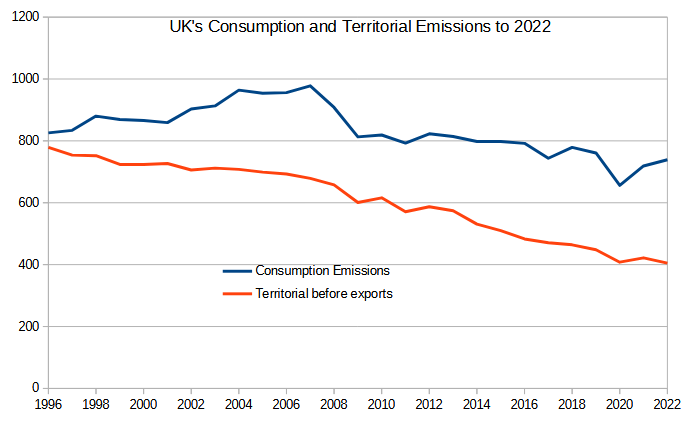
The story is essentially the same as before, with a somewhat rapidly-declining Net Zero-relevant metric (orange line) and a Consumption Emissions metric (i.e our actual emissions) that is hardly declining at all. The gap between the two is inevitably widening. If you put a line (ordinary least squares) through the two datasets, you will predict that we’ll hit Net Zero in 2050, but that our Consumption Emissions in that year will still be 557 Mt CO2e. Those emissions would be entirely imported, by definition. [In 2022, Imported Emissions are already well over half of our Consumption Emissions.]
What this means is that we will hit our Net Zero target on time, but still be emitting more CO2 in 2050 than many people think we are emitting today. We’ll say we’re on 0, but we’ll be on 557 Mt.
In fact, somewhat spookily, the orange line reaches Y = 0 when the year = 2050.2. On the present data we hit Net Zero exactly in 2050. Coincidence? [We wouldn’t hit Y = 0 on Consumption Emissions until 2130, on a wild extrapolation of this data.]
This figure shows our Net Emission Imports (i.e. Imported – Exported) as far as the latest update. The only way is up.
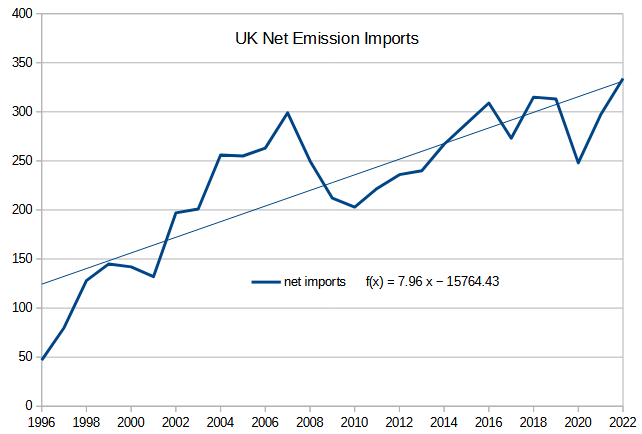
Conclusion: all the blather about how necessary Net Zero is to save the planet is incoherent for several reasons. Top is that, if the UK reaches Net Zero, the grand total of the world’s emissions will hardly notice. A close second comes the observation that we are just displacing our emissions to other countries, making our triumphant parade to Net Zero a mere accounting trick.
It’s as if we had pledged to give up keeping slaves, and when we reached the target of Zero Slaves, we all jumped around, slammed trebles, and popped party popping things, etc. Most of the public in that halcyon day would be blissfully unaware that we were still vicariously keeping slaves by importing goods from – shall we say – less scrupulous countries.
My suggestion would be that we need to impress upon our leaders that they are chasing the wrong number in Territorial Emissions Before Exports. But there’s no point pursuing the Consumption Emissions down to Net Zero, either, because success on that metric would result in the destruction of the UK as a functioning country. [I don’t exaggerate.] There’s no way that anyone could pretend otherwise, meaning that recognising Consumption Emissions as the appropriate target for our self-sacrifice would necessitate its abandonment as insane.
Or that’s what happens in a version of reality that I’d like to live in.


Jit, that’s close to telepathy. I was just about to post an article that overlaps to an extent (but only to an extent) with the excellent points you make. No doubt climate alarmists would say that fools rarely differ, but I prefer to think that great minds think alike. 🙂
I will defer posting my piece for 24 hours, to allow yours to be read and appreciated, and then with a view to mine in effect being a complement to yours.
LikeLiked by 1 person
I should add that we are close to the point where our imported emissions exceed our territorial emissions, as the former increase while the latter decline. Indeed, given that the data for imported emissions is three years out of date, we might already have passed that point, we just don’t know it. What an embarrassing and appalling position for us to be in. Unfortunately I don’t see any red faces amongst the net zero zealots in Parliament.
LikeLiked by 1 person
Imported vs Territorial:
According to the current release, for 2022:
GHG from UK goods and services produced and consumed here 211 Mt
Heating 63 Mt
Transport 61 Mt
Exports 70 Mt
Totalling 405 Mt.
GHGs embedded in imports 404 Mt.
So the present estimate is that it was perilously close in 2022, and it’s likely tipped over in the two years since. As noted, it’s more than half, if you don’t count our exports on our side of the ledger, as is normal.
LikeLiked by 1 person
“Another fake Net Zero market that nobody wanted is set to collapse”
Kathryn Porter in the Telegraph on the trouble with home-grown bio-ethanol production. Now that we have a big deal with Professor Trump, the Americans can sell us bio-ethanol that is cheaper than ours, thus driving our producers into the ground.
As she notes, the demand for bio-ethanol is quite artificial – it’s used to dilute petrol to make it less energy dense – er to make it “renewable” – we still pay the same duty on the petrol now it is 10% bio-ethanol.
If a rational government came in with a No To Net Zero policy, there would be no need for bio-ethanol, save for the manufacture of cheap cider. They probably use imported corn syrup for that, I don’t know.
The one thing she didn’t mention – and why I put this here – is that a really devious government would applaud this development. Any imports of bio-ethanol from the US and burnt here would not count as carbon dioxide emissions as far as the Net Zero benchmark is concerned. In that respect, it would count against the US’s emissions, like Drax does.
LikeLiked by 2 people