In Knowing Your Arson from Your Elbow, I skated over some of what I could find out about arson and wildfires, and promised to return with more. A year passed with no addition: but see more discussion under John’s piece, plus my transcript of the BBC’s coverage of the 2024 Greek wildfires. But yesterday I wondered whether the 2023 EFFIS report was out yet. It wasn’t. But I discovered that in the original blog post, I had not referred to the 2022 EFFIS report, which contains a few nuggets on arson in Europe.
EFFIS stands for European Forest Fire Information Service. While seemingly funded by the EU, external countries contribute to it, including North African and Middle Eastern countries with a Mediterranean coast. The annual reports consist of a mini-report on the year’s fires from all the constituent countries. There are also broader scale statistics, so that we can examine trends, if we care to. Of course, we don’t need to look at the actual data, do we? We already know how wildfires are changing thanks to Teh Climate Emergency.
Some countries, but not all, include data on the causes of fires. As this series is trying to get to the bottom of how important arson is as a cause of wildfires, it’s useful information. Now, it’s a long and dry document; I didn’t read it all. Instead I whizzed through instances of “arson” and “lightning” and otherwise skimmed for identified causes. Here’s a summary of what I found.
Reminder: fires can have natural or artificial causes. Dry lightning is almost the only natural cause. The artificial causes may be accident, infrastructure failure, carelessness, or arson.
Austria
82% of fires (178) human-caused. Negligence about 50%, discarded cigarettes 20%, hot ashes (presumably barbecues) 15%, arson suspected 10%. “The majority of naturally caused fires remained incipient or very small fires, similar to recent years.”
Bulgaria
The main causes for the forest fires during 2022 are as follows:
- Carelessness – 321 in number (62%);
- Arson – 16 in number (3%);
- Natural – 21 in number (4%);
- Unknown – 158 in number (31%).
Croatia – no data on causes.
Cyprus
“Out of the 89 forest fires that occurred in Cyprus during 2022, 23 forest fires (26%) were of unknown origin. Regarding forest fires with known cause, most fires were intentionally set (35 fires – 53%). A percentage of 8% is due to natural causes (lightning), whilst the remaining percentage, amounting to 39%, is attributed to human negligence.”
Czechia
“The main causes for the forest fires are usually:
• Negligence 52%
• Human caused 33%”
Estonia
“In 2022, 12 of the 26 fires were of unknown origin, one was caused by lightning and the rest were of human origin, mostly vegetation management.”
Finland
“The most common cause of wildfires in Finland was human actions. These caused more than 70%, mainly from accidents. The second biggest reason was natural (less than 10% of fires). The reason for the fire could not be found in over 10% of the cases.”
France
“Only 6 312 fires, or 33% of the total, have a known cause. This percentage, higher than the 2006-2021 average of 26% of fires with a known cause, reflects progress in the search for causes. Of these fires with a known cause :
- 330 were attributed to a natural cause (lightning), i.e. 1% of all fires or 2% of fires with a known cause, which is below the average of 7% of fires with a known cause, and a far cry from the 2006 record (580 fires or 23% of known causes).
- 4 119 fires were accidental, i.e. 22% of all fires, or 67% of fires with a known cause, which is close to the average.
- 1 863 fires were of deliberate origin, i.e. 10% of all fires or 31% of fires with a known cause, which is slightly higher than the average of 27% of known causes.”
Germany
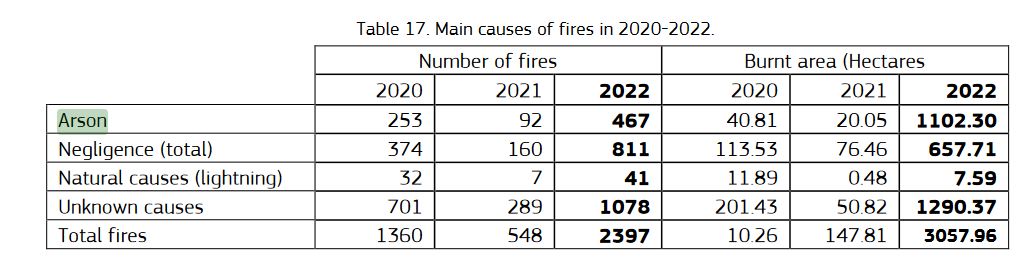
Greece – no data on causes.
Hungary
“99 % of forest fires are human induced (negligence or arson). Most fires are induced by negligence (adults and infants) and only a small proportion of fires are caused by arsonists. Typical forest fire causes are the incorrectly extinguished fires of hikers, illicit agricultural fires, discarded cigarette butts and sometimes slash burning.”
Ireland – no data on causes.
Italy
“Some 2% of forest fires are due to natural causes (lightning). This phenomenon is growing in the north-east of the country. With regard to man-made and intentional fires, the most frequent motivations are the renewal of pastures, while further reasons are linked to hunting activity, social unrest and pyromania. Unintentional causes are mainly due to activities of burning plant debris generated by agricultural activities as well as to recreational activities.”
Latvia – no data on causes.
Lithuania
“In many cases, the ignition source for fires is associated with traditional agricultural burning practices, although the fire causes for the majority of fire incidents remained unknown.”
Netherlands
“Anecdotal evidence suggests that the number of fires ignited by natural causes (lightning) or due to working activities near vegetation (EFFIS classification 304 –‘Works’) in the Netherlands is very small, with the great majority of fires caused by human behaviour (deliberate or accidental).”
Norway
“The primary triggers of forest and wildland fires are typically man-made. Examples: burning debris or grass in the spring, activities related to forestry, ignition by purpose etc. The primary natural cause is lightning during thunderstorms. These occurrences can lead to fires either instantaneously, or they might manifest the following day, ignited by the drying process.”
Poland
“Human activity was the main cause of forest fires; specifically arson represented almost half of the fires (40.93%), followed by negligence (27.88%) and accident (4.56%), whereas unknown causes accounted for 25.8%.”
Portugal
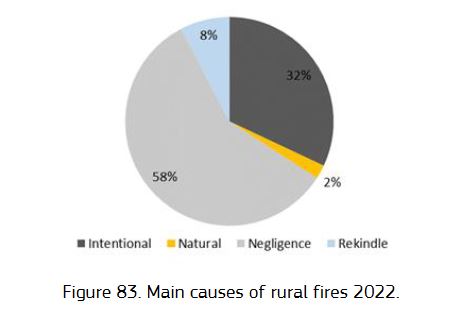
Republic of North Macedonia – no data on causes.
Romania
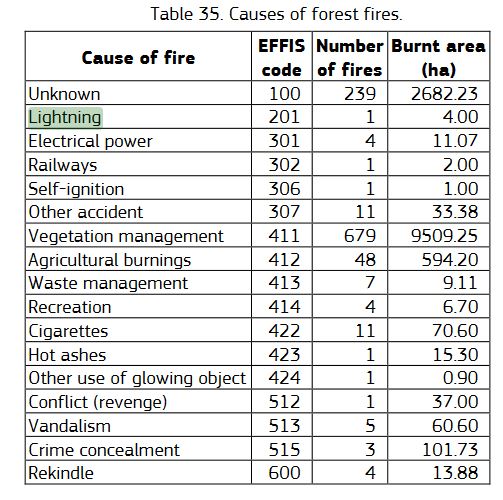
Serbia
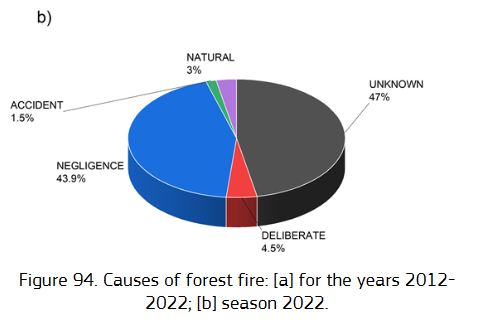
Slovakia
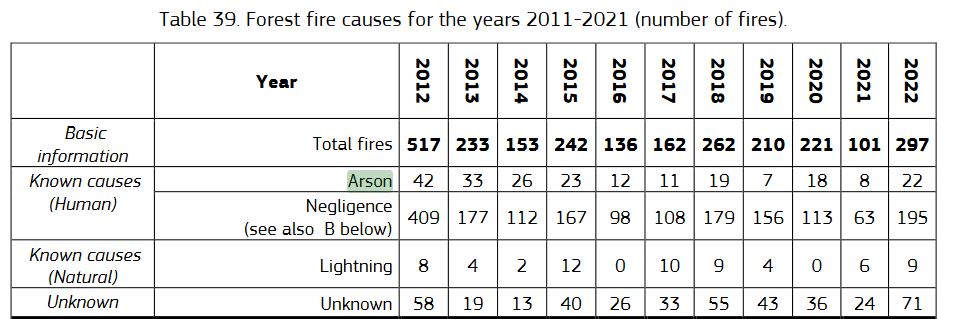
Slovenia
“In 2022, 76 fires (35%) were of unknown origin. Of the remaining fires, 59 (27%) were deliberately started, 12 (6%) were of natural origin and the remaining 70 (32%) were reported as accidental or negligent, mostly because of agricultural burnings,”
Spain – no data on causes.
Sweden
“During 2022 almost half of the fires had unknown causes (46 %) and 15% were deliberate. 14% were caused by use of fire, 5% known but not specified, 5% recreation and 4% lightning.”
Switzerland
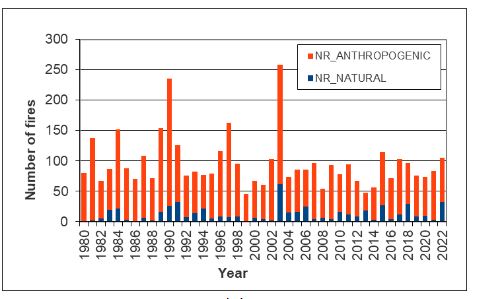
Turkey
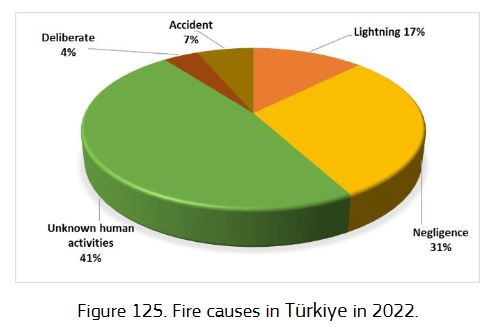
Ukraine
I don’t know if Ukraine has contributed to these reports in the past, or whether this year’s entry is part of aligning itself with the EU. Either way, as you may imagine, there were a lot of fires in Ukraine caused by battles in 2022. Of course fire is and always will be a weapon of war, even in World War 4 (sensu Einstein). Recent innovations include drones dropping thermite, which one may assume to be about the most terrifying thing to have dropped on you in the height of summer.
United Kingdom – no data on causes.
Algeria – no data on causes.
Israel – no data on causes.
Lebanon
“A total of 73.59 % of the fires had unknown causes. Neglect was accounted for 15.37% of all fire causes while 10.16% of fire causes was due to Arson.”
Morocco – no data on causes.
Summary
This canvassing of 2022 data shows that natural fires are a small or very small percentage of all fires (1-5% ish for the most part). That is the size of the problem that climate change is taking a wrench to. (ASTERISK: this says nothing about the consequences of fires, once they have ignited.) Accidents are more frequent than deliberately set fires, though the figures are often quite close and sometimes the other way (e.g. Cyprus).
The cynic says that the important people will never admit arson into the conversation. It is politically expedient to put all the blame on Teh Climate Emergency, rather than give a more balanced but necessarily less clear picture.
In choosing who to blame, the important people have chosen you, dear reader, although you were not there. The guy with the bic lighter and the jerry can does not matter in this crime scene. Rather than blame individuals for these grave conflagrations, they have to blame everyone for them. That gives them the excuse to enact laws that will do nothing to curtail wildfires, but will harm people who are just trying to get on. There is a degree of insecurity here: they do not trust us, the plebs, to understand a nuanced argument. Instead, fires have to be “caused” by Teh Climate Emergency, injected with steroids or something thanks to our diabolical use of a 2004 Land Cruiser.
The people whose job it is to fight the fires are far more interested in the facts. A fair few paragraphs are wasted damning the character of our shifting climate in this annual report, but it’s obvious that the serious people see this as irrelevant. Why? Because they can’t hose Teh Climate Emergency down, or cut a firebreak in it, or put it in cuffs and take it away.
A final ecological point, which I have made before: fire-adapted habitats that do not catch fire get more and more dangerous every year, until they do catch fire. At that point hot hell rages, and it is the fault of Teh Climate Emergency, and not 30 years of fuel building, a typical hot dry Mediterranean summer, and a spark.
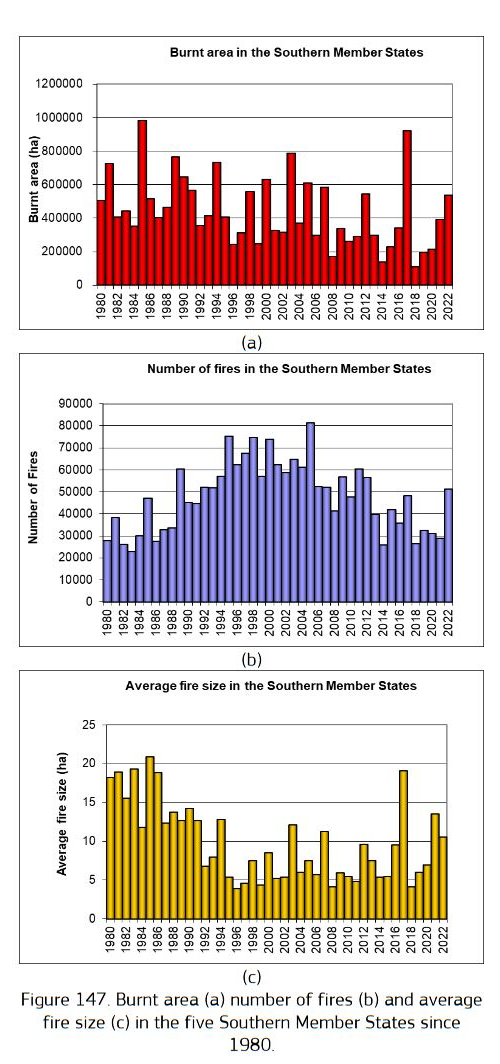
This figure shows wildfire statistics for the 5 southern EU states [Portugal, Spain, France, Italy and Greece] from 1980-2022. I can see the fingerprints of Teh Climate Emergency. Can’t you?
 Climate Scepticism
As Jaime said regarding my last piece, you did this for no financial reward – well done. Shouldn’t paid journalists (at the BBC, perhaps) be carrying out this sort of serious and valuable journalism?
I worried that your analysis would fail the alarmist test, because even if fires aren’t (by and large) caused naturally, if an increase in hot dry weather makes them worse, then climate change still has its fingerprints on the issue. However, the graphs at the end of your piece provide the killer piece of information, and should put the argument to bed. It won’t, of course….
LikeLiked by 1 person
Jit,
Let it not go unsaid that this quantification of the non-climatic causations of wildfire is the very issue that Dr Patrick T. Brown claims to be ignored by prestigious journals such as Nature. The climate science community’s response was as predictable as it was unfounded. Basically, we were led to believe that Brown was a lying idiot, since these journals were actually heaving with this sort of analysis. In fact, what they pointed to was a single paper that mentioned non-climatic causations but made no attempt to quantify. That’s what passes for good climate science nowadays.
LikeLiked by 2 people
Hi Jit
“But yesterday I wondered whether the 2023 EFFIS report was out yet. It wasn’t.”
There’s this document, which appears to be a PowerPoint Presentation:
“Wildfires in the European Union 2023” by ‘Group of Experts on Forest-based Industries and Sectorally Related Issues, 8 December 2023’, and includes some data up to 16th Nov 2023 (‘Slide #11’)
Click to access 20_SANMIGUEL_Jesus_JRC_incendies_Europe.pdf
LikeLike
Thanks Joe. It looks as if the burnt area in 2023 was above average, but below 2022’s level.
John, it seems that the people who have to fight fires are interested in what causes them. Climate scientists, on the other hand, are interested in showing that climate change is causing them, or making them worse.
Mark, I acknowledge that so far we have only looked at what you might call stage 1 of a fire: enough development for it to take hold. There are other ways climate change might be making wildfires worse, but these are more difficult to evaluate than the initial spark. Personally, I think the arguments on such lines are weak, & may eventually try to show why.
LikeLiked by 1 person
There has been a lot in the news about wildfires in Europe this summer. They have been pretty bad – though as usual, one suspects that blaming climate change is not going to help. This is what the Mail says today, in a bit of a non-sequitur:
LikeLike
“Arson arrests spike as California faces extreme fire risk“
LikeLiked by 1 person
Jit – thanks for the link. But “a person dragging chains down the road of their trailer, or even welding.”? “are you serious” said a tennis player.
LikeLike
Well, not many of us decide to do a weld on the roadside… I think hot manifolds are a bigger problem. The largest California fire in 2024 was caused when someone ran his car aground in dry grass. For some reason, when it caught fire, he pushed it into a ravine.
LikeLiked by 1 person