Back in the day when real men killed dinosaurs with their teeth and science was a disinterested search for the truth, it was permissible to say out loud that some species might benefit from global warming, as we naively called it then.
“Warm” being such a nice word, the desired threat level was not achieved, and so “climate change” was born. Of course we have now reached “climate breakdown.” [Note to Guardian journalists: using that phrase without blushing proves you are idiots. There is no climate breakdown, nor will there ever be, nor can there ever be: all that there is is a rising shriek of hyperbole accompanying a thousand hacks trying to blow gas into a giant green Zeppelin.]
Anyway, it soon became the case that any possible benefits arising from global warming had to be removed from public display, lest it dilute the message (an excellent recent example being the removal of a list of such benefits from the BBC’s bitesize revision site). Not only that: any good thing seemingly happening because of fine weather had to be heavily caveated. Thus we find what has become a standard portent of doom attached to any good news story:
“Species X has had an excellent year, researchers say, rebounding to record numbers from near extinction thanks to the fine weather this summer. But it remains threatened by climate change.”
Because everything is threatened by climate change, and nothing good can ever come of it.
Yesterday the BBC reported that the large blue butterfly has had a good year. On my first go through the article I merely skimmed the article to search for the obligatory acknowledgement:
Extreme weather and climate change also pose a danger, particularly because large blues rely on flowering plants and ant nests.
OK, so never mind that the sentence is nonsense. The required dose of salt was tossed over the shoulder into the Devil’s eye.
Anyway, this story gave me a chance to talk about insects, and I like insects. Let’s begin with the ebullience of the title:
Huge recovery for butterfly once extinct in the UK
Unalloyed optimism there. The large blue was only extinct in the UK for about 4 years, but it was extinct. The reporter – who shall remain nameless to spare her blushes – represents “BBC News Climate and Science.” Yes folks, we have reached the desperate strait when Climate is elevated as something separate from Science.
An endangered butterfly that was once extinct in the UK has had its best summer in 150 years.
I don’t know what happened in 1872 (Edward Newman’s British Butterflies was published in 1869), but on the face of it it looks as if the global warming we’ve had so far has benefitted this species. This would not be surprising. Butterflies generally like it hot. Most butterflies in the UK have a northern limit: any further north and it’s too cold. A few have a southern limit, like the Scotch argus. There are species like the Glanville fritillary that literally cling like limpets to the foot of southern cliffs. What butterflies hate are the miserable summers, the cold summers, the wet and dreary summers. The sunny summers, the hot summers, the dry summers: they love it.
Let’s rewind a sec:
Extreme weather and climate change also pose a danger, particularly because large blues rely on flowering plants and ant nests.
I said it was nonsense, and it is. You might as well say that the large blue is in particular danger because it is alive. Is there a butterfly in the world that does not rely on flowering plants?
The project saw conservationists focus on restoring a type of wild meadowland where the large blue likes to live.
“It’s one of the strangest butterflies in the world,” said Prof [Jeremy] Thomas.
It leads a very unusual life, spending most of the year as a caterpillar inside red ant nests where it feeds on grubs. This lifecycle makes it more challenging to protect.
This was a chance for the reporter to tell the interesting story about the large blue’s life history, which kinda got mangled. First, if we rewind to 150 years ago, the last time the large blue had a summer this good, and roughly when Edward Newman’s book on British butterflies was published:
Zeller tells us that the egg is laid on the wild thyme, and that the caterpillar feeds on that plant – a statement copied by myself in the previous editions of this history, and still, as yet, only partially confirmed.
Newman, 1874 edition of British Butterflies
So, 150 years ago the large blue’s life history was a puzzle, and I presume that caterpillars, collected together with wild thyme, failed to thrive in captivity. They disappeared in the wild too. What happens is that the caterpillar is collected by a worker of the ant Myrmica sabuleti and taken underground (see featured image). Its sweet secretions ensure that the ants look after it. Meanwhile, the caterpillar is chomping on not just “grubs” – but the grubs of the host ant.
Now the demise and resurrection of the large blue was, as you might expect, well known to students of ecology. The story was of a butterfly restricted to the south of England, and on south-facing slopes in the south of England, and on ground that was particularly hot because its turf was only an inch high due to grazing. A key point was that the large blue was widespread in mainland Europe, but was on the edge of its range in the UK. It was dependent on a thermophilic ant, and it was found in the hottest places on the hottest hillsides in the hottest parts of the UK. So if global warming was to have done anything, it would have helped, not hindered. But you have to have the other things: the ant, the thyme, the short turf. And even if you have those things, the large blue won’t automagically appear. Its adults are short lived. They don’t spread far. The suitable habitat is widely scattered and cut into small fragments. Without a friendly ecologist to carry the butterfly from one place to another, its extinction was assured. Its extinction is still assured without support because local extinctions are inevitable, and surviving populations elsewhere will be unable to recolonise the empty habitat.
When I was a student, the then Institute of Terrestrial Ecology published The greenhouse effect and terrestrial ecosystems of the UK (1990), of which I excerpt this:

and this little gem from the end of the report (Chapter 12: historical evidence of climatic change effects, by M. D. Hooper):
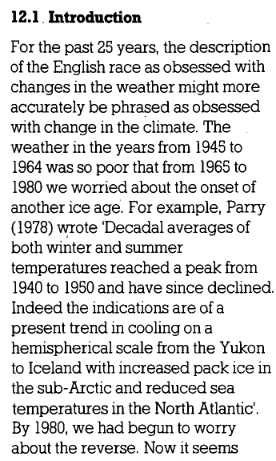
Four years later, the ITE investigated what climate change meant for rare species with Climate change and rare species in Britain:

In other words, species that might benefit from warmer weather will not be able to do so because of habitat fragmentation.
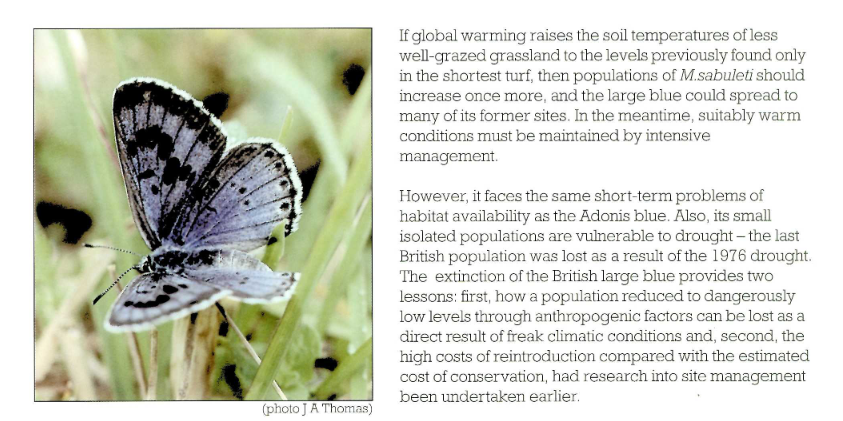
Here the population is described as having been reduced by anthropogenic factors (land use change, not carbon dioxide). The drought that finished it off was “freak climatic conditions.” Of course, if you are restricted to one place, it is expected that sooner or later the summer will be unsuitable entirely for survival and breeding. And even if you are in a place which is usually only just hot enough, there is always the chance that one year it will be too hot. And that would be that.
This is from the caption to the report’s frontispiece:

“Both harmful and beneficial effects.” The latter have now been expunged. Now we have this attitude, as I found searching for news of the Adonis blue:

The “climate crisis” is killing off the nice insects, and making sure that the horrible ones thrive.
Notes and References
The featured image, a drawing of the ant with an early caterpillar of a large blue comes from E. B. Ford’s 1945 Butterflies.
The greenhouse effect and terrestrial ecosystems of the UK. ITE research publication no. 4, 1990
Climate change and rare species in Britain. ITE research publication no. 8, 1994.
 Climate Scepticism
Miri it is while suer y last
With fugheles son
Or nu neheth windes blast
And weder strong.
Ei, ei! What this night is long
And ich with wel michel wrong
Soregh and murne and faste.
LikeLike
We sceptics have a new occupation – looking out good news stories and finding within them the inevitable “but climate change will make it worse” caveat.
It will be interesting to see how the alarmists deal with it if the good news just keeps on coming. It might become more than a little difficult to keep saying “but climate change”. Will they simply cease reporting on good news?
LikeLike
I think of the second sentence as coming from our inner Dalek: “Exterminate!” We all have an inner Dalek but it’s embarrassing when you have to reveal it at every turn. Every turn for the better, that is, of course.
Cultivating great mental health has never been the alarmist’s strongpoint. That might even matter.
LikeLike
I sure don’t think it’s good news for the innocent ant grubs.
Has there been any comment upon the effect of climate Armageddon on those thermophilic ants?
LikeLiked by 2 people
Since learning about the life cycle of the Large Blue, I’ve been intrigued by one aspect. We are told that they prefer a close-cropped sward, but there are only two animals that can produce such a thing. They are sheep, especially if they are allowed to over-graze, and rabbits. Both were introduced into Britain, sheep by neolithic farmers and rabbits by the Normans in the 111th/12th century. So my question is, how and when did the Large Blue arrive in Britain?
LikeLiked by 1 person
Bill rabbits were introduced into Britain by the romans (although for a time this introduction was attributed to the Normans). Donkeys eat grass down to the roots (as do goats). Both were probably more common in the past.
LikeLike
I was out and about today and met some Daleks.
You’ll never believe what they were saying. As spontaneous and unpredictable as someone reciting the consensus creed whenever something positive has happened.
LikeLike
Jit, I would welcome your thoughts on this in the Guardian yesterday:
https://www.theguardian.com/environment/2022/aug/26/country-diary-its-a-summer-of-love-for-the-red-soldier-beetle
” I’m not the only one struggling with the extreme temperature. Bumblebees usually throng the feral buddleia bushes and clumps of red dead-nettle that grow along the path, but today they’re conspicuous by their absence – their furry bodies make them susceptible to heat exhaustion and unable to forage or fly….
…But some like it hot. A stand of common hogweed is swarming with hundreds of common red soldier beetles (Rhagonycha fulva). These soft-bodied leatherwings are so-called as their orangey-red and black colouration is reminiscent of the red-coated uniform of the British army, but these insects prefer to make love, not war. They dedicate a significant proportion of their short lives to mating and are more popularly known as hogweed bonking beetles. True to form, pairs of insects cover the mattress-like umbels of white flowers, the smaller males piggybacking their paramours. A few females are attempting to shake off their suitors, curling their abdomens to avoid genital contact, but most couples are copulating.
As cold-blooded creatures, a whole range of their biological functions is affected by changes in their thermal environment. Beetle reproductive rates typically increase when the temperature rises, but heat stress can have a significant impact on fertility. Research shows that heatwave conditions can damage male beetle reproduction, reducing sperm production, viability and migration through the female reproductive tract, and that exposure to successive heatwaves can leave males virtually sterile.
A more recent study suggests that beetles have sophisticated mechanisms that potentially allow them to cope with temperature fluctuations. But with the climate crisis driving extreme weather events and scientists predicting that UK summer temperatures could regularly reach or exceed 40C, only time will tell whether a summer of love will continue to perpetuate the species.”
LikeLike
Alan, the ants are fairly common, despite their thermophilic habit. In practice they can be found in early successional habitats, but disappear if the grass grows too long. I don’t know what toll the butterflies take on the ants. I presume it is tolerable. The author of the BBC piece did not mention that large blues are also cannibals. Charming things, butterflies.
Bill, the butterflies are quite sedentary so they must have arrived when there was still a land bridge to the continent. Presumably this occurred after some of the wildwood had already been cleared, which dates it to the mesolithic but before the inundation of Doggerland. The answer is, I dunno.
Mark, beetles have behavioural mechanisms to avoid the heat of the day. I have been on insect surveys on hot summer days and seen nothing. Returning after dark, the same areas were swarming with life.
LikeLike
Richard:
INSULATE! INSULATE!
LikeLiked by 2 people
Here’s another example of “it might be good news – BUT CLIMATE CHANGE!”
“Climate change: Avocados and exotic plants grow in hot UK summer”
https://www.bbc.co.uk/news/science-environment-62665053
“Record-breaking hot and dry weather this summer has seen more exotic plants including figs and avocadoes growing in the UK, gardeners have told BBC News.
It’s part of a trend of Mediterranean and sub-tropical plants thriving in recent years, they say.”
Good news, perhaps? Not so fast:
“But scientists warn that lack of water in the future could threaten plants.”
And, perhaps inevitably, that message of nothing good coming from climate change is reinforced at the end of the article:
“But experts are also warning that a continuation of hot dry summers like the one seen this year will negatively impact crops as all plants need water to grow and establish.
“Long summers may well be initially warmly welcomed in the UK, and provide an exciting opportunity for growing new exotic food crops,” explains Chris Atkinson, a plant scientist from the Natural Resources Institute, University of Greenwich explains.
But he warns water shortages pose a problem to effectively growing any type of plant.”
LikeLiked by 1 person
“‘Extinct’ butterfly species reappears in UK”
https://www.bbc.co.uk/news/uk-65804939
It couldn’t possibly have happened despite (or, Heavens above, even because of) climate change, so we are told this:
They might be right for all I know. Yet no evidence at all is supplied for the claim that they must have been released by unknown persons for unknown reasons.
LikeLike
Mark, this sort of thing may have something to do with it!

I’m not sure why this beast became extinct, but I can hazard that habitat loss was quite important. It was widespread before retreating to its last stronghold in Kent. It was once a pest of fruit trees. Should you be tempted, you can buy them here: https://www.wwb.co.uk/spring-and-summer-eggs-and-larvae-order-now-for-supply-in-season
Now that I’ve had a look, I’m sorely tempted to have a go myself!
LikeLiked by 1 person
Mark, saw that on BBC news today, with your above comment – “told the BBC the insects will have been released, but they don’t know by who or why”
my thoughts were the same as yours at the time.
then JIT comes along and throws a spanner in the works 🙂
my “conspiracy theory” is Extinction Rebellion are finally doing something useful.
LikeLike
Habitat seems to be far more important than climate – not a reference to climate in this article, but lots to habitat:
“Endangered marsh fritillary butterfly makes a comeback in Lake District
Species thriving again after ponies and cattle replace grazing sheep to allow growth of wildflowers”
https://www.theguardian.com/environment/2023/jun/26/endangered-marsh-fritillary-butterfly-comeback-lake-district
LikeLike
“A vintage butterfly summer in Britain – what’s going on?
A record number peacocks and red admirals have visited my garden, possibly thanks to the unsettled weather”
https://www.theguardian.com/environment/2023/aug/31/vintage-butterfly-summer-britain-whats-going-on
LikeLike
“The nature writer Richard Mabey tells me the “unprecedented explosion” of butterflies he’s witnessed over the past fortnight has put him in a state of cognitive dissonance, given the climate and extinction crises.”
Hate to inform you Dick, mate, but you were deep within a state of cognitive dissonance BEFORE the ‘butterfly explosion’.
LikeLiked by 1 person
“UK butterfly numbers at highest level since 2019”
https://www.bbc.co.uk/news/uk-66812657
We have to be told this:
But then this too:
LikeLike
Honey bees are grumpy this year – must be climate change. Poor Alfa was attacked just ambling by some hives at least 20 feet away. I had to get her out of there quickly before more descended. Even so, over a hundred yards away, another couple managed to find her. That was a hot dry day last week. I guess they must be even more grumpy now because it’s been raining for several hours and it’s not warm!
LikeLike
It doesn’t make a lot of sense to measure the health of Britain’s butterfly population by the numbers of a species that is largely an immigrant. In other words, the quantity of red admirals here depends largely on the weather on the continent, and says nothing about our resident species.
It would be rather like measuring the health of Britain’s bird population based on how many pheasants have been recorded.
I will look into the Butterfly Conservation report, if there is one.
LikeLike
More evidence that habitat loss is far more important than climate change – ironic then that the ludicrous efforts to combat climate change (via wind farms, solar panels etc) often involve significant habitat loss:
“Rewilding leads to bumper year for rare Kent moth”
https://www.bbc.co.uk/news/articles/cndejylzl8eo
LikeLike
More evidence (birds this time) around habitat loss being the main cause of loss of wildlife (and nothing – or little – to do with climate change):
“Wild Woodbury: Red List bird species return after rewilding”
https://www.bbc.co.uk/news/uk-england-dorset-66843416
LikeLike
“South Downs golf course becomes haven for rare butterflies”
https://www.bbc.co.uk/news/uk-england-sussex-67134265
Yet again, it’s about habitat – not climate change.
LikeLike
The claim of 34 species seems far fetched to me. I’d be interested to see the list.
LikeLike
I would also be interested to see a list of the 34 species, but I can’t find one. The best I’ve been able to do is here:
https://www.southdowns.gov.uk/brighton-golf-course-is-above-par-for-wildlife/
Meanwhile, it’s all doom and gloom after all:
“Caterpillars struggle to survive climate change, says study”
https://www.bbc.co.uk/news/uk-england-cambridgeshire-67254664
And yet:
In other words, sort out habitat loss, and climate change probably isn’t an issue.
LikeLike
“Butterflies could lose spots as climate warms – Exeter University researchers”
https://www.bbc.co.uk/news/uk-england-devon-68008127
No comment!
LikeLike
“Rare swallowtail butterfly suffers worst summer since records began
Exclusive: one of Britain’s rarest butterflies, found only in Norfolk Broads, critically threatened by climate crisis”
https://www.theguardian.com/environment/2024/jan/30/rare-swallowtail-butterfly-suffers-worst-summer-since-records-began
The Guardian’s still pushing this one. Unfortunately the facts don’t fit the narrative. Its “worst summer” was also a hopeless washout summer, yet the Guardian claims that the flooding in the Norfolk Broads was due to rising sea levels – no mention of endless summer rain. Worse than that, it also blamed “summer droughts”. Maybe there’s something in the narrative – what do I know? But I do know that if last year was the butterfly’s “worst” it certainly wasn’t due to a summer drought.
Drought? Rain? Who cares? It’s climate change – innit?
LikeLike
Thanks Mark. Tide levels in the broads were a factor when they tried to introduce the Dutch race of the large copper back in the 1950s. Back then it was also known that butterflies like hot weather. And that habitat loss was the major threat.
😦
LikeLike
Phoning around enough people , means they can cherrypick the one that fits the narrative.
LikeLike
So much for scientific rigour:
“Butterfly study finds sharpest fall on record for small tortoiseshell in England
Rate of decline in 2023 thought to be linked to climate breakdown as UK-wide survey shows mixed picture across 58 species”
https://www.theguardian.com/environment/2024/apr/03/small-tortoiseshell-butterfly-population-numbers-england-worst-year-on-record
“The small tortoiseshell butterfly has suffered its worst year on record in England, and has declined by 82% across the UK since 1976, according to the annual scientific count of butterfly populations.
The sharp decline in numbers of the once-common garden butterfly has puzzled scientists, but it is thought to be linked to climate breakdown...”
If that were correct, one would expect its numbers to be declining fairly uniformly across the UK. Are they? No:
“…It had its worst year on record in England, its second worst in Wales and its joint-fifth worst in Scotland in 2023 but did well in Northern Ireland, logging its second-best year.…”
How about butterflies generally? If it’s “climate breakdown”, they’ll all be struggling, more or less equally, yes? No:
“…Half the 58 species monitored had a better than average year, while the other half were below average at monitored sites….“
Climate or habitat? My money’s on habitat:
“…Some showed encouraging signs that conservation efforts are working: the large blue, which was reintroduced to the UK in the 1980s after it became extinct in 1979, recorded its best year yet. The chequered skipper, which was returned to England in 2018 after becoming extinct in the 1970s, also recorded its best ever year.…”
LikeLiked by 1 person
More evidence that habitat loss is far more important than climate change:
“Bid to revive fortunes of rare butterfly”
https://www.bbc.co.uk/news/articles/c6pyeg2p2d0o
The National Trust will plant 20,000 marsh violets to provide a food source for caterpillars of the small pearl-bordered fritillary butterfly.
It is hoped the 400 patches of 50 plants will attract more of the species, which has undergone severe decline across England.
It is part of a project to connect habitats across the landscape in the Shropshire Hills, immortalised as the “blue remembered hills” in AE Housman’s A Shropshire Lad.
Caroline Uff, an ecological consultant to the National Trust, said new areas could start to be recolonised by the butterflies within a couple of years.
LikeLiked by 3 people
More evidence that the success or failure of butterfly populations has a lot more to do with habitat loss/preservation than climate change:
“Record numbers of rare butterfly seen at reserve”
https://www.bbc.co.uk/news/articles/c7222eg1zy5o
LikeLike
Mark; that article and the previous one highlight the importance of food plants in the local habitat. However they get very little attention in gardening circles compared to the enthusiasm for plants which provide nectar/pollen to adult insects. Yet, as the articles show, those food plants will also attract adults for egg laying and will – hopefully – be followed by the emergence of the next generation.
I try to make my garden wildlife-friendly (it’s a good excuse for benign neglect!) and I have often wondered whether greater awareness of food plant preferences among garden enthusiasts might help support butterflies, moths etc.. Admittedly my own efforts at growing specific food plants have been rather unsuccessful so far. As I see it, domestic gardens have great potential to provide small patches of key food plants in a protected environment.
So I have written to the RHS suggesting that they update their plant info to state which ones are food sources for which insects.
LikeLiked by 1 person
Climate change is good news!
“Specieswatch: Jersey tiger moth heads north as climate heats up
The farthest north this species used to be seen was the Channel Islands but it is now common in Bedfordshire”
https://www.theguardian.com/environment/article/2024/jul/03/specieswatch-jersey-tiger-moth-global-heating-bedfordshire
...Unlike some other moths, the caterpillars eat a variety of roadside weeds including nettles, and those hatched in September shelter through the winter on rough patches of ground with plenty of food plants.
The farthest north this species used to be seen was Jersey (as the name suggests) but global heating has transformed its fortunes.
First it colonised the coast of Dorset and was seen in London – now it is heading north. The speed of this advance can be gauged by the fact that Butterfly Conservation still classes it as nationally scarce and report its colonisation only of counties to the south of London.
The Bedfordshire moths website, however, in 2023 described the species as common in the county. The enthusiasts expect the moth to be seen anytime from 12 July this year. It is the warmer winters allowing these caterpillars to survive that is thought to be aiding the species’ spread.
LikeLike
Well this is amusing. The Guardian can’t get its story straight. Six weeks ago they were telling us it was the warmest spring on record . . . . . because climate change.
https://www.theguardian.com/uk-news/article/2024/jun/03/may-spring-warmest-record-uk-met-office
Now, everyone has noticed the lack of insects this summer, especially butterflies and that is also due to climate change, and farming, and pesticides and . . . . . a “cool wet spring”:
https://www.theguardian.com/commentisfree/article/2024/jul/13/butterflies-summer-absence-british-spring-decline-insects
So what was it? The warmest spring on record because of ‘climate breakdown’ or a “cool wet spring” because weather?
Are butterfly numbers declining because it’s getting generally warmer, or do they decline suddenly when it gets cooler, because of natural variations in the weather? Or is the Guardian editorial team staffed by ideologically driven morons who must necessarily shoehorn climate change in as an explanation for all types of weather and for worrying species declines which clearly must have an explanation other than the ‘climate crisis’ which they basically invented in 2019?
LikeLiked by 3 people
Brilliant, Jaime. Hard on the heels of that, the BBC gives us this:
“Moths wreak ‘unprecedented’ destruction on orchard”
https://www.bbc.co.uk/news/articles/c51y50xdjl2o
Inevitably, perhaps, we are told with absolute confidence by the MD of the company (Somerset Cider Brandy Company) that:
“It’s the result of our climate breakdown and we’ve been seeing different things each year but this year it’s the apple ermine moth which is worse than anyone in living memory can say,” she said.
LikeLiked by 2 people
All this talk of insects, climate change and inconsistency got me thinking. It has been apparent to me for a long time now that everything has been linked to climate change. So I searched (with every expectation of discovery) for an article claiming that climate change is making butterflies increase in size. Here is what popped up:
Climate change has caused Britain’s butterflies to get bigger
https://www.nhm.ac.uk/discover/news/2022/april/climate-change-has-caused-britain-s-butterflies-to-get-bigger.html
I then searched (with every expectation of discovery) for an article claiming that climate change is making butterflies decrease in size. Here is what popped up:
Warmer Earth could see smaller butterflies that struggle to fly, affecting food systems
https://phys.org/news/2022-09-warmer-earth-smaller-butterflies-struggle.html
The sad thing is that I went searching for this contradiction fully expecting to find it. I just knew it would be out there. The predictability of it all has to mean something.
LikeLiked by 4 people
John: They’re just a very funny shape. Bigger in one dimension, smaller in another. This isn’t hard. It’s the killer poison that will come out of some of their parts if we emit any more CO2 that has me worried.
LikeLike
Well, it gives a sceptic the chance to make an alarmist think. Next time the topic comes up at the pub, ask the alarmist to name two organisms, one fair and one foul. Next question: what will be the effect of climate change on them? The alarmist already knows. The tumblers whirl. Google is consulted (or mojeek). It is duly discovered that, indeed, the foul creature will thrive under climate change, and the fair creature will decline.
The fact is, we no longer hear about the benefits of climate change, and most of the negatives are spurious or exaggerated. There are human reasons for this, not physical ones.
LikeLiked by 1 person
But there’s so much more:
“Climate crisis has impact on insects’ colours and sex lives, study finds
Scientists fear adaptations to global heating may leave some species struggling to mate successfully”
https://www.theguardian.com/environment/article/2024/jul/13/climate-insect-colours-sex-lives-study
…scientists are still trying to work out what will happen to insects’ sex lives now that human-induced climate breakdown is raising temperatures to unprecedented levels. [But they’re not unprecedented, are they?].
“On the one hand, we could be rejoicing, saying: how are the insects? They are responding to climate change. We don’t have to worry about them,” said Mariella Herberstein, a behavioural ecologist at Macquarie University in Sydney, Australia, who is one of the authors of the study.
“And then we could wake up the next day going: Oh, damn – they can’t find each other any more because they have lost really important identification colours that help them find a mate.”
LikeLiked by 1 person
Jaime – bet the get out is “with the warm conditions influenced by high overnight temperatures”.
ps – it’s fun to watch the weather people cringe as they have to say “where has our summer gone”.
LikeLiked by 1 person
Okay, where does this one fit into the climate crisis narrative?
Stonehenge could be toppled by moles if earth’s temperature keeps rising
https://www.dailymail.co.uk/news/article-3611827/Could-moles-really-end-toppling-Stonehenge.html
LikeLike
I can well believe the mole hill story. Climate breakdown this year has resulted in the playing field nearby being covered in molehills, which normally only happens during autumn and winter, when it’s wetter and the worms are more active. This means that my dog cannot cross the field without demanding vocally that I kick every singe molehill in order for her to chase the flying earth! The ground is quite treacherous to walk across; you could end up twisting your ankle by stepping on a collapsing tunnel.
As far as insects are concerned, maybe another reason they are declining is that they are being eaten by larger and more aggressive spiders . . . . . caused by climate change.
LikeLike
“The report was produced by the Union of Concerned Scientists (UCS), the UN Heritage body Unesco and the United Nations Environment Programme (UNEP).”
So unbiased then.
LikeLiked by 1 person
“‘Warning sign to us all’ as UK butterfly numbers hit record low
Conservation charity raises alarm over climate crisis after wet spring and summer dampen mating chances”
https://www.theguardian.com/environment/article/2024/jul/29/warning-sign-uk-butterfly-numbers-record-low
Butterfly numbers are the lowest on record in the UK after a wet spring and summer dampened their chances of mating.
Butterfly Conservation, which runs the Big Butterfly Count, sounded the alarm after this year’s count revealed the worst numbers since it began 14 years ago.
Many people have noticed the lack of fluttering insects in their gardens. Experts say this is due to the unusually wet conditions so far in 2024.…
Despite the fact that we were always told that climate change meant hot and dry late spring and early summer weather was more likely, needless to say we are now being told:
…Climate breakdown means the UK is more likely to face extremes in weather, and the natural rhythms of the seasons that insects such as butterflies are used to can no longer be relied on….
Read on far enough, and you do learn this:
…The extra rain is not the only problem; the charity said 80% of butterfly species in the UK had declined since the 1970s, with habitat loss, climate breakdown and pesticide use being the main causes. Butterfly populations already hit by these issues would be less likely to be able to cope with extreme weather.…
I have no doubt the cool wet summer is bad news for butterflies, but I suspect that habitat loss and pesticide use are the really big problems.
LikeLiked by 2 people
Thank you Mark. More disinformation from the Guardian. Butterfly Conservation’s press release did mention climate change… but nowhere did it mention this fantasy phenomenon “climate breakdown.” It is therefore a direct misquote. Here is the original:
Butterfly Conservation link.
What about the headline? Butterfly Conservation’s:
Wet weather and low temperatures causing havoc for butterflies during Big Butterfly Count.
Of course our Guardian friends cannot bring themselves to utter the words “low temperatures” as it sticks in their throats.
As to Butterfly Conservation’s invocation of the magic words? It’s disappointing, for the obvious reason that nothing we do to “tackle” climate change will have the slightest effect on helping to save butterflies.
LikeLiked by 2 people
“‘Extinct’ butterfly now breeding in Kent”
https://www.bbc.co.uk/news/articles/cpwdgnjy2y3o
A species of butterfly which is thought to have died out in England more than 60 years ago is showing signs of breeding in Kent.
The large tortoiseshell butterfly was common in the UK but disappeared in the 1960s, possibly because of Dutch elm disease, although scientists have been unable to confirm this.
Now they are making a comeback, with more than 30 spotted in a Kent woodland this year.”
They’re living proof that eco systems can recover if they’re given the chance,” said conservationist William Malpas.
I would suggest they’re living proof that habitat matters far more than climate change as to whether a species will thrive or decline.
LikeLiked by 1 person
“Concerns over record-low butterfly and moth numbers”
https://www.bbc.co.uk/news/articles/c6p2p64zdxro
Missing the sun this summer? It turns out we’re not the only ones.
Butterflies need dry weather and heat to flourish, something they just have not been getting enough of this year.
And that has conservationists worried.
With just one day left to go in the annual Butterfly Conservation’s Big Butterfly Count, external, participants have so far recorded the lowest number ever in the 14-year history of the biggest citizen science project in the UK….
...Rosie Irwin of Butterfly Conservation says habitat loss, pesticide use and climate change are all impacting the population numbers.
This year’s fall in numbers has been exacerbated by the wet spring and late arrival of summer temperatures.
Butterflies also need some warm and dry conditions to be able to fly around and mate.…
It’s a bit difficult to see how – when we have always been told that climate change will bring wet winters and hot dry summers – climate change can be blamed for this decline when the spring and summer have been cold and wet rather than dry and hot. It also contradicts other reports that some butterflies have been making a comeback where habitat has been restored. Habitat loss and pesticide use yes, climate change no – this year at least.
LikeLike
“Egg count for rare butterfly sees ‘positive result'”
https://www.bbc.co.uk/news/articles/cn4mlyezd7do
The number of rare butterflies found on a nature reserve remains stable despite increasing climate and habitat threats, a wildlife trust has found.
A team of volunteers from Berkshire, Buckinghamshire and Oxfordshire Wildlife Trust (BBOWT) recently counted the number of brown hairstreak butterfly eggs at Asham Meads in Oxfordshire.
The species is found in select areas across the south of Britain and is classified as vulnerable due to declining numbers from habitat loss.
Colin Williams, from BBOWT, said the discovery of 43 eggs – an increase of 33% on 2022 – was a “positive result”….
As usual the BBC lumps climate change without evidence (as they like to say about Trump’s often bizarre claims) in to a story that involves a real and different threat (habitat loss), and without making any effort to assess the relative levels of risk. Of course, what this story demonstrates is that habitat is the issue, not climate change. If climate change was a big deal for butterflies, then we wouldn’t be seeing this positive result.
LikeLike
“US lost a fifth of its butterflies within two decades”
https://www.bbc.co.uk/news/articles/cwyjkn729gpo
As is so often the case these days, the BBC reports:
…Habitat loss, pesticides, and climate change are key causes of this decline, according to the researchers.…
No attempt to indicate the significance of the factors, no attempt to state which is the most important, which the least important. Without that information, the BBC piece is barely worth reading if one is looking for a meaningful insight into the causes of butterfly population decline in the USA.
Unfortunately the study is behind a paywall, unless you are a member of an institution that unlocks it for you:
https://www.science.org/doi/10.1126/science.adp4671
However, the public is allowed access to the editor’s summary and the abstract. The former includes this:
…Many insects have the potential for rapid population growth and recovery, but habitat restoration, species-specific interventions, and reducing pesticide use are all likely needed to curb population declines.
If climate change was a big deal, then the possibility of rapid population growth and recovery would presumably be limited. It all suggests that the main factors are habitat loss and pesticide use, with climate change thrown in to the mix because, well, because it always is and it’s expected.
LikeLike
Last year the UK had a poor summer – cool and damp; certainly not one to see them shouting about climate change. Consequently (but also for other reasons), butterflies had a hard time of it.
“Last year ‘one of the worst for UK butterflies'”
https://www.bbc.co.uk/news/articles/c230kzz73zmo
Inevitably, we get this drivel:
…“We have destroyed wildlife habitats, polluted the environment, used pesticides on an industrial scale and we are changing the climate,” Dr Fox said.
“That means that when we have poor weather, these already-depleted butterfly populations are highly vulnerable and can’t bounce back like they once did.
“And with climate change, that unusual weather is becoming more and more usual.”…
Tick and pass on the first two/three (destruction of habitats; pollution; use of pesticides), but climate change? Really? Now climate change is being blamed because we had a depressingly normal cool and damp summer (“…unusual weather is becoming more and more usual.”). But it wasn’t unusual weather!
LikeLiked by 1 person
The Guardian article is word for word in tune with the BBC one to start with, but it does provide some nuance:
https://www.theguardian.com/environment/2025/apr/02/last-summer-was-second-worst-for-common-uk-butterflies-since-1976
…Butterfly numbers fluctuate annually because of the fickle British climate, and the summer of 2024 was notable for its wet spring and relatively cool temperatures.…
…Butterfly Conservation is leading calls this year to reduce council grass-cutting and encourage people to leave lawns long to benefit butterflies and other insects. Scientific research last year revealed that gardens with long grass increased butterfly abundance and species.
“By far the best thing we can do to help butterflies is to create more habitat,” said Fox. “That is why we are calling on people and councils across the UK to pledge to not cut their grass this year from April to September: this simple act can make a real, immediate difference to butterflies, moths and other wildlife.”
LikeLike
“Walkers asked to look for rare mountain butterfly”
https://www.bbc.co.uk/news/articles/cj091y7m0n2o
Visitors to the Lake District are being asked to look out for a mountain butterfly which is the only one of its kind in England.
The mountain ringlet is so elusive that, even in Scotland where it is more common, conservationists are still unsure exactly how many exist.
The public is being asked to log any sightings of the creature, which is brown with orange wing spots, to help scientists improve their knowledge of the species.
Martin Wain, from the wildlife charity Butterfly Conservation North of England, external, said: “We urgently need to know more about where it is so we can learn more about how to protect it.”...
Got that? We need to know more about where it is so that we can protect it. In other words, by logical extrapolation, we don’t know as much as we would like, and we don’t necessarily knw where it is. How, then, can the BBC go on casually to tell us this?
…Experts are concerned numbers are being affected by climate change, with areas of suitable habitat becoming smaller as temperatures rise.…
This insertion of climate change into almost everything is as insidious as it is dishonest.
Meanwhile, an expert website tells us this:
https://www.ukbutterflies.co.uk/species.php?species=epiphron
…It is believed that this butterfly was one of the first to recolonise the British Isles after the last ice age. Despite this heritage, this species is a relatively-recent discovery, with the Lake District population being discovered in 1809 in Ambleside, Westmorland, and the Scottish population in 1844 in Perthshire.…
And this:
https://butterfly-conservation.org/butterflies/mountain-ringlet
…The butterfly’s status is difficult to assess due to the remoteness and unpredictable weather of its mountain habitats, but its range appears stable.... [my emphasis].
LikeLike
Thank you Mark. My book of butterflies says it is found at 350-900 m elevation in Scotland, and favours south-facing slopes there. Are we worried yet?
LikeLike
“It is believed that this butterfly was one of the first to recolonise the British Isles after the last ice age.“
If so then it has survived the various warm spells over the intervening 12 – 15,000 years when temperatures were similar to, or higher than today…….
LikeLiked by 1 person
“It is believed that this butterfly was one of the first to recolonise the British Isles after the last ice age.“
How would you know that? is it because (as Jit notes) it likes the cold, so started in the south & as the glaciers retreated moved north?
LikeLike
“Rare heath fritillary butterflies surge in number on Exmoor after sunny spring
More than 1,000 of one UK’s rarest butterflies seen around Holnicote Estate thanks to grazing cattle and good weather”
https://www.theguardian.com/environment/2025/jun/25/heath-fritillary-butterfly-exmoor-numbers-rise
The combination of sunny spring weather and habitat improved by a herd of red Devon cattle has led to a surge in numbers of one of the UK’s rarest butterflies on moorland in the English west country.
As well as increasing in established pockets on Exmoor, the heath fritillary is spreading to new areas, which experts say is highly unusual.
More than 1,000 heath fritillary butterflies, nicknamed the woodman’s follower, have been seen at sites on the National Trust’s Holnicote Estate on Exmoor and nearby land, a significant rise from about 600 at the same time last year.
Three spots have been recolonised and one small site has had a dramatic increase, from just four butterflies in 2024 to 186 this year.
The heath fritillary was almost extinct in Britain in the early 1980s, but targeted conservation work has brought it back from the brink….
Conservation work does the trick. Climate change has nothing to do with it. Again.
LikeLiked by 1 person
It’s another of the fritillaries that was formerly relatively abundant. Two things did for it here: general deforestation meaning that residual populations were isolated and vulnerable to local extinction, and the exploitation of coal, which meant that the old coppice system of woodland management fell into disuse.
The former cyclical management of woodlands meant that there was always a constant supply of new clearings, where the host plant (cow wheat) could flourish.
Of course, there was no management when the butterfly thrived in prehistoric woodlands, but here the constant creation of smaller gaps came about via the falling of old trees.
LikeLike
Yet more evidence that habitat is of far greater importance than climate change:
“Rare butterfly hits purple patch at Sussex rewilding project
Ecologists say 283 purple emperor recordings on one day at Knepp signal higher numbers nationwide”
https://www.theguardian.com/environment/2025/jul/04/purple-emperors-rare-butterfly-improved-population-sussex-rewilding-project
A conservation project in West Sussex has had its best day on record for rare purple emperor butterfly sighting, and ecologists say they are confident the species is doing well nationally.
Purple emperor populations steadily declined over the course of the 20th century but they have been slowly recolonising the landscape at Knepp since 2001, when Isabella Tree and her husband, Charlie Burrell, decided to turn the stretch of former farmland into a “process-led” rewilding project.
Ecologists at Knepp recorded 283 purple emperors on 1 July alone....
…Hulme stressed that although the purple emperors may be the most “glamorous” success story at Knepp, other species had also benefited from the rewilding. Butterflies such as purple hairstreaks and the silver-washed fritillary, as well as nightingales and swifts are also being sighted in record numbers. He described “clouds of butterflies everywhere … none of us want summer 2025 to ever end”.
Tree said the success of the purple emperor showed the power of rewilding: “When nature is allowed to recover, wildlife will return soon after.”
LikeLiked by 2 people
Here’s another one:
“Butterfly numbers ‘boosted by trees and hedgerows'”
https://www.bbc.co.uk/news/articles/cx2n0le34epo
Trees, hedgerows and small copses can significantly increase the number of butterflies in farmed landscapes, a study has found.
Oxford University carried out research with the Butterfly Conservation charity which found ancient trees were associated with higher butterfly species richness.
The study, funded by The Woodland Trust, found that despite butterflies being in “desperate trouble”, farmland can play a “vital role” in helping species recover....
LikeLiked by 1 person
A study has found? What a joke. A study has found something that everyone already knew.
LikeLiked by 1 person
Yet again, when it comes to butterfly numbers, it’s much more about habitat than about climate change (though admittedly, the “climate crisis driven” weather has been good for butterflies this year):
“‘Butterfly bomb’ as estate enjoys population surge”
https://www.bbc.co.uk/news/articles/cvg9nxq8elro
A charity that looks after a large Essex estate has spotted almost half of the UK’s butterfly species this year, despite recent significant population declines.
In 2022, Butterfly Conservation reported that numbers had dropped by 80%, external since the 1970s.
David Finkle, chief executive of Markshall, in Coggeshall, said: “This year we have seen a butterfly bomb… It’s almost like a cannon of butterflies has exploded, and they’re absolutely everywhere.“
Of the 59 butterfly species present in the UK, the charity has spotted 28 on its 2,200 acres so far this year….
LikeLiked by 1 person
“‘National rescue mission’ to save butterflies”
And more in the same vein. Telegraph link.
LikeLike
Is this the same story as the one in the Telegraph? Naturally, the BBC put a climate crisis spin on it, and don’t mention things like habitat loss:
“Butterfly count to assess population ’emergency'”
https://www.bbc.co.uk/news/articles/c0q8v5vxe4go
…”It’s a way of tracking the state of nature every year, reacting to the kind of wild weather rollercoaster that we have now.”…
Amazingly, though, we do get this:
...There are hopes that, with the warm weather, this year’s count could be more positive.
“It’s looking really promising,” said Dr Hoare....
Did you catch that? Warm weather good.
LikeLiked by 1 person
“Butterfly count follows worst year on record”
https://www.bbc.co.uk/news/articles/c628er5vymjo
Note the negative headline. The reality is that butterflies do better in warm dry weather of the kind that is supposed to be more common thanks to climate change. And habitat loss is the main driver of declining butterfly numbers:
...Dr Hoare said: “Butterflies are an indicator of the health of our environment.
“With about half of Britain’s butterfly species already threatened or near threatened with extinction, it’s really important that we understand what’s driving these declines in nature – and we can use butterflies as an indicator.
“When we get things right, they bounce back really quickly, and they can show us where nature recovery is working, but when their numbers are declining, that’s a real sign that we need to do more.” [My emphasis].
He added that Somerset was a significant area for butterflies with “really lovely rural habitats”....
LikeLike
It does seem to be a great year for butterflies, in my garden at least. Good to see after last year’s poor showing.
LikeLike
Mike H,
I was out for a walk above Dent in the Yorkshire Dales last week – butterflies all over the place. Great to see.
LikeLike
Don’t tantalise an entomologist! Which species?
LikeLike
No idea – I’m not an entomologist! Quite small and white, but not cabbage white butterflies.
LikeLike
Small white, or green-veined white, depending on the underwing.
LikeLike
Jit; my list includes Comma, Red Admiral, Peacock, Orange Tip, Brimstone (earlier), Meadow Brown, Gatekeeper, Speckled Wood, Tortoiseshell (large, I assume), some small blue ones and medium-sized Whites.
The “brown jobs” are by far the most numerous and I may well have missed several species as they are not easy to differentiate!
My hope is to see some Hummingbird Hawk Moths here in Surrey; my son gets them in N. Herefordshire.
In contrast to the profusion of butterflies, I have seen relatively few Dragon- and Damselflies this year.
LikeLike
Green-veined white, I would say. They were clustering in quite large groups, if that helps.
LikeLike
Mike, the large tortoiseshell would be quite a find – it’s extinct in the UK but maybe a few come over the channel each year. It could be small tortoiseshell, but also look at painted lady, which looks somewhat similar.
The blues are another that can be told from the underwing – probably holly blue or common blue.
It sounds from the list as if there is some rough grassland nearby – the meadow browns and gatekeepers coming from there.
LikeLike
Jit; you are right, of course – must have been small tortoiseshell. I forgot which one is still around!
I’ll try and check underwings but I am rarely able to get close enough. I’ve found that the “Identify” button on my iphone often works well.
Yes, I have some patches of rough grass, a couple of which also have some wildflowers. Plus my “lawn” is more like a neglected playing field! Gardening for wildlife is a great excuse for lazy/incompetent gardeners like me :).
LikeLiked by 1 person
Mike, you can say you consulted an ecologist who gave the scheme the ok. I would recommend leaving some patches unmown over winter if possible, to protect the caterpillars of e.g. meadow browns.
LikeLike
Thanks Jit. I do leave the wildflower patches to their own devices; they are largely long grass anyway. The “lawn” is cut infrequently, always on the highest setting, and I doubt there will be any need for another cut before next year, unless we get a real wet spell.
LikeLike
“Monarch butterflies’ mass die off in 2024 caused by pesticide exposure – study
New peer-reviewed research found an average of seven pesticides in each of 10 butterflies tested”
https://www.theguardian.com/us-news/2025/aug/01/monarch-butterflies-mass-die-off-pesticides
A 2024 mass monarch butterfly die off in southern California was probably caused by pesticide exposure, new peer-reviewed research finds, adding difficult-to-obtain evidence to the theory that pesticides are partly behind dramatic declines in monarchs’ numbers in recent decades.
Researchers discovered hundreds of butterflies that had died or were dying in January 2024 near an overwintering site, where insects spend winter months. The butterflies were found twitching or dead in piles, which are common signs of neurotoxic pesticide poisoning, researchers wrote.
Testing of 10 of the insects revealed an average of seven pesticides in each, and at levels that researchers suspect were lethal. Proving that pesticides kill butterflies in the wild is a challenge because it’s difficult to find and test them soon after they die. Though the sample size is limited, the authors wrote, the findings provide “meaningful insight” into the die off and broader population decline.…
LikeLiked by 1 person
“Southern European butterfly spotted in UK for first time”
https://www.bbc.co.uk/news/articles/cwy1wgly21zo
…It is not yet clear what has driven the species’ expansion…
[wait for it]
…though a warming climate is thought to be part of the answer.…
Yet…
Whilst it is thought a warming climate has played a role in its spread, modelling from a 2008 Climatic Risk Atlas of European Butterflies, external showed that even under the most extreme warming scenarios the species was not expected in the Low Countries until after 2050.
LikeLiked by 1 person
As an aside, sitting on our patio the other day we noticed a strange/fascinating looking Moth visiting our flowers, which I can’t recall seeing before (Live on the Isle Of Man for 30ish yrs).
Took a few pics but it moved fast, so no pics to share. But a quick search led to –
Hummingbird hawk-moth | The Wildlife Trusts
Seems a few have been spotted on the IOM.
Why anyone would think “a warming climate” in the UK is a bad thing is beyond me.
ps – ok, we can expect more MET yellow/amber/red warnings for extreme heat & rain, but at least the snow warnings in Scotland will disappear.
LikeLike
Mark – just reread your above comment & BBC link.
This partial quote “showed that even under the most extreme warming scenarios the species was not expected in the Low Countries until after 2050.” Prompted me to follow the 2008 Climatic Risk Atlas of European Butterflies link. Can only access the abstract from 2008 –
“The overarching aim of the atlas is to communicate the potential risks of climatic change to the future of European butterflies. The main objectives are to: (1) provide a visual aid to discussions on climate change risks and impacts on biodiversity and thus contribute to risk communication as a core element of risk assessment; (2) present crucial data on a large group of species which could help to prioritise conservation efforts in the face of climatic change; (3) reach a broader audience through the combination of new scientific results with photographs of all treated species and some straight forward information about the species and their ecology. The results of this atlas show that climate change is likely to have a profound effect on European butterflies. Ways to mitigate some of the negative impacts are to (1) maintain large populations in diverse habitats; (2) encourage mobility across the landscape; (3) reduce emissions of greenhouse gasses; (4) allow maximum time for species adaptation; (4) conduct further research on climate change and its impacts on biodiversity. The book is a result of long-term research of a large international team of scientists, working at research institutes and non-governmental organizations, many within the framework of projects funded by the European Commission.”
Seems to be part of BioRisk 22 which I can’t be bothered to follow at the moment.
LikeLike
As usual (from that site) did a dig after hearing about the mud slides – Anthropogenic disturbance produces divergent effects in the community structure and composition of tropical semi-evergreen forests in the Eastern Himalaya
probably best moved to another relevant post.
LikeLike
Mark, it looks like a normal small white to me, but I’m not going to challenge the butterfly specialists on that.
Of note is that contrary to what folks might be led to believe, the normal small white occurs in all the same places as the southern. It’s not as if the two species have a disjunct distribution.
Dougie, hummingbird hawkmoth is probably right. I’ve seen them around these parts this year. They are strongly migratory but their appearance depends on weather in Europe. I have noted that they have a liking for red valerian, if you happen to have any of that in your garden!
LikeLiked by 1 person
dfhunter; quite agree – if a bit of warming brings more Hummingbird Hawk Moths to these shores, I’ll be delighted! I’ve only seen one once around here (Chobham, Surrey) but usually see a few when I visit my son’s place in N. Herefordshire.
As Jit says, they seem to like Red Valerian and I’ve also seen them around Buddlieas. Their caterpillars’ food plant is Lady’s Bedstraw (named for its historic use!) which I have sown around here to try and attract them but without success.
LikeLiked by 1 person
Thanks for the tips/advice on Hummingbird Hawk Moths. Never heard of Red Valerian before, but guess what image came up on my 1st web search –
How to Grow and Care for Red Valerian | BBC Gardeners World Magazine
LikeLike
“Country diary: So many butterflies, it reminds me of summers past
Allendale, Northumberland: What a joy it is to see them back in the garden, speckled woods, commas and small heaths. According to the Big Butterfly Count, I’m not the only one revelling in the abundance”
https://www.theguardian.com/environment/2025/aug/16/country-diary-so-many-butterflies-it-reminds-me-of-summers-past
LikeLiked by 1 person
“Rare butterfly returns after decades-long absence”
https://www.bbc.co.uk/news/articles/cdd3ml49jmqo
One of the rarest butterflies in the UK has returned to Wales, decades after last being seen in the country.
The endangered Wood White, known for its delicate cream colour and striped antennae, was recorded at four sites in Powys by the Butterfly Conservation, including a female laying eggs.
The species used to have a permanent colony in south-east Wales but died out several decades ago due to a destruction of habitat, with only some “sporadic sightings” since….[My emphasis].
LikeLike
Quite a few woodland butterflies suffered from the widespread adoption of coal. Coppicing for charcoal rapidly reduced, and the patchwork of habitats in old woods became overgrown.
PS. I don’t think every butterfly with striped antennae is a wood white. The key identification points are rather more subtle.
LikeLike
“Britain’s butterflies bounce back in annual count – but only to average levels
Biggest insect survey in world finds UK’s hot summer led to increase in numbers of many species, but overall trends are still concerning”
https://www.theguardian.com/environment/2025/sep/09/britains-butterflies-bounce-back-in-annual-count-but-only-to-average-levels
It’s official. It wasn’t a “climate crisis” summer – it was a good summer. And the decline in butterfly populations isn’t down to climate change, after all:
…Fox said: “There remains a need for us to take urgent action to support our butterfly populations, including by improving the environment in which they live, restoring habitats and reducing pesticide use. Until we do these things we are unlikely to see a great recovery in butterfly numbers, regardless of how much the sun shines.”
LikeLiked by 1 person
“More butterflies seen but action vital say experts”
https://www.bbc.co.uk/news/articles/c04qnlynkqpo
Butterfly numbers have “vastly improved” over the past year, a conservation charity has said, but “urgent measures” were needed to reverse their decline.
Butterfly Conservation said its annual survey, the Big Butterfly Count, showed the sunniest spring and hottest summer recorded in the UK had created good conditions after 2024’s record-breaking lows.
On average, spotters in Devon saw 12.5 butterflies and day-flying moths per count, a 40% increase compared to last year, with the gatekeeper being the most commonly recorded one….
…Dr Richard Fox, head of science at Butterfly Conservation, said…urgent action was needed to support butterflies, such as restoring their habitats and reducing pesticide use.
“Until we do these things we are unlikely to see a great recovery in butterfly numbers, regardless of how much the sun shines,” he added.…
Not climate change, then.
LikeLiked by 1 person
“Rangers welcome increase in rare butterfly numbers”
https://www.bbc.co.uk/news/articles/c1792zwz7jzo
Rangers have a welcomed a boost in the population of a rare butterfly species following years of work to improve their habitat.
The number of Dingy Skipper butterflies surveyed at Cannock Chase Country Park had increased by more than 50% since the previous survey in 2023, according to Staffordshire County Council.
Bosses said the rise was significant, as there had been a national decline of 40% in the species since the 1970s….
…She said: “This work is testament to how vital conservation work is in protecting vulnerable species and creating healthy habitats where wildlife can flourish.”…
Not climate change, then.
LikeLiked by 1 person
Yet another article demonstrating that climate change isn’t a problem – habitat loss/restoration is key:
“Moth is reserve’s 10,000th recorded species”
https://www.bbc.co.uk/news/articles/crl56w46ex1o
A rare moth that mimics the appearance of a wasp has become the 10,000th species of wildlife recorded at a nature reserve.
The six-belted clearwing was found at the National Trust’s Wicken Fen in Cambridgeshire.
The conservation charity believes the site, near Ely, is the first in the country to record so many different species, making it the “most biodiverse reserve in the UK”.
Countryside manager Alan Kell said: “It is absolutely a case in point that if you give nature the opportunity and the space, it will do remarkable things.”…
…”When the National Trust bought Wicken for £10 back in 1899, it was only two acres (0.8ha) in size,” Mr Kell said.
“A concerted effort over time to expand, restore and care for it has created this haven for wildlife that is a thousand times the size it was, and we believe, the most biodiverse reserve in the UK.“
During the 20th Century, 13 species new to science have been discovered at the reserve.
The charity said the number of species surged since an expansion of the reserve, which started in 1999.
It now extends across 2,053 acres (830ha).
The expansion, combined with warmer temperatures, which led many insects to move further north, and more sophisticated monitoring methods, has helped the reserve to reach the milestone of 10,000 different species.
Mr Kell said: “I never fail to be surprised by what we find here.”...
LikeLike
“Good weather gives butterfly species a boost”
https://www.bbc.co.uk/news/articles/cpvdmr20jwxo
A “treasure” of Northern Ireland’s countryside has had a bumper year, thanks to warm weather and conservation efforts.
The Marsh Fritillary butterfly used to be widespread across the UK and Ireland but plummeted in the last century as farming practices changed.
After years of work with landowners by the charity Butterfly Conservation, the latest survey of silken caterpillar nests has seen huge increases.
The charity said it showed the importance of habitat restoration, because good weather alone is not enough to reverse decades of decline.…
Yet again, while weather can make a difference, it’s habitat that matters much more than climate. It’s an interesting article, the sort of thing the BBC is capable of doing well – and should be doing more often – rather than obsessing endlessly about climate change.
LikeLiked by 2 people
A bit o/t, but just started reading a book about ants & thought of this Jit post. the book is “Empire Of Ants by Susanne Foitzik & Olaf Fritsche”.
The quote provided by Jit – “What happens is that the caterpillar is collected by a worker of the ant Myrmica sabuleti and taken underground (see featured image). Its sweet secretions ensure that the ants look after it. Meanwhile, the caterpillar is chomping on not just “grubs” – but the grubs of the host ant.” I find it a fascinating example of all ants survival tactics/strategy. Much more to read on this, but onto the leafcutter ants which rely on mushroom species leucoagaricus to break down the foliage the ants provide.
Some think Cockroaches are destined to survive nuclear holocaust, but ants are survival experts, and a Cockroach would stand no chance against them.
LikeLiked by 1 person
ps – Happy New Year to all 🙂
LikeLiked by 1 person
Meanwhile:
“Rare butterfly numbers reach record levels”
https://www.bbc.co.uk/news/articles/c20z7jw5zzdo
A record number of one of the UK’s rarest butterflies has been found at a nature site.
More than double the number of silk shelters were found at Lydlinch Common this year compared to last year, according an annual survey by Wareham based national charity Butterfly Conservation.
The Marsh Fritillary butterfly was once widespread across the UK but has plummeted over the last 100 years due to changes in farming practices wiping out its habitat.…
A useful reminder that habitat loss is far more deadly to most species than is climate change.
LikeLiked by 1 person
“Rare butterflies bounce back after landowners in Wales cut back on flailing hedges
More than 300 brown hairstreak butterfly eggs discovered near Llandeilo this winter after decade of decline”
https://www.theguardian.com/environment/2026/jan/30/wales-brown-hairstreak-butterfly-landowners-conservation
Record numbers of eggs of the rare brown hairstreak butterfly have been found in south-west Wales after landowners stopped flailing hedges every year.
The butterfly lays its eggs on blackthorn every summer. But when land managers and farmers mechanically cut hedges every autumn, thousands of the eggs are unknowingly destroyed.
Conservationists have now persuaded landowners to cut hedges in a more gentle rotation, with sections left uncut for up to three years, to enable more eggs to survive over winter. The caterpillars emerge with the foliage in spring and hatch into adult butterflies in July....
…Volunteers for Butterfly Conservation this winter counted 276 brown hairstreak eggs on blackthorn hedges on the north verge of the busy A40 west of Llandeilo and 117 eggs on the south verge – both record counts and a 50% increase on the previous year. Three nearby sections of hedgerow also recorded increases after sympathetic management, including the planting of new blackthorn bushes.…
Yet again, the greatest threat to most wildlife is habitat loss, not climate change. If climate change is the problem, restoration of habitat on its own wouldn’t work, yet clearly it does.
LikeLiked by 1 person
Don’t get me started on hedgerow cutting! So many farms cut in the autumn, every year – I suppose they have spare time and a spare tractor after the harvest. This is terrible for butterflies in the egg stage on young twigs. It’s also terrible for birds, when fruit (e.g. sloes) should be available all winter, and getting more nutritious, or at least palatable, as the winter goes on.
Good management of hedgerows should be a matter of cross-compliance as far as receipt of any grants is concerned.
LikeLiked by 1 person
“The farmers fighting to save a rare butterfly”
https://www.bbc.co.uk/news/articles/crm8er3kj2po
As always, it’s about habitat. Not a mention of climate change.
LikeLike
Sounds like it might be off-site provision for the “biodiversity net gain” that developers are obliged to deliver. It’s a growing business, because most developments can’t meet the biodiversity requirements within their red lines. That said, invertebrates don’t matter as far as the biodiversity metric is concerned.
LikeLike
“Large tortoiseshell butterfly confirmed no longer extinct in UK
Early spring sightings show colourful insect is a resident species for first time in decades, says conservation charity”
https://www.theguardian.com/environment/2026/mar/09/large-tortoiseshell-butterfly-no-longer-extinct-uk
The large tortoiseshell – an elusive and enigmatic butterfly that became extinct in Britain in the last century – is a UK resident species once again, with a flurry of early spring sightings.
Britain’s list of native butterflies has increased to 60 with the return of the insect after individuals emerged from hibernation in woodlands in Kent, Sussex, Hampshire, Dorset, Cornwall and the Isle of Wight.
The sightings have led Butterfly Conservation to declare the large tortoiseshell (Nymphalis polychloros) a resident species in the UK – as opposed to a migratory one – for the first time in the charity’s 58-year history....
…The loss of elms due Dutch elm disease was once considered a factor in the large tortoiseshell’s extinction in the UK by the 1960s, but lepidopterists now believe Britain may have always been at the northerly limit of its natural range and the species’ return is now assisted by global heating.
It last flourished in Britain during a run of fine summers in the 1940s, but in recent years growing numbers have migrated across the North Sea and the Channel as a result of population rises in the Netherlands and France.
Higher temperatures this century have also helped many continental moth species move into or re-establish themselves in Britain, including the spectacular Clifden nonpareil moth….
Did I read that right? Climate change reported by the Guardian as having a positive result, plus acknowledgement that the 1940s saw comparable weather (albeit it has to be described instead as “a run of fine summers“)? Despite taking some comfort from that, I still can’t help wondering whether habitat loss is a much bigger issue here than climate change.
LikeLiked by 1 person
Mark, the tale on PM this evening was similar, boiling down to “we don’t know why it went extinct, but it’s come back because of climate change.” [They did belatedly mention the elms.]
LikeLike
“Mexico’s monarch butterfly population jumps 64%, offering hope for at-risk species
The insects covered its largest area since 2018, despite threats from habitat loss, climate crisis and pesticides”
https://www.theguardian.com/world/2026/mar/20/mexico-monarch-butterfly-population-increases
Is climate change even a factor? Or does it just get thrown in, lazily and casually, because that’s the way at the Guardian?
…In the US, the increasing use of herbicides like glyphosate and dicamba has seen the amount of milkweed, the only plant that monarch caterpillars can eat, drop considerably, with butterfly numbers also plummeting as a result.…
...In Mexico, the spread of avocado farming in the state of Michoacán has seen vast swaths of forest lost to illegal logging, driven partly by organized crime groups who have infiltrated the highly profitable avocado trade.
Compared with a peak of nearly 18.21 hectares (45 acres) in the winter of 1995, the area covered by monarchs in Mexico today is just a sliver, and well below the 6.07 hectares (15 acres) that scientists say are necessary for the species’ survival....
LikeLiked by 1 person
Not to split hairs, but it’s not a species, it’s a subspecies. Even were the migratory subspecies to go extinct – and that would be a terrible loss – there is no danger to the species as a whole, which is found in a lot of other places, without the annual migration.
LikeLike
“Project to bring rare butterfly back to Yorkshire”
https://www.bbc.co.uk/news/articles/cly081kmrnlo
Yet again, a story about habitat loss, not climate change:
A rare wetland plant is making a return to East Yorkshire to support the nationally scarce swallowtail butterfly.
Milk parsley, which grows in marshy habitats, was once widespread around Hornsea Mere, but has declined sharply in recent decades.
If the planting project succeeds, conservationists hope it could help bring the swallowtail – the UK’s largest native butterfly – back to the area for the first time in more than a century.
John Barnard, a wetland specialist, said: “There are historical records of swallowtails right across East Yorkshire. So bringing milk parsley back basically puts things in place for where they originally lived.”...
…Milk parsley is their key food plant and formed part of East Yorkshire’s natural fen landscape until large-scale drainage in the 18th and 19th Centuries.…
LikeLike
Whoever would have thought it? Habitat loss bad, climate change good:
“Butterfly numbers are dropping but here are five species you may see more of”
https://www.bbc.co.uk/news/articles/c75kk7p41npo
Increasingly warm and sunny weather over the last half century – driven in part by climate change – has helped some British butterfly species to flourish, according to one of the world’s biggest insect monitoring schemes.
But the overall picture is more troubling. Data collected over half a century shows many of the UK’s most distinctive butterflies are in steep decline….
…Of the 59 native species monitored, 33 have declined, 25 have improved and one mountain species has too little data to assess.
Butterfly species which are doing well include the Red admiral, some of which are now spending winter in the UK as the climate warms.
Comma butterflies, with their distinctively ragged wing edges, have recovered in numbers since the survey began.
Orange tip numbers are up more than 40% since 1976, and Black hairstreak – one of the UK’s rarest butterflies – is recovering thanks to conservation work.
The Large Blue has also done well thanks to conservation efforts, after being declared extinct in 1979.
The survey results highlight a growing divide between adaptable species and specialists, according to the charity, Butterfly Conservation.
Butterflies able to thrive in a wide range of environments – including farmland, parks and gardens – are generally coping better and, in some cases, increasing in number.
Warmer conditions linked to climate change are helping drive this trend, the charity says, by boosting survival and extending the geographic range and breeding seasons for flexible species.…
…because butterflies are cold-blooded insects, they generally thrive in warmer conditions.
“Most British butterflies reach their northern range limit in the UK, so they have opportunities to expand further north into northern England and Scotland,” she adds.
But butterflies whose lifecycles are tied to specific habitats, such as woodland clearings or chalk grasslands, are struggling.
Many are declining at alarming rates, as those environments come under pressure. They are failing to expand their ranges because of a lack of suitable new habitats to colonise…..
LikeLiked by 2 people
Do BBC editors check the contents of other articles, or is just throwing “climate change” into everything now so deeply routed that they don’t even think about it? Despite the other article pretty much saying that climate change aka gentle warming in the UK is helping butterflies, this overlapping article (why two articles on the same subject?) reverts to type:
“UK butterflies declining after 50 years of data”
https://www.bbc.co.uk/news/articles/cddq51v7nygo
…Experts say habitat loss, pollution and climate change are driving long-term declines, particularly among rarer species.…[my emphasis].
Yet, “Professor Richard Fox, from Butterfly Conservation, said…restoring habitats was key to reversing declines, adding that conservation efforts were becoming “increasingly urgent”.
So, habitat loss, not climate change, is the issue.
LikeLiked by 2 people
The AI says there are c. 1,000 butterfly species in Borneo. The perils of greater warmth in evidence.
LikeLiked by 1 person
The Guardian article obviously relied on the same press release as the BBC, but is just hopelessly confused – perhaps perplexed by the thought that climate change might be helping butterflies, it has to try to say the opposite at the same time:
“More than half of Britain’s butterfly species in decline, monitoring scheme shows
Warmer weather has benefited some species in Britain, but others that rely on specific plants or habitats have struggled”
https://www.theguardian.com/environment/2026/apr/15/butterfly-monitoring-scheme-britain-decline
“Insectageddon” has not occurred, but there has been a loss of butterfly diversity over the past half a century, according to the world’s largest insect monitoring scheme.
More than 44m butterfly sightings scientifically collected in Britain since 1976 show that of the 58 native species recorded, 33 species have declined and 25 have increased in number.
Global heating is proving a boon to some butterfly species: the purple emperor (up 136%), red admiral (up 330%) and comma (up 178%) are moving northwards through Britain owing to warmer weather….
Oh dear, how inconvenient. No Insectaggedon, despite George Monbiot in the Guardian assuring us of just that:
“Insectageddon: farming is more catastrophic than climate breakdown”
https://www.theguardian.com/commentisfree/2017/oct/20/insectageddon-farming-catastrophe-climate-breakdown-insect-populations
At least Monbiot blamed farming activities more than climate change. But how can we at the Guardian reverse the “climate change is good” part of this report? Hmm, let’s think:
...Habitat loss and pollution are driving declines, but global heating is often playing an indirect role. According to Fox, the grassland-dwelling wall brown and grayling are likely to be vanishing because a combination of warmer weather and nitrogen pollution mainly from vehicles is causing grass to grow taller, making it too cool for some caterpillars to thrive.
“The rain is now dilute fertiliser and that’s raining down on our plant communities and causing them to change,” Fox said. “Changes in the composition, structure and even chemical makeup of plants is bound to have knock-on effects on specialist herbivores like our butterfly caterpillars.”...
Desperate stuff. That’s really got nothing to do with climate change. Rain (as opposed to, say, lots morre rain) isn’t climate change. Grass growth due to “dilute fertiliser” isn’t either.
LikeLiked by 1 person
One key habitat factor which does not – imho – get enough promotion is the availability of the food plant(s) for caterpillars. While there is much focus these days on “plants for pollinators” and so forth, that concentrates on the provision of nectar and/or pollen. Jit will know all about this but, aiui, in quite a few species of butterfly and moth the adult cannot feed so its only purpose is to mate and lay eggs – on the appropriate food plant.
The Comma illustrates the point (I stand to be corrected) in that it used to be a specialist feeder on hop plants. The decline of that industry took comma numbers with it. However the caterpillars have, in recent years, adapted to feeding on nettles and numbers are recovering.
I have been in fitful correspondence with the RHS over this, trying to persuade them to include food plant info on their website – ideally as a simple table listing species and their food plants (as published by the Butterfly Conservation Trust). While they do now make passing mention about certain plants hosting caterpillars, there is no simple guide for someone wanting to know how to attract certain species.
So, as Mark keeps saying, it is habitat that matters. A bit of warmth is probably a good thing.
LikeLiked by 1 person
The levels of ignorance on display by soi-disant experts actually make me Quite Cross. A rain of dilute fertiliser! Nitrogen pollution mainly from vehicles! Total disinformation. Here is a figure showing UK NOx emissions that took me a few seconds to find: it’s a gov.uk graph, but I don’t know which publication it came from.
LikeLiked by 1 person
Mike, I can’t confirm your tale of the comma. It’s not something I’ve heard, which does not mean it isn’t true.
However, regarding gardening for butterflies, I can recommend “The Butterfly Gardener” by Miriam Rothschild (part of the banking dynasty and a renowned entomologist) and Clive Farrell (he does the indoor part, if you’ve ever considered growing geranium bronzes in your greenhouse). It’s inspirational, but it does make you wish for an enormous garden. Mine is dated 1983, but it may have been republished after. I used to see copies quite a bit for a couple of quid.
LikeLiked by 1 person
As soon as Justin Rowlatt Climate editor gets involved in a BBC news article, you know which way the narrative to the viewer/reader will be gently nudged. As quoted above, I find this statement from the BBC article a bit odd –
“Increasingly warm and sunny weather over the last half century – driven in part by climate change“
Warmer, I remember 1976 exactly 50yrs ago. And “sunny weather over the last half century“, wonder what that means, was it mostly cloudy in the UK up to 1976 ?
Then they throw in “driven in part by climate change“, without expanding on what else may have been responsible for the “other part”.
No wonder I only watch BBC NEWS to see how biased they have become, sadly.
LikeLiked by 1 person
I worked in both farming and the malting industry in the 70/80’s , during that time the controls on NOX nitrous oxide started to become quite strict. Farmers were using oil or gas grain dryers which used the hot exhaust from the flame mixed with air as the heat source containing NOX, the dried grain would then be sold on to Malting companies who would process the grain to create a raw malt requiring drying, again in oil fired kilns and in some maltings peat, again with NOX. Burning sulphur in the flame chambers reduced the NOX but had it’s own controls. The USA had strict controls on levels of carcinogens in imported whisky including NOX and SO2 . The graph shows the reductions in NOX from the 90’s onwards it is certainly not a fertiliser.
LikeLiked by 1 person
“Rare butterflies spotted after 430 trees planted”
https://www.bbc.co.uk/news/articles/cwyx2gwed6zo
Rare butterflies have been spotted after a group of volunteers planted hundreds of elm trees.
According to The UK Butterfly Monitoring Scheme, butterflies are in sharp decline, with the white-letter hairstreak species falling by 80% since the survey began in 1973.
The Friends of the Quantocks has now planted more than 400 elm trees, the white-letter hairstreak’s natural habitat, in a bid to boost their numbers.
“A number of butterflies have been lost on the Quantocks over the past 75 years,” said Robin Stamp, chairman of the group. “We thought, let’s do our utmost to find it if it still does exist and then do something about its habitat, which are elm trees.”….
Yet again, it’s all about habitat, not climate change.
LikeLiked by 2 people
Wonder if – “White-letter hairstreak butterflies are hard to spot, as they fly around the tops of tall elm trees.” is more relevant, rather than “Rare butterflies have been spotted after a group of volunteers planted hundreds of elm trees“.
Take it they planted saplings & good work to all involved, but “Dutch elm disease means many trees die before they reach their full height” seems to have been the main possible factor in “white-letter hairstreak species falling by 80% since the survey began in 1973”.
LikeLiked by 1 person
Jit, Thanks for the book recommendation: I’ll see if I can find a copy.
Wrt the Comma, the UK butterflies website says:
“This butterfly was once widespread over most of England and Wales, and parts of southern Scotland, but by the middle of the 1800s had suffered a severe decline that left it confined to the Welsh border counties, especially West Gloucestershire, East Gloucestershire, Herefordshire and Monmouthshire. It is thought that the decline may have been due to a reduction in Hop farming, a key larval foodplant at the time. Since the 1960s this butterfly has made a spectacular comeback, with a preference for Common Nettle as the larval foodplant, and it is now found throughout England, Wales, the Isle of Man and the Channel Islands and has recently reached Scotland.”
Hardly definitive but sounds reasonable, especially since the small area it was confined to did maintain some hop farming. Also and it’s another example of the crucial influence of habitat.
LikeLiked by 1 person
Mike – that’s interesting. None of my several butterfly books mention that possibility. Newland and Still says:
It does seem a bit odd, for the comma to retreat westward, when there was so much hop growing in Kent. The decline seems to pre-date any effective insecticide, so that doesn’t seem to be a possibility. The industry was troubled by an aphid (the “damson-hop aphid”) – so I wonder whether measures taken against the aphid might have had an effect on the butterfly. [It’s something I need to read about…]
Dougie: regarding white-letter hairstreak, one of the top problems as far as I know was the increased management of hedgerows. Look around these days and you’ll often see that hedgerows are trimmed annually, and they are trimmed in autumn, straight after harvest. That means that the butterfly eggs, on the outer twigs, cannot survive. The recommendation is for rotational cutting on each length, but who wants to do that when you can just drive the tractor all the way along? Such trimming also has an effect on birds, which like to feed on e.g. sloes, which are all sliced off before becoming tender (they become better eating the longer the winter goes).
LikeLiked by 1 person
Jit – thanks for the reply, seems there are so many variables/opinions, it’s near impossible for the layperson to decide what are the main factors on decline/increase in our UK flora & fauna.
As Mark is probably sick of pointing out “it’s all about habitat, not climate change”.
As an aside, I let my back garden go wild for many years though laziness, but was rewarded with all kinds of wildlife (that’s my excuse anyway). The wife finally had enough & had it cleared & chipped bark put down. The Fungi love it.
LikeLike
“Norfolk’s butterflies are flourishing but they remain at risk” at the EDP, may be paywalled.
LikeLike
“Rare butterfly population increases by 9000%”
https://www.bbc.co.uk/news/articles/cg537mr5qv3o
For the umpteenth time – habitat, not climate change.
LikeLike
“Britain ‘set for bumper year’ for butterflies”
https://www.bbc.co.uk/news/articles/cwyml03r1e9o
Not climate change, then.
LikeLiked by 1 person
“Butterflies thrive in micro-reserve garden”
https://www.bbc.co.uk/news/articles/cy45ng9352xo
Not climate change.
LikeLike
Not to be picky, but the typical garden supports zero species of butterfly. The best that can usually be said is that butterflies pass through and use flowers for nectar. To join up the lifecycle from egg to adult is an entirely different proposition. Unfortunately too, tiny isolated populations will inevitably go extinct thanks to chance events. Still, they’re doing what they can, and should be saluted for that!
LikeLiked by 1 person
Jit; Absolutely! It needles me that the provision of nectar and pollen gets mentioned frequently while very little is said about what is needed for the rest of the lifecycles of butterflies, moths, etc..
I have had several exchanges with the RHS to incorporate food plant designations into their plant descriptions and/or provide links to websites which list the foodplant(s) for each species. There has been some progress – they say they have this under review. Generally, it does seem to get a few more mentions these days on wildlife blogs, programmes, etc, but there’s a long way to go.
It’s frustrating because it should be so easy to look up the relevant info for any particular species. Equally, if the info was flagged up against each of the – relatively few – plants, it would help raise awareness.
Meanwhile I continue to encourage some bedstraw plants in the hope of encouraging some Hummimgbird Hawk Moths – I have seen one so far this year!
LikeLiked by 2 people
Mike, I offer this from a book I might have mentioned before… The Butterfly Gardener:
LikeLike
Jit, Thanks for that. I actually bought the book based on your recommendation but haven’t got around to reading it yet! The Butterfly Conservation Trust has a similar list on its website, as well as one for the more common moths. I would just like to see this aspect given more visibility as it is so fundamental.
LikeLiked by 1 person
“Nature reserves spot rare species during heatwaves”
BBC link.
LikeLike